



Abstract
The aim of this feasibility study was to investigate the impact of inflammation management on wound pH, temperature, and bacterial burden, using the principles of TIME and Wound Bed Preparation. A quantitative non‐comparative, prospective, descriptive observational design. Following ethical approval, 26 participants with 27 wounds of varying aetiologies were observed twice weekly for 2 weeks. Wounds were treated with cleansing, repeated sharp debridement, and topical cadexomer iodine. Wound pH (pH indicator strips), temperature (infrared camera), bacterial burden (fluorescence imaging) and size (ruler method) was monitored at each visit. The mean age of all participants was 47 years (SD: 20.3 years), and 79% (n = 19) were male, and most wounds were acute (70%; n = 19) and included surgical and trauma wounds, the remaining (30%; n = 8) were chronic and included vascular ulcers and non‐healing surgical wounds. Mean wound duration was 53.88 days (SD: 64.49 days). Over the follow up period, pH values ranged from 6 to 8.7, temperature (centre spot) ranged from 28.4°C to 36.4°C and there was an average 39% reduction in wound size. Inflammation management had a positive effect on pH, temperature, bacterial burden, and wound size. This study demonstrated that it was feasible to practice inflammation management using a structured approach to enhance wound outcomes.
Keywords: MolecuLight, time, wound assessment, wound pH, wound temperature
1. INTRODUCTION AND BACKGROUND
Non‐healing wounds are a significant problem for both the individual and the health care system and with the rising population ageing demographic this is set to escalate further. 1 Optimal wound management requires health care professionals to conduct a comprehensive wound assessment to examine the status of the wound and its progress, or lack thereof, through the stages of the wound healing process. 2 , 3 , 4 , 5 , 6 Moreover, in clinical practice, wound assessment is the key way to determine how a wound is progressing, or not. 1 , 2 , 6 Therefore, timely and meaningful assessment, followed by the selection of appropriate interventions is needed for achieving successful wound closure. 7 , 8 , 9
The TIME acronym was used to address the principles associated with impaired wound healing. T refers to tissue management, I refers to infection/inflammation, M refers to moisture, and E refers to the quality of the wound edge. 10 , 11 , 12 This framework acknowledges the cellular processes involved in wound healing and provides health care professionals with a structured approach for managing hard‐to‐heal wounds. 8 , 10 Successful wound preparation incorporates these elements and includes methods for maintenance debridement, an understanding of the infection continuum, biofilms, and the development of new dressings.
Most wounds contain biofilm which presents a major challenge to wound healing. 13 Sharp debridement is recognised for its ability to reduce biofilm, although as the biofilm reforms quickly, there is need to combine the debridement with the use of appropriate antimicrobial agents. 13 Cadexomer iodine is routinely used in the wound management clinic where this study was conducted, it is continued for 2 weeks and then the treatment plan is reassessed. Despite the widespread use of topical antimicrobials with Cadexomer iodine in clinical practice, there are relatively few studies that have investigated its effect on pH.
MolecuLight i:X is a point‐of‐care diagnostic imaging device for the detection of moderate to heavy bacterial loads. 14 , 15 The device is based on the principles of auto‐fluorescence, whereby the device illuminates the wound with violet light, causing tissues and bacteria to produce endogenous fluorescence signals. 16 Additionally, the researcher examined if the principle of TIME (I‐Inflammation management) and Wound Bed Preparation influenced the parameters of wound healing (pH, temperature, and wound area reduction).
2. METHODS
2.1. Research design
This study employed a non‐comparative, prospective, descriptive observational study approach to follow patients with locally infected or non‐healing wounds of varying aetiologies, over a 2‐week period. Ethical approval to undertake the study was obtained in July 2019 (reference number: 2019‐06 (02)). The 10 articles of the Nuremberg Code, the basic ethical principles from the Belmont Report, and the Code of Professional Conduct for Nurses and Midwives 17 were adhered to throughout the study.
2.2. Objectives
The overarching objective of this study was to assess the effect of inflammation management on wound pH, temperature, and bacterial burden, and to use this information to inform the development of smart dressings.
2.3. Outcomes
Wound pH, as measured using pH indicator strips MQuant (Merck).
Wound temperature, as measured using an infrared camera.
Presence of bacteria in the wounds, as measured using MolecuLight i:X.
Wound healing depicted by the percentage reduction in wound size from baseline to study end, as measured using the ruler method.
2.4. Sample size and setting
Advice was sought from the Biostatistical Consulting and Support Service, in the university where the research team is based. The sample size was estimated based on the findings from a previous study, where the researcher identified among the included participants, an average baseline wound size of 910.5 mm2 (SD: 1132.29 mm2). There was an average improvement (decrease in wound size) of approximately 281.9 mm2 (SD: 470.56 mm2). Approximately 70% of patients had at least a 20% reduction in wound size in a 2‐week period. To detect an average reduction of least 200 mm2 (SD: 470.56 mm2), using an alpha (α) of .05 and a power of 0.9, approximately 47 patients were required. Allowing for a 10% loss to follow‐up, the researcher initially planned to recruit approximately 52 patients for the study. It was envisaged that this would allow achievement of the number of patients with at least a 20% reduction in wound size, to within a margin of error of approximately 12%. Non‐probability, convenience sampling was used to recruit participants. Consecutively presenting patients attending the specialist wound clinic were invited to participate by the gatekeeper, the manager of the wound management clinic.
2.5. Inclusion criteria
- Patients who had an open localised infected or non‐healing wound.
- Infected: signs and symptoms clinically assessed such as pain, heat, oedema, erythema, malodour, and purulent exudate.
- Non‐healing as identified when no progression towards healing had been noted over a 2‐week period.
Patients that were attending the dressing clinic at least twice weekly.
Patients that were attending the dressing clinic for a minimum duration of 2 weeks.
Patients who gave consent.
2.6. Exclusion criteria
Patients who would not be regularly attending the wound clinic.
Patients who did not consent.
2.7. Instruments
2.7.1. pH indicator strips
The wound surface pH was measured using pH indicator strips MQuant (Merck). This method had been used and validated in other studies. 18 , 19 , 20 One of the nurses in the dressing clinic removed the wound dressing, the researcher took the pH measurement using the pH strip (5‐10, and then 6.5‐10) prior to wound cleansing. The pH strip was placed on the wound for 15 seconds and read after 30 seconds to allow the strip to develop. The pH strip was then compared with the colour code. The accuracy of the strips was validated against buffer solutions (pH 4, pH 7, and pH 10).
2.7.2. Thermal imaging
FLIR E 6 is a thermal imaging camera with a medium resolution of 160 × 120 pixels. Its measurable range is between 20°C and 250°C and it has an accuracy of 0.2°C. Based on previous studies the value for emissivity was estimated to be 0.98. 21 , 22 The FLIR E6 thermal imaging camera is non‐invasive and did not touch the wound. After measuring the pH of the wound, the researcher then made a FLIR E6 thermal image of the wound. The thermal image was taken at 20 cm from the wound. 22 , 23 Temperatures were measured in degrees centigrade. FLIR Tools software application was used to locate and record the following measurements:
The temperature of the centre of the wound.
The hottest part of the wound.
The average wound temperature.
The average and highest wound edge.
Room temperature and humidity.
2.7.3. Imaging of bacterial burden
A hand‐held fluorescence imaging device (MolecuLight i:X MolecuLight Inc, Toronto, Canada) was used to detect and monitor regions of bacterial burden in the wound and periwound regions. The device is non‐invasive and does not contact the wound. This device through endogenous autofluorescence visualises the presence of potentially harmful levels of bacteria in the wound. Bacteria can be seen on the wound surface and subsurface tissues to a depth of 1.5 mm. 16 The researcher captured the images after dressing removal after the pH was monitored. The range finder on the device determined the accurate distance between the wound and the device, which was between 8 and 12 cm. A standard image was taken of the wound, then the lights were turned off and a fluorescent image of the wound was taken. The ambient‐light sensor on the device indicated whether the room was dark enough to take the fluorescence images. In situations where the light was too bright, a single‐use‐only dark drape was used. Real‐time visualisation of pathogenic bacteria in the wound was assessed and recorded. Moderate/heavy bacterial contamination (≥104 CFU/g) present in the wound and surrounding region appear as red (most gram‐negative and gram‐positive species) or cyan/white (Pseudomonas aeruginosa) on images. 15 , 24 , 25 , 26 , 27 Additional details on imaging colour indicators are shown in Table 1.
TABLE 1.
Colour indicators for interpretation of fluorescence images
| Colour | Indicator |
|---|---|
| Red | Potentially pathogenic bacteria |
| Cyan | Pseudomonas aeruginosa |
| Black/dark | Blood, highly vascularised tissues, pigmented lesions, necrotic tissue |
| Green | Connective tissue |
2.7.4. Wound measurement
At each visit, a ruler was used to measure wound length (longest axis) and width (greatest perpendicular axis), from which the area was calculated by multiplying the length by the width. The depth and any undermining were measured using a wound measuring stick. The length, width, and area were recorded to track progression. The depth and undermining if present were also recorded. The researcher also measured the wound using digital photography using the MolecuLight i:X device. The wound reduction rate was calculated as follows; wound reduction rate (%) = (baseline area week 1 day 1, area at week 2 day 4)/baseline area × 100. 28 , 29
2.8. Study procedure
This study adopted the following principles of TIME and Wound Bed Preparation performed by a nurse in the dressing clinic:
Cleanse‐using saline.
Debride‐using curettage.
Manage‐using topical cadexomer Iodine and gauze dressing or a foam dressing depending on the level of exudate. In clinical practice cadexomer iodine is used for 2 weeks and then the treatment plan is reassessed.
Dressings changed twice weekly for 2 weeks.
2.9. Data analysis
Microsoft Excel (version 16.35) and STATA (version 15.1) was used to perform descriptive and inferential data analysis as appropriate. Descriptive statistics were presented using means, SDs, counts, and percentages. The frequency distributions were used to describe categorical data including gender, comorbidities, type of wound, and location of wound, whereas the means and SDs were used to describe continuous data including age, duration of the wound, pH, temperature, and wound size. Correlation analysis was conducted using the Pearson correlation coefficient to test for linear relationships between the data. 30 , 31 Thermographic analysis was performed using the FLIR software and FLIR Tools. Analysis exploring the mean differences in pH, temperature, and wound size from baseline to finish was also conducted. RevMan 5 was used to calculate mean differences and 95% confidence intervals (CI). 32 Table 1 illustrates how the Fluorescence Images were interpreted.
3. RESULTS
3.1. The flow of participants through the study
Twenty‐six participants were recruited; two participants developed a second wound during the study, therefore, a total of 27 wounds were observed over the 2‐week period. Figure 1 illustrates the flow of participants in the study. While baseline data were collected on 26 participants at week 1, 1 participant did not return for their scheduled follow‐up visits and was subsequently excluded from the study (4%; n = 1). Data were collected at four‐time points over the 2‐week duration.
FIGURE 1.
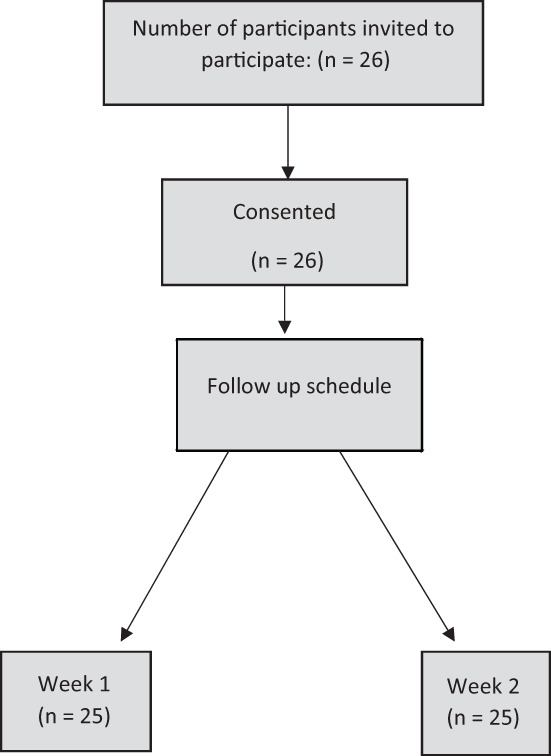
The flow of participants through the study
3.2. Demographic profile of the participants
Most of the participants (79%; n = 19) were male. The age of participants spanned from 18 to 81 years of age (mean age 47 years; SD: 20.3 years). Sixty‐two percent (n = 15) of the participants presented with comorbidities, and 26% (n = 7) had two or more comorbidities. Cardiovascular disease 30% (n = 7) was the most common reported co‐morbidity, followed by gastrointestinal diseases 22% (n = 5) and diabetes 13% (n = 3). In addition, 38% (n = 9) of the participants were overweight. Further, 41% (n = 10) of the participants smoked.
Wounds were classified as acute if their duration was less than 12 weeks at baseline and chronic if their duration was greater than 3 months at baseline. Most of the wounds observed were surgical (67%; n = 18). Overall, 70% (n = 19) of the wounds were classified as acute and included surgical wounds, pilonidal sinus, and wounds caused by trauma. Thus, 30% (n = 8) were classified as chronic wounds and included vascular ulcers and non‐healing surgical wounds. The mean duration of the participants' wounds was 53.88 days (SD: 64.49 days, range: 3‐217 days). The most common anatomical sites were the foot (22%; n = 6), the lower leg (19%; n = 5), abdomen (19%; n = 5) and buttocks (19%; n = 5).
3.3. pH
For pH measurement, a figure <7 indicates acidity and >7 indicates alkalinity. Overall, pH at baseline ranged from 7.90 to 8.70 (mean 8.57; SD: 0.22). Most participants (93%; n = 25) had a pH above 8 on day 1 and this was irrespective of the wound being acute or chronic. Seven percent (n = 2) of the participants had a pH lower than 8 (pH 7.9). Both wounds were acute, one surgical and one caused by trauma. One wound was almost healed, and the other was necrotic. The MolecuLight i:X device displayed a black image of both wounds, suggesting that the wounds were displaying highly vascularised tissue, pigmented lesions, or necrotic tissue. Table 2 presents the mean pH values over the study duration. There was a 0.76‐unit reduction in mean pH from pH 8.57 to 7.81 over the study follow‐up period.
TABLE 2.
Mean wound surface pH weeks 1 to 2 (n = 27)
| Week | Mean | SD | Minimum | Maximum |
|---|---|---|---|---|
| Week 1 day 1 | 8.57 | 0.22 | 7.90 | 8.70 |
| Week 1 day 2 | 8.30 | 0.46 | 6.50 | 8.70 |
| Week 2 day 3 | 8.14 | 0.60 | 6.50 | 8.70 |
| Week 2 day 4 | 7.81 | 0.91 | 6.00 | 8.70 |
3.4. Temperature
Room temperature ranged from 18.9°C to 23.3°C, with an overall mean temperature of 21.52°C. Figure 2 illustrates the method used to analyse the infrared images. The temperature of the centre of the wound, the highest wound edge reading, the hottest part of the wound, and the average wound temperature was recorded.
FIGURE 2.
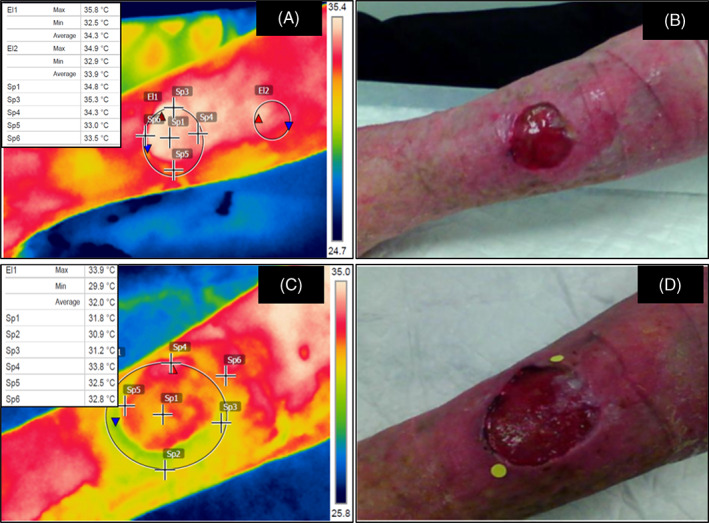
Temperature analysis in the FLIR Tool application. The wound of the eighth participant is illustrated in Figure 2. (A‐D) Normal photographs of the venous leg ulcer at the start and end of the study respectively. The legends in the upper right corners show the characteristics of the wound temperature including the maximum, the mean wound temperature, the centre spot, the wound edges, and adjacent skin.
Figure 2A,D is normal photographs of the venous leg ulcer at the start and end of the study respectively. The legends in the upper right corners show the characteristics of the wound temperature including the maximum, the mean wound temperature, the centre spot, the wound edges, and adjacent skin.
Tables 3, 4, 5 report the summary statistics of wound temperatures and the room temperatures. Overall, wound bed temperatures immediately after dressing removal in week 1, day 1, ranged from 28.40°C to 36.30°C (centre spot: mean temperature of 32.55°C; SD: 2.21°C). On week 2, day 4, the mean wound temperature was lower and ranged from 28.50°C to 36.40°C (centre spot: mean temperature of 31.88°C; SD: 2.06°C). This was an overall reduction in the temperature of the centre spot of 2%.
TABLE 3.
Summary wound temperature (°C) wound centre spot
| Week | Mean (n = 27) | SD | Minimum | Maximum | Room mean |
|---|---|---|---|---|---|
| Week 1 day 1 | 32.55 | 2.21 | 28.40 | 36.30 | 21.56 |
| Week 1 day 2 | 32.17 | 1.80 | 28.80 | 36.10 | 21.69 |
| Week 2 day 3 | 32.10 | 1.99 | 28.70 | 37.00 | 21.44 |
| Week 2 day 4 | 31.88 | 2.06 | 28.50 | 36.40 | 21.41 |
TABLE 4.
Summary wound temperature (°C)‐highest wound edge
| Week | Mean | SD | Minimum | Maximum |
|---|---|---|---|---|
| Week 1 day1 | 34.03 | 1.80 | 33.3 | 36.3 |
| Week 1 day 2 | 33.29 | 1.58 | 31.1 | 36.2 |
| Week 2 day 3 | 33.06 | 1.93 | 29.3 | 37.1 |
| Week 2 day 4 | 32.96 | 1.81 | 29.4 | 37.2 |
TABLE 5.
Summary average wound temperatures (°C)
| Week | Mean | SD | Minimum | Maximum |
|---|---|---|---|---|
| Week 1 day 1 | 32.68 | 1.86 | 30.50 | 34.80 |
| Week 1 day 2 | 32.19 | 1.57 | 29.90 | 35.30 |
| Week 2 day 3 | 32.19 | 1.90 | 28.90 | 36.20 |
| Week 2 day 4 | 32.24 | 1.78 | 29.20 | 36.00 |
Overall, the highest temperature at the wound edge was 37.2°C. In week 1 this ranged from 33.3°C to 36.3°C (highest wound edge mean temperature 34.03°C; SD: 1.80°C). In week 2, day 4, the highest wound edge ranged from 29.4°C to 37.2°C (highest wound edge mean temperature 32.96°C; SD: 1.81°C) (Table 4). This equates to a 3% reduction in the highest wound edge temperature from baseline to study completion.
The average wound temperature was calculated based on the difference between the highest and lowest reading of the wound temperature. In week 1, the average wound temperature was 32.68°C (SD: 1.86°C), in week 2 this was 32.24°C (SD: 1.78°C) (Table 5). Further analysis showed that the mean difference in average wound temperature from baseline to study completion was 0.44°C (95% CI: −0.53°C to 1.41°C; P = .37). This indicates a 1% reduction in average wound temperature from baseline to study completion.
3.5. Wound size
The wound area in week 1, day 1, ranged from 70 to 455 mm2 with a mean baseline wound size of 97.40 mm2 (SD: 102.20 mm2). Wound area in week 2, day 4, ranged from 0 to 333 mm2, with a mean wound size of 59.10 mm2 (SD: 79.10 mm2). Table 6 displays the summary statistics for wound size over the 2 weeks.
TABLE 6.
Wound size (mm2)
| Week | Mean (mm2) | SD (mm2) | Minimum (mm2) | Maximum (mm2) |
|---|---|---|---|---|
| Day 1 | 97.40 | 102.20 | 70.00 | 455.00 |
| Day 2 | 81.90 | 91.80 | 40.00 | 390.00 |
| Day 3 | 70.80 | 84.50 | 90.00 | 333.00 |
| Day 4 | 59.10 | 79.10 | 0.00 | 333.00 |
Further analysis showed that the mean difference in wound size from start to finish was 38.30 mm2 (95% CI: −10.45 to 87.05 mm2; P = .12). One wound healed and most wounds reduced in size (Table 6). Overall, there was a 39% reduction in wound size from baseline to study completion. There was a strong positive correlation between pH and wound area (r = 0.92) and between temperature and wound size (r = 0.98), as pH and temperature decreased, wound size also decreased.
3.6. Bacterial burden imaging
At baseline, 78% (n = 21) of the wounds had harmful levels of bacteria present in their wounds indicated by the red, blush red or cyan colour on the fluorescence image (Table 7). This figure was reduced to 22% (n = 6) following 2 weeks of inflammation management. One wound image (4%) had cyan (Pseudomonas aeruginosa) and the remaining 22% (n = 6) of wounds had red, with blush red in one wound, indicating the sub‐surface bacterial presence. Overall, these wounds had an associated rise in the wound temperature, and the wound pH remained the same (15%; n = 4) or increased (11%; n = 2).
TABLE 7.
Participant characteristics at baseline and end of the study
| Wound no. | Patient no. | Type | Wound size (mm2) baseline | Wound size (mm2) end | Percentage reduction/increase (%) | Temperature centre spot (TCC) (°C) baseline | TCC end | Percentage reduction/increase (%) | pH baseline | pH end | Percentage reduction (%) | Bacterial burden baseline | Bacterial burden end |
|---|---|---|---|---|---|---|---|---|---|---|---|---|---|
| 1 | 1 | PS | 125.00 | 24.00 | 81% | 35.90 | 33.20 | 8% | 8.50 | 8.30 | 2% | +Red | Negative |
| 2 | 5 | PS | 18.00 | 4.00 | 78% | 33.10 | 32.60 | 1.5% | 8.70 | 6.50 | 25% | +Cyan | Negative |
| 3 | 12 | PS | 10.00 | 4.00 | 60% | 33.10 | 33.10 | 0% | 8.70 | 8.30 | 5% | Negative | Negative |
| 4 | 18 | PS | 99.00 | 70.00 | 29% | 36.30 | 36.40 | 3%↑ | 8.70 | 8.70 | 0% | +Cyan | +Red |
| 5 | 22 | HA | 50.40 | 16.00 | 68% | 34.60 | 34.70 | 3%↑ | 8.70 | 8.50 | 2% | +Red | Negative |
| 6 | 2 | DF | 45.00 | 6.00 | 87% | 34.10 | 33.20 | 3% | 8.30 | 6.50 | 22% | +Red | Negative |
| 7 | 2b | DF | 57.50 | 50.00 | 13% | 28.90 | 32.00 | 11%↑ | 7.90 | 8.50 | 8%↑ | Negative | +Blush red |
| 8 | 10 | DF | 8.00 | 8.00 | 0% | 29.10 | 29.60 | 2%↑ | 8.70 | 8.50 | 2% | +Cyan | Negative |
| 9 | 3 | AB | 111.00 | 60.00 | 45% | 35.10 | 33.60 | 4% | 8.70 | 8.30 | 5% | +Red/cyan | Negative |
| 10 | 4 | AB | 15.00 | 1.00 | 93% | 33.50 | 32.10 | 4% | 8.70 | 6.00 | 31% | +Cyan | Negative |
| 11 | 11 | AB | 7.00 | 0.00 | 100% | 31.40 | 31.70 | 1%↑ | 7.90 | 6.00 | 24% | negative | Negative |
| 12 | 13 | AB | 5.40 | 1.20 | 78% | 34.50 | 31.80 | 8% | 8.50 | 6.50 | 24% | +Cyan | Negative |
| 13 | 21 | TA | 150.00 | 82.80 | 45% | 30.50 | 28.50 | 7% | 8.70 | 7.90 | 9% | +Red | Negative |
| 14 | 6 | TT | 90.00 | 19.20 | 79% | 30.80 | 29.00 | 6% | 8.70 | 8.10 | 7% | +Cyan | Negative |
| 15 | 15 | TL | 38.00 | 31.50 | 17% | 31.90 | 31.00 | 3% | 8.70 | 8.30 | 5% | Negative | Negative |
| 16 | 24 | TL | 292.50 | 192.50 | 34% | 29.90 | 29.60 | 1% | 8.50 | 8.10 | 0% | +Red | Negative |
| 17 | 25 | TL | 33.00 | 15.40 | 53% | 30.70 | 34.10 | 11%↑ | 8.50 | 6.60 | 22% | +Red | Negative |
| 18 | 7 | TF | 77.00 | 54.00 | 30% | 33.80 | 31.00 | 8% | 8.70 | 8.30 | 5% | +Cyan | Negative |
| 19 | 17 | TF | 192.50 | 44.00 | 77% | 33.30 | 30.80 | 8% | 8.70 | 8.10 | 7% | +Red | Negative |
| 20 | 19 | TF | 112.50 | 67.20 | 40% | 32.50 | 32.20 | 1% | 8.70 | 8.50 | 2% | +Cyan/red | Negative |
| 21 | 8 | VU | 140.00 | 169.30 | 17% ↑ | 34.80 | 31.80 | 9% | 8.70 | 8.70 | 0% | +Red/cyan | +Red |
| 22 | 8a | VU | 210.00 | 210.00 | 0% | 34.30 | 33.60 | 2% | 8.50 | 8.70 | 2%↑ | +Cyan | +Red |
| 23 | 20 | VU | 455.00 | 333.00 | 27% | 28.40 | 31.00 | 8%↑ | 8.70 | 8.70 | 0% | +Red | +Red |
| 24 | 11a | G | 26.40 | 40.00 | 34% ↑ | 33.40 | 30.70 | 8% | 8.50 | 8.70 | 2%↑ | Negative | +Red |
| 25 | 14 | BA | 60.00 | 6.00 | 90% | 31.90 | 32.90 | 14 | 8.70 | 6.80 | 22% | +Red | Negative |
| 26 | 23 | BA | 24.00 | 6.40 | 73% | 33.60 | 32.10 | 4% | 8.50 | 8.10 | 5% | +Cyan | Negative |
| 27 | 16 | c | 177.60 | 88.00 | 50% | 29.50 | 29.30 | 1% | 8.70 | 8.10 | 7% | Negative | Negative |
| 26 | 23 | BA | 24.00 | 6.40 | 73% | 33.60 | 32.10 | 4% | 8.50 | 8.10 | 5% | +Cyan | Negative |
| 27 | 16 | c | 177.60 | 88.00 | 50% | 29.50 | 29.30 | 1% | 8.70 | 8.10 | 7% | Negative | Negative |
Abbreviations: AB, abdominal surgical wound; BA, back abscess (excised and drained); C, chest wound; DF, diabetic foot; G, groin wound; HA, hip abscess (excised and drained); PS, pilonidal sinus; TA, trauma arm; TF, trauma foot (surgical); TL, trauma leg; TT, trauma thigh; VF, venous ulcer.
4. DISCUSSION
Wound healing is a complex process caused by tissue injury and comprises four, often overlapping stages, namely, haemostasis, inflammation, proliferation and remodelling. 33 Most wounds progress through these stages of healing uninhibited. However, a minority of wounds do not progress in a timely manner, often getting stuck in the inflammatory phase, resulting in a chronic wound. 8 Lack of appropriate assessment, where early identification of problems with wound healing are not readily identified, leads to inappropriate management, compounding the challenge of non‐healing wounds. 34 Notably, many of the large studies that have explored the costs of wound care 35 , 36 , 37 have identified that a lack of appropriate assessment and diagnosis leads to both poor outcomes and high costs. This is worrying as in a more recent account Guest, 38 reported that there is an overall increase in people with wounds and notably there are more younger people presenting with wounds than ever before. Therefore, if the current state of play pertaining to the provision of wound management services remains unchallenged, the growing burden of wounds will have a huge effect on limited healthcare resources 38 and on the individuals and their families.
A thorough wound assessment is a pivotal part of Wound Bed Preparation. 8 Wound care principles such as Tissue, Inflammation/Infection, Moisture imbalance, and Epithelial edge summarised by the TIME concept, provide a systematic approach to wound management. According to guidelines developed by the Health Service Executive 6 and the European Wound Management Association, 39 the objective of Wound Bed Preparation is to promote optimal healing and wound‐closure using appropriate diagnosis and treatment of the cause of delayed wound healing. 40 Although this approach is commonly adopted in clinical practice, 8 , 41 , 42 , 43 , 44 it has not been widely tested in clinical practice. 13
A total of 108 pH observations were analysed. Individual pH values varied from person to person ranging from 7.90 to 8.70 at baseline. Most patients had a pH above 8 at baseline irrespective of whether the wound was acute or chronic. Interestingly, only two wounds, one surgical and one trauma, had a pH lower than pH 8 at baseline. Of these, one wound was almost healed, and the other was necrotic. As the wound heals and re‐epithelialisation occurs, the healed area returns to being acidic. 45 Necrotic wounds have previously been reported as being associated with a lower pH. 46
Overall, both acute and chronic wounds that healed went through a phase of slowly decreasing pH (alkaline) values until the wound was in the re‐epithelisation stage and almost closed, whereupon the pH returned to an acidic pH. A rise in pH in wounds that had been previously recorded as having lower pH values indicated the presence of harmful levels of bacteria in the wound. At the study baseline, 78% (n = 21) percent of the participants had potentially harmful bacteria present in their wounds. Following 2 weeks of inflammation management, the presence of bacteria decreased to 26% (n = 7) of participants displaying the presence of pathogenic bacteria in their wounds.
The reductions in pH values in the current study may be due to the interventions aimed at inflammation management, in particular, debridement, or it could be that Cadexomer iodine influenced pH either directly, or inadvertently, by reducing the bacteria present in the wound. The bacterial reduction will ultimately reduce the amount of ammonia in the wound and therefore result in a lower pH value. 45 To the author's knowledge there are no studies to confirm if wound debridement lowers pH. However, there are studies that report that larval therapy increases the wound pH by releasing ammonia into the wound bed. 47 , 48
Overall, in the current study, the results of the relationship between pH and wound healing outcomes, as evidenced by changes in the wound surface area, indicate that as pH reduced, wound size also decreased. There was a 39% reduction in wound size from baseline to study‐end and a reduction in wound size of 39% over 2 weeks is of clinical significance. In the current study, in all instances where harmful levels of bacteria were evident, this was accompanied by a wound pH value of 8.30 or above. Moreover, when the pH was lower or equal to 6.50, harmful levels of bacteria were not present in the wound. Therefore, it is reasonable to conclude that inflammation management using a combined approach of debridement and antimicrobial use enhanced wound outcomes with a reduction in pH, bacterial burden, and wound size from baseline to study end.
The results demonstrated that as temperature decreased wound size also decreased. Notably, in instances where the wound was infected the temperature increased. In the presence of potentially pathogenic bacteria in some wounds, there was a notable difference from the temperature in the centre of the wound to the temperature at the highest wound edge and periwound. This demonstrates that it is important to measure temperature at different points of the wound, such as at the centre of the wound and the wound edges and periwound. Previous research concurs with this finding, that an increased periwound temperature is indicative of bacterial colonisation. 49 , 50
In the current study, there was a wide variation of wound temperatures which could be due to internal and external factors such as the wound location, the wound type, the participants' age and weight, and the participants' comorbidities and room temperature. 51 , 52 Gethin and O'Connor 22 in an observational study of individuals with diabetic foot ulcers, reported a mean wound temperature of 30.90°C (SD: 3.00°C) at baseline and in the current study, the mean wound temperature at baseline was higher at 32.55°C (SD: 2.21°C). This was possibly due to the type and location of all the wounds, as they were of mixed aetiology. However, in the present study, the mean temperature of the three diabetic foot ulcers was 30.70°C, a finding like Gethin and O'Connor. 22 This indicates that the temperature is cooler on the lower extremities. It would be expected that the limbs would have a lower temperature than the core body area such as the trunk. 52 Further, this highlights the variability of wound temperature at different locations in the body. On the other hand, the low temperature could also be possibly due to poor perfusion secondary to diabetes. People with type 2 diabetes often develop diabetes‐related complications including neuropathy and micro‐and macrovascular impairments. 53
Notably, most temperature measurements in the current study were below the 33°C threshold that is argued to be needed for the cellular activity of neutrophils, fibroblasts, and epithelial cells. 54 , 55 The findings suggest that wound temperature is variable depending on wound aetiology and location. Thus, it may not be relevant to consider an average cut‐off temperature which is accepted as beneficial, rather it is more important to look at trends and deviations within each individual participant.
Biofilms are often the cause of delayed healing even when underlying diseases and other factors have been addressed. 56 , 57 , 58 It is thought that biofilm is present in most, if not all, chronic non‐healing wounds. 13 , 56 , 58 , 59 Hurlow, Blanz 59 in a study of human wound debridement samples reported that 75% of the samples tested had biofilm present, despite previous treatment with antimicrobial agents and antibiotics. Although the wounds that contained biofilm were not all acutely infected, in all instances when infection was noted, biofilm was also present.
All wounds contain bacteria, and the infection continuum spans from contamination through critical colonisation to infection. Thereafter, the infection spreads and finally results in systemic infection. 6 , 60 Colonisation is the presence of bacteria in the wound which does not affect the patient. At this stage, there is no active disease or ill‐health, and therefore no signs or symptoms of infection. Critical colonisation is the point when the bacteria are causing a problem locally in the wound, without causing systemic problems for the patient. However, if not well managed, or in patients with a compromised immune response, critical colonisation can develop further where the patient may present with the active signs of infection. 61
Bacterial colonisation can occur in asymptomatic patients as evidenced in the current study, where most of the participants had no symptoms of infection other than a rise in wound pH and wound temperature. Previous studies have highlighted that the host's response to bacterial burden varies greatly, and often is completely absent, with the result that the patient is asymptomatic. 25 , 26 , 62 Gardner and Hillis, 63 in a study investigating the diagnostic validity of clinical signs of localised wound infection in individuals with diabetic foot ulcers, demonstrated that no single sign of infection was sufficient to predict bacterial loads greater than 106 CFU/g. However, it is important to identify wounds that have been colonised with potentially harmful levels of bacteria to guide appropriate treatment with debridement and an antimicrobial dressing, thus preventing the wound from escalating to full‐scale infection. 61 Bacteria produce ammonia, which is liberated from urea by the enzyme ureases; this in turn, results in an alkaline wound environment. The literature reviewed indicated that most bacteria are inhibited in a lower pH environment. 45 , 64 , 65 However, a causal relationship between the degree of bacterial contamination and pH value has not yet been established. 22 , 66
In this study, in all instances where harmful levels of bacteria were evident, this was accompanied by a pH value of 8.30 or above. Further, when the pH was lower or equal to 6.50, potentially harmful levels of bacteria were not present in the wound as assessed with the MolecuLight i:X fluorescence imaging device. 14 , 67 , 68
4.1. Limitations
This study was conducted in a single site and included a relatively small heterogeneous sample in relation to age and wound aetiology, therefore, caution is needed in making generalisations from the results. Further, the study did not stratify the results according to wound aetiology due to the small numbers in each group. Therefore, it was considered more appropriate to analyse the participants collectively. This may limit the generalisability and interpretation of the results as there was a lot of variability in the findings. Nonetheless, the participants were representative of the types of patients attending a dressing clinic in an acute hospital.
5. CONCLUSION
The study provides some evidence that wound pH and temperature play a fundamental role in wound healing. Moreover, the findings indicate that an increased rise in pH and temperature from the previous pattern is indicative of bacterial burden and should raise concerns with the clinician. Non‐invasive techniques, such as pH and temperature measurement, and bacterial burden assessment allow changes in wound status to be monitored and hence can facilitate early detection of potential problems. Overall, the study illustrates that objective assessment incorporating the principles of TIME, a structured method of inflammation management including cleansing, frequent sharp debridement, and treatment with an antimicrobial agent, improves wound outcomes.
CONFLICT OF INTEREST
The MolecuLight™ i:X fluorescence imaging device was given at no charge, but the drapes were purchased.
ACKNOWLEDGEMENTS
This research received funding from Irish Research Council, Enterprise Partnership Scheme. Project ID: EPSPG/2016/159. Enterprise Partner: Fleming Medical Ltd. Open access funding provided by IReL. WOA Institution: N/A Consortia Name : IReL gold OA 2022
Derwin R, Patton D, Strapp H, Moore Z. The effect of inflammation management on pH, temperature, and bacterial burden. Int Wound J. 2023;20(4):1118‐1129. doi: 10.1111/iwj.13970
Funding information Irish Research Council, Enterprise Partnership Scheme, Grant/Award Number: EPSPG/2016/159
REFERENCES
- 1. Vowden P, Vowden K. The economic impact of hard‐to‐heal wounds: promoting practice change to address passivity in wound management. Wounds Int. 2016;7:10‐15. [Google Scholar]
- 2. Gethin G. The importance of continous measuring. Wounds UK. 2006;2:60‐68. [Google Scholar]
- 3. Wendelken ME, Berg WT, Lichtenstein P, Markowitz L, Comfort C, Alvarez OM. Wounds measured from digital photographs using photodigital planimetry software: validation and rater reliability. Wounds. 2011;23:267‐275. [PubMed] [Google Scholar]
- 4. Benbow M. Best practice in wound assessment. Nurs Stand. 2016;30:40‐47. doi: 10.7748/ns.30.27.40.s45 [DOI] [PubMed] [Google Scholar]
- 5. Ding S, Lin F, Gillespie BM. Surgical wound assessment and documentation of nurses: an integrative review. J Wound Care. 2016;25:232‐240. doi: 10.12968/jowc.2016.25.5.232 [DOI] [PubMed] [Google Scholar]
- 6. Health Service Executive . HSE National Wound Management Guidelines. Dublin: HSE; 2018. [Google Scholar]
- 7. Bosanquet DC, Harding KG. Wound duration and healing rates: cause or effect? Wound Repair Regen. 2014;22:143‐150. doi: 10.1111/wrr.12149 [DOI] [PubMed] [Google Scholar]
- 8. Harries RL, Bosanquet DC, Harding KG. Wound bed preparation: TIME for an update. Int Wound J. 2016;13(Suppl 3):8‐14. doi: 10.1111/iwj.12662 [DOI] [PMC free article] [PubMed] [Google Scholar]
- 9. Moore Z, Dowsett C, Smith G, et al. TIME CDST: an updated tool to address the current challenges in wound care. J Wound Care. 2019;28:154‐161. doi: 10.12968/jowc.2019.28.3.154 [DOI] [PubMed] [Google Scholar]
- 10. Schultz GS, Sibbald RG, Falanga V, et al. Wound bed preparation: a systematic approach to wound management. Wound Repair Regen. 2003;11(Suppl 1):S1‐S28. doi: 10.1046/j.1524-475x.11.s2.1.x [DOI] [PubMed] [Google Scholar]
- 11. Werdin F, Tennenhaus M, Schaller HE, Rennekampff HO. Evidence‐based management strategies for treatment of chronic wounds. Eplasty. 2009;9:e19. [PMC free article] [PubMed] [Google Scholar]
- 12. McCallon SK, Weir D, Lantis JC 2nd. Optimizing wound bed preparation with collagenase enzymatic debridement. J Am Coll Clin Wound Spec. 2014;6:14‐23. doi: 10.1016/j.jccw.2015.08.003 [DOI] [PMC free article] [PubMed] [Google Scholar]
- 13. Schultz G, Bjarnsholt T, James GA, et al. Consensus guidelines for the identification and treatment of biofilms in chronic nonhealing wounds. Wound Repair Regen. 2017;25:744‐757. doi: 10.1111/wrr.12590 [DOI] [PubMed] [Google Scholar]
- 14. DaCosta RS, Kulbatski I, Lindvere‐Teene L, et al. Point‐of‐care autofluorescence imaging for real‐time sampling and treatment guidance of bioburden in chronic wounds: first‐in‐human results. PLoS One. 2015;10:e0116623. doi: 10.1371/journal.pone.0116623 [DOI] [PMC free article] [PubMed] [Google Scholar]
- 15. Raizman R, Dunham D, Lindvere‐Teene L, et al. Use of a bacterial fluorescence imaging device: wound measurement, bacterial detection and targeted debridement. J Wound Care. 2019;28:824‐834. doi: 10.12968/jowc.2019.28.12.824 [DOI] [PubMed] [Google Scholar]
- 16. Rennie MY, Dunham D, Lindvere‐Teene L, Raizman R, Hill R, Linden R. Understanding real‐time fluorescence signals from bacteria and wound tissues observed with the MolecuLight i:XTM. Diagnostics. 2019;9:22. [DOI] [PMC free article] [PubMed] [Google Scholar]
- 17. Nursing and Midwifery Board of Ireland . Code of Professional Conduct and Ethics for Registered Nurses and Registered Midwives. Dublin: Nursing and Midwifery Board of Ireland; 2014. [Google Scholar]
- 18.Shukla VK, Shukla D, Tiwary SK, Agrawal S, Rastogi A. Evaluation of pH measurement as a method of wound assessment. J Wound Care. 2007;16:291‐294. doi: 10.12968/jowc.2007.16.7.27062 [DOI] [PubMed] [Google Scholar]
- 19.Ono S, Imai R, Ida Y, et al. Increased wound pH as an indicatorof local wound infection in second degree burns. Burns. 2015;41:820‐824. doi: 10.1016/j.burns.2014.10.023 [DOI] [PubMed] [Google Scholar]
- 20.Kumar P, Honnegowda T. Effect of limited access dressing onsurface pH of chronic wounds. Plast Aesthet Res. 2015;2:257‐260. doi: 10.4103/2347-9264.165449 [DOI] [Google Scholar]
- 21. Keenan E, Gethin G, Flynn L, et al. Enhanced thermal imaging of wound tissue for better clinical decision making. Physiol Meas. 2017;38:1104‐1115. doi: 10.1088/1361-6579/aa6ea0 [DOI] [PubMed] [Google Scholar]
- 22. Gethin G, O'Connor GM, Abedin J, et al. Monitoring of pH and temperature of neuropathic diabetic and nondiabetic foot ulcers for 12 weeks: an observational study. Wound Repair Regen. 2018;26:251‐256. doi: 10.1111/wrr.12628 [DOI] [PubMed] [Google Scholar]
- 23. Nakagami G, Sanada H, Iizaka S, et al. Predicting delayed pressure ulcer healing using thermography: a prospective cohort study. J Wound Care. 2010;19:465‐472. [DOI] [PubMed] [Google Scholar]
- 24. Al‐Jalodi O, Serena LM, Breisinger K, et al. A novel debridement device for the treatment of hard‐to‐heal wounds: a prospective trial. J Wound Care. 2021;30:S32‐s36. doi: 10.12968/jowc.2021.30.Sup5.S32 [DOI] [PubMed] [Google Scholar]
- 25. Serena TE, Harrell K, Serena L, et al. Real‐time bacterial fluorescence imaging accurately identifies wounds with moderate‐to‐heavy bacterial burden. J Wound Care. 2019;28:346‐357. doi: 10.12968/jowc.2019.28.6.346 [DOI] [PubMed] [Google Scholar]
- 26. Le L, Baer M, Briggs P, et al. Diagnostic accuracy of point‐of‐care fluorescence imaging for the detection of bacterial burden in wounds: results from the 350‐patient fluorescence imaging assessment and guidance trial. Adv Wound Care. 2021;10:123‐136. doi: 10.1089/wound.2020.1272 [DOI] [PMC free article] [PubMed] [Google Scholar]
- 27. Oropallo AR, Andersen C, Abdo R, et al. Guidelines for point‐of‐care fluorescence imaging for detection of wound bacterial burden based on Delphi consensus. Diagnostics. 2021;11:1219. doi: 10.3390/diagnostics11071219 [DOI] [PMC free article] [PubMed] [Google Scholar]
- 28. Jessup RL. What is the best method for assessing the rate of wound healing? A comparison of 3 mathematical formulas. Adv Skin Wound Care. 2006;19:138‐147. [DOI] [PubMed] [Google Scholar]
- 29. Vidal A, Mendieta Zeron H, Giacaman I, et al. A simple mathematical model for wound closure evaluation. J Am Coll Clin Wound Spec. 2015;7:40‐49. doi: 10.1016/j.jccw.2016.07.002 [DOI] [PMC free article] [PubMed] [Google Scholar]
- 30. Watson R, Atkinson I, Egerton PA. Successful Statistics for Nursing and Healthcare. Basingstoke; New York: Palgrave Macmillan; 2006. [Google Scholar]
- 31. Scott I, Mazhindu D. Statistics for Healthcare Professionals: An Introduction. London: Sage; 2014. [Google Scholar]
- 32. The Nordic Cochrane Centre and The Cochrane Collaboration . Review Manager (RevMan)Version 535. Copenhagen: Cochrane Informatics and Knowledge Management Department; 2014. [Google Scholar]
- 33. Frykberg RG, Banks J. Challenges in the treatment of chronic wounds. Adv Wound Care. 2015;4:560‐582. doi: 10.1089/wound.2015.0635 [DOI] [PMC free article] [PubMed] [Google Scholar]
- 34. Greatrex‐White S, Moxey H. Wound assessment tools and nurses' needs: an evaluation study. Int Wound J. 2015;12:293‐301. doi: 10.1111/iwj.12100 [DOI] [PMC free article] [PubMed] [Google Scholar]
- 35. Hall J, Buckley HL, Lamb KA, et al. Point prevalence of complex wounds in a defined United Kingdom population. Wound Repair Regen. 2014;22:694‐700. doi: 10.1111/wrr.12230 [DOI] [PubMed] [Google Scholar]
- 36. Guest JF, Ayoub N, McIlwraith T, et al. Health economic burden that wounds impose on the National Health Service in the UK. BMJ Open. 2015;5:e009283. doi: 10.1136/bmjopen-2015-009283 [DOI] [PMC free article] [PubMed] [Google Scholar]
- 37. Gray TA, Rhodes S, Atkinson RA, et al. Opportunities for better value wound care: a multiservice, cross‐sectional survey of complex wounds and their care in a UK community population. BMJ Open. 2018;8:e019440. doi: 10.1136/bmjopen-2017-019440 [DOI] [PMC free article] [PubMed] [Google Scholar]
- 38. Guest JD. Health economic burden that wounds impose on the UK's National Health Service. Wounds UK. 2019;5:e009283. [DOI] [PMC free article] [PubMed] [Google Scholar]
- 39. EWMA . Wound Bed Preparation in Practice. European Wound Management Association (EWMA)London: European Wound Management Association (EWMA); 2004. [Google Scholar]
- 40. Strohal R, Dissemond J, O'Brien J, et al. EWMA document: debridement: an updated overview and clarification of the principle role of debridement. J Wound Care. 2013;22:S1‐S49. doi: 10.12968/jowc.2013.22.Sup1.S1 [DOI] [PubMed] [Google Scholar]
- 41. Dowsett C, Newton H. Wound bed preparation: TIME in practice. Wounds UK. 2005;1:58‐64. [Google Scholar]
- 42. Dowsett C. Use of TIME to improve community nurses' wound care knowledge and practice. Wounds UK. 2009;5:14‐21. [Google Scholar]
- 43. Leaper DJ, Schultz G, Carville K, et al. Extending the TIME concept: what have we learned in the past 10 years? Int Wound J. 2012;9(Suppl 2):1‐19. doi: 10.1111/j.1742-481X.2012.01097.x [DOI] [PMC free article] [PubMed] [Google Scholar]
- 44. Sibbald RG, Elliott JA, Ayello EA, et al. Optimizing the moisture management tightrope with wound bed preparation 2015(c). Adv Skin Wound Care. 2015;28:466‐476; quiz 477–468. doi: 10.1097/01.Asw.0000470851.27030.98 [DOI] [PubMed] [Google Scholar]
- 45. Jones EM, Cochrane CA, Percival SL. The effect of pH on the extracellular matrix and biofilms. Adv Wound Care. 2015;4:431‐439. doi: 10.1089/wound.2014.0538 [DOI] [PMC free article] [PubMed] [Google Scholar]
- 46. Tsukada K, Tokunaga K, Iwama T, et al. The pH changes of pressure ulcers related to the healing process of wounds. Wounds. 1992;4:16‐20. [Google Scholar]
- 47. Choudhury AJ, Gogoi D, Chutia J, et al. Controlled antibiotic‐releasing Antheraea assama silk fibroin suture for infection prevention and fast wound healing. Surgery. 2016;159:539‐547. doi: 10.1016/j.surg.2015.07.022 [DOI] [PubMed] [Google Scholar]
- 48. Yan L, Chu J, Li M, et al. Pharmacological properties of the medical maggot: a novel therapy overview. Evid Based Complement Alternat Med. 2018;2018:4934890. doi: 10.1155/2018/4934890 [DOI] [PMC free article] [PubMed] [Google Scholar]
- 49. Sibbald RG, Woo K, Ayello EA. Increased bacterial burden and infection: the story of NERDS and STONES. Adv Skin Wound Care. 2006;19:447‐461. quiz 461‐463. [DOI] [PubMed] [Google Scholar]
- 50. Sibbald RG, Mufti A, Armstrong DG. Infrared skin thermometry: an underutilized cost‐effective tool for routine wound care practice and patient high‐risk diabetic foot self‐monitoring. Adv Skin Wound Care. 2015;28:37‐44. doi: 10.1097/01.ASW.0000458991.58947.6b [DOI] [PubMed] [Google Scholar]
- 51. Chudecka M, Lubkowska A, Kempińska‐Podhorodecka A. Body surface temperature distribution in relation to body composition in obese women. J Therm Biol. 2014;43:1‐6. doi: 10.1016/j.jtherbio.2014.03.001 [DOI] [PubMed] [Google Scholar]
- 52. Neves EB, Salamunes ACC, de Oliveira RM, et al. Effect of body fat and gender on body temperature distribution. J Therm Biol. 2017;70:1‐8. doi: 10.1016/j.jtherbio.2017.10.017 [DOI] [PubMed] [Google Scholar]
- 53. Kenny GP, Sigal RJ, McGinn R. Body temperature regulation in diabetes. Temperature. 2016;3:119‐145. doi: 10.1080/23328940.2015.1131506 [DOI] [PMC free article] [PubMed] [Google Scholar]
- 54. Jensen PK, Therkelsen AJ. Cultivation at low temperature as a measure to prevent contamination with fibroblasts in epithelial cultures from human skin. J Invest Dermatol. 1981;77:210‐212. [DOI] [PubMed] [Google Scholar]
- 55. Esclamado RM, Damiano GA, Cummings CW. Effect of local hypothermia on early wound repair. Arch Otolaryngol Head Neck Surg. 1990;116:803‐808. [DOI] [PubMed] [Google Scholar]
- 56. Wolcott R, Rumbaugh K, Ga J, et al. Biofilm maturity studies indicate sharp debridement opens a timedependent therapeutic window. J Wound Care. 2010;19:320‐328. doi: 10.12968/jowc.2010.19.8.77709 [DOI] [PubMed] [Google Scholar]
- 57. Bjarnsholt T. The role of bacterial biofilms in chronic infections. APMIS Suppl. 2013;121:1‐51. doi: 10.1111/apm.12099 [DOI] [PubMed] [Google Scholar]
- 58. Bjarnsholt T, Eberlein T, Malone M, et al. Management of wound biofilm made easy. Wounds Int. 2017;8:1‐16. [Google Scholar]
- 59. Hurlow J, Blanz E, Gaddy JA. Clinical investigation of biofilm in non‐healing wounds by high resolution microscopy techniques. J Wound Care. 2016;25(Suppl 9):S11‐S22. doi: 10.12968/jowc.2016.25.Sup9.S11 [DOI] [PMC free article] [PubMed] [Google Scholar]
- 60. Negut I, Grumezescu V, Grumezescu AM. Treatment strategies for infected wounds. Molecules. 2018;23:2392. doi: 10.3390/molecules23092392 [DOI] [PMC free article] [PubMed] [Google Scholar]
- 61. Siddiqui AR, Bernstein JM. Chronic wound infection: facts and controversies. Clin Dermatol. 2010;28:519‐526. doi: 10.1016/j.clindermatol.2010.03.009 [DOI] [PubMed] [Google Scholar]
- 62. Reddy M, Gill SS, Wu W, et al. Does this patient have an infection of a chronic wound? JAMA. 2012;307:605‐611. doi: 10.1001/jama.2012.98 [DOI] [PubMed] [Google Scholar]
- 63. Gardner SE, Hillis SL, Frantz RA. Clinical signs of infection in diabetic foot ulcers with high microbial load. Biol Res Nurs. 2009;11:119‐128. doi: 10.1177/1099800408326169 [DOI] [PMC free article] [PubMed] [Google Scholar]
- 64. Nagoba B, Suryawanshi N, Wadher BJ, et al. Acidic environment and wound healing: a review. Wounds. 2015;27:5‐11. [Google Scholar]
- 65. Wiegand C, Abel M, Ruth P, et al. pH influence on antibacterial efficacy of common antiseptic substances. Skin Pharmacol Physiol. 2015;28:147‐158. doi: 10.1159/000367632 [DOI] [PubMed] [Google Scholar]
- 66. Schneider LA, Korber A, Grabbe S, Dissemond J. Influence of pH on wound‐healing: a new perspective for wound‐therapy? Arch Dermatol Res. 2007;298:413‐420. Review. doi: 10.1007/s00403-006-0713-x [DOI] [PubMed] [Google Scholar]
- 67. Farhan N, Jeffery S. Utility of MolecuLight i:X for managing bacterial burden in pediatric burns. J Burn Care Res. 2019;41(2):328‐338. doi: 10.1093/jbcr/irz167 [DOI] [PubMed] [Google Scholar]
- 68. Hurley CM, McClusky P, Sugrue RM, Clover JA, Kelly JE. Efficacy of a bacterial fluorescence imaging device in an outpatient wound care clinic: a pilot study. J Wound Care. 2019;28:438‐443. doi: 10.12968/jowc.2019.28.7.438 [DOI] [PubMed] [Google Scholar]