


Figure 1-. Characterization of bear hair color.
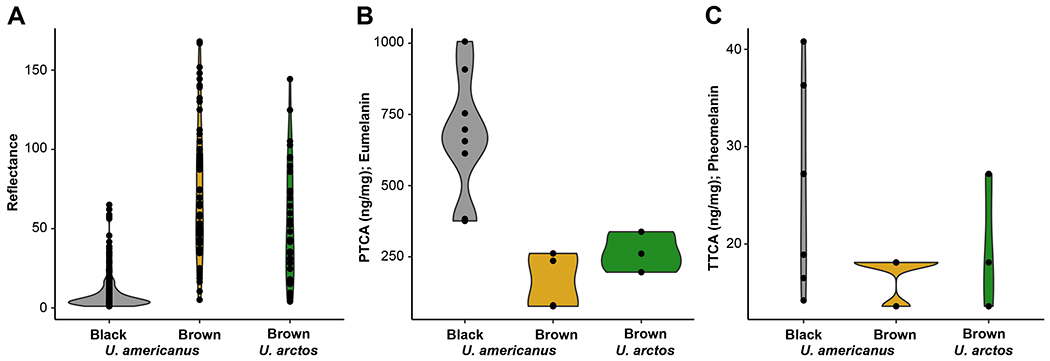
Violin plots of hair reflectance for two bear species (Ursus americanus [n = 327] and U. arctos [n = 33]) categorized by qualitative phenotyping from photos as either black or brown animals (black U. americanus- grey; brown U. americanus- yellow; brown U. arctos- green). Chemical analysis via alkaline hydrogen peroxide oxidation followed by high performance liquid chromatography (HPLC) of 13 U. americanus and three U. arctos individuals’ hair for the concentration of (B) eumelanin (as PTCA; ANOVA F=14.512; P<0.001) or (C) pheomelanin (as TTCA; ANOVA F=2.0297; P=0.17). PTCA concentration in hair ranged from 75–1010 ng mg−1, where TTCA was limited to 13–40 ng mg−1 in U. americanus. Specifically, two-tailed t-tests between U. americanus black and brown animals (P<0.001), and U. americanus black and U. arctos were significantly different (P<0.001); whereas, no difference was observed between species with brown coloration (P=0.17). In U. arctos, PTCA and TTCA ranged respectively from 200–340 ng mg−1 and 13–27 ng mg−1. Both species indicate a dilution of eumelanin, and not an increase in pheomelanin, produces the characteristic hair-lightening.