



Abstract
Introduction Surgical treatment of thumb trapeziometacarpal osteoarthritis usually involves 4 to 8 weeks of postoperative casting and splinting followed by varying mobilization protocols. Suspension arthroplasty has been described as an alternative to allow earlier range of motion exercises. The purpose of this study was to compare patient-reported outcomes (PRO) when adding a two-string suture-button suspension arthroplasty (Mini TightRope, MTR) to our usual procedure of ligament reconstruction and tendon interposition (LRTI), allowing early mobilization. Can we allow early mobilization using this technique without jeopardizing the PRO results at the 1 year follow-up and without an increased risk of complication?
Materials and Methods A prospective study using the MTR system (Arthrex) as a suture-button suspensionplasty was conducted. Twelve patients (MTR group) and 36 historical patients (LRTI alone) were included.
Results At 12 months, the median value for quick disabilities of the arm, shoulder, and hand was 11.3 (range, 0–43.2) in the MTR group and 13.6 (range, 0–88.6) in the LRTI group, resulting in similar improvements, p = 0.46. One in twelve patients in the MTR group was dissatisfied and 9 in 36 in the LRTI group were dissatisfied, p = 0.41. No complications were observed during the first year.
Conclusion Supplemental suture-button suspensionplasty can be utilized for high demand patients and patients who want to reduce immobilization time without major complications and with similar PRO as LRTI at 6 and 12 months.
Level of evidence Four case series
Keywords: suture-button, interposition arthroplasty, TMC osteoarthritis, Mini TightRope
Introduction
Osteoarthritis of the trapeziometacarpal (TMC) joint is common particularly in postmenopausal women. 1 The first choice of treatment is conservative, and surgery is only warranted when conservative treatment has failed, and osteoarthritis is present both clinically and radiographically. Several techniques have been described with no technique superior to the other. 2 Postoperative regimens usually involve 4 to 8 weeks of casting and splinting followed by varying mobilization protocols. 3 In our clinic, the postoperative regimen after trapeziectomy and ligament reconstruction with tendon interposition (LRTI) is 3 weeks of casting followed by 3 weeks of splinting while starting motion guided by a hand therapist. Minimal weight bearing is allowed after 6 weeks and there are no restrictions after 12 weeks.
Suspension arthroplasty has been described as an addition to trapeziectomy to allow for accelerated rehabilitation. 4 5 6 A biomechanical study demonstrated that a suture-button device is suitable for maintenance of posttrapeziectomy space height and prevents thumb metacarpal subsidence. 6 We expect the suspension arthroplasty to function as an internal stabilizer for the thumb and that it is reasonable to let patient use the thumb immediately after surgery.
The aim of this study was (1) to compare patient-reported outcome (PRO) adding a two-string suture-button suspensionplasty to our usual procedure of LRTI and allowing early mobilization, and (2) to evaluate pinch force, mobility of the thumb, visual analog scale (VAS) score, thumb subsidence, and major complications following a supplemental two-string suture-button suspension to our standard LRTI procedure. Our theory was that a suture-button suspensionplasty between the first and second metacarpal would add stability and allow for immediate mobilization without jeopardizing the PRO at 6 and 12 months. We expect PRO measure results in this group to be at least similar to or better than our standard surgical technique and postoperative regimen, at 6 months and 1 year after surgery.
Method
A prospective series of 12 patients with TMC osteoarthritis had surgery with our standard LRTI procedure followed by an additional Mini TightRope (MTR) system (Arthrex) (demographics are presented in Table 1 ). All 12 patients were treated at our facility between October 2018 and January 2019. Historical patients, only operated on with LRTI, were found 3:1 and matched on gender, age (± 7 years), and preoperative PRO scores (± 7 points). Thirty-six historical patients operated on with LRTI alone were chosen, all treated at our facility between 2013 and 2018.
Table 1. Demographics of operated patients before surgery.
| LRTI and Mini TightRope group | LRTI group | p -Value | |
|---|---|---|---|
| n | 12 | 36 | – |
| Age, median (range) | 53.5 (38–68) | 57.5 (40–69) | 0.294 |
| Gender, (male/female) | 4/8 | 12/24 | – |
| Q-DASH, a median (range) | 44.32 (17.5–70.5) | 43.18 (25–75) | 0.924 |
| Pain b 1–5 scale, median (range) | 4.0 (2–4) | 4 (2–5) | 0.414 |
| Osteoarthritis grade, c median, mean, (range) | 2.5, 2.5 (2–3) | 2.0, 2.37 (1–4) | 0.471 |
Abbreviations: LRTI, ligament reconstruction and tendon interposition; TMC, trapeziometacarpal.
Preoperative Quick Disabilities of the Arm, Shoulder, and Hand Questionnaire.
Pain scale from 1 to 5: 1 = no pain, 2 = mild pain, 3 = moderate pain, 4 = severe pain, 5 = extreme pain.
TMC Eaton Littler osteoarthritis grade (1–4, 4 being the worst).
The 12 patients in the MTR group were followed pre- and postoperatively at 6, 12, 26, and 52 weeks. The 36 patients in the LRTI group were followed with PRO pre- and postoperatively at 26 and 52 weeks. The MTR group was followed with PRO as well as pinch force measures and VAS scores (0–10). The validated Danish Quick Disabilities of the Arm, Shoulder and Hand (Q-DASH) questionnaire was used. 7 8 Patients were asked if they were satisfied with the result following surgery (yes/no). Preoperative radiographs, including posterior–anterior, lateral, and Robert's view, were used for staging of disease. Postoperative metacarpal subsidence was measured on thumb lateral radiographs in the MTR group ( Fig. 1 ). Pinch strength was measured using a calibrated pinch meter in the MTR group. Lack of mobility of the thumb was measured as the distance from the tip of the thumb and the base of the fifth digit in the MTR group. Informed consent was obtained from all patients. The Danish Patient Safety Authority approved the study (3–3013–2899/1).
Fig. 1.
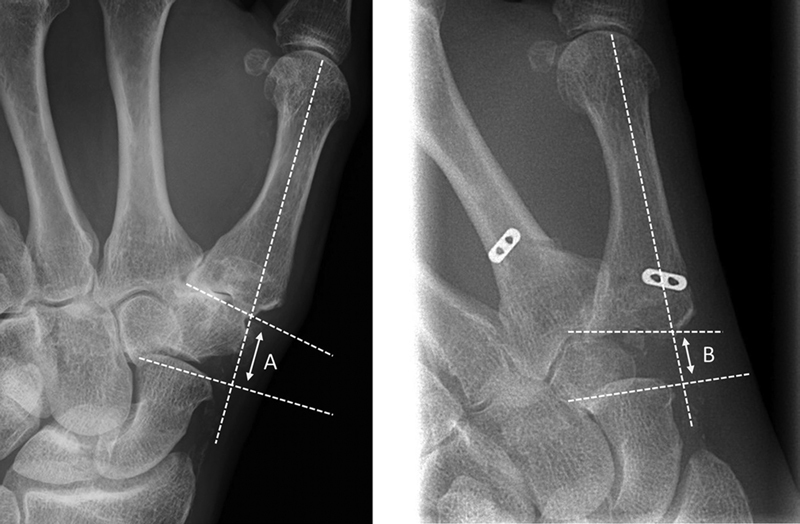
Subsidence was measured as shown above. One line was drawn connecting the corners of the thumb metacarpal base on a lateral radiograph and another was drawn connecting the distal two corners of the scaphoid. A third line was drawn along the central part of the metacarpal bone and parallel to the long axis of the bone. Subsidence was calculated in percent as (A-B)/A*100.
Operative Technique
Both the MTR group ( n = 12) and the LRTI group ( n = 36) were operated under tourniquet control and with a lateral infraclavicular block in the supine position. The procedures were done by two senior hand surgeons and one hand surgery fellow. All 48 patients were first operated on with the same technique described by Burton and Pellegrini. 9 Twelve patients (MTR group) had an additional insertion of the MTR system. A 1.1 mm tapered suture passing Kirschner wire (K-wire) is passed through the base of the thumb metacarpal bone as close to the base as possible. Care was taken not to injure the graft. The K-wire is aimed from the dorsoradial aspect of the first metacarpal bone with the hand in neutral position, the thumb in abducted position, toward the proximal third of the second metacarpal bone, as recommended by the manufacturer. The K-wire is identified on the ulnar aspect of the second metacarpal bone and soft tissue retracted. When the correct position is obtained, the MTR system is installed. A suture-button is threaded with the #2 Fiberwire suture at both sides of the suspension arthroplasty and tightened so as the thumb maintains full range of motion but at the same time prevents subsidence. This is done by making sure the hand can lay flat on the table with the thumb in abduction before final tightening. Radiographic documentation is obtained before closure ( Fig. 2 ).
Fig. 2.

Perioperative X-ray illustrating the Kirschner-wire placement and subsequent Mini TightRope suspension.
Postoperative Regimen
The MTR group were given a soft dressing for 3 to 5 days with no casting or splinting in the postoperative regimen. The historical group was given a dorsoradial cast for 3 weeks followed by a thumb spica splint for an additional 3 weeks.
Statistics
A sample size calculation was performed using the results from Yao and Song. 5 Yao and Song found an improvement of 58.2 points in Q-DASH scores in 14 patients 5 years following surgery using the MTR system. We found an improvement of 31.02 (standard deviation: 19.36) points in Q-DASH scores 4 years following surgery in our historical control group of patients operated on with LRTI. 10 Using these results and allowing for 30% drop-out in both groups, 12 patients were needed. To increase power, we compared with a historical control group in a 3:1 ratio resulting in 12 patients in the MTR group and 36 patients in the LRTI group. Alpha of 0.05 and power at 80% were chosen. We expect this number of patients to suffice to evaluate major complications and adverse event in the first year after surgery. Preoperative demographics are shown in Table 1 . Nonparametric statistics were used comparing PRO between groups (Mann–Whitney U test). In the MTR group, pinch force, mobility, VAS score, and subsidence were all compared with preoperative values in the same group.
Data analysis was performed using SPSS software v. 25 and nonparametric analysis was chosen.
Results
At 6 months, follow-up median Q-DASH was 9.1 (range, 0–45.5) in the MTR group and 18.2 (range, 0–77.3) in the LRTI group resulting in an improvement of 31.82 points (range, 3.9–63.6) for patients in the MTR group and 19.3 points (range, −22.73–63.63) for patients in the LRTI group, p = 0.28. At 12 months, median Q-DASH was 11.3 (range, 0–43.2) in the MTR group and 13.6 (range, 0–88.6) in the LRTI group resulting in an improvement from baseline in the MTR group of 26.15 points (range, 2.25–68.15) and in the LRTI group 23.86 points (range, −20.45–68.18), p = 0.46 ( Fig. 3 ).
Fig. 3.

Quick Disabilities of the Arm, Shoulder, and Hand (Q-DASH) scores before and after surgery. Mini TightRope (MTR) suspension in blue. Standard ligament reconstruction and tendon interposition (LRTI in green).
At 6 months, one of 12 patients in the MTR group was dissatisfied and 9 of 36 were dissatisfied in the LRTI group, p = 0.41. The same results were seen at 1 year following surgery, p = 0.41. For both groups, satisfied patients had significantly larger improvement in Q-DASH scores at 1 year follow-up (median improvement for satisfied patients was 32.95 points and median improvement for patients who were not satisfied was 3.91 points, p < 0.01).
Median pinch force was 3.5 KgF before surgery in the MTR group. At 1 year following surgery, the median pinch force was 4.05 KgF; this improvement compared with preoperative pinch force was not significant, p = 0.29 ( Fig. 4 ).
Fig. 4.

Pinch Force (kg) before and after Mini TightRope (MTR) suspension. *Significantly worse than preoperative scores, p = 0.017. LRTI, ligament reconstruction and tendon interposition.
Mobility of the thumb before surgery was slightly reduced in the MTR group before surgery. Following surgery, the mobility was significantly improved at 52 weeks as compared with preoperatively, p = 0.027 ( Fig. 5 ).
Fig. 5.

Lack of mobility measured as a distance from the tip of the first finger to the base of the 5th finger before and after Mini TightRope (MTR) suspension. *Significantly better than preoperative mobility, p = 0.028.
Median VAS score before surgery was 7.0 in the MTR group. At 6 weeks following surgery, median VAS was 3.5. This was further reduced at 12, 26, and 52 weeks to median VAS of 0.0, 1.0, and 0.0, respectively, p < 0.01 at all follow-up times compared with preoperative scores ( Fig. 6 ).
Fig. 6.

Visual analog scale before and after Mini TightRope (MTR) suspension. *Significantly better than preoperative scores, p < 0.01.
Postoperative trapezial space heights expressed as a percentage of preoperative trapezial height ranged from 47 to 75%. Subsidence, therefore, ranged from 25 to 53% at 6 months following surgery (10 of 12 patients) ( Fig. 1 ).
No complications were observed during the first year of follow-up after MTR suspension as a supplement to the standard LRTI procedure. There were no infections and no fractures of the first or second metacarpal bones.
Discussion
Our aim was to compare PRO adding a two-string suture-button suspensionplasty to our usual procedure of LRTI and allowing early mobilization. When comparing our 12 MTR patients (LRTI with a supplemental MTR) with the 36 patients operated on with LRTI alone, there was a lower Q-DASH and higher satisfaction in the MTR group at 6 and 12 months, although this was not significant. Furthermore, the difference between groups after 1 year did not exceed previously reported minimal clinically important differences. 11 12 13 14 Yao and Song did 2- and 5-year retrospective follow-up with Q-DASH improvement of 58 points but with 3 of 14 patients needing revision surgery at 5-year follow-up. 5 15 One retrospective study of 23 patients who underwent suture-button suspensionplasty did 2 weeks of immobilization, 91% of patients were satisfied at 1 year follow-up, and three patients needed additional surgery due to complications. 16
For the MTR group, the results also showed improved key pinch, significantly better mobility, and significantly less pain compared with preoperatively. This is in line with the results found by Assiotis et al 17 who did trapeziectomy and MTR suspension arthroplasty on 21 patients. These same measurements were not available for the LRTI group. Regarding subsidence of the first metacarpal bone, we have measurements from 10 of the 12 MTR patients, ranging from 25 to 53% at 6 months postoperatively. This is in line with Yao et al 15 who found an average subsidence on 14 of 16 thumbs of 29% after suture-button suspensionplasty at 5-year follow-up. Following LRTI, another study by Reissner et al 18 found a proximal migration of 54% 1 year post surgery.
Limitations of this study include the small number of patients operated on with MTR technique. Post-hoc power analysis of our data resulted in a power estimate of 15 to 23%. This leaves a great chance for type two error in this study. In the historical LRTI group, results regarding pinch force, mobility, VAS scores, and metacarpal subsidence were not available.
No other study has compared LRTI to LRTI with a supplemental suture-button suspensionplasty. It may be argued that LRTI and suspension arthroplasty serve the same purpose of stabilizing the first metacarpal bone. Both procedures aim at reconstructing attenuated or missing ligaments, but with LRTI there is also an interpositioning of material in between the bone ends as to avoid subsidence of the first metacarpal bone. In addition, some surgeons use a K-wire for temporary stabilization of the LRTI construct in the postoperative period. When using only suture-button suspensionplasty, one biomechanical study actually showed that dual MTR fixation provided superior load bearing and maintenance of trapezial space height compared with LRTI Bio-Tenodesis screw procedures, and suggested that patients who undergo suture-button suspensionplasty may be able to move earlier because of the immediate stability the construct affords. 19 By combining LRTI with suture-button suspensionplasty, one would theoretically expect a very stable construct with the ability to maintain trapezial space height while allowing for early mobilization, and keeping the patients at least as satisfied as the patients in the LRTI group. Future studies of interest to allow for early mobilization would include arthroscopic hemitrapeziectomy and MTR suspension alone as compared with the suggested techniques or LRTI alone.
Conclusion
Adding a suture-button suspensionplasty to our usual surgical treatment of TMC arthrosis does not give any added complications. The added stability and immediate mobilization may result in faster recovery as pinch strength was regained and median VAS pain score was 0.0 at 12 weeks. Mobility was improved at 12 months. Supplemental suture-button suspensionplasty can be utilized for high demand patients and patients who want to reduce immobilization time without major complications and with similar PRO as LRTI at 6 and 12 months.
Acknowledgments
None.
Conflict of Interest None declared.
Informed Consent
Written informed consent was obtained from all subjects before the study.
Ethical Approval
The Danish Patient Safety Authority (STPS) approved the study 3–3013–2899/1, reference EMGW. Following approval from STPS, our local ethical committee decided that they did not require approval for this study (H-19086573). Registration of data was approved by our legal department (P-2020–129).
Authors' Contribution
CHJ conceived the study. RWJ did statistical analysis, drafting of manuscripts, gained approval from the Danish Data Protection Agency. KA did thorough manuscript revision and writing. All authors reviewed and edited the manuscript and approved the final version of the manuscript
References
- 1.Sonne-Holm S, Jacobsen S.Osteoarthritis of the first carpometacarpal joint: a study of radiology and clinical epidemiology. Results from the Copenhagen Osteoarthritis Study Osteoarthritis Cartilage 20061405496–500. 10.1016/j.joca.2005.12.001[published Online First: Epub Date]|. [DOI] [PubMed] [Google Scholar]
- 2.Vermeulen G M, Slijper H, Feitz R, Hovius S E, Moojen T M, Selles R W.Surgical management of primary thumb carpometacarpal osteoarthritis: a systematic review J Hand Surg Am 20113601157–169. 10.1016/j.jhsa.2010.10.028[published Online First: Epub Date]|. [DOI] [PubMed] [Google Scholar]
- 3.Wolfe T, Chu J Y, Woods T, Lubahn J D.A systematic review of postoperative hand therapy management of basal joint arthritis Clin Orthop Relat Res 2014472041190–1197. 10.1007/s11999-013-3285-z[published Online First: Epub Date]|. [DOI] [PMC free article] [PubMed] [Google Scholar]
- 4.Cox C A, Zlotolow D A, Yao J.Suture button suspensionplasty after arthroscopic hemitrapeziectomy for treatment of thumb carpometacarpal arthritis Arthroscopy 201026101395–1403. 10.1016/j.arthro.2010.07.006[published Online First: Epub Date]|. [DOI] [PubMed] [Google Scholar]
- 5.Yao J, Song Y.Suture-button suspensionplasty for thumb carpometacarpal arthritis: a minimum 2-year follow-up J Hand Surg Am 201338061161–1165. 10.1016/j.jhsa.2013.02.040[published Online First: Epub Date]|. [DOI] [PubMed] [Google Scholar]
- 6.Yao J, Zlotolow D A, Murdock R, Christian M.Suture button compared with K-wire fixation for maintenance of posttrapeziectomy space height in a cadaver model of lateral pinch J Hand Surg Am 201035122061–2065. 10.1016/j.jhsa.2010.09.007[published Online First: Epub Date]|. [DOI] [PubMed] [Google Scholar]
- 7.Herup A, Merser S, Boeckstyns M. [Validation of questionnaire for conditions of the upper extremity] Ugeskr Laeger. 2010;172(48):3333–3336. [PubMed] [Google Scholar]
- 8.Kitis A, Celik E, Aslan U B, Zencir M.DASH questionnaire for the analysis of musculoskeletal symptoms in industry workers: a validity and reliability study Appl Ergon 20094002251–255. 10.1016/j.apergo.2008.04.005[published Online First: Epub Date]|. [DOI] [PubMed] [Google Scholar]
- 9.Burton R I, Pellegrini V D., JrSurgical management of basal joint arthritis of the thumb. Part II. Ligament reconstruction with tendon interposition arthroplasty J Hand Surg Am 19861103324–332. 10.1016/s0363-5023(86)80137-x[published Online First: Epub Date]|. [DOI] [PubMed] [Google Scholar]
- 10.Wejnold Jørgensen R, Odgaard A, Flensted F, Daugaard H, Hjorth Jensen C.Patient-reported outcomes following interposition arthroplasty of the basal joint of the thumb J Plast Surg Hand Surg 20201–6. 10.1080/2000656X.2020.1830101[published Online First: Epub Date]|. [DOI] [PubMed] [Google Scholar]
- 11.Kazmers N H, Qiu Y, Yoo M, Stephens A R, Tyser A R, Zhang Y.The minimal clinically important difference of the PROMIS and QuickDASH instruments in a nonshoulder hand and upper extremity patient population J Hand Surg Am 20204505399–4.07E8. 10.1016/j.jhsa.2019.12.002[published Online First: Epub Date]|. [DOI] [PMC free article] [PubMed] [Google Scholar]
- 12.Mintken P E, Glynn P, Cleland J A.Psychometric properties of the shortened disabilities of the Arm, Shoulder, and Hand Questionnaire (QuickDASH) and Numeric Pain Rating Scale in patients with shoulder pain J Shoulder Elbow Surg 20091806920–926. 10.1016/j.jse.2008.12.015[published Online First: Epub Date]|. [DOI] [PubMed] [Google Scholar]
- 13.Smith-Forbes E V, Howell D M, Willoughby J, Pitts D G, Uhl T L.Specificity of the minimal clinically important difference of the quick Disabilities of the Arm Shoulder and Hand (QDASH) for distal upper extremity conditions J Hand Ther 2016290181–88. 10.1016/j.jht.2015.09.003[published Online First: Epub Date]|. [DOI] [PubMed] [Google Scholar]
- 14.Sorensen A A, Howard D, Tan W H, Ketchersid J, Calfee R P.Minimal clinically important differences of 3 patient-rated outcomes instruments J Hand Surg Am 20133804641–649. 10.1016/j.jhsa.2012.12.032[published Online First: Epub Date]|. [DOI] [PMC free article] [PubMed] [Google Scholar]
- 15.Yao J, Cheah A E. Mean 5-year follow-up for suture button suspensionplasty in the treatment of thumb carpometacarpal joint osteoarthritis. J Hand Surg Am. 2017;42(07):5690–5.69E13. doi: 10.1016/j.jhsa.2017.03.011. [DOI] [PubMed] [Google Scholar]
- 16.Putnam M D, Meyer N J, Baker D, Brehmer J, Carlson B D.Trapezium excision and suture suspensionplasty (TESS) for the treatment of thumb carpometacarpal arthritis Tech Hand Up Extrem Surg 20141802102–108. 10.1097/BTH.0000000000000046[published Online First: Epub Date]|. [DOI] [PubMed] [Google Scholar]
- 17.Assiotis A, Giannakakis N, Hacker A. Trapeziumectomy and mini tightrope stabilization of the first metacarpal for thumb carpometacarpal osteoarthritis: a prospective case series. Acta Orthop Belg. 2017;83(03):473–479. [PubMed] [Google Scholar]
- 18.Reissner L, Marks M, Schindele S, Herren D B.Comparison of clinical outcome with radiological findings after trapeziectomy with ligament reconstruction and tendon interposition J Hand Surg Eur Vol 20164103335–339. 10.1177/1753193415616959[published Online First: Epub Date]|. [DOI] [PubMed] [Google Scholar]
- 19.Hooke A W, Parry J A, Kakar S.Mini tightrope fixation versus ligament reconstruction - tendon interposition for maintenance of post-trapeziectomy space height: a biomechanical study J Hand Surg Am 20164103399–403. 10.1016/j.jhsa.2015.12.007[published Online First: Epub Date]|. [DOI] [PubMed] [Google Scholar]