



Abstract
Efforts to devolve rights and engage Indigenous Peoples and local communities in conservation have increased the demand for evidence of the efficacy of community‐based conservation (CBC) and insights into what enables its success. We examined the human well‐being and environmental outcomes of a diverse set of 128 CBC projects. Over 80% of CBC projects had some positive human well‐being or environmental outcomes, although just 32% achieved positive outcomes for both (i.e., combined success). We coded 57 total national‐, community‐, and project‐level variables and controls from this set, performed random forest classification to identify the variables most important to combined success, and calculated accumulated local effects to describe their individual influence on the probability of achieving it. The best predictors of combined success were 17 variables suggestive of various recommendations and opportunities for conservation practitioners related to national contexts, community characteristics, and the implementation of various strategies and interventions informed by existing CBC frameworks. Specifically, CBC projects had higher probabilities of combined success when they occurred in national contexts supportive of local governance, confronted challenges to collective action, promoted economic diversification, and invested in various capacity‐building efforts. Our results provide important insights into how to encourage greater success in CBC.
Keywords: accumulated local effects, community‐based conservation, conservation evaluation, conservation outcomes, evidence‐based conservation, machine learning, random forest classification, aprendizaje automático, clasificación aleatoria de bosque, conservación basada en la comunidad, conservación basada en evidencias, evaluación de la conservación, efectos locales acumulados, resultados de la conservación, 基于社区的保护, 保护评估, 保护结果, 基于证据的保护, 机器学习, 随机森林分类, 累积局部效应
Resumen
Los esfuerzos por transferirle derechos e involucrar a los pueblos originarios y a las comunidades locales en la conservación han incrementado la demanda de evidencia sobre la eficiencia de la conservación basada en la comunidad (CBC) y de conocimiento sobre lo que posibilita su éxito. Analizamos los resultados ambientales y de bienestar humano en un conjunto diverso de 28 proyectos de CBC. Más del 80% de estos proyectos tuvieron resultados positivos para el ambiente o el bienestar humano, aunque sólo el 32% logró resultados positivos para ambos (es decir, éxito combinado). Codificamos en total 57 variables y controles a nivel nacional, comunitario y de proyecto en este conjunto, aplicamos una clasificación aleatoria de bosque para identificar las variables más importantes para el éxito combinado y calculamos los efectos locales acumulados para describir su influencia sobre la probabilidad de alcanzar el éxito combinado. Los mejores pronósticos del éxito combinado se obtuvieron con 17 variables sugerentes de varias políticas y oportunidades para los practicantes de la conservación relacionadas con los contextos nacionales, las características de la comunidad y la implementación de varias estrategias e intervenciones guiadas por los marcos existentes de CBC. Específicamente, los proyectos de CBC tuvieron mayor probabilidad de tener éxito combinado cuando se dieron dentro de contextos nacionales que respaldan la gobernanza local, enfrentan los retos de la acción colectiva, promueven la diversificación económica e invierten en varios esfuerzos por construir capacidades. Nuestros resultados proporcionan información importante sobre cómo alentar un mayor éxito en la CBC.
【摘要】
向原住民和当地社区移交权力并促进其参与保护工作的努力, 增加了对以社区为基础的保护工作(community‐based conservation, CBC)有效性证据的需求和探究其成功背后深层原因的需求。本研究分析了128个不同的CBC项目的人类福祉和环境保护成效。我们发现, 超过80%的CBC项目都有积极的人类福祉或环境保护成效, 但只有32%的项目在这两方面同时取得了积极成果(即综合性成功)。我们对这些成功项目中的57个国家、社区和项目水平的变量和控制因素进行了编码, 并进行随机森林分类, 以确定影响综合性成功最重要的变量。我们还计算了累积局部效应, 以描述它们对实现综合性成功的概率的单独影响。结果表明, 有17个变量是综合性成功的最佳预测因素, 代表了保护实践者的各种政策和机会, 它们与国家背景、社区特点以及在现有的CBC框架下实施的战略和干预措施有关。具体来说, 位于支持地方治理的国家、面对着集体行动挑战、可以促进经济多样化, 以及投资于各种能力建设工作的CBC项目取得综合性成功的概率更高。我们的结果为鼓励CBC取得更大成就提供了重要的见解。【翻译:胡怡思;审校:聂永刚】
INTRODUCTION
Interest in community‐based conservation (CBC) has grown concurrent with the recognition of its potential to advance conservation goals while strengthening the agency and well‐being of Indigenous Peoples and local communities (IPLCs). Over one‐quarter of the world's terrestrial area covering 75% of the world's ecoregions are governed by IPLCs (RRI 2015; Garnett et al. 2018), creating landscapes of immense sociocultural and economic value to the communities connected to them (Bridgewater & Rotherham 2019), as well as exceptional conservation value to the world beyond (Frechette et al. 2018; Schuster et al. 2019; Walker et al. 2020; Fa et al. 2020). This reality, coupled with growing threats from globalization and extractive industrial development (Gilberthorpe & Hilson 2016; IPBES 2019), will continue to juxtapose local and supralocal interests (Dinerstein et al. 2019), and require acknowledgement of a legacy of ineffective conservation policies and approaches (Brockington & Igoe 2006; Dowie 2009; IUCN 2020; Tauli‐Corpuz et al. 2020).
For normative and practical reasons, it is widely accepted that protection of IPLC‐governed landscapes should be achieved with a community‐based approach (Ellis & Mehrabi 2019; Waldron et al. 2020), which necessitates further evaluation of the CBC frameworks that guide how conservation practitioners engage with IPLCs. Despite long‐standing calls for adopting a community‐based approach (e.g., Chapin 2004), practitioner frameworks and guidance for effectively doing so are still evolving. Frameworks for CBC now exist across multiple conservation organizations (e.g., Mahajan et al., 2021; Ostrom, 2009; TNC, 2022) and generally coalesce around strategies and interventions that create the enabling conditions for IPLCs to effectively govern and continue stewarding their territories and resources. These enabling conditions are supported by many broadly conceived strategies and interventions well known to CBC practitioners, including those that help secure their rights to territory and resources (Robinson et al. 2018; Tseng et al. 2021), strengthen local leadership and governance capacity (Moore et al. 2006; Brooks et al. 2013), create forums for multistakeholder engagement and decision‐making (Edmunds & Wollenberg 2001; Kusters et al. 2018), and provide sustainable economic development opportunities (Roe et al. 2012). Although CBC is context dependent and multifaceted (Schwartz et al. 2018; Mahajan et al. 2021), these elements are often researched independently.
Recent reviews of CBC projects suggest that successes are possible under certain conditions and with certain interventions; however, many are largely descriptive (e.g., Burivalova et al. 2019, 2017) or based on conventional statistical analyses (bivariate or multivariate) of CBC outcomes and their explanatory variables (Brooks et al. 2013; Brooks 2017; d'Armengol et al. 2018; Hajjar et al. 2021). Furthermore, some of these reviews focus on single dimension outcomes (e.g., Roe et al. 2015), making it difficult to examine the relative importance of the diverse strategies and interventions commonly leveraged in a single project, the necessity to generate benefits for nature without harm to people, and the frequency with which they succeed at generating benefits for both. This combined outcome is of particular interest because dual benefits are often an explicit goal of CBC, though notoriously difficult to achieve (Chhatre & Agrawal 2009; McShane et al. 2011; Brooks 2017).
Further synthesis of the evidence is needed to assess the efficacy of commonly employed strategies and interventions, as well as to ensure better outcomes for future conservation efforts. We addressed this need by examining a sample of 128 CBC projects that reported on both human well‐being and environmental outcomes and coded 57 explanatory variables informed by existing CBC frameworks (e.g., Mahajan et al., 2021; TNC, 2022). We then used machine learning to model the predictors of combined success among the explanatory variables that met our criteria for consideration. This approach overcomes the drawbacks of previous approaches because it requires little to no a priori knowledge about the relative importance of different explanatory variables, can manage correlated variables and nonlinear relationships common with socioecological data, and better detects small individual effects. Thus, we hope that our analysis will provide novel insights into what might catalyze CBC success—information that is needed to develop effective strategies and identify evidence gaps that must be filled to strengthen existing CBC frameworks.
METHODS
Our approach involved literature review and sample selection; coding and variable processing; modeling of combined success using random forest classification (RFC) to identify important national‐, community‐, and project‐level variables; and estimating accumulated local effects (ALEs) to describe how each variable affects the probability of achieving it (Figure 1). Data compilation and management were performed in Excel (Excel for MSO 365, version 1908), and analyses and mapping were performed using the statistical computing platform R (R Core Team, 2019, version 4.0.3) and ArcMap (version 10.6.1).
FIGURE 1.

Analytic process applied to the sample of community‐based conservation projects examined to determine features important to combined success in human well‐being and environmental outcomes
Sample curation
Our sample draws from diverse sources of evidence, including peer‐review journals, books, theses, dissertations, conference proceedings, and technical reports. Studies must have provided adequate description of community‐level characteristics and interventions, as well as reported on human well‐being and environmental outcomes (Appendix S1). Methodological approaches ranged from case studies to quasi‐experimental research designs and included qualitative and quantitative indicators. Because we permitted diverse evidence, we calculated composite measures of majority indicator type and design for each project and used these as proxies for the strength and quality of the evidence reported (Appendices S2 & S3).
We first considered the projects from previous related reviews that examined strategies and interventions relevant to the CBC frameworks we were specifically interested in testing (Mahajan et al. 2021; TNC 2022). This included 2 reviews of CBC and ICDP projects (Brooks et al. 2013, 2006); a review of alternative livelihood strategies (Roe et al. 2015); and a review of CBC strategies implemented in tropical forest conservation, including protected areas, community‐based natural resource management, certification, and payments for ecosystem services (Burivalova et al. 2019). We employed best practices to expand this sample by conducting a supplementary literature search in February 2020 focused on filling gaps in the date ranges and CBC strategies captured by these previous reviews (CEE 2018) and conducted our search in Google Scholar via Publish or Perish software (Harzing 2007). Like Brooks et al. (2013, 2006), we searched for “community‐based conservation” or “CBC” or “integrated conservation and development” or “ICDP” and “∼impact and ∼environment” and restricted the dates to 2012–2020 to capture publications that minimized the possibility for duplicates, which were manually removed when they occurred.
Coding and variable processing
We read each paper and coded their social, economic, and environmental outcomes (intended and unintended). This coding included an outcome and indicator category (e.g., environmental outcome: restoration and recovery indicator), description (e.g., forest cover), valence (e.g., increasing), type (e.g., quantitative), design (e.g., time series), and outcome (e.g., positive). Indicator outcomes were based on an interpretation of the indicator's trend and impact, which we coded as negative, neutral, or positive. Project‐level social, economic, and environmental outcomes were assigned by aggregation of all the individual indicators measured (statistically significant or not) and were scored as negative if all indicators were negative, negative and neutral, or neutral only; mixed if there were some positive indicators; or positive if all indicators were positive. Lastly, we used project‐level outcomes to develop the response variable of our RFC model, that is, combined success, where success was assigned to projects if all the human well‐being (social, economic, or both) and environmental outcomes measured were positive and failure was assigned otherwise. An analysis of the sensitivity of our results to response variable coding is in Appendix S4.
To better understand the factors associated with success at generating benefits for people and nature, we coded or obtained from supplementary sources 57 explanatory variables with hypothesized importance to project outcomes, including 7 variables related to national context, 17 community characteristics, 27 attributes of project design and implementation, and 6 control variables (Appendix S3). We used an adaptive coding scheme and retained as much overlap with previous reviews as possible.
Missing data are commonly cited in reviews of the CBC literature as a function of inadequate monitoring and evaluation or an incomplete reporting of the numerous factors that may be relevant to project outcomes (Pullin & Stewart 2006; Humphries et al. 2018). Most of our explanatory variables had some proportion of missing data (36 out of 57). Of these, 20 had substantial missing data proportions (MDP > 0.30), which we excluded from imputation and subsequent modeling and defined as an evidence gap. Like other systematic reviews (Brooks et al. 2013; Hajjar et al. 2021), we imputed missing values for explanatory variables with MDP ≤ 0.30. Overall, the level of missing data among explanatory variables was negligible, ranging from 0‐16%. Further, sensitivity analyses showed no evidence of a positive correlation between a variable's proportion of missing data or degree of imputation and its importance in the final random forest classification model (Appendix S5). We used a nonparametric imputation method combining random forest and predictive mean matching to fill missing values in each explanatory variable by considering all other information available for the project (Stekhoven 2013). We estimated imputation error (IE) for each explanatory variable, normalized mean squared error (NMSE) for numerical variables, or proportion falsely classified (PFC) for categorical variables. We used IE > 0.30 as our threshold for unacceptable imputation error, resulting in the exclusion of 3 explanatory variables.
Finally, we performed a second blind review of a stratified random sample of 20% of our inclusion set to calculate interrater reliability (IRR) for each coded variable. We calculated Cohen's kappa (Cohen 1960; Garner et al. 2019) and used an IRR < 0.60 as an indicator of less than moderate agreement (McHugh 2012), resulting in the exclusion of 6 explanatory variables.
Modeling combined success
We summarized indicator‐ and project‐level outcomes (Bryer & Speerschneider 2016; Wickham ), then employed RFC (Breiman 2001), a specific implementation of classification and regression tree (CART) analysis (Wei‐Yin 2008; Humphries et al. 2018), to identify the variables most important to combined success in human well‐being (social, economic, or both) and environmental outcomes. RFC provides a flexible, nonparametric approach to exploring the effects of numerous theoretically important explanatory variables on CBC outcomes. A key advantage is its ease of implementation and robustness to challenges common to the socioecological data typically available for CBC projects (Cutler et al. 2007). We used mean decrease Gini as a measure of importance and present the median of bootstrap estimates and 90% confidence intervals (CIs) (rather than 95% given the smaller sample size) based on the percentile interval method, which is defined by the 0.05 and 0.95 quantiles of the bootstrap distribution (Banjanovic & Osborne 2016).
Our response variable for the RFC model was combined success. Our explanatory variables came from the 57 variables we coded that were informed by previous reviews and existing CBC frameworks (Appendix S3). In sum, 28 explanatory variables met our inclusion criteria after accounting for missing data proportions, imputation error, and inter‐rater reliability (MDP ≤ 0.30, IE ≤ 0.30, and IRR ≥ 0.60) (Appendix S6). Prior to modeling, our project sample (n = 128) was parsed into training and test data. Test data were established from a randomly selected 20% of the original sample (n = 26) and had balanced representation of response outcomes (0:1 = 13:13). We used the remaining 80% of the sample to train the RFC model (n = 102, 0:1 = 74:28). RFC is adversely affected by unbalanced training data (Shaikhina et al. 2019), and balancing can significantly improve model performance. Thus, we balanced the training data with a synthetic minority oversampling technique (Chawla et al. 2002; Torgo 2010); compared model performance measures among original and variously balanced training data; and conducted an analysis of the sensitivity of our results to different initial training and test splits (Appendices S7 & S8).
We ran bootstrapped (B = 1000) RFC models on our best performing balanced training data and optimized model parameters with grid search (Liaw & Wiener 2002; Reif et al. 2012; Paluszynska et al. 2019). An iterative variable selection process aimed at improving model performance reduced the 28 variables we initially considered to 17 through the following 3 steps: pruning of redundant variables based on feature importance scores and ALEs; stepwise tests of removing variables with ALEs that appeared uninformative or lacked theoretical justification; and removal of remaining variables with a median feature importance score <0.50 mean decrease Gini.
We report several measures of performance for the final RFC model including accuracy, recall, and precision (Frank 2019). We also derived receiver operating characteristic (ROC) and area under the curve (AUC) statistics to illustrate the diagnostic ability of the model as a binary classifier (Sing et al. 2005; Ballings & Van den Poel 2013). We bootstrap estimated (B = 1000) each of these measures to assess the model's fit to the training data, as well as its performance on test data (Appendix S9). We accepted a median ROC‐AUC ≥ 0.70 on test data as a suitable level of discrimination between CBC outcomes and a minimum value of model performance at predicting combined success. Across the variable and model selection process described above, ROC‐AUC on test data improved from 0.58 (90% CI: 0.47, 0.67) to 0.70 (0.60, 0.79).
To aid in effect interpretation, we calculated bootstrap estimated (B = 1000) ALEs for each variable in the RFC model (Apley 2018; Molnar 2018, 2019). ALE plots were used to illustrate a variable's overall effect on combined success, and allow for visualization of the patterns and trends in the prediciton of combined success associated with individual variables (Apley & Zhu 2020). Last, we conducted an exploratory analysis of overall and 2‐way interactions between variables (Appendix S10).
RESULTS
Sample description
Our sample included 128 CBC projects implemented across 37 different countries in Latin America, Africa, and Asia that spanned terrestrial (74%), marine or coastal (19%), and freshwater (7%) ecosystems (Figure 2; Appendix S11). Twelve countries had 1 project represented in the sample, and Cameroon, India, Mexico, Indonesia, Brazil, and Tanzania had multiple projects. Most projects were described in peer‐review journals (79%) and were implemented by government agencies (42%), nongovernmental organizations (13%), or partnerships between them (38%). Most projects (67%) were also at a later stage of implementation (≥6 years) at the time of their evaluation. Projects were evaluated from 1983 to 2017, and 80% occurred prior to 2010, most of those from 2000 to 2004. Thirty‐eight percent of projects predominately reported quantitative indicators, 34% qualitative, 26% author‐reported or from secondary sources, and 2% had a mix of indicator types with no clear majority. Forty‐nine percent of projects predominately reported indicators with treatment or time controls, 43% with no control, and 8% reported indicators with mixed methodological designs and no clear majority. Of the projects that reported indicator outcomes against a control in treatment or time, nearly half considered additional confounding variables, and 17% employed more rigorous designs (e.g., quasi‐experimental or randomized control trials). Collectively, these statistics suggest that most of the evidence in our sample involved primary data collection (72%) and methods that factored in one or more controlling variables (58%) (Appendix S2).
FIGURE 2.

Numbers, locations, and biomes of community‐based conservation projects represented in the analytic sample. The number of projects in each country is visualized in natural breaks on the map, a classification method that finds groupings based on maximizing the difference between classes (references in Appendix S11)
Project outcomes
Across social, economic, and environmental outcomes, positive indicators were frequently reported in at least 1 of these domains. Of the 110 projects reporting social outcomes, 42% reported all positive indicators, and an additional 48% reported mixed results (Figure 3a; Appendix S12a). There was notable variation across social indicator categories. For example, indicators related to health, education, and quality of life were predominately positive (73%), followed by indicators related to attitudes and behaviors affecting natural resource management (e.g., willingness to adopt new or improved practices) (68%) and conservation awareness and attitudes (67%). In contrast, the majority of indicators related to access and use, equity and representativeness, and well‐being and empowerment were neutral to negative (58–59%). Descriptions and sample sizes of indicator categories are in Appendix S13.
FIGURE 3.

(a) Social, (b) economic, (c) environmental, and (d) combined social, economic, and environmental outcomes of community‐based conservation projects. In (a‐c) indicator‐level outcomes are summarized in the stacked bar graphs across the top (NRM, natural resource management). Indicators were scored as negative, neutral, or positive. Project‐level outcomes are in the single bar graphs across the bottom and are an aggregation of all the indicators measured for that project. Project‐level outcomes were negative if all indicators were negative, negative or neutral, or neutral only; were mixed if there were some positive indicators; and were positive if all indicators were positive. In (d), the response variable in subsequent modeling, projects were a success if human well‐being (social, economic, or both) and environmental outcomes were positive and a failure otherwise. Heat maps showing the percentage, mean, and SD for indicator and project‐level outcomes are in Appendix S12
Of the 113 projects that reported economic outcomes, 50% had all positive indicators, and an additional 35% were mixed (Figure 3b; Appendix S12b). We observed less variation within economic indicator categories because most had a majority that were positive. Enterprise establishment indicators had the highest proportion of positive outcomes (91%), followed by indicators related to efficiency, productivity, and sustainability (85%). However, improvements in poverty metrics and perceptions of economic security that would ideally follow the establishment of a new livelihood enterprise (e.g., ecotourism) occurred less often. We observed this specifically with improvements in employment opportunity, income, livelihoods, and living standards. Although a slight majority of indicators in these categories were positive, each had a considerable proportion of neutral to negative reporting (37–40%).
For environmental outcomes, 60% reported all positive indicators, and an additional 20% were mixed (Figure 3c; Appendix S12c). Like the economic indicator categories above, all environmental subcategories tended to be positive. Indicators related to restoration and recovery, diversity and resilience, and proconservation activities (e.g., patrolling, nest protection, etc.) were predominately positive (>75%), whereas indicators related to abundance and extent, ecological condition and function, disturbance, degradation, and illegal activity had higher neutral to negative reporting (32–42%).
Combined success was observed with less frequency. Of the 128 projects that reported a combination of human well‐being (social, economic, or both) and environmental indicators, 32% achieved positive outcomes in all domains (Figure 3d). The results of the RFC model were used to identify the predictors of this outcome.
Variable importance
Bootstrap estimated (B = 1000) feature importance scores for the 17 explanatory variables in our final RFC model (Figure 4; Appendix S14) showed that the control variable project period ranked highest in importance, although national‐level variables that suggest favorable contexts for local governance were among the most important (environmental democracy ranked second, political stability ranked third, voice and accountability ranked fourth, and IPLC legal insecurity ranked fifth). However, project‐level variables made up the greatest share of variables important to combined success (53%). Two community‐level variables also met our feature importance threshold (mean decrease Gini ≥ 0.50), although they ranked lower relative to many others (economy ranked twelfth and social cohesion challenge ranked seventeenth). Model performance statistics on training data confirmed that these 17 explanatory variables were good at discerning the outcomes reported in the project sample (ROC‐AUC = 0.97 [90% CI: 0.95, 0.99]), whereas the same statistics on test data suggested that they were reasonably good at discerning the outcomes of projects beyond the sample as well (ROC‐AUC = 0.70 [0.60, 0.79]) (Appendix S9).
FIGURE 4.

Bootstrap estimated (B = 1000) feature importance scores for explanatory variables of the random forest classification (RFC) model of combined success for community‐based conservtion projects (Figure 3d) (IPLC, Indigenous peoples and local communities; red symbol, bootstrap median; bar, 90% confidence interval defined by the 0.05 and 0.95 quantiles of the bootstrap distribution). Feature importance scores are relative, ranked from highest to lowest feature importance, and describe which variables are important to model prediction. Definitions, hypothesized effects, and a comparison of alternate feature importance measures are provided in Table 1 and Appendix S16
Variable effects
Bootstrap estimated (B = 1000) ALEs for each of the 17 explanatory variables (Figure 5) showed that most variable's trends were consistent with their hypothesized effect (Table 1). The national‐level variables environmental democracy, political stability, and voice and accountability showed significant effects across much of their range, although IPLC legal insecurity showed no clear pattern despite being important to overall model performance (Figure 5a). What is shown is a lower probability of combined success in countries with less environmental democracy, political stability, or voice and accountability. Conversely, success was more likely in countries with greater environmental democracy (e.g., 12% [90% CI: 6, 17]).
FIGURE 5.
Bootstrap estimated (B = 1000) accumulated local effects (ALEs) for (a) national‐, (b) community‐, and (c) project‐level variables and (d) control variables of the random forest classification (RFC) model of combined success for community‐based conservation projects. Plots are ordered from highest to lowest feature importance within each level (Fig. 4) (continuous variables: light blue line, individual bootstrap estimate; dark blue line, bootstrap median; envelope, 90% confidence interval defined by the 0.05 and 0.95 quantiles of the bootstrap distribution; dotted red line, smoothed loess curve; categorical variables: light blue barcode, individual bootstrap estimate; dark blue symbol, bootstrap median; blue error bar, 90% confidence interval defined by the 0.05 and 0.95 quantiles of the bootstrap distribution; **, significant effect; *, potential (but nonsignificant) effect). Each plot is centered and the value plotted is interpreted as a change in the probability of combined success associated with a specific value of the variable (Molnar 2019)


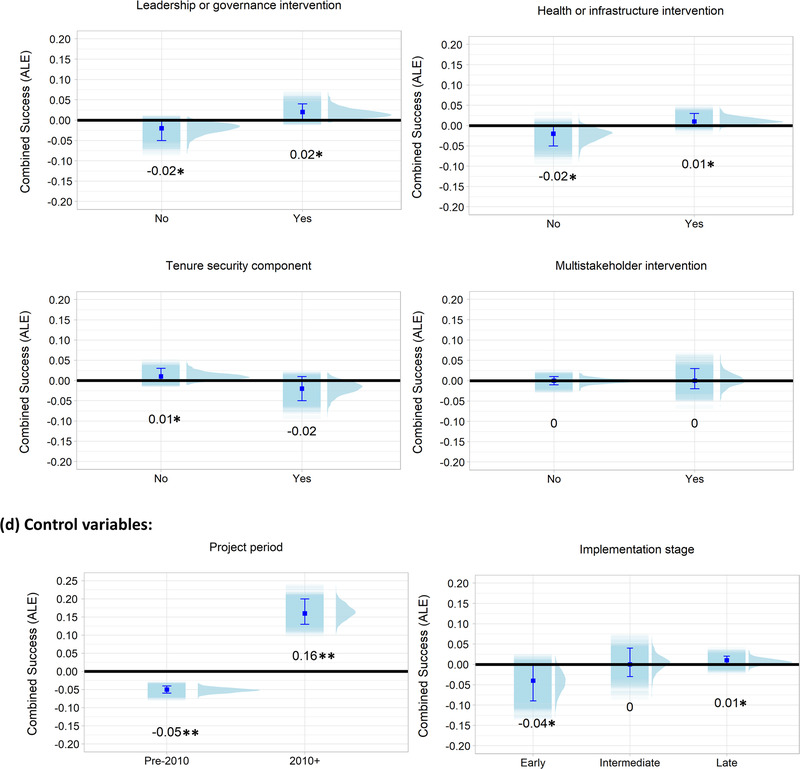
TABLE 1.
Definitions and descriptive statistics of the variables used in the random forest classification (RFC) model of combined human well‐being and environmental outcomes in community‐based conservation
| Observations | |||||
|---|---|---|---|---|---|
| Response variable (target) | Train | Train (bal) a | Test | ||
| Combined success: project‐level outcome calculated from the combination of human well‐being (social, economic, or both) and environmental outcomes reported; considered success if all single dimension outcomes were positive and failure if otherwise. | 102 | 112 | 26 | ||
| Failure (0) | 74 | 56 | 13 | ||
| Success (1) | 28 | 56 | 13 | ||
| Continuous explanatory variables (features) b | Min | Mean | Max | SE | |
|---|---|---|---|---|---|
| National‐level variables (n = 4) | |||||
| Environmental democracy (+): index score based on indicators of the extent to which a country's citizens enjoy access to information, participation in decision‐making forums, and justice in environmental matters (e.g., laws and regulations governing freedom of information; regulation on extractive industry; requirement for consultation, etc.); values obtained from World Resources Institute Environmental Democracy Index (Worker & De Silva 2015); higher values indicate greater environmental democracy c |
Train: Train (bal): Test: |
0.09 0.09 0.90 |
1.34 1.31 1.36 |
1.90 1.90 2.14 |
0.04 0.03 0.10 |
| IPLC legal insecurity (–): index score of the legal security of Indigenous Peoples and local communities (IPLCs) have over their territories and resources as assessed from numerous indicators; values for each country obtained by taking least secure score from LandMark's separate IP and LC legal security indices; higher values indicate greater insecurity (Wily et al. 2018) d |
Train: Train (bal): Test: |
1.10 1.10 1.10 |
2.20 2.22 2.15 |
4.00 4.00 4.00 |
0.08 0.08 0.15 |
| Political stability (+): index score for political stability based on indicators of the likelihood of political instability, politically motivated violence (e.g., civil unrest, armed conflict, ethnic tensions), or both; values obtained from the World Bank Political Stability Index for year of project assessment (or next closest within a 2‐year window) (Kraay et al. 2010); higher values indicate greater political stability |
Train: Train (bal): Test: |
–1.95 –1.79 –1.87 |
–0.44 –0.58 –0.48 |
1.01 0.89 1.14 |
0.07 0.06 0.14 |
| Voice and accountability (+): index score for voice and accountability based on indicators of the extent to which individuals can participate and be adequately represented in political processes (e.g., perceptions of confidence in electoral processes, freedom of expression, the accountability of public officials); values obtained from the World Bank Voice and Accountability Index for the year of project assessment (or next closest within a 2‐year window) (Kraay et al. 2010); higher values indicate greater voice and accountability |
Train: Train (bal): Test: |
–1.58 –1.40 –1.63 |
–0.11 –0.15 –0.11 |
1.13 1.13 1.29 |
0.06 0.05 0.12 |
| Observations | |||||
|---|---|---|---|---|---|
| Categorical explanatory variables (features) b | Train | Train (bal) a | Test | ||
| Community‐level variables (n = 2) | |||||
| Economy (+): predominant type of economy that best characterizes the community; ordinal scale reflects increasing levels of market access | |||||
| Subsistence based (1) | 46 | 51 | 11 | ||
| Mixed (2) | 53 | 58 | 12 | ||
| Market based (3) | 3 | 3 | 3 | ||
| Social cohesion challenge (–): indications of a potential social cohesion challenge referenced directly or suggested by demographic information related to population size, diversity, or pressure | |||||
| No (0) | 34 | 36 | 15 | ||
| Yes (1) | 68 | 76 | 11 | ||
| Project‐level variables (n = 9) | |||||
| Acknowledged conflict or trust issues (+): whether conflict or trust issues were identified and whether there was evidence of activities and interventions that could reasonably be assumed to address them (e.g., specific mention of conflict resolution or trust‐building activities; capacity‐building activities related to strengthening social and institutional capital, such as convening community members and assemblies, clarifying rules and regulations, developing community‐based monitoring and enforcement, promoting transparency and accountability among leadership, etc.); variable is a composite that required responses to both intermediate questions be yes to be considered confirmation of a project acknowledging conflict or trust issues | |||||
| No (0) | 63 | 75 | 14 | ||
| Yes (1) | 39 | 37 | 12 | ||
| Conservation biome (×): predominant biome in which the project occurs | |||||
| Terrestrial (1) | 78 | 82 | 17 | ||
| Freshwater (2) | 6 | 4 | 2 | ||
| Marine or coastal (3) | 18 | 26 | 7 | ||
| Conservation target (×): primary conservation target of the project | |||||
| Targeted species and habitats (1) | 17 | 25 | 9 | ||
| Biodiversity and landscapes (2) | 75 | 77 | 16 | ||
| Ecosystem health or services (3) | 10 | 10 | 1 | ||
| Economic development intervention type (+/×): type of economic intervention implemented by the project; categories include none or assumed benefits; commercial permits and concessions (e.g., leases); compensation‐focused interventions (e.g., payment for conservation activities like patrolling, or provision of ecosystem services, etc.); and diversification‐focused interventions (e.g., introduction of alternative methods, resources, or occupations; small business loans and incentives for alternative livelihoods development) | |||||
| None or assumed benefits (1) | 22 | 29 | 5 | ||
| Commercial permits and concessions (2) | 11 | 15 | 4 | ||
| Compensation focused (3) | 28 | 22 | 6 | ||
| Diversification focused (4) | 41 | 46 | 11 | ||
| Health or infrastructure intervention (+): whether there was a healthcare or infrastructure component to the project (e.g., nutritional programs, vaccination clinics, roads, schools, wells, irrigation infrastructure) | |||||
| No (0) | 26 | 39 | 14 | ||
| Yes (1) | 76 | 73 | 12 | ||
| Leadership or governance intervention (+): whether there was a human, social, or institutional capacity‐building component to the project focused on strengthening community leadership or the capacity for natural resource governance (e.g., knowledge exchange, training in conflict resolution, establishment of CBOs, land‐use planning, etc.) | |||||
| No (0) | 37 | 51 | 14 | ||
| Yes (1) | 65 | 61 | 12 | ||
| Multistakeholder intervention (+): whether there was an explicit multistakeholder intervention implemented in the project (e.g., coordination of stakeholders, vertical integration of nested institutions of governance, political representation in decision‐making forums) | |||||
| No (0) | 71 | 81 | 24 | ||
| Yes (1) | 31 | 31 | 2 | ||
| Tenure security component (+): whether the community had secure tenure at the time of intervention (as suggested by communal or private property) or there was an effort to increase it as part of project design through formalization efforts like titling | |||||
| No (0) | 56 | 72 | 14 | ||
| Yes (1) | 46 | 40 | 12 | ||
| Training or technical assistance intervention (+): whether there was a human capacity building component to the project focused on the provision of training or technical assistance | |||||
| No (0) | 35 | 45 | 16 | ||
| Yes (1) | 67 | 67 | 10 | ||
| Control variables (n = 2) | |||||
| Implementation stage (+): how old the project was or the implementation stage of the project at the time of its evaluation; ordinal scale reflects increasing project duration and maturity | |||||
| Early 0–2 years (1) | 7 | 14 | 3 | ||
| Intermediate 3–5 years (2) | 24 | 23 | 8 | ||
| Late 6+ years (3) | 71 | 75 | 15 | ||
| Project period (+): time over which the project was assessed; breakpoints chosen based on calls to the conservation community encouraging the adoption of more people‐centered approaches, which were gaining momentum in the mid to late 2000s (Chapin 2004; Chan et al. 2007; Kareiva & Marvier 2012), while a global economic recession was winding down. Thus, we hypothesized that later projects [2010+] may have benefited from improved guidance and better enabling conditions for positive human well‐being and environmental outcomes to occur. | |||||
| Pre‐2010 (1) | 81 | 85 | 21 | ||
| 2010+ (2) | 21 | 27 | 5 | ||
Training data modeled in the analysis are balanced training data (c), per Appendix S8.
Hypothesized effect for each explanatory variable follows its name in parentheses (see Appendix S3 for details).
Because this index was compiled in 2017, it may overestimate levels of environmental democracy for earlier projects.
Because this index was compiled in 2019, it may overestimate levels of legal security for earlier projects.
Community characteristics were less influential on the probability of combined success (Figure 5b). We observed no evidence of an effect with respect to economy type, whereas social cohesion challenge had a potential (but nonsignificant) negative effect given that its confidence interval includes 0 (–1% [90% CI–2, 0]).
Many aspects of project design and implementation influenced CBC outcomes (Figure 5c). Economic development interventions, particularly diversification‐focused strategies such as alternative methods, resources, or occupations, had a significant positive effect (4% [90% CI: 1, 7]). Conversely, projects based on commercial permits and concessions (e.g., timber leases) showed a significant negative effect (–7% [90% CI: –12, –3]). No evidence of an effect was observed for compensation‐focused strategies, such as payment for ecosystem services (PES).
Training or technical assistance interventions followed economic development interventions in importance, and their implementation had a significant positive effect (3% [90% CI: 1, 5]). Following that, projects that acknowledged conflict or trust issues had a significant positive effect (5% [90% CI: 2, 9]). Implementation of other capacity‐building interventions showed potential (but nonsignificant) positive effects, including leadership or governance interventions (2% [90% CI: 0, 4]) and health or infrastructure interventions (1% [90% CI: 0, 3]). No evidence of an effect was observed for conservation biome, conservation target, tenure security component, and multistakeholder interventions, although there was a potential (but nonsignificant) positive effect for projects that did not have a tenure security component.
Two control variables, project period and implementation stage (Figure 5d), had notable effects. Projects implemented after 2010 had a significant positive effect (16% [90% CI: 13, 20]). The plot for the implementation stage variable showed that very young projects had a potential (but nonsignificant) negative effect (‐4% [90% CI: –9, 0]), and late‐stage projects had a potential (but nonsignificant) positive effect (1% [90% CI: 0, 2]).
DISCUSSION
Our application of RFC is well suited to learning from the small samples and highly dimensional, correlated data common to CBC literature. In addition to the control variables summarized in Appendix S15, our results showed that national‐level contexts have a considerable influence on CBC outcomes and to a lesser degree, certain characteristics of the communities themselves. Most importantly, many project‐level strategies and interventions at the discretion of conservation practitioners had a positive effect on human well‐being and environmental outcomes. Our findings provide evidentiary support for existing CBC frameworks, clarify evidence gaps requiring further study, and offer insights into the factors important for CBCs to deliver benefits for people and nature.
National contexts and local governance
The importance of context to CBC outcomes is a widely held, though frequently untested assumption (Dickman et al. 2015; Miller et al. 2015). Three of our national‐level variables had significant effects, including environmental democracy, political stability, and voice and accountability. In contrast to previous reviews that aggregated several national‐level variables into a single dimension and showed no evidence of an effect or negative effects (Brooks et al. 2013; Hajjar et al. 2021), we considered each independently and found different results. We suggest that each national‐level indicator represents a different aspect of the social, economic, and political context influencing the operational environment and the capacity for local governance of natural resources. Particularly important to the combined success of CBC projects were national contexts that supported free prior and informed consent and provided pathways for communities to seek justice in environmental matters; provided communities access to information and the ability to participate and freely express their interests in political and decision‐making processes (Barelli 2012; Tomlinson 2019); and promoted stability with respect to supralocal governance structures, regulatory environments, recognition, and enforcement of rights (Ribot et al. 2006). Consideration of readily available national‐level indicators that convey this information (i.e., environmental democracy, voice and accountability, and political stability respectively) provides important situational awareness for conservation practitioners and has bearing on feasibility and conservation investment prioritization (e.g., Eklund et al. 2011; Garnett et al. 2011), as well as indicating which strategies and interventions might be leveraged in response. For example, greater investment in capacity‐building efforts that foster community engagement and representation in decision‐making processes may be important where environmental democracy and voice and accountability are low. Local efforts might involve creating or strengthening community‐based organizations and building the capacity for community leaders to more readily participate in decision‐making fora, whereas supralocal efforts might involve advocacy for the enforcement of existing frameworks that call for equity and the inclusion of marginalized groups, increasing transparency and accountability, and removing barriers to access and participation in consultation and decision‐making processes (Gaventa & McGee 2013).
Collective action
Collective action is foundational to many CBC frameworks (Olson 1965; Agrawal & Ostrom 2001; Colfer 2007; Bodin 2017; Mahajan et al. 2021). Low levels of social cohesion can undermine collective action—a situation more likely when communities lack familiarity, frequent interaction, shared identity and purpose, reciprocity, and trust (Olson 1965; Ostrom 1990, 2010). It is reasonable to assume that these disabling conditions are more likely to exist when communities are large, diverse, rapidly changing, or have experienced conflict, inequality, or legacies of marginalization or dispossession (Stern & Coleman 2015; Manfredo et al. 2017).
Social cohesion challenges suggested by various community characteristics had a potential (but nonsignificant) negative effect on CBC outcomes, whereas acknowledgement of conflict or trust issues in project design had a significant positive effect. Trust building is an emerging focus of current conservation science and practice (Pretty & Smith 2004; Stern & Baird 2015; Metcalf et al. 2015), and research shows that trust‐building activities can increase communication and willingness to adopt sustainable levels of use among members of a natural resource group (Meinzen‐Dick et al. 2018). Others have made complimentary observations that positive forest outcomes can be achieved through the implementation of interventions focused on building shared identity and purpose (Wilkie & Painter 2021). Collectively, these findings suggest that increased attention to collective action challenges and investments in various ways to mitigate them can improve CBC outcomes.
Strategic guidance
Consistent with earlier reviews of CBC, we found that many project‐level variables influenced CBC outcomes. It is widely assumed that sustainable, place‐based economic opportunities are critically important to CBC success. However, despite the increased adoption of integrated conservation and development approaches (Roe et al. 2012; Miller 2014) and a significant investment by conservation organizations in sustainable livelihoods, evidence of their effectiveness is mixed (e.g., Roe et al. 2015; Burivalova et al. 2019). Although positive economic outcomes are frequently reported (e.g., increased employment opportunities or income), many times they are achieved at the cost of negative social outcomes such as conflict or increased wealth inequality (Blundo‐Canto et al. 2018). Such evidence suggests a need for further research on enabling conditions, complimentary interventions, and unintended consequences associated with the livelihoods strategies most commonly implemented with IPLCs.
Although our analysis was not set up to explore the reasons specific economic development interventions succeeded or failed, diversification‐based approaches (e.g., alternative methods, resources, and occupations) had a significant positive effect on CBC outcomes. Research suggests that livelihood interventions are best leveraged in support of those most vulnerable to conservation‐imposed costs (Wright et al. 2016), and that participatory planning approaches that solicit the community's input on livelihood opportunities in advance of their implementation can better align with community values and visions, resulting in a greater chance for their durability and success (Heiner et al. 2019; Sene‐Harper et al. 2019). Further, we found no evidence of an effect for compensation‐based strategies (e.g., PES), which is consistent with the variability in evidence reported for such strategies (e.g., Jayachandran et al. 2017; Burivalova et al. 2019). In short, more work is needed to unpack the efficacy of different livelihood interventions, especially regarding adequate and equitable benefits, disproportionate costs, and their resilience considering alternatives and opportunity costs. For example, how lucrative is an acai berry (Euterpe oleracea) enterprise compared with the potential for a timber lease? Although we attempted to collect such information from the studies in our sample, many did not adequately report on them, and evidence gaps remain. Thus, more formal tests of the relative importance of these factors to the success of livelihood interventions and CBC in general are still needed. In particular, research into the effects of external development potential and conversion threats is an important future direction, an effort that might benefit from the high‐resolution global maps of future development pressure now available (Oakleaf et al. 2019).
We also found that many capacity‐building interventions influence CBC outcomes (Moore et al. 2006), reinforcing widely held assumptions that local capacity is foundational to the success of CBC (Pretty 2003; Pretty & Smith 2004; Ostrom 2009; Lockwood 2010; Agrawal & Benson 2011). Theoretical and empirical evidence suggests that community leaders and institutions can motivate collective action (Glowacki & von Rueden 2015; Warren 2016) and promote sustainable natural resource management through improved coordination, enforcement, compliance, and conflict resolution (Stein et al. 2011; Persha et al. 2011). Beyond this, community leaders and institutions can facilitate social learning and the diffusion of innovations within the community and beyond (Valente & Davis 1999; Mascia & Mills 2018). Strong community leadership and institutions have been associated with positive CBC outcomes (Brooks 2017), whereas others have noted that when community leaders and institutions are ineffective, subject to corruption or elite capture, or incapable of coordination with others, CBC can fail (Knight et al. 2016; Warren & Visser 2016). We found that strengthening human capital through training or technical assistance interventions had significant positive effects. Beyond this, we found that capacity‐building interventions focused on leadership or governance, or general community well‐being, such as health or infrastructure improvements, had potential (but nonsignificant) positive effects (Jones et al. 2020).
Tenure security is foundational to many CBC frameworks, yet we found no evidence for an effect of formalization, a tenure security intervention broadly implemented by conservation practitioners and the one specifically tested by our variable construction (Masuda et al. 2020). This finding is consistent with recent calls for additional research into the importance of tenure security interventions to CBC outcomes, with some reporting positive human well‐being and environmental outcomes associated with tenure security in general (Robinson et al. 2014) and others emphasizing the need for increased attention to the types of interventions employed, especially “nontechnical” interventions, such as capacity building and awareness raising (Tseng et al. 2021). With respect to formalization efforts specifically, many authors of regionally focused studies who examined the effects of titling on forest outcomes report negative effects (Liscow 2013), no effects (Buntaine et al. 2015), or context‐specific variability in outcomes that were seemingly influenced by the capacity of community institutions to expel private interests (Vélez et al. 2020). Given the findings of our tenure security component and leadership and governance variables, we second calls for further research on the importance of different tenure security interventions, and suggest that the specific means of strengthening tenure security and the complementary activities undertaken might be more important than formalization alone (Agarwala & Ginsberg 2017). Results of a recent global analysis of community forest management provides further support for this recommendation: clear de facto rights and the strength of community institutions had a stronger association with positive outcomes in community forest management than de jure rights (Hajjar et al. 2021). In practice, this suggests a broader suite of tenure security interventions that might include participatory mapping (Chapin et al. 2005), efforts to create and strengthen community‐based organizations for natural resource management, and proactive investments in participatory land‐use planning that can better prepare communities to confront external development threats and negotiate with private interests (e.g., Heiner et al. 2019).
Similarly, we found no evidence of an effect for multistakeholder interventions. Improper implementation of multistakeholder interventions can do more harm than good, for example, by perpetuating existing inequitable power dynamics (Edmunds & Wollenberg 2001; Warner 2016). Given that multistakeholder platforms can promote self‐determination and the active participation of previously marginalized groups, an important emphasis of emerging human rights‐based frameworks (e.g., United Nations Declaration on the Rights of Indigenous Peoples [IUCN 2012]), practical insights, and methodological advances on how to implement them more effectively will be important to improving the efficacy of these interventions and clarifying their contribution to CBC success (e.g., Kusters et al. 2018).
Limitations and caveats
To our knowledge, we are among the first to use machine‐learning methods to analyze CBC projects and to identify the variables most associated with their ability to deliver positive human well‐being and environmental outcomes. There are general limitations associated with the comprehensiveness and quality of the CBC literature and its potential reporting bias (Pullin & Stewart 2006), and, like all studies, ours has several limitations that future efforts to evaluate CBC outcomes can improve on.
First, we did not capture the universe of CBC projects, but rather have selected what we considered a sample representative of the strategies and interventions commonly employed. RFC is amendable to small samples, and our model performed reasonably well on training and test data. Nevertheless, certain regions (e.g., North America, Australia) and biomes (e.g., freshwater, marine or coastal) were underrepresented, as were potentially relevant projects framed in ways not captured by our search terms but reflective of the diversity and evolution of terminology used to describe this body of work. As a result, we acknowledge our findings could change with a different sample and have identified an expansion of search terms that better captures the various perspectives and framings of community‐based conservation projects (e.g., OECMs, comanagement, customary or local management, community‐led conservation), as well as the varied contexts in which they occur to be an important future direction.
Second, our results may be sensitive to variable construction and coding. For transparency, we provide detailed documentation of the response and explanatory variables we extracted from our sample and how they were defined (Appendix S3). Unfortunately, many variables of theoretical significance and hypothesized importance to CBC outcomes were unavailable for our modeling effort (Appendix S6). For example, “meaningful engagement and participation” is a common, though ill‐defined, recommendation for effective CBC (Vermeulen & Sheil 2007; Persha et al. 2011; Andrade & Rhodes 2012). We attempted to characterize meaningful engagement and participation as a function of community consultation in project design, community involvement in project management, and community participation in project activities. However, each of these variables had missing data proportions that precluded them from further consideration. Observations such as these reiterate the need for better monitoring and reporting of key components and assumptions, as well as further analysis of their importance to CBC outcomes.
Third, there are certain limitations and caveats to RFC despite it being a novel contribution of this work with certain advantages over conventional analytical approaches. Foremost is that RFC is challenged by overly small and unbalanced samples. We addressed this by imputation of missing variables to avoid further reductions in sample size, synthetic matching to balance training data, and bootstrapping to improve model performance and provide a means of calculating confidence in our estimates. To address the implications of these analytic decisions, additional analyses in the Supporting Information explore the sensitivity of our results to assignment of test and training data; balancing of the training data; imputation of missing values among our explanatory variables; and response variable definition (Appendices S4, S5, S7, & S8).
Further, we used RFC to identify important variables, but because it only identifies which variables are important but not how, we also estimated ALEs. We qualify our results by emphasizing that the variables considered were only a set of possibilities motivated by existing CBC frameworks, which were further reduced by variable processing and model selection (Appendix S6). The relative importance and effects of the variables reported are thus contingent on this process (Appendix S1). As a result, we do not claim to have captured all the variables that could be important to CBC outcomes in and beyond our sample or causality for those ultimately included. However, the 17 variables that emerged from our modeling effort are important predictors of combined success for the 128 CBC projects in our sample. Taken together and situated with other evidence, we believe our results provide important advances relevant to the design and implementation of CBC projects more broadly.
Mounting threats to places of conservation value long stewarded by IPLCs make CBC projects that generate positive outcomes for people and nature now more imperative than ever. A practical lens and new analytic approaches that allow for rigorous exploration of the myriad factors associated with the social, economic, and environmental outcomes of CBC can provide valuable insights for researchers, policy makers, and practitioners confronting the challenges ahead. We contribute to the ongoing effort to build an evidence base for equitable and effective CBC, primarily through our application of exploratory machine learning methods, alignment with existing practitioner frameworks, and emphasis on actionable leverage points. Some of our findings complement previous efforts, such as reinforcing the importance of capacity‐building interventions and continued investments beyond a typical funding cycle. Some of our findings add additional data points to a mixed evidence base on the efficacy of many commonly employed strategies and interventions, suggesting a need for further research. For example, our results suggest that economic development interventions, especially diversification‐focused strategies, are important to combined success, but we found no evidence of an effect for compensation‐based livelihoods, such as PES, or interventions related to tenure security and multistakeholder platforms. Last, some of our findings are novel. Our results suggest that national contexts supportive of effective local governance and projects that promote trust and collective action are favorable to success. Our results can help catalyze greater success in CBC, but the need for more research remains. There are many outstanding questions, but the ones most immediate include how robust are these predictors of success across a greater range of socioecological systems and contexts; and how much of an effect do variables currently unaccounted for in our model have on predicted outcomes? We propose that closer attention to the important variables and evidence gaps identified by our study can help focus future monitoring and evaluation efforts, evolve stronger CBC practitioner frameworks, and contribute to a more effective, equitable, and evidence‐based practice that supports IPLCs in continued stewardship of their traditional territories and the world's critical conservation landscapes.
Supporting information
Appendices S1–S16
ACKNOWLEDGMENTS
We thank the following individuals for contributions to the planning, review, and presentation of this work: A. Aldous, A. Akalleq‐Burgess, R. Cortez, M. Fariss, E. Meyers‐Madeira, C. Schwinn, and members of the Alliance for Conservation Evidence and Sustainability (ACES). Financial and administrative support for this effort was provided by generous contributions from an anonymous private donor; the Global Conservation in Partnership with Indigenous Peoples and Local Communities Team; and Protect Oceans, Lands and Waters Science Team of The Nature Conservancy.
Fariss, B. , DeMello, N. , Powlen, K. A. , Latimer, C. E. , Masuda, Y. , & Kennedy, C. M. (2023). Catalyzing success in community‐based conservation. Conservation Biology, 37, e13973. 10.1111/cobi.13973
Article impact statement: Machine learning helps identify features of community‐based conservation important to positive outcomes for people and nature.
REFERENCES
- Agarwala, M. , & Ginsberg, J. R. (2017). Untangling outcomes of de jure and de facto community‐based management of natural resources. Conservation Biology, 31, 1232–1246. [DOI] [PubMed] [Google Scholar]
- Agrawal, A. , & Benson, C. S. (2011). Common property theory and resource governance institutions: Strengthening explanations of multiple outcomes. Environmental Conservation, 38, 199–210. [Google Scholar]
- Agrawal, A. , & Ostrom, E. (2001). Collective action, property rights, and decentralization in resource use in India and Nepal. Politics & Society, 29, 485–514. [Google Scholar]
- Andrade, G. S. M. , & Rhodes, J. R. (2012). Protected areas and local communities: An inevitable partnership toward successful conservation strategies? Ecology and Society, 17, art14. [Google Scholar]
- Apley, D. (2018). ALEPlot: Accumulated Local Effects (ALE) Plots and Partial Dependence (PD) Plots . R package.
- Apley, D. W. , & Zhu, J. (2020). Visualizing the effects of predictor variables in black box supervised learning models. Journal of the Royal Statistical Society: Series B (Statistical Methodology), 82, 1059–1086. [Google Scholar]
- Ballings, M. , & Van den Poel, D. (2013). AUC: Threshold independent performance measures for probabilistic classifiers . R package.
- Banjanovic, E. S. , & Osborne, J. W. (2016). Confidence intervals for effect sizes: Applying bootstrap resampling. Practical Assessment, Research and Evaluation, 21, 5. [Google Scholar]
- Barelli, M. (2012). Free, prior and informed consent in the aftermath of the UN Declaration on the Rights of Indigenous Peoples: Developments and challenges ahead. The International Journal of Human Rights, 16, 1–24. [Google Scholar]
- Blundo‐Canto, G. , Bax, V. , Quintero, M. , Cruz‐Garcia, G. S. , Groeneveld, R. A. , & Perez‐Marulanda, L. (2018). The different dimensions of livelihood impacts of Payments for Environmental Services (PES) Schemes: A systematic review. Ecological Economics, 149, 160–183. [Google Scholar]
- Bodin, Ö. (2017). Collaborative environmental governance: Achieving collective action in social‐ecological systems. Science, 357, 6352. [DOI] [PubMed] [Google Scholar]
- Breiman, L. (2001). Random forests. Machine Learning, 45, 5–32. [Google Scholar]
- Bridgewater, P. , & Rotherham, I. D. (2019). A critical perspective on the concept of biocultural diversity and its emerging role in nature and heritage conservation. People and Nature, 1, 291–304. [Google Scholar]
- Brockington, D. , & Igoe, J. (2006). Eviction for conservation: A global overview. Conservation and Society, 4, 424–470. [Google Scholar]
- Brooks, J. , Waylen, K. A. , & Mulder, M. B. (2013). Assessing community‐based conservation projects: A systematic review and multilevel analysis of attitudinal, behavioral, ecological, and economic outcomes. Environmental Evidence, 2, 2. [Google Scholar]
- Brooks, J. S. (2017). Design features and project age contribute to joint success in social, ecological, and economic outcomes of community‐based conservation projects. Conservation Letters, 10, 23–32. [Google Scholar]
- Brooks, J. S. , Franzen, M. A. , Holmes, C. M. , Grote, M. N. , & Borgerhoff Mulder, M. (2006). Development as a conservation tool: Evaluating ecological, economic, attitudinal and behavioral outcomes (Systematic Review No. 20). Centre for Evidence‐Based Conservation. [Google Scholar]
- Bryer, J. , & Speerschneider, K. (2016). likert: Analysis and visualization Likert items . R package.
- Buntaine, M. , Hamilton, S. , & Millones, M. (2015). Titling community land to prevent deforestation: An evaluation of a best‐case program in Morona‐Santiago, Ecuador. Global Environmental Change, 33, 32–43. [Google Scholar]
- Burivalova, Z. , Allnutt, T. F. , Rademacher, D. , Schlemm, A. , Wilcove, D. S. , & Butler, R. A. (2019). What works in tropical forest conservation, and what does not: Effectiveness of four strategies in terms of environmental, social, and economic outcomes. Conservation Science and Practice, 1, e28. [Google Scholar]
- Burivalova, Z. , Hua, F. , Koh, L. P. , Garcia, C. , & Putz, F. (2017). A critical comparison of conventional, certified, and community management of tropical forests for timber in terms of environmental, economic, and social variables. Conservation Letters, 10, 1–11. [Google Scholar]
- Chan, K. , Pringle, R. M. , Ranganathan, J. A. I. , Boggs, C. L. , Chan, Y. L. , Ehrlich, P. R. , Haff, P. K. , Heller, N. E. , Al‐Khafaji, K. , & Macmynowski, D. P. (2007). When agendas collide: Human welfare and biological conservation. Conservation Biology, 21, 59–68. [DOI] [PubMed] [Google Scholar]
- Chapin, M. (2004). A challenge to conservationist. Worldwatch Magazine, 17, 17–31. [Google Scholar]
- Chapin, M. , Lamb, Z. , & Threlkeld, B. (2005). Mapping indigenous lands. Annual Review of Anthropology, 34, 619–638. [Google Scholar]
- Chawla, N. V. , Bowyer, K. W. , LO, H. , & Kegelmeyer, W. P. (2002). SMOTE: Synthetic minority over‐sampling technique. Journal of Artificial Intelligence Research, 16, 321–357. [Google Scholar]
- Chhatre, A. , & Agrawal, A. (2009). Trade‐offs and synergies between carbon storage and livelihood benefits from forest commons. Proceedings of the National Academy of Sciences of the United States of America, 106, 17667–17670. [DOI] [PMC free article] [PubMed] [Google Scholar]
- Cohen, J. (1960). A coefficient of agreement for nominal scales. Educational and Psychological Measurement, 20, 37–46. [Google Scholar]
- Colfer, C. J. P. (2007). Simple rules for catalyzing collective action in natural resource management contexts. Center for International Forestry Research (CIFOR). [Google Scholar]
- Collaboration for Environmental Evidence (CEE) . (2018). Guidelines and standards for evidence synthesis in environmental management, Version 5. Author. [Google Scholar]
- Cutler, D. R. , Edwards, T. C. , Beard, K. H. , Cutler, A. , Hess, K. T. , Gibson, J. , & Lawler, J. J. (2007). Random forests for classification in ecology. Ecology, 88, 2783–2792. [DOI] [PubMed] [Google Scholar]
- d'Armengol, L. , Prieto Castillo, M. , Ruiz‐Mallén, I. , & Corbera, E. (2018). A systematic review of co‐managed small‐scale fisheries: Social diversity and adaptive management improve outcomes. Global Environmental Change, 52, 212–225. [Google Scholar]
- Dickman, A. J. , Hinks, A. E. , Macdonald, E. A. , Burnham, D. , & Macdonald, D. W. (2015). Priorities for global felid conservation. Conservation Biology, 29, 854–864. [DOI] [PubMed] [Google Scholar]
- Dinerstein, E. , Vynne, C. , Sala, E. , Joshi, A. R. , Fernando, S. , Lovejoy, T. E. , Mayorga, J. , Olson, D. , Asner, G. P. , Baillie, J. E. M. , Burgess, N. D. , Burkart, K. , Noss, R. F. , Zhang, Y. P. , Baccini, A. , Birch, T. , Hahn, N. , Joppa, L. N. , & Wikramanayake, E. (2019). A Global deal for nature: Guiding principles, milestones, and targets. Science Advances, 5, 1–17. [DOI] [PMC free article] [PubMed] [Google Scholar]
- Dowie, M. (2009). Conservation refugees: The hundred‐year conflict between global conservation and native peoples. MIT Press. [Google Scholar]
- Edmunds, D. , & Wollenberg, E. (2001). A strategic approach to multistakeholder negotiations. Development and Change, 32, 231–253. [Google Scholar]
- Eklund, J. , Arponen, A. , Visconti, P. , & Cabeza, M. (2011). Governance factors in the identification of global conservation priorities for mammals. Philosophical Transactions of the Royal Society B: Biological Sciences, 366, 2661–2669. [DOI] [PMC free article] [PubMed] [Google Scholar]
- Ellis, E. C. , & Mehrabi, Z. (2019). Half Earth: Promises, pitfalls, and prospects of dedicating Half of Earth's land to conservation. Current Opinion in Environmental Sustainability, 38, 22–30. [Google Scholar]
- Fa, J. E. , Watson, J. E. M. , Leiper, I. , Potapov, P. , Evans, T. D. , Burgess, N. D. , Molnár, Z. , Fernández‐Llamazares, Á. , Duncan, T. , Wang, S. , Austin, B. J. , Jonas, H. , Robinson, C. J. , Malmer, P. , Zander, K. K. , Jackson, M. V. , Ellis, E. , Brondizio, E. S. , & Garnett, S. T. (2020). Importance of Indigenous Peoples’ lands for the conservation of Intact Forest Landscapes. Frontiers in Ecology and the Environment, 18, 135–140. [Google Scholar]
- Frank, M. S. (2019). Computational social science and political event analysis . https://medium.com/the‐die‐is‐forecast/shining‐a‐light‐on‐the‐black‐box‐of‐machine‐learning‐2b49fe471cee
- Frechette, A. , Ginsburg, C. , & Walker, W. (2018). Toward a global baseline of carbon storage in collective lands: Indigenous Peoples’ and local communities’ contributions to climate change mitigation. Resources and Rights Initiative (RRI). [Google Scholar]
- Garner, M. , Lemon, J. , Fellows, I. , & Puspendra, S. (2019). irr: Various coefficients of interrater reliability and agreement . R package.
- Garnett, S. , Burgess, N. D. , Fa, J. E. , Fernández‐Llamazares, Á. , Molnár, Z. , Robinson, C. J. , Watson, J. E. M. , Zander, K. K. , Austin, B. , Brondizio, E. S. , Collier, N. F. , Duncan, T. , Ellis, E. , Geyle, H. , Jackson, M. V. , Jonas, H. , Malmer, P. , McGowan, B. , Sivongxay, A. , & Leiper, I. (2018). A spatial overview of the global importance of Indigenous lands for conservation. Nature Sustainability, 1, 369–374. [Google Scholar]
- Garnett, S. , Joseph, L. , Watson, J. , & Zander, K. (2011). Investing in threatened species conservation: Does corruption outweigh purchasing power? PLoS ONE, 6, e22749. [DOI] [PMC free article] [PubMed] [Google Scholar]
- Gaventa, J. , & McGee, R. (2013). The impact of transparency and accountability initiatives. Development Policy Review, 31, s3–s28. [Google Scholar]
- Gilberthorpe, E. , & Hilson, G. (Eds.). (2016). Natural resource extraction and indigenous livelihoods: Development challenges in an era of globalization. Routledge. [Google Scholar]
- Glowacki, L. , & von Rueden, C. (2015). Leadership solves collective action problems in small‐scale societies. Philosophical Transactions of the Royal Society B: Biological Sciences, 370, 20150010. [DOI] [PMC free article] [PubMed] [Google Scholar]
- Hajjar, R. , Oldekop, J. A. , Cronkleton, P. , Newton, P. , Russell, A. J. M. , & Zhou, W. (2021). A global analysis of the social and environmental outcomes of community forests. Nature Sustainability, 4, 216–224. [Google Scholar]
- Harzing, A. W. (2007). The publish or perish book. Tarma Software Research. [Google Scholar]
- Heiner, M. , Hinchley, D. , Fitzsimons, J. , Weisenberger, F. , Bergmann, W. , McMahon, T. , Milgin, J. , Nardea, L. , Oakleaf, J. , Parriman, D. , Poelina, A. , Watson, H. , Watson, K. , & Kiesecker, J. (2019). Moving from reactive to proactive development planning to conserve Indigenous community and biodiversity values. Environmental Impact Assessment Review, 74, 1–13. [Google Scholar]
- Humphries, G. , Magness, D. R. , & Huettmann, F. (Eds.). (2018). Machine learning for ecology and sustainable natural resource management. Springer International Publishing. [Google Scholar]
- Intergovernmental Science‐Policy Platform on Biodiversity and Ecosystem Services (IPBES) . (2019). Global assessment report on biodiversity and ecosystem services of the Intergovernmental Science‐Policy Platform on Biodiversity and Ecosystem Services. Author. [Google Scholar]
- International Union for Conservation of Nature (IUCN) . (2012). Collaboration and multi‐stakeholder dialogue: A review of literature. Author. [Google Scholar]
- International Union for Conservation of Nature (IUCN) . (2020). Human Rights as an enabling condition in the post‐2020 Global Biodiversity Framework . https://www.iucn.org/news/protected‐areas/202002/human‐rights‐enabling‐condition‐post‐2020‐global‐biodiversity‐framework
- Jayachandran, S. , de Laat, J. , Lambin, E. F. , Stanton, C. Y. , Audy, R. , & Thomas, N. E. (2017). Cash for carbon: A randomized trial of payments for ecosystem services to reduce deforestation. Science, 357, 267–273. [DOI] [PubMed] [Google Scholar]
- Jones, I. J. , MacDonald, A. J. , Hopkins, S. R. , Lund, A. J. , Liu, Z. Y.‐C. , Fawzi, N. I. , Purba, M. P. , Fankhauser, K. , Chamberlin, A. J. , Nirmala, M. , Blundell, A. G. , Emerson, A. , Jennings, J. , Gaffikin, L. , Barry, M. , Lopez‐Carr, D. , Webb, K. , De Leo, G. A. , & Sokolow, S. H. (2020). Improving rural health care reduces illegal logging and conserves carbon in a tropical forest. Proceedings of the National Academy of Sciences of the United States of America, 117, 28515–28524. [DOI] [PMC free article] [PubMed] [Google Scholar]
- Kareiva, P. , & Marvier, M. (2012). What is conservation science? BioScience, 62, 962–969. [Google Scholar]
- Knight, R. , Brinkhurst, M. , & Vogelsang, J. (2016). Community land protection facilitators guide. Namati. [Google Scholar]
- Kraay, A. , Kaufmann, D. , & Mastruzzi, M. (2010). September 29 The worldwide governance indicators: Methodology and analytical issues (Policy Research Working Papers No. 5430). The World Bank. http://elibrary.worldbank.org/doi/book/10.1596/1813‐9450‐5430 [Google Scholar]
- Kusters, K. , Buck, L. , de Graaf, M. , Minang, P. , van Oosten, C. , & Zagt, R. (2018). Participatory planning, monitoring and evaluation of multi‐stakeholder platforms in integrated landscape initiatives. Environmental Management, 62, 170–181. [DOI] [PMC free article] [PubMed] [Google Scholar]
- Liaw, A. , & Wiener, M. (2002). Classification and regression by RandomForest. R News, 2, 18–22. [Google Scholar]
- Liscow, Z. D. (2013). Do property rights promote investment but cause deforestation? Quasi‐experimental evidence from Nicaragua. Journal of Environmental Economics and Management, 65, 241–261. [Google Scholar]
- Lockwood, M. (2010). Good governance for terrestrial protected areas: A framework, principles and performance outcomes. Journal of Environmental Management, 91, 754–766. [DOI] [PubMed] [Google Scholar]
- Mahajan, S. L. , Jagadish, A. , Glew, L. , Ahmadia, G. , Becker, H. , Fidler, R. Y. , Jeha, L. , Mills, M. , Cox, C. , DeMello, N. , Harborne, A. R. , Masuda, Y. J. , McKinnon, M. C. , Painter, M. , Wilkie, D. , & Mascia, M. B. (2021). A theory‐based framework for understanding the establishment, persistence, and diffusion of community‐based conservation. Conservation Science and Practice, 3, e299. [Google Scholar]
- Manfredo, M. J. , Teel, T. L. , Sullivan, L. , & Dietsch, A. M. (2017). Values, trust, and cultural backlash in conservation governance: The case of wildlife management in the United States. Biological Conservation, 214, 303–311. [Google Scholar]
- Mascia, M. B. , & Mills, M. (2018). When conservation goes viral: The diffusion of innovative biodiversity conservation policies and practices. Conservation Letters, 11, e12442. [Google Scholar]
- Masuda, Y. J. , Kelly, A. C. , Robinson, B. E. , Holland, M. B. , Bedford, C. , Childress, M. , Game, E. T. , Ginsburg, C. , Hilhorst, T. , Lawry, S. W. , Miteva, D. A. , Musengezi, J. , Naughton‐Treves, L. , Sunderlin, W. D. , & Veit, P. (2020). How do practitioners characterize land tenure security? Conservation Science and Practice, 2, e186. [Google Scholar]
- McHugh, M. L. (2012). Interrater reliability: The kappa statistic. Biochemia Medica, 22, 276–282. [PMC free article] [PubMed] [Google Scholar]
- McShane, T. O. , Hirsch, P. D. , Trung, T. C. , Songorwa, A. N. , Kinzig, A. , Monteferri, B. , Mutekanga, D. , Thang, H. V. , Dammert, J. L. , Pulgar‐Vidal, M. , Welch‐Devine, M. , Peter Brosius, J. , Coppolillo, P. , & O'Connor, S. (2011). Hard choices: Making trade‐offs between biodiversity conservation and human well‐being. Biological Conservation, 144, 966–972. [Google Scholar]
- Meinzen‐Dick, R. , Janssen, M. A. , Kandikuppa, S. , Chaturvedi, R. , Rao, K. , & Theis, S. (2018). Playing games to save water: Collective action games for groundwater management in Andhra Pradesh, India. World Development, 107, 40–53. [Google Scholar]
- Metcalf, E. C. , Mohr, J. J. , Yung, L. , Metcalf, P. , & Craig, D. (2015). The role of trust in restoration success: Public engagement and temporal and spatial scale in a complex social‐ecological system. Restoration Ecology, 23, 315–324. [Google Scholar]
- Miller, D. C. (2014). Explaining global patterns of international aid for linked biodiversity conservation and development. World Development, 59, 341–359. [Google Scholar]
- Miller, D. C. , Minn, M. , & Sinsin, B. (2015). The importance of national political context to the impacts of international conservation aid: Evidence from the W National Parks of Benin and Niger. Environmental Research Letters, 10, 115001. [Google Scholar]
- Molnar, C. (2018). iml: An R package for interpretable machine learning. Journal of Open Source Software, 3, 786. [Google Scholar]
- Molnar, C. (2019). Interpretable machine learning. A guide for making black box models explainable . https://christophm.github.io/interpretable‐ml‐book/
- Moore, S. A. , Severn, R. C. , & Millar, R. (2006). A conceptual model of community capacity for biodiversity conservation outcomes. Geographical Research, 44, 361–371. [Google Scholar]
- Oakleaf, J. R. , Kennedy, C. M. , Baruch‐Mordo, S. , Gerber, J. S. , West, P. C. , Johnson, J. A. , & Kiesecker, J. (2019). Mapping global development potential for renewable energy, fossil fuels, mining and agriculture sectors. Scientific Data, 6, 101. [DOI] [PMC free article] [PubMed] [Google Scholar]
- Olson, M. (1965). The logic of collective action: Public goods and the theory of groups. Harvard University Press. [Google Scholar]
- Ostrom, E. (1990). Governing the commons: The evolution of institutions for collective action. Cambridge University Press. [Google Scholar]
- Ostrom, E. (2009). A general framework for analyzing sustainability of social‐ecological systems. Science, 325, 419–422. [DOI] [PubMed] [Google Scholar]
- Ostrom, E. (2010). Analyzing collective action. Agricultural Economics, 41, 155–166. [Google Scholar]
- Paluszynska, A. , Przemyslaw, B. , & Jiang, Y. (2019). randomForestExplainer: Explaining and visualizing random forests in terms of variable importance . R package.
- Persha, L. , Agrawal, A. , & Chhatre, A. (2011). Social and ecological synergy: Local rulemaking, forest livelihoods, and biodiversity conservation. Science, 331, 1606–1608. [DOI] [PubMed] [Google Scholar]
- Pretty, J. (2003). Social capital and the collective management of resources. Science, 302, 1912–1914. [DOI] [PubMed] [Google Scholar]
- Pretty, J. , & Smith, D. (2004). Social capital in biodiversity conservation and management. Conservation Biology, 18, 631–638. [Google Scholar]
- Pullin, A. , & Stewart, G. (2006). Guidelines for systematic review in conservation and environmental management. Conservation Biology, 20, 1647–1656. [DOI] [PubMed] [Google Scholar]
- R Core Team . (2019). R: A language and environment for statistical computing. R Foundation for Statistical Computing. [Google Scholar]
- Reif, M. , Shafait, F. , & Dengel, A. (2012). Meta‐learning for evolutionary parameter optimization of classifiers. Machine Learning, 87, 357–380. [Google Scholar]
- Ribot, J. C. , Agrawal, A. , & Larson, A. M. (2006). Recentralizing while decentralizing: How national governments reappropriate forest resources. World Development, 34, 1864–1886. [Google Scholar]
- Rights and Resources Initiative (RRI) . (2015). Who owns the world's land? A global baseline of formally recognized indigenous and community land rights. Author. [Google Scholar]
- Robinson, B. E. , Masuda, Y. J. , Kelly, A. , Holland, M. B. , Bedford, C. , Childress, M. , Fletschner, D. , Game, E. T. , Ginsburg, C. , Hilhorst, T. , Lawry, S. , Miteva, D. A. , Musengezi, J. , Naughton‐Treves, L. , Nolte, C. , Sunderlin, W. D. , & Veit, P. (2018). Incorporating land tenure security into conservation. Conservation Letters, 11, e12383. [Google Scholar]
- Robinson, B. E. , Holland, M. B. , & Naughton‐Treves, L. (2014). Does secure land tenure save forests? A meta‐analysis of the relationship between land tenure and tropical deforestation. Global Environmental Change, 29, 281–293. [Google Scholar]
- Roe, D. , Booker, F. , Day, M. , Zhou, W. , Allebone‐Webb, S. , Hill, N. A. O. , Kumpel, N. , Petrokofsky, G. , Redford, K. , Russell, D. , Shepherd, G. , Wright, J. , & Sunderland, T. C. H. (2015). Are alternative livelihood projects effective at reducing local threats to specified elements of biodiversity and/or improving or maintaining the conservation status of those elements? Environmental Evidence, 4, 22. [Google Scholar]
- Roe, D. , Elliot, J. , Sandbrook, C. , & Walpole, M. J. (2012). Linking biodiversity conservation and poverty alleviation: What, why and where? In Roe, D. , Elliott, J. , Sandbrook, C. , & Walpole, M. (Eds.), Biodiversity conservation and poverty alleviation: Exploring the evidence for a link (pp. 1–18). Wiley. [Google Scholar]
- Schuster, R. , Germain, R. R. , Bennett, J. R. , Reo, N. J. , & Arcese, P. (2019). Vertebrate biodiversity on indigenous‐managed lands in Australia, Brazil, and Canada equals that in protected areas. Environmental Science & Policy, 101, 1–6. [Google Scholar]
- Schwartz, M. W. , Cook, C. N. , Pressey, R. L. , Pullin, A. S. , Runge, M. C. , Salafsky, N. , Sutherland, W. J. , & Williamson, M. A. (2018). Decision support frameworks and tools for conservation. Conservation Letters, 11, e12385. [Google Scholar]
- Sene‐Harper, A. , Matarrita‐Cascante, D. , & Larson, L. R. (2019). Leveraging local livelihood strategies to support conservation and development in West Africa. Environmental Development, 29, 16–28. [Google Scholar]
- Shaikhina, T. , Lowe, D. , Daga, S. , Briggs, D. , Higgins, R. , & Khovanova, N. (2019). Decision tree and random forest models for outcome prediction in antibody incompatible kidney transplantation. Biomedical Signal Processing and Control, 52, 456–462. [Google Scholar]
- Sing, T. , Sander, O. , Beerenwinkel, N. , & Lengauer, T. (2005). ROCR: Visualizing classifier performance in R. Bioinformatics, 21, 3940–3941. [DOI] [PubMed] [Google Scholar]
- Stein, C. , Ernstson, H. , & Barron, J. (2011). A social network approach to analyzing water governance: The case of the Mkindo catchment, Tanzania. Physics and Chemistry of the Earth, Parts A/B/C, 36, 1085–1092. [Google Scholar]
- Stekhoven, D. J. (2013). missForest: Nonparametric missing value imputation using random forest . R package.
- Stern, M. J. , & Baird, T. D. (2015). Trust ecology and the resilience of natural resource management institutions. Ecology and Society, 20, art14. [Google Scholar]
- Stern, M. J. , & Coleman, K. J. (2015). The multidimensionality of trust: Applications in collaborative natural resource management. Society & Natural Resources, 28, 117–132. [Google Scholar]
- Tauli‐Corpuz, V. , Alcorn, J. , Molnar, A. , Healy, C. , & Barrow, E. (2020). Cornered by PAs: Adopting rights‐based approaches to enable cost‐effective conservation and climate action. World Development, 130, 104923. [Google Scholar]
- The Nature Conservancy (TNC) . (2022). The Voice, Choice, and Action (VCA) framework: A conservation practitioner's guide to indigenous and community‐led conservation, Version 2.0. The Nature Conservancy, Arlington, VA. [Google Scholar]
- Tomlinson, K. (2019). Indigenous rights and extractive resource projects: Negotiations over the policy and implementation of FPIC. The International Journal of Human Rights, 23, 880–897. [Google Scholar]
- Torgo, L. (2010). Data mining with R: Learning with case studies (2nd ed.). Chapman & Hall/CRC. [Google Scholar]
- Tseng, T.‐W. J. , Robinson, B. E. , Bellemare, M. F. , BenYishay, A. , Blackman, A. , Boucher, T. , Childress, M. , Holland, M. B. , Kroeger, T. , Linkow, B. , Diop, M. , Naughton, L. , Rudel, T. , Sanjak, J. , Shyamsundar, P. , Veit, P. , Sunderlin, W. , Zhang, W. , & Masuda, Y. J. (2021). Influence of land tenure interventions on human well‐being and environmental outcomes. Nature Sustainability, 4, 242–251. [Google Scholar]
- Valente, T. W. , & Davis, R. L. (1999). Accelerating the diffusion of innovations using opinion leaders. The Annals of the American Academy of Political and Social Science, 566, 55–67. [Google Scholar]
- Vélez, M. A. , Robalino, J. , Cardenas, J. C. , Paz, A. , & Pacay, E. (2020). Is collective titling enough to protect forests? Evidence from Afro‐descendant communities in the Colombian Pacific region. World Development, 128, 104837. [Google Scholar]
- Vermeulen, S. , & Sheil, D. (2007). Partnerships for tropical conservation. Oryx, 41, 434–440. [Google Scholar]
- Waldron, A. , Adams, V. , Allan, J. , & Arnell, A. (2020). Protecting 30% of the planet for nature: Costs, benefits and economic implications . Campaign for Nature. [Google Scholar]
- Walker, W. S. , Gorelik, S. R. , Baccini, A. , Aragon‐Osejo, J. L. , Josse, C. , Meyer, C. , Macedo, M. N. , Augusto, C. , Rios, S. , Katan, T. , Souza, A. A. , Cuellar, S. , Llanos, A. , Zager, I. , Mirabal, G. D. , Solvik, K. K. , Farina, M. K. , & Moutinho, P. , Schwartzman, S. (2020). The role of forest conversion, degradation, and disturbance in the carbon dynamics of Amazon indigenous territories and protected areas. Proceedings of the National Academy of Sciences of the United States of America, 117, 3015–3025. [DOI] [PMC free article] [PubMed] [Google Scholar]
- Warner, J. (2016). Multi‐stakeholder platforms for integrated water management. Routledge. [Google Scholar]
- Warren, C. (2016). Leadership, social capital and coastal community resource governance: The case of the destructive seaweed harvest in West Bali. Human Ecology, 44, 329–339. [DOI] [PMC free article] [PubMed] [Google Scholar]
- Warren, C. , & Visser, L. (2016). The local turn: An introductory essay revisiting leadership, elite capture and good governance in Indonesian conservation and development programs. Human Ecology, 44, 277–286. [DOI] [PMC free article] [PubMed] [Google Scholar]
- Wei‐Yin, L. (2008). Encyclopedia of statistics in quality and reliability. In Ruggeri, F. , Kenett, R. S. , & Faltin, F. W. (Eds.), Encyclopedia of statistics in quality and reliability (pp. 315–323). John Wiley & Sons. [Google Scholar]
- Wickham, H. (2016). ggplot2 (2nd ed.). Springer International Publishing. [Google Scholar]
- Wilkie, D. , & Painter, M. (2021). Factors of success in community forest conservation. Conservation Science and Practice, 3, e388. [Google Scholar]
- Wily, L. A. , Tagliarino, N. , Vidal, A. , Salcedo‐La Vina, C. , Ibrahim, S. , Almeida, B. , & Harvard Law and International Development Society (LIDS) . (2018). Indicators of the legal security of indigenous and community lands . LandMark. http://www.landmarkmap.org/data/
- Worker, J. , & De Silva, L. (2015). The Environmental Democracy Index . World Resources Institute. www.environmentaldemocracyindex.org
- Wright, J. H. , Hill, N. A. O. , Roe, D. , Rowcliffe, J. M. , Kümpel, N. F. , Day, M. , Booker, F. , & Milner‐Gulland, E. J. (2016). Reframing the concept of alternative livelihoods. Conservation Biology, 30, 7–13. [DOI] [PMC free article] [PubMed] [Google Scholar]
- WWF , UNEP‐WCMC , SGP/ICCA‐GSI , LM , TNC , CI , WCS , EP , ILC‐S , CM , & IUCN . (2021). The state of Indigenous Peoples’ and Local Communities’ lands and territories . Author. [Google Scholar]
Associated Data
This section collects any data citations, data availability statements, or supplementary materials included in this article.
Supplementary Materials
Appendices S1–S16