



Abstract
Transthyretin‐mediated amyloidosis (ATTR) is a rare, under‐recognized, progressively debilitating, fatal disease caused by the aggregation and extracellular deposition of amyloid transthyretin (TTR) fibrils in multiple organs and tissues throughout the body. TTR is predominantly synthesized by the liver and normally circulates as a homotetramer, while misfolded monomers aggregate to form amyloid fibrils. One strategy to treat ATTR amyloidosis is to reduce the amount of TTR produced by the liver using drugs that directly target the TTR mRNA or gene. This narrative review focuses on how TTR gene silencing tools act to reduce TTR production, describing strategies for improved targeted delivery of these agents to hepatocytes where TTR is preferentially expressed. Antisense oligonucleotides (ASOs) and small interfering RNAs (siRNAs), termed RNA silencers, cause selective degradation of TTR mRNA, while a TTR gene editing tool reduces TTR expression by introducing nonsense mutations into the TTR gene. Two strategies to facilitate tissue‐specific delivery of these nucleic acid‐based drugs employ endogenous receptors expressed by hepatocytes. Lipid nanoparticles (LNPs) that recruit apolipoprotein E support low‐density lipoprotein receptor‐mediated uptake of unconjugated siRNA and are now used for CRISPR gene editing tools. Additionally, conjugating N‐acetylgalactosamine (GalNAc) moieties to ASOs or siRNAs facilitates receptor‐mediated uptake by the asialoglycoprotein receptor. In summary, ATTR is a progressive disease with various clinical manifestations due to TTR aggregation, deposition, and amyloid formation. Receptor‐targeted ligands (eg, GalNAc) and nanoparticle encapsulation (eg, LNPs) are technologies to deliver ASOs, siRNAs, and gene editing tools to hepatocytes, the primary location of TTR synthesis.
Keywords: amyloid, antisense therapy, ATTR, cardiomyopathy, CRISPR, gene editing, polyneuropathy, RNAi, silencer, siRNA
1. TRANSTHYRETIN AMYLOIDOSIS
1.1. Transthyretin
Transthyretin‐mediated amyloidosis (ATTR) is a rare and progressive disease that reduces survival and quality of life. ATTR is caused by the deposition of transthyretin (TTR) amyloid fibrils in various organs and tissues. 1 , 2 , 3 TTR is encoded by a single gene on chromosome 18, and though conserved across species, it is thought to be a non‐essential protein. 4 The TTR protein is abundant, predominantly synthesized by the liver and secreted to the plasma, though a small amount of TTR is synthesized by the retinal pigment epithelium, pancreas, and choroid plexus (<5% of the total combined). TTR is responsible for the transport of the retinol vitamin A and thyroxine. 1 , 5 , 6
TTR normally circulates as a homo‐tetramer in equilibrium with component homodimers and monomers. TTR monomers are susceptible to misfolding. In patients with ATTR, misfolded TTR monomers (both full‐length and fragmented) aggregate and form fibrils that are deposited in systemic tissues and organs (Figure 1). 3 , 7 , 8 , 9
FIGURE 1.

Approaches to Transthyretin‐mediated Amyloidosis Treatment. The following are treatment modalities to replace, reduce, stabilize, or disrupt transthyretin (TTR) in the treatment of transthyretin‐mediated amyloidosis (ATTR). Replace TTR: liver transplant. Reduce TTR: ASO (inotersen, eplontersen); siRNA (patisiran, vutrisiran); Gene editing (NTLA‐2001). Stabilize TTR: tafamidis, acoramidis, diflunisal [off‐label use]. Disrupt amyloid fibrils: Combination therapy (doxycycline and tauroursodeoxycholic acid); Monoclonal antibodies (PRX004, NI006); Pan‐amyloid technologies (AT‐02, AT‐03, AT‐04 [all preclinical]).
1.2. ATTR
There are two forms of ATTR. The hereditary form of ATTR (ATTRv) is due to the aggregation of variant TTR in amyloid fibrils, while wild‐type ATTR (wtATTR) is due to aggregation of normal TTR—a process that occurs with advancing age. Most ATTRv patients experience a combination of polyneuropathy (PN) and cardiomyopathy (CM) symptoms whereas wtATTR primarily affects the heart.
There are >130 single‐point mutations in the TTR gene that are associated with ATTRv. 10 , 11 Some genetic variants principally induce a PN phenotype and others manifest a CM phenotype; however, the majority of TTR variants result in a mixed phenotype with both cardiac and neurologic involvement. 12 , 13 Other clinical manifestations of ATTR include gastrointestinal, renal, bladder, ocular, central nervous system (CNS), and autonomic nervous system (orthostasis, erectile) dysfunctions. 10 , 14 In addition to phenotypic differences, TTR mutations can vary in terms of population prevalence and geographic distribution. 11 , 15 Phenotypes and disease severity are influenced by factors such as age of onset, gender, and paternal or maternal inheritance. 15 , 16
Polyneuropathy associated with ATTRv (ATTRv‐PN) includes both early‐ and late‐onset phenotypes. It is characterized by amyloid fibril deposition in the endoneurium and surrounding blood vessels. 17 , 18 In the early stages of ATTRv‐PN, the fibrils tend to accumulate in peripheral small nerve fibers, resulting in distal sensory symptoms of pain, numbness, and paresthesia. 13 , 14 , 19 Autonomic dysfunctions such as gastrointestinal issues and erectile dysfunction can also occur, along with more general symptoms such as weight loss and fatigue. As the disease progresses, sensory symptoms extend proximally and patients usually experience loss of sensation and reflexes, muscle weakness, steppage gait, and impaired balance. Cardiac manifestations are not always apparent at diagnosis, although they are often found at presentation in males with late‐onset ATTRv. 13 For patients with ATTRv‐PN, survival time from symptom onset is approximately 6–12 years, with cardiac involvement and/or multiple organ failure usually contributing to mortality. 13 , 20
Wild‐type TTR amyloid cardiomyopathy (wtATTR‐CM) is diagnosed predominantly (~85%) in men ≥60 years of age. 10 The hereditary form of cardiomyopathy (ATTRv‐CM) may present much earlier (from late 20s to early 40s), affecting both men and women equally. 21 Both types are characterized by the accumulation of amyloid fibrils in the myocardium, which leads to thickening of ventricular walls, conduction abnormalities, arrhythmias, and heart failure. 22 , 23 Diagnosis can be challenging since these symptoms overlap with more common cardiac conditions. 24 However, certain clinical manifestations may be considered “clues” or “red flags” for ATTR‐CM, including bilateral carpal tunnel syndrome, polyneuropathy, trigger finger, tendon rupture, lumbar spinal stenosis, intolerance to standard heart failure medications, and autonomic dysfunctions (eg, gastrointestinal problems, orthostatic hypotension). 12 , 14 In contrast to patients with ATTR‐PN, ATTR‐CM can be fatal within 2–6 years after diagnosis, 12 , 24 depending on the stage of the disease.
2. ATTR TREATMENT STRATEGIES
Until recently, the standard of care for patients with ATTRv was to replace the factory of mutant TTR through liver transplantation. However, this leaves recipients with a threat of organ rejection, a lifetime of immunosuppressant medications with attendant risks of infection and malignancy, and the possibility of progressive wild‐type TTR amyloid fiber accumulation. 25 , 26 Alternative strategies that are approved or are in various stages of development overcome the challenges associated with organ transplantation and have the added potential to treat patients with either wild type or hereditary ATTR. These approaches act at either the nucleic acid level (gene silencers) or at the protein level (protein stabilizers or disruptors) (Figure 1). 10 , 27 , 28 Specifically, RNA silencers and gene editing tools are designed to act at the nucleic acid level to reduce TTR synthesis by the liver. Small molecule drugs are designed to act at the protein level to stabilize the TTR tetramer and limit the rate of dissociation to monomers and consequent amyloid formation. 10 , 11 , 29 Agents that disrupt pre‐existing amyloid fibrils promote their removal by macrophages. 10 The mechanism by which gene silencers reduce serum TTR and strategies to facilitate their selective delivery to hepatocytes are discussed below.
3. REDUCTION OF SERUM TTR LEVELS WITH RNA SILENCERS OR GENE EDITING TOOLS
RNA silencers and gene editing tools target the TTR mRNA or gene, respectively, to reduce circulating serum TTR levels. 30 Current agents approved or under investigation in the clinic include the antisense oligonucleotides (ASOs) inotersen and eplontersen; the small interfering RNAs (siRNAs) patisiran and vutrisiran; and a CRISPR/Cas9 gene editing tool NTLA‐2001 (Table 1; Figure 2). 3 , 10 , 31 Due to the role of TTR as a transporter via binding to retinol‐binding protein, vitamin A supplementation is recommended with siRNA and ASO treatments. 32 , 33
TABLE 1.
TTR gene silencing agents
| Nucleic acid target | Gene silencer a | Drug name | Formulation | Ligand conjugate | Admin route | Dose | Indication(s) | Phase b |
|---|---|---|---|---|---|---|---|---|
| RNA | ASO | Inotersen | – | – | SC | 284 mg QW | ATTRv‐PN | Approved |
| Eplontersen c | – | GalNAc | SC | 45 mg Q4W | ATTRv‐PN ATTR‐CM | Phase 3 | ||
| siRNA | Patisiran | LNP | – | IV Infusion | 0.3 mg/kg Q3W d | ATTRv‐PN | Approved | |
| Revusiran | – | GalNAc | SC | 500 mg QW | ATTR‐CM | D/C | ||
| Vutrisiran e | – | GalNAc | SC | 25 mg Q3M | ATTRv‐PN ATTR‐CM | Approved Phase 3 | ||
| DNA | CRISPR‐Cas9 | NTLA‐2001 | LNP | ‐ | IV Infusion | Up to 1 mg/kg single, one‐time dose f | ATTRv‐PN ATTR‐CM | Phase 1 |
Abbreviations: ASO, antisense oligonucleotide; ATTR(v), (hereditary) transthyretin amyloidosis; CM, cardiomyopathy; CRISPR, gene editing technology (targeted gene knockout); D/C, discontinued; GalNAc, triantennary N‐acetylgalactosamine; IV, intravenous; LNP, lipid nanoparticle; PN, polyneuropathy; SC, subcutaneous; siRNA, small interfering RNA (ribonucleic acid); Q3M, every 3 months; Q3W, every 3 weeks; Q4W, every 4 weeks; QW, every week.
ASO leads to RNase‐H1‐mediated mRNA degradation, siRNA leads to Ago2‐mediated mRNA degradation, and CRISPR‐Cas9 leads to DNA gene editing.
As of May 2022.
Eplontersen also known as ION‐682884, IONIS‐TTR‐LRx, and AKCEA‐TTR‐LRx.
Dosage for patients <100 kg; dosage is 30 mg for those ≥100 kg;
Vutrisiran also known as ALN‐TTRsc02.
Ascending dose trial underway.
FIGURE 2.
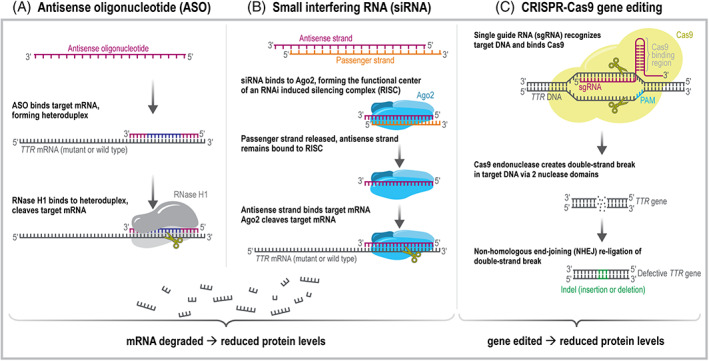
Mechanisms of RNA Silencing and DNA‐Editing Treatments for ATTR. Panel A: Single‐stranded ASOs (eg, inotersen and eplontersen) consist of 10 DNA nucleotides flanked by five chemically modified ribonucleotides. The ASO binds target TTR mRNA, forming a DNA/RNA heteroduplex that binds to and activates ribonuclease H1 (RNase H1). RNase H1 then cleaves the target mRNA. TTR mRNA is degraded, reducing expression of mutant and wild‐type TTR. Panel B: Double‐stranded siRNA (eg, patisiran, vutrisiran) is chemically modified to prevent degradation and is composed of an antisense strand (complementary to the target mRNA) and a passenger strand. The siRNA binds argonaute2 (Ago2) and other proteins to form the RNA‐induced silencing complex (RISC). Once assembled, the passenger strand is released. The antisense strand remains bound to RISC and binds to target TTR mRNA, which is then cleaved by Ago2. TTR mRNA is degraded, reducing expression of mutant and wild‐type TTR. Panel C: CRISPR‐Cas 9 gene editing tool (eg, NTLA‐2001) consists of a single guide RNA (sgRNA) and a Cas9 mRNA sequence (which is translated into Cas9 endonuclease protein once inside the cell). The upstream region of sgRNA contains a 20‐nucleotide sequence that is complementary to TTR DNA and is guided there by a 3‐nucleotide protospacer adjacent motif (PAM). The downstream region of sgRNA binds to Cas9. After cleavage of the TTR DNA via two nuclease domains of Cas9, the double‐strand break is re‐ligated via non‐homologous end‐joining (NHEJ). NHEJ is likely to generate insertion and deletion errors (indels) in the re‐ligated DNA strands, which effectively decreases functional TTR mRNA levels and subsequent protein production.
3.1. RNA silencers: antisense oligonucleotides and siRNAs to reduce serum TTR
ASOs and siRNAs are designed to alter the disease phenotype of ATTR amyloidosis by degrading both wild‐type and mutant TTR RNA transcripts, reducing the synthesis of TTR protein. 10 They employ short sequences of synthetic oligonucleotides to specifically bind the TTR mRNA through Watson‐Crick base pair interactions and support endogenous ribonuclease activity. 34 , 35 The single‐stranded (ASOs) or double‐stranded (siRNAs) synthetic oligonucleotides generally range in length from 15 to 30 nucleotides and are chemically modified to increase affinity for the target RNA and impart greater resistance to degradation by nucleases as well as to limit off‐target effects (Table 2). 5 , 30 , 36 , 37 , 38 , 39
TABLE 2.
Comparison of ASO and siRNA properties
| Similarities | ASO and siRNA |
|---|---|
| Structure |
|
| mRNA binding |
|
| Nucleotide modifications |
|
| Dosing |
|
| Differences | ASO | siRNA |
|---|---|---|
| Structure |
|
|
| mRNA cleavage |
|
|
| Non‐nucleotide modifications for systemic delivery |
|
|
Abbreviations: Ago2, argonaute 2; ASO, antisense oligonucleotide; PS, phosphorothioate (modification to phosphate backbone); RISC, RNA‐induced silencing complex; siRNA, small interfering RNA.
3.1.1. Antisense oligonucleotides
The two ASO treatments that have been evaluated in ATTR amyloidosis, inotersen and eplontersen, have identical sequences (Table 1). They bind directly to the 3′ untranslated region (UTR) of the TTR mRNA where there are no known mutations 40 , 41 and contain ten continuous 2'deoxynucleotides flanked by five chemically modified ribonucleotides. A DNA/RNA heteroduplex forms upon ASO binding to the mRNA which activates RNase H1 to cleave the TTR mRNA, thereby reducing expression of both the mutant and wild‐type TTR protein (Figure 2A). 30 , 38 , 40 , 41 , 42
Inotersen has been approved for the treatment of polyneuropathy in adult patients with ATTRv amyloidosis in the US, EU, Canada, UK, and Brazil (stage 1 or 2 only by the European Medicines Agency [EMA]). 33 , 43 , 44 In patients with ATTRv‐PN, treatment with inotersen slowed the progression of the disease as measured by a neuropathy impairment score and reduced the decline in quality of life over time. 45 , 46 Because of an increased risk of glomerulonephritis and thrombocytopenia, renal function and platelet count safety monitoring is required in patients receiving inotersen. 33
Eplontersen is a ligand‐conjugated antisense oligonucleotide (LICA) with a high‐affinity ligand, N‐acetylgalactosamine (GalNAc), covalently attached to the amino terminus to facilitate uptake by a tissue‐specific receptor, asialoglycoprotein receptors (ASGPR), in hepatocytes. In a phase 1 clinical trial in healthy volunteers, eplontersen demonstrated an approximately 30‐fold increase in potency in reducing TTR levels compared to inotersen. 40 No severe or serious adverse events, and no significant abnormalities in renal or hematological parameters were reported. Phase 3 clinical trials are currently underway to determine the effect of eplontersen on disease course in patients with ATTRv‐PN and all ATTR‐CM. 40 , 47 , 48 , 49
3.1.2. Small interfering RNAs
Similar to ASOs, the three siRNAs that have been evaluated for ATTR, patisiran, revusiran and vutrisiran, are designed to target the 3'UTR of the TTR mRNA (Table 1). 50 , 51 Each siRNA is composed of an antisense strand complementary to the TTR mRNA and a passenger strand, and is chemically modified to protect the molecule from degradation. 39 Once in the cytoplasm, the siRNA binds to the protein argonaute2 (Ago2) forming the functional center of the RNA‐induced silencing complex (RISC). 52 , 53 , 54 After assembly, the siRNA unwinds and the functional antisense strand remains bound to RISC while the passenger strand is released. The now single‐stranded antisense strand binds to TTR mRNA and the mRNA is cleaved by Ago2 and ultimately degraded, leading to reductions in production of both mutant and wildtype TTR protein (Figure 2B). 5 , 34 , 39 , 55
Patisiran is a lipid nanoparticle (LNP) encapsulated siRNA that has been approved for the treatment of polyneuropathy of adult patients with hereditary ATTR amyloidosis in the US, EU, Canada, UK, Brazil, Japan and Israel (stage 1 or 2 only by the EMA). In patients with ATTRv‐PN, patisiran was effective in treating disease progression. 56 Patisiran treatment requires premedication with a corticosteroid and antihistamine due to infusion‐related reactions. 32
Revusiran was the first GalNAc‐siRNA that was investigated in the clinic for ATTR. 37 , 57 Weekly dosing with revusiran showed a dose‐dependent reduction in TTR levels. 57 , 58 , 59 However, clinical development of revusiran was halted due to a mortality imbalance between the revusiran and placebo treatment arms, though no clear causative mechanism for the increased deaths was identified. 59 , 60
Vutrisiran is a GalNAc conjugated siRNA approved for the treatment of ATTRv‐PN in the US. In the registrational phase 3 trial involving patients with ATTRv‐PN, the study endpoints were met and vutrisiran was effective in treating multiple disease‐related outcomes relative to placebo. 61 , 62 A phase 3 trial in patients with ATTR‐CM is ongoing. 63
3.2. CRISPR‐Cas gene editing tool to reduce serum TTR
NTLA‐2001 is an investigational, clustered regularly interspaced short palindromic repeats (CRISPR) with CRISPR‐associated (Cas) endonuclease tool that is intended to edit the DNA sequence in hepatocytes responsible for TTR expression. It consists of a single guide RNA (sgRNA) and human‐codon optimized Cas9 mRNA sequence from Streptococcus pyogenes (which is translated into Cas9 protein once inside the cell) encapsulated in a lipid nanoparticle. 31 The sgRNA has two functions: recognition of the target DNA and binding to the Cas9 endonuclease (Figure 2C). 31 , 64 , 65 Cas9 is responsible for the double‐strand break that allows the desired editing outcome—which in this case is non‐homologous end‐joining (NHEJ) of the cleaved DNA strands. NHEJ is prone to generating insertion and deletion errors in the re‐ligated DNA strands, 31 , 65 which effectively decreases functional TTR mRNA levels and subsequent production of TTR.
Published interim results from a phase 1, open‐label study of six patients with ATTRv‐PN showed that administration of NTLA‐2001 was associated with a dose‐dependent reduction in serum TTR levels for up to 28 days (Table 1). 31 NTLA‐2001 is in trial for the treatment of both ATTRv‐PN and all forms of ATTR‐CM. Patients received glucocorticoid and histamine receptor type 1 and type 2 blockade before infusion to minimize allergic reactions to the lipid nanoparticle coat of the therapeutic. 31 With successful cleavage and subsequent knockdown of TTR DNA, this CRISPR‐Cas9‐based technology has the potential to become a one‐time therapeutic strategy in patients with ATTR. 31
4. TARGETED HEPATIC DELIVERY OF RNA SILENCERS AND GENE EDITING TOOLS TO TREAT ATTR
There are currently two strategies used to enhance the delivery of RNA silencers and gene editing tools to hepatocytes. ASOs and siRNAs can be directly conjugated to a GalNAc ligand to support receptor‐mediated uptake by the ASGPR. Alternatively, gene editing tools and siRNA can be encapsulated in hepatic‐targeted LNP to support low‐density lipoprotein (LDL) receptor‐mediated uptake (Figure 3).
FIGURE 3.

Cellular Internalization and Release of GalNAc‐conjugated molecules (A) vs. LNP‐packaged molecules (B). Panel A: GalNAc‐conjugated molecules include ASO or siRNA; oligonucleotide indicated by the pink bar. The GalNAc‐oligonucleotide binds to asialoglycoprotein receptor (ASGPR) on the hepatocyte surface. Following endosome internalization, the GalNAc‐oligonucleotide dissociates from ASGPR, allowing ASGPR to be recycled back to the hepatocyte surface. GalNAc is cleaved from the ASO or siRNA after internalization, and the active oligonucleotide is released into the cytosol. Panel B: LNP‐packaged molecules include CRISPR‐Cas9 therapies (ie, sgRNA + Cas9 mRNA) or unconjugated siRNA; nucleic acid cargo indicated by the green bar. After LNP administration, polyethylene glycol (PEG) lipids (indicated by black coils) dissociate and apolipoprotein E (ApoE) binds. The resulting LNP is delivered into liver sinusoids and is endocytosed into hepatocytes through the binding of low‐density lipoprotein receptors (LDL‐R). The LNP then fuses with the endosomal membrane, releasing the nucleic acid cargo into the cytosol.
4.1. GalNAc conjugated ASO and siRNA
GalNAc conjugation to oligonucleotides is designed to support selective delivery of drugs to hepatocytes (Figure 3A). Typically, three GalNAc residues—referred to as a triantennary or trivalent cluster—are conjugated to the 5′ end of the ASO or the 3′ end of the siRNA passenger strand. Three residues are often used because triantennary GalNAc has high affinity and specificity for ASGPR, which most often exists in a trimer configuration. 52 , 66 , 67 , 68 ASGPR is primarily and highly expressed on hepatocytes, with approximately 500 000 receptors per cell, of which 5%–10% are present on the cell surface at any time. ASGPR clears serum glycoproteins via clathrin‐mediated endocytosis and therefore has a high rate of uptake and rapid internalization and recycling (~15 min). 52 , 57 Upon binding to the ASGPR, the GalNAc‐conjugated oligonucleotide is taken into the hepatocyte via endocytosis. Following endosome internalization, a drop in pH leads to the dissociation of the GalNAc‐oligonucleotide from ASGPR, allowing ASGPR to be recycled back to the hepatocyte surface. 57 GalNAc is rapidly cleaved from the ASO or siRNA after internalization by endosomal glycosidases, releasing the active oligonucleotide (Figure 3A). 57 , 69 Oligonucleotide functionality requires release from the endosome after internalization. It is believed that a small fraction of internalized oligonucleotides, likely <1%, are transported into the cytoplasm from endosomes. 57 , 66 Though limited numbers of oligonucleotides are released from endosomes, once within the cell, ASOs and siRNAs induce robust and sustained effects.
GalNAc conjugation to ASOs improves potency up to 30‐fold in humans compared with unconjugated ASOs. 30 , 70 This allows for lower doses and less frequent dosing, with the potential for an improved safety profile. 40 , 52 In the NEURO‐TTRansform and the CARDIO‐TTRansform studies, 45 mg of the GalNAc conjugated ASO, eplontersen, is subcutaneously administered every 4 weeks either in the clinic or at home with an option for self‐administration, while the unconjugated ASO with the same sequence (inotersen), requires 284 mg dosing once weekly to produce a similar level TTR protein reduction. 47 , 48 , 49
siRNAs conjugated to GalNAc may be administered less frequently, subcutaneously, and with no pre‐medication required (eg, corticosteroids), in contrast to LNP‐encapsulated siRNA that commonly require intravenous administration. 34 , 36 , 67 , 71 The GalNAc conjugated siRNA vutrisiran is administered by a health care professional every 3 months in the HELIOS‐A and HELIOS‐B trials, 62 , 63 while the unconjugated, LNP formulated siRNA patisiran is administered every 3 weeks by IV infusion. 56
4.2. Hepatic targeted lipid nanoparticles
LNPs are both biocompatible and biodegradable and have been demonstrated to support nucleic acid delivery, including delivery of ATTR therapies to the liver. 72 , 73 , 74 After intravenous LNP administration, polyethylene glycol (PEG) lipids dissociate from the nanoparticle surface, allowing for apolipoprotein E (ApoE) binding (Figure 3B). The resulting opsonized LNP (ie, with bound ApoE) is delivered directly into liver sinusoids via systemic circulation, where it passes through endothelial fenestrae to hepatocytes. These LNPs are endocytosed into hepatocytes by binding to LDL receptors, which are primarily located on hepatocyte cell membranes. Within the acidic environment of the endosome, the LNP becomes positively charged and fuses with the negatively charged endosomal membrane so that the nucleic acid cargo can be released into the cytosol.
LNP technologies are currently used to deliver two ATTR gene silencers—an approved siRNA (patisiran) and a CRISPR gene‐editing tool currently in development (NTLA‐2001). 31 , 73 Both are administered intravenously and require premedication with a corticosteroid and antihistamine to mitigate potential infusion‐related reactions. 31 , 32
5. ADVANTAGES AND CHALLENGES OF HEPATIC TARGETED RNA SILENCERS AND GENE EDITING TOOLS TO TREAT ATTR
The RNA silencing agents in clinical development that employ receptor‐mediated uptake by hepatocytes have an extended pharmacological effect in comparison to the unconjugated silencers, 40 , 51 while gene editing tools could potentially require a single dose. 31 Less frequent dosing afforded by these hepatic targeted drugs may improve patient burden and compliance. In addition, the GalNAc conjugated ASOs improve potency with the potential for an improved safety profile. 40 Recent and upcoming readouts from the phase 3 clinical trials will be important to assess the efficacy and safety of these drugs for treating patients with all forms of ATTR amyloidosis.
While most TTR is produced and secreted by the liver, CNS and ocular manifestations of ATTR are thought to be due to amyloid deposition of non‐hepatically‐synthesized TTR that begins decades before the onset of symptoms. 75 , 76 , 77 CNS complications have been increasingly noted in patients following liver transplantation, suggesting that long‐term survival may lead to amyloid deposits from CNS‐synthesized mutant TTR—a complication not commonly reported in the natural history of the disease. 77 CNS deposition following siRNA treatment has also been reported, such as a recently published case of leptomeningeal disease secondary to amyloidosis. 78 Additionally, long‐term risk of ocular manifestations has been noted after liver transplantation and ATTR stabilization, due to intraocular production and deposition of mutant TTR in patients with prolonged survival. 76 , 79 These tissue compartments, however, are protected by the blood‐brain barrier and inaccessible to current RNA silencers and gene editors administered by parenteral routes of delivery. 80 Access to these regions could potentially be addressed by intrathecal and/or intravitreal injection 81 , 82 or advancements in delivery across the blood‐brain barrier. 83 , 84 , 85
6. CONCLUSION
Transthyretin‐mediated amyloidosis is a progressive disease with various clinical manifestations due to TTR aggregation, deposition, and amyloid formation. Receptor‐targeted ligands (eg, GalNAc) and nanoparticle encapsulation (eg, LNPs) are technologies to deliver ASOs, siRNAs, and gene editing tools to hepatocytes, the primary location of TTR synthesis. Our understanding of the long‐term effects of hepatically targeted treatments on ATTR phenotypes—including the potential for CNS and ocular amyloidosis—will continue to grow as more patients receive treatment and RNA silencers and gene editing tools continue to improve. In the meantime, treatments that can suppress TTR protein synthesis remain a key strategy in improving survival and quality of life in patients with ATTR.
CONFLICT OF INTEREST
Thomas H. Brannagan 3rd has received consulting income from Akcea, Alnylam and Ionis. Institutional support in the form of clinical trial funding from Alnylam and Ionis. John L. Berk has received consulting income from Corino Therapeutics, Ionis/Akcea, Alnylam, Eidos/BridgeBio and Intellia. Institutional support through clinical trial participation has been received from Alnylam, Ionis, Pfizer, Corino, and Eidos/BridgeBio. Julian D. Gillmore is a consultant for Eidos, Ionis, Alnylam, Pfizer and Intellia. Mathew S. Maurer has grant support from NIH—R01HL139671. Consulting income from Eidos, Prothena, Ionis and Alnylam, Novo‐Nordisk and Intellia. Institutional support in the form of clinical trial funding from Pfizer, Attralus, Ionis, Eidos and Alnylam. Marcia Waddington‐Cruz received honorariums from NHI, Prothena, FoldRx, Ionis, Pfizer, Alnylam, PTC and Genzyme for travel expenses related to presentations at medical meetings, for acting as a principal investigator in clinical trials and as a consultant member. Mariana Fontana has received consultancy/advisory board income from Akcea, Alnylam, Alexion, Intellia, Ionis, Pfizer, Eidos, Janssen, and Novo Nordisk, and salary from the British Heart Foundation. Ahmad Masri receives research grants from Pfizer, Akcea, Ionis and Ultromics and fees (consultant, honoraria) from Eidos, Pfizer, Ionis, BMS, Attralus, Tenaya and Cytokinetics. Laura Obici received speaker and consulting honoraria from Alnylam, SOBI, Akcea and Pfizer. Teresa Coelho is a past and current investigator in clinical trials sponsored by FoldRx, Pfizer, Alnylam, Ionis, Prothena and Eidos ‐ Institution was paid per protocol. Consultant for Pfizer, Alnylam, Ionis, Akcea, Sobi, Eidos and Prothena pro bono. Pfizer, Alnylam, Ionis and Biogen supported expenses with travel, accommodation and registrations for scientific meetings. Jose Nativi‐Nicolau received funding for research from Akcea/Ionis, Pfizer Inc and Eidos Therapeutics, and consulting funding from Alnylam Pharmaceuticals, Pfizer Inc and Akcea/Ionis. Brenda F. Baker, Nick Viney, Lisa A. Hannan, Michela Brambatti, and Gustavo Buchele are employees and stockholders of Ionis Pharmaceuticals, Inc.
ACKNOWLEDGEMENTS
Medical writing/editorial support under the guidance of the authors was provided by Jacqueline Benjamin and Mildred Bahn of Prescott Medical Communications Group (Chicago, IL) and funded by Ionis Pharmaceuticals, Inc. in accordance with Good Publication Practice guidelines. Graphics support was provided by Tracy Reigle and Wanda Sullivan of Ionis Pharmaceuticals, Inc.
Brannagan TH 3rd, Berk JL, Gillmore JD, et al. Liver‐directed drugs for transthyretin‐mediated amyloidosis. J Peripher Nerv Syst. 2022;27(4):228‐237. doi: 10.1111/jns.12519
REFERENCES
- 1. Fleming CE, Nunes AF, Sousa MM. Transthyretin: more than meets the eye. Prog Neurobiol. 2009;89(3):266‐276. [DOI] [PubMed] [Google Scholar]
- 2. Buxbaum JN, Reixach N. Transthyretin: the servant of many masters. Cell Mol Life Sci. 2009;66(19):3095‐3101. [DOI] [PMC free article] [PubMed] [Google Scholar]
- 3. Buxbaum JN. Oligonucleotide drugs for transthyretin amyloidosis. N Engl J Med. 2018;379(1):82‐85. [DOI] [PubMed] [Google Scholar]
- 4. Liz MA, Coelho T, Bellotti V, Fernandez‐Arias MI, Mallaina P, Obici L. A narrative review of the role of transthyretin in health and disease. Neurol Ther. 2020;9(2):395‐402. [DOI] [PMC free article] [PubMed] [Google Scholar]
- 5. Niemietz C, Chandhok G, Schmidt H. Therapeutic oligonucleotides targeting liver disease: TTR amyloidosis. Molecules. 2015;20(10):17944‐17975. [DOI] [PMC free article] [PubMed] [Google Scholar]
- 6. Richardson SJ, Wijayagunaratne RC, D'Souza DG, Darras VM, Van Herck SLJ. Transport of thyroid hormones via the choroid plexus into the brain: the roles of transthyretin and thyroid hormone transmembrane transporters. Front Neurosci. 2015;9:66. [DOI] [PMC free article] [PubMed] [Google Scholar]
- 7. Saraiva MJ. Transthyretin amyloidosis: a tale of weak interactions. FEBS Lett. 2001;498(2–3):201‐203. [DOI] [PubMed] [Google Scholar]
- 8. Lim KH, Dasari AK, Hung I, et al. Structural changes associated with transthyretin misfolding and amyloid formation revealed by solution and solid‐state NMR. Biochemistry. 2016;55(13):1941‐1944. [DOI] [PMC free article] [PubMed] [Google Scholar]
- 9. Dasari AKR, Arreola J, Michael B, Griffin RG, Kelly JW, Lim KH. Disruption of the CD loop by enzymatic cleavage promotes the formation of toxic transthyretin oligomers through a common transthyretin misfolding pathway. Biochemistry. 2020;59(25):2319‐2327. [DOI] [PMC free article] [PubMed] [Google Scholar]
- 10. Gertz MA, Mauermann ML, Grogan M, Coelho T. Advances in the treatment of hereditary transthyretin amyloidosis: a review. Brain Behav. 2019;9(9):e01371. [DOI] [PMC free article] [PubMed] [Google Scholar]
- 11. Adams D, Koike H, Slama M, Coelho T. Hereditary transthyretin amyloidosis: a model of medical progress for a fatal disease. Nat Rev Neurol. 2019;15(7):387‐404. [DOI] [PubMed] [Google Scholar]
- 12. Maurer MS, Bokhari S, Damy T, et al. Expert consensus recommendations for the suspicion and diagnosis of transthyretin cardiac amyloidosis. Circ Heart Fail. 2019;12(9):e006075. [DOI] [PMC free article] [PubMed] [Google Scholar]
- 13. Adams D, Ando Y, Beirao JM, et al. Expert consensus recommendations to improve diagnosis of ATTR amyloidosis with polyneuropathy. J Neurol. 2021;268(6):2109‐2122. [DOI] [PMC free article] [PubMed] [Google Scholar]
- 14. Benson MD, Dasgupta NR, Rao R. Diagnosis and screening of patients with hereditary transthyretin amyloidosis (hATTR): current strategies and guidelines. Ther Clin Risk Manag. 2020;16:749‐758. [DOI] [PMC free article] [PubMed] [Google Scholar]
- 15. Cruz Rodriguez JB, Tallaj JA. Narrative review of pharmacotherapy for transthyretin cardiac amyloid. Ann Transl Med. 2021;9(6):519. [DOI] [PMC free article] [PubMed] [Google Scholar]
- 16. Bonaiti B, Olsson M, Hellman U, Suhr O, Bonaïti‐Pellié C, Planté‐Bordeneuve V. TTR familial amyloid polyneuropathy: does a mitochondrial polymorphism entirely explain the parent‐of‐origin difference in penetrance? Eur J Hum Genet. 2010;18(8):948‐952. [DOI] [PMC free article] [PubMed] [Google Scholar]
- 17. Planté‐Bordeneuve V, Said G. Familial amyloid polyneuropathy. Lancet Neurol. 2011;10(12):1086‐1097. [DOI] [PubMed] [Google Scholar]
- 18. Sousa MM, Saraiva MJ. Neurodegeneration in familial amyloid polyneuropathy: from pathology to molecular signaling. Prog Neurobiol. 2003;71(5):385‐400. [DOI] [PubMed] [Google Scholar]
- 19. Waddington‐Cruz M, Ando Y, Amass L, et al. Feasibility of assessing progression of transthyretin amyloid polyneuropathy using nerve conduction studies: findings from the transthyretin amyloidosis outcomes survey (THAOS). J Peripher Nerv Syst. 2021;26(2):160‐166. [DOI] [PMC free article] [PubMed] [Google Scholar]
- 20. Waddington‐Cruz M, Schmidt H, Botteman MF, et al. Epidemiological and clinical characteristics of symptomatic hereditary transthyretin amyloid polyneuropathy: a global case series. Orphanet J Rare Dis. 2019;14(1):34. [DOI] [PMC free article] [PubMed] [Google Scholar]
- 21. Koike H, Katsuno M. Transthyretin amyloidosis: update on the clinical spectrum, pathogenesis, and disease‐modifying therapies. Neurol Ther. 2020;9(2):317‐333. [DOI] [PMC free article] [PubMed] [Google Scholar]
- 22. Castano A, Drachman BM, Judge D, Maurer MS. Natural history and therapy of TTR‐cardiac amyloidosis: emerging disease‐modifying therapies from organ transplantation to stabilizer and silencer drugs. Heart Fail Rev. 2015;20(2):163‐178. [DOI] [PMC free article] [PubMed] [Google Scholar]
- 23. Witteles RM, Bokhari S, Damy T, et al. Screening for transthyretin amyloid cardiomyopathy in everyday practice. JACC Heart Fail. 2019;7(8):709‐716. [DOI] [PubMed] [Google Scholar]
- 24. Rozenbaum MH, Large S, Bhambri R, et al. Impact of delayed diagnosis and misdiagnosis for patients with transthyretin amyloid cardiomyopathy (ATTR‐CM): a targeted literature review. Cardiol Ther. 2021;10(1):141‐159. [DOI] [PMC free article] [PubMed] [Google Scholar]
- 25. Carvalho A, Rocha A, Lobato L. Liver transplantation in transthyretin amyloidosis: issues and challenges. Liver Transpl. 2015;21(3):282‐292. [DOI] [PubMed] [Google Scholar]
- 26. Ando Y, Adams D, Benson MD, et al. Guidelines and new directions in the therapy and monitoring of ATTRv amyloidosis. Amyloid. 2022;29(3):143‐155. [DOI] [PubMed] [Google Scholar]
- 27. Aimo A, Castiglione V, Rapezzi C, et al. RNA‐targeting and gene editing therapies for transthyretin amyloidosis. Nat Rev Cardiol. 2022;19:655‐667. [DOI] [PubMed] [Google Scholar]
- 28. Yadav JD, Othee H, Chan KA, et al. Transthyretin amyloid cardiomyopathy‐current and future therapies. Ann Pharmacother. 2021;55(12):1502‐1514. [DOI] [PubMed] [Google Scholar]
- 29. Cioffi CL, Raja A, Muthuraman P, et al. Identification of transthyretin tetramer kinetic stabilizers that are capable of inhibiting the retinol‐dependent retinol binding protein 4‐transthyretin interaction: potential novel therapeutics for macular degeneration, transthyretin amyloidosis, and their common age‐related comorbidities. J Med Chem. 2021;64(13):9010‐9041. [DOI] [PMC free article] [PubMed] [Google Scholar]
- 30. Crooke ST, Liang XH, Baker BF, Crooke RM. Antisense technology: a review. J Biol Chem. 2021;296:100416. [DOI] [PMC free article] [PubMed] [Google Scholar]
- 31. Gillmore JD, Gane E, Taubel J, et al. CRISPR‐Cas9 In vivo gene editing for transthyretin amyloidosis. N Engl J Med. 2021;385(6):493‐502. [DOI] [PubMed] [Google Scholar]
- 32. Alnylam Pharmaceuticals . Prescribing information for Onpattro (patisiran) lipid complex injection. Revised: 05/2021. https://www.alnylam.com/wp-content/uploads/pdfs/ONPATTRO-Prescribing-Information.pdf. Accessed November 11, 2021.
- 33. Ionis Pharmaceuticals and Akcea Therapeutics . Prescribing information for Tesgsedi (inotersen) injection. Revised: 05/2021. https://tegsedihcp.com/pdf/prescribing-information.pdf. Accessed November 11, 2021.
- 34. Roberts TC, Langer R, Wood MJA. Advances in oligonucleotide drug delivery. Nat Rev Drug Discov. 2020;19(10):673‐694. [DOI] [PMC free article] [PubMed] [Google Scholar]
- 35. Craig K, Abrams M, Amiji M. Recent preclinical and clinical advances in oligonucleotide conjugates. Expert Opin Drug Deliv. 2018;15(6):629‐640. [DOI] [PubMed] [Google Scholar]
- 36. Debacker AJ, Voutila J, Catley M, Blakey D, Habib N. Delivery of oligonucleotides to the liver with GalNAc: from research to registered therapeutic drug. Mol Ther. 2020;28(8):1759‐1771. [DOI] [PMC free article] [PubMed] [Google Scholar]
- 37. Hu B, Zhong L, Weng Y, et al. Therapeutic siRNA: state of the art. Signal Transduct Target Ther. 2020;5(1):101. [DOI] [PMC free article] [PubMed] [Google Scholar]
- 38. Crooke ST, Baker BF, Crooke RM, Liang XH. Antisense technology: an overview and prospectus. Nat Rev Drug Discov. 2021;20(6):427‐453. [DOI] [PubMed] [Google Scholar]
- 39. Kuijper EC, Bergsma AJ, Pijnappel W, Aartsma‐Rus A. Opportunities and challenges for antisense oligonucleotide therapies. J Inherit Metab Dis. 2021;44(1):72‐87. [DOI] [PMC free article] [PubMed] [Google Scholar]
- 40. Viney NJ, Guo S, Tai LJ, et al. Ligand conjugated antisense oligonucleotide for the treatment of transthyretin amyloidosis: preclinical and phase 1 data. ESC Heart Fail. 2021;8(1):652‐661. [DOI] [PMC free article] [PubMed] [Google Scholar]
- 41. Mathew V, Wang AK. Inotersen: new promise for the treatment of hereditary transthyretin amyloidosis. Drug Des Devel Ther. 2019;13:1515‐1525. [DOI] [PMC free article] [PubMed] [Google Scholar]
- 42. Liang XH, Sun H, Nichols JG, Crooke ST. RNase H1‐dependent antisense oligonucleotides are robustly active in directing RNA cleavage in both the cytoplasm and the nucleus. Mol Ther. 2017;25(9):2075‐2092. [DOI] [PMC free article] [PubMed] [Google Scholar]
- 43. Conceição I. Novel RNA‐targeted therapies for hereditary ATTR amyloidosis and their impact on the autonomic nervous system. Clin Auton Res. 2019;29(Suppl 1):11‐17. [DOI] [PMC free article] [PubMed] [Google Scholar]
- 44. Ionis Pharmaceuticals and Akcea Therapeutics . Summary of product characteristics for Tesgsedi. 2018. https://www.ema.europa.eu/en/documents/product-information/tegsedi-epar-product-information_en.pdf. Accessed November 11, 2021.
- 45. Benson MD, Waddington‐Cruz M, Berk JL, et al. Inotersen treatment for patients with hereditary transthyretin amyloidosis. N Engl J Med. 2018;379(1):22‐31. [DOI] [PMC free article] [PubMed] [Google Scholar]
- 46. Brannagan TH, Wang AK, Coelho T, et al. Early data on long‐term efficacy and safety of inotersen in patients with hereditary transthyretin amyloidosis: a 2‐year update from the open‐label extension of the NEURO‐TTR trial. Eur J Neurol. 2020;27(8):1374‐1381. [DOI] [PMC free article] [PubMed] [Google Scholar]
- 47. Coelho T, Ando Y, Benson MD, et al. Design and rationale of the global phase 3 NEURO‐TTRansform study of antisense oligonucleotide AKCEA‐TTR‐LRx (ION‐682884‐CS3) in hereditary transthyretin‐mediated amyloid polyneuropathy. Neurol Ther. 2021;10(1):375‐389. [DOI] [PMC free article] [PubMed] [Google Scholar]
- 48. Ionis Pharmaceuticals . CARDIO‐TTRansform: a Study to Evaluate the Efficacy and Safety of AKCEA‐TTR‐LRx in Participants with Transthyretin‐Mediated Amyloid Cardiomyopathy (ATTR‐CM). https://clinicaltrials.gov/ct2/show/NCT04136171. Accessed November 11, 2021.
- 49. Ionis Pharmaceuticals . NEURO‐TTRansform: a Study to Evaluate the Efficacy and Safety of Eplontersen (Formerly Known as ION‐682884, IONIS‐TTR‐LRx and AKCEA‐TTR‐LRx) in Participants with Hereditary Transthyretin‐Mediated Amyloid Polyneuropathy. https://clinicaltrials.gov/ct2/show/NCT04136184. Accessed November 11, 2021.
- 50. Hayashi Y, Jono H. Recent advances in oligonucleotide‐based therapy for transthyretin amyloidosis: clinical impact and future prospects. Biol Pharm Bull. 2018;41(12):1737‐1744. [DOI] [PubMed] [Google Scholar]
- 51. Habtemariam BA, Karsten V, Attarwala H, et al. Single‐dose pharmacokinetics and pharmacodynamics of transthyretin targeting N‐acetylgalactosamine‐small interfering ribonucleic acid conjugate, vutrisiran, in healthy subjects. Clin Pharmacol Ther. 2021;109(2):372‐382. [DOI] [PubMed] [Google Scholar]
- 52. Huang Y. Preclinical and clinical advances of GalNAc‐decorated nucleic acid therapeutics. Mol Ther Nucleic Acids. 2017;6:116‐132. [DOI] [PMC free article] [PubMed] [Google Scholar]
- 53. Katzmann JL, Packard CJ, Chapman MJ, Katzmann I, Laufs U. Targeting RNA with antisense oligonucleotides and small interfering RNA: JACC state‐of‐the‐art review. J Am Coll Cardiol. 2020;76(5):563‐579. [DOI] [PubMed] [Google Scholar]
- 54. Wang HW, Noland C, Siridechadilok B, et al. Structural insights into RNA processing by the human RISC‐loading complex. Nat Struct Mol Biol. 2009;16(11):1148‐1153. [DOI] [PMC free article] [PubMed] [Google Scholar]
- 55. Ruger J, Ioannou S, Castanotto D, Stein CA. Oligonucleotides to the (gene) rescue: FDA approvals 2017‐2019. Trends Pharmacol Sci. 2020;41(1):27‐41. [DOI] [PubMed] [Google Scholar]
- 56. Adams D, Gonzalez‐Duarte A, O'Riordan WD, et al. Patisiran, an RNAi therapeutic, for hereditary transthyretin amyloidosis. N Engl J Med. 2018;379(1):11‐21. [DOI] [PubMed] [Google Scholar]
- 57. Springer AD, Dowdy SF. GalNAc‐siRNA conjugates: leading the way for delivery of RNAi therapeutics. Nucleic Acid Ther. 2018;28(3):109‐118. [DOI] [PMC free article] [PubMed] [Google Scholar]
- 58. Zimmermann TS, Karsten V, Chan A, et al. Clinical proof of concept for a novel hepatocyte‐targeting GalNAc‐siRNA conjugate. Mol Ther. 2017;25(1):71‐78. [DOI] [PMC free article] [PubMed] [Google Scholar]
- 59. Judge DP, Kristen AV, Grogan M, et al. Phase 3 multicenter study of revusiran in patients with hereditary transthyretin‐mediated (hATTR) amyloidosis with cardiomyopathy (ENDEAVOUR). Cardiovasc Drugs Ther. 2020;34(3):357‐370. [DOI] [PMC free article] [PubMed] [Google Scholar]
- 60. Sutherland JE, Hettinger JL, Chan A, Gilbert J, Warner GL, Davis WP. Nonclinical safety profile of revusiran, a 1st‐generation GalNAc‐siRNA conjugate for treatment of hereditary transthyretin‐mediated amyloidosis. Nucleic Acid Ther. 2020;30(1):33‐49. [DOI] [PMC free article] [PubMed] [Google Scholar]
- 61. Adams D, Tournev IL, Taylor MS, et al. Efficacy and safety of vutrisiran for patients with hereditary transthyretin‐mediated amyloidosis with polyneuropathy: a randomized clinical trial. Amyloid. 2022. doi: 10.1080/13506129.2022.2091985 [DOI] [PubMed] [Google Scholar]
- 62. Alnylam Pharmaceuticals . HELIOS‐A: A Study of Vutrisiran (ALN‐TTRSC02) in Patients with Hereditary Transthyretin Amyloidosis (hATTR Amyloidosis). https://clinicaltrials.gov/ct2/show/NCT03759379. Accessed May 26, 2022.
- 63. Alnylam Pharmaceuticals . HELIOS‐B: A Study to Evaluate Vutrisiran in Patients with Transthyretin Amyloidosis with Cardiomyopathy. https://www.clinicaltrials.gov/ct2/show/NCT04153149. Accessed May 26, 2022.
- 64. Kozovska Z, Rajcaniova S, Munteanu P, Dzacovska S, Demkova L. CRISPR: history and perspectives to the future. Biomed Pharmacother. 2021;141:111917. [DOI] [PubMed] [Google Scholar]
- 65. Xu Y, Liu R, Dai Z. Key considerations in designing CRISPR/Cas9‐carrying nanoparticles for therapeutic genome editing. Nanoscale. 2020;12(41):21001‐21014. [DOI] [PubMed] [Google Scholar]
- 66. Lorenzer C, Dirin M, Winkler AM, Baumann V, Winkler J. Going beyond the liver: progress and challenges of targeted delivery of siRNA therapeutics. J Control Release. 2015;203:1‐15. [DOI] [PubMed] [Google Scholar]
- 67. Nair JK, Willoughby JL, Chan A, et al. Multivalent N‐acetylgalactosamine‐conjugated siRNA localizes in hepatocytes and elicits robust RNAi‐mediated gene silencing. J Am Chem Soc. 2014;136(49):16958‐16961. [DOI] [PubMed] [Google Scholar]
- 68. Huang X, Leroux JC, Castagner B. Well‐defined multivalent ligands for hepatocytes targeting via asialoglycoprotein receptor. Bioconjug Chem. 2017;28(2):283‐295. [DOI] [PubMed] [Google Scholar]
- 69. Shemesh CS, Yu RZ, Gaus HJ, et al. Elucidation of the biotransformation pathways of a GalNAc3‐conjugated antisense pligonucleotide in rats and monkeys. Mol Ther Nucleic Acids. 2016;5(5):e319. [DOI] [PMC free article] [PubMed] [Google Scholar]
- 70. Wang Y, Yu RZ, Henry S, Geary RS. Pharmacokinetics and clinical pharmacology considerations of GalNAc3‐conjugated antisense oligonucleotides. Expert Opin Drug Metab Toxicol. 2019;15(6):475‐485. [DOI] [PubMed] [Google Scholar]
- 71. Crooke ST, Liang XH, Crooke RM, Baker BF, Geary RS. Antisense drug discovery and development technology considered in a pharmacological context. Biochem Pharmacol. 2021;189:114196. [DOI] [PubMed] [Google Scholar]
- 72. Witzigmann D, Kulkarni JA, Leung J, Chen S, Cullis PR, van der Meel R. Lipid nanoparticle technology for therapeutic gene regulation in the liver. Adv Drug Deliv Rev. 2020;159:344‐363. [DOI] [PMC free article] [PubMed] [Google Scholar]
- 73. Akinc A, Maier MA, Manoharan M, et al. The Onpattro story and the clinical translation of nanomedicines containing nucleic acid‐based drugs. Nat Nanotechnol. 2019;14(12):1084‐1087. [DOI] [PubMed] [Google Scholar]
- 74. Maestro S, Weber ND, Zabaleta N, Aldabe R, Gonzalez‐Aseguinolaza G. Novel vectors and approaches for gene therapy in liver diseases. JHEP Rep. 2021;3(4):100300. [DOI] [PMC free article] [PubMed] [Google Scholar]
- 75. Sousa L, Coelho T, Taipa R. CNS involvement in hereditary transthyretin amyloidosis. Neurology. 2021;97(24):1111‐1119. [DOI] [PubMed] [Google Scholar]
- 76. Minnella AM, Rissotto R, Antoniazzi E, et al. Ocular involvement in hereditary amyloidosis. Genes (Basel). 2021;12(7):955. [DOI] [PMC free article] [PubMed] [Google Scholar]
- 77. Wange N, Anan I, Ericzon BG, et al. Atrial fibrillation and central nervous complications in liver transplanted hereditary transthyretin amyloidosis patients. Transplantation. 2018;102(2):e59‐e66. [DOI] [PMC free article] [PubMed] [Google Scholar]
- 78. Carberry N, Yu S, Fayerman RN, et al. Leptomeningeal disease secondary to Thr60Ala transthyretin amyloidosis: case report and review of the literature. Neurohospitalist. 2022. doi: 10.1177/19418744221127849 [DOI] [PMC free article] [PubMed] [Google Scholar]
- 79. Buxbaum JN, Brannagan T 3rd, Buades‐Reinés J, et al. Transthyretin deposition in the eye in the era of effective therapy for hereditary ATTRV30M amyloidosis. Amyloid. 2019;26(1):10‐14. [DOI] [PubMed] [Google Scholar]
- 80. Dohrn MF, Medina J, Olaciregui Dague KR, Hund E. Are we creating a new phenotype? Physiological barriers and ethical considerations in the treatment of hereditary transthyretin‐amyloidosis. Neurol Res Pract. 2021;3(1):57. [DOI] [PMC free article] [PubMed] [Google Scholar]
- 81. Bennett CF, Krainer AR, Cleveland DW. Antisense oligonucleotide therapies for neurodegenerative diseases. Annu Rev Neurosci. 2019;42:385‐406. [DOI] [PMC free article] [PubMed] [Google Scholar]
- 82. Vitravene Study Group . A randomized controlled clinical trial of intravitreous fomivirsen for treatment of newly diagnosed peripheral cytomegalovirus retinitis in patients with AIDS. Am J Ophthalmol. 2002;133(4):467‐474. [DOI] [PubMed] [Google Scholar]
- 83. Nagata T, Dwyer CA, Yoshida‐Tanaka K, et al. Cholesterol‐functionalized DNA/RNA heteroduplexes cross the blood‐brain barrier and knock down genes in the rodent CNS. Nat Biotechnol. 2021;39(12):1529‐1536. [DOI] [PubMed] [Google Scholar]
- 84. Min HS, Kim HJ, Naito M, et al. Systemic brain delivery of antisense oligonucleotides across the blood‐brain barrier with a glucose‐coated polymeric nanocarrier. Angew Chem Int Ed Engl. 2020;59(21):8173‐8180. [DOI] [PMC free article] [PubMed] [Google Scholar]
- 85. Brown KM, Nair JK, Janas MM, et al. Expanding RNAi therapeutics to extrahepatic tissues with lipophilic conjugates. Nat Biotechnol. 2022;40:1500‐1508. [DOI] [PubMed] [Google Scholar]