



Abstract
Tardive dystonia is a relatively uncommon long term complication of neuroleptic therapy. The prevalence of this syndrome is unknown. This study, of chronic hospitalised psychiatric patients, revealed a tardive dystonia prevalence of 1.5%. Risk factors in this small population appeared to be mental retardation and convulsive therapy.
Full text
PDF

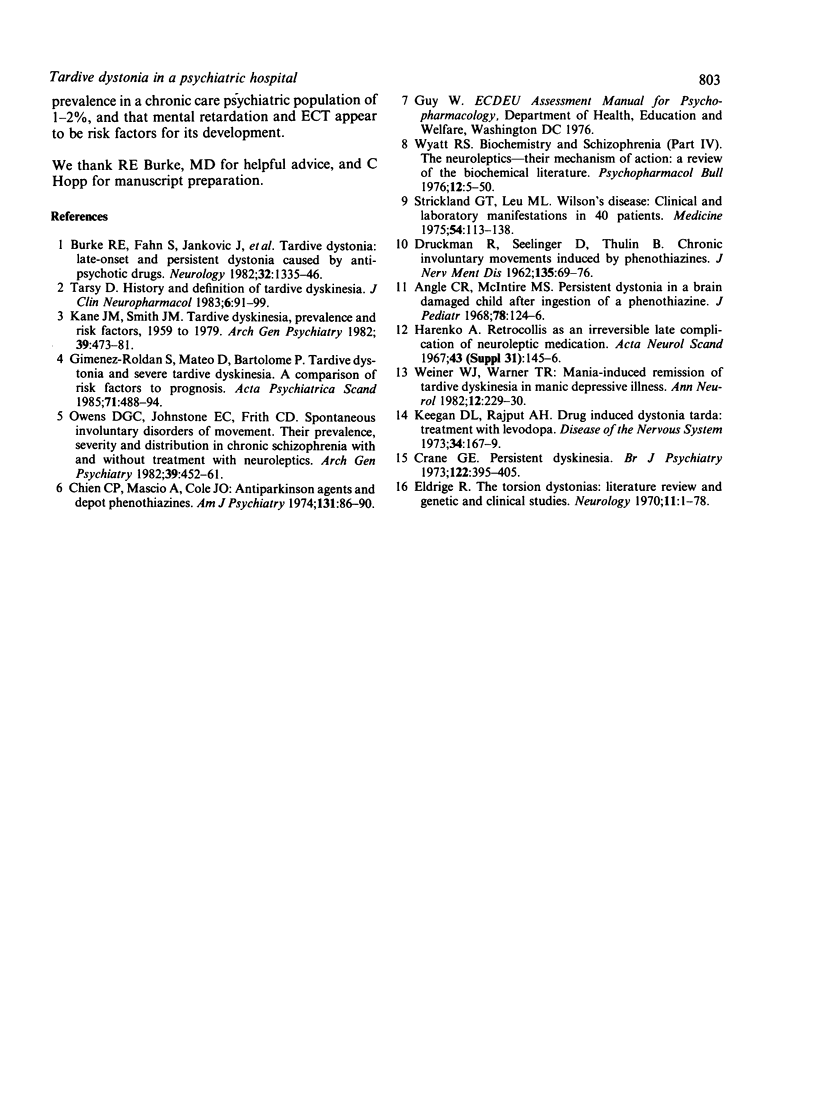
Selected References
These references are in PubMed. This may not be the complete list of references from this article.
- Angle C. R., McIntire M. S. Persistent dystonia in a brain-damaged child after ingestion of phenothiazine. J Pediatr. 1968 Jul;73(1):124–126. doi: 10.1016/s0022-3476(68)80050-2. [DOI] [PubMed] [Google Scholar]
- Burke R. E., Fahn S., Jankovic J., Marsden C. D., Lang A. E., Gollomp S., Ilson J. Tardive dystonia: late-onset and persistent dystonia caused by antipsychotic drugs. Neurology. 1982 Dec;32(12):1335–1346. doi: 10.1212/wnl.32.12.1335. [DOI] [PubMed] [Google Scholar]
- Chien C. P., Dimascio A., Cole J. O. Antiparkinsonian agents and depot phenothiazine. Am J Psychiatry. 1974 Jan;131(1):86–90. doi: 10.1176/ajp.131.1.86. [DOI] [PubMed] [Google Scholar]
- Crane G. E. Persistent dyskinesia. Br J Psychiatry. 1973 Apr;122(569):395–405. doi: 10.1192/bjp.122.4.395. [DOI] [PubMed] [Google Scholar]
- DRUCKMAN R., SEELINGER D., THULIN B. Chronic involuntary movements induced by phenothiazines. J Nerv Ment Dis. 1962 Jul;135:69–76. doi: 10.1097/00005053-196207000-00009. [DOI] [PubMed] [Google Scholar]
- Giménez-Roldán S., Mateo D., Bartolomé P. Tardive dystonia and severe tardive dyskinesia. A comparison of risk factors and prognosis. Acta Psychiatr Scand. 1985 May;71(5):488–494. doi: 10.1111/j.1600-0447.1985.tb05061.x. [DOI] [PubMed] [Google Scholar]
- Harenko A. Retrocollis as an irreversible late complication of neuroleptic medication. Acta Neurol Scand. 1967;43(Suppl):145+–145+. doi: 10.1111/j.1600-0404.1967.tb02090.x. [DOI] [PubMed] [Google Scholar]
- Kane J. M., Smith J. M. Tardive dyskinesia: prevalence and risk factors, 1959 to 1979. Arch Gen Psychiatry. 1982 Apr;39(4):473–481. doi: 10.1001/archpsyc.1982.04290040069010. [DOI] [PubMed] [Google Scholar]
- Keegan D. L., Rajput A. H. Drug induced dystonia tarda: treatment with L-dopa. Dis Nerv Syst. 1973 Mar;34(3):167–169. [PubMed] [Google Scholar]
- Owens D. G., Johnstone E. C., Frith C. D. Spontaneous involuntary disorders of movement: their prevalence, severity, and distribution in chronic schizophrenics with and without treatment with neuroleptics. Arch Gen Psychiatry. 1982 Apr;39(4):452–461. doi: 10.1001/archpsyc.1982.04290040052008. [DOI] [PubMed] [Google Scholar]
- Strickland G. T., Leu M. L. Wilson's disease. Clinical and laboratory maniestations in 40 patients. Medicine (Baltimore) 1975 Mar;54(2):113–137. [PubMed] [Google Scholar]
- Tarsy D. History and definition of tardive dyskinesia. Clin Neuropharmacol. 1983 Jun;6(2):91–99. doi: 10.1097/00002826-198306000-00003. [DOI] [PubMed] [Google Scholar]
- Weiner W. J., Werner T. R. Mania-induced remission of tardive dyskinesia in manic-depressive illness. Ann Neurol. 1982 Aug;12(2):229–230. doi: 10.1002/ana.410120241. [DOI] [PubMed] [Google Scholar]
- Wyatt R. J. Biochemistry and schizophrenia (part IV) the neuroleptics--their mechanism of action: a review of the biochemical literature. Psychopharmacol Bull. 1976 Jul;12(3):5–50. [PubMed] [Google Scholar]