


Fig. 2.
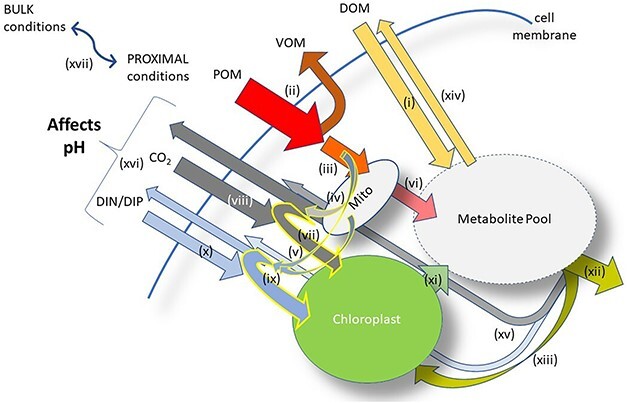
Protist plankton resource acquisition mechanisms. Not all mechanisms may be present in all protist types (see Fig. 1). Dissolved organic matter (DOM; sugars, amino acids, etc.) is taken up (i) and enters the metabolite pool; this action supports osmotrophy. Particulate organic matter (POM; such as prey) is engulfed, and a fraction (ca. 20–40%) is egested as voided organic matter (VOM) during digestion (ii). The retained fraction is broken down and a fraction (ca. 30%) is lost through specific dynamic action (SDA; iii) as CO2 (iv) and as dissolved inorganic nutrients (DIN, as ammonium; DIP as phosphate; v). This anabolic activity is associated with the mitochondria (Mito) and other sub-cellular compartments. The resultant remaining digestate enters the metabolite pool (vi); this activity, with (ii) and (iii), constitutes phagotrophy. The CO2, DIN and DIP lost through SDA contribute to meeting the CO2 demands for photosynthesis in chloroplasts (yellow-edged arrow, vii), with the balance of the CO2 demand being brought in from outside of the cell (viii). Similarly, any additional demand for DIN and/or DIP over that supplied by recycling (yellow-edged arrow, ix) is brought in from outside (x). Products from phototrophy contribute to the metabolite pool (xi). The total metabolite pool supports biomass growth (xii) including synthesis of chloroplasts (xiii). Excess metabolites are leaked (xiv), and there are additional losses of CO2 through respiration, with allied regeneration of DIN (as ammonium) and DIP to maintain cellular stoichiometric balance (xv). The net uptake vs release of CO2 and DIN, DIP (xvi), including whether DIN uptake comprises nitrate vs ammonium (ammonium being the form released), modifies seawater alkalinity and carbonate chemistry, and thence affects [H+] and pH. Osmotrophy (i) has an unknown impact on pH, depending on the buffering capacity of different organic chemicals, and how their assimilations may release CO2, DIN and DIP. The bulk water chemistry differs from the proximal conditions (next to the cell), as a function of diffusion (xvii); diffusion is slower for larger, faster-growing and/or slower-moving cells. The metabolite pool as indicated here is a general cellular pool, not located in a specific single space (i.e. it resides across the chloroplasts, mitochondria, endoplasmic reticulum, vacuoles etc.). See also Supplementary material Fig. S1.