


Fig. 1:
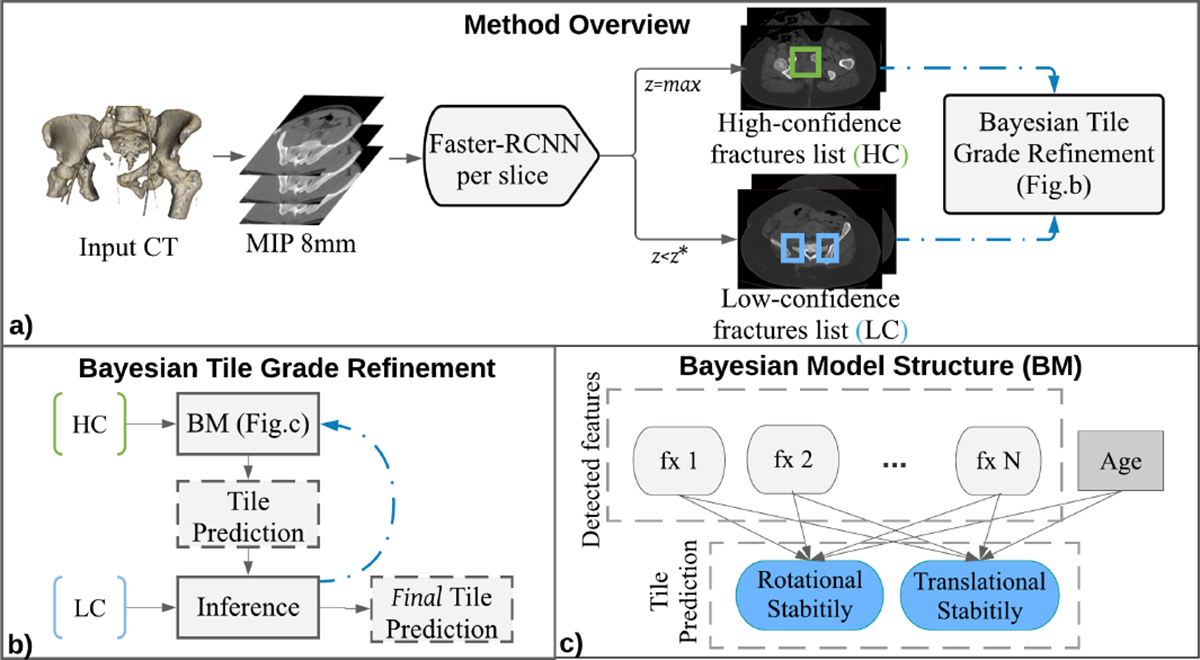
a) Method overview. After training on maximum intensity projections (MIPs) and corresponding annotations generated from 3D CT segmentation maps of key fracture classes that contribute to Tile grading, Faster-RCNN is used to extract high- and lower-confidence findings, such as fractures. b) Tile grade refinement algorithm using causal Bayesian model. Detailed description can be found in Alg. 1. c) Structure of the Bayesian model (BM): [fx 1 - fx N] are findings detected by the Faster-RCNN. Tile grade is represented by a combination of translational and rotational instability.