


Figure 2.
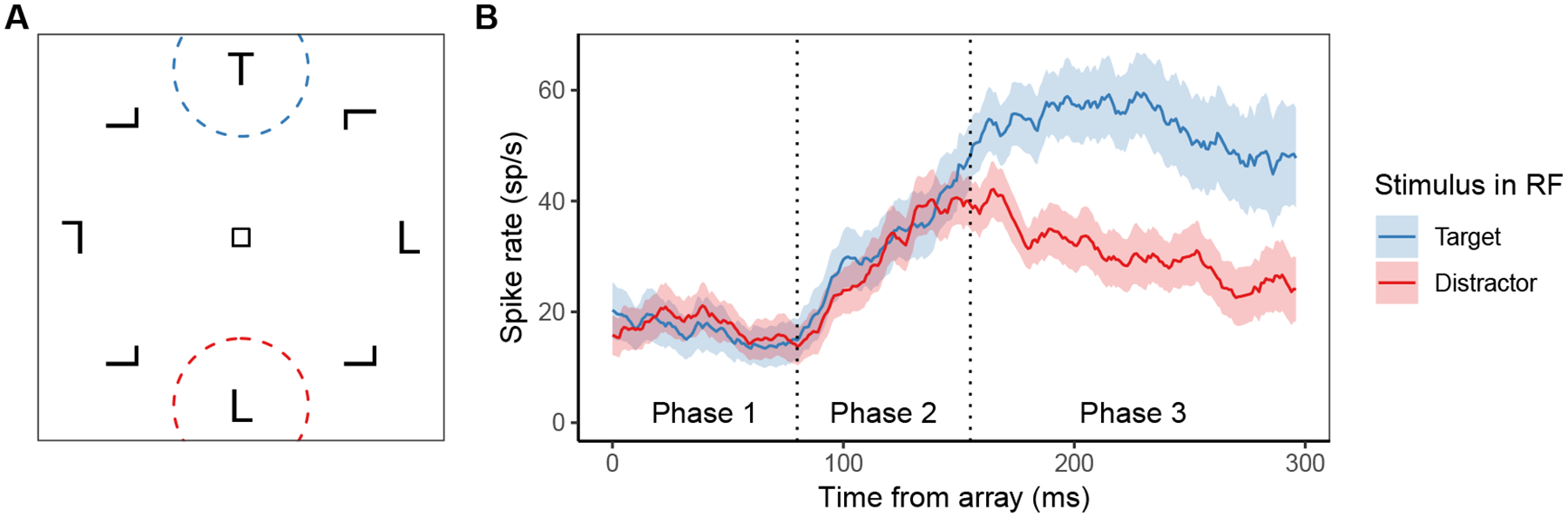
A) An example of a visual search array, with the receptive fields of two visually-selective neurons in Frontal Eye Fields (FEF) indicated by the dashed circles. B) Examples of the canonical response profiles for those neurons, depending on whether the object in their receptive field is a target or distractor. In phase 1, the neuron remains at its pre-array baseline spike rate. In phase 2, the neuron increases its firing rate in response to the presence of any kind of object in its receptive field (RF). In phase 3, the neuron’s spiking activity evolves such that it has a higher firing rate when a target is in its RF relative to a distractor.