


Figure 4. Muscimol treatment and introduction of inhibitory input renormalizes desynchronized evoked neurotransmitter release.
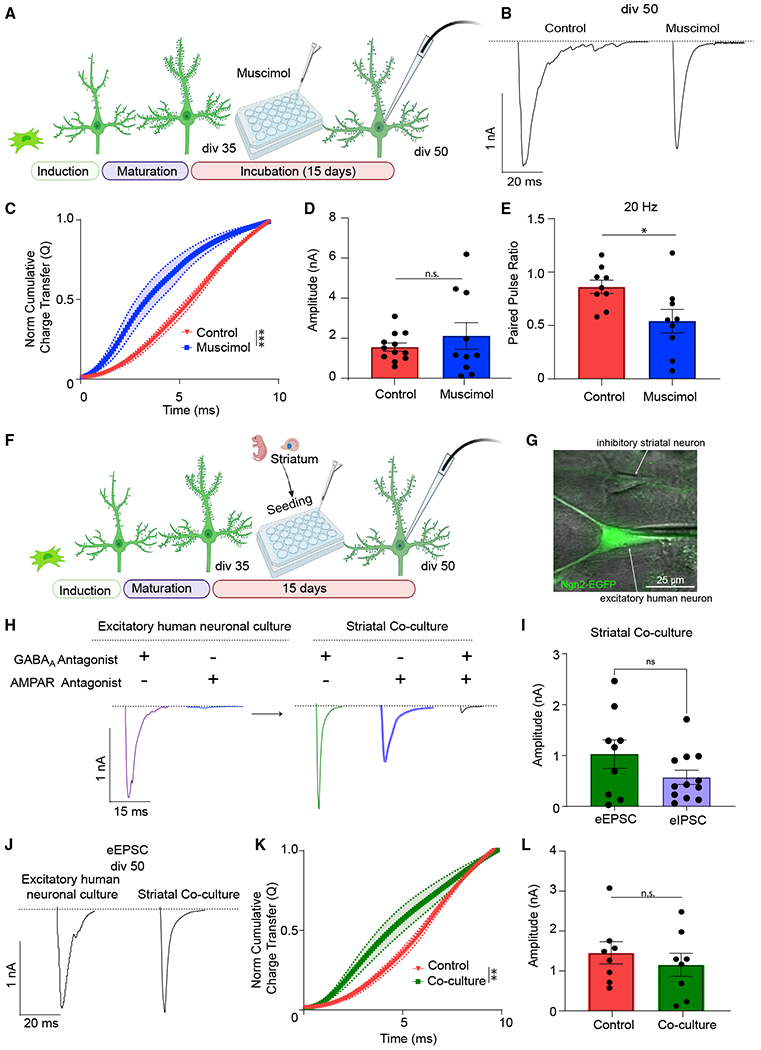
(A) Experimental design for chronic (15 days) 10 μM muscimol treatment of div50 iN cells.
(B) Representative traces of eEPSCs following chronic muscimol treatment versus control at div50.
(C) The NCCT(Q) of eEPSCs following muscimol treatment versus controls at div50 reveals that muscimol treatment makes evoked release significantly more synchronous; bars show mean ± SEM; control, n = 10; muscimol, n = 7; N = 2; p < 0.001; simple linear regression; p < 0.0001; Kolmogorov-Smirnov test.
(D and E) The amplitude of eEPSCs does not change following muscimol treatment, whereas the PPR at 20 Hz stimulation becomes significantly decreased in treated cultures; dots show individual cells; bars show mean ± SEM; eEPSC amplitude, control, n = 12; muscimol, n = 10; N = 2; p = 0.396; unpaired test; PPR, control, n = 9; muscimol, n = 9; N = 2; p = 0.02; unpaired t test.
(F) Experimental design for rat striatal-human iN cell co-cultures.
(G) Representative image of whole-cell patch clamping of EGFP(+) iN cells in proximity of an inhibitory striatal neuron. Scale bar, 25 μm.
(H) Representative traces of eEPSC currents of iN cells showing the absence of inhibitory currents in pure iN cell cultures and presence upon rat striatal coculturing. The representative postsynaptic responses were recorded from the same cell in each group, upon perfusion of blockers.
(I) iN cells that are co-cultured with rat striatal neurons show robust inhibitory transmission where eEPSC and eIPSC amplitudes do not differ (recordings were performed from different iN cells); dots show individual cells; bars show mean ± SEM; eEPSC n = 9; eIPSC n = 12; N = 2; p = 0.131; unpaired t test.
(J) div50 eEPSCs representative traces following rat striatal co-culturing versus pure iN cell cultures.
(K and L) The NCCT(Q) of eEPSCs following rat striatal co-culturing versus pure iN cultures at div50 reveals that inhibitory innervation makes evoked release significantly more synchronous with no change in eEPSC amplitudes; bars show mean ± SEM; NCCT, control, n = 6; striatal co-cultures, n = 9; N = 2; p = 0.002; simple linear regression; p < 0.0001; Kolmogorov-Smirnov test; eEPSC amplitudes, control, n = 8; striatal co-cultures, n = 8; N = 2; p = 0.466; unpaired t test. Significance levels are as follows: *p < 0.05, **p < 0.01, ***p < 0.001, ****p < 0.0001; ns, non-significance.