


Figure 2. A population of Pf neurons represent ipsiversive velocity.
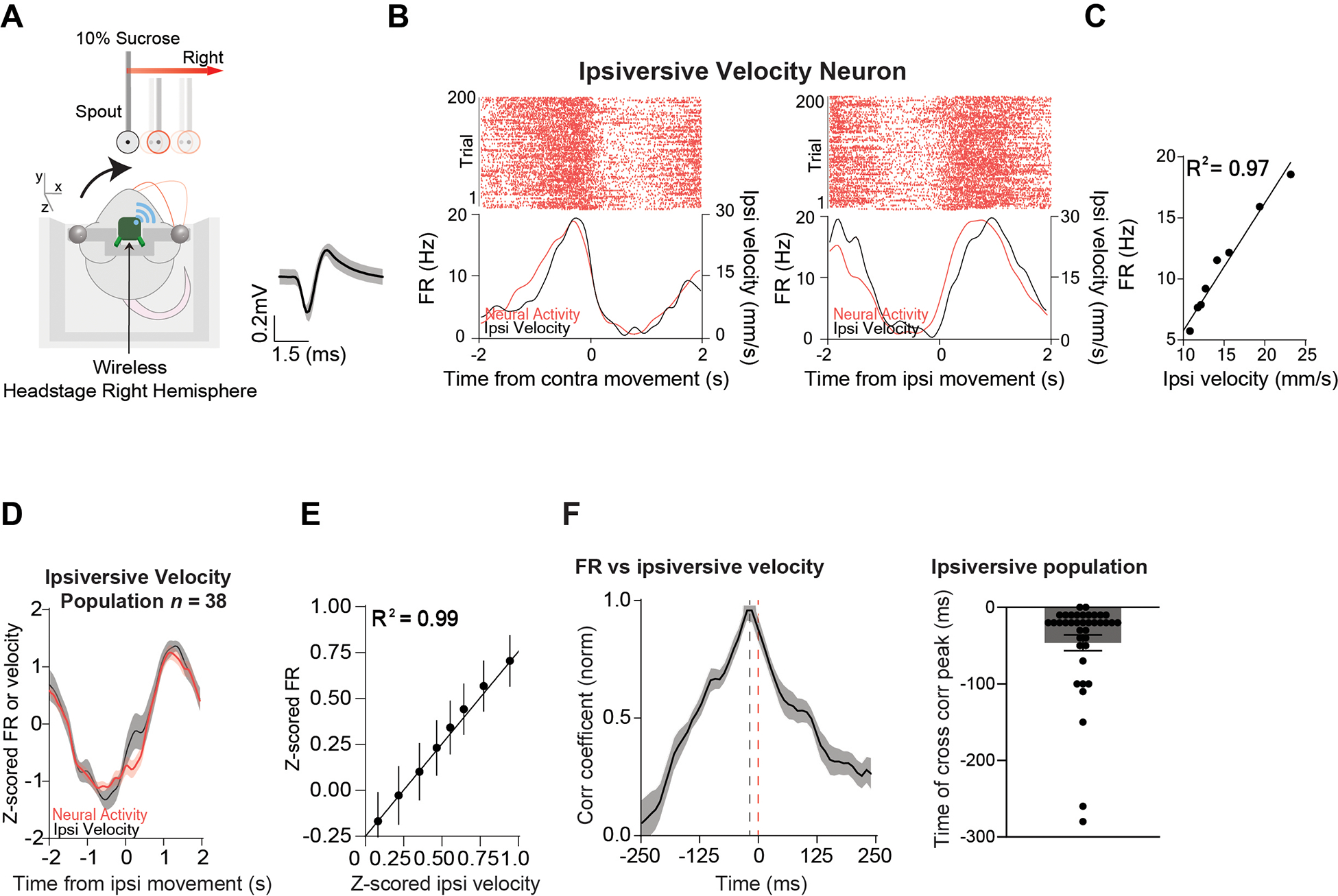
A) Illustration of a mouse tracking the reward in the direction ipsiversive to the electrode implant. The average wave form of the ipsiversive population. B) Representative Pf ipsiversive velocity neuron showing high correlation with ipsiversive velocity. Left: Peri-event raster plot of a representative Pf ipsiversive velocity neuron showing the neural activity and the corresponding velocity when the target was moving contraversive (0 to 2 seconds). Right: Peri-event raster plot of the same Pf neuron and the corresponding velocity when the target was moving ipsiversive (0 to 2 seconds). C) There was a high correlation between the ipsiversive velocity and the firing rate of the representative neuron. Correlation (p < 0.0001). D) The population of ipsiversive velocity neurons (n = 38) increased their firing rate during ipsiversive movement and decreased during contraversive movement. E) There was a high positive correlation between Pf firing rate and velocity Correlation (p < 0.0001). F) Cross-correlation between activity of ipsiversive velocity neurons and ipsiversive velocity shows that neural activity preceded the behavior. Error bars indicate mean ± SEM. See also Figures S1–S2.