


Figure 5. Correlations with other behavioral variables.
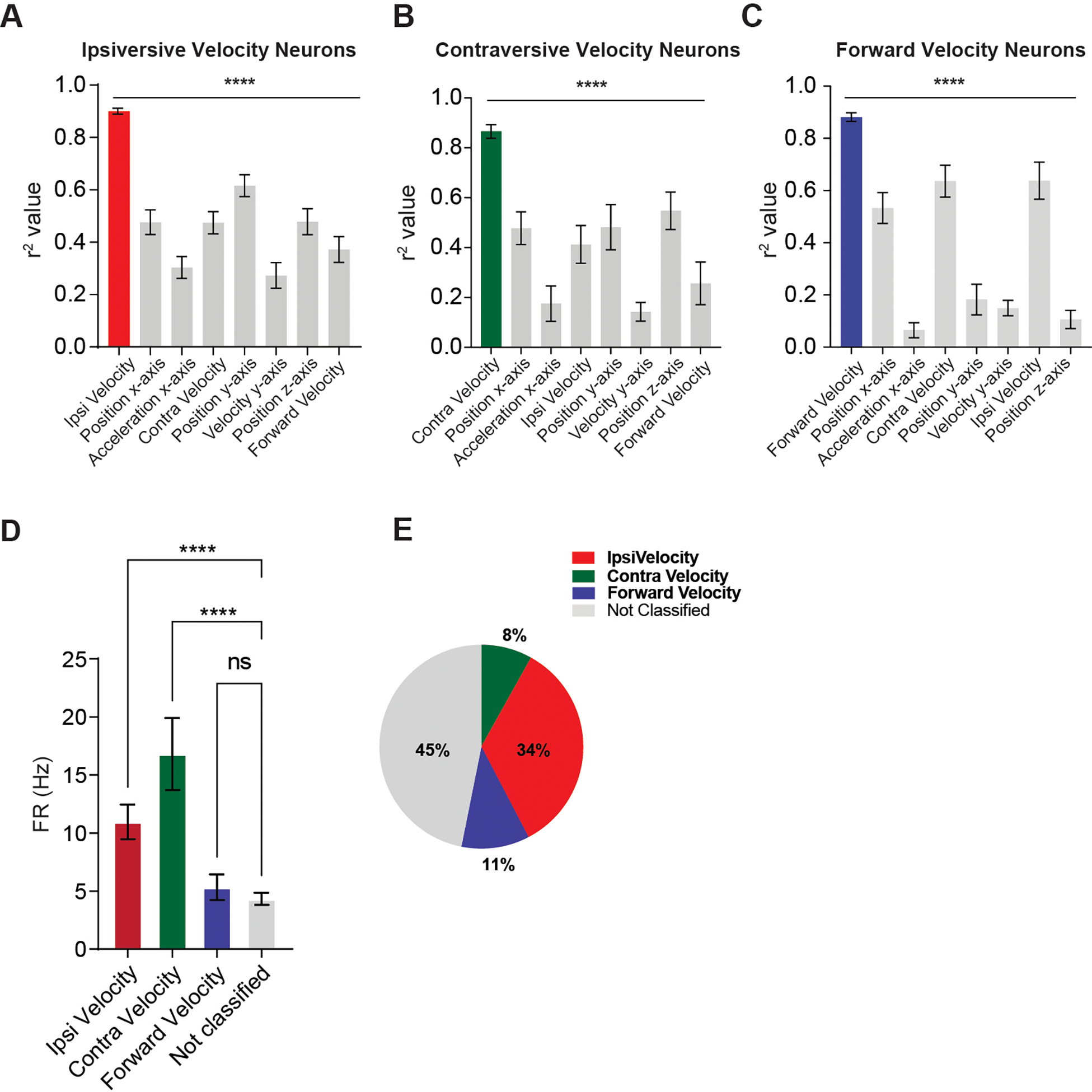
A) Ipsiversive velocity neurons have significantly higher positive correlation with ipsiversive velocity than all other kinematic variables (One-way ANOVA, main effect of kinematic variable F(7, 296) = 18.79, p < 0.0001). Dunnett’s post hoc comparison revealed that all other correlations are significantly lower than ipsiversive velocity (ps < 0.0001). B) Contraversive velocity neurons have significantly higher positive correlation with contraversive velocity than other kinematic variables (One-way ANOVA, main effect F(7, 64) = 8.23, p < 0.0001). Dunnett’s post hoc comparisons revealed that other correlations are significantly lower than contraversive velocity (ps < 0.0001). C) Forward velocity neurons have significantly higher positive correlation with forward velocity than other kinematic variables (One-way ANOVA, main effect F (7, 88) = 43.67, p < 0.0001). Dunnett’s post hoc comparison revealed that all other correlations are significantly lower than forward velocity except for ipsiversive velocity (ps < 0.0001, ipsiversive velocity ps = 0.11). D) One-way ANOVA revealed a significant main effect of group in firing rates of the classified neurons (F(3,107) = 13.71, p < 0.0001). Ipsiversive and contraversive velocity neurons had significantly higher firing rates than unclassified neurons (Dunnett’s, p < 0.0001). E) Percent of each population of neurons. Error bars indicate mean ± SEM. **** p < 0.0001. See also Figures S3–S4.