


Figure 6. Optogenetic excitation produces ipsiversive turning.
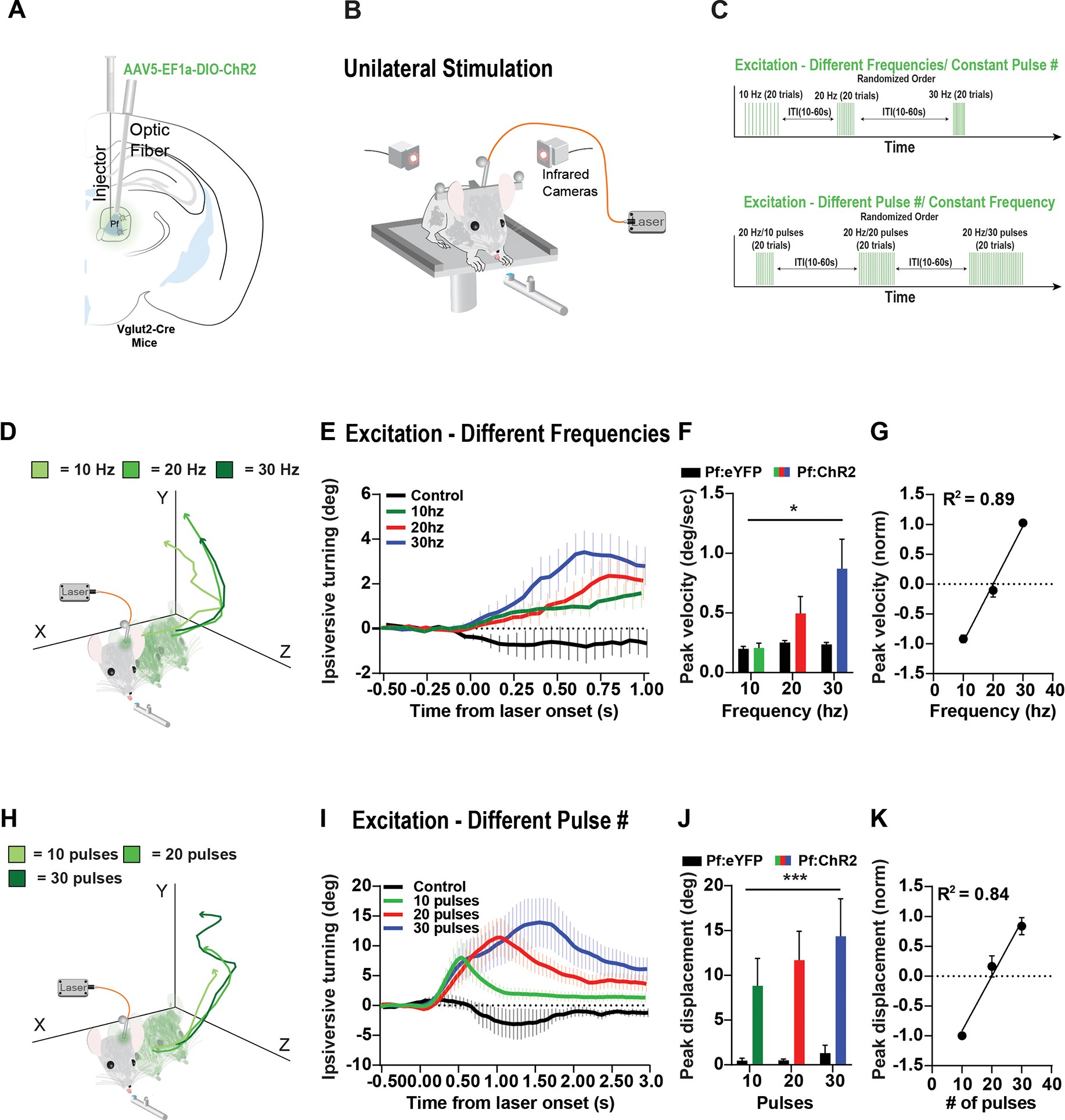
A) For optogenetic excitation, the Cre-dependent excitatory opsin DIO-ChR2 was injected into the Pf of Vglut2-Cre mice. Controls received injections of eYFP. Optic fibers were placed above the Pf. B) Mice received unilateral optogenetic stimulation while engaged in the reward-tracking task. C) Either the stimulation frequency was varied with a fixed number of pulses (Top: 10 pulses for 10 Hz, 20 Hz and 30 Hz) or the frequency was held constant, and the number of pulses was varied (Bottom: 20 Hz with 10, 20 and 30 pulses). Stimulation was delivered with a random inter-trial interval (ITI). D) Head position traces of a representative animal from optogenetic excitation using different frequencies with the same number of pulses (10, 5ms pulses). Excitation would produce ipsiversive head turning. In addition to horizontal head movement, they would also slightly move their head up and forward. E) Stimulation at different frequencies caused ipsiversive head turning (control = Pf:eYFP 30hz). F) Stimulation significantly increased ipsiversive velocity in Pf:ChR2 mice relative to Pf:eYFP controls (2-way ANOVA, Virus [ChR2 or eYFP] × Frequency, main effect of virus F(1,24) 6.169, p = 0.0204, no effect of frequency F(2,24) = 2.879, p = 0.0757, and no interaction F(2, 24) = 2.366, p = 0.1154). (Pf:ChR2 n = 6 hemispheres, Pf:eYFP n = 4 hemispheres). G) Ipsiversive velocity increased linearly with stimulation frequency (Linear regression, p < 0.0001). H) Head position traces of a representative animal from optogenetic excitation using different pulse numbers with the same frequency (20hz, 5ms pulses). I) Stimulation at different number of pulses caused ipsiversive head turning (control = Pf:eYFP 30pulses). J) Stimulation significantly increased ipsiversive displacement in Pf:ChR2 mice relative to Pf:eYFP controls (2-way ANOVA, Virus [ChR2 or eYFP] × Pulses, main effect of virus F(1,24) = 18.19, p = 0.0003, no effect of pulses, F(2,24) = 8.0.5252, p = 0.5981, and no interaction F(2,24) = 0.2886, p = 0.7519). (Pf:ChR2 n = 6 hemispheres, Pf:eYFP n = 4 hemispheres). K) Ipsiversive displacement increased linearly with stimulation pulse number (Linear regression, p < 0.0001). Error bars indicate mean ± SEM. *p < 0.05, ***p < 0.001 See also Figures S5–S6.