


Figure 7. Optogenetic inhibition produces downward head movement.
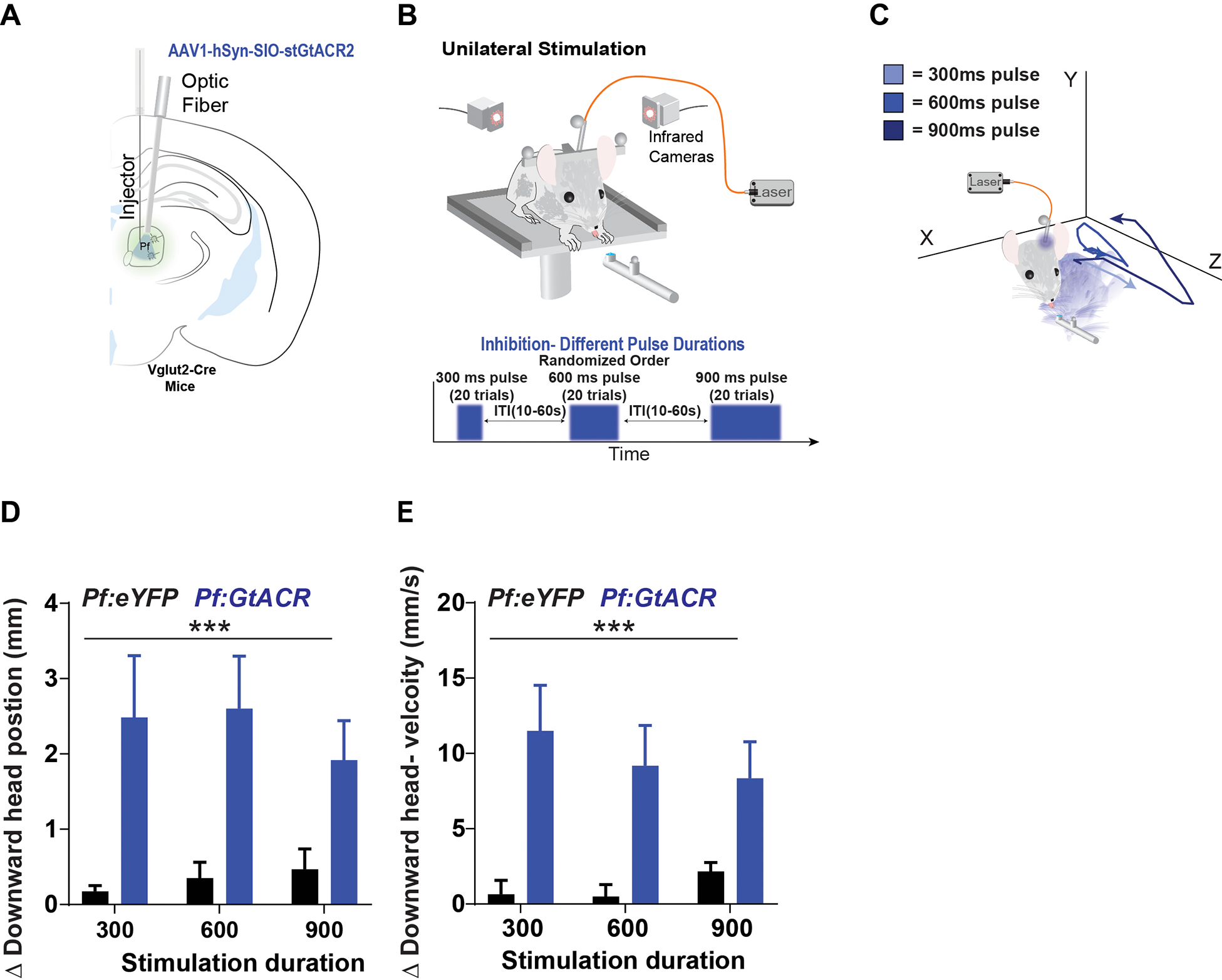
A). For optogenetic inhibition, the Cre-dependent inhibitory opsin SIO-StGtACR2 was injected into the Pf of Vglut2-Cre mice. Controls received injections of eYFP. Optic fibers were placed above the Pf. B) Mice received unilateral optogenetic stimulation while engaged in the reward-tracking task. The duration of the pulses was varied (Bottom: 300ms, 600ms and 900ms pulses) and was delivered with a random ITI. C) Head position traces of a representative animal from optogenetic inhibition using different durations. Inhibition would cause their head to move downwards followed by a pause in movement. D) Photo-stimulation produced downward head movement, as indicated by downward position change (2-way ANOVA, Virus [GtACR or eYFP] × Duration, significant main effect of virus, F(1,24) = 15.49, p = 0.0006, no significant effect of duration, F(2,24) = 0.1041, p = 0.9015, no significant interaction F(2,24) = 0.2963, p = 0.7462). E) Stimulation significantly increased downward head velocity (2-way ANOVA, Virus × Duration, significant main effect of virus F(1,24) = 18.23, p = 0.0003, no significant effect of duration F(2,24) = 0.1324, p = 0.8766, no significant interaction F(2,24) = 0.4542 p = 0.6403). (Pf:GtACR n = hemispheres, Pf:eYFP n = 4 hemispheres). Error bars indicate mean ± SEM. *** p < 0.001. See also Figures S5 and S7.