


Fig. 2.
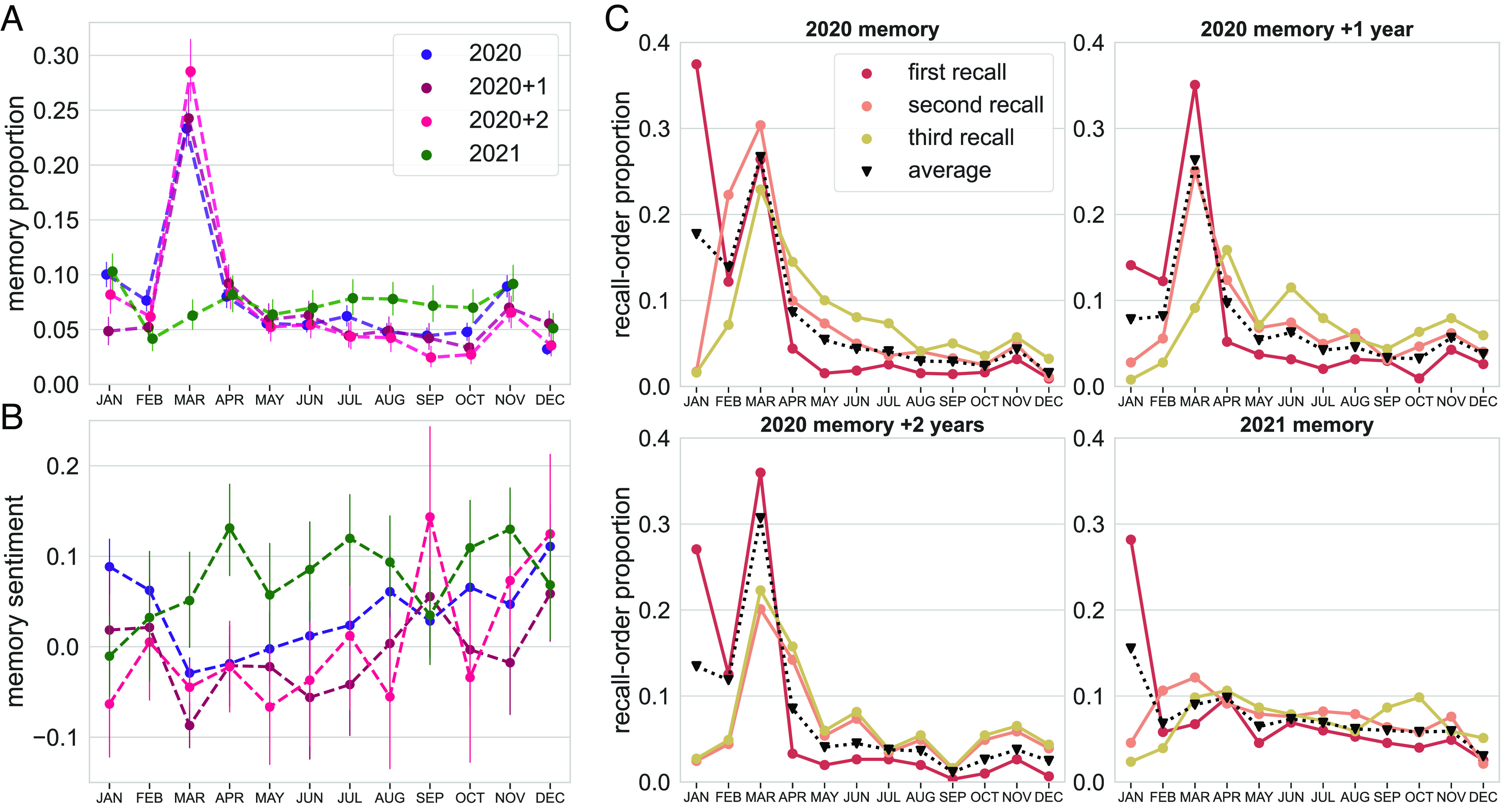
Distribution and characteristics of recollections by month. Participants first recalled events as they spontaneously remembered them and then dated each memory by month. (A). Mean across within-participant proportions (including all possible date options) of memory for each month. Memory for March 2020 was greater when recalled that year, as well as one (2020+1) and two (2020+2) years later; this pattern was not observed for memory of 2021. Colors indicate which year and when it was recalled (e.g., “2020+1” is memory for 2020 recalled 1 y later); error bars are SEM across subjects. Note that 2020 and 2021 memory collections occurred in early December of those years (i.e., recency effects are captured by November memory; for those collections, dotted lines between November and December are omitted). See SI Appendix, Fig. S4 for individual-level plots across all date options. (B). Average sentiment score for retrieved memories ranging from −1 (negative) to 1 (positive). Memory for March 2020 was more negative than other months of 2020; this was not the case for 2021 memory. Additionally, more negative sentiment predicted a greater amount of recall for that month, regardless of memory collection. (C). Proportion of participants’ dated recall for their first through third entries by memory collection; colors indicate recall number, black dotted line is the average across first three entries. In addition to the tendency to recall a year sequentially (i.e., higher proportion of January memory as the first entry), March was recalled earlier than other months of 2020; this pattern did not occur for 2021 memory.