


Fig. 3.
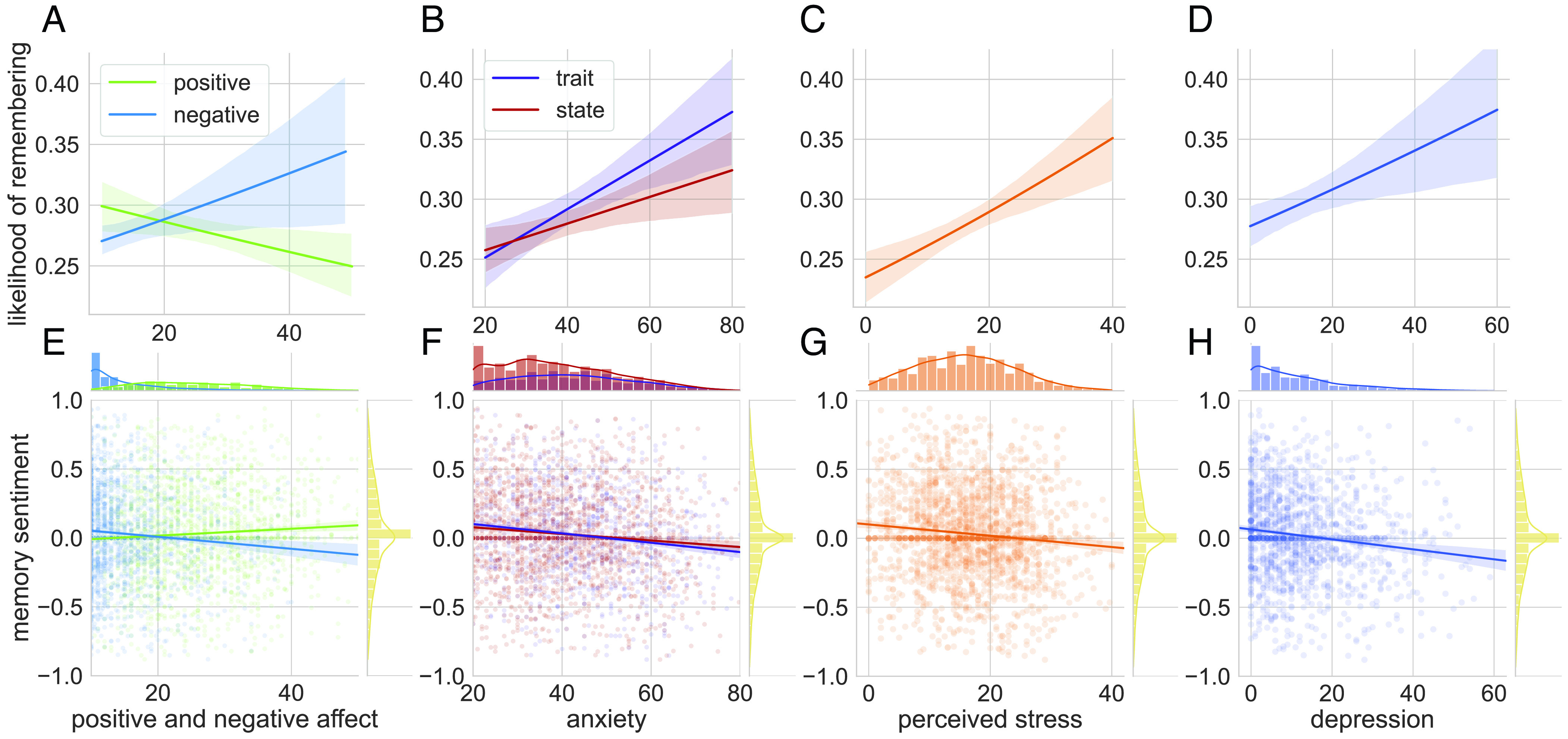
Likelihood of later retrieving a month and its sentiment given experienced emotion during that month. We administered a series of assessments from April to December of 2020 that evaluated immediate and longer-term affect and tested whether these measures predicted the likelihood of that month being later remembered in autobiographical memory (A–D). We found that negative affect, as assessed by (A) immediate negative affect (39), (B) state and trait-level anxiety (40), (C) experienced stress (41), and (D) depression (42), increased the likelihood of later recalling that month. Shaded regions reflect 95% CIs. (E–H). We also found that all measures predicted the sentiment of autobiographical memories (ranging from −1, negative, to 1, positive) in the expected direction: (E) immediate negative affect led to more negative sentiment for that month, while immediate positive affect led to more positive sentiment; (F) increased state and trait-level anxiety, (G) stress levels, and (H) depression also predicted more negative sentiment for that month. Shaded regions reflect 95% CIs. Marginal distributions represent the variable on the corresponding axis.