



Abstract
We investigate the previously observed superconductivity in ferromagnetic SmN in the context of the breakdown of order between two magnetic phases. Nitrogen vacancy doped SmN is a semiconductor which lies in the intermediary between ferromagnetic SmN and anti-ferromagnetic Sm. Optical data reported here corroborate the prediction that electrical transport is mediated by Sm 4f defect states, and electrical transport measurements characterise the metal-insulator transition over the doping range. Our measurements show that the superconducting state in nitrogen vacancy doped is the most robust near the breakdown of magnetic order, and indicate the location of a quantum critical point. Furthermore we provide additional evidence that the superconducting state is formed from majority spin electrons and thus of unconventional S = 1 type.
Subject terms: Electronic properties and materials, Magnetic properties and materials, Phase transitions and critical phenomena, Semiconductors, Superconducting properties and materials
Introduction
The borders of ordered magnetic states in f-electron systems are a common source of emergent phenomena, including unconventional superconductivity and heavy fermion behaviour1–6. Significant effort has been expended understanding these phenomena in terms of zero-temperature phase transitions and their associated quantum critical points (QCP), which are commonly found near spin-order instabilities presenting as zero-temperature magnetic transitions7–12. Traditionally QCPs lie at boundaries between antiferromagnetic (AFM) and paramagnetic (PM) phases. However there is recent interest in ferromagnetic (FM) phase boundaries13–17. Lanthanide compounds have led as examples, and although the rare earth mononitrides (LnN, Ln a lanthanide) were proposed already some years ago as likely heavy-fermion candidates18–20, that prediction has not yet been explored in great detail.
The LnN (LnN) are poised at a metal-insulator boundary, and ongoing studies over the last half century have placed them variously on the two sides of that boundary21–23. Recent thin films are mostly on the insulator side, showing signatures of a dopable semiconducting ground state with a narrow but clear band gap24–27. Electron doping in thin films can be routinely controlled by a residual concentration V of nitrogen vacancies28–31. The LnN crystallise in the NaCl structure with lattice constants varying from 0.51 to 0.48 nm across the series32. Within that structure the cations form a close-packed FCC network that differs only in the stacking sequence from that in the hexagonal structures of the pure lanthanide metals. Remarkably, in addition to their similar local close-packed arrangements, the Ln-Ln separation is only slightly different; in particular the Sm-Sm separation in SmN is 0.3560 nm vs 0.3606 nm in metallic Sm, a contrast of only 1.3%.
The picture that emerges is then of a close-packed lanthanide lattice with nitrogen ions entering the network with minimal influence on the Ln packing density. The nitrogen ions each remove three electrons from the Ln 5d, 4f and 6s states that form the conduction channel, finally reducing the mobile electron concentration to zero in the stoichiometric LnN. In the pure metallic Ln phase the magnetic exchange, ferromagnetic for most, is dominated by an RKKY interaction via those mobile electrons, and nesting across portions of the Fermi surface then leads to the rich range of spiral spin alignments revealed by neutron scattering studies fifty years ago33. In contrast the nitrides, also mostly ferromagnetic, involve an indirect exchange via the Ln 5d and N 2p states34,35.
Interest in the LnN series has thrived for well over half a century, although a focus on their magnetic properties has been only rarely extended to discussions of their strong correlation18–20. Most attention has been expended on GdN, with the series’ highest Curie temperature of 65 K. In the half-filled 4f level, the S configuration dictates that there is no orbital contribution to the magnetic moment; it is an entirely conventional spin-only ferromagnetic compound. Furthermore the wide spin-splitting places the 4f bands far from the Fermi energy such that they do not contribute to electron transport. Electron doping in GdN is usually facilitated by nitrogen vacancies which lift the Fermi energy into the dispersive Ln 5d bands28.
The lighter members of the LnN feature majority spin 4f bands lying within the conduction band (CB) precipitating dopable strongly correlated 4f states36–38. The Sm ion in SmN has five 4f electrons, ensuring that there are two empty majority-spin 4f bands threading the 5d CB39–41. The inter-ion exchange precipitates ferromagnetic spin alignment of those five occupied 4f states below 30 K. However, within the H state the spin magnetic moment is opposed by an orbital moment of similar magnitude so that the net magnetic moment is nearly zero; SmN displays ferromagnetic alignment and exchange split bands but has a near zero net moment of 0.035 per Sm ion42–44.
When nitrogen vacancies are induced in the crystal the two unfilled majority spin 4f states on the six Sm ions which coordinate the vacancy are drawn into the intrinsic band gap, and towards the valance band maximum with increasing doping levels45. The three electrons released by a nitrogen vacancy thus do not appear in the intrinsic Sm 5d conduction band minimum (CBM), they rather occupy the majority spin 4f states on those now mixed Sm/Sm ions surrounding the vacancy. These states appear 1 eV lower than those on fully nitrogen coordinated ions, pinning the Fermi energy to the mid-gap region, where they hybridise with both the 5d and N 2p45.
Within the LnN series the Sm/SmN pair stands out as the one in which the end points have contrasting magnetic order, ferromagnetic below 30 K in the mononitride but antiferromagnetic below 100 K in metallic Sm46,47. The situation is reminiscent of those materials where competing magnetic ground states are traversed via doping48, materials which display emergent correlated behaviours in the intermediary between these ground states. Significantly, SmN is also the only LnN in which superconductivity has been reported across the doping range range. This has been observed in heavily doped (i.e. nitrogen deficient) SmN49, motivating a search for heavy-fermion superconductivity that is commonly found near a QCP2,50,51. Here we report a combined experimental and computational study of the band structure and defect states that precipitate superconductivity in SmN and measurements which indicate the location of a quantum critical point.
The results are presented as follows, to being we discuss in section “Band structure” the calculated and experimental valence bands of SmN. We then discuss the calculated band structure of stochometric and nitrogen vacancy doped SmN, before moving to the experimental results in section “Electrical transport and optical spectroscopy”. The optical spectroscopy represents transitions between filled and unfilled states in the band structure, which can be used to validate the calculations of section “Band structure”, while the electrical transport measurements relate to the properties of the material in the vicinity of the Fermi energy. Finally in section “Preliminary phase diagram” we bring together the computational band structure and experimental results to build a preliminary phase diagram for SmN, and comment on the nature of the superconductivity. Full details of the experimental and computational methods can be found in section “Methods”.
Results
Band structure
Figure 1 shows the experimental X-ray photo-emission spectroscopy (XPS) spectrum along with the calculated density of states (DOS) in the valence band of SmN. The lowest energy feature in the experimental data, with a centre near − 19.5 eV, matches well with the calculated position of the the Sm 5p states. The calculation shows two spin-split peaks, while the experiment is carried out at ambient temperature in the paramagnetic phase, so the majority and minority Sm 5p states are degenerate at intermediate energy. Moving to higher energy the N 2s states are placed by the calculation at eV, however these are not clear in the measurement. One notes that the N 2s feature is substantially weaker in comparison with the Sm-associated features. Possibly that results from a level of resonance in the Sm features associated with similar energies between the excitation X-ray and the Sm M edge.
Figure 1.
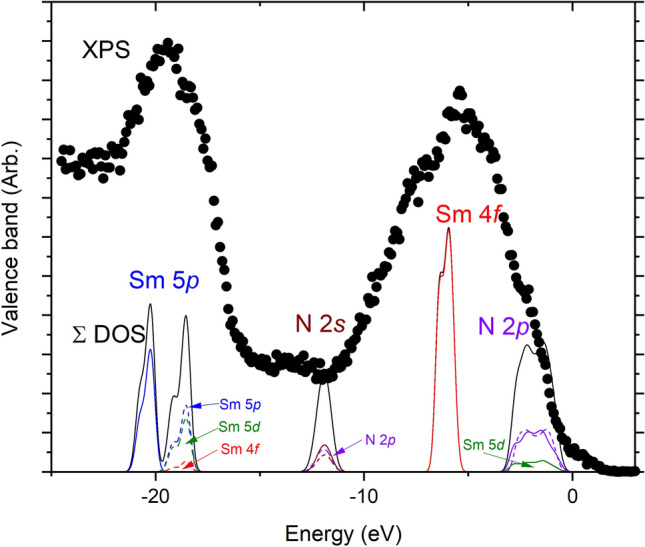
XPS measurements (black circles) and DOS calculations (lines) for SmN. The total DOS (majority and minority spin) are shown in solid black lines, the contribution from separate orbitals are shown in various colours (majority spin-solid lines, minority spin-dashed lines), for clarity only the significant contributions to each peak are shown.
The valence band maximum (VBM) is formed from N 2p states, which the calculation finds hybridised with the majority spin Sm 5d states. Finally the peak in the XPS data at 5.25 eV matches well with the calculated location of the Sm 4f states, of which majority spin only are present. The correspondence between the calculated Sm 4f states and the experimental XPS spectrum is significant as this indicates the calculated value of eV is appropriate (see section “Density functional theory calculations”). The XPS data are much broader than the calculated DOS, particularly for the Sm 4f states, as is also observed in ErN52. This signals the multiplet structure of the 4f states are not captured by our calculation. A recent series of calculations using a density-functional + dynamical mean-field theory approach can be found in reference53, where these effects are more accurately captured in the stochometric LnN and in EuN54.
Typically the band-structure of undoped SmN is based on the two-atom primitive unit cell, which lacks any disorder. A physical crystal will deviate somewhat from the pristine structure imposed by these periodic boundary conditions. To investigate something closer to the physical material we have relaxed an undoped 54 atom super-cell which was seeded with a small amount of disorder. The resulting band structure, unfolded to represent the familiar bands of the primitive unit cell, is shown in Fig. 2a (for clarity the majority spin bands only are shown). The band structure shown in Fig. 2a is indeed very similar to that of the commonly reported primitive unit cell39,45 with the main contrast at the VBM. In the primitive unit cell calculation the VBM is at with a close to 0.5 eV drop towards the X point. In our disordered super-cell we see the VBM at is suppressed resulting in a near direct gap at the X point .
Figure 2.

Calculated band structure and DOS for undoped (a) and nitrogen vacancy doped (b) SmN supercells. The 4f character of the bands in indicated in red. and X indicate optical transitions present in Fig. 4.
Figure 2b shows the unfolded bands of a SmN super-cell doped with a nitrogen vacancy at 3 % concentration. As described in our earlier work45, the structural disorder resulting from the vacancy results in long range periodicity and thus new defect states in the crystal. These manifest as the ghost-like bands, the shading of which signifies the weight of the unfolded state for a given k-point. The most striking feature is that the Fermi energy resides in the intrinsic gap region rather than the VBM or the CBM. It is pinned here by defect states which are largely localised to the six Sm ions which coordinate the vacancy site45. This is a clear contrast to the other V doped LnN studied computationally, the more simple GdN28 and LuN31, where V doping lifts the Fermi energy into the Ln 5d CB in a more conventional donor doping manner.
Electrical transport and optical spectroscopy
With the computational band structure in mind we now turn to the electrical transport and optical spectroscopy measurements. The resistivity as a function of temperature in Fig. 3 show clearly the contrasting behaviour between films grown with various concentrations of V. The most conductive film in panel (a) shows a positive coefficient of temperature; it is clearly doped to degeneracy, and as such is beyond interpretation in the context of Figs. 1 and 2. The more nearly stoichiometric films show resistivities that diverge at the lowest temperatures. The most nearly stoichiometric film has a resistivity which increases strongly with decreasing temperature. The inset of panel (c) shows the measurements plotted below 120 K, with the linear dependence below 40 K characteristic of variable range hopping 55. The anomaly near 20 K in the conductive film is close to the ferromagnetic transition. This is a result of magnetic disorder scattering56–58 peaking very near the Curie temperature. A similar feature is present in our moderately doped films (not shown) and results from a band gap reduction across the Curie temperature24. This feature is obscured in the most resistive films by the rise in resistivity at low temperature.
Figure 3.

Resistivity as a function of temperature for three SmN films produced to harbour significantly different concentrations of nitrogen vacancies. Panel (a) shows a film with a metallic like conductivity. Panels (b) and (c) show films with non-metallic conductivity. The inset to panel (c) shows the data plotted appropriately to display the variable range hopping type conductivity at low temperatures.
Far IR to near UV optical spectroscopy was performed on a series of films doped variously with nitrogen vacancies leading to dc (zero-frequency) conductivities ranging from 110cm to 5000 cm. Figure 4 shows the resulting optical responses of four films, two from the extremes of our conductivity and two representative of the centre. The most insulating film in panel (d) of Fig. 4 is the closest to stoichiometric that we have grown, and as such has a dc resistivity above our measurement limits and correspondingly the optical conductivity falls below our measurement limits at low energy. At 30 meV there is an absorption relating to the IR active TO mode vibration which we see in all LnN films59. There is then no absorption in the MIR region before an increase near 1 eV signalling the onset of optical transitions. The onset of absorption is marked as X in Fig. 4d and the corresponding optical transition is indicated in Fig. 2a. Moving to the next most insulating film in panel (c) we now see a feature begin to develop below the intrinsic optical gap, noted as in Fig. 4c and the corresponding optical transition in Fig. 2b. Panel (c) also shows the joint density of states (JDOS—dashed line) corresponding to the electronic structure of the material illustrated in Fig. 2b. The JDOS shows a double peaked MIR feature, the centre of which corresponds remarkably well to the peak in the MIR data. Recalling that the localised V state spans the full range of wave vector space it is clear that the transition here involves the defect states at the Fermi energy and the relatively flat X valence band. As usual the relative strengths in the conductivity features are not fully represented by the JDOS; the coupling between the initial and final states depends critically on the dipole matrix elements that vary widely among transitions.
Figure 4.
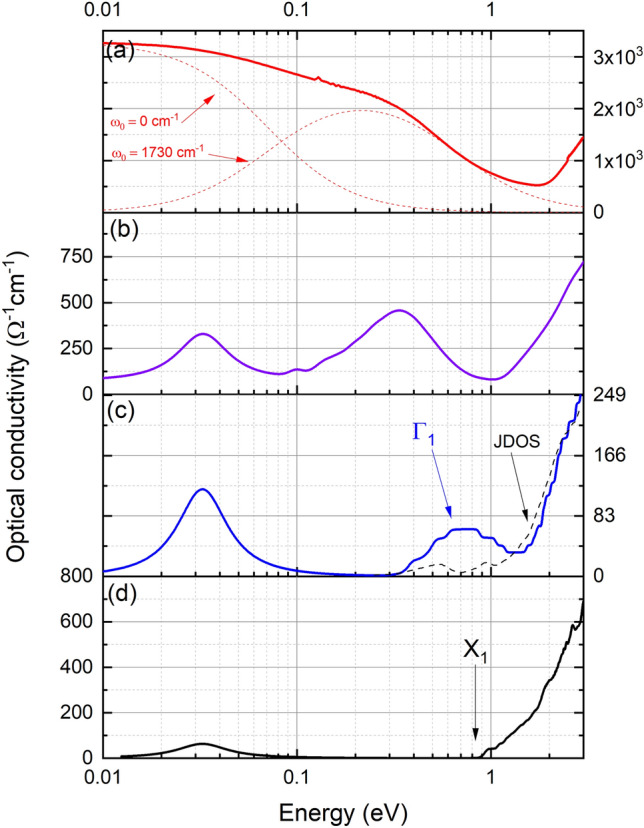
Optical conductivity for four SmN films based on reflection and transmission measurements. Panel (c) shows in addition the joint density of states corresponding to the band structure of Fig. 2b. The points X and corrospond to optical transitions indicated in Fig. 2. The colours are consistent between Figs. 3 and 4 and represent measurements on the same films.
The moderately conductive film in panel (b) has a finite zero-frequency conductivity consistent with the electrical measurements in Fig. 3. The MIR feature has grown in magnitude and shifted to lower energies. Finally the most conductive film in panel (a) has a strong free carrier absorption at the lowest energies, which matches well the measured dc conductivity. The MIR feature has now softened with a centre near 0.2 eV. The contributions with central frequencies at cm and cm which dominate the optical conductivity are plotted separately for clarity.
The development of the MIR absorption is the most important change with V across Fig. 4a–d, along with its softening to lower energy as the conductivity increases. Lorenztian fits to the feature in the full set of films yield the central energy plotted versus the conductivity in Fig. 5a. This shows a sharply reduced energy as the conductivity rises, falling from 0.75 eV in near-stoichiometric film to 0.2 eV in heavily doped films. In order to understand the softening of the MIR feature, we return to the calculated band structure in nitrogen deficient SmN45 and Fig. 2b in the present manuscript. As noted above a defect band dominated by the 4f states on the Sm ions neighbouring a vacancy forms within the SmN fundamental gap when the crystals are doped with V. The Fermi level is then pinned to these in-gap defect states, forming an increasingly extended-state band as the V concentration, and thus doping, increases.
Figure 5.

Panel (a) shows the centre of the mid infra-red feature for a series of SmN films. The coloured points indicated films in Figs. 3 and 4. Panel (b) shows the difference between the Fermi energy and valence band maximum for calculations over a range of nitrogen vacancy doping concentrations. The transitions X and indicated in Figs. 2 and 4 and also labelled here.
The present measurements (shown in Fig. 5a) indicate that the in-gap states move deeper with an increasing V effectively pulling the Fermi energy towards the valence band maximum. As these states span the Fermi energy they can harbour both final and initial states for an optical transition involving any of the extended-state bands in the CB and VB. On that basis we look at transitions involving the mid-gap 4f states. These transitions effectively represent a measurement of the separation between the VBM at and the Fermi energy on one side, and the separation between the Fermi energy and the unoccupied states at the CBM on the other side. In Fig. 5b we have plotted the separation in energy between the valence band maximum and Fermi energy for the four concentrations examined computationally (note that for the 0 % doping case the value represents the minimum direct optical gap between the VB and CBM at X). The optical transitions and X indicated in Figs. 2 and 4 are again indicated in Fig. 5. The agreement between the optical data and the calculation are striking and suggest that the transitions from the VBM to the defect states at the Fermi energy are the dominant contribution to the MIR feature in the optical spectra. This clarifies our previous report60, the MIR feature clearly tracks the defect states which are accommodated by Sm ions adjacent to the vacancy site, rather than an intrinsic unfilled majority spin 4f states.
Now guided by the band structure calculations, the location of defect states lying at the Fermi energy necessarily imply that they are involved in all aspects of electron transport. One now expects that electron transport in SmN should be dominated by 4f in-gap states rather than extended states in the intrinsic 5d CB. In that regard there already exist anomalous Hall effect data that suggest 4f conduction in SmN36, rather than the 5d conduction seen in GdN61. In the dilute doping case the occupied states are localised, resulting in the variable range hopping type conductivity of Fig. 3c. As V increases a percolation limit is found, resulting in a lower resistivity and metallic like temperature dependence, seen in the heavily doped film in Fig. 3a and the conventional Drude roll-off in the same film, shown in Fig. 4a. The transition between non-metallic and metallic conductivity can be seen in Fig. 6a which shows the ratio of 300 K conductivity to 2 K conductivity for the series of SmN films. It is significant that the SmN films which have exhibited robust superconductivity are found near this transition, which we discuss in more detail below.
Figure 6.

Panel (a) shows the ratio of 300 K conductivity to 2 K conductivity for the series of SmN films. Panel (b) shows a phase diagram for the series of SmN films with the paramagnetic, ferromagnetic (filled circles) and superconducting (filled triangles) phases of SmN and anti-ferromagnetic phase of metallic Sm. The two open triangles show the robust superconducting transitions already reported in reference49. The inset shows an example of the magneto-resistance measurements used to characterise the onset of superconductivity.
Preliminary phase diagram
Figure 6b shows a preliminary phase diagram depicting the paramagnetic, ferromagnetic and superconducting phases of SmN and the anti-ferromagnetic phase of Sm metal. The order parameter of choice is carrier concentration, for which we use the low temperature conductivity as a proxy. The filled circles on the plot show the transition between the paramagnetic and ferromagnetic phases. The temperature of this transition was estimated from the peak in the resistivity as discussed previously. The Curie temperature grows with increasing conductivity from 20 K in the most undoped films to a maximum of 30 K. This suggests a carrier enhanced exchange interaction. Exactly such an enhancement is seen also in GdN29,34 and DyN62. Unlike those examples the end state of Sm metal is AFM and indeed the Curie temperature in Fig. 6b drops and finally looks to terminate near a nitrogen vacancy doping corresponding to a conductivity of 20,000 cm.
Although we have only observed clear superconductivity (via both a Meniser effect and a zero-resistance) in a few films49 we regularly see the onset of a low temperature phase characterised by a resistance drop, which is often more clearly observed in the low temperature magneto-resistance. The low temperature magneto-resistance for a film is plotted in the inset to Fig. 6b. This shows the change in sign from the negative magneto-resistance common in our films in the ferromagnetic phase near 30 K to positive at 5 K and below. This is similar to the magneto-resistance in ref49, which we interpret as the onset of the superconducting phase. The onset of this phase is plotted as triangles in Fig. 6b. It is significant that the onset of the low temperature phase roughly tracks the onset of ferromagnetism, which is enhanced in the more conductive films before a sharp drop. The crosses on the x-axis of Fig. 6 show films in which we did not observe a low temperature transition or onset above our minimum temperature of 1.9 K. It is interesting that almost all films in the conductivity range of 1–1000 cm show a low temperature transition, while most films above 1000 cm do not.
The scatter in the data, particularly at high conductivity, highlight that is a rough proxy for the order parameter. We propose the carrier concentration, driven by nitrogen vacancy doping, is the most natural choice of order parameter and although the conductivity is proportional to this, there are other contributions, for example the scattering time, which may cause problems with this proxy, particularly in the most conductive films.
The competition between the AFM and FM phases in the region above 1000 cm is reminiscent of the competition between the Kondo and RKKY interactions proposed decades ago63. Within that picture the ground state was RKKY-mediated AFM, changing to PM when the Kondo interaction dominates. In the present system Fig. 6b shows a falling Curie temperature above 1000 cm; the FM exchange coupling clearly weakens with the increasing dominance of the AFM interaction of Sm metal. It is significant that the superconducting transitions appears strongest just where the fall in Curie temperature shows the influence of FM/AFM competition. This is the region where a weakening inter-ion pairing mechanism would be expected to result in the strong quantum fluctuations which result in quantum critical behaviours. The superconducting transition appears precisely where one would expect within the quantum critical point scenario. This study suggests a quantum critical point in the SmN-Sm phase diagram near a nitrogen vacancy doping corresponding to 20000 cm, at the breakdown of magnetic order.
The present results, along with previous experimental reports36, support electron transport in a completely spin-polarised defect band. Any electron pair formed in the defect band of SmN must thus have S=1 which requires an odd orbital wave function. This suggests the origins of the superconducting state may indeed not be of the conventional s-wave phonon mediated pairing. The more exotic spin-spin pairing mechanism of interest here is thought to be viable only near a critical point where long range magnetic order is suppressed2,50.
Conclusions
We have undertaken experimental and computational studies on SmN films over a wide range of conductivities. The data show SmN exhibits a hopping type conductivity when nearly stoichiometric, and becomes metallic when doped with a significant concentration of nitrogen vacancies. We show that the DFT+U band structure of SmN represents the physical material over a wide range of nitrogen vacancy doping, and that electrical transport is mediated though in-gap defect states, which project strongly onto majority spin Sm 4f states. We have tracked the superconducting and magnetic transitions of SmN and found that the most robust superconductivity is near the breakdown of magnetic order, at the boundary between the FM and AFM phases of SmN and Sm respectively. Our measurements point to the location of a quantum critical point in the SmN-Sm phase diagram and further suggest that the observed superconductivity is unconventional S = 1 type.
Methods
Thin film growth
SmN thin films were grown in various ultra-high vacuum chambers with base pressures on the order of 10 mbar (see reference32 for details). A range of substrates have been used (AlO, Si and SiO) selected for ease of electron transport and optical measurements. Sm was evaporated at a flux of 1 /s in the presence of molecular nitrogen at varying pressures from mbar to mbar to control V64. As a further level of control the substrate temperature during growth was varied in the range of 300 K to 700 K. X-ray diffraction confirmed all films were rock-salt SmN. Once grown to the chosen thickness ( 100 nm) the films were passivated with insulating AlN.
Electrical transport, optical and X-ray spectroscopy measurements
Van der Pauw electron-transport measurements were conducted in a Quantum Design Physical Properties Measurement System. Optical transmission and reflection measurements were conducted at ambient temperature between energies of 0.01–4 eV in a Bruker Vertex 80v Fourier transform spectrometer. Reflection measurements were referenced using an Al film, and the results then adjusted for the finite reflectivity of Al65. The optical measurements were modelled using the software package RefFit66, as described in Ref.60, with the resulting optical conductivity presented here.
The XPS measurements were performed using a Kratos XSAM 800 spectrometer. An Al source was used to provide monochromated K X-rays. During analysis, the operating pressure was typically mbar or better. To remove the AlN passivation layer, the samples were sputtered using Ar ions.
Density functional theory calculations
Density functional theory based calculations were undertaken using Quantum Espresso67,68 and recently developed rare earth pseudo-potentials69. Self-consistent calculations on the primitive cell were completed using a k-mesh with divisions, while super-cell calculations were on a division k-mesh. The wave function and charge density cut-off energies were 50 Ry and 200 Ry respectively for all calculations. Following our DFT calculations the output from Quantum Espresso was used to generate maximally localised Wannier functions using Wannier 9070–72. The resulting Wannier functions were then used to calculate the DOS and JDOS on denser k-meshes of divisions.
The 4f electrons of the LnN series are strongly correlated and thus require careful treatment beyond the traditional DFT methods35,39. In the basic DFT (i.e. LSDA) the 4f states are found at or near the Fermi energy for most of the stoichiometric LnN. In reality the strongly correlated nature of these electrons pushes the filled states below and unfilled states above the Fermi energy. This physics can be approximated using the DFT+U method where the behaviour of the correlated orbitals is determined by an adjustable parameter U. In the present study two U parameters are used, as described first in reference35. One to account for the strongly correlated 4f states (), and a second applied to the 5d states (). Selection of the Hubbard parameters is guided by recourse to experimental results, and is discussed in reference45 and in section “Band structure".
Author contributions
W.F.H.H., H.J.T., B.J.R. and R.G.B. conceived the project. Optical spectroscopy measurements and analysis were performed by W.F.H.H., K.V.K. and R.G.B. Electrical transport measurements and analysis were performed by W.F.H.H. X-ray spectroscopy measurements and analysis were performed by J.D.M. Density functional theory calculations were performed by W.F.H..H and E.X.M.T. All authors contributed to the manuscript.
Funding
This research was supported by the New Zealand Endeavour fund (Grant No. RTVU1810). The MacDiarmid Institute is supported under the New Zealand Centres of Research Excellence Programme. The computations were performed on the Rāpoi high performance computing facility of Victoria University of Wellington. The authors acknowledge the assistance of Catherine Hobbis and Colin Doyle at the university of Auckland for their assistance with XPS measurements along with the many helpful discussions with Franck Natali.
Data availability
The data used during this study are available from the corresponding author upon reasonable request.
Competing interests
The authors declare no competing interests.
Footnotes
Publisher's note
Springer Nature remains neutral with regard to jurisdictional claims in published maps and institutional affiliations.
References
- 1.Wirth S, Steglich F. Exploring heavy fermions from macroscopic to microscopic length scales. Nat. Rev. Mater. 2016;1:16051. doi: 10.1038/natrevmats.2016.51. [DOI] [Google Scholar]
- 2.Pfleiderer C. Superconducting phases of -electron compounds. Rev. Mod. Phys. 2009;81:1551. doi: 10.1103/RevModPhys.81.1551. [DOI] [Google Scholar]
- 3.Basov DN, Averitt RD, van der Marel D, Dressel M, Haule K. Electrodynamics of correlated electron materials. Rev. Mod. Phys. 2011;83:471. doi: 10.1103/RevModPhys.83.471. [DOI] [Google Scholar]
- 4.Adler R, Kang C-J, Yee C-H, Kotliar G. Correlated materials design: Prospects and challenges. Rep. Prog. Phys. 2018;82:012504. doi: 10.1088/1361-6633/aadca4. [DOI] [PubMed] [Google Scholar]
- 5.Taillefer L. Scattering and pairing in cuprate superconductors. Annu. Rev. Condens. Matter Phys. 2010;1:51. doi: 10.1146/annurev-conmatphys-070909-104117. [DOI] [Google Scholar]
- 6.Dzero M, Xia J, Galitski V, Coleman P. Topological Kondo insulators. Annu. Rev. Condens. Matter Phys. 2016;7:249. doi: 10.1146/annurev-conmatphys-031214-014749. [DOI] [Google Scholar]
- 7.Kirchner S, Paschen S, Chen Q, Wirth S, Feng D, Thompson JD, Si Q. Colloquium: Heavy-electron quantum criticality and single-particle spectroscopy. Rev. Mod. Phys. 2020;92:011002. doi: 10.1103/RevModPhys.92.011002. [DOI] [Google Scholar]
- 8.Komijani Y, Coleman P. Emergent critical charge fluctuations at the Kondo breakdown of heavy fermions. Phys. Rev. Lett. 2019;122:217001. doi: 10.1103/PhysRevLett.122.217001. [DOI] [PubMed] [Google Scholar]
- 9.Coleman P, Pépin C, Si Q, Ramazashvili R. How do Fermi liquids get heavy and die? J. Phys. Condens. Matter. 2001;13:748. doi: 10.1088/0953-8984/13/35/202. [DOI] [Google Scholar]
- 10.Keimer MJB. The physics of quantum materials. Nat. Phys. 2017;13:1045–1055. doi: 10.1038/nphys4302. [DOI] [Google Scholar]
- 11.Monthoux P, Pines D, Lonzarich D. Superconductivity without phonons. Nature. 2007;450:1177. doi: 10.1038/nature06480. [DOI] [PubMed] [Google Scholar]
- 12.Sachdev S. Quantum Phase Transitions. 2. Cambridge University Press; 2011. [Google Scholar]
- 13.Brando M, Belitz D, Grosche FM, Kirkpatrick TR. Metallic quantum ferromagnets. Rev. Mod. Phys. 2016;88:025006. doi: 10.1103/RevModPhys.88.025006. [DOI] [Google Scholar]
- 14.Rai BK, Stavinoha M, Banda J, Hafner D, Benavides KA, Sokolov DA, Chan JY, Brando M, Huang C-L, Morosan E. Ferromagnetic ordering along the hard axis in the Kondo lattice YbIr 3 Ge 7. Phys. Rev. B. 2019;99:121109(R). doi: 10.1103/PhysRevB.99.121109. [DOI] [Google Scholar]
- 15.Hafner D, Rai BK, Banda J, Kliemt K, Krellner C, Sichelschmidt J, Morosan E, Geibel C, Brando M. Kondo-lattice ferromagnets and their peculiar order along the magnetically hard axis determined by the crystalline electric field. Phys. Rev. B. 2019;99:201109(R). doi: 10.1103/PhysRevB.99.201109. [DOI] [Google Scholar]
- 16.Shen B, Zhang Y, Komijani Y, Nicklas M, Borth R, Wang A, Chen Y, Nie Z, Li R, Lu X, Lee H, Smidman M, Steglich F, Coleman P, Yuan H. Strange-metal behaviour in a pure ferromagnetic Kondo lattice. Nature. 2020;579:51. doi: 10.1038/s41586-020-2052-z. [DOI] [PubMed] [Google Scholar]
- 17.Steppke A, Küchler R, Lausberg S, Lengyel E, Steinke L, Borth R, Lühmann T, Krellner C, Nicklas M, Geibel C, Steglich F, Brando M. Ferromagnetic quantum critical point in the heavy-fermion metal YbNi4(P1–x As x)2. Science. 2013;339:933. doi: 10.1126/science.1230583. [DOI] [PubMed] [Google Scholar]
- 18.Wachter P. Empty f-states, Kondo insulators-or what? Phys. B: Condens. Matter. 2001;300:105. doi: 10.1016/S0921-4526(01)00575-0. [DOI] [Google Scholar]
- 19.Petit L, Tyer R, Szotek Z, Temmerman WM, Svane A. Rare earth monopnictides and monochalcogenides from first principles: Towards an electronic phase diagram of strongly correlated materials. New J. Phys. 2010;12:113041. doi: 10.1088/1367-2630/12/11/113041. [DOI] [Google Scholar]
- 20.Petit L, Szotek Z, Lüders M, Svane A. Rare-earth pnictides and chalcogenides from first-principles. J. Phys. Condens. Matter. 2016;28:223001. doi: 10.1088/0953-8984/28/22/223001. [DOI] [PubMed] [Google Scholar]
- 21.Didchenko R, Gortsema F. Some electric and magnetic properties of rare earth monosulfides and nitrides. J. Phys. Chem. Solids. 1963;24:863. doi: 10.1016/0022-3697(63)90062-3. [DOI] [Google Scholar]
- 22.Hulliger F. Magnetic properties of the rare earth pnictides. J. Magn. Magn. Mater. 1978;8:183. doi: 10.1016/0304-8853(78)90121-X. [DOI] [Google Scholar]
- 23.Hulliger, F. In Non-Metallic Compounds-II, Series Handbook on the Physics and Chemistry of Rare Earths, Vol. 4 153–236 (Elsevier, 1979) . 10.1016/S0168-1273(79)04006-X
- 24.Trodahl HJ, Preston ARH, Zhong J, Ruck BJ, Strickland NM, Mitra C, Lambrecht WRL. Ferromagnetic redshift of the optical gap in GdN. Phys. Rev. B. 2007;76:085211. doi: 10.1103/PhysRevB.76.085211. [DOI] [Google Scholar]
- 25.Mitra C, Lambrecht WRL. Calculated interband optical transition spectra of GdN. Phys. Rev. B. 2008;78:195203. doi: 10.1103/PhysRevB.78.195203. [DOI] [Google Scholar]
- 26.Yoshitomi H, Kitayama S, Kita T, Wada O, Fujisawa M, Ohta H, Sakurai T. Optical and magnetic properties in epitaxial GdN thin films. Phys. Rev. B. 2011;83:155202. doi: 10.1103/PhysRevB.83.155202. [DOI] [Google Scholar]
- 27.Vidyasagar R, Kita T, Sakurai T, Ohta H. Electronic transitions in GdN band structure. J. Appl. Phys. 2014;115:203717. doi: 10.1063/1.4880398. [DOI] [Google Scholar]
- 28.Punya, A., Cheiwchanchamnangij, T., Thiess, A. & Lambrecht, W. First-principles Study of Nitrogen Vacancies in GdN MRS Proceedings 1290 (2011).
- 29.Plank NOV, Natali F, Galipaud J, Richter JH, Simpson M, Trodahl HJ, Ruck BJ. Enhanced Curie temperature in N-deficient GdN. Appl. Phys. Lett. 2011;98:112503. doi: 10.1063/1.3566996. [DOI] [Google Scholar]
- 30.Holmes-Hewett WF, Pot C, Buckley RG, Koo A, Ruck BJ, Natali F, Shaib A, Miller JD, Trodahl HJ. Nitrogen vacancies and carrier-concentration control in rare-earth nitrides. Appl. Phys. Lett. 2020;117:222409. doi: 10.1063/5.0034031. [DOI] [Google Scholar]
- 31.Devese S, Van Koughnet K, Buckley RG, Natali F, Murmu PP, Anton E-M, Ruck BJ, Holmes-Hewett WF. Probing the defect states of LuN1- : An experimental and computational study. AIP Adv. 2022;12:035108. doi: 10.1063/5.0080549. [DOI] [Google Scholar]
- 32.Natali F, Ruck BJ, Plank NOV, Trodahl HJ, Granville S, Meyer C, Lambrecht WRL. Rare-earth mononitrides. Prog. Mater. Sci. 2013;58:1316. doi: 10.1016/j.pmatsci.2013.06.002. [DOI] [Google Scholar]
- 33.Legvold, S. Chapter 3 Rare Earth Metals and Alloys, Series Handbook of Ferromagnetic Materials, Vol. 1 (Elsevier, 1980) 183–295. 10.1016/S1574-9304(05)80118-X.
- 34.Sharma A, Nolting W. Additional carrier-mediated ferromagnetism in GdN. Phys. Rev. B. 2010;81:125303. doi: 10.1103/PhysRevB.81.125303. [DOI] [Google Scholar]
- 35.Larson P, Lambrecht WRL. Electronic structure of Gd pnictides calculated within the approach. Phys. Rev. B. 2006;74:085108. doi: 10.1103/PhysRevB.74.085108. [DOI] [Google Scholar]
- 36.Holmes-Hewett WF, Ullstad FH, Ruck BJ, Natali F, Trodahl HJ. Anomalous Hall effect in SmN: Influence of orbital magnetism and -band conduction. Phys. Rev. B. 2018;98:235201. doi: 10.1103/PhysRevB.98.235201. [DOI] [Google Scholar]
- 37.Holmes-Hewett WF, Buckley RG, Ruck BJ, Natali F, Trodahl HJ. conduction in the magnetic semiconductor NdN. Phys. Rev. B. 2019;100:195119. doi: 10.1103/PhysRevB.100.195119. [DOI] [Google Scholar]
- 38.Degiorgi L, Bacsa W, Wachter P. Electronic structure of YbN. Phys. Rev. B. 1990;42:530. doi: 10.1103/PhysRevB.42.530. [DOI] [PubMed] [Google Scholar]
- 39.Larson P, Lambrecht WRL, Chantis A, vanSchilfgaarde M. Electronic structure of rare-earth nitrides using the LSDA+U approach: Importance of allowing 4f orbitals to break the cubic crystal symmetry. Phys. Rev. B. 2007;75:045114. doi: 10.1103/PhysRevB.75.045114. [DOI] [Google Scholar]
- 40.Preston A, et al. Comparison between experiment and calculated band structures for DyN and SmN. Phys. Rev. B. 2007;76:245120. doi: 10.1103/PhysRevB.76.245120. [DOI] [Google Scholar]
- 41.Morari C, Beiuşeanu F, Di Marco I, Peters L, Burzo E, Mican S, Chioncel L. Magnetism and electronic structure calculation of SmN. J. Phys. Condens. Matter. 2015;27:115503. doi: 10.1088/0953-8984/27/11/115503. [DOI] [PubMed] [Google Scholar]
- 42.Meyer C, Ruck BJ, Zhong J, Granville S, Preston ARH, Williams GVM, Trodahl HJ. Near-zero-moment ferromagnetism in the semiconductor SmN. Phys. Rev. B. 2008;78:174406. doi: 10.1103/PhysRevB.78.174406. [DOI] [Google Scholar]
- 43.Anton E-M, Ruck BJ, Meyer C, Natali F, Warring H, Wilhelm F, Rogalev A, Antonov VN, Trodahl HJ. Spin/orbit moment imbalance in the near-zero moment ferromagnetic semiconductor SmN. Phys. Rev. B. 2013;87:134414. doi: 10.1103/PhysRevB.87.134414. [DOI] [Google Scholar]
- 44.McNulty JF, Ruck BJ, Trodahl HJ. On the ferromagnetic ground state of SmNx. Phys. Rev. B. 2016;93:054413. doi: 10.1103/PhysRevB.93.054413. [DOI] [Google Scholar]
- 45.Holmes-Hewett WF. Electronic structure of nitrogen-vacancy doped SmN: Intermediate valence and transport in a ferromagnetic semiconductor. Phys. Rev. B. 2021;104:075124. doi: 10.1103/PhysRevB.104.075124. [DOI] [Google Scholar]
- 46.Yao, Y., Ho, L. & Young, C. The electrical resistivity of polycrystalline samarium and of Sm-3at. J. Less Common Metals69, 355. 10.1016/0022-5088(80)90292-1 (1980). https://www.sciencedirect.com/science/article/pii/0022508880902921.
- 47.Thompson P, Campbell S, Chaplin D, Edge A. Resistivity studies of samarium. J. Magn. Magn. Mater. 1992;104–107:1503. doi: 10.1016/0304-8853(92)91427-U. [DOI] [Google Scholar]
- 48.Sachdev S. Quantum phase transitions. Phys. World. 1999;12:33. doi: 10.1088/2058-7058/12/4/23. [DOI] [Google Scholar]
- 49.Anton E-M, Granville S, Engel A, Chong SV, Governale M, Zülicke U, Moghaddam AG, Trodahl HJ, Natali F, Vézian S, Ruck BJ. Superconductivity in the ferromagnetic semiconductor samarium nitride. Phys. Rev. B. 2016;94:024106. doi: 10.1103/PhysRevB.94.024106. [DOI] [Google Scholar]
- 50.Mathur ND, Grosche FM, Julian SR, Walker IR, Freye DM, Haselwimmer RKW, Lonzarich GG. Magnetically mediated superconductivity in heavy fermion compounds. Nature. 1998;394:39. doi: 10.1038/27838. [DOI] [Google Scholar]
- 51.Coleman A, Schofield P. Quantum criticality. Nature. 2005;433:226–229. doi: 10.1038/nature03279. [DOI] [PubMed] [Google Scholar]
- 52.McKay MA, Wang QW, Al-Atabi HA, Yan YQ, Li J, Edgar JH, Lin JY, Jiang HX. Band structure and infrared optical transitions in ErN. Appl. Phys. Lett. 2020;116:171104. doi: 10.1063/5.0006312. [DOI] [Google Scholar]
- 53.Galler A, Pourovskii LV. Electronic structure of rare-earth mononitrides: Quasiatomic excitations and semiconducting bands. New J. Phys. 2022;24:043039. doi: 10.1088/1367-2630/ac6317. [DOI] [Google Scholar]
- 54.Richter JH, Ruck BJ, Simpson M, Natali F, Plank NOV, Azeem M, Trodahl HJ, Preston ARH, Chen B, McNulty J, Smith KE, Tadich A, Cowie B, Svane A, van Schilfgaarde M, Lambrecht WRL. Electronic structure of EuN: Growth, spectroscopy, and theory. Phys. Rev. B. 2011;84:235120. doi: 10.1103/PhysRevB.84.235120. [DOI] [Google Scholar]
- 55.Mott, N., & Davis, E. Electronic Processes in Non-Crystalline Materials (OUP Oxford, 2012). https://books.google.co.nz/books?id=Pl1b_yhKH-YC.
- 56.Maity T, Trodahl HJ, Natali F, Ruck BJ, Vézian S. Electron transport in heavily doped GdN. Phys. Rev. Mater. 2018;2:014405. doi: 10.1103/PhysRevMaterials.2.014405. [DOI] [Google Scholar]
- 57.De Gennes P, Friedel J. Anomalies de résistivité dans certains métaux magníques. J. Phys. Chem. Solids. 1958;4:71. doi: 10.1016/0022-3697(58)90196-3. [DOI] [Google Scholar]
- 58.Fisher ME, Langer JS. Resistive anomalies at magnetic critical points. Phys. Rev. Lett. 1968;20:665. doi: 10.1103/PhysRevLett.20.665. [DOI] [Google Scholar]
- 59.Holmes-Hewett WF, Buckley RG, Butler TJ, Pot C, Van Koughnet K, Ruck BJ, Trodahl HJ. TO() mode resonances in the rare-earth nitrides. AIP Adv. 2022;12:075120. doi: 10.1063/5.0098290. [DOI] [Google Scholar]
- 60.Holmes-Hewett WF, Buckley RG, Ruck BJ, Natali F, Trodahl HJ. Optical spectroscopy of SmN: Locating the conduction band. Phys. Rev. B. 2019;99:205131. doi: 10.1103/PhysRevB.99.205131. [DOI] [Google Scholar]
- 61.Trodahl HJ, Natali F, Ruck BJ, Lambrecht WRL. Carrier-controlled anomalous Hall effect in an intrinsic ferromagnetic semiconductor. Phys. Rev. B. 2017;96:115309. doi: 10.1103/PhysRevB.96.115309. [DOI] [Google Scholar]
- 62.Shaib A, Natali F, Chan JR, Ullstad F, Holmes-Hewett WF, Miller JD, Ruck BJ, Trodahl HJ. Coexisting structural phases in the catalytically driven growth of rock salt GdN. Mater. Res. Express. 2020;7:046404. doi: 10.1088/2053-1591/ab802f. [DOI] [Google Scholar]
- 63.Doniach S. The Kondo lattice and weak antiferromagnetism. Phys. B+C. 1977;91:231. doi: 10.1016/0378-4363(77)90190-5. [DOI] [Google Scholar]
- 64.Ullstad F, Bioletti G, Chan JR, Proust A, Bodin C, Ruck BJ, Trodahl J, Natali F. Breaking molecular nitrogen under mild conditions with an atomically clean lanthanide surface. ACS Omega. 2019;4:5950. doi: 10.1021/acsomega.9b00293. [DOI] [PMC free article] [PubMed] [Google Scholar]
- 65.Ehrenreich H, Philipp HR, Segall B. Optical properties of aluminum. Phys. Rev. 1963;132(1918):1918. doi: 10.1103/PhysRev.132.1918. [DOI] [Google Scholar]
- 66.Kuzmenko AB. Kramers–Kronig constrained variational analysis of optical spectra. Rev. Sci. Instrum. 2005;76:083108. doi: 10.1063/1.1979470. [DOI] [Google Scholar]
- 67.Giannozzi P, et al. QUANTUM ESPRESSO: A modular and open-source software project for quantum simulations of materials. J. Phys. Condens. Matter. 2009;21:395502. doi: 10.1088/0953-8984/21/39/395502. [DOI] [PubMed] [Google Scholar]
- 68.Cococcioni M, de Gironcoli S. Linear response approach to the calculation of the effective interaction parameters in the LDA+ U method. Phys. Rev. B. 2005;71:035105. doi: 10.1103/PhysRevB.71.035105. [DOI] [Google Scholar]
- 69.Topsakal M, Wentzcovitch R. Accurate projected augmented wave (PAW) datasets for rare-earth elements Comput. Mater. Sci. 2014;95:263. doi: 10.1016/j.commatsci.2014.07.030. [DOI] [Google Scholar]
- 70.Mostofi AA, Yates JR, Pizzi G, Lee Y-S, Souza I, Vanderbilt D, Marzari N. An updated version of wannier90: A tool for obtaining maximally-localised Wannier functions. Comput. Phys. Commun. 2014;185:2309. doi: 10.1016/j.cpc.2014.05.003. [DOI] [Google Scholar]
- 71.Marzari N, Vanderbilt D. Maximally localized generalized Wannier functions for composite energy bands. Phys. Rev. B. 1997;56:12847. doi: 10.1103/PhysRevB.56.12847. [DOI] [Google Scholar]
- 72.Souza I, Marzari N, Vanderbilt D. Maximally localized Wannier functions for entangled energy bands. Phys. Rev. B. 2001;65:035109. doi: 10.1103/PhysRevB.65.035109. [DOI] [Google Scholar]
Associated Data
This section collects any data citations, data availability statements, or supplementary materials included in this article.
Data Availability Statement
The data used during this study are available from the corresponding author upon reasonable request.