



Abstract
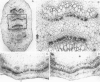
It is difficult to retain and localize radioactive, water-soluble compounds within plant cells. Existing techniques retain water-soluble compounds with varying rates of efficiency and are limited to processing only a few samples at one time. We developed a modified pressure infiltration technique for the preparation of microautoradiographs of 14C-labeled, water-soluble compounds in plant tissue. Samples from cottonwood (Populus deltoides Bartr. ex Marsh.) labeled with 14C were excised, quick frozen in liquid N2, freeze-dried at −50°C, and pressure-infiltrated with epoxy resin without intermediate solvents or prolonged incubation times. The technique facilitates the mass processing of samples for microautoradiography, gives good cellular retention of labeled water-soluble compounds, and is highly reproducible.
Full text
PDF


Images in this article
Selected References
These references are in PubMed. This may not be the complete list of references from this article.
- Dickson R. E., Larson P. R. Incorporation of C-photosynthate into major chemical fractions of source and sink leaves of cottonwood. Plant Physiol. 1975 Aug;56(2):185–193. doi: 10.1104/pp.56.2.185. [DOI] [PMC free article] [PubMed] [Google Scholar]
- Fisher D. B. Artifacts in the Embedment of Water-soluble Compounds for Light Microscopy. Plant Physiol. 1972 Feb;49(2):161–165. doi: 10.1104/pp.49.2.161. [DOI] [PMC free article] [PubMed] [Google Scholar]
- Fisher D. B., Housley T. L. The Retention of Water-soluble Compounds during Freeze-Substitution and Microautoradiography. Plant Physiol. 1972 Feb;49(2):166–171. doi: 10.1104/pp.49.2.166. [DOI] [PMC free article] [PubMed] [Google Scholar]
- Spurr A. R. A low-viscosity epoxy resin embedding medium for electron microscopy. J Ultrastruct Res. 1969 Jan;26(1):31–43. doi: 10.1016/s0022-5320(69)90033-1. [DOI] [PubMed] [Google Scholar]