


FIGURE 7.
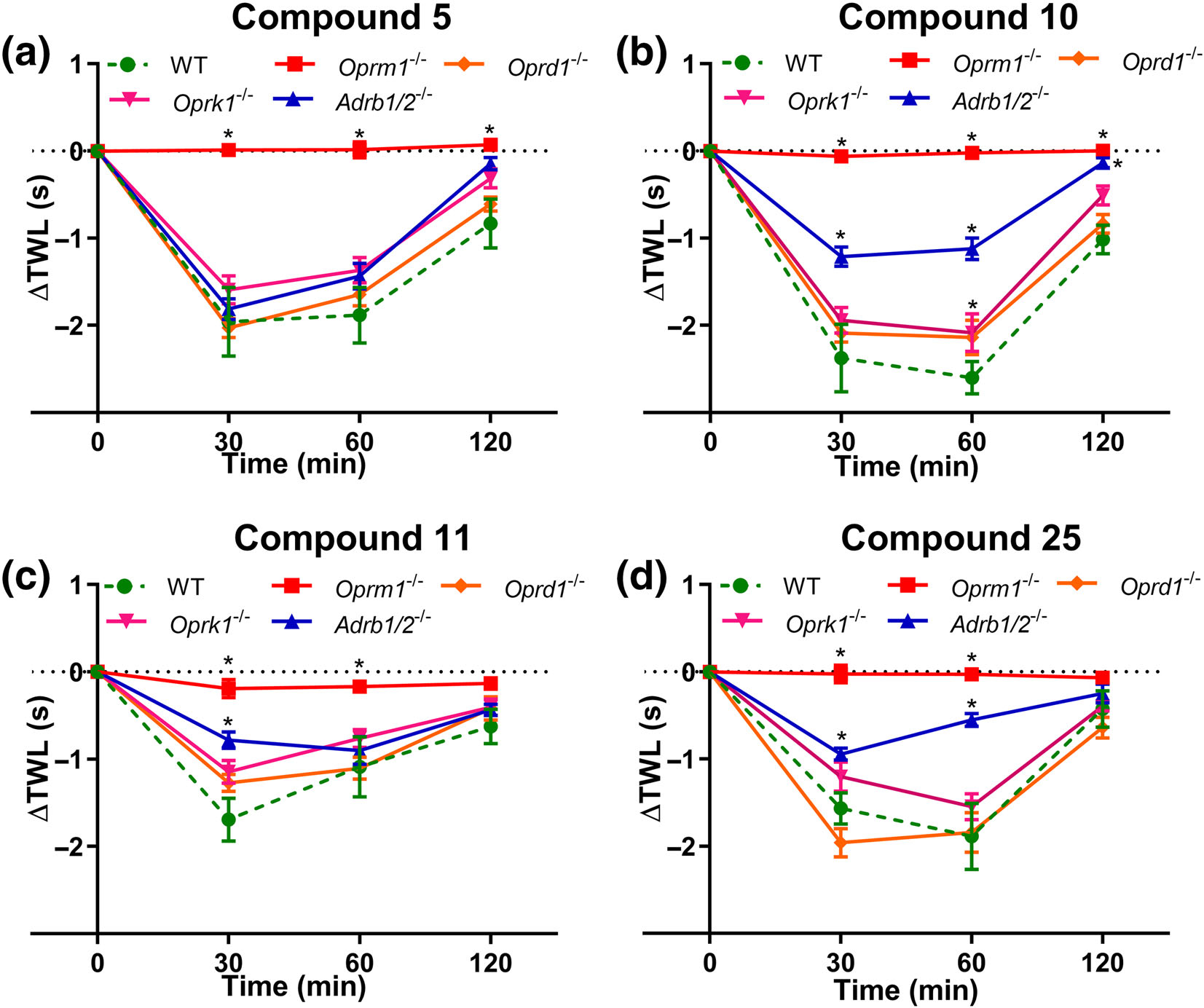
Pharmacological characterization of compounds (a) 5, (b) 10, (c) 11 and (d) 25 in adult male and female naïve Oprm1−/− (n = 8, 8, 6 and 6 for compounds 5, 10, 11 and 25, respectively), Oprd1−/− (n = 7, 7, 6 and 7 for compounds 5, 10, 11 and 25, respectively), Oprk1−/− (n = 9, 9, 6 and 9 for compounds 5, 10, 11 and 25, respectively), Adrb1/2−/− (n = 8, 8, 6 and 8 for compounds 5, 10, 11 and 25, respectively) and C57BL/6J mice (n = 8, 8, 7 and 10 for compounds 5, 10, 11 and 25, respectively). Homozygous ablation of Oprd1 or Oprk1 did not significantly affect the thermal hyperalgesia induced by ~ED75 doses of compounds 5, 10, 11 and 25 compared with wild-type C57BL/6 mice. In contrast, subcutaneous administration of an ~ED75 dose of all compounds - 5, 10, 11 and 25 - failed to produce thermal hyperalgesia in Oprm1−/− mice lacking both 6- and 7-TM MOR. Homozygous ablation of Adrb1 and Adrb2 only partly restored the thermal hypersensitivity induced by compounds 10, 11 and 25, but not the hyperalgesic effects of compound 5. Data presented as mean ± SEM. *P < 0.05, significantly different from WT C57BL/6 mice; two-way ANOVA with post hoc Bonferroni test