


Abstract
Objective:
There is little known about the medico-legal risk for infectious disease specialists in Canada. The objective of this study was to identify the causes of these medico-legal risks with the goal of improving patient safety and outcomes.
Methods:
A 10-year retrospective analysis of Canadian Medical Protective Association (CMPA) closed medico-legal cases from 2012 to 2021 was performed. Peer expert criticism was used to identify factors that contributed to the medico-legal cases at the provider, team, or system level, and were contrasted with the patient complaint.
Results:
During the study period there were 571 infectious disease physician members of the CMPA. There were 96 patient medico-legal cases: 45 College complaints, 40 civil legal matters, and 11 hospital complaints. Ten cases were associated with severe patient harm or death. Patients were most likely to complain about perceived deficient assessments (54%), diagnostic errors (53%), inadequate monitoring or follow-up (20%), and unprofessional manner (20%). In contrast, peer experts were most critical of the areas of diagnostic assessment (20%), deficient assessment (10%), failure to perform test/intervention (8%), and failure to refer (6%).
Conclusion:
While infectious disease physicians tend to have lower medico-legal risks compared to other health care providers, these risks still do exist. This descriptive study provides insights into the types of cases, presenting conditions, and patient allegations associated with their practice.
Keywords: Canada, infectious disease physicians, infections, malpractice, medico-legal risk
Abstract
Objectif :
On sait peu de choses sur les risques médico-légaux auxquels sont exposés les spécialistes des maladies infectieuses au Canada. L’objectif de cette étude est de cibler les causes qui sous-tendent ces risques et, ce faisant, d’améliorer la sécurité et l’issue clinique des patients.
Méthodes :
Une analyse rétrospective sur 10 ans des dossiers médico-légaux conclus par l’Association canadienne de protection médicale (ACPM) entre 2012 et 2021 a été effectuée. Des experts ont été consultés pour cerner les facteurs à l’origine des dossiers médico-légaux en question, que ce soit à l’échelle des prestataires de soins, des équipes ou du système, et ces facteurs ont été mis en parallèle avec les plaintes des patients.
Résultats :
Au cours de la période de l’étude, 571 médecins membres de l’ACPM étaient spécialisés dans le traitement des maladies infectieuses. Quatre-vingt-seize dossiers médico-légaux portant sur des patients ont été recensés : 45 plaintes auprès d’un Collège, 40 poursuites au civil et 11 plaintes intrahospitalières. Un préjudice grave ou un décès a été constaté dans dix dossiers. Les motifs de plainte les plus répandus chez les patients étaient les évaluations perçues comme déficientes (54 %), les erreurs de diagnostic (53 %), une surveillance ou un suivi inadéquats (20 %) et un comportement non professionnel (20 %). En revanche, les experts consultés se sont surtout montrés critiques à l’égard des évaluations diagnostiques (20 %), des évaluations déficientes (10 %), du manquement à faire un test ou une intervention (8 %) et du manquement à orienter quelqu’un vers une ou un collègue (6 %).
Conclusion :
Les risques médico-légaux des médecins spécialisés dans le traitement des maladies infectieuses sont généralement moindres que ceux d’autres professionnels de la santé. Néanmoins, ces risques existent. Cette étude descriptive jette un éclairage sur le type de dossiers associés à la pratique de ces médecins, sur les motifs de consultation et sur les allégations formulées par les patients.
Summary:
Infectious disease (ID) physicians play a vital role in managing a broad spectrum of illnesses, from common infections to complex conditions, through rapid disease detection, effective treatment, preventive measures, and appropriate use of antimicrobial agents. ID doctors generally have a lower risk of complaints and lawsuits compared to other types of doctors. However, these risks do still exist and are important to consider.
Our research team conducted a review of medico-legal cases over a 10-year period (2012–2021) involving ID physicians, with the goal of identifying why these problems occurred and how physicians might avoid them in the future. We examined why patients complained, what the types of diseases were, and the extent of patient harm. We also looked at which other types of doctors were most often involved in these cases.
Most of the cases were either complaints made to a college (47%) or civil legal cases (42%). The rate of cases remained relatively stable over the study period. Twenty percent of complaints were linked to conditions of the bones, muscles, and connective tissue, such as osteomyelitis and septic arthritis. More than half of the patients who complained specifically mentioned concerns with the physician's assessment or a diagnostic error. In contrast, when expert physicians reviewed these cases, they only identified diagnostic errors in 20% of cases, and deficient assessments in 10% of cases.
This research is important for two reasons. First, it may help to create a clearer picture of the current medico-legal landscape within the ID specialty. Second, by identifying areas of potential risk, it can guide the development of strategies to reduce these risks, thereby improving patient safety and trust in health care providers.
Mots-Clés : Canada, infections, médecins spécialisés dans le traitement des maladies infectieuses, risques médico-légaux, faute professionnelle
Introduction
Infectious disease (ID) physicians play a critical role in the diagnosis, treatment, and prevention of infectious diseases in Canada. Their work is fundamental to individual patient health and to the broader community, involving a wide variety of infections, from common ailments to more complex, less understood conditions (1–4). An ID physician's role often places them at the intersection of rapid disease detection, comprehensive management, prevention of disease transmission, and appropriate use of antimicrobial agents—all of which contribute to the overall health infrastructure of the country.
ID specialists face many of the same medico-legal risks as other physicians. Medico-legal risk in the context of health care practitioners refers to the potential legal issues that can arise from their practice of medicine. These issues include civil legal matters as well as complaints made to medical regulators (Colleges) or hospitals and may result from alleged delay in diagnosis or treatment (5–9), inadequate or poor communication with patients (10–12), breaches of patient confidentiality (13,14), and malpractice (15).
A comprehensive understanding of the medico-legal risks facing ID physicians is critical not only for optimizing patient safety, but also for the professional liability of physicians themselves and managing clinical risk (16–18).
In this paper, we explore the medico-legal risks of ID physicians in Canada through a retrospective analysis of medico-legal cases from the Canadian Medical Protective Association (CMPA). This research will also identify key themes, trends, and contributing factors for these medico-legal cases with the goal of informing strategies to improve patient safety, support ID physicians in their practice and provide insights into potential strategies for mitigating these risks.
Methods
Study design
We performed a 10-year retrospective descriptive quantitative and content analysis of medico-legal cases at the CMPA closed between January 1, 2012 and December 31, 2021. Cases included civil legal cases, medical regulatory authority (College), and hospital complaints.
The study included a 10-year medico-legal trend analysis and a 10-year contributing-factor analysis of cases involving ID physicians.
The CMPA and medico-legal coding
The CMPA is a mutual medical defence organization for Canadian physicians, which protects the professional integrity of physicians and promote safe medical care in Canada. Each case represents a matter voluntarily brought to the CMPA by a physician seeking medico-legal support. As of May 2020, the CMPA had over 109,000 physician-members, estimated as >95% of physicians in Canada. During this time course there were 571 CMPA members designated as infectious disease physicians (TOW-52) (0.5%).
Medico-legal cases supported by the CMPA are routinely coded using the contributing factors framework (19), based on peer expert review. Peer experts were individuals, usually physicians with training or experience similar to the named physician(s), who were retained by a party in the complaint to review case materials and attribute contributing factors to the patient safety incident. In this study, we categorize health care related harm for patients arising from different types of patient safety incidents, including inherent risk and harmful incident. Definitions of patient harm were adapted from the American Society for Healthcare Risk Management's Healthcare Associated Preventable Harm Classification Tool (20).
Case selection
Cases were included if there was at least one ID physician named in the complaint; some included cases had more than one physician named. We included all case outcomes and care settings.
Data abstraction
Abstracted data included patient age and gender, presenting conditions, and level of harm experienced. Data also included the area of specialty for each physician. Case types were stratified by civil legal actions, College complaints, and hospital complaints. Reporting on any subgroups with fewer than 10 cases, patients, or members is purposely limited to protect the privacy of patients and physicians.
Statistical analysis
In this study, we employed the PROC SQL procedure available in Statistical Analysis System (SAS) Enterprise Guide 8.3 to facilitate complex data manipulation and extraction tasks from CMPA membership database and CMPA case database. We performed descriptive statistics to summarize the central tendencies and variations in the collected variables. Median was used to measure the age that is robust to outliers. Wilson Confidence Interval was calculated for the case rates.
Ethics approval
The ethics review panel of the Advarra Institutional Review Board reviewed and approved the study in compliance with Canada's Tri-Council Policy Statement on the Ethical Conduct for Research Involving Humans (TCPS 2).
Results
Case characteristics
There were 96 cases involving ID physicians that closed between 2012 and 2021. Of the 96 cases, 45 were complaints made to a College (47%), 40 were civil legal cases (42%), and 11 were hospital complaints (11%) (Figure 1). Physician characteristics can be found in Table 1. The patient population consisted of 56% females and 43% males, with less than 1% unidentified. Patient age ranged, with the majority falling within the 30–64 and 65–79 years age groups. The median age was 52 (IQR 42–66) years.
Figure 1:
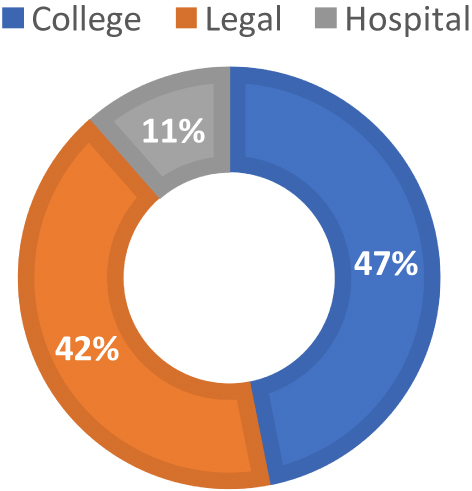
Breakdown of college, civil legal, and hospital complaint cases involving infectious disease physicians, Canadian Medical Protective Association (CMPA), 2012–2021 (n = 96 cases)
Table 1:
Ages of patients involved in medico-legal matters against infectious disease physicians
| Patient age range | No. of patients |
|---|---|
| 0–17 | <10 |
| 18–29 | <10 |
| 30–64 | 50 |
| Over 65 | 26 |
| Age missed | 8 |
Case rates
Figure 2 compares the case rate in ID physicians to that for all physicians. Rates of College complaints for ID physicians remained relatively stable throughout the study period, which was consistent with the rates of College complaints across other specialties. As seen in Figure 2, ID physicians have significantly lower case rates of College complaints compared to all of physician specialties (p < 0.01), whereas there was no significant difference between the rate of legal cases for ID physician and all physician specialties. The 10-year average case rate shows:
Figure 2:

Trend over a 10-year period of medico-legal cases involving infectious diseases and all CMPA members per 1,000 members, CMPA closed cases, 2012–2021
-
•
College: 18 per 1,000 ID physicians (95% CI 8–35) versus 48 per 1,000 all physicians (95% CI 47–49).
-
•
Legal: 12 per 1,000 ID physicians (95% CI 5–27) versus 15 per 1,000 all physicians (95% CI 14–15).
Patient presenting clinical condition
Table 2 provides the most frequent presenting conditions for which a patient was seen by an ID physician in these cases. There may be more than one presenting condition per case.
Table 2:
Most frequent clinical presentations among closed cases with a named infectious disease physician (n = 96)
| Clinical presentation | Example diseases | No. of cases |
|---|---|---|
| Diseases of musculoskeletal system and connective tissue | • Osteomyelitis • Septic arthritis |
19 (20%) |
| Diseases of the respiratory system | • Acute respiratory failure • Pneumonia |
11 (11%) |
| Diseases of the nervous system | • Spinal abscess • Cord compression |
10 (10%) |
| Diseases of the skin and subcutaneous tissue | • Cellulitis, skin ulcers | 8 (8%) |
| Diseases of the genitourinary system | • Prostatitis, vaginitis | 5 (5%) |
| Diseases of the circulatory system | • Endocarditis | 5 (5%) |
| Diseases of the digestive system | • Ulcerative colitis | <5 |
| Neoplasms | <5 | |
| Diseases of the eye and adnexa | • Chorioretinitis | <5 |
| Diseases of the ear and mastoid process | • Chronic otitis media | <5 |
Note: A patient may have had more than one presenting condition. Clinical categories with less than five cases were suppressed due to patient privacy
Patient allegations and peer expert criticisms
Allegations reflect the patient or caregivers’ perception of the problem(s) that occurred during care, while peer expert opinions focus on whether the standard of care was met. There may be more than one allegation per case, and patient allegations do not necessarily align with peer expert criticisms. By their nature, all 96 medico-legal cases had at least one patient complaint. Of those cases, only 35 had documented peer expert criticism of the care provided by the ID physician.
Figures 3A and 3B compare the percentage of contributing factors that reflect peer expert criticism with the most common reasons for complaint. Patient complaints frequently included allegations of deficient assessments (52 cases), diagnostic errors (51 cases), inadequate monitoring or follow-up (19 cases), and unprofessional manner (19 cases). In contrast, peer experts were most likely to criticize diagnostic errors (19 cases), deficient assessments (10 cases), and failure to perform tests or interventions (8 cases). Notably, patient allegations and peer expert criticisms did not necessarily align. For example, 54 patients alleged that their physician conducted a deficient assessment; in only eight of those cases did the peer expert agree that the assessment was deficient. Furthermore, there were two cases where the patient did not feel they received a deficient assessment, but the peer expert identified this as an area of criticism.
Figure 3:


The most common allegations from patients (A) and documented criticisms from peer experts (B) in closed medico-legal cases (n = 96) involving infectious disease physicians, 2012–2021
Patient harm
In the 96 cases involving ID physicians, 38% (36/96) experienced health care–related harm that had a negative effect on their health or quality of life as determined by peer expert review. Harm ranged from mild (eg, ID physician prescribed prolonged course of antibiotics that caused long-term side effects) to severe (eg, delayed diagnosis of a diabetic foot ulcer that led to infection requiring an amputation). There were three cases that resulted in death.
Health care–related harm can occur despite well-managed care, and for 14% of patients (13/96), peer experts supported the clinical care that patients received and concluded the harm was an inherent risk of the investigation, medication or treatment provided. In 24% of the cases (23/96), there was a patient safety incident that resulted in harm to the patient. Of note, patient harms may be related to other clinical issues on the file and not necessarily resulting from the ID physician's care.
Physician characteristics
There was a total of 175 physicians named in the 96 cases, of whom 102 were ID specialists. In 56 (58%) cases, the ID specialist was the only member named in the complaint. In 40 (42%) cases, at least one additional physician was named, most commonly from the specialties of family medicine and emergency medicine. The cases were decided against the named physician in 26% of cases.
Discussion
In this study, we explore the medico-legal risks of ID physicians in Canada. College complaints and civil legal cases represented the majority of cases in our sample, and rates of these cases for ID physicians have remained relatively stable since 2012. These findings are consistent with those reported in other jurisdictions, which suggest that ID physicians face comparatively lower medico-legal risk than other specialties (14,21).
A portion of cases involved other medical specialties, primarily emergency medicine and family medicine. As these specialties are frequently involved in preliminary diagnosis management of infections, and identifying the need for specialist intervention, their interaction with ID physicians is to be expected (22). A study by Braam et al. (2022) underscores the critical role of inter-physician collaboration in enhancing patient care and outcomes. They found that effective physician collaboration improves patient care, safety, and efficiency, while reducing error rates and medico-legal risk.
Further, a significant proportion of medico-legal complaints were associated with diseases of the musculoskeletal system and connective tissue, such as osteomyelitis and septic arthritis, which are common infections faced by ID physicians in their practice (23–25). By highlighting these findings, ID physicians can gain a better understanding of the clinical scenarios most frequently associated with patient safety incidents, as well as legal and College complaints, enabling them to take proactive measures to address these issues in their practice.
Although ID specialists typically have a lower rate of medico-legal cases compared to other physicians, 38% of cases resulted in patient harm or death. These incidents often involved delay or mismanagement of medication or complications related to existing comorbidities, leaving ID physicians in incredibly challenging and complex clinical situations. These harmful incidents can have significant individual implications, affecting the life of the patient and their trust in their physician (26–28). Further, these incidents can impact the patient's perception and trust in medical institutions, shaping their overall view of the health care system (29,30). The contrast between patient allegations and peer expert opinion presents another opportunity for targeted improvement in several areas of care. For example, while 54% of patients expressed concerns over deficient assessment in their care, peer experts identified deficiencies in clinical assessments in only 10% of cases. What does this disparity imply? Our results suggest that even when peer experts felt that the clinical standard of care had been met, patients were still sufficiently dissatisfied that they filed a medico-legal complaint. These findings point to potential issues in physician–patient communication and management of expectations, especially around diagnoses and treatment plans. We see elsewhere how effective physician communication and empathy are shown to foster patient trust, reduce misunderstandings, and empower patients to become active participants in their own care (31–34). As echoed in prior literature, these soft skills, including interpersonal skills such as listening, communicating, and empathizing, may hold as much significance as medical expertise in delivering quality patient care (35–37). By enhancing patient understanding and aligning expectations earlier on in the treatment process, physicians can potentially reduce the incidence of complaints, which, in turn, could lower their medico-legal risk. One recent study shows that the relational aspects of medical practice, including physician–patient relationship, have the highest potential to decrease the number of malpractice complaints (38).
Looking beyond the perception of care, one area that received the highest percentage of criticism from peer experts was diagnostic error. Diagnostic error has been identified as a factor contributing to medico-legal risk in a variety of clinical areas, including emergency medicine and surgery (5,6,8,10,39,40). ID specialists are skilled diagnosticians, but in 20% of our cases peer experts identified diagnostic errors. ID physicians might consider how factors such as cognitive bias and other errors in clinical reasoning can affect their diagnostic process (41,42). For example, in clinical reasoning an anchoring bias occurs when a physician or care team remains focused on an early differential diagnosis despite subsequent signs and symptoms that suggest the need to consider alternative diagnoses (43,44). Strategies such as deliberate reflection, the collective intelligence of the care team, and the use of decision support systems may be useful for any physician to consider in their diagnostic process (42,45–47).
This study has some important limitations. Although data in this study were manually reviewed to ensure data quality, retrospective studies are limited by the accuracy of their source material, which in this case is the available medical and legal records. The descriptive methods allow an overview of the medico-legal landscape in the area of infectious diseases, but do not provide strong evidence of associations between patient or physician variables. Members report medico-legal matters to the CMPA at their own discretion, and this analysis may not include all Canadian medico-legal cases involving ID specialists. Due to the voluntary nature of the data, we cannot determine the exact proportion of cases involving ID specialists in Canada, nor can we deduce if a specific clinical presentation increases medicolegal risk. Finally, this study focused exclusively on Canadian cases; the findings may not be generalizable to different health care systems or legal environments.
Looking ahead, there are several research opportunities emerging from this study. A detailed investigation into the elements contributing to deficient assessment and diagnostic errors might reveal areas for medical education and practice improvements. A comparative study across other medical specialties could also deepen our understanding of the medico-legal landscape, highlighting the specific challenges unique to each field and those shared across the health care sector.
In conclusion, this study describes the medico-legal risk of ID physicians. While this specialty has a relatively lower medico-legal risk that has remained stable during the last decade, a significant portion of the reviewed cases were associated with patient harm. There may be an opportunity to reduce medico-legal risk by building an understanding of how cognitive biases may impact the diagnostic process, and by practising effective physician–patient communication.
Funding Statement
This study was funded by the Canadian Medical Protective Association.
Contributors:
Conceptualization, K Pacheco, J Fortier, G Garber; Data curation, J Ju, K Barbosa, K Lemay; Formal analysis, J Ji, K Lemay; Methodology, J Ji, K Barbosa, K Lemay, J Fortier, G Garber; Writing – original draft, K Pacheco; Writing – review & editing, K Pacheco, J Ji, K Barbosa, K Lemay, J Fortier, G Garber; Software, J Ji; Visualization, J Ji, K Barbosa, K Lemay; Project administration, J Fortier, G Garber; Supervision, J Fortier, G Garber
Ethics Approval:
N/A
Informed Consent:
N/A
Registry and The Registration no. of the Study/Trial:
N/A
Data Accessibility:
N/A
Funding:
This study was funded by the Canadian Medical Protective Association.
Disclosures:
All authors were employees of the Canadian Medical Protective Association, a not-for-profit mutual defense organization for physicians, at the time of this study. No other competing interests were declared.
Peer Review:
This manuscript has been peer reviewed.
Animal Studies:
N/A
References
- 1.Bouiller K, Peiffer-Smadja N, Cevik M, Last K, Antunović IA, Šterbenc A, et al. Role and perception of clinical microbiology and infectious diseases trainees during the COVID-19 crisis. Future Microbiol. 2022;17:411–6. [DOI] [PMC free article] [PubMed] [Google Scholar]
- 2.McCarthy MW, Walsh TJ. The rise of hospitalists: an opportunity for infectious diseases investigators. Expert Rev Anti Infect Ther. 2018;16(5):385–9. [DOI] [PubMed] [Google Scholar]
- 3.Norrby SR. Infectious disease emergencies: role of the infectious disease specialist. Clin Microbiol Infect. 2005;11 Suppl 1:9–11. [DOI] [PMC free article] [PubMed] [Google Scholar]
- 4.Zahn M, Adalja AA, Auwaerter PG, Edelson PJ, Hansen GR, Hynes NA, et al. Infectious Diseases Physicians: Improving and Protecting the Public's Health: Why Equitable Compensation Is Critical. Clin Infect Dis. 2019;69(2):352–6. [DOI] [PMC free article] [PubMed] [Google Scholar]
- 5.Senard O, Houselstein T, Crémieux AC. Reasons for Litigation in Arthroplasty Infections and Lessons Learned. J Bone Joint Surg Am. 2019;101(20):1806–11. [DOI] [PubMed] [Google Scholar]
- 6.Kessler RA, Benzil DL, Loewenstern J, Chen S, Bhammar A, Kohli KM, et al. Malpractice Litigation in Brain Tumor Surgery: A 31-Year Analysis of Causative Factors in the United States from the Westlaw Database. World Neurosurg. 2019;122:e1570–e7. [DOI] [PubMed] [Google Scholar]
- 7.Cioffi A, Cecannecchia C. Hepatitis outbreak in children: Medico-legal implications and liability protection. Have we learned anything from the COVID-19 pandemic? Front Public Health. 2022;10:989433. [DOI] [PMC free article] [PubMed] [Google Scholar]
- 8.Ring J, Talbot C, Cross C, Hinduja K. NHSLA litigation in hip fractures: Lessons learnt from NHSLA data. Injury. 2017;48(8):1853–7. [DOI] [PubMed] [Google Scholar]
- 9.Neilson HK, Fortier JH, Finestone P, Ogilby CM, Liu R, Bridges EJ, et al. Diagnostic Delays in Sepsis: Lessons Learned From a Retrospective Study of Canadian Medico-Legal Claims. Critical Care Explorations. 2023;5(2):e0841. [DOI] [PMC free article] [PubMed] [Google Scholar]
- 10.Pfaff R, Berkeley RP, Moore G, Heniff M. Duty to Warn in the Emergency Department: Three Medical Legal Cases That Illustrate Providers’ Broad Risk and Liability. Clin Pract Cases Emerg Med. 2020;4(3):285–8. [DOI] [PMC free article] [PubMed] [Google Scholar]
- 11.Mouton J, Gauthé R, Ould-Slimane M, Bertiaux S, Putman S, Dujardin F. Litigation in orthopedic surgery: What can we do to prevent it? Systematic analysis of 126 legal actions involving four university hospitals in France. Orthop Traumatol Surg Res. 2018;104(1):5–9. [DOI] [PubMed] [Google Scholar]
- 12.Busetti F, Baffoni G, Tocco Tussardi I, Raniero D, Turrina S, De Leo D. Policies and practice in the disclosure of medical error: Insights from leading countries to address the issue in Italy. Med Sci Law. 2021;61(1_suppl):88–91. [DOI] [PubMed] [Google Scholar]
- 13.Applebaum J, Humphries LA, Nepps ME, Berger DS, O’Neill K. Malpractice litigation surrounding in vitro fertilization in the United States: a legal literature review. Fertil Steril. 2023;119(4):572–80. [DOI] [PubMed] [Google Scholar]
- 14.Frati P, Gulino M, Turillazzi E, Zaami S, Fineschi V. The physician's breach of the duty to inform the parent of deformities and abnormalities in the foetus: “wrongful life” actions, a new frontier of medical responsibility. J Matern Fetal Neonatal Med. 2014;27(11):1113–7. [DOI] [PubMed] [Google Scholar]
- 15.Jena AB, Seabury S, Lakdawalla D, Chandra A. Malpractice Risk According to Physician Specialty. New England Journal of Medicine. 2011;365(7):629–36. [DOI] [PMC free article] [PubMed] [Google Scholar]
- 16.Treglia M, Pallocci M, Passalacqua P, Sabatelli G, De Luca L, Zanovello C, et al. Healthcare. 2022;10(7):1336. [DOI] [PMC free article] [PubMed] [Google Scholar]
- 17.Bolcato M, Rodriguez D, Aprile A. Risk Management in the New Frontier of Professional Liability for Nosocomial Infection: Review of the Literature on Mycobacterium Chimaera. Int J Environ Res Public Health. 2020;17(19). [DOI] [PMC free article] [PubMed] [Google Scholar]
- 18.Sanavio M, Anna A, Bolcato M. Mycobacterium Chimaera: Clinical and medico-legal considerations starting from a case of sudden acoustic damage. Leg Med (Tokyo). 2020;47:101747. [DOI] [PubMed] [Google Scholar]
- 19.McCleery A, Devenny K, Ogilby C, Dunn C, Steen A, Whyte E, et al. Using medico-legal data to support safe medical care: A contributing factor coding framework. J Healthc Risk Manag. 2019;38(4):11–8. [DOI] [PubMed] [Google Scholar]
- 20.Hoppes MJ. Serious safety events: A focus on Harm Classification: Deviation in care as link. Edition No. 2 ed: Chicago, Illinois: American Society for Healthcare Risk Management; 2014. [Google Scholar]
- 21.Hickson GB, Federspiel CF, Pichert JW, Miller CS, Gauld-Jaeger J, Bost P. Patient Complaints and Malpractice Risk. JAMA, 2002;287(22):2951–57. 10.1001/jama.287.22.2951 [DOI] [PubMed] [Google Scholar]
- 22.Hogue AL, Allison JR, Shafer CW, Huntington MK. Infectious Disease: Community Response to Emerging Infectious Diseases. FP Essent. 2019;476:25–9. [PubMed] [Google Scholar]
- 23.Romanò CL, Tsantes AG, Papadopoulos DV, Tsuchiya H, Benzakour T, Benevenia J, et al. Infectious disease specialists and teamwork strategies worldwide: the World Association against Infection in Orthopedics and Trauma (WAIOT) and SICOT continue to cooperate in fighting musculoskeletal infections. Sicot j. 2022;8:E1. [DOI] [PMC free article] [PubMed] [Google Scholar]
- 24.Le Saux N. Diagnosis and management of acute osteoarticular infections in children. Paediatr Child Health. 2018;23(5):336–43. [DOI] [PMC free article] [PubMed] [Google Scholar]
- 25.Hadano Y, Kosaka S, Tomoda Y, Awaya Y, Kato R. Infectious diseases consultations from general internal medicine physicians in Japan: A descriptive single-center study. Medicine (Baltimore). 2022;101(47):e31896. [DOI] [PMC free article] [PubMed] [Google Scholar]
- 26.Mollborn S, Stepanikova I, Cook KS. Delayed care and unmet needs among health care system users: when does fiduciary trust in a physician matter? Health Serv Res. 2005;40(6 Pt 1):1898–917. [DOI] [PMC free article] [PubMed] [Google Scholar]
- 27.Pearson SD, Raeke LH. Patients’ trust in physicians: many theories, few measures, and little data. J Gen Intern Med. 2000;15(7):509–13. [DOI] [PMC free article] [PubMed] [Google Scholar]
- 28.Mechanic D, Schlesinger M. The impact of managed care on patients’ trust in medical care and their physicians. Jama. 1996;275(21):1693–7. [PubMed] [Google Scholar]
- 29.Skirbekk H, Magelssen M, Conradsen S. Trust in healthcare before and during the COVID-19 pandemic. BMC Public Health. 2023;23(1):863. [DOI] [PMC free article] [PubMed] [Google Scholar]
- 30.Smith CP. First, do no harm: institutional betrayal and trust in health care organizations. J Multidiscip Healthc. 2017;10:133–44. [DOI] [PMC free article] [PubMed] [Google Scholar]
- 31.Ganesh K. Patient-doctor relationship: Changing perspectives and medical litigation. Indian J Urol. 2009;25(3):356–60. [DOI] [PMC free article] [PubMed] [Google Scholar]
- 32.Chaitoff A, Sun B, Windover A, Bokar D, Featherall J, Rothberg MB, et al. Academic Medicine. 2017;92(10):1464–71. [DOI] [PubMed] [Google Scholar]
- 33.Street RL, Jr., Gordon H, Haidet P. Physicians’ communication and perceptions of patients: is it how they look, how they talk, or is it just the doctor? Soc Sci Med. 2007;65(3):586–98. [DOI] [PMC free article] [PubMed] [Google Scholar]
- 34.Wang H, Kline JA, Jackson BE, Laureano-Phillips J, Robinson RD, Cowden CD, et al. Association between emergency physician self-reported empathy and patient satisfaction. PLOS ONE. 2018;13(9):e0204113. [DOI] [PMC free article] [PubMed] [Google Scholar]
- 35.Tavakoly Sany SB, Behzhad F, Ferns G, Peyman N. Communication skills training for physicians improves health literacy and medical outcomes among patients with hypertension: a randomized controlled trial. BMC Health Serv Res. 2020;20(1):60. [DOI] [PMC free article] [PubMed] [Google Scholar]
- 36.Reynolds A. Patient-centered Care. Radiol Technol. 2009;81(2):133–47. [PubMed] [Google Scholar]
- 37.Schenk EC, Bryant RA, Van Son CR, Odom-Maryon T. Perspectives on Patient and Family Engagement With Reduction in Harm: The Forgotten Voice. J Nurs Care Qual. 2019;34(1):73–9. [DOI] [PubMed] [Google Scholar]
- 38.Hanganu B, Manoilescu IS, Paparau C, Gheuca-Solovastru L, Buhas CL, Szalontay AS, et al. Why Are Patients Unhappy with Their Healthcare? A Romanian Physicians’ Perspective. Int J Environ Res Public Health. 2022;19(15). [DOI] [PMC free article] [PubMed] [Google Scholar]
- 39.Cortel-LeBlanc MA, Lemay K, Woods S, Bakewell F, Liu R, Garber G. Medico-legal risk and use of medical directives in the emergency department. Cjem. 2023. [DOI] [PubMed]
- 40.Calder LA, Whyte EM, Neilson HK, Zhang C, Barry TK, Barry SP. Trends and Contributing Factors in Medico-legal Cases Involving Spine Surgery. Spine. 2022;47(11):E469–E76. [DOI] [PubMed] [Google Scholar]
- 41.Croskerry PS, Geeta; Mamede, Sílvia. Cognitive debiasing 2: impediments to and strategies for change. BMJ Quality & Safety. 2013;22(Suppl_2):ii65–ii72. [DOI] [PMC free article] [PubMed] [Google Scholar]
- 42.Schaller-Paule MA, Steinmetz H, Vollmer FS, Plesac M, Wicke F, Foerch C. Lessons in clinical reasoning – pitfalls, myths, and pearls: the contribution of faulty data gathering and synthesis to diagnostic error. Diagnosis. 2021;8(4):515–24. [DOI] [PubMed] [Google Scholar]
- 43.Vick A, Estrada CA, Rodriguez JM. Clinical Reasoning for the Infectious Disease Specialist: A Primer to Recognize Cognitive Biases. Clinical Infectious Diseases. 2013;57(4):573–8. [DOI] [PubMed] [Google Scholar]
- 44.Norman GR, Monteiro SD, Sherbino J, Ilgen JS, Schmidt HG, Mamede S. The Causes of Errors in Clinical Reasoning: Cognitive Biases, Knowledge Deficits, and Dual Process Thinking. Academic Medicine. 2017;92(1):23–30. [DOI] [PubMed] [Google Scholar]
- 45.Sibbald M, Monteiro S, Sherbino J, LoGiudice A, Friedman C, Norman G. Should electronic differential diagnosis support be used early or late in the diagnostic process? A multicentre experimental study of Isabel. BMJ Quality & Safety. 2022;31(6):426–33. [DOI] [PMC free article] [PubMed] [Google Scholar]
- 46.Tversky A, Kahneman D. Judgment under Uncertainty: Heuristics and Biases. Science. 1974;185(4157):1124–31. [DOI] [PubMed] [Google Scholar]
- 47.Croskerry P. From Mindless to Mindful Practice — Cognitive Bias and Clinical Decision Making. New England Journal of Medicine. 2013;368(26):2445–8. [DOI] [PubMed] [Google Scholar]
Associated Data
This section collects any data citations, data availability statements, or supplementary materials included in this article.
Data Citations
Data Availability Statement
N/A