



Abstract
Biomaterial associated microbial infection and blood thrombosis are two of the barriers that inhibit the successful use of implantable medical devices in modern healthcare. Modification of surface topography is a promising approach to combat microbial infection and thrombosis without altering bulk material properties necessary for device function and without contributing to bacterial antibiotic resistance. Similarly, the use of other antimicrobial techniques such as grafting poly(ethylene glycol) (PEG) and nitric oxide (NO) release also improve the biocompatibility of biomaterials. In this review, we discuss the development of surface texturing techniques utilizing ordered submicron-size pillars for controlling bacterial adhesion and biofilm formation, and we present combinatorial approaches utilizing surface texturing in combination with poly(ethylene glycol) (PEG) grafting and NO release to improve the biocompatibility of biomaterials. The manuscript also discusses efforts towards understanding the molecular mechanisms of bacterial adhesion responses to the surface texturing and NO releasing biomaterials, focusing on experimental aspects of the approach.
1. Introduction
Medical devices are ubiquitous in modern health care. Devices ranging in complexity from simple catheters to valves, stents, and grafts, and even to highly complex artificial organs such as in-dwelling pumps, extra-corporeal membrane oxygenators and cardiac replacement devices such as ventricular assist devices and artificial hearts all require materials that come into significant contact with biological systems as an essential technology for these devices. Biomaterials exhibiting sufficient biocompatibility including hemocompatibility for both short- and long- term implantation remain a limiting factor in the development of advanced versions of these devices. After decades of focused research and literally thousands of publications, two important device associated complications, blood thrombosis (Rose et al., 2001;Jaffer et al., 2015;Susen et al., 2015) and microbial infection (Pereda and Conte, 2011;VanEpps and Younger, 2016), remain significant barriers to the implementation of blood-contacting medical devices. Device associated thrombosis is initiated by both activation of the blood plasma coagulation cascade as device surfaces come into contact with blood and activate the zymogens of the coagulation cascade, and also from platelet adhesion/activation to plasma proteins adsorbed on the device surfaces. Infection is initiated by pathogenic bacterial adhesion to adsorbed proteins followed subsequently by biofilm formation and maturation(Gorbet and Sefton, 2004;Rochford et al., 2012;Labarrere et al., 2020). Both of these important biological reactions are related to the materials used in these devices, but more importantly, they are specifically influenced by the surface properties of materials. The development of new biomaterials possessing multifunctional surfaces with anti-thrombotic and anti-microbial properties is going to be necessary for the continued development and application of biomaterials in advanced implantable medical devices.
While the bulk material properties such as strength and flexibility will usually determine the suitability of the material for an application in medical devices, the physical and/or chemical properties of the material surface are paramount to the successful function of many biomedical devices and are largely determinant of the biocompatibility. Surface engineering and modification becomes an important strategy to allow medical-device designers to retain desirable bulk properties while improving the biocompatibility (Yaseen et al., 2011;Vogler, 2013). There are many methods of surface modifications ranging from chemical(Balakrishnan et al., 2005;Monika et al., 2015) and physical (Variola et al., 2009;Harvey et al., 2013) modifications of the original surface, and to the use of coatings as a biological-contacting layer(Song et al., 2020b;Mitra et al., 2021). Physical modification results in a change in the topography or morphology of the surface with little to no change in the chemistry, while chemical treatment results in surface functionalization, oxidization, or ion infusion, for example (Bose et al., 2018). The goal of these approaches is to modify the material surface properties known to influence biocompatibility such as surface topography, water wettability (surface energy), surface chemistry, surface charge, surface chemical patterns, and roughness, in order to create a chemical and/or physical environment that offers a favorable response to hard or soft tissue while simultaneously minimizing adverse responses such as pathogenic infections or thrombosis while contacting with blood, thereby improving the success of these biomaterials in medical applications.
Surface topographical modification is an attractive research field in improvement of biological responses to implanted devices with unique cell-protein-surface interactions (Harawaza et al., 2021). When a medical device is implanted into the body, proteins from blood, interstitial fluid, or other fluid sources will immediately adsorb on material surfaces and form a layer that influences the subsequent cell interactions. Surface topography such as grooves and ridges or pits and pillars can have a dramatic effect on both the plasma protein adsorption and the subsequent cell-surface interactions (Lord et al., 2010;Hasan et al., 2018a). Numerous experimental studies have shown that macro, micro, and even nanoscale features mediate the adherence, proliferation, and migration of cells (Hansen et al., 2007;Anselme et al., 2010;Estévez et al., 2014;Jeon et al., 2014;Sousa et al., 2019). Surface topography also influences bacterial adhesion responses (Perera-Costa et al., 2014;Chang et al., 2018) and platelet adhesion and activation (Park et al., 2001b;Koh et al., 2010), and simulation studies of pillars embedded in a hydrogel matrix demonstrate a reduction in bacterial adhesion(Liu and Balazs, 2018). Since cells must compete with bacteria for surface space in many environments, the creation of bacteria-repellent surfaces using topography becomes highly important for tissue engineering. A large number of studies have been conducted to investigate how micron- and nano- scale topographies affect bacterial adhesion and biofilm formation, and to explore the possibility of promoting host tissue growth while inhibiting bacterial adhesion(Hsu et al., 2013;Perera-Costa et al., 2014;Liu et al., 2016;Chang et al., 2018;Hasan et al., 2018b). Although certain features were found to promote bacterial attachment and biofilm formation, the most successful features were identified as having an antifouling function. These features ranged from nano- to micro- scale, and could be either well-defined or have a relatively random size and distribution, they may have been designed or inspired from natural antifouling surfaces or been engineered as a novel surface structure, and may have been tested on polymeric and metallic materials, yet all these materials have in common that they can show significant control of bacterial adhesion and biofilm formation. Surface topographies can also show reductions in platelet adhesion and activation, providing a feasible approach for reducing the thrombogenicity of biomaterials (Milner et al., 2006;Koh et al., 2010). Because this technique generates multifunctional surfaces, topographic modification has come to the fore in the area of antimicrobial and anti-biofouling materials (Graham and Cady, 2014;Rigo et al., 2018;Echeverria et al., 2020;Yang et al., 2021a), and is a promising approach to design implant surfaces for improved biocompatibility of medical devices (Harvey et al., 2013;Bose et al., 2018;Demirci et al., 2022).
To date, there is no material or technique that has proven ideal for controlling microbial infection or thrombosis on implanted medical devices. While surface topography modification has shown significant antimicrobial and antithrombotic effects and has been extensively studied, this use of a single approach still has its limitations. For example, the presence of small number of surface defects following fabrication of physical surface modification such as missed or collapsed structures may lead to local adhesion that can amplify leading to formation of a platelet mass or biofilm. Furthermore, the adsorption of biological components on topographic surfaces during long term exposure may lead to a loss in surface effectiveness, resulting in biofouling or thrombosis. A combination of two or more different strategies is a practical approach to achieve maximum biological performances of biomaterials, both in controlling microbial infections (Song et al., 2020a;Zou et al., 2021) and inhibiting potential for thrombotic events (Ashcraft et al., 2021), by balancing the pros and cons of each of the strategies. The combination of surface topography modification with other techniques may overcome the shortcomings of each individual approach and provide potentially additive or even synergetic effects on increasing the antimicrobial and/or antithrombotic performances of biomaterials. In this review, we will discuss recent developments in surface texturing techniques and combinatorial approaches of surface techniques with other strategies such as grafting of poly(ethylene glycol) (PEG) and nitric oxide (NO) release to improve biocompatibility of implanted biomaterials.
2. Surface texturing
2.1. Basic theories of surface topography influences on bacterial adhesion responses to surface.
In general, surface topography modification falls into two categories of patterns depending on the size of features, microscale and nanoscale, with these having different mechanisms in controlling bacterial adhesion and biofilm formation. Some of these surfaces were inspired from naturally existing antifouling surfaces such as plant leaves(Fu et al., 2018), shark skin(Chung et al., 2007), and insect wings(Ivanova et al., 2017). Normally, microscale topographies do not have direct bactericidal effects, but may inhibit bacterial adhesion through influencing bacteria-material interactions, while some nanoscale topographies were created to inhibit biofilms by killing bacteria through mechanical forces(Linklater et al., 2021). Surface topography modification alters surface properties including roughness, surface energy (surface wettability), and hydrodynamic forces at the interface which influence bacterial adhesion, and by influencing initial bacterial adhesion they limit the subsequent biofilm formation. Bacteria can employ a variety of mechanisms to colonize terrains with diverse surface topographies. Understanding how surface topography influences bacteria responses is essential for rational design of antifouling materials. Recent reviews on how bacterial cells respond to micro- and nano- scale topography provide a good summary of the most relevant work in this field (Cheng et al., 2019b;Lee et al., 2021).
Microscale patterns have been shown to influence bacterial adhesion behavior of different strains on various material surfaces including polymeric and metallic materials. Topographic features such as pattern size, shape, and distribution play an important role in bacterial attachment and biofilm formation (Perera-Costa et al., 2014). It is a common observation that bacterial adhesion is reduced as the size of the pattern is smaller, especially when the size is reduced below a micron, as the bacterial cells are unable to access the underlying surface between features and the overall interaction area between cell and surface is reduced (Ge et al., 2015;Wang et al., 2015). Bacterial cells can also actively sense the microscale surface topography and choose their position to settle during adhesion. There is evidence to show that cells can sense the conditions and will maximize contact area with the surfaces. This results in a specific alignment of the cells depending on the arrangement of the topographical details(Hsu et al., 2013). The edge areas of features are often the locations where bacteria prefer localization(Wang et al., 2015). Bacterial structures such as flagella, type-IV pili, and envelope proteins (Friedlander et al., 2013;Gu et al., 2016;Gordon and Wang, 2019) have been found important in sensing and responding the physical properties of a surface.
The nanostructure of insect wings has inspired many studies and designs for controlling bacterial adhesion and biofilm formation. The first example of a nanostructure that kills bacteria was reported on the surface of clanger cicada (Psaltoda claripennis) wings where Pseudomonas aeruginosa cells were found not to be repelled by the topography, but instead the nanopillar arrays present on the wing surface penetrated the bacteria, resulting in cell death(Ivanova et al., 2012). Further studies showed that nanopillars on cicada wings effectively kill Gram-negative cells, but Gram-positive cells remain resistant due to their thick cell wall, suggesting that the cell mechanical properties, in particular cell rigidity, are important factors in determining bacterial resistance/sensitivity to the bactericidal nature of the wing surface (Hasan et al., 2013;Pogodin et al., 2013). More nano-topographic surfaces designed to mimic the nanostructure of insect wing were created on a variety materials and found to have strong bactericidal effects, e.g., vertically aligned carbon nanotubes (Linklater et al., 2018), black silicon(Ivanova et al., 2013), and gold (Wu et al., 2016). The discovery of insect wing nanostructures and the development of new biomimicking antibacterial nanostructured surfaces represents a new generation of biomaterials that can kill bacteria on contact based solely on physical surface structure(Linklater et al., 2021).
Modification of surface topography can alter surface wettability, resulting in significant effect on bacterial adhesion. Two models, the Wenzel and Cassie-Baxter states, have been developed to describe wetting of a topographically modified surface. In Wenzel state, the surface topography enhances both hydrophobicity and hydrophilicity depending on the nature of the corresponding flat surface and always amplifies the intrinsic wettability of a surface, while in Cassie-Baxter state, air is entrapped within the features of the topography and the sessile water drop is supported by a composite surface of air and the substrate solid, resulting in increased hydrophobicity. The wetting state of surface topography apparently affects bacterial adhesion. An important example in nature is that the micro- or nano- structures on lotus and rice leaves make the surface superhydrophobic and exhibit excellent self-cleaning effects and non-contamination(Feng et al., 2002). We created a series of submicron and micron sized textured pillar surfaces using polyurethane (PU) biomaterials, and then modified one set of these surfaces to be hydrophilic through glow discharge air plasma treatment. Results showed that the original textured hydrophobic surfaces showed significant reductions in adhesion of Stapholoccus epidermidis under shear as compared to smooth surfaces, regardless of the sizes of the patterns. However, bacterial adhesion on hydrophilic surfaces was dependent on the size of patterns. The submicron patterned surfaces showed reduced bacterial adhesion while the micron pattern surfaces were found to have increased bacterial adhesion. The data suggest that both the increased surface hydrophobicity and decreased availability of contact area contribute to a reduction in bacterial adhesion on hydrophobic textured surfaces, while in the case of hydrophilic textured surfaces, the availability of contact area is the primary determinant factor for bacterial adhesion (Xu and Siedlecki, 2014).
The wettability of textured surfaces may also be transient and can change the adhesion at long time exposures. Friedlander et al. (Friedlander et al., 2013) reported that adhesion of Escherichia coli on polydimethylsiloxane (PDMS) surfaces having micron scale hexagonal features was significantly reduced during the first 2h because of Cassie-Baxter state of the textured surface, but this behavior abruptly reversed to significantly increased adhesion at longer exposures. This is because flagella are able to reach into crevices, access additional surface area, and produce a dense, fibrous network. This facilitates the transition from Cassie-Baxter to Wenzel wetting state and changes the wettability of the surface, promoting biofilm formation, and suggesting that the future design of antifouling surfaces should consider the bacterial behavior in native, structured environments and also that the study of adhesion and biofilms for long term exposure is necessary.
2.2. Surface texturing with ordered arrays of submicron pillars
Pillars with square, round, or hexagonal shapes are the most common topographic features in the studies of surface topography modification for controlling bacterial biofilm formation. Other features include line patterns, irregular micro pits, honeycomb structures, cylindrical wells, and ridges. Fabrication of pillar shaped surface structures can be ordered or random. Random structures can be obtained by etching techniques, while order structures generally start from a silicon master pattern which is created by photolithography or electron beam lithography (EBL) technique. It is relatively easy to create structure at micron scale level of any desired shape using photolithography while EBL is a preferred tool of choices for writing submicron or nanoscale structure on a wide variety of materials. The minimum feature sizes of photolithography and EBL techniques are ~ 500 nm and ~6 nm, respectively (Bogalecki and du Plessis, 2010). A two-stage soft lithography replication process(Xia and Whitesides, 1998) can be used for transferring patterns from silicon master to polymeric biomaterial surfaces by working through a negative PDMS mold produced by casting against master patter. The polymer film with texture is then fabricated against the PDMS mold (Figure 1A). In our experience, a large advantage to the two-stage technique is that many replicates can be prepared from each silicone negative, while utilizing the wafer directly for fabrication often leads to damage when the first replicate is made making it prohibitively expensive. This process produces a very high yield of pillars, generally ~99.8% on polymer film surfaces, indicating high efficiency in reproducing textured surfaces(Xu and Siedlecki, 2012).
Figure 1.

A two-stage soft lithography replication process for fabrication of textured polyurethane (PU) films (A), designs of square shape pillars (B) and round shape pillars (C) textured patterns. Reprinted from Xu and Siedlecki, Acta Biomaterialia, 2012. 8, 72–8.
Submicron textured surfaces have higher efficiency than micron size patterns in controlling bacterial adhesion (Xu and Siedlecki, 2012;2014). While it is useful to study the design and application of submicron textured surfaces, the rationale for the design of such surface topography has been largely missing until a more recent study(Xu and Siedlecki, 2022). Generally, the dimensions of submicron pillars are desired to be smaller than the size of individual bacterial cells to limit the ability of the cells to access the space between pillars. Pillars reduce the surface contact area and thus reduce the opportunities for interactions between cells and surfaces. At the same time, the textured structure increases the surface hydrophobicity due to the trapped air in space between pillars. Both of these factors contribute to the interaction between cells and surfaces, resulting in the reduction of attachment and colonization of bacteria on surfaces. In a recent study, we created a series of textured surfaces with different pillar geometries (Table 1, Figure 1B, 1C) on polyurethane urea (PUU) biomaterial surfaces with two pillar shapes, square and round, and explored the Staphylococcal bacterial adhesion and biofilm formation on these submicron textured surfaces(Xu and Siedlecki, 2022).
Table 1.
Design parameters of textured pillars and the properties of textured surfaces on PUU substrate (Xu and Siedlecki, 2022).
| Pattern # | Pattern (D/Sr/H) (nm) | Pillar Shape | Pillar diameter (D) (nm) | Pillar Spacing (Sr) (nm) | Pillar height (H) (nm) | Aspect ratio (H/D) | Surface area fraction (%) | Water contact angle (°) |
|---|---|---|---|---|---|---|---|---|
| 1 | 500/300/500 | Square | 500 | 300 | 500 | 1.00 | 36.6 | 131.5±1.9 |
| 2 | 700/700/300 | Square | 700 | 700 | 300 | 0.43 | 29.1 | 123.4±2.6 |
| 3 | 500/500/600 | Square | 500 | 500 | 600 | 1.20 | 28.9 | 134.7±1.3 |
| 4 | 400/400/600 | Round | 400 | 400 | 600 | 1.50 | 24.8 | 142.7±2.6 |
| 5 | 500/500/600 | Round | 500 | 500 | 600 | 1.20 | 26.7 | 138.0±3.0 |
| 0 | Smooth | - | - | - | - | - | 100.0 | 92.8±3.0 |
2.3. Inhibition of bacterial adhesion and biofilm formation by pillar textured surfaces
As discussed above, bacterial cells settle on the surfaces to maximize contact area to strengthen the binding with surfaces. Due to the limited access into pillar spaces, bacterial cells often adhere on the top surface areas of adjacent pillars individually or as 2–4 cell clusters on submicron textured surfaces (Figure 2)(Xu and Siedlecki, 2022). Normally, submicron textured surfaces lack the ability to kill bacteria, but in the case of small diameter pillars it appears the bacteria may experience pillar penetration through the cell. For example, cells were observed sitting on the top of pillars on Pattern #4 but the cell height appears less than pillar height, indicating that sharp polymeric pillars may have penetrated the cell and killed the bacteria (Fig. 2D).
Figure 2.

AFM images of S. aureus adhesion on textured surfaces. Square shaped pillars: Pattern 1, 500/300/500 (A), Pattern 2, 700/700/300 (B), Pattern 3, 500/500/600 (C). Round shaped pillars: Pattern 4, 400/400/600 (D), Pattern 5, 500/500/600 (E). Blue arrows show bacterial cells captured in Pattern 3 or penetrated by the pillar in Pattern 4. Reprinted from Xu and Siedlecki, Journal of Biomedical Materials Research Part A, 2022.110, 1238–1250.
Surface contact area appears to be a more important factor in designing submicron textured surfaces compared to wettability(Xu and Siedlecki, 2022). Bacterial adhesion of both S. epidermidis RP62A and S. aureus Newman D2C increased linearly with surface contact area fraction (p<0.05, Fig. 3A), while the relationship between adhesion and wettability was not significant (p>0.05, Fig. 3B). These results suggest that the smaller the surface contact area, the lower the bacterial adhesion, but the degree of hydrophobicity has less effect on adhesion for submicron textured surfaces as long as the substrate is generally hydrophobic. The smaller surface contact area can be reached by reducing pillar size or increasing the spacing between pillars. However, decreasing the pillar size can cause adverse effects on the mechanical strength of the pillars, leading to pillar collapse or missing pillars following the replication process and this may lead to localized adhesion and biofilm formation after long exposure times. As a result, design of textured surfaces on polymeric biomaterials should consider ways to minimize the surface contact area such as reducing pillar size and increasing the spaces between pillars, while at the same time retaining pillar integrity to avoid defects in patterns resulting from either missing pillars or collapse of pillars from insufficient strength.
Figure 3.
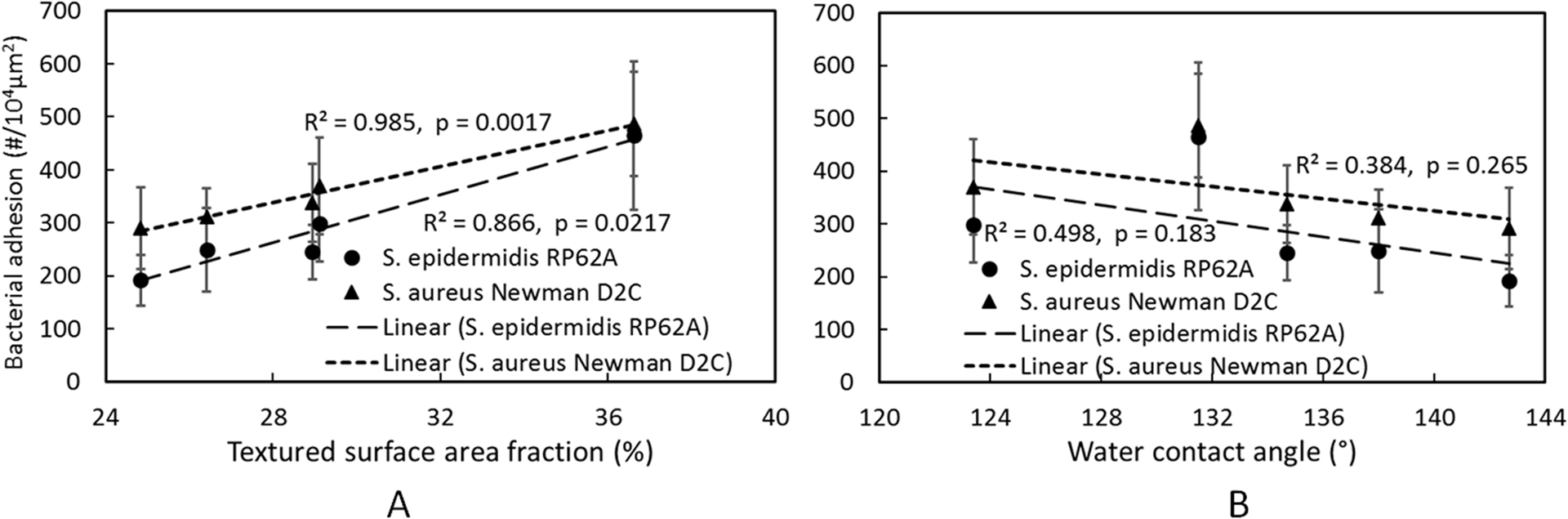
Correlation of bacterial adhesion with textured surface area fraction (A), textured surface water contact angle (B). Reprinted from Xu and Siedlecki, Journal of Biomedical Materials Research Part A, 2022.110, 1238–1250.
3. Combinatorial approach to improve biocompatibility of biomaterials
Utilizing a combination of two or more approaches in a biomaterial system is an important strategy for improving the biocompatibility of the biomaterials. Surface texturing with well-defined submicron textured surfaces inhibit bacterial adhesion and biofilm formation as well as platelet adhesion(Milner et al., 2006), however surface texturing is still far from ideal for controlling thrombosis and microbial infection. One of the reasons is that physical surface defects such as missed pillars during fabrication is always unavoidable, potentially leading to local adhesion and accumulation of platelets or bacteria. Considering the advantages of chemical modification, it is of interest to see how a combination of chemical and physical approaches will affect biological responses. Herein we discuss two combinatorial strategies of surface texturing with other chemical approaches including poly(ethylene glycol) (PEG) grafting and nitric oxide (NO) release to improve biocompatibility of implanted biomaterials.
3.1. Combination of surface texturing and poly(ethylene glycol) (PEG) to improve the biocompatibility of biomaterials
Grafting polymer brushes to polymeric biomaterial substrates is an effective chemical surface modification approach to enhance biomaterial biocompatibility while maintaining the original bulk material performance (Sun et al., 2020). Poly(ethylene glycol) (PEG) is widely used in the modification of biomaterials because of its high efficiency in resisting protein adsorption, weak immunogenicity, and good compatibility with living cells (Alibeik et al., 2010). Both in vitro and in vivo experiments have shown PEG grafted surfaces have great potential for clinical applications in medical devices and implants (Nagaoka and Nakao, 1990). Many studies have been reported that grafting PEG to PU biomaterial surfaces reduces protein adsorption (Chen et al., 2009), repels bacterial adhesion(Park et al., 1998;Park et al., 2001a), and reduces platelet adhesion(Park et al., 1999), thereby improving the biocompatibility. PU copolymers are among the primary materials used in a variety of blood-contacting medical devices due to their broad range of mechanical properties, fatigue resistance, and relatively good hemocompatibility, and as discussed above, PU copolymers are suitable for surface topography modification to improve the biological responses to materials. We studied combining chemical modification by grafting PEG onto physically modified (surface topography texturing) PU materials to yield a combinatorial surface with the expectation that biological responses to these surfaces will have significant reductions in platelet adhesion/activation and bacterial adhesion(Xu and Siedlecki, 2017).
The method of grafting a polymer brush layer to inorganic or polymeric substrates depends on material surface chemical composition and properties(Zdyrko and Luzinov, 2011). Park et al.(Park et al., 1998) reported a two-step treatment to graft PEG onto PDMS-based PUs. First −NCO groups were introduced onto the PU surface with from hexamethylene diisocyanate (HMDI) by allophanate reaction between urethane proton and isocyanate group in the presence of catalyst; subsequently the −NCO groups were reacted with PEG forming PEG-NCO-PU groups on the material. Liu et al. proposed a 3-step chemical treatment to graft high density PEG onto poly(ester-urethane) under mild-reaction conditions(Liu et al., 2018). Similar to 2-step treatment, the film surface was first incorporated with −NCO groups on the surface by allophanate reaction; followed by reaction between the −NCO groups and NH2 groups in tris(2-aminoethyl)amine via condensation reaction to immobilize −NH2 on the surface; and finally, PEG was grafted on the polyurethane surface through Michael addition between terminal C=C bond of monoallyloxy PEG and −NH2 groups on the film surface. The material characterization shows the 3-step treated PEG surfaces have high grafting density and possess outstanding mechanical properties and resistance to protein adsorption and platelet adhesion(Liu et al., 2018). To create a PEG-grafted-textured surface by combinatory approach, PU films were first physically textured with ordered arrays of pillars using a soft lithography two-stage replication molding technique as discussed prior. The textured PU films were then treated by two-step reactions with introduction of −NCO groups to surface from HMDI in the presence of triethylamine as a catalyst, then grafting the PEG onto PU surface (Xu and Siedlecki, 2017).
PEG grafting generates a layer on polymeric the biomaterial surface and alters the surface chemistry and physiochemical surface properties. For example, surface wettability was changed from super hydrophobic to hydrophilic due the chemistry of PEG. PEG modification may also change the original surface topography during treatment. Due to the solvent involved in PEG modification, pillars with high aspect ratios may collapse and form a new pattern on surfaces. We found the submicron textured pillars with height of 600 nm collapsed (Fig. 4A) while micron size pillars were intact after PEG grafting. The characterization of biological responses to surfaces including protein adsorption, platelet adhesion/activation, and bacterial adhesion/biofilm formation showed that PEG modification significantly reduced human fibrinogen (Fg) adsorption, suggesting PEG-grafted textured biomaterial surfaces were resistant to protein adsorption. Results also showed PEG-textured surfaces greatly increased the efficiency in reducing bacterial adhesion and platelet adhesion/activation due to the additive effects of physical topography and grafted PEG (Fig. 4B, 4C), suggesting that a combination of chemical modification and surface texturing will be more efficient in preventing biomaterial-associated thrombosis and infection of biomaterials.
Figure 4.

AFM topography image of PEG modified on textured PU surfaces with 500/500/600 nm pillar pattern(A). S. epidermidis RP62A adhesion (B) and platelet adhesion and activation (indicated by platelet circularity) (C) on smooth, textured with 400/400/600, 500/500/600 nm pillars, and PEG-textured PU surfaces in PBS for 1h. **: p<0.01, ***: p<0.001. Reprinted from Xu and Siedlecki, Journal of Biomedical Materials Research Part B: Applied Biomaterials 2017. 105, 668–678.
3.2. Combination of surface texturing and nitric oxide release
Nitric oxide (NO) releasing biomaterials represent another strategy towards multifunctional aspects in improving biocompatibility with potential for clinical use. NO is an endogenous gas molecule and its continuous release from the endothelial cells that line all blood vessels promotes various physiological functions in human body including enhancing endothelization, preventing the adhesion/activation of platelets, inhibiting bacterial proliferation and biofilm formation, signaling in the immune system response, and promoting angiogenesis and wound healing processes(Radomski et al., 1987;Bogdan, 2001;Fang, 2012;Barraud et al., 2015;Wo et al., 2016;Mimansa et al., 2020). NO possesses broad-spectrum antibacterial activity against both Gram-positive and Gram-negative bacteria including methicillin-resistant Staphylococcus aureus (MRSA). The reactive species produced by NO, a diatomic free radical, can cross the membranes to enter the microbial cell readily and kill the microbe by degrading cell membranes, damaging DNA, denaturing proteins through production of potent nitrosating species or by combining with reactive oxygen species (e.g., superoxide, peroxide) and oxidizing the same targets(Fang, 1997;Jones et al., 2010). NO can improve the activity of traditional antibiotics and increase bacterial susceptibility to multiple classes of antibiotics when used in combination antibiotics and it slows the development of antibiotic resistance(Rouillard et al., 2021). For these reasons, polymeric materials that mimic endogenous NO release provide a potential solution against medical device-associated microbial infection and also can prevent thrombus formation (Brisbois et al., 2016;Wo et al., 2016;Goudie et al., 2017;Devine et al., 2021). However, the limits of lifetime, storage stability and costly synthesis of NO donors are challenges for the design of NO releasing materials, even though many NO donors have been synthesized and used for the goal of prolonged and controlled NO delivery(Cheng et al., 2019a;Yu et al., 2019). Combinations of NO release with other antimicrobial and thromboresistant techniques such as surface topography modification might be an alternative approach to overcome their inherent drawbacks and enhance the biocompatibility of biomaterials.
Indeed, such combination of surface topography and NO release can be thought of as inspiration from a natural anticoagulative and antibacterial surface, the inner surface of a blood vessel. The inner surface of the aortic intima is not flat but rather possesses roughness over the scale of several microns, with micro-grooves in the blood flow direction and nano-protuberances on the ridges(Klee and Hocker, 1999). At the same time, endothelial cells on the blood vessel surface produce NO which contributes to anti-platelet activation/aggregation, anti-inflammation, and antibacterial properties of blood vessels in the cardiovascular system (Strijdom et al., 2009;Carpenter and Schoenfisch, 2012). Motivated by this natural surface, we created a dual functional surface with a combination of surface texturing and NO release integrated on polyurethane biomaterials, where the NO donor, S-nitroso-N-acetylpenicillamine (SNAP) was incorporated in textured PU biomaterials consisting of ordered arrays of pillars on surfaces. Results showed this biomimetic modification of surface texturing and NO release provides an effective approach to improve the biocompatibility of polymeric materials in combating thrombosis and microbial infection (Wo et al., 2017b;Xu et al., 2017;Xu et al., 2019).
NO donors can be incorporated into materials either by blending and physical dispersion within the polymeric matrix or by covalently binding them to either the polymer backbones and/or to the inorganic polymeric filler particles that are often employed to enhance the mechanics of biomedical polymers (e.g., fumed silica or titanium dioxide)(Frost et al., 2005). Over the past two decades, researchers have focused on using N-diazeniumdiolates (Varu et al., 2009;Cai et al., 2012;Handa et al., 2013) and S-nitrosothiols (Varu et al., 2009;Coneski and Schoenfisch, 2011;Laver et al., 2013) for controlled NO delivery due to their relatively high stability and the ability to release NO under physiological conditions. SNAP, a commonly used S-nitrosothiol, has been reported to be one of the most stable NO donors due to its intermolecular hydrogen bonding(Wo et al., 2015) and has been shown to be a very promising candidate in terms of antithrombosis and antimicrobial infection for fabrication of long term NO releasing biomedical polymers such as polyurethanes(Brisbois et al., 2013;Brisbois et al., 2015;Wo et al., 2017a). Incorporation of SNAP into PU biomaterials can be accomplished by either doping into the PU directly before fabrication of medical devices(Brisbois et al., 2013;Handa et al., 2014) or impregnation into PU after swelling in mild solvent following fabrication(Colletta et al., 2015). Under physiological conditions the former method was found to release NO for up to 3 weeks in low water uptake biomedical grade polymers such as Elast-eon E2As(Brisbois et al., 2013), while the later can achieve stable NO release for > 4 weeks in silicon Foley urinary tract catheters (Colletta et al., 2015).
Textured and NO releasing polyurethane biomaterials can be fabricated via two different processes based on the above-mentioned methods for incorporating SNAP. In a first process, SNAP was blended in PU solution with known concentration. Using soft lithography two-stage replication molding techniques (Fig. 1A), a SNAP-free PU was first spin cast onto a textured silicone mold, then SNAP-doped PU was added on top of this first layer, and then finally, another layer of the regular PU was coated on SNAP-doped PU layer, resulting in SNAP-doped textured PU films composed of 3 layers with a base of PU, a middle layer containing SNAP, and a textured PU top layer with textured patterns (Figure 5A1)(Xu et al., 2017). The thickness of each layer can be adjusted by additional spin coating of each material. Initially, the structure of the textured top thin layer appeared affected by diffusion of SNAP from the SNAP-doped middle layer, leading to some shallow pillars (Figure 5B1). To improve texturing, the increase in thickness of the top layer is necessary to limit the diffusion of SNAP into the textured layer during fabrication (Figure 5B2). In a second process, SNAP was dissolved in solvent of methanol (MeOH) and methyl ethyl ketone (MEK) (3:7 v/v). The textured PU films were first fabricated by soft lithography two-stage process and then soaked in SNAP-containing solutions and SNAP was impregnated into PU films by swelling the polymers (Figure 5A2)(Wo et al., 2017b). The loading amount of SNAP in impregnated PU films can be modified by adjusting the SNAP concentrations in MEK+MeOH solvent. It should be noted that the textured pillars may be affected by impregnation process and that pillars of small diameter and high aspect ratios, e.g., 500/500/600 nm pattern, may collapse and result in defects. Short pillars (e.g., 700/700/300 nm, Figure 5B3, B4) or micron size pillars remain intact.
Figure 5.

Schematic diagrams of textured and NO-releasing biomaterials by SNAP-doped (A1) and SNAP-impregnated PU films. Yellow color represents regular PU and green color represents SNAP containing PU. AFM topographic images of thin SNAP-doped PU (B1) and thick SNAP-doped PU (B2) with pattern 500/500/600 nm, textured PUs with pattern 700/700/300 nm before (B3) and after (B4) impregnated with SNAP; NO release from SNAP-doped PU (C1) and SNAP-impregnated PU (C2). Scale bar = 5μm. Reprinted from Xu LC et al. Acta Biomaterialia, 2017. 51: p. 53–65 and Wo Y et al. Biomaterials Science, 2017. 5(7): p. 1265–1278.
NO release from SNAP textured PU films depends on the SNAP incorporation method and textured patterns. S-nitrosothiol can decompose into disulfides and release NO under light, heat or in the presence of metal ions. The NO release flux rate depends on the topcoat polymer layer thickness, the surface topography, and the content of S-nitrosothiol in the SNAP-doped polymer films. NO flux was generally higher on the textured surface than on the normal smooth surface, likely due to the increased surface area of the textured film(Xu et al., 2017). NO flux > 0.5 ×10⁻¹⁰ mol min−1 cm−2 released from 15% SNAP-doped textured with 500/500/600 nm patterns lasts up to 10 days (Fig. 5C1). However, the SNAP-impregnated polymers release NO much more slowly and stably, with release out to 38 days (Fig. 5C2). The short lifetime of NO release in SNAP-doped textured films is believed due to issues with recrystallization and degradation of the SNAP during the repeated layers spun coat during fabrication.
Textured and NO releasing biomaterials surfaces have shown synergistic and additive effects on inhibition of bacterial adhesion and biofilm formation. Under near static condition, surface texturing alone reduced S. epidermidis bacterial adhesion by ~ 61–64% compared to smooth samples, while SNAP-doped textured polymer films increased the reduction rate to 88% for textured films with 500/500/600 nm patterns and loaded with 15 wt% SNAP. Longer term experiments to observe biofilm formation demonstrate that the SNAP doped-textured PU surface inhibit biofilm formation for > 28 days (Xu et al., 2017). Additional experiments on SNAP-impregnated textured PU surfaces show the combined benefits of NO release and texturing on adhesion of 4 representative hospital infection strains (S. epidermidis, S. aureus, P. aeruginosa, and E. coli), where both additive and in some cases even synergistic effects were seen, with reductions in bacterial adhesion greater than the sum of the individual reductions. NO release also kills bacteria on surfaces; viability test shows reduction rates up to 97% on SNAP impregnated textured PU surfaces (Wo et al., 2017b).
Surface topographic features at the submicrometer level show significant reductions in platelet response compared to smooth surfaces (Milner et al., 2006). In a study of platelet adhesion to textured and NO releasing surfaces in plasma, results demonstrated that the textured film without SNAP significantly reduced platelet adhesion with a reduction of 58% compared to the smooth unloaded polyurethane biomaterials (p<0.001) in plasma. The NO releasing surfaces also significantly reduced the platelet adhesion with a reduction rate of approximately 76%. The combination of surface texturing and NO release sinergistically worked to reduce platelet adhesion by ~89%. An in vitro plasma coagulation assay showed that this combined surface significantly increased the plasma coagulation time and reduced coagulation factor XII (FXII) activation, thereby reducing the risk of blood coagulation and thrombosis(Xu et al., 2019). All these results demonstrate that a biomimetic modification with combination of surface texturing and NO release provides an effective approach to improve the biocompatibility of polymeric materials in combating thrombosis and microbial infection.
4. Mechanistic study of bacterial adhesion and biofilm formation on combined surface texturing and NO releasing surfaces.
While surface texturing and combination with other antimicrobial and anti-thrombogentic approaches have been widely studied, mechanistic studies of biological responses to a variety of surfaces are still limited and molecular mechanisms behind them are poorly understood. Surface texturing reduces the surface contact area for interactions of bacterial cells and surface, and appears to interrupt both bacterial attachment and biofilm formation. In contrast to bacterial adhesion on regular smooth surfaces where cells are likely to adhere with clusters and form biofilms (Fig. 6A), individual cells or small clusters of 2–4 cells are often observed on textured surfaces, and these bacteria/small aggregates seem to settle into the areas between pillars to maximize contact area. When cells cannot access completely into the spaces between pillars, for example with S. epidermidis adhesion on submicron textured surfaces (Fig. 2), the individual cells can be embedded or trapped, and line in the spaces between pillars if the spaces are large enough for the access of cell. An example of this is seen in Fig. 6C showing P. aeruginosa adhesion on 700/700/300 nm patterned surfaces. In the case of NO releasing biomaterials, individual cells or small clusters with 2–4 cells were found adhered on smooth surfaces (Fig. 6B), and generally only individual cells were attached to the top of pillars on the textured-NO releasing surfaces instead of accessing into the spaces although they have same geometry (Fig. 6D vs. Fig. 6C), suggesting NO may serve signals to further inhibit bacterial interaction with surface during attachment.
Figure 6.

P. aeruginosa adhesion on smooth (A), smooth with 15% SNAP (B), side view bacterial adhesions on 700/700/300 nm patterned without SNAP (C), and 700/700/300 nm patterned with 10% SNAP PU films (D). Scale bar = 10 μm. Side-view (C) and (D) scan area: 15×15 μm2. Reprinted from Wo Y et al. Biomaterials Science, 2017. 5(7): p. 1265–1278.
Bacteria can use multiple signaling pathways to monitor and respond appropriately to changing environments. When transitioning from planktonic cells to the sessile biofilm community, bacterial cells undergo a series of physiological, metabolic, and phenotypic changes during the course of biofilm development via small molecule chemical signals (Stoodley et al., 2002). Extracellular quorum sensing (QS) and intracellular nucleotide second messengers such as cyclic dimeric guanosine monophosphate (c-di-GMP) signaling, are two important chemical signaling systems that control the transition during biofilm formation. QS allows bacteria to sense the population density and species composition of the surrounding bacterial consortium through secretion and detection of chemical signals called autoinducers (Jayaraman and Wood, 2008), while c-di-GMP is an universal intracellular secondary messenger which controls the biofilm life cycle in many bacterial species (Jenal and Malone, 2006;Römling et al., 2013;Jenal et al., 2017;Yang et al., 2018;Suchanek et al., 2020). Although much is known about QS control of biofilms, the molecular mechanism by which c-di-GMP controls biofilm formation on the topography modified and NO releasing surfaces is less well understood.
C-di-GMP is a soluble molecule and functions as second messenger in bacterial cells attachment. It is synthesized from two molecules of GTP (Guanosine-5’-triphosphate) by di-guanylate cyclases (DGCs) and is degraded into pGpG (5’-Phosphoguanylyl-(3’,5’)-guanosine) and GMP by phosphodiesterases (PDEs) (Hengge, 2009;Valentini and Filloux, 2016). DGCs and PDEs respond to a broad range of environmental cues and modulate intracellular levels of c-di-GMP, which regulates various cellular functions including biofilm formation, virulence, and dispersal in many bacterial species (Thormann et al., 2006;Cotter and Stibitz, 2007;Chen et al., 2012;Ha and O’Toole, 2015). It is commonly accepted that high intracellular c-di-GMP content enhances biofilm formation by reducing motility and inducing production of biofilm matrix while low c-di-GMP content in biofilm cells leads to increased motility and biofilm dispersal for many bacterial species (Kulasakara et al., 2006;Yang et al., 2018;Yang et al., 2021b). In contrast to common observation as a positive regulator of the sessile state however, it was also observed that reducing c-di-GMP level can increase the attachment of bacteria for some species. For example, Suchanek et al. observed that the attachment of E coli was enhanced by deletion of the c-di-GMP-dependent flagellar brake YcgR or the diguanylate cyclase DgcE, due to the increased swimming speed of E. coli in absence of YcgR-mediated motor control(Suchanek et al., 2020). More studies demonstrate that bacterial cells can sense the environments such as temperature (Townsley and Yildiz, 2015), shear (Rodesney et al., 2017) and even material surface stiffness (Song et al., 2018) to regulate biofilm formation via c-di-GMP signaling. NO was reported as a key mediator of biofilm dispersal that is conserved across microbial species (Barraud et al., 2006;Barraud et al., 2009b) and it induces P. aeruginosa biofilm dispersal by enhancing the activity of phosphodiesterase, resulting in the degradation of c-di-GMP (Barraud et al., 2009a). However, the study of NO release and surface texturing on c-di-GMP signaling is still limited. In addition, microorganisms may also use other cyclic nucleotide second messengers to regulate adhesion and biofilm formations such as cyclic adenosine-monophosphate (cAMP), cyclic guanosine -monophosphate (cGMP), and cyclicdi-AMP (Gomelsky, 2011). It seems likely that generating increasingly detailed analysis of nucleotide second messengers in cells will reveal molecular mechanisms of bacterial cells in response to the biomaterial surfaces with surface texturing and/or NO release or other modified surfaces.
5. Overall Perspective and Conclusions
Surface topography modification is a promising approach to combat biomaterial associated microbial infection and blood thrombosis in order to improve the biocompatibility of biomaterials for the implantation of blood-contacting medical devices, all done without altering the bulk material properties and without the use of antibiotics. Surface texturing with submicron pillars reduces the surface contact area and changes the physicochemical properties at surfaces, thereby influencing the interaction between bacterial cells and surfaces and inhibiting initial attachment. Design of pillars should consider ways to minimize the surface contact area for the interaction of cells with surfaces, while retaining pillar integrity and minimizing the defects in patterns such as missing or collapsed pillars from insufficient strength should be avoided.
Surface texturing can be combined with other antibacterial or antithrombosis approaches to further improve the biocompatibility. Surface texturing with pillars interrupts the bacterial attachment and secretion of EPS for the biofilm matrix, inhibiting biofilms formed on surfaces. The combination of surface texturing and chemical modification with PEG increases the surface resistance to protein adsorption, platelet adhesion/activation, and bacterial adhesion, and increases the efficiency in preventing biomaterial-associated thrombosis and infection of biomaterials compared to each approach singularly. Similarly, biomimetic combinations of surface texturing and NO release also provides an effective approach to improve the biocompatibility of polymeric materials in combating thrombosis and microbial infection.
While surface texturing and combinatorial approaches to minimize bacterial adhesion and biofilm formation have been elucidated in literature, the mechanistic studies of biological responses to the modified surfaces are still limited and molecular mechanisms behind the phenomena are less well understood. Quorum sensing and c-di-GMP signaling are two important chemical signaling systems that control bacterial adhesion and biofilm formation. Small-molecule chemical signals in these two systems convey information about the presence, nature, number, and characteristics of the surrounding bacterial species as well as the composition of the environment. The systematic analysis of these small molecules such as a combination study of QS and c-di-GMP would be beneficial to understand the molecular mechanisms of bacterial responses to biomaterial surfaces with different modifications, with the new knowledge obtained providing rational for further improvements in the design of biomaterial surfaces and development of synthetic materials intended to be used in implant applications.
Acknowledgement
The work is financially supported from NIH R01 HL153231 and R21 AI139706.
References:
- Alibeik S, Zhu S, and Brash JL (2010). Surface modification with PEG and hirudin for protein resistance and thrombin neutralization in blood contact. Colloids Surf B Biointerfaces 81, 389–396. [DOI] [PubMed] [Google Scholar]
- Anselme K, Davidson P, Popa AM, Giazzon M, Liley M, and Ploux L (2010). The interaction of cells and bacteria with surfaces structured at the nanometre scale. Acta Biomaterialia 6, 3824–3846. [DOI] [PubMed] [Google Scholar]
- Ashcraft M, Douglass M, Chen Y, and Handa H (2021). Combination strategies for antithrombotic biomaterials: an emerging trend towards hemocompatibility. Biomaterials Science 9, 2413–2423. [DOI] [PMC free article] [PubMed] [Google Scholar]
- Balakrishnan B, Kumar DS, Yoshida Y, and Jayakrishnan A (2005). Chemical modification of poly(vinyl chloride) resin using poly(ethylene glycol) to improve blood compatibility. Biomaterials 26, 3495–3502. [DOI] [PubMed] [Google Scholar]
- Barraud N, Hassett DJ, Hwang SH, Rice SA, Kjelleberg S, and Webb JS (2006). Involvement of nitric oxide in biofilm dispersal of Pseudomonas aeruginosa. Journal of Bacteriology 188, 7344–7353. [DOI] [PMC free article] [PubMed] [Google Scholar]
- Barraud N, Kelso MJ, Rice SA, and Kjelleberg S (2015). Nitric oxide: a key mediator of biofilm dispersal with applications in infectious diseases. Current Pharmaceutical Design 21, 31–42. [DOI] [PubMed] [Google Scholar]
- Barraud N, Schleheck D, Klebensberger J, Webb JS, Hassett DJ, Rice SA, and Kjelleberg S (2009a). Nitric oxide signaling in Pseudomonas aeruginosa biofilms mediates phosphodiesterase activity, decreased cyclic di-GMP levels, and enhanced dispersal. Journal of Bacteriology 191, 7333–7342. [DOI] [PMC free article] [PubMed] [Google Scholar]
- Barraud N, Storey MV, Moore ZP, Webb JS, Rice SA, and Kjelleberg S (2009b). Nitric oxide-mediated dispersal in single- and multi-species biofilms of clinically and industrially relevant microorganisms. Microbial Biotechnology 2, 370–378. [DOI] [PMC free article] [PubMed] [Google Scholar]
- Bogalecki A, and Du Plessis M (2010). Design and Manufacture of Quantum-Confined SI Light Sources. SAIEE Africa Research Journal 101. [Google Scholar]
- Bogdan C (2001). Nitric oxide and the immune response. Nature Immunology 2, 907–916. [DOI] [PubMed] [Google Scholar]
- Bose S, Robertson SF, and Bandyopadhyay A (2018). Surface modification of biomaterials and biomedical devices using additive manufacturing. Acta Biomaterialia 66, 6–22. [DOI] [PMC free article] [PubMed] [Google Scholar]
- Brisbois EJ, Davis RP, Jones AM, Major TC, Bartlett RH, Meyerhoff ME, and Handa H (2015). Reduction in Thrombosis and Bacterial Adhesion with 7 Day Implantation of S-Nitroso-N-acetylpenicillamine (SNAP)-Doped Elast-eon E2As Catheters in Sheep. Journal of materials chemistry. B, Materials for biology and medicine 3, 1639–1645. [DOI] [PMC free article] [PubMed] [Google Scholar]
- Brisbois EJ, Handa H, Major TC, Bartlett RH, and Meyerhoff ME (2013). Long-term nitric oxide release and elevated temperature stability with S-nitroso-N-acetylpenicillamine (SNAP)-doped Elast-eon E2As polymer. Biomaterials 34, 6957–6966. [DOI] [PMC free article] [PubMed] [Google Scholar]
- Brisbois EJ, Major TC, Goudie MJ, Meyerhoff ME, Bartlett RH, and Handa H (2016). Attenuation of thrombosis and bacterial infection using dual function nitric oxide releasing central venous catheters in a 9 day rabbit model. Acta Biomaterialia 44, 304–312. [DOI] [PMC free article] [PubMed] [Google Scholar]
- Cai W, Wu J, Xi C, and Meyerhoff ME (2012). Diazeniumdiolate-doped poly(lactic-co-glycolic acid)-based nitric oxide releasing films as antibiofilm coatings. Biomaterials 33, 7933–7944. [DOI] [PMC free article] [PubMed] [Google Scholar]
- Carpenter AW, and Schoenfisch MH (2012). Nitric oxide release: Part II. Therapeutic applications. Chemical Society Reviews 41, 3742–3752. [DOI] [PMC free article] [PubMed] [Google Scholar]
- Chang Y-R, Weeks ER, and Ducker WA (2018). Surface Topography Hinders Bacterial Surface Motility. ACS Applied Materials & Interfaces 10, 9225–9234. [DOI] [PubMed] [Google Scholar]
- Chen H, Zhang Y, Li D, Hu X, Wang L, Mcclung WG, and Brash JL (2009). Surfaces having dual fibrinolytic and protein resistant properties by immobilization of lysine on polyurethane through a PEG spacer. Journal of Biomedical Materials Research Part A 90A, 940–946. [DOI] [PubMed] [Google Scholar]
- Chen Y, Chai Y, Guo J-H, and Losick R (2012). Evidence for Cyclic Di-GMP-Mediated Signaling in Bacillus subtilis. Journal of Bacteriology 194, 5080–5090. [DOI] [PMC free article] [PubMed] [Google Scholar]
- Cheng J, He K, Shen Z, Zhang G, Yu Y, and Hu J (2019a). Nitric Oxide (NO)-Releasing Macromolecules: Rational Design and Biomedical Applications. Frontiers in chemistry 7, Article 530. [DOI] [PMC free article] [PubMed] [Google Scholar]
- Cheng Y, Feng G, and Moraru CI (2019b). Micro- and Nanotopography Sensitive Bacterial Attachment Mechanisms: A Review. Frontiers in Microbiology 10, Article 191. [DOI] [PMC free article] [PubMed] [Google Scholar]
- Chung KK, Schumacher JF, Sampson EM, Burne RA, Antonelli PJ, and Brennan AB (2007). Impact of engineered surface microtopography on biofilm formation of Staphylococcus aureus. Biointerphases 2, 89–94. [DOI] [PubMed] [Google Scholar]
- Colletta A, Wu J, Wo Y, Kappler M, Chen H, Xi C, and Meyerhoff ME (2015). S-Nitroso-N-acetylpenicillamine (SNAP) Impregnated Silicone Foley Catheters: A Potential Biomaterial/Device To Prevent Catheter-Associated Urinary Tract Infections. ACS Biomaterials Science & Engineering 1, 416–424. [DOI] [PMC free article] [PubMed] [Google Scholar]
- Coneski PN, and Schoenfisch MH (2011). Synthesis of nitric oxide-releasing polyurethanes with S-nitrosothiol-containing hard and soft segments. Polymer Chemistry 2, 906–913. [DOI] [PMC free article] [PubMed] [Google Scholar]
- Cotter PA, and Stibitz S (2007). c-di-GMP-mediated regulation of virulence and biofilm formation. Curr Opin Microbiol 10, 17–23. [DOI] [PubMed] [Google Scholar]
- Demirci S, Dikici T, and Güllüoğlu AN (2022). Micro/Nanoscale Surface Modification of Ti6Al4V Alloy for Implant Applications. Journal of Materials Engineering and Performance 31, 1503–1511. [Google Scholar]
- Devine R, Douglass M, Ashcraft M, Tayag N, and Handa H (2021). Development of Novel Amphotericin B-Immobilized Nitric Oxide-Releasing Platform for the Prevention of Broad-Spectrum Infections and Thrombosis. ACS Applied Materials & Interfaces 13, 19613–19624. [DOI] [PMC free article] [PubMed] [Google Scholar]
- Echeverria C, Torres MDT, Fernández-García M, De La Fuente-Nunez C, and Muñoz-Bonilla A (2020). Physical methods for controlling bacterial colonization on polymer surfaces. Biotechnology Advances 43, 107586. [DOI] [PubMed] [Google Scholar]
- Estévez M, Martínez E, Yarwood SJ, Dalby MJ, and Samitier J (2014). Adhesion and migration of cells responding to microtopography. Journal of Biomedical Materials Research Part A, 1659–1668. [DOI] [PubMed] [Google Scholar]
- Fang FC (1997). Perspectives series: host/pathogen interactions. Mechanisms of nitric oxide-related antimicrobial activity. Journal of Clinical Investigation 99, 2818–2825. [DOI] [PMC free article] [PubMed] [Google Scholar]
- Fang FC (2012). Antimicrobial actions of nitric oxide. Nitric Oxide 27, S10. [Google Scholar]
- Feng L, Li S, Li Y, Li H, Zhang L, Zhai J, Song Y, Liu B, Jiang L, and Zhu D (2002). Super-Hydrophobic Surfaces: From Natural to Artificial. Advanced Materials 14, 1857–1860. [Google Scholar]
- Friedlander RS, Vlamakis H, Kim P, Khan M, Kolter R, and Aizenberg J (2013). Bacterial flagella explore microscale hummocks and hollows to increase adhesion. Proceedings of the National Academy of Sciences 110, 5624–5629. [DOI] [PMC free article] [PubMed] [Google Scholar]
- Frost MC, Reynolds MM, and Meyerhoff ME (2005). Polymers incorporating nitric oxide releasing/generating substances for improved biocompatibility of blood-contacting medical devices. Biomaterials 26, 1685–1693. [DOI] [PubMed] [Google Scholar]
- Fu J, Zhang H, Guo Z, Feng D-Q, Thiyagarajan V, and Yao H (2018). Combat biofouling with microscopic ridge-like surface morphology: a bioinspired study. Journal of The Royal Society Interface 15, 20170823. [DOI] [PMC free article] [PubMed] [Google Scholar]
- Ge X, Leng Y, Lu X, Ren F, Wang K, Ding Y, and Yang M (2015). Bacterial responses to periodic micropillar array. Journal of Biomedical Materials Research Part A 103, 384–396. [DOI] [PubMed] [Google Scholar]
- Gomelsky M (2011). cAMP, c-di-GMP, c-di-AMP and now cGMP: bacteria use them all! Mol Microbiol 79, 562–565. [DOI] [PMC free article] [PubMed] [Google Scholar]
- Gorbet MB, and Sefton MVMV (2004). Biomaterial-associated thrombosis: roles of coagulation factors, complement, platelets and leukocytes. Biomaterials 25, 5681–5703. [DOI] [PubMed] [Google Scholar]
- Gordon VD, and Wang L (2019). Bacterial mechanosensing: the force will be with you, always. Journal of Cell Science 132. [DOI] [PMC free article] [PubMed] [Google Scholar]
- Goudie MJ, Pant J, and Handa H (2017). Liquid-infused nitric oxide-releasing (LINORel) silicone for decreased fouling, thrombosis, and infection of medical devices. Scientific Reports 7, 13623. [DOI] [PMC free article] [PubMed] [Google Scholar]
- Graham M, and Cady N (2014). Nano and Microscale Topographies for the Prevention of Bacterial Surface Fouling. Coatings 4, 37–59. [Google Scholar]
- Gu H, Chen A, Song X, Brasch ME, Henderson JH, and Ren D (2016). How Escherichia coli lands and forms cell clusters on a surface: a new role of surface topography. Scientific Reports 6, 29516. [DOI] [PMC free article] [PubMed] [Google Scholar]
- Ha D-G, and O’toole GA (2015). C-di-GMP and its Effects on Biofilm Formation and Dispersion: a Pseudomonas Aeruginosa Review. Microbiol Spectr 3, MB-0003–2014. [DOI] [PMC free article] [PubMed] [Google Scholar]
- Handa H, Brisbois EJ, Major TC, Refahiyat L, Amoako KA, Annich GM, Bartlett RH, and Meyerhoff ME (2013). In vitro and in vivo study of sustained nitric oxide release coating using diazeniumdiolate-oped poly(vinyl chloride) matrix with poly(lactide-co-glycolide) additive. Journal of materials chemistry. B, Materials for biology and medicine 1, 3578–3587. [DOI] [PMC free article] [PubMed] [Google Scholar]
- Handa H, Major TC, Brisbois EJ, Amoako KA, Meyerhoff ME, and Bartlett RH (2014). Hemocompatibility comparison of biomedical grade polymers using rabbit thrombogenicity model for preparing nonthrombogenic nitric oxide releasing surfaces. Journal of Materials Chemistry B 2, 1059–1067. [DOI] [PMC free article] [PubMed] [Google Scholar]
- Hansen JC, Lim JY, Xu L-C, Siedlecki CA, Mauger DT, and Donahue HJ (2007). Effect of surface nanoscale topography on elastic modulus of individual osteoblastic cells as determined by atomic force microscopy. Journal of Biomechanics 40, 2865–2871. [DOI] [PMC free article] [PubMed] [Google Scholar]
- Harawaza K, Cousins B, Roach P, and Fernandez A (2021). Modification of the surface nanotopography of implant devices: A translational perspective. Materials Today Bio 12, 100152. [DOI] [PMC free article] [PubMed] [Google Scholar]
- Harvey AG, Hill EW, and Bayat A (2013). Designing implant surface topography for improved biocompatibility. Expert Review of Medical Devices 10, 257–267. [DOI] [PubMed] [Google Scholar]
- Hasan A, Saxena V, and Pandey LM (2018a). Surface Functionalization of Ti6Al4V via Self-assembled Monolayers for Improved Protein Adsorption and Fibroblast Adhesion. Langmuir 34, 3494–3506. [DOI] [PubMed] [Google Scholar]
- Hasan J, Jain S, Padmarajan R, Purighalla S, Sambandamurthy VK, and Chatterjee K (2018b). Multi-scale surface topography to minimize adherence and viability of nosocomial drug-resistant bacteria. Materials & Design 140, 332–344. [DOI] [PMC free article] [PubMed] [Google Scholar]
- Hasan J, Webb HK, Truong VK, Pogodin S, Baulin VA, Watson GS, Watson JA, Crawford RJ, and Ivanova EP (2013). Selective bactericidal activity of nanopatterned superhydrophobic cicada Psaltoda claripennis wing surfaces. Applied Microbiology and Biotechnology 97, 9257–9262. [DOI] [PubMed] [Google Scholar]
- Hengge R (2009). Principles of c-di-GMP signalling in bacteria. Nat Rev Micro 7, 263–273. [DOI] [PubMed] [Google Scholar]
- Hsu LC, Fang J, Borca-Tasciuc DA, Worobo RW, and Moraru CI (2013). Effect of Micro- and Nanoscale Topography on the Adhesion of Bacterial Cells to Solid Surfaces. Applied and Environmental Microbiology 79, 2703–2712. [DOI] [PMC free article] [PubMed] [Google Scholar]
- Ivanova EP, Hasan J, Webb HK, Gervinskas G, Juodkazis S, Truong VK, Wu AHF, Lamb RN, Baulin VA, Watson GS, Watson JA, Mainwaring DE, and Crawford RJ (2013). Bactericidal activity of black silicon. Nature communications 4, 2838. [DOI] [PMC free article] [PubMed] [Google Scholar]
- Ivanova EP, Hasan J, Webb HK, Truong VK, Watson GS, Watson JA, Baulin VA, Pogodin S, Wang JY, Tobin MJ, Löbbe C, and Crawford RJ (2012). Natural Bactericidal Surfaces: Mechanical Rupture of Pseudomonas aeruginosa Cells by Cicada Wings. Small 8, 2489–2494. [DOI] [PubMed] [Google Scholar]
- Ivanova EP, Nguyen SH, Guo Y, Baulin VA, Webb HK, Truong VK, Wandiyanto JV, Garvey CJ, Mahon PJ, Mainwaring DE, and Crawford RJ (2017). Bactericidal activity of self-assembled palmitic and stearic fatty acid crystals on highly ordered pyrolytic graphite. Acta Biomaterialia 59, 148–157. [DOI] [PubMed] [Google Scholar]
- Jaffer IH, Fredenburgh JC, Hirsh J, and Weitz JI (2015). Medical device-induced thrombosis: what causes it and how can we prevent it? Journal of Thrombosis and Haemostasis 13, S72–S81. [DOI] [PubMed] [Google Scholar]
- Jayaraman A, and Wood TK (2008). Bacterial quorum sensing: signals, circuits, and implications for biofilms and disease. Annu. Rev. Biomed. Eng 10, 145–167. [DOI] [PubMed] [Google Scholar]
- Jenal U, and Malone J (2006). Mechanisms of cyclic-di-GMP signaling in bacteria. Annu Rev Genet 40, 385–407. [DOI] [PubMed] [Google Scholar]
- Jenal U, Reinders A, and Lori C (2017). Cyclic di-GMP: second messenger extraordinaire. Nature Reviews Microbiology 15, 271–284. [DOI] [PubMed] [Google Scholar]
- Jeon H, Simon CG Jr, and Kim G (2014). A mini-review: Cell response to microscale, nanoscale, and hierarchical patterning of surface structure. Journal of Biomedical Materials Research Part B: Applied Biomaterials 102, 1580–1594. [DOI] [PubMed] [Google Scholar]
- Jones ML, Ganopolsky JG, Labbé A, Wahl C, and Prakash S (2010). Antimicrobial properties of nitric oxide and its application in antimicrobial formulations and medical devices. Applied Microbiology and Biotechnology 88, 401–407. [DOI] [PubMed] [Google Scholar]
- Klee D, and Hocker H (1999). “Polymers for biomedical applications: Improvement of the interface compatibility,” in Biomedical Applications: Polymer Blends.), 1–57. [Google Scholar]
- Koh LB, Rodriguez I, and Venkatraman SS (2010). The effect of topography of polymer surfaces on platelet adhesion. Biomaterials 31, 1533–1545. [DOI] [PubMed] [Google Scholar]
- Kulasakara H, Lee V, Brencic A, Liberati N, Urbach J, Miyata S, Lee DG, Neely AN, Hyodo M, Hayakawa Y, Ausubel FM, and Lory S (2006). Analysis of Pseudomonas aeruginosa diguanylate cyclases and phosphodiesterases reveals a role for bis-(3’−5’)-cyclic-GMP in virulence. Proc Natl Acad Sci U S A 103, 2839–2844. [DOI] [PMC free article] [PubMed] [Google Scholar]
- Labarrere CA, Dabiri AE, and Kassab GS (2020). Thrombogenic and Inflammatory Reactions to Biomaterials in Medical Devices. Frontiers in Bioengineering and Biotechnology 8. [DOI] [PMC free article] [PubMed] [Google Scholar]
- Laver JR, Mclean S, Bowman LA, Harrison LJ, Read RC, and Poole RK (2013). Nitrosothiols in bacterial pathogens and pathogenesis. Antioxid Redox Signal 18, 309–322. [DOI] [PubMed] [Google Scholar]
- Lee SW, Phillips KS, Gu H, Kazemzadeh-Narbat M, and Ren D (2021). How microbes read the map: Effects of implant topography on bacterial adhesion and biofilm formation. Biomaterials 268, 120595. [DOI] [PubMed] [Google Scholar]
- Linklater DP, Baulin VA, Juodkazis S, Crawford RJ, Stoodley P, and Ivanova EP (2021). Mechano-bactericidal actions of nanostructured surfaces. Nature Reviews Microbiology 19, 8–22. [DOI] [PubMed] [Google Scholar]
- Linklater DP, De Volder M, Baulin VA, Werner M, Jessl S, Golozar M, Maggini L, Rubanov S, Hanssen E, Juodkazis S, and Ivanova EP (2018). High Aspect Ratio Nanostructures Kill Bacteria via Storage and Release of Mechanical Energy. Acs Nano 12, 6657–6667. [DOI] [PubMed] [Google Scholar]
- Liu L, Ercan B, Sun L, Ziemer KS, and Webster TJ (2016). Understanding the Role of Polymer Surface Nanoscale Topography on Inhibiting Bacteria Adhesion and Growth. ACS Biomaterials Science & Engineering 2, 122–130. [DOI] [PubMed] [Google Scholar]
- Liu L, Gao Y, Zhao J, Yuan L, Li C, Liu Z, and Hou Z (2018). A Mild Method for Surface-Grafting PEG Onto Segmented Poly(Ester-Urethane) Film with High Grafting Density for Biomedical Purpose. Polymers 10, 1125. [DOI] [PMC free article] [PubMed] [Google Scholar]
- Liu Y, and Balazs AC (2018). Modeling Biofilm Formation on Dynamically Reconfigurable Composite Surfaces. Langmuir 34, 1807–1816. [DOI] [PubMed] [Google Scholar]
- Lord MS, Foss M, and Besenbacher F (2010). Influence of nanoscale surface topography on protein adsorption and cellular response. Nano Today 5, 66–78. [Google Scholar]
- Milner KR, Snyder AJ, and Siedlecki CA (2006). Sub-micron texturing for reducing platelet adhesion to polyurethane biomaterials. Journal of Biomedical Materials Research Part A 76, 561–570. [DOI] [PubMed] [Google Scholar]
- Mimansa K, Tapan B, Arun K, and Sandeep A (2020). Understanding the Potential Role and Delivery Approaches of Nitric Oxide in Chronic Wound Healing Management. Current Pharmaceutical Design 26, 1–16. [DOI] [PubMed] [Google Scholar]
- Mitra D, Kang E-T, and Neoh KG (2021). Polymer-Based Coatings with Integrated Antifouling and Bactericidal Properties for Targeted Biomedical Applications. ACS Applied Polymer Materials 3, 2233–2263. [Google Scholar]
- Monika Mahto, S. K, Das S, Ranjan A, Singh SK, Roy P, and Misra N (2015). Chemical modification of poly(vinyl chloride) for blood and cellular biocompatibility. RSC Advances 5, 45231–45238. [Google Scholar]
- Nagaoka S, and Nakao A (1990). Clinical application of antithrombogenic hydrogel with long poly (ethylene oxide) chains. Biomaterials 11, 119–121. [DOI] [PubMed] [Google Scholar]
- Park JH, Lee KB, Kwon IC, and Bae YH (2001a). PDMS-based polyurethanes with MPEG grafts: Mechanical properties, bacterial repellency, and release behavior of rifampicin. Journal of Biomaterials Science-Polymer Edition 12, 629–645. [DOI] [PubMed] [Google Scholar]
- Park JH, Park KD, and Bae YH (1999). PDMS-based polyurethanes with MPEG grafts: synthesis, characterization and platelet adhesion study. Biomaterials 20, 943–953. [DOI] [PubMed] [Google Scholar]
- Park JY, Gemmell CH, and Davies JE (2001b). Platelet interactions with titanium: modulation of platelet activity by surface topography. Biomaterials 22, 2671–2682. [DOI] [PubMed] [Google Scholar]
- Park KD, Kim YS, Han DK, Kim YH, Lee EHB, Suh H, and Choi KS (1998). Bacterial adhesion on PEG modified polyurethane surfaces. Biomaterials 19, 851–859. [DOI] [PubMed] [Google Scholar]
- Pereda D, and Conte JV (2011). Left Ventricular Assist Device Driveline Infections. Cardiology Clinics 29, 515–527. [DOI] [PubMed] [Google Scholar]
- Perera-Costa D, Bruque JM, González-Martín ML, Gómez-García AC, and Vadillo-Rodríguez V (2014). Studying the Influence of Surface Topography on Bacterial Adhesion using Spatially Organized Microtopographic Surface Patterns. Langmuir 30, 4633–4641. [DOI] [PubMed] [Google Scholar]
- Pogodin S, Hasan J, Baulin Vladimir a., Webb Hayden k., Truong Vi k., Phong nguyen The h., Boshkovikj V, Fluke Christopher j., Watson Gregory s., Watson Jolanta a., Crawford Russell j., and Ivanova Elena p. (2013). Biophysical Model of Bacterial Cell Interactions with Nanopatterned Cicada Wing Surfaces. Biophysical Journal 104, 835–840. [DOI] [PMC free article] [PubMed] [Google Scholar]
- Radomski MW, Palmer RMJ, and Moncada S (1987). The role of nitric oxide and cGMP in platelet adhesion to vascular endothelium. Biochemical and Biophysical Research Communications 148, 1482–1489. [DOI] [PubMed] [Google Scholar]
- Rigo S, Cai C, Gunkel-Grabole G, Maurizi L, Zhang X, Xu J, and Palivan CG (2018). Nanoscience-Based Strategies to Engineer Antimicrobial Surfaces. Advanced Science 5, 1700892. [DOI] [PMC free article] [PubMed] [Google Scholar]
- Rochford ETJ, Richards RG, and Moriarty TF (2012). Influence of material on the development of device-associated infections. Clinical Microbiology and Infection 18, 1162–1167. [DOI] [PubMed] [Google Scholar]
- Rodesney CA, Roman B, Dhamani N, Cooley BJ, Katira P, Touhami A, and Gordon VD (2017). Mechanosensing of shear by Pseudomonas aeruginosa leads to increased levels of the cyclic-di-GMP signal initiating biofilm development. Proceedings of the National Academy of Sciences 114, 5906–5911. [DOI] [PMC free article] [PubMed] [Google Scholar]
- Römling U, Galperin MY, and Gomelsky M (2013). Cyclic di-GMP: the First 25 Years of a Universal Bacterial Second Messenger. Microbiology and Molecular Biology Reviews 77, 1–52. [DOI] [PMC free article] [PubMed] [Google Scholar]
- Rose EA, Gelijns AC, Moskowitz AJ, Heitjan DF, Stevenson LW, Dembitsky W, Long JW, Ascheim DD, Tierney AR, Levitan RG, Watson JT, Meier P, and Randomized Evaluation Mech A (2001). Long-term use of a left ventricular assist device for end-stage heart failure. New England Journal of Medicine 345, 1435–1443. [DOI] [PubMed] [Google Scholar]
- Rouillard KR, Novak OP, Pistiolis AM, Yang L, Ahonen MJR, Mcdonald RA, and Schoenfisch MH (2021). Exogenous Nitric Oxide Improves Antibiotic Susceptibility in Resistant Bacteria. ACS Infectious Diseases 7, 23–33. [DOI] [PubMed] [Google Scholar]
- Song B, Zhang E, Han X, Zhu H, Shi Y, and Cao Z (2020a). Engineering and Application Perspectives on Designing an Antimicrobial Surface. ACS Applied Materials & Interfaces 12, 21330–21341. [DOI] [PMC free article] [PubMed] [Google Scholar]
- Song F, Wang H, Sauer K, and Ren D (2018). Cyclic-di-GMP and oprF Are Involved in the Response of Pseudomonas aeruginosa to Substrate Material Stiffness during Attachment on Polydimethylsiloxane (PDMS). Frontiers in Microbiology 9, Article110. [DOI] [PMC free article] [PubMed] [Google Scholar]
- Song J, Winkeljann B, and Lieleg O (2020b). Biopolymer-Based Coatings: Promising Strategies to Improve the Biocompatibility and Functionality of Materials Used in Biomedical Engineering. Advanced Materials Interfaces 7, 2000850. [Google Scholar]
- Sousa MP, Arab-Tehrany E, Cleymand F, and Mano JF (2019). Surface Micro- and Nanoengineering: Applications of Layer-by-Layer Technology as a Versatile Tool to Control Cellular Behavior. Small 15, 1901228. [DOI] [PubMed] [Google Scholar]
- Stoodley P, Sauer K, Davies DG, and Costerton JW (2002). Biofilms as complex differentiated communites. Annual Review of Microbiology 56, 187–209. [DOI] [PubMed] [Google Scholar]
- Strijdom H, Chamane N, and Lochner A (2009). Nitric oxide in the cardiovascular system: a simple molecule with complex actions. Cardiovascular Journal of Africa 20, 303–310. [PMC free article] [PubMed] [Google Scholar]
- Suchanek VM, Esteban-López M, Colin R, Besharova O, Fritz K, and Sourjik V (2020). Chemotaxis and cyclic-di-GMP signalling control surface attachment of Escherichia coli. Molecular Microbiology 113, 728–739. [DOI] [PubMed] [Google Scholar]
- Sun W, Liu W, Wu Z, and Chen H (2020). Chemical Surface Modification of Polymeric Biomaterials for Biomedical Applications. Macromolecular Rapid Communications 41, 1900430. [DOI] [PubMed] [Google Scholar]
- Susen S, Rauch A, Van Belle E, Vincentelli A, and Lenting PJ (2015). Circulatory support devices: fundamental aspects and clinical management of bleeding and thrombosis. Journal of Thrombosis and Haemostasis 13, 1757–1767. [DOI] [PubMed] [Google Scholar]
- Thormann KM, Duttler S, Saville RM, Hyodo M, Shukla S, Hayakawa Y, and Spormann AM (2006). Control of formation and cellular detachment from Shewanella oneidensis MR-1 biofilms by cyclic di-GMP. J Bacteriol 188, 2681–2691. [DOI] [PMC free article] [PubMed] [Google Scholar]
- Townsley L, and Yildiz FH (2015). Temperature affects c-di-GMP signalling and biofilm formation in Vibrio cholerae. Environmental Microbiology 17, 4290–4305. [DOI] [PMC free article] [PubMed] [Google Scholar]
- Valentini M, and Filloux A (2016). Biofilms and Cyclic di-GMP (c-di-GMP) Signaling: Lessons from Pseudomonas aeruginosa and Other Bacteria. The Journal of Biological Chemistry 291, 12547–12555. [DOI] [PMC free article] [PubMed] [Google Scholar]
- Vanepps JS, and Younger JG (2016). Implantable Device-Related Infection. Shock 46, 597–608. [DOI] [PMC free article] [PubMed] [Google Scholar]
- Variola F, Vetrone F, Richert L, Jedrzejowski P, Yi J-H, Zalzal S, Clair S, Sarkissian A, Perepichka DF, Wuest JD, Rosei F, and Nanci A (2009). Improving Biocompatibility of Implantable Metals by Nanoscale Modification of Surfaces: An Overview of Strategies, Fabrication Methods, and Challenges. Small 5, 996–1006. [DOI] [PubMed] [Google Scholar]
- Varu VN, Tsihlis ND, and Kibbe MR (2009). Basic science review: nitric oxide--releasing prosthetic materials. Vasc Endovascular Surg 43, 121–131. [DOI] [PubMed] [Google Scholar]
- Vogler EA (2013). “Chapter 8 - Surface Modification for Biocompatibility,” in Engineered Biomimicry, eds. Lakhtakia A & Martín-Palma RJ. (Boston: Elsevier; ), 189–220. [Google Scholar]
- Wang L, Chen W, and Terentjev E (2015). Effect of micro-patterning on bacterial adhesion on polyethylene terephthalate surface. Journal of Biomaterials Applications 29, 1351–1362. [DOI] [PubMed] [Google Scholar]
- Wo Y, Brisbois EJ, Bartlett RH, and Meyerhoff ME (2016). Recent advances in thromboresistant and antimicrobial polymers for biomedical applications: just say yes to nitric oxide (NO). Biomaterials Science 4, 1161–1183. [DOI] [PMC free article] [PubMed] [Google Scholar]
- Wo Y, Brisbois EJ, Wu J, Li Z, Major TC, Mohammed A, Wang X, Colletta A, Bull JL, Matzger AJ, Xi C, Bartlett RH, and Meyerhoff ME (2017a). Reduction of Thrombosis and Bacterial Infection via Controlled Nitric Oxide (NO) Release from S-Nitroso-N-acetylpenicillamine (SNAP) Impregnated CarboSil Intravascular Catheters. ACS Biomater Sci Eng 3, 349–359. [DOI] [PMC free article] [PubMed] [Google Scholar]
- Wo Y, Li Z, Brisbois EJ, Colletta A, Wu J, Major TC, Xi C, Bartlett RH, Matzger AJ, and Meyerhoff ME (2015). Origin of long-term storage stability and nitric oxide release behavior of carboSil polymer doped with S-Nitroso-N-acetyl-d-penicillamine. ACS Appl Mater Interfaces 7, 22218–22227. [DOI] [PMC free article] [PubMed] [Google Scholar]
- Wo Y, Xu L-C, Li Z, Matzger AJ, Meyerhoff ME, and Siedlecki CA (2017b). Antimicrobial nitric oxide releasing surfaces based on S-nitroso-N-acetylpenicillamine impregnated polymers combined with submicron-textured surface topography. Biomaterials Science 5, 1265–1278. [DOI] [PMC free article] [PubMed] [Google Scholar]
- Wu S, Zuber F, Brugger J, Maniura-Weber K, and Ren Q (2016). Antibacterial Au nanostructured surfaces. Nanoscale 8, 2620–2625. [DOI] [PubMed] [Google Scholar]
- Xia Y, and Whitesides GM (1998). Soft lithography. Annual Review of Materials Science 28, 153–184. [Google Scholar]
- Xu L-C, Meyerhoff ME, and Siedlecki CA (2019). Blood coagulation response and bacterial adhesion to biomimetic polyurethane biomaterials prepared with surface texturing and nitric oxide release. Acta Biomaterialia 84, 77–87. [DOI] [PMC free article] [PubMed] [Google Scholar]
- Xu L-C, and Siedlecki CA (2012). Submicron-textured biomaterial surface reduces staphylococcal bacterial adhesion and biofilm formation. Acta Biomaterialia 8, 72–81. [DOI] [PubMed] [Google Scholar]
- Xu L-C, and Siedlecki CA (2014). Staphylococcus epidermidis adhesion on hydrophobic and hydrophilic textured biomaterial surfaces. Biomedical Materials 9, 035003. [DOI] [PubMed] [Google Scholar]
- Xu L-C, and Siedlecki CA (2022). Submicron topography design for controlling staphylococcal bacterial adhesion and biofilm formation. Journal of Biomedical Materials Research Part A 110, 1238–1250. [DOI] [PMC free article] [PubMed] [Google Scholar]
- Xu L-C, Wo Y, Meyerhoff ME, and Siedlecki CA (2017). Inhibition of bacterial adhesion and biofilm formation by dual functional textured and nitric oxide releasing surfaces. Acta Biomaterialia 51, 53–65. [DOI] [PMC free article] [PubMed] [Google Scholar]
- Xu LC, and Siedlecki CA (2017). Protein adsorption, platelet adhesion, and bacterial adhesion to Polyethylene-glycol-textured polyurethane biomaterial surfaces. Journal of Biomedical Materials Research Part B: Applied Biomaterials 105, 668–678. [DOI] [PubMed] [Google Scholar]
- Yang K, Shi J, Wang L, Chen Y, Liang C, Yang L, and Wang L-N (2021a). Bacterial anti-adhesion surface design: surface patterning, roughness and wettability: A review. Journal of Materials Science & Technology, in press. [Google Scholar]
- Yang S, Wu Y, Qu C, Fein JB, He Y, Huang Q, and Cai P (2021b). Quantitative analysis of the surficial and adhesion properties of the Gram-negative bacterial species Comamonas testosteroni modulated by c-di-GMP. Colloids and Surfaces B: Biointerfaces 198, 111497. [DOI] [PubMed] [Google Scholar]
- Yang Y, Li Y, Gao T, Zhang Y, and Wang Q (2018). C-di-GMP turnover influences motility and biofilm formation in Bacillus amyloliquefaciens PG12. Research in Microbiology 169, 205–213. [DOI] [PubMed] [Google Scholar]
- Yaseen M, Pan E, Zhao X, and Lu J (2011). Surface Modification to Improve Biocompatibility. Comprehensive Biotechnology 5, 65–81. [Google Scholar]
- Yu H, Cui L-X, Huang N, and Yang Z-L (2019). Recent developments in nitric oxide-releasing biomaterials for biomedical applications. Medical Gas Research 9, 184–191. [DOI] [PMC free article] [PubMed] [Google Scholar]
- Zdyrko B, and Luzinov I (2011). Polymer Brushes by the “Grafting to” Method. Macromolecular Rapid Communications 32, 859–869. [DOI] [PubMed] [Google Scholar]
- Zou Y, Zhang Y, Yu Q, and Chen H (2021). Dual-function antibacterial surfaces to resist and kill bacteria: Painting a picture with two brushes simultaneously. Journal of Materials Science & Technology 70, 24–38. [Google Scholar]