


Figure 1. Design and immunogenicity of hyperglycosylated NC99 trihead nanoparticle immunogens.
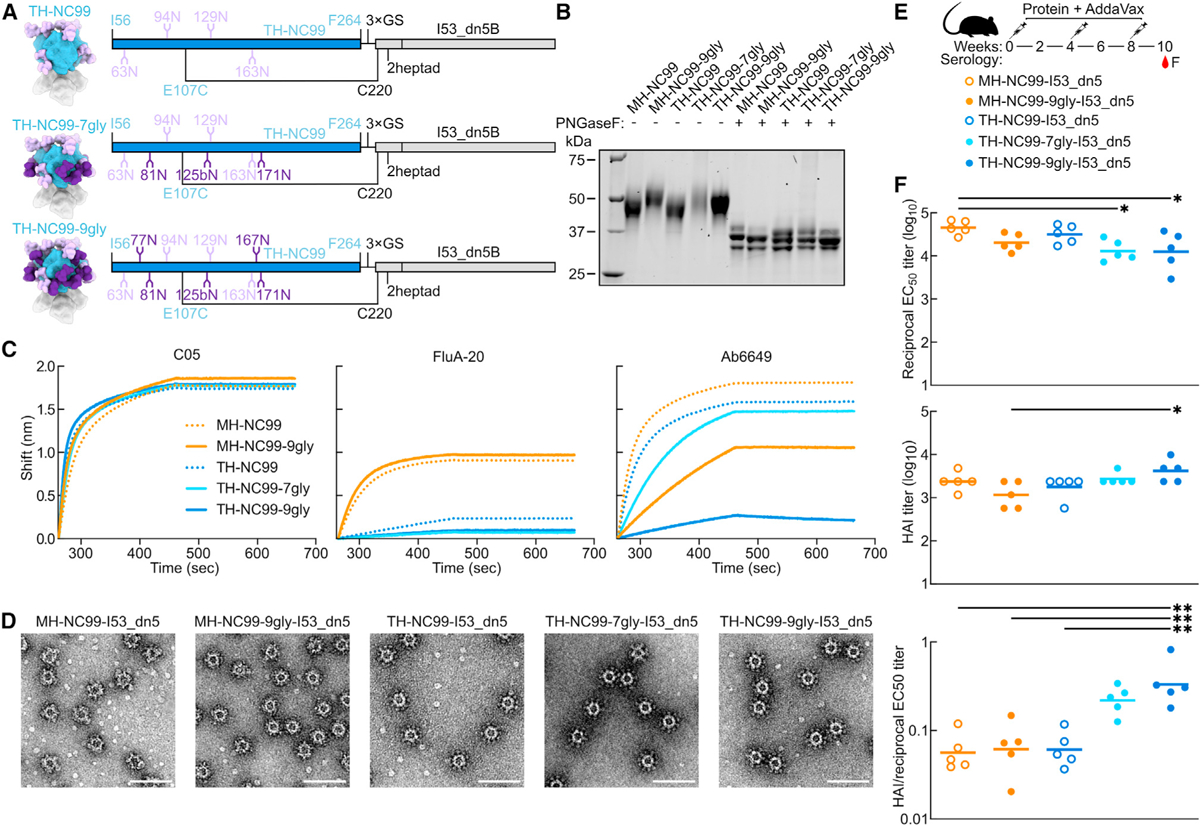
(A) Model structures and gene diagrams for wild-type and hyperglycosylated NC99 triheads with wild-type glycans in light purple and glycan knockins in dark purple. NC99 HA numbering is in blue, and trihead model numbering is in black.
(B) Reducing SDS-PAGE of wild-type and hyperglycosylated NC99 monoheads and triheads without and with PNGaseF digestion.
(C) BLI of wild-type and hyperglycosylated NC99 monoheads and triheads against C05, FluA-20, and Ab6649.
(D) nsEM micrographs of hyperglycosylated NC99 monohead and trihead I53_dn5 nanoparticles. Scale bars = 100 nm.
(E) Schematic illustrating mouse study timeline, immunizations, and serology timepoint.
(F) Week 10 NC99-foldon trimer ELISA titers plotted as the reciprocal EC50 titer, hemagglutination inhibition (HAI) titers, and the ratio of HAI/reciprocal EC50 titers of hyperglycosylated NC99 monohead and trihead nanoparticles in BALB/c mice. Each symbol represents an individual animal, and the geometric mean of each group is indicated by the bar (n = 5 mice/group).
Statistical significance was determined using one-way ANOVA with Tukey’s multiple comparisons test; *p < 0.05; **p < 0.01.