



Abstract
Those managing ulcerative colitis (UC) must be aware of new treatments. Mesalamine (5-ASA) is the first treatment for mild UC. Steroids have been the first therapy for patients with more severe UC but these are not effective or safe long term. This means that other medicines are needed. Newer advanced therapies are now frequently used. There are several types of advanced therapies. These are the anti-TNF, anti-integrin and anti-IL12/23 agents as well as the JAK inhibitors and sphingosine1-phosphate receptor modulators. All of these are effective in treating UC. Choosing among treatments is complicated. There are multiple factors to think about when choosing a treatment for UC. Without research studies that directly compare the different treatments, the use of any one treatment should be based on effectiveness and safety. Other considerations include specific disease features, patient factors and the preference of patients.
Introduction
Ulcerative colitis (UC) is a chronic, relapsing, and remitting inflammatory bowel disease (IBD) subtype affecting the rectum and colon.1 There are millions of IBD sufferers worldwide, with an increasing incidence worldwide.1-4 Active mucosal inflammation in UC results in diarrhoea, rectal bleeding, systemic effects, and in a minority can cause life-threatening sequelae.5-7 The recognition of the associated individual and societal health burdens has led to an increase in novel therapy development and availability.8,9 The increasing number, mechanisms of action, variable efficacy, and overall complexity of therapies means that any physician managing UC requires a nuanced understanding of therapeutic application. This text is intended as an evidence-based guide for UC management, with a particular emphasis of advanced therapy utilization in moderate to severe UC.
The ideal therapy should be safe, efficacious, cheap, and have no harmful side effects. No agent has all these characteristics, meaning that a hierarchical approach to therapeutic positioning of available agents is needed with strong emphasis on individual patient and disease characteristics and patient preferences.
Treatment of UC
First-line therapy
The goal of therapy is to induce and maintain remission, while minimizing the need for corticosteroids. Following induction, maintenance of remission is maximized with continued medical therapy.10 Goals of therapy have been evolving recently with the recognition that short-, medium-, and long-term goals may differ and that clinical remission in the absence of endoscopic healing and possibly even histologic remission may not be optimal for long-term outcomes.11
Ulcerative proctitis
Ulcerative proctitis should be initially managed with rectal 5-aminosalicylic acid (5-ASA) only. For those not responding to topical 5-ASA, rectally administered steroid therapy can be tried and for those individuals resistant to both topical 5-ASA and steroids other topical therapies such as tacrolimus or short chain fatty acids have been reported to be variably effective. It is unusual for a patient with proctitis to require systemic therapy, and most studies of systemic therapies have specifically excluded patients with proctitis.
Mild-to-moderate UC
Despite the availability of advanced therapies, 5-ASA-based therapies continue to be the first-line therapy for most patients with mild to moderate UC given the good efficacy and excellent safety profile.10 Combination of oral controlled release 5-ASA with rectal administered 5-ASA may provide enhanced clinical response.10 If response or remission is achieved, the same therapy should be continued as maintenance, though rectal preparations may not be preferred by patients for long-term treatment, and oral 5-ASA preparations can be utilized alone (Fig. 1).
Figure 1.
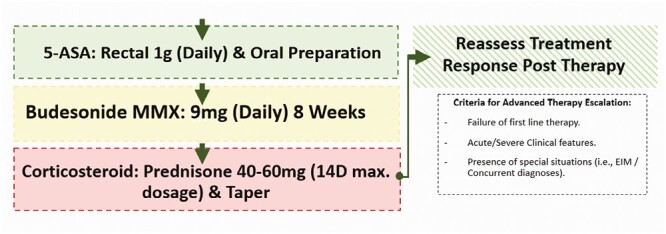
First-line mild to moderate UC (> E1 disease extent) induction therapy algorithm.
In mild-to-moderate UC of any extent, oral multi-matrix (MMX) budesonide is also efficacious as an induction agent but has not been demonstrated to be an effective or safe maintenance therapy and, therefore, must be followed with another therapy that is effective for maintenance of remission. This may be a 5-ASA preparation but, as discussed further, may require a thiopurine or advanced therapy to maintain remission when a patient has required steroid therapy to achieve remission.12,13
Moderate to severe UC
First-line therapy for moderate to severely active UC generally consists of oral systemic corticosteroids to induce remission. A prednisone dosage of 40–60 mg daily, for 7 to 14 days followed by a taper period is typically used.10 Corticosteroid resistance is defined as a lack of symptomatic response by day 14.10,14 Following the induction of remission, oral corticosteroid should be tapered and discontinued in favour of thiopurine maintenance therapy or, in selected cases, a trial of oral 5-ASA therapy.10 Longer term oral corticosteroids lack maintenance efficacy and are associated with a significant side effect profile.10 In instances where thiopurine therapy is not tolerated, is contraindicated or, increasingly, is not preferred because of its increased risk of infections and certain malignancies, the use of advanced therapies for ongoing maintenance therapy following steroid induction is indicated.
Progression to advanced therapies
When first-line therapy fails to achieve or maintain remission, advanced therapies should be considered. There are multiple considerations prior to the progression of a UC patient to advanced therapy. Safety, both short- and long-term, should remain a foremost priority, while aiming to induce and maintain remission. Additional associated IBD features or comorbidities should be integrated into the advanced therapy-selection process. There are several classes of advanced therapies that have each been shown to provide clinical and endoscopic improvement with induction therapy and reduce the chance of relapse with continued therapy.
Anti-tumour necrosis factor antibodies
Infliximab
The anti-tumour necrosis factor monoclonal antibody, infliximab, was the first biologic drug to be shown to be effective in the treatment of patients who failed or did not tolerate ‘conventional therapy’ with 5-ASA, steroids, and/or thiopurines.15,16 Remarkable treatment effect (over placebo) was reported for infliximab from the Active Ulcerative Colitis Trial (ACT) 1 and the ACT2 trials, with induction response of 69%/61% (5 mg/kg/10 mg/kg dosages) at week 8 (vs. 37% with placebo).15 Maintenance evaluation at weeks 30 and 54 (ACT1 only) noted statistically significant improvements (over placebo) in both clinical and histologic remission.15
Two decades after introduction, infliximab continues to be a highly efficacious induction agent, even in comparison to emergent therapies17 (Table 1). Infliximab combination therapy with azathioprine has been demonstrated to deliver higher rates of corticosteroid-free remission (in comparison to either therapy individually) in anti-TNF naïve UC patients, increasing the potential for therapeutic capture.18 Combination thiopurine infliximab therapy additionally reduces the incidence of anti-infliximab antibodies, extending the window of potential drug efficacy.19,20 However, combination therapy may result in marginally increased incidence of infective complications, while use is necessarily limited in young (<20 years of age) male patients given the increased risk of hepatosplenic T-cell lymphoma in this demographic group.21,22 Other anti-TNF agents, including adalimumab and golimumab, have been shown also to be effective treatments for UC.23-26 In addition to their beneficial impact on intestinal disease activity, the anti-TNF agents can also be effective against a number of the joint, skin, and eye extraintestinal manifestations (EIMs) and, as such, may be preferred advanced therapies in patients with those particular manifestations.27,28
Table 1.
Advanced therapies – TNF-α inhibitors.
| Anti-TNF-α inhibitors | |
| Infliximab | Mechanism: Chimeric IgG1 monoclonal antibody with high affinity to tumour necrosis factor-α (TNF-α) |
| Originator study outcomes: Active Ulcerative Colitis Trials (ACT-1/ACT-2) – randomized, double-bind, placebo-controlled trials. Clinical response of 61–69 percent with infliximab dosages versus 37% with placebo at week 8, induction assessment. Maintenance assessment at 54 weeks, clinical response of 44–45 percent infliximab dosages versus 20 percent with placebo15 | |
| Special considerations: Formation of anti-infliximab antibodies associated with loss of response, variable rates reported across cohorts.121,122 Low serum infliximab levels in active UC, without antibody formation, may necessitate advanced dosing for treatment effect123 | |
| Adalimumab | Mechanism: Fully humanized IgG1 monoclonal antibody to TNF-α, with interruption of p55/p75 cell surface reception interactions29 |
| Originator study outcomes: ULTRA-2 – phase 3, multicentre, international, randomized, double-bind, placebo-controlled trial.29 Clinical response in 50.4% with adalimumab versus 34.6% with placebo at week 8, induction assessment.29 Clinical response in 30.2% with adalimumab versus 18.3% with placebo at week 52, maintenance assessment.29 Statistically significant difference over placebo in favour of adalimumab for all primary (i.e., clinical remission, histologic remission) and secondary (i.e. IBDQ response, discontinuation of steroid, sustained endoscopic response) endpoints at induction/ maintenance intervals.29 Of anti-TNF naïve patients 21.3% achieved clinical remission at week 829 | |
| Special Considerations: Parallel usage in rheumatoid arthritis, ankylosing spondylitis, seronegative arthritides, and psoriasis. Consideration of prioritized usage in UC with concomitant diagnoses. Minimal safety concerns from extensive global trial reporting30 | |
| Golimumab | Mechanism: Fully humanized IgG1 monoclonal antibody to TNF-α124 |
| Originator study outcomes: PURSUIT Trials – multicentre, randomized, double-blind, placebo-controlled phase 2/3 studies.33,34,124 Subcutaneous golimumab found to be more efficacious in induction than IV golimumab, and superior to placebo.124 Clinical response in 51%–54.9% with golimumab vs. 30.3% with placebo at week 6, induction assessment.24 Clinical response in 47–49.7% with golimumab vs. 31.2%% with placebo at week 54, maintenance assessment.29 Highest rate of SAE in 100 mg Golimumab maintenance group.33 Reduced corticosteroid use in 2-year maintenance follow-up34 | |
| Special considerations: Parallel usage in rheumatoid arthritis, ankylosing spondylitis, psoriatic arthritis | |
However, anti-TNF agents increase risk of infection and certain malignancies. Some of this risk can be mitigated by screening for latent TB, by immunizations against other pathogens and by cancer prevention and screening strategies such as sun avoidance and cervical cytology testing.
Adalimumab
The UC long-term remission and maintenance with adalimumab (ULTRA)-2 trial was the first to assess both induction and maintenance effect of adalimumab administered with standard dosing.29 A treatment effect of more than 15% greater clinical response at induction and more than 12% for maintenance therapy was noted.29 A favourable safety profile was observed with numerically higher rate of adverse events observed in the placebo group.29 Global trial safety reporting of drug outcomes from multiple indications have confirmed safety, with below expected age-adjusted mortality rates30 (Table 1).
Subcutaneous administration following induction is a significant step for patient convenience. For patients with concomitant arthritides or dermatopathology, the presence of a therapy for dual indications is also highly beneficial. Being fully humanized adalimumab theoretically carries a lower risk of antibody-mediated loss of response as compared to infliximab.31 In contrast to infliximab, adalimumab has not been studied or used as an induction agent in acute-severe UC. Ultimately, adalimumab is likely to be surpassed by new therapies with higher absolute treatment effects.17
Golimumab
Golimumab has the higher molecular affinity for human TNF-α compared with both adalimumab and infliximab.32 It was initially thought that this attribute would likely confer increased clinical effect. However, the findings from the phase 3 trial have been generally comparable within class. Clinical induction response was noted to be more than 19% higher compared to placebo.24 Maintenance assessment at 1 year noted 16% greater treatment response than placebo, with increased steroid-free remission up to 2 years33,34 (Table 1).
Leukocyte trafficking inhibitor
Vedolizumab
Since its launch, vedolizumab has become widely adopted as an advanced therapy of choice for patients with moderate to severe UC. Its gut-specific mechanism of action provides theoretical safety advantages over other classes of therapy, and it has an excellent short- and long-term safety record (Table 2). Real-world cohorts demonstrate high rates of maintenance of remission, with 60% of patients in clinical remission at 12 months, and anti-TNF naïve patients more likely to achieve remission at all time points.35
Table 2.
Advanced therapies – lymphocyte trafficking blockers and anti-interleukin antibodies.
| Lymphocyte trafficking blocker | |
| Anti-integrin antibody – vedoluzimab | -Mechanism: MAB antagonizing α4β7 integrin, on leukocyte subset binding to mucosal address in cell adhesion molecule-1(MAdCAM-1), associated with gut leukocyte trafficking.125 |
| -Originator study outcomes: GEMINI-1 phase 3 study – randomized, double-blind, placebo-controlled trials of vedolizumab in active disease with induction and continued maintenance phase. Week 6 Induction Response and Week 52 maintenance Assessment (endoscopic and clinical). Induction response: 47.1% vs. 25.5% (Vedolizumab vs. Placebo). Maintenance response: 41.8% vs. 44.8% vs. 18.9% (8 weekly vedoluzimab vs. 4 weekly vedoluzimab vs. placebo)126 | |
| Special considerations: Vedolizumab does not appear to be linked to increased malignancy incidence or recurrence (in IBD patients with drug exposure in historical-treated malignancy)112,113 | |
| Sphingosine-1-phosphate receptor (S1PR) Modulator – Ozanimod | -Mechanism: Sphingosine-1-phosphate receptor (S1PR) Modulator. High affinity to S1PR1 and S1PR564 |
| -Originator study outcomes: True North Study – Phase 3, multicentre, randomized, double-blind, placebo-controlled trial.66 Induction and maintenance phases using ozanimod hydrochloride 1 mg daily. Randomization of Ozanimod induction responders to maintenance study arms. Statistically higher rates of induction response (47.8% vs. 25.9%, P < 0.001) over placebo. Statistically higher rates of clinical response in maintenance period (60% vs. 41.0%; P < 0.001) over placebo. Post hoc analysis of initial 10-week ozanimod responders (post-induction) with mucosal healing had higher rates of clinical remission, mucosal healing, and steroid-free remission.67 | |
| -Special considerations: S1P receptor modulators are associated with specific adverse events – bradycardia and retinal changes – that require screening of patients at risk. Infection and liver enzyme elevation have been observed66 | |
| Interleukin 12/23 and interleukin 23 inhibitors | |
| Ustekinumab | Mechanism: MAB antagonist of the IL-12 and IL-23 p40 subunit45 |
| -Originator study outcomes: UNIFI phase 3, double-blind, placebo-controlled, multicentre trial.45 Variable dosage induction and assessment at week 8–10% difference in induction group rate clinical remission (130 mg–15.6% and 6 mg/kg 15.5%) to placebo group (5.3%). Statistically significant clinical response at induction of 51.3–61.8% vs. 31.3% (Ustekinumab groups vs. placebo; P < 0.001). Subsequent maintenance dosage of 90 mg SC at 8 or 12 weeks, for patients with initial response. Clinical response at maintenance evaluation in 68–71% vs. 44.6% (Ustekinumab groups vs. placebo; P < 0.001)45 | |
| -Special considerations: Induction response is the best indicator for extended remission. Low or no association with recurrent or novel malignancy112 | |
| Mirikizumab | Mechanism: IG-G4 MAB antagonist of p19 subunit of IL-2350 |
| Originator study outcomes: LUCENT-1 induction study and LUCENT-2 maintenance study – phase 3 double-blind, multicentre, randomized, placebo-controlled trial.51,52 Induction protocol of Mirikizumab (300 mg) 4 weekly vs. placebo, with reassessment at week 12.52 Statistically higher rates of clinical response with Mirikizumab (63.5% vs. 42.2%; P = 0.00001).52 In patients without prior biologic exposure, clinical remission rate was higher than placebo (30.9% vs. 15.8%; P < 0.001).52 The rate of clinical remission at week 52 was statistically significant and higher in favour of Mirikizumab (63.6% vs. 36.9%; P < 0.001)51 | |
| Special considerations: Greater than 25% maintenance clinical remission even in patients with previous biologic exposure51 | |
Support for the first line of vedolizumab is derived from the VARSITY study, a head-to-head comparison of vedolizumab and adalimumab. A higher rate of clinical remission was observed at week 52 with vedolizumab (31.3% Vedolizumab vs. 22.5% adalimumab, CI 2.5 to 15.0; P = 0.006); endoscopic improvement was observed more frequently with vedolizumab (39.7% vs. 27.7%, 95% CI 5.2 to 18.5; P < 0.001).36
The ability to dose escalate (with reduction of administration interval from 8 weekly) further improves the ability to capture partial responders.37,38 The potential barrier of intravenous administration has also been tackled with development of a subcutaneous formulation for maintenance therapy,39 with non-inferiority as compared to the intravenous formulation.40,41
The application of vedolizumab is best considered as a highly safe, efficacious intervention for patients meeting advanced therapy criteria, generally without the presence of EIMs. Perhaps, most importantly, the gut-specific nature of vedolizumab has meant complete absence of progressive multifocal leukoencephalopathy cases, reported earlier in as many as 1 in 1000 natalizumab-exposed patients.42,43
Interleukin-12/23 inhibitors
Ustekinumab
Ustekinumab is a monoclonal antibody to a subunit of the IL-12 and IL-23 molecules. Both interleukins are of a common family, and play role in the potentiation of helper T-cell response in autoimmune inflammatory responses.44 The UNIFI trial reported 77.6% (498 of 642) of patients exposed to ustekinumab had a clinical response within 16 weeks.45 In biologic naïve patients, clinical response was observed in 57.9% to 66.7% (vs. 35.8% in placebo arm) at week 845 (Table 2).
Serious infections were most common in the placebo group, with no significant incidence of cancer in any group.45 Overall safety and lack of serious infections in patients treated with ustekinumab remain low.46 These data suggest that ustekinumab could also reasonably be considered as an option for first-line advanced therapy for biologic naïve patients particularly those with associated psoriasis or psoriatic arthritis47-49 (Tables 1 and 2) Efficacy in gut, skin, and joint inflammatory disorders suggests that the common pathway remains an important therapeutic target.44
Mirikizumab
Mirikizumab is a selective monoclonal antibody against the p19 subunit of IL-23.50 Initial phase 3 results have shown statistically significant higher rates of clinical responsewith mirikizumab in induction (63.5% vs. 42.2%; P < 0.001) and maintenance (63.6% vs. 36.9%; P < 0.001).51,52 Additional safety reporting is awaited, though no drug-related deaths or adverse event rates significantly higher than placebo have been reported to date51,52 (Tables 1 and 3).
Table 3.
Colitis assessment/reassessment approach: Elements of evaluation of ulcerative colitis patient necessary to allow appropriate choice of therapy.
|
|
|
|
High rates of clinical response and remission in biologic exposed patients are promising. Further quality of life score (IBDQ) reporting and post-hoc analysis have shown significant improvement in comparison to placebo.53 Over 75% of treated with mirikizumab had improvement in quality of life at week 52.53
Janus Kinase (JAK) inhibitors
The Janus Kinase (JAK) inhibitors are small molecule drugs that block a key pathway in the mediation of effect of numerous pro-inflammatory cytokines. There are several JAK inhibitors that have been studied in UC and shown to be effective for both induction and maintenance therapy. A highly efficacious oral agent that can be used for both induction and maintenance therapy would be a major breakthrough for UC patients (Table 4).
Table 4.
Advanced therapies – janus kinase (JAK) inhibitors.
| Tofacitinib |
|
|
|
|
|
| Upadacitinib |
|
|
|
|
|
|
Filgotinib
|
|
|
|
|
Tofacitinib
A meta-analysis of 17 studies (including 1,162 UC patients) reporting on real-world tofacitinib response rates, noted 8-week induction remission in 34.7% of patients (95% CI, 29.2%–45.1%), with 6-month remission in 38.3% (95% CI, 29.2–47.5%).54 Mucosal healing, reported on by six studies, was achieved in 41.9% of patients at week 8 (95% CI, 18.1%–65.6%).54 These response rates and subsequent real world results are more impressive when considering that tofacitinib was typically used as a second- or third-line advanced therapy following prior biologic failure54,55 (Table 4).
The possibility of tofacitinib as an efficacious agent has been tempered by its side effect profile. The OCTAVE studies reported rates of infection, skin cancer, dyslipidaemia, cardiovascular, and thrombotic events that were higher than placebo.55 Meta-analysis findings suggest that incidence of serious adverse events may not be as high as initially suspected.56,57 However, concerns regarding critical thrombosis and potential for major adverse cardiovascular events (MACE) have limited the broader use of this agent.57,58 Although not life threatening, the increased incidence of herpes zoster can result in significant morbidity in a significant minority.59 This risk can be mitigated somewhat by pre-treatment vaccination.
Upadacitinib
The selective JAK inhibitor molecules, such as upadacitinib, appear to have improved efficacy and safety profile compared to non-selective agents. Phase 3 studies of upadacitinib showed high-post induction remission compared to placebo, with adjusted treatment difference of 21.6% in favour of upadacitinib.60 In maintenance therapy, upadacitinib (combined 15 mg OD and 30 mg OD dose groups) produced an adjusted treatment difference of over 30.7% in comparison to placebo60 (Table 4).
Safety concerns with respect to thromboembolic events and cardiovascular events arising from non-selective JAK inhibitors seem, thus far, not to be replicated with upadacitinib.60 The ‘UC-1to3’ phase 3 induction and maintenance studies report no increase in venous thromboembolic events (VTE) or MACE.60 Overall, the selective inhibition of JAK-1 may represent a mechanistic difference, with longer term follow-up required to determine true safety profile. Considerable debate continues regarding the actual incidence of VTE that are attributable to JAK inhibition.57,61,62
Filgotinib
Filgotinib is an oral JAK-1 preferential inhibitor. Initial reported results from a phase 2/3 study show higher efficacy compared with placebo for both induction and maintenance of remission for the 200 mg daily dosage.63 Maintenance therapy with filgotinib resulted in 37.2% of patients being in clinical remission at week 58, a 26% absolute gain over placebo.63
The clinically efficacious dosage of filgotinib (200 mg) was not reported to be associated with statistically higher rates of infection or serious adverse events (SAE) in comparison to placebo.63 Indeed, numerically higher rates of SAEs were noted for the placebo group in induction and maintenance phase comparisons (Induction: placebo 5.0% vs. filgotinib 4.7%; maintenance: placebo 7.7% vs. filgotinib 4.5%).63 No treatment-related deaths were reported. Further real-world outcome reporting and corroboration are required. The reported efficacy as a maintenance therapy represents a potentially significant advance in oral drug treatment – particularly if safety profiles are mirrored in routine clinical use (Table 4).
Sphingosine-1-phosphate receptor (S1PR) modulator
Ozanimod
Ozanimod is a novel pathway agent, acting as a sphingosine-1-phosphate receptor (S1PR) modulator, with high affinity to S1PR1 and S1PR5 receptor subtypes.64 S1P receptors mediate lymphocyte trafficking from lymph nodes and endothelial integrity.64,65 Mechanistic studies have shown a reduction in circulating B and T lymphocytes as a result of S1P-receptor modulation.64
Phase 3 study results have demonstrated statistically significant higher rates of induction and maintenance of remission in comparison to placebo (induction 18.4% vs. 6.0%, P < 0.001; maintenance 47.8% vs. 25.9%, P < 0.001).66 Subjects assigned to maintenance therapy following initial clinical response and demonstrated mucosal healing were found to have higher rates of clinical remission and steroid-free remission at week 5267 (Tables 1 and 3).
Based on initial results, it is likely that extended therapy will increase the likelihood of maintaining remission. However, real-world incidence rates of AEs including hepatic dysfunction and ocular and cardiac side effects need to be assessed.
Immunomodulators in UC
A number of immunomodulators have demonstrated efficacy in UC and may retain some therapeutic role despite a general trend towards deployment of other advanced therapies.
Ciclosporin is a calcineurin inhibitor and downregulates interleukin synthesis and cell-mediated antigen reactions.68 Intravenous ciclosporin has significant efficacy (50%–70% reported induction response) in the management of acute severe UC (ASUC), though with a myriad of serious side effects and toxicity issues requiring active drug level monitoring.69,70 Ciclosporin was employed relatively commonly in steroid refractory UC prior to the introduction of infliximab in the early 2000s.70 Randomized control trial evidence has shown non-inferiority of ciclosporin to infliximab in ASUC.71 Systematic review and meta-analysis have shown the superiority of both IFX and ciclosporin to placebo, with 1 year colectomy rates with ciclosporin comparable to those with IFX.72 Ciclosporin may remain a valid option in refractory UC particularly when economic or other factors preclude advanced therapy use.
Tacrolimus is another calcineurin inhibitor, with widespread use following solid organ transplantation.73 Randomized control trial evidence has shown a clinical response rate of 50%, in contrast to 13.3% with placebo at a 2-week assessment.74 Systematic review and meta-analysis, including two small RCTs, demonstrated efficacy of tacrolimus in inducing short-term clinical response and producing 70%–90% colectomy-free survival at 12 months.75 While tacrolimus appears effective in the short to medium term in UC, toxicity and side effect concerns limit general usage.
Thiopurine analogues (i.e., azathioprine and 6-mercaptopurine) have been some of the most widely used drugs in IBD.76 Long-term reporting from the United Kingdom, on outcomes of approximately 12,000 IBD patients on thiopurine monotherapy, has demonstrated efficacy in the maintenance of remission in UC.77 The lack of randomized control evidence or trial data for thiopurines in IBD underscores the importance of outcome data in this context.78 Multi-year thiopurine use has been linked to increased lymphoma risk and increased incidence of non-melanoma skin cancers.79,80 Ultimately, the role of thiopurines in UC may be to maintain remission in select patients for whom other safer agents are unavailable or are precluded by economic factors.81–83
Mycophenolate mofetil is a mycophenolic acid precursor and inhibits T- and B-lymphocyte proliferation via intracellular nucleotide depletio resulting in immune response modulation.84 While reports of efficacy in induction and maintenance of remission exist, there is a clear paucity of RCT evidence to support broader use.85,86 Mycophenolate has been directly associated with drug-induced colitis, with this phenomenon creating management ambiguity in the long-term management of remitting-relapsing UC.87,88
Methotrexate has demonstrated no superiority to placebo in inducing or maintaining remission in UC in a RCT.89 Systematic review and meta-analysis of available evidence confirms a lack of efficacy in the treatment of UC with methotrexate.90
Choosing advanced therapy
The positioning of the advanced therapies in the UC treatment algorithm is rapidly evolving and becoming more complicated, particularly as more classes of therapy become available – with only limited direct comparative randomized trials. Both vedolizumab and ustekinumab have demonstrated good efficacy in patients who have not previously been treated with advanced therapy (i.e., bionaive patients), and both have very reassuring safety profiles in clinical trial and real-world outcome reporting. These properties would place these agents as reasonable choices as first-line advanced therapy in UC in the out-patient setting. However, the other agents discussed above have all been shown to be effective for induction and maintenance therapy in bio-naive patients and may be reasonable choices in these patients, particularly when taking into account individual patient factors and preferences (Fig. 2).
Figure 2.
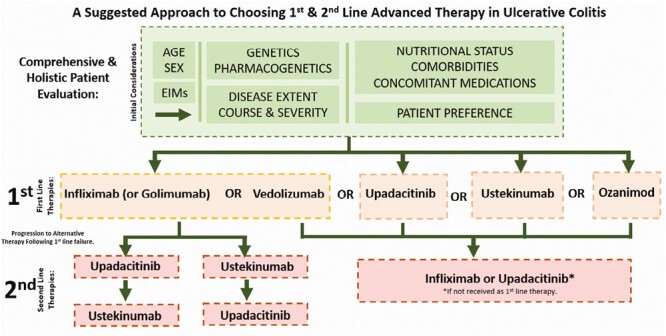
Advanced therapy treatment algorithm.
Vedolizumab was directly compared to the anti-TNF agent, adalimumab, in the VARSITY trial and found to have superior efficacy when used in standard dosing.36 However, this should not be taken to mean that vedolizumab is superior to all anti-TNFs. In the absence of direct head-to-head trials involving other therapies, clinicians must turn to other methods of comparison such as network meta-analyses or uncontrolled cohort studies with propensity score matching.
A network meta-analysis comparing infliximab, adalimumab, golimumab, vedolizumab, ustekinumab, and tofacitinib concluded that infliximab was the most efficacious therapy for inducing remission in the bio-naive patient population.91 This was followed closely by vedolizumab, with vedolizumab being more effective than both infliximab and adalimumab in maintenance of clinical remission and endoscopic improvement.91 Another subsequent network meta-analysis that also included upadacitinib, filgotinib, and ozanimod concluded that upadacitinib was the most efficacious first-line induction therapy for both induction and maintenance therapy in bio-naive patients.17
The placement of vedolizumab as first-line advanced therapy preserves anti-TNFs as an option as second-line therapy. The fact that infliximab has demonstrated efficacy, even in the most severe cases of acute severe colitis, makes it an attractive choice when patients have failed first-line therapy (Tables 1–3). However, it should be recognized that the vast majority of controlled data regarding second-line therapies pertains to the situation in which anti-TNF therapy is used as first-line advanced therapy, and one of the other classes of therapy is used as second- or third-line therapy.
It has been suggested, based upon a recent network meta-analysis that adjusted for differences in maintenance trial design, that upadacitinib is numerically superior to other therapies in induction and maintenance of clinical remission and endoscopic improvement.17
When patients have failed one or more advanced medical therapies, it is appropriate to consider the option of surgical management, as it can provide many patients with good long-term quality of life, without need for medical therapy.
Special situations
Although vedolizumab may be considered to be the preferred first-line advanced therapy in UC, there are special situations based on individual patient or disease characteristics or factors that may alter the choice of advanced therapy.
Extraintestinal manifestations
EIMs can occur in roughly 20%–50% of IBD patients with the commonest being arthropathy, uveitis, erythema nodosum, and aphthous ulceration.92–94 Effective treatment of active intestinal inflammation may or may not directly influence EIM activity, and the various advanced therapies have differing effects on individual EIMs. These differences may influence treatment choice.
The dominant modality of EIM management has been anti-TNF therapy – with demonstrated efficacy in ocular, dermatological, and joint EIMs.27,28,94 Given that patients with EIM may be at higher risk of aggressive disease, with infliximab as the most potent advanced therapy, providing dual coverage makes therapeutic sense.28
Other biologics have demonstrated efficacy in various presentations. Vedolizumab, which is primarily gut-specific, has been shown to improve enteropathic arthritis, but this is not a generally accepted reason to select vedolizumab over other advanced therapies.66 JAK inhibitors (i.e., tofacitinib, filgotinib) have been approved for or are under investigation for management of arthridities.95,96 Meanwhile the anti-interleukin 12/23 agent ustekinumab has been licensed in the management of psoariasis and psoriatic arthritis.97,98
Historical practice has given preference to anti-TNF agents which tend to have ameliorating effects on many joint manifestations and may provide benefit for some patients with psoriasis or psoriatic arthritis. However, with the widespread use of alternative advanced therapies, it is likely that further insights into optimal EIM management will emerge.
Pregnancy
All agents are considered safe in pregnancy including during conception and are continued right through pregnancy – with exception of JAK inhibitors and ozanimod which at present are considered contraindicated in pregnancy.99 The maintenance of remission and minimization of corticosteroid exposure during pregnancy is essential to positive pregnancy outcomes in IBD.100,101 Conception planning and pregnant patients should be reassured about advanced therapy safety and actively engaged in treatment planning.101
UC in an aging population
The bimodal incidence of UC means that new a significant number of new IBD diagnoses will be in patients above the age of 65.102-104 An estimated 25%–35% of patients with IBD are above the age of 60.105 This presents unique clinical challenges and management considerations. Elderly patients are more likely to have significant co-morbidities, to be exposed to the risks of polypharmacy and have inherently higher malignancy risk and increased potential for infectious complications.106-108 Older patients may also have predominantly left-sided disease, with a milder symptom burden or subtle onset.103,109 Disease course in the elderly may be milder, with decreased advanced therapy need as a proxy indicator.109 However, in the context of acute severe UC, elderly patients may in fact have higher colectomy rates.109
The choice of advanced therapy, if required, therefore, requires careful consideration. The use of JAK inhibitors should be balanced with the potential risk of VTE, cardiovascular events, and herpes zoster reactivation. Use of highly effective Shingrix vaccination to mitigate shingles risk.110 Upfront use of an anti-TNF may be justified by intended duration of therapy, holistic consideration of patient longevity, and the need to ‘preserve’ physiological reserves. Elderly patients on infliximab may not have significantly increased risk of adverse events, based on IBD outcome data.111 Meanwhile, ustekinumab and vedolizumab are not associated with increased malignancy incidence, even with those with prior history of neoplasia.112,113
Discussion
The range of available and emerging therapeutic options for UC management is immensely promising for patients. Over the coming years, additional novel agents involving lymphocyte trafficking pathways, selective JAK inhibition, IL-23 inhibition, S1P-receptor modulators and well as PDE4 inhibitors are likely to emerge.114 The rate of discovery of the past 20 years suggests that further pathways of inflammation mediation will continue to be identified as therapeutic targets, alongside paradigm defining breakthroughs on the role of the intestinal microbiome on intestinal and systemic inflammation.
The possibility of identification of microbiome profiles associated with IBD occurrence, relapse, and remission suggests that microbiome alteration may be a therapeutic target. Faecal microbiota transplant (FMT) has already been examined in cohort studies and RCTs, with demonstrated superiority in induction of remission to placebo in metanalysis.115-117 Further characterization of high-risk microbiome profiles continues to be a key area of research. Host–microbiome interactions adds an exponential level of complexity to phenotypic expression, which may itself emerge as a therapeutic target for multiple disease processes.118,119
The role of dual or multiple concurrent or sequential advanced therapy usage remains undefined. Economic considerations, as well uncertainty over adverse effects currently limit the widespread use of concurrent advanced therapies. However, early data does exist suggesting that ‘combination’ therapy may be efficacious and have acceptable safety profile.77 The first dual biologic controlled trial, involving guselkumab and golimumab, shows higher efficacy in combination than with either agent individualy.120 The core consideration in employing multiple simultaneous or sequential advanced therapies is predominantly whether a cumulative treatment effect significantly surpasses the current modest clinical and endoscopic response rates typically observed with even the most efficacious individual agents.
The increasing prevalence of UC means that more patients will likely require advanced therapy. It is imperative that the healthcare providers caring for these individuals understand the attributes of these therapies in order to optimally leverage their use for patient benefit.
Contributor Information
Ronit Das, Gastroenterology / IBD - Mount Sinai Hospital IBD Centre, Toronto, Canada.
A Hillary Steinhart, Gastroenterology / IBD - Mount Sinai Hospital IBD Centre, Toronto, Canada; Department of Medicine, University of Toronto, Toronto, Canada.
Author contributions
Ronit Das: manuscript concept and design, drafting of the initial version of the manuscript, critical revision of the manuscript for important intellectual content. Hillary Steinhart: manuscript concept and design, critical revision of the manuscript for important intellectual content.
Funding
Unfunded.
Declaration of Conflict of Interest
Dr Das has received educational funding from Takeda. Dr Steinhart has received research funding from Abbvie, Arena (Pfizer), Cellgene (BMS), Genentech/Roche, Janssen, and Takeda; he has been on an Advisory Board for AbbVie, Amgen, BioJAMP, BMS, Fresenius Kabi, Janssen, McKesson, Mylan Pharmaceuticals, Organon, Pendopharm, Pfizer, Sandoz, Takeda, Viatris; he has been a consultant for NKS Pharmacy; he has been on a speakers’ bureau for AbbVie, Amgen, BMS, Janssen, Organon, Pfizer, and Takeda.
Data Availability
Not applicable.
References
- 1. Ng SC, Shi HY, Hamidi N, Underwood FE, Tang W, Benchimol EI, Panaccione R, et al. “Worldwide Incidence and Prevalence of Inflammatory Bowel Disease in the 21st Century: A Systematic Review of Population-Based Studies.” The Lancet 390, no. 10114 (2017): 2769–78. 10.1016/S0140-6736(17)32448-0 [DOI] [PubMed] [Google Scholar]
- 2. Burisch J, Jess T, Martinato M, Lakatos PL; ECCO -EpiCom. “The Burden of Inflammatory Bowel Disease in Europe.” Journal of Crohn’s and Colitis 7, no. 4 (2013): 322–37. 10.1016/j.crohns.2013.01.010 [DOI] [PubMed] [Google Scholar]
- 3. Kaplan GG. “The Global Burden of IBD: From 2015 to 2025.” Nature Reviews Gastroenterology & Hepatology 12, no. 12 (2015): 720–7. 10.1038/nrgastro.2015.150 [DOI] [PubMed] [Google Scholar]
- 4. Kamm MA. “Rapid Changes in Epidemiology of Inflammatory Bowel Disease.” The Lancet 390, no. 10114 (2017): 2741–2. 10.1016/S0140-6736(17)32669-7 [DOI] [PubMed] [Google Scholar]
- 5. Kornbluth A, Sachar DB; Practice Parameters Committee of the American College of Gastroenterology. “Ulcerative Colitis Practice Guidelines in Adults: American College of Gastroenterology, Practice Parameters Committee.” Official Journal of the American College of Gastroenterology | ACG 105, no. 3 (2010): 501–23; quiz 524. 10.1038/ajg.2009.727 [DOI] [PubMed] [Google Scholar]
- 6. Feuerstein JD, Isaacs KL, Schneider Y, Siddique SM, Falck-Ytter Y, Singh S; AGA Institute Clinical Guidelines Committee. “AGA Clinical Practice Guidelines on the Management of Moderate to Severe Ulcerative Colitis.” Gastroenterology 158, no. 5 (2020): 1450–61. 10.1053/j.gastro.2020.01.006 [DOI] [PMC free article] [PubMed] [Google Scholar]
- 7. Bernstein CN, Ng SC, Lakatos PL, Moum B, Loftus EV Jr; Epidemiology and Natural History Task Force of the International Organization of the Study of Inflammatory Bowel Disease. “A Review of Mortality and Surgery in Ulcerative Colitis: Milestones of the Seriousness of the Disease.” Inflammatory Bowel Diseases 19, no. 9 (2013): 2001–10. 10.1097/MIB.0b013e318281f3bb [DOI] [PubMed] [Google Scholar]
- 8. Hazel K, O’Connor A.. “Emerging Treatments for Inflammatory Bowel disease.” Therapeutic Advances in Chronic Disease 11 (2020): 2040622319899297. https://pubmed.ncbi.nlm.nih.gov/32076497/ [DOI] [PMC free article] [PubMed] [Google Scholar]
- 9. Alsoud D, Verstockt B, Fiocchi C, Vermeire S.. “Breaking the Therapeutic Ceiling in Drug Development in Ulcerative Colitis.” The Lancet Gastroenterology & Hepatology 6, no. 7 (2021): 589–95. 10.1016/S2468-1253(21)00065-0 [DOI] [PubMed] [Google Scholar]
- 10. Bressler B, Marshall JK, Bernstein CN, Bitton A, Jones J, Leontiadis GI, Panaccione R, Steinhart AH, Tse F, Feagan B; Toronto Ulcerative Colitis Consensus Group. “Clinical Practice Guidelines for the Medical Management of Nonhospitalized Ulcerative Colitis: The Toronto Consensus.” Gastroenterology 148, no. 5 (2015): 1035–58.e3. 10.1053/j.gastro.2015.03.001 [DOI] [PubMed] [Google Scholar]
- 11. Turner D, Ricciuto A, Lewis A, D'Amico F, Dhaliwal J, Griffiths AM, Bettenworth D, et al. ; International Organization for the Study of IBD. “STRIDE-II: An Update on the Selecting Therapeutic Targets in Inflammatory Bowel Disease (STRIDE) Initiative of the International Organization for the Study of IBD (IOIBD): Determining Therapeutic Goals for Treat-to-Target strategies in IBD.” Gastroenterology 160, no. 5 (2021): 1570–83. 10.1053/j.gastro.2020.12.031 [DOI] [PubMed] [Google Scholar]
- 12. Danese S, Hart A, Dignass A, Fiorino G, Louis E, Bonovas S, D'Haens G, et al. “A Multicentre Prospective Cohort Study Assessing the Effectiveness of Budesonide MMX® (Cortiment®MMX®) for Active, Mild-To-MODERATE ulcerative Colitis.” United European Gastroenterology Journal 7, no. 9 (2019): 1171–82. 10.1177/2050640619864848 [DOI] [PMC free article] [PubMed] [Google Scholar]
- 13. Salice M, Rizzello F, Calabrese C, Privitera Hrustemovic H, Gionchetti P.. “Budesonide MMX: Efficacy and Safety Profile in the Treatment of Ulcerative Colitis.” Expert Review of Gastroenterology & Hepatology 13, no. 7 (2019): 607–13. 10.1080/17474124.2019.1621745 [DOI] [PubMed] [Google Scholar]
- 14. Gisbert JP, Chaparro M.. “Systematic Review with Meta-Analysis: Inflammatory Bowel Disease in the Elderly.” Alimentary Pharmacology & Therapeutics 39, no. 5 (2014): 459–77. 10.1111/apt.12616 [DOI] [PubMed] [Google Scholar]
- 15. Rutgeerts P, Sandborn WJ, Feagan BG, Reinisch W, Olson A, Johanns J, Travers S, et al. “Infliximab for Induction and Maintenance Therapy for Ulcerative Colitis.” New England Journal of Medicine 353, no. 23 (2005): 2462–76. 10.1056/NEJMoa050516 [DOI] [PubMed] [Google Scholar]
- 16. Sands BE, Tremaine WJ, Sandborn WJ, Rutgeerts PJ, Hanauer SB, Mayer L, Targan SR, Podolsky DK.. “Infliximab in the Treatment of Severe, Steroid-Refractory Ulcerative Colitis: a Pilot Study.” Inflammatory Bowel Diseases 7, no. 2 (2001): 83–8. 10.1097/00054725-200105000-00001 [DOI] [PubMed] [Google Scholar]
- 17. Panaccione R, Collins EB, Melmed GY, Vermeire S, Danese S, Higgins PDR, Kwon CS, et al. “Efficacy and Safety of Advanced Therapies for Moderately to Severely Active Ulcerative Colitis at Induction and Maintenance: an Indirect Treatment Comparison Using Bayesian Network Meta-analysis.” Crohns Colitis 360 5, no. 2 (2023): otad009. 10.1093/crocol/otad009 [DOI] [PMC free article] [PubMed] [Google Scholar]
- 18. Panaccione R, Ghosh S, Middleton S, Márquez JR, Scott BB, Flint L, van Hoogstraten HJF, et al. “Combination Therapy With Infliximab and Azathioprine Is Superior to Monotherapy With Either Agent in Ulcerative Colitis.” Gastroenterology 146, no. 2 (2014): 392–400.e3. 10.1053/j.gastro.2013.10.052 [DOI] [PubMed] [Google Scholar]
- 19. Bar-Yoseph H, Waterman M, Almog R, Billiet T, Vermeire S, Ungar B, Yanai H, Dotan I, Ben-Horin S, Chowers Y.. “Prevention of Antidrug Antibody Formation to Infliximab in Crohn’s Patients With Prior Failure of Thiopurines.” Clinical Gastroenterology and Hepatology 15, no. 1 (2017): 69–75. 10.1016/j.cgh.2016.06.028 [DOI] [PubMed] [Google Scholar]
- 20. Mogensen DV, Brynskov J, Ainsworth MA, Nersting J, Schmiegelow K, Steenholdt C.. “A Role for Thiopurine Metabolites in the Synergism Between Thiopurines and Infliximab in Inflammatory Bowel Disease.” Journal of Crohn’s and Colitis 12, no. 3 (2018): 298–305. 10.1093/ecco-jcc/jjx149 [DOI] [PubMed] [Google Scholar]
- 21. Shah ED, Coburn ES, Nayyar A, Lee KJ, Koliani-Pace JL, Siegel CA.. “Systematic Review: Hepatosplenic T-Cell Lymphoma on Biologic Therapy for Inflammatory Bowel Disease, Including Data from the Food and Drug Administration Adverse Event Reporting System.” Alimentary Pharmacology and Therapeutics 51, no. 5 (2020): 527–33. 10.1111/apt.15637 [DOI] [PMC free article] [PubMed] [Google Scholar]
- 22. Kirchgesner J, Lemaitre M, Carrat F, Zureik M, Carbonnel F, Dray-Spira R.. “Risk of Serious and Opportunistic Infections Associated With Treatment of Inflammatory Bowel Diseases.” Gastroenterology 155, no. 2 (2018): 337–46.e10. 10.1053/j.gastro.2018.04.012 [DOI] [PubMed] [Google Scholar]
- 23. Olivera P, Danese S, Pouillon L, Bonovas S, Peyrin-Biroulet L.. “Effectiveness of Golimumab in Ulcerative Colitis: A Review of the Real World Evidence.” Digestive and Liver Disease 51, no. 3 (2019): 327–34. 10.1016/j.dld.2018.11.002 [DOI] [PubMed] [Google Scholar]
- 24. Sandborn WJ, Feagan BG, Marano C, Zhang H, Strauss R, Johanns J, Adedokun OJ, et al. “Subcutaneous Golimumab Induces Clinical Response and Remission in Patients With Moderate-to-Severe Ulcerative Colitis.” Gastroenterology 146, no. 1 (2014): 85–95; quiz e14. 10.1053/j.gastro.2013.05.048 [DOI] [PubMed] [Google Scholar]
- 25. García-Bosch O, Gisbert JP, Cañas-Ventura A, Merino O, Cabriada JL, García-Sánchez V, Gutiérrez A, et al. “Observational Study on the Efficacy of Adalimumab for the Treatment of Ulcerative Colitis and Predictors of Outcome.” Journal of Crohn’s and Colitis 7, no. 9 (2013): 717–22. 10.1016/j.crohns.2012.10.004 [DOI] [PubMed] [Google Scholar]
- 26. Löwenberg M, de Boer NKH, Hoentjen F.. “Golimumab for the Treatment of Ulcerative Colitis.” Clinical and Experimental Gastroenterology 7 (2014): 53–9. https://www.ncbi.nlm.nih.gov/pmc/articles/PMC3958527/ [DOI] [PMC free article] [PubMed] [Google Scholar]
- 27. Vavricka SR, Gubler M, Gantenbein C, Spoerri M, Froehlich F, Seibold F, Protic M, et al. “Anti-TNF Treatment for Extraintestinal Manifestations of Inflammatory Bowel Disease in the Swiss IBD Cohort Study.” Inflammatory Bowel Diseases 23, no. 7 (2017): 1174–81. 10.1097/MIB.0000000000001109 [DOI] [PubMed] [Google Scholar]
- 28. Thomas G, Florian R, Torsten K, et al. “Emerging Treatment Options for Extraintestinal Manifestations in IBD.” Gut 70, no. 4 (2021): 796. 10.1136/gutjnl-2020-322129 [DOI] [PMC free article] [PubMed] [Google Scholar]
- 29. Sandborn WJ, van Assche G, Reinisch W, Colombel J-F, D'Haens G, Wolf DC, Kron M, Tighe MB, Lazar A, Thakkar RB.. “Adalimumab Induces and Maintains Clinical Remission in Patients With Moderate-to-Severe Ulcerative Colitis.” Gastroenterology 142, no. 2 (2012): 257–65.e1. 10.1053/j.gastro.2011.10.032 [DOI] [PubMed] [Google Scholar]
- 30. Burmester GR, Gordon KB, Rosenbaum JT, Arikan D, Lau WL, Li P, Faccin F, Panaccione R.. “Long-Term Safety of Adalimumab in 29,967 Adult Patients From Global Clinical Trials Across Multiple Indications: an Updated Analysis.” Advances in Therapy 37, no. 1 (2020): 364–80. 10.1007/s12325-019-01145-8 [DOI] [PMC free article] [PubMed] [Google Scholar]
- 31. Murdaca G, Negrini S, Greco M, Schiavi C, Giusti F, Borro M, Puppo F.. “Immunogenicity of Infliximab and Adalimumab.” Expert Opinion on Drug Safety 18, no. 5 (2019): 343–5. 10.1080/14740338.2019.1602117 [DOI] [PubMed] [Google Scholar]
- 32. Shealy DJ, Cai A, Staquet K, Baker A, Lacy ER, Johns L, Vafa O, et al. “Characterization of Golimumab, a Human Monoclonal Antibody Specific for Human Tumor Necrosis factor α.” MAbs 2, no. 4 (2010): 428–39. 10.4161/mabs.12304 [DOI] [PMC free article] [PubMed] [Google Scholar]
- 33. Sandborn WJ, Feagan BG, Marano C, Zhang H, Strauss R, Johanns J, Adedokun OJ, et al. “Subcutaneous Golimumab Maintains Clinical Response in Patients with Moderate-to-Severe Ulcerative Colitis.” Gastroenterology 146, no. 1 (2014): 96–109.e1. 10.1053/j.gastro.2013.06.010 [DOI] [PubMed] [Google Scholar]
- 34. Gibson PR, Feagan BG, Sandborn WJ, Marano C, Strauss R, Johanns J, Padgett L, et al. “Maintenance of Efficacy and Continuing Safety of Golimumab for Active Ulcerative Colitis: PURSUIT-SC Maintenance Study Extension Through 1 Year.” Clinical and Translational Gastroenterology 7, no. 4 (2016): e168. 10.1038/ctg.2016.24 [DOI] [PMC free article] [PubMed] [Google Scholar]
- 35. Pulusu SSR, Srinivasan A, Krishnaprasad K, Cheng D, Begun J, Keung C, Van Langenberg D, et al. “Vedolizumab for Ulcerative Colitis: Real World Outcomes from a Multicenter Observational Cohort of Australia and Oxford.” World Journal of Gastroenterology 26, no. 30 (2020): 4428–41. 10.3748/wjg.v26.i30.4428 [DOI] [PMC free article] [PubMed] [Google Scholar]
- 36. Sands BE, Peyrin-Biroulet L, Loftus EV, Danese S, Colombel J-F, Törüner M, Jonaitis L, et al. “Vedolizumab versus Adalimumab for Moderate-to-Severe Ulcerative Colitis.” New England Journal of Medicine 381, no. 13 (2019): 1215–26. 10.1056/NEJMoa1905725 [DOI] [PubMed] [Google Scholar]
- 37. Perry C, Fischer K, Elmoursi A, Kern C, Currier A, Kudaravalli P, Akanbi O, et al. “Vedolizumab Dose Escalation Improves Therapeutic Response in a Subset of Patients with Ulcerative Colitis.” Digestive Diseases and Sciences 66, no. 6 (2021): 2051–8. 10.1007/s10620-020-06486-x [DOI] [PubMed] [Google Scholar]
- 38. Sandborn W, Wolf D, D’haens G, Jansson J, Chen J, Uddin S, Candela N, Lasch K, Kisfalvi K.. “P510 Dose Escalation of Subcutaneous Vedolizumab in Patients with Ulcerative Colitis: A Post Hoc Analysis of the VISIBLE Trial Data.” Journal of Crohn’s and Colitis 14, no. Supplement_1 (2020): S442–3. 10.1093/ecco-jcc/jjz203.639 [DOI] [Google Scholar]
- 39. Sandborn WJ, Baert F, Danese S, Krznarić Z, Kobayashi T, Yao X, Chen J, et al. “Efficacy and Safety of Vedolizumab Subcutaneous Formulation in a Randomized Trial of Patients With Ulcerative Colitis.” Gastroenterology 158, no. 3 (2020): 562–72.e12. 10.1053/j.gastro.2019.08.027 [DOI] [PubMed] [Google Scholar]
- 40. Ventress E, Young D, Rahmany S, Harris C, Bettey M, Smith T, Moyses H, et al. “Transitioning from Intravenous to Subcutaneous Vedolizumab in Patients with Inflammatory Bowel Disease [TRAVELESS].” Journal of Crohn’s and Colitis 16, no. 6 (2022): 911–21. 10.1093/ecco-jcc/jjab224 [DOI] [PMC free article] [PubMed] [Google Scholar]
- 41. Kobayashi T, Ito H, Ashida T, Yokoyama T, Nagahori M, Inaba T, Shikamura M, et al. “Efficacy and Safety of a New Vedolizumab Subcutaneous Formulation in Japanese Patients with Moderately to Severely Active Ulcerative Colitis.” Intest Res 19, no. 4 (2021): 448–60. 10.5217/ir.2020.00026 [DOI] [PMC free article] [PubMed] [Google Scholar]
- 42. Nicholas S, Tilman S-H, Nico M, Gary C, Heinz W.. “Natalizumab-Associated PML.” Neurology 88, no. 12 (2017): 1197. 10.1212/WNL.0000000000003739 [DOI] [PubMed] [Google Scholar]
- 43. Berger JR. “Natalizumab and Progressive Multifocal Leucoencephalopathy.” Annals of the Rheumatic Diseases 65, no. Suppl 3 (2006): iii48–53. 10.1136/ard.2006.058404 [DOI] [PMC free article] [PubMed] [Google Scholar]
- 44. Łukasik Z, Gracey E, Venken K, Ritchlin C, Elewaut D.. “Crossing the Boundaries: IL-23 and its Role in Linking Inflammation of the Skin, Gut and Joints.” Rheumatology 60, no. Suppl 4 (2021): iv16–27. 10.1093/rheumatology/keab385 [DOI] [PMC free article] [PubMed] [Google Scholar]
- 45. Sands BE, Sandborn WJ, Panaccione R, O'Brien CD, Zhang H, Johanns J, Adedokun OJ, et al. ; UNIFI Study Group. “Ustekinumab as Induction and Maintenance Therapy for Ulcerative Colitis.” New England Journal of Medicine 381, no. 13 (2019): 1201–14. 10.1056/NEJMoa1900750 [DOI] [PubMed] [Google Scholar]
- 46. Proton R, Regan A, Majed K, et al. “Long-Term Effectiveness and Safety of Infliximab, Golimumab and Ustekinumab in Patients with Psoriatic Arthritis from a Canadian Prospective Observational Registry.” BMJ Open 10, no. 8 (2020): e036245. 10.1136/bmjopen-2019-036245 [DOI] [PMC free article] [PubMed] [Google Scholar]
- 47. Thibodaux RJ, Triche MW, Espinoza LR.. “Ustekinumab for the Treatment of Psoriasis and Psoriatic Arthritis: A Drug Evaluation and Literature Review.” Expert Opinion on Biological Therapy 18, no. 7 (2018): 821–7. 10.1080/14712598.2018.1492545 [DOI] [PubMed] [Google Scholar]
- 48. Ogdie A, Coates LC, Gladman DD.. “Treatment Guidelines in Psoriatic Arthritis.” Rheumatology 59, no. Suppl 1 (2020): i37–46. 10.1093/rheumatology/kez383 [DOI] [PMC free article] [PubMed] [Google Scholar]
- 49. Singh JA, Guyatt G, Ogdie A, Gladman DD, Deal C, Deodhar A, Dubreuil M, et al. “2018 American College of Rheumatology/National Psoriasis Foundation Guideline for the Treatment of Psoriatic Arthritis.” Journal of Psoriasis and Psoriatic Arthritis 4, no. 1 (2018): 31–58. 10.1177/2475530318812244 [DOI] [Google Scholar]
- 50. Sandborn WJ, Ferrante M, Bhandari BR, Berliba E, Feagan BG, Hibi T, Tuttle JL, et al. “Efficacy and Safety of Mirikizumab in a Randomized Phase 2 Study of Patients With Ulcerative Colitis.” Gastroenterology 158, no. 3 (2020): 537–49.e10. 10.1053/j.gastro.2019.08.043 [DOI] [PubMed] [Google Scholar]
- 51. MC Dubinsky PI, Li X, Howaldt S, et al. “Efficacy and Safety of Mirikizumab as Maintenance Therapy in Patients With Moderately to Severely Active Ulcerative Colitis: results From the Phase 3 LUCENT-2 Study.” Gastroenterologia y Hepatologia 18, no. 7 Suppl 2 (2022): 3–4 [PMC free article] [PubMed] [Google Scholar]
- 52. Geert DH, Taku K, Nathan M, et al. “O29 Efficacy and safety of mirikizumab in patients with ulcerative colitis: phase 3 LUCENT-1 study results.” Gut 71, no. Suppl 1 (2022): A16. 10.1136/gutjnl-2022-BSG.29 [DOI] [Google Scholar]
- 53. Sands BE, Feagan B, Gibble TH, Traxler KA, Morris N, Li X, Schreiber S, Jairath V, Armuzzi A, Jones J.. “A31 Mirikizumab Improves Quality of LIfe in Mod-Severe Active UC: improvement in IBDQ Scores in Participatients in Phase-3 RCT.” Journal of the Canadian Association of Gastroenterology 6, no. Supplement_1 (2023): 16–7. 10.1093/jcag/gwac036.031 [DOI] [Google Scholar]
- 54. Taxonera C, Olivares D, Alba C.. “Real-World Effectiveness and Safety of Tofacitinib in Patients With Ulcerative Colitis: systematic Review With Meta-Analysis.” Inflammatory Bowel Diseases 28, no. 1 (2022): 32–40. 10.1093/ibd/izab011 [DOI] [PubMed] [Google Scholar]
- 55. Sandborn WJ, Su C, Sands BE, D'Haens GR, Vermeire S, Schreiber S, Danese S, et al. “Tofacitinib as Induction and Maintenance Therapy for Ulcerative Colitis.” New England Journal of Medicine 376, no. 18 (2017): 1723–36. 10.1056/NEJMoa1606910. [DOI] [PubMed] [Google Scholar]
- 56. Bonovas S, Lytras T, Nikolopoulos G, Peyrin-Biroulet L, Danese S.. “Systematic Review with Network Meta-Analysis: Comparative Assessment of Tofacitinib and Biological Therapies for Moderate-to-Severe Ulcerative Colitis.” Alimentary Pharmacology & Therapeutics 47, no. 4 (2018): 454–65. 10.1111/apt.14449 [DOI] [PubMed] [Google Scholar]
- 57. Olivera PA, Lasa JS, Peretto G, Zuily S, Danese S, Peyrin-Biroulet L.. “Review article: Risk of Cardiovascular Events in Patients with Inflammatory Bowel Disease Receiving Small Molecule Drugs.” Alimentary Pharmacology & Therapeutics 57, no. 11 (2023): 1231–1248. 10.1111/apt.17509 [DOI] [PubMed] [Google Scholar]
- 58. Solitano V, Fiorino G, D’Amico F, Peyrin-Biroulet L, Danese S.. “Thrombosis in IBD in the Era of JAK Inhibition.” Current Drug Targets 22, no. 1 (2021): 126–36. 10.2174/1389450121666200902164240 [DOI] [PubMed] [Google Scholar]
- 59. Olivera PA, Lasa JS, Bonovas S, Danese S, Peyrin-Biroulet L.. “Safety of Janus Kinase Inhibitors in Patients With Inflammatory Bowel Diseases or Other Immune-mediated Diseases: a Systematic Review and Meta-Analysis.” Gastroenterology 158, no. 6 (2020): 1554–73.e12. 10.1053/j.gastro.2020.01.001 [DOI] [PubMed] [Google Scholar]
- 60. Danese S, Vermeire S, Zhou W, Pangan AL, Siffledeen J, Greenbloom S, Hébuterne X, et al. “Upadacitinib as Induction and Maintenance Therapy for Moderately to Severely Active Ulcerative Colitis: Results From Three Phase 3, Multicentre, Double-Blind, Randomised Trials.” The Lancet 399, no. 10341 (2022): 2113–28. 10.1016/S0140-6736(22)00581-5 [DOI] [PubMed] [Google Scholar]
- 61. Yates M, Mootoo A, Adas M, Bechman K, Rampes S, Patel V, Qureshi S, Cope AP, Norton S, Galloway JB.. “Venous Thromboembolism Risk With JAK Inhibitors: a Meta-Analysis.” Arthritis Rheumatol 73, no. 5 (2021): 779–88. 10.1002/art.41580 [DOI] [PubMed] [Google Scholar]
- 62. Maqsood MH, Weber BN, Haberman RH, Lo Sicco KI, Bangalore S, Garshick MS.. “Cardiovascular and Venous Thromboembolic Risk With Janus Kinase Inhibitors in Immune-Mediated Inflammatory Diseases: A Systematic Review and Meta-Analysis of Randomized Trials.” ACR Open Rheumatology 4, no. 10 (2022): 912–22. 10.1002/acr2.11479 [DOI] [PMC free article] [PubMed] [Google Scholar]
- 63. Feagan BG, Danese S, Loftus EV Jr, Vermeire S, Schreiber S, Ritter T, Fogel R, et al. “Filgotinib as Induction and Maintenance Therapy for Ulcerative Colitis (SELECTION): A Phase 2b/3 Double-Blind, Randomised, Placebo-Controlled Trial.” Lancet 397, no. 10292 (2021): 2372–84. 10.1016/S0140-6736(21)00666-8 [DOI] [PubMed] [Google Scholar]
- 64. Scott F, Clemons B, Brooks J, et al. “Ozanimod (RPC1063) is a potent sphingosine-1-phosphate receptor-1 (S1P1) and receptor-5 (S1P5) agonist with autoimmune disease-modifying activity.” British Journal of Pharmacology 173, no. 11 (2016): 1778–92. [DOI] [PMC free article] [PubMed] [Google Scholar]
- 65. Peyrin-Biroulet L, Christopher R, Behan D, Lassen C.. “Modulation of Sphingosine-1-Phosphate in Inflammatory Bowel Disease.” Autoimmunity Reviews 16, no. 5 (2017): 495–503. 10.1016/j.autrev.2017.03.007 [DOI] [PubMed] [Google Scholar]
- 66. Sandborn WJ, Feagan BG, D’Haens G, Wolf DC, Jovanovic I, Hanauer SB, Ghosh S, et al. “Ozanimod as Induction and Maintenance Therapy for Ulcerative Colitis.” New England Journal of Medicine 385, no. 14 (2021): 1280–91. 10.1056/NEJMoa2033617 [DOI] [PubMed] [Google Scholar]
- 67. Reinisch W, Axelrad J, Ahmad HA, Pondel M, Ather S, Elegbe A, Sninsky C, Longman R. “.P431 Early Mucosal Healing at Week, 10 with Ozanimod Predicts Clinical Outcomes at Week, 52: Post Hoc Analysis of the Phase, 3 True North Clinical Trial.” Journal of Crohn’s and Colitis 16, no. Supplement_1 (2022): i415. 10.1093/ecco-jcc/jjab232.558 [DOI] [PMC free article] [PubMed] [Google Scholar]
- 68. Italia JL, Bhardwaj V, Ravi Kumar MNV.. “Disease, Destination, Dose and Delivery Aspects of Ciclosporin: The State of the Art.” Drug Discovery Today 11, no. 17-18 (2006): 846–54. 10.1016/j.drudis.2006.07.015 [DOI] [PubMed] [Google Scholar]
- 69. Durai D, Hawthorne AB.. “Review Article: How and When to use Ciclosporin in Ulcerative Colitis.” Alimentary Pharmacology & Therapeutics 22, no. 10 (2005): 907–16. 10.1111/j.1365-2036.2005.02680.x [DOI] [PubMed] [Google Scholar]
- 70. Campbell S, Travis S, Jewell D.. “Ciclosporin Use in Acute Ulcerative Colitis: A Long-Term Experience.” European Journal of Gastroenterology & Hepatology 17, no. 1 (2005): 79–84. 10.1097/00042737-200501000-00016 [DOI] [PubMed] [Google Scholar]
- 71. Laharie D, Bourreille A, Branche J, Allez M, Bouhnik Y, Filippi J, Zerbib F, et al. “Ciclosporin Versus Infliximab in Patients with Severe Ulcerative Colitis Refractory to Intravenous Steroids: A Parallel, Open-Label Randomised Controlled Trial.” The Lancet 380, no. 9857 (2012): 1909–15. 10.1016/S0140-6736(12)61084-8 [DOI] [PubMed] [Google Scholar]
- 72. Barberio B, Black CJ, Savarino EV, Ford AC.. “Ciclosporin or Infliximab as Rescue Therapy in Acute Glucorticosteroid-Refractory Ulcerative Colitis: systematic Review and Network Meta-Analysis.” Journal of Crohn’s and Colitis 15, no. 5 (2021): 733–41. 10.1093/ecco-jcc/jjaa226 [DOI] [PubMed] [Google Scholar]
- 73. van Dieren JM, Kuipers EJ, Samsom JN, Nieuwenhuis EE, van der Woude JC.. “Revisiting the Immunomodulators Tacrolimus, Methotrexate, and Mycophenolate Mofetil: Their Mechanisms of Action and Role in the Treatment of IBD.” Inflammatory Bowel Diseases 12, no. 4 (2006): 311–27. 10.1097/01.mib.0000209787.19952.53 [DOI] [PubMed] [Google Scholar]
- 74. Ogata H, Kato J, Hirai F, Hida N, Matsui T, Matsumoto T, Koyanagi K, Hibi T.. “Double-Blind, Placebo-Controlled Trial of Oral Tacrolimus (FK506) in the Management of Hospitalized Patients with Steroid-Refractory Ulcerative Colitis.” Inflammatory Bowel Diseases 18, no. 5 (2012): 803–8. 10.1002/ibd.21853 [DOI] [PubMed] [Google Scholar]
- 75. Komaki Y, Komaki F, Ido A, Sakuraba A.. “Efficacy and Safety of Tacrolimus Therapy for Active Ulcerative Colitis; A Systematic Review and Meta-analysis.” Journal of Crohn’s and Colitis 10, no. 4 (2016): 484–94. 10.1093/ecco-jcc/jjv221 [DOI] [PMC free article] [PubMed] [Google Scholar]
- 76. Actis GC, Pellicano R, Ribaldone DG.. “A Concise History of Thiopurines for Inflammatory Bowel Disease: from Anecdotal Reporting to Treat-to-Target Algorithms.” Reviews on Recent Clinical Trials 14, no. 1 (2019): 4–9. 10.2174/1574887113666180910120959 [DOI] [PubMed] [Google Scholar]
- 77. Evangelos S, Wendi Q, Apostolos P, et al. “Thiopurine Monotherapy is Effective in Ulcerative Colitis But Significantly Less so in Crohn’s Disease: Long-Term Outcomes for 11 928 Patients in the UK Inflammatory Bowel Disease Bioresource.” Gut 70, no. 4 (2021): 677. 10.1136/gutjnl-2019-320185 [DOI] [PMC free article] [PubMed] [Google Scholar]
- 78. van Gennep S, de Boer NK, D’Haens GR, Löwenberg M.. “Thiopurine Treatment in Ulcerative Colitis: a Critical Review of the Evidence for Current Clinical Practice.” Inflammatory Bowel Diseases 24, no. 1 (2018): 67–77. 10.1093/ibd/izx025 [DOI] [PubMed] [Google Scholar]
- 79. Khan N, Abbas AM, Lichtenstein GR, Loftus EV, Bazzano LA.. “Risk of Lymphoma in Patients With Ulcerative Colitis Treated With Thiopurines: a Nationwide Retrospective Cohort Study.” Gastroenterology 145, no. 5 (2013): 1007–15.e3. 10.1053/j.gastro.2013.07.035 [DOI] [PubMed] [Google Scholar]
- 80. Abbas AM, Almukhtar RM, Loftus EV, Lichtenstein GR, Khan N.. “Risk of Melanoma and Non-Melanoma Skin Cancer in Ulcerative Colitis Patients Treated With Thiopurines: a Nationwide Retrospective Cohort.” Official Journal of the American College of Gastroenterology | ACG 109, no. 11 (2014): 1781–93. 10.1038/ajg.2014.298 [DOI] [PubMed] [Google Scholar]
- 81. Chhibba T, Ma C.. “Is there Room for Immunomodulators in Ulcerative Colitis?.” Expert Opinion on Biological Therapy 20, no. 4 (2020): 379–90. 10.1080/14712598.2020.1708896 [DOI] [PubMed] [Google Scholar]
- 82. Carl E, Sara R, Yang C, Scott M, Jonas H.. “Impact of Thiopurines on the Natural History and Surgical Outcome of Ulcerative Colitis: A Cohort Study.” Gut 68, no. 4 (2019): 623. 10.1136/gutjnl-2017-315521 [DOI] [PubMed] [Google Scholar]
- 83. Bermejo F, Aguas M, Chaparro M, et al. “Recommendations of the Spanish Working Group on Crohn’s Disease and Ulcerative Colitis (GETECCU) on the use of thiopurines in inflammatory bowel disease.” Gastroenterología y Hepatología (English Edition) 41, no. 3 (2018): 205–21. doi: 10.1016/j.gastre.2018.03.002 [DOI] [PubMed] [Google Scholar]
- 84. Allison AC. “Mechanisms of Action of Mycophenolate Mofetil.” Lupus 14, no. Suppl 1 (2005): s2–8. 10.1191/0961203305lu2109oa [DOI] [PubMed] [Google Scholar]
- 85. Smith MR, Cooper SC.. “Mycophenolate Mofetil Therapy in the Management of Inflammatory Bowel Disease—A Retrospective Case Series and Review.” Journal of Crohn’s and Colitis 8, no. 8 (2014): 890–7. 10.1016/j.crohns.2014.01.014 [DOI] [PubMed] [Google Scholar]
- 86. Palaniappan S, Ford AC, Greer D, Everett SM, Chalmers DM, Axon ATR, Hamlin PJ.. “Mycophenolate mofetil therapy for refractory inflammatory bowel disease.” Inflammatory Bowel Diseases 13, no. 12 (2007): 1488–92. 10.1002/ibd.20258 [DOI] [PubMed] [Google Scholar]
- 87. Liapis G, Boletis J, Skalioti C, Bamias G, Tsimaratou K, Patsouris E, Delladetsima I.. “Histological Spectrum of Mycophenolate Mofetil-Related Colitis: Association with Apoptosis.” Histopathology 63, no. 5 (2013): 649–58. 10.1111/his.12222 [DOI] [PubMed] [Google Scholar]
- 88. Stephen L, Boer WB, Kavitha S, Kumarasinghe MP.. “Pointers and Pitfalls of Mycophenolate-Associated Colitis.” Journal of Clinical Pathology 66, no. 1 (2013): 8. 10.1136/jclinpath-2012-200888 [DOI] [PubMed] [Google Scholar]
- 89. Herfarth H, Barnes EL, Valentine JF, Hanson J, Higgins PDR, Isaacs KL, Jackson S, et al. “Methotrexate Is Not Superior to Placebo in Maintaining Steroid-Free Response or Remission in Ulcerative Colitis.” Gastroenterology 155, no. 4 (2018): 1098–1108.e9. 10.1053/j.gastro.2018.06.046 [DOI] [PMC free article] [PubMed] [Google Scholar]
- 90. Nielsen OH, Steenholdt C, Juhl CB, Rogler G.. “Efficacy and Safety of Methotrexate in the Management of Inflammatory Bowel Disease: A Systematic Review and Meta-Analysis of Randomized, Controlled Trials.” eClinicalMedicine 20 (2020): 100271. https://pubmed.ncbi.nlm.nih.gov/32300735/ [DOI] [PMC free article] [PubMed] [Google Scholar]
- 91. Singh S, Murad MH, Fumery M, Dulai PS, Sandborn WJ.. “First- and Second-Line Pharmacotherapies for Patients With Moderate to Severely Active Ulcerative Colitis: an Updated Network Meta-Analysis.” Clinical Gastroenterology and Hepatology 18, no. 10 (2020): 2179–91.e6. 10.1016/j.cgh.2020.01.008 [DOI] [PMC free article] [PubMed] [Google Scholar]
- 92. Rogler G, Singh A, Kavanaugh A, Rubin DT.. “Extraintestinal Manifestations of Inflammatory Bowel Disease: current Concepts, Treatment, and Implications for Disease Management.” Gastroenterology 161, no. 4 (2021): 1118–32. 10.1053/j.gastro.2021.07.042 [DOI] [PMC free article] [PubMed] [Google Scholar]
- 93. Vavricka SR, Rogler G, Gantenbein C, Spoerri M, Prinz Vavricka M, Navarini AA, French LE, et al. “Chronological Order of Appearance of Extraintestinal Manifestations Relative to the Time of IBD Diagnosis in the Swiss Inflammatory Bowel Disease Cohort.” Inflammatory Bowel Diseases 21, no. 8 (2015): 1794–800. 10.1097/MIB.0000000000000429. [DOI] [PubMed] [Google Scholar]
- 94. Hedin CRH, Vavricka SR, Stagg AJ, Schoepfer A, Raine T, Puig L, Pleyer U, et al. “The Pathogenesis of Extraintestinal Manifestations: implications for IBD Research, Diagnosis, and Therapy.” Journal of Crohn’s and Colitis 13, no. 5 (2019): 541–54. 10.1093/ecco-jcc/jjy191 [DOI] [PubMed] [Google Scholar]
- 95. Mease P, Hall S, FitzGerald O, van der Heijde D, Merola JF, Avila-Zapata F, Cieślak D, et al. “Tofacitinib or Adalimumab Versus Placebo for Psoriatic Arthritis.” New England Journal of Medicine 377, no. 16 (2017): 1537–50. 10.1056/NEJMoa1615975 [DOI] [PubMed] [Google Scholar]
- 96. Kavanaugh A, Kremer J, Ponce L, Cseuz R, Reshetko OV, Stanislavchuk M, Greenwald M, et al. “Filgotinib (GLPG0634/GS-6034), an Oral Selective JAK1 Inhibitor, Is Effective as Monotherapy in Patients With Active Rheumatoid Arthritis: Results From a Randomised, Dose-Finding Study (DARWIN 2).” Annals of the Rheumatic Diseases 76, no. 6 (2017): 1009–19. 10.1136/annrheumdis-2016-210105 [DOI] [PubMed] [Google Scholar]
- 97. McInnes IB, Kavanaugh A, Gottlieb AB, Puig L, Rahman P, Ritchlin C, Brodmerkel C, et al. “Efficacy and Safety of Ustekinumab in Patients with Active Psoriatic Arthritis: 1 Year Results of the Phase 3, Multicentre, Double-Blind, Placebo-Controlled PSUMMIT 1 Trial.” The Lancet 382, no. 9894 (2013): 780–9. 10.1016/S0140-6736(13)60594-2 [DOI] [PubMed] [Google Scholar]
- 98. Gordon KB, Strober B, Lebwohl M, Augustin M, Blauvelt A, Poulin Y, Papp KA, et al. “Efficacy and Safety of Risankizumab in Moderate-to-Severe Plaque Psoriasis (UltIMMa-1 and UltIMMa-2): Results From Two Double-Blind, Randomised, Placebo-Controlled and Ustekinumab-Controlled Phase 3 trials.” The Lancet 392, no. 10148 (2018): 650–61. 10.1016/S0140-6736(18)31713-6 [DOI] [PubMed] [Google Scholar]
- 99. Brondfield MN, Mahadevan U.. “Inflammatory Bowel Disease in Pregnancy and Breastfeeding.” Nature Reviews Gastroenterology & Hepatology 20, no. 8 (2023): 504–23. https://pubmed.ncbi.nlm.nih.gov/37002407/ [DOI] [PubMed] [Google Scholar]
- 100. Florence-Damilola O, Millie L, Kirk L, Uma M.. “Exposure to Corticosteroids in Pregnancy is Associated with Adverse Perinatal Outcomes Among Infants of Mothers with Inflammatory Bowel Disease: Results From the PIANO Registry.” Gut 71, no. 9 (2022): 1766. 10.1136/gutjnl-2021-325317 [DOI] [PubMed] [Google Scholar]
- 101. Nguyen GC, Seow CH, Maxwell C, Huang V, Leung Y, Jones J, Leontiadis GI, Tse F, Mahadevan U, van der Woude CJ; IBD in Pregnancy Consensus Group. “The Toronto Consensus Statements for the Management of Inflammatory Bowel Disease in Pregnancy.” Gastroenterology 150, no. 3 (2016): 734–57.e1. 10.1053/j.gastro.2015.12.003 [DOI] [PubMed] [Google Scholar]
- 102. Kontola K, Oksanen P, Huhtala H, Jussila A.. “Increasing Incidence of Inflammatory Bowel Disease, with Greatest Change Among the Elderly: a Nationwide Study in Finland, 2000–2020.” Journal of Crohn’s and Colitis 17, no. 5 (2023): 706–11. 10.1093/ecco-jcc/jjac177 [DOI] [PubMed] [Google Scholar]
- 103. Sousa P, Bertani L, Rodrigues C.. “Management of inflammatory bowel disease in the elderly: a review.” Digestive and Liver Disease 55, no. 8 (2023): 1001–9. 10.1016/j.dld.2022.12.024 [DOI] [PubMed] [Google Scholar]
- 104. Kaplan GG, Windsor JW.. “The Four Epidemiological Stages in the Global Evolution of Inflammatory Bowel Disease.” Nature Reviews Gastroenterology & Hepatology 18, no. 1 (2021): 56–66. 10.1038/s41575-020-00360-x [DOI] [PMC free article] [PubMed] [Google Scholar]
- 105. Sturm A, Maaser C, Mendall M, Karagiannis D, Karatzas P, Ipenburg N, Sebastian S, et al. “European Crohn’s and Colitis Organisation Topical Review on IBD in the Elderly.” Journal of Crohn’s and Colitis 11, no. 3 (2017): 263–73. 10.1093/ecco-jcc/jjw188 [DOI] [PubMed] [Google Scholar]
- 106. Zhu M, Ran Z.. “Clinical Characteristics of Ulcerative Colitis in Elderly Patients.” JGH Open 5, no. 8 (2021): 849–54. doi: 10.1002/jgh3.12612 [DOI] [PMC free article] [PubMed] [Google Scholar]
- 107. Zammarchi I, Lanzarotto F, Cannatelli R, Munari F, Benini F, Pozzi A, Lanzini A, Ricci C.. “Elderly-Onset vs Adult-Onset Ulcerative Colitis: A Different Natural History?.” BMC Gastroenterology 20, no. 1 (2020): 147. 10.1186/s12876-020-01296-x [DOI] [PMC free article] [PubMed] [Google Scholar]
- 108. Song EM, Lee H-S, Park SH, Kim G-U, Seo M, Hwang SW, Yang D-H, et al. “Clinical Characteristics and Long-Term Prognosis of Elderly Onset Ulcerative Colitis.” Journal of Gastroenterology and Hepatology 33, no. 1 (2018): 172–9. 10.1111/jgh.13826 [DOI] [PubMed] [Google Scholar]
- 109. Ananthakrishnan AN, Shi HY, Tang W, Law CCY, Sung JJY, Chan FKL, Ng SC.. “Systematic Review and Meta-analysis: Phenotype and Clinical Outcomes of Older-onset Inflammatory Bowel Disease.” Journal of Crohn’s and Colitis 10, no. 10 (2016): 1224–36. 10.1093/ecco-jcc/jjw054 [DOI] [PMC free article] [PubMed] [Google Scholar]
- 110. James SF, Chahine EB, Sucher AJ, Hanna CS.. “The New Adjuvanted Recombinant Herpes Zoster Vaccine.” Annals of Pharmacotherapy 52, no. 7 (2018): 673–80. 10.1177/1060028018758431 [DOI] [PubMed] [Google Scholar]
- 111. Calafat M, Mañosa M, Ricart E, Nos P, Iglesias-Flores E, Vera I, López-Sanromán A, et al. “Risk of Immunomediated Adverse Events and Loss of Response to Infliximab in Elderly Patients with Inflammatory Bowel Disease: a Cohort Study of the ENEIDA Registry.” Journal of Crohn’s and Colitis 16, no. 6 (2022): 946–53. 10.1093/ecco-jcc/jjab213 [DOI] [PubMed] [Google Scholar]
- 112. Hong SJ, Zenger C, Pecoriello J, Pang A, Vallely M, Hudesman DP, Chang S, Axelrad JE.. “Ustekinumab and Vedolizumab Are Not Associated With Subsequent Cancer in IBD Patients with Prior Malignancy.” Inflammatory Bowel Diseases 28, no. 12 (2022): 1826–32. 10.1093/ibd/izac035 [DOI] [PMC free article] [PubMed] [Google Scholar]
- 113. Card T, Ungaro R, Bhayat F, Blake A, Hantsbarger G, Travis S.. “Vedolizumab Use is Not Associated with Increased Malignancy Incidence: GEMINI LTS Study Results and Post-Marketing Data.” Alimentary Pharmacology & Therapeutics 51, no. 1 (2020): 149–57. 10.1111/apt.15538 [DOI] [PMC free article] [PubMed] [Google Scholar]
- 114. Al-Bawardy B, Shivashankar R, Proctor DD.. “Novel and Emerging Therapies for Inflammatory Bowel Disease.” Frontiers in Pharmacology 12 (2021): 651415. https://pubmed.ncbi.nlm.nih.gov/33935763/ [DOI] [PMC free article] [PubMed] [Google Scholar]
- 115. Haifer C, Paramsothy S, Kaakoush NO, Saikal A, Ghaly S, Yang T, Luu LDW, Borody TJ, Leong RW.. “Lyophilised Oral Faecal Microbiota Transplantation for Ulcerative Colitis (LOTUS): A Randomised, Double-Blind, Placebo-Controlled Trial.” The Lancet Gastroenterology and Hepatology 7, no. 2 (2022): 141–51. 10.1016/S2468-1253(21)00400-3 [DOI] [PubMed] [Google Scholar]
- 116. Saurabh K, Shubi V, Sudheer KV, et al. “Faecal Microbiota Transplantation with Anti-Inflammatory Diet (FMT-AID) Followed by Anti-Inflammatory Diet Alone is Effective in Inducing And Maintaining Remission Over 1 Year in Mild to Moderate Ulcerative Colitis: A Randomised Controlled Trial.” Gut 71, no. 12 (2022): 2401. 10.1136/gutjnl-2022-327811 [DOI] [PubMed] [Google Scholar]
- 117. Costello SP, Soo W, Bryant RV, Jairath V, Hart AL, Andrews JM.. “Systematic Review with Meta-Analysis: Faecal Microbiota Transplantation for the Induction of Remission for Active Ulcerative Colitis.” Alimentary Pharmacology & Therapeutics 46, no. 3 (2017): 213–24. 10.1111/apt.14173 [DOI] [PubMed] [Google Scholar]
- 118. Zhou H, Beltrán JF, Brito IL.. “Host-Microbiome Protein-Protein Interactions Capture Disease-Relevant Pathways.” Genome Biology 23, no. 1 (2022): 72. 10.1186/s13059-022-02643-9 [DOI] [PMC free article] [PubMed] [Google Scholar]
- 119. Malard F, Dore J, Gaugler B, Mohty M.. “Introduction to Host Microbiome Symbiosis in Health and Disease.” Mucosal Immunology 14, no. 3 (2021): 547–54. 10.1038/s41385-020-00365-4 [DOI] [PMC free article] [PubMed] [Google Scholar]
- 120. Feagan BG, Sands BE, Sandborn WJ, Germinaro M, Vetter M, Shao J, Sheng S, Johanns J, Panés J; VEGA Study Group. “Guselkumab Plus Golimumab Combination Therapy Versus Guselkumab Or Golimumab Monotherapy in Patients with Ulcerative Colitis (VEGA): A Randomised, Double-Blind, Controlled, Phase 2, Proof-of-Concept Trial.” The Lancet Gastroenterology and Hepatology 8, no. 4 (2023): 307–20. 10.1016/S2468-1253(22)00427-7 [DOI] [PubMed] [Google Scholar]
- 121. Brandse JF, Mould D, Smeekes O, Ashruf Y, Kuin S, Strik A, van den Brink GR, DʼHaens GR.. “A Real-life Population Pharmacokinetic Study Reveals Factors Associated with Clearance and Immunogenicity of Infliximab in Inflammatory Bowel Disease.” Inflammatory Bowel Diseases 23, no. 4 (2017): 650–60. 10.1097/MIB.0000000000001043 [DOI] [PubMed] [Google Scholar]
- 122. Ben-Horin S, Heap GA, Ahmad T, Kim H, Kwon T, Chowers Y.. “The Immunogenicity of Biosimilar Infliximab: Can We Extrapolate the Data Across Indications?.” Expert Review of Gastroenterology & Hepatology 9, no. Suppl 1 (2015): 27–34. 10.1586/17474124.2015.1091307 [DOI] [PubMed] [Google Scholar]
- 123. Seow CH, Newman A, Irwin SP, Steinhart AH, Silverberg MS, Greenberg GR.. “Trough Serum Infliximab: A Predictive Factor of Clinical Outcome for Infliximab Treatment in Acute Ulcerative Colitis.” Gut 59, no. 1 (2010): 49–54. 10.1136/gut.2009.183095 [DOI] [PubMed] [Google Scholar]
- 124. Rutgeerts P, Feagan BG, Marano CW, Padgett L, Strauss R, Johanns J, Adedokun OJ, et al. “Randomised Clinical Trial: A Placebo-Controlled Study of Intravenous Golimumab Induction Therapy for Ulcerative Colitis.” Alimentary Pharmacology & Therapeutics 42, no. 5 (2015): 504–14. 10.1111/apt.13291 [DOI] [PMC free article] [PubMed] [Google Scholar]
- 125. Parikh A, Leach T, Wyant T, Scholz C, Sankoh S, Mould DR, Ponich T, Fox I, Feagan BG.. “Vedolizumab for the Treatment of Active Ulcerative Colitis: a Randomized Controlled Phase 2 Dose-ranging Study.” Inflammatory Bowel Diseases 18, no. 8 (2012): 1470–9. 10.1002/ibd.21896 [DOI] [PubMed] [Google Scholar]
- 126. Feagan BG, Rutgeerts P, Sands BE, Hanauer S, Colombel J-F, Sandborn WJ, Van Assche G, et al. “Vedolizumab as Induction and Maintenance Therapy for Ulcerative Colitis.” New England Journal of Medicine 369, no. 8 (2013): 699–710. 10.1056/NEJMoa1215734 [DOI] [PubMed] [Google Scholar]
- 127. Winthrop KL, Curtis JR, Lindsey S, Tanaka Y, Yamaoka K, Valdez H, Hirose T, et al. “Herpes Zoster and Tofacitinib: Clinical Outcomes and the Risk of Concomitant Therapy.” Arthritis & Rheumatology 69, no. 10 (2017): 1960–8. 10.1002/art.40189 [DOI] [PMC free article] [PubMed] [Google Scholar]
Associated Data
This section collects any data citations, data availability statements, or supplementary materials included in this article.
Data Availability Statement
Not applicable.