



Age at Diagnosis in U.S. Adults With Type 1 Diabetes
Background:
Adult-onset type 1 diabetes is frequently misdiagnosed as type 2 diabetes, leading to inappropriate care (1). Emerging data suggest that up to 62% of type 1 diabetes cases develop after age 20 years (2). However, prior studies have been done in selected clinical populations. Clarifying the burden of adult-onset type 1 diabetes in the general population may help reduce misdiagnosis.
Objective:
To characterize the age distribution of type 1 diabetes diagnosis in the United States, overall and according to demographic and clinical characteristics.
Methods:
The National Health Interview Survey (NHIS) is a nationally representative survey of the noninstitutionalized U.S. population (3). We combined all NHIS survey cycles for which diabetes subtype data were available (2016, 2017, 2019, 2020, 2021, and 2022). The National Center for Health Statistics Institutional Review Board approved the survey protocol. All participants provided written informed consent.
Demographic and medical information, including history of diabetes, was collected through interviews. Persons with diabetes reported diabetes type, use of insulin, and age at diagnosis. We included adults (aged ≥18 years) with type 1 diabetes, defined as a reported diagnosis of type 1 diabetes and current use of insulin.
We generated histograms and kernel density plots of age at type 1 diabetes diagnosis. We estimated the median age at diagnosis and the percentage of adults who were diagnosed after age 20, 30, and 40 years, overall and by demographic and clinical characteristics. Analyses were done using Stata 17.0 (StataCorp) and used survey weights to generate nationally representative estimates.
Findings:
We included 947 adults with type 1 diabetes in the NHIS cycles from 2016 to 2022, representing approximately 1.3 million U.S. adults (mean age at the time of the survey, 49 years; 48% women; 73% non-Hispanic White) (Table). The distribution of age at type 1 diabetes diagnosis was right-skewed, peaking around age 15 years (Figure). The median age at diagnosis was 24 years (IQR, 12 to 40 years) (Table). Type 1 diabetes was diagnosed later for men than women (median age, 27 vs. 22 years) and for racial/ethnic minority adults than non-Hispanic White adults (median age, 26 to 30 vs. 21 years). Overall, 37% of participants reported a diagnosis after age 30 years, with higher rates for men and racial/ethnic minority adults.
Table.
Age at Diagnosis in U.S. Adults With Type 1 Diabetes, Overall and by Sociodemographic and Clinical Characteristics, NHIS, 2016 to 2022*
| Characteristic | Unweighted Population Count, n | Percentage of Population (95% CI) | Weighted Population Count (Thousands), n† | Median Age at Diagnosis (IQR), y | Percentage Diagnosed After Age 20 y (95% CI) | Percentage Diagnosed After Age 30 y (95% CI) | Percentage Diagnosed After Age 40 y (95% CI) |
|---|---|---|---|---|---|---|---|
|
| |||||||
| Overall | 947 | 100 | 1329 | 24 (12–40) | 57 (52–61) | 37 (33–40) | 22 (19–25) |
| Sex | |||||||
| Women | 467 | 48 (44–53) | 638 | 22 (10–37) | 53 (48–59) | 32 (28–37) | 19 (15–23) |
| Men | 480 | 52 (47–56) | 691 | 27 (13–40) | 59 (53–65) | 41 (36–46) | 25 (21–29) |
| Race/ethnicity | |||||||
| Non-Hispanic White | 707 | 73 (69–76) | 970 | 21 (11–36) | 52 (48–57) | 33 (29–37) | 20 (17–23) |
| Non-Hispanic Black | 102 | 10 (8–12) | 133 | 30 (15–41) | 69 (57–79) | 45 (35–56) | 25 (17–36) |
| Hispanic | 90 | 12 (9–15) | 159 | 26 (16–40) | 60 (47–72) | 47 (35–60) | 25 (16–36) |
| Non-Hispanic Asian | 22 | 3 (2–5) | 40 | 29 (21–39) | 91 (64–98) | 36 (16–63) | 22 (9–43) |
| Other | 26 | 3 (2–4) | 40 | 45 (20–53) | 74 (52–88) | 59 (37–78) | 53 (30–75) |
| Current health insurance status | |||||||
| Uninsured | 22 | 2 (1–4) | 27 | 24 (12–35) | 71 (43–88) | 32 (13–59) | 24 (9–50) |
| Insured | 924 | 98 (96–99) | 1302 | 24 (12–40) | 56 (52–60) | 37 (33–41) | 22 (19–25) |
| Missing | 1 | ||||||
| Current weight status | |||||||
| BMI <25 kg/m2 | 303 | 33 (29–37) | 439 | 18 (10–33) | 46 (39–53) | 29 (23–35) | 16 (12–20) |
| BMI 25–29.9 kg/m2 | 300 | 32 (29–36) | 425 | 26 (12–40) | 59 (53–66) | 38 (32–44) | 22 (17–28) |
| BMI ≥30 kg/m2 | 325 | 33 (30–37) | 439 | 27 (15–42) | 64 (57–70) | 43 (36–49) | 27 (22–33) |
| Missing | 19 | 2 (1–3) | 27 | 29 (10–50) | 58 (30–82) | 49 (24–74) | 35 (15–61) |
| Family history of diabetes ‡ | |||||||
| No | 201 | 21 (18–25) | 279 | 20 (12–34) | 48 (40–57) | 26 (20–34) | 17 (12–23) |
| Yes | 248 | 26 (22–30) | 346 | 28 (13–41) | 61 (52–69) | 43 (36–50) | 25 (20–31) |
| Missing | 498 | 53 (49–57) | 704 | 24 (10–40) | 58 (52–63) | 38 (33–43) | 22 (18–26) |
| Ever diagnosed with high blood pressure | |||||||
| No | 462 | 53 (50–57) | 704 | 19 (10–31) | 46 (40–52) | 25 (21–30) | 13 (10–17) |
| Yes | 485 | 47 (43–50) | 625 | 30 (15–45) | 69 (63–74) | 50 (44–55) | 32 (27–37) |
| Ever diagnosed with high cholesterol | |||||||
| No | 483 | 52 (48–56) | 691 | 20 (10–34) | 48 (43–54) | 30 (25–35) | 17 (14–21) |
| Yes | 464 | 48 (44–52) | 638 | 29 (13–42) | 65 (59–71) | 44 (39–50) | 27 (22–32) |
BMI = body mass index; NHIS = National Health Interview Survey.
Estimates were based on the NHIS 2016, 2017, 2019, 2020, 2021, and 2022 cycles. Data on diabetes type were unavailable in 2018.
Calculated by applying NHIS weighted estimates to the 2020 U.S. Census population.
Estimates were based on the NHIS 2016, 2017, and 2020 cycles. Data on family history of diabetes were unavailable in 2018, 2019, 2021, and 2022.
Figure. Distribution of age at diagnosis in U.S. adults with type 1 diabetes (n = 947), NHIS, 2016 to 2022.
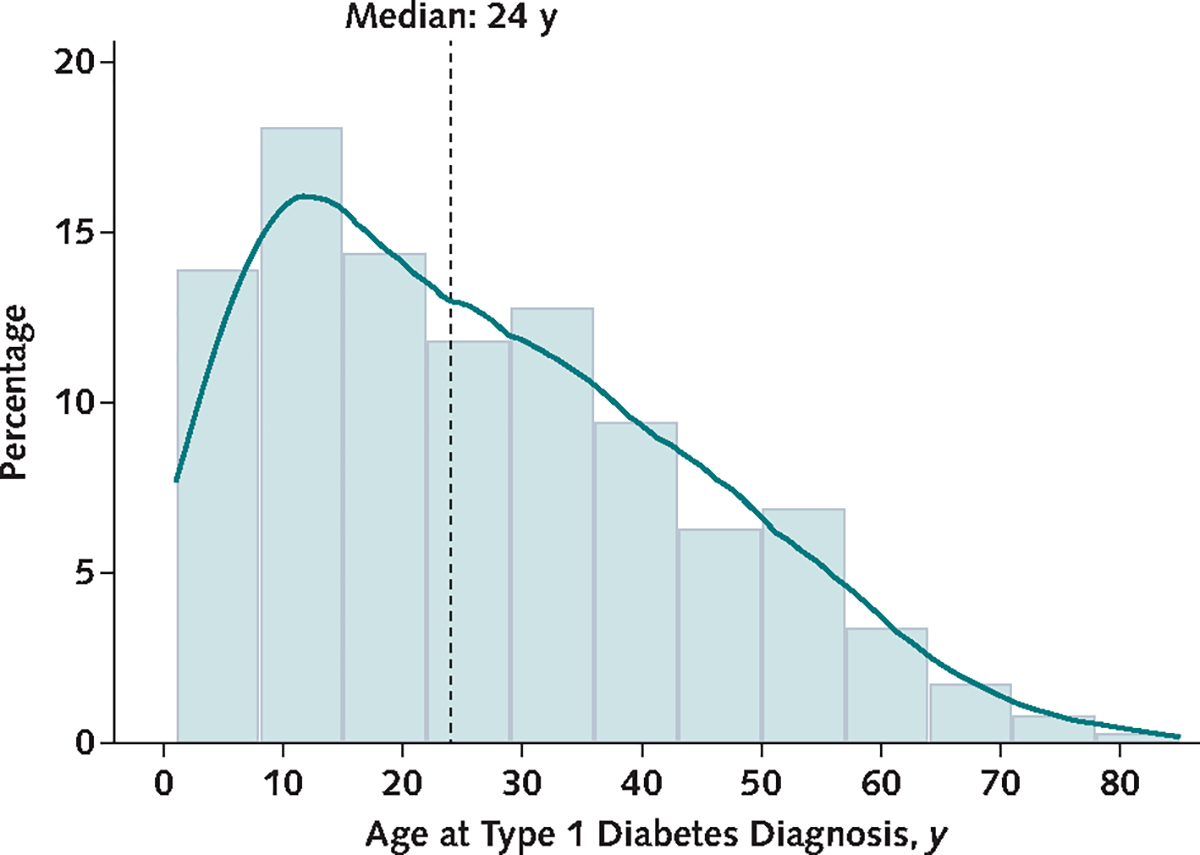
The histogram and kernel density plot were based on the NHIS 2016, 2017, 2019, 2020, 2021, and 2022 cycles. Data on diabetes type were unavailable in 2018. NHIS = National Health Interview Survey.
Discussion:
Nearly 4 in 10 U.S. adults with type 1 diabetes were diagnosed after age 30 years. The median age at diagnosis was 24 years and was substantially higher for men and racial/ethnic minority adults.
Adult-onset type 1 diabetes often presents with mild symptoms, making it challenging to distinguish from type 2 diabetes (1). Autoantibody and C-peptide testing are recommended for diagnosis in adults suspected of having type 1 diabetes. However, how to best identify high-risk adults remains unclear. Traditional markers used to differentiate type 1 and type 2 diabetes, such as body mass index, may have limited utility, especially because obesity is now common in the type 1 diabetes population (4). Novel risk scores that combine clinical features and relevant biomarkers may improve type 1 diabetes diagnoses in adults (1).
Consistent with our findings, prior studies suggest that more than half of type 1 diabetes cases develop in adults (2). We extended existing research by characterizing the age at diagnosis in a nationally representative sample and by documenting variation across race/ethnicity and clinical characteristics.
Study limitations included possible misclassification due to self-report of diabetes type and age at diagnosis. Key diagnostic measures, including levels of autoantibodies, C-peptide, and markers of diabetes other than types 1 and 2, were not collected. Nonetheless, our definition of type 1 diabetes has demonstrated excellent performance in external validation studies (5). Some subgroup estimates were imprecise because of limited sample size. The NHIS did not collect information on diabetes type or age at diagnosis in participants younger than 18 years. Therefore, our analyses may underestimate the proportion of type 1 diabetes cases that developed during childhood.
The onset of type 1 diabetes during adulthood is common, particularly in men and racial/ethnic minority patients. Tools integrating clinical measures and biomarkers may improve the accuracy of diagnosis for these patients.
Grant Support:
By grants K24 HL152440 (Dr. Selvin) and HL153774 (Dr. Echouffo-Tcheugui) from the National Heart, Lung, and Blood Institute of the National Institutes of Health. The funders had no role in the design or conduct of the study; collection, management, analysis, or interpretation of the data; preparation, review, or approval of the manuscript; or decision to submit the manuscript for publication.
Footnotes
Disclosures: Disclosures can be viewed at www.acponline.org/authors/icmje/ConflictOfInterestForms.do?msNum=M23-1707.
Reproducible Research Statement: Study protocol: Not available. Statistical code: Available from Dr. Fang (e-mail, mfang9@jh.edu). Data set: Publicly available at www.cdc.gov/nchs/nhis/2022nhis.htm.
Contributor Information
Michael Fang, Department of Epidemiology, Johns Hopkins Bloomberg School of Public Health, Baltimore, Maryland.
Dan Wang, Department of Epidemiology, Johns Hopkins Bloomberg School of Public Health, Baltimore, Maryland.
Justin B. Echouffo-Tcheugui, Division of Endocrinology, Diabetes, and Metabolism, Johns Hopkins School of Medicine, Baltimore, Maryland.
Elizabeth Selvin, Department of Epidemiology, Johns Hopkins Bloomberg School of Public Health, Baltimore, Maryland.
References
- 1.Leslie RD, Evans-Molina C, Freund-Brown J, et al. Adult-onset type 1 diabetes: current understanding and challenges. Diabetes Care. 2021;44:2449–2456. doi: 10.2337/dc21-0770 [DOI] [PMC free article] [PubMed] [Google Scholar]
- 2.Gregory GA, Robinson TI, Linklater SE, et al. ; International Diabetes Federation Diabetes Atlas Type 1 Diabetes in Adults Special Interest Group. Global incidence, prevalence, and mortality of type 1 diabetes in 2021 with projection to 2040: a modelling study. Lancet Diabetes Endocrinol. 2022;10:741–760. doi: 10.1016/S2213-8587(22)00218-2 [DOI] [PubMed] [Google Scholar]
- 3.National Center for Health Statistics. 2022 National Health Interview Survey (NHIS): Codebook for Sample Adult File. 5 June 2023. Accessed at https://ftp.cdc.gov/pub/Health_Statistics/NCHS/Dataset_Documentation/NHIS/2022/adult-codebook.pdf on 3 August 2023. [Google Scholar]
- 4.Fang M, Jeon Y, Echouffo-Tcheugui JB, et al. Prevalence and management of obesity in U.S. adults with type 1 diabetes. Ann Intern Med. 2023;176:427–429. doi: 10.7326/M22-3078 [DOI] [PMC free article] [PubMed] [Google Scholar]
- 5.Nooney JG, Kirkman MS, Bullard KM, et al. Identifying optimal survey-based algorithms to distinguish diabetes type among adults with diabetes. J Clin Transl Endocrinol. 2020;21:100231. doi: 10.1016/j.jcte.2020.100231 [DOI] [PMC free article] [PubMed] [Google Scholar]