


Table 2.
Pros and cons of genetically engineered mice (GEM).
| Technique | Pros | Cons |
|---|---|---|
| Transgenic using ubiquitous promoter | Initial technique used to generate GEM | -Random integration effect |
| -Ubiquitous, non-physiologic expression | ||
| Transgenic using tissue specific promoter | Tissue specific expression | -Random integration effects |
| -Expression may be non-physiologic | ||
| Homologous recombination “knock-out” | Useful for gene inactivation | -Vector, targeting can be challenging, unpredictable. |
| -Gene inactivated in all tissues. | ||
| -CRISPR improvement. | ||
| Homologous recombination “knock-in” | Express mutant cDNA, fusion gene | -Same as knock-out. |
| Physiologic expression from endogenous promoter. | -Expression of mutant in non-relevant tissue (e.g. ldh2 KI) | |
| Conditional knock-out/knock-in plus | Target knockout to specific tissue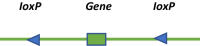
|
-More complex breeding. |
| Tissue specific Cre (trigger for event) | -Tissue specific expression may be "leaky" | |
| Conditional knock-out/knock-in plus | Trigger Cre expression post-natal | -More complex breeding |
| time specific Cre (eg, Mx1, CreERT2) | -Time specific expression may be leaky |