


Figure 1.
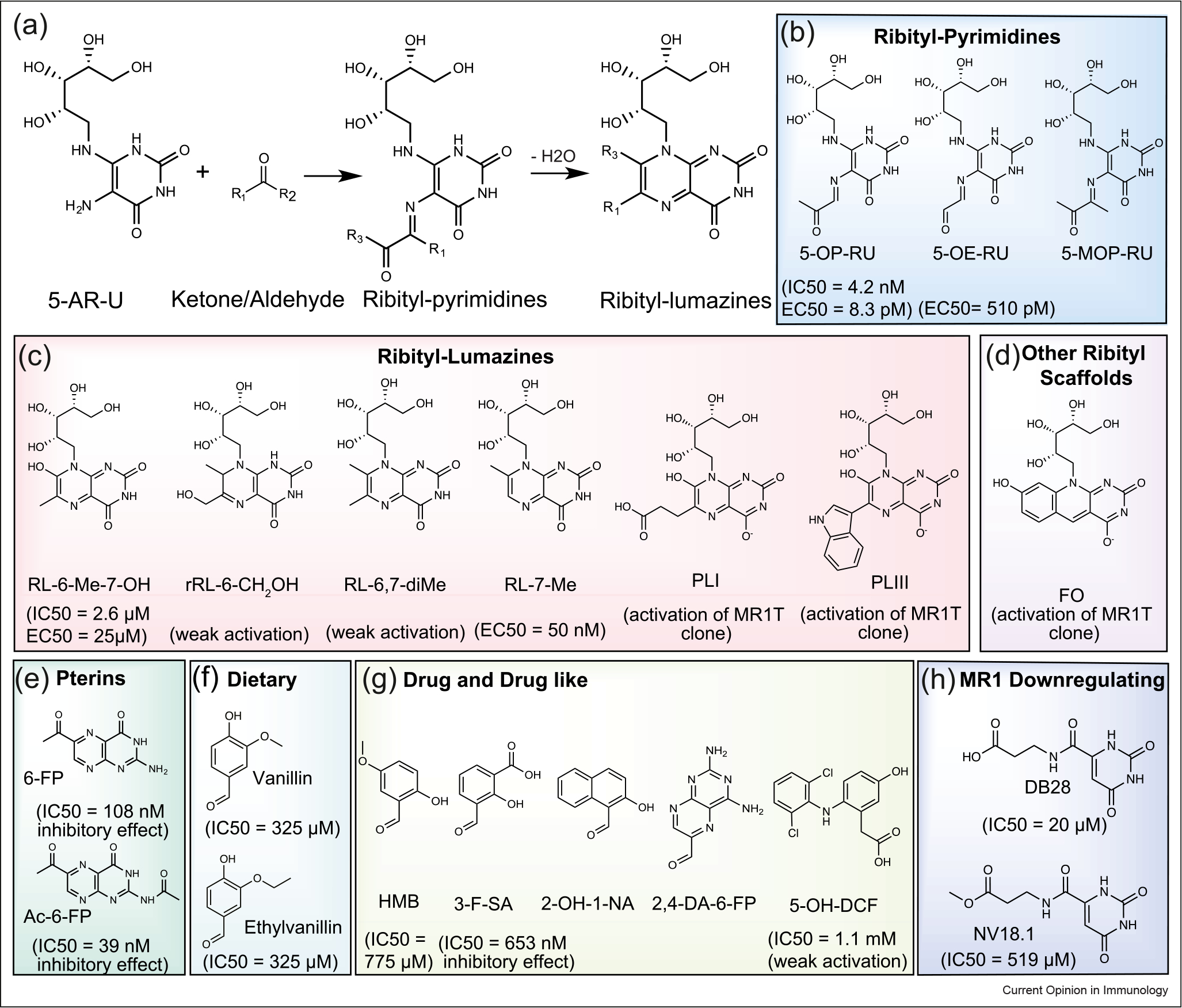
Broad range of MR1 Ags. (a) Condensation reactions of bacterially produced riboflavin intermediate 5-A-RU with reactive ketones/aldehydes producing pyrimidine-based Ags, which subsequently dehydrate to ribityllumazine compounds if not captured by MR1. (b–h) Chemical structures of different categories of MR1-binding Ags. (b–d) Riboflavin-based Ags. The MR1 ligand affinities (IC50) as measured by the fluorescence-based polarization assay and the activation potency (EC50) of MAIT cells are included. (b) Ribityl-pyrimidines: 5-OP-RU, 5-OE-RU, and 5-(1-methyl-2-oxopropylideneamino)-6-d-ribitylaminouracil (5-MOP-RU). (c) Ribityl-lumazines: RL-6-Me-7-OH, reduced 6-hydroxymethyl-8-d-ribityllumazine (rRL-6-CH2OH), 6,7-dimethyl-8-d-ribityllumazine (RL-6,7-diMe), and RL-7-Me, 6-(2-carboxyethyl)-7-hydroxy-8-ribityllumazine (PLI), and 6-(1H-indol-3-yl)-7-hydroxy-8-ribityllumazine (PLIII). (d) Other ribityl scaffolds: FO. (e) Folate-based metabolites, including 6-FP and Ac-6-FP. (f–h) Various classes of small-molecule scaffolds aside from vitamin-B derivatives, including (f) dietary compounds∷ Vallin, and Ethylvanillin; (g) drug-related compounds: HMB, 3-F-SA, 2-OH-1-NA, 2,4-DA-6-FP, and DCF; and (h) MR1 downregulated compounds: DB28 and NV18.1.