



Abstract
A number of risk factors for cardiovascular disease including hyperinsulinemia, glucose intolerance, dyslipidemia, obesity, and elevated blood pressure are collectively known as metabolic syndrome (MS). Since mitochondrial activity is modulated by the availability of energy in cells, the disruption of key regulators of metabolism in MS not only affects the activity of mitochondria but also their dynamics and turnover. Therefore, a link of MS with mitochondrial dysfunction has been suspected since long. As a chronobiotic/cytoprotective agent, melatonin has a special place in prevention and treatment of MS. Melatonin levels are reduced in diseases associated with insulin resistance like MS. Melatonin improves sleep efficiency and has antioxidant and anti-inflammatory properties, partly for its role as a metabolic regulator and mitochondrial protector. We discuss in the present review the several cytoprotective melatonin actions that attenuate inflammatory responses in MS. The clinical data that support the potential therapeutical value of melatonin in human MS are reviewed.
Keywords: Melatonin, Metabolic syndrome, Mitochondria, Inflammation, Diabetes, Obesity, Insulin signaling, Aging
Introduction
A number of risk factors for cardiovascular disease including hyperinsulinemia, glucose intolerance, dyslipidemia, obesity, and elevated blood pressure (BP) are collectively known as metabolic syndrome (MS). MS prevalence ranges from 15 to 30% depending on the world region considered [1, 2]. A 1.5- to 2.5-fold increase in cardiovascular mortality occurs when MS is present, representing one of the major public health problems nowadays.
The link of MS and mitochondrial dysfunction has been suspected since long. Mitochondrial activity is modulated by the availability of energy in cells and the disruption of key regulators of metabolism not only affects the activity of mitochondria but also their dynamics and turnover [3, 4]. Mitochondrial dysfunction is associated with the functional decline found in tissues and organs during many age-related diseases such as MS and diabetes. Recently, a study carried out in nondiabetic participants from the Baltimore Longitudinal Study of Aging has associated impaired mitochondrial capacity with greater insulin resistance [5].
MS is preventable. The excessive fat accumulation, either in white adipose tissue or other organs, is the consequence of hypertrophy and hyperplasia of white adipocytes in a context of positive energy balance. Without question, poor diet, lack of exercise, and chronic insulin resistance are major contributing factors to excessive fat accumulation [6, 7]. The abnormal nutritional balance is controlled mainly at the hypothalamic level by a complex circuitry of orexigenic and anorexigenic signals and by an endogenous clock that sets a circadian rhythm of appetite–satiety, a function highly affected by modern life habits.
In the last decade, there has been a considerable increase in our understanding of the cellular and molecular factors that contribute to MS development. One basic function that appears to be heavily influenced by (and influences) obesity and metabolic disease is the internal timing system [8–10]. The correlation between increased occurrence of obesity and the ubiquity of modern social habits, such as light at night, unusual meal timing, irregular sleep/wake schedules, and traveling between different time zones, all encompassed by a “24/7” lifestyle, strongly suggests that impairment of sleep and the circadian system is involved in the etiology of MS. Several clinical surveys have shown increased prevalence of MS in night-shift workers, indicating that artificial lighting may contribute to the increased prevalence of metabolic disorders [11–14]. Thus, both animal and human data have clearly proved that circadian and sleep disruption leads to insulin resistance and MS. In a study performed with 593 type 2 diabetes mellitus patients, sleep debt was associated with long-term metabolic disruption, which may promote the progression of the disease. For every 30 min of weekday sleep debt, the risk of obesity and insulin resistance at 12 months increased by 18 and 41%, respectively [15]. Collectively, these findings indicate the need for improving sleep quality to prevent the development of obesity and insulin resistance as well as its progression to diabetes.
As a chronobiotic/cytoprotective agent, melatonin has a special place in prevention and treatment of MS [16, 17]. Melatonin improves sleep efficiency and has antioxidant and anti-inflammatory properties, partly for its role as a metabolic regulator and mitochondrial protector [18–20]. This review summarizes what is known about a putative therapeutic role of melatonin concerning MS prevention and treatment. Medical literature was identified by searching databases including (MEDLINE and EMBASE), bibliographies from the published literature and clinical trial registries/databases. Searches were last updated on April 30, 2017.
Mitochondria, inflammation, and the metabolic syndrome
Low degree inflammation in white adipose tissue leads to impaired glucose tolerance, insulin resistance, and diabetes [21, 22] (Fig. 1). Tumor necrosis factor (TNF)-α, interleukin (IL)-1β and IL-6, leptin, and resistin give rise to a vicious circle leading to fat deposition. Occurrence of inflammation in obesity is also supported by the increase in C-reactive protein and other inflammatory biomarkers [23, 24].
Fig. 1.
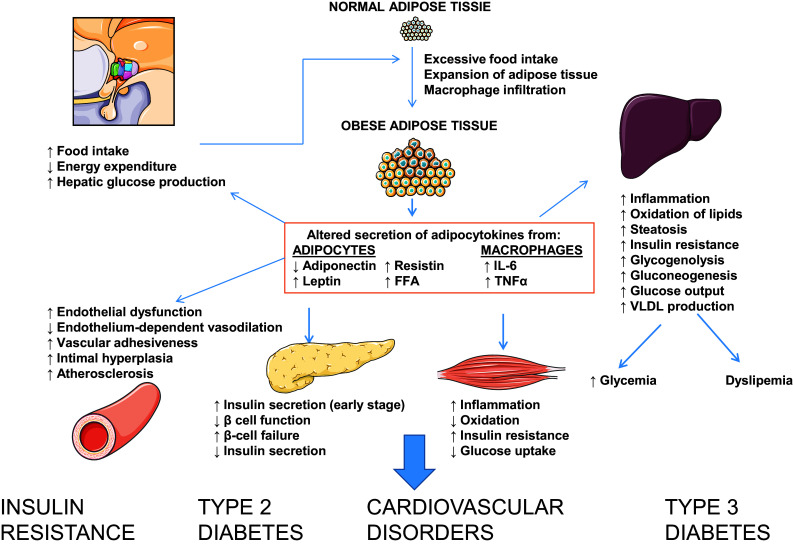
MS is the consequence of obesity-induced changes in adipocytokine secretion that lead to the development of systemic insulin resistance, type 2 and 3 diabetes mellitus, and cardiovascular disorders. Overnutrition that results from a combination of increased food intake and reduced energy expenditure leads to adipose tissue expansion, increased adipocyte size and number, and increased macrophage infiltration that, together, lead to increased free fatty acid release, dysregulated secretion from adipocytes of a variety of adipocytokines, including adiponectin, leptin, and resistin, and increased release from resident macrophages of the inflammatory cytokines (TNF-α, IL-6). Dysregulated secretion of these adipokines elicits a variety of adverse effects on numerous tissues
Early MS is characterized by the increased systemic markers of lipid oxidation, such as oxidized low-density lipoproteins and isoprostanes, which contribute to the development of insulin resistance [3–5]. In the mitochondria, lipid peroxidation particularly affects cardiolipin, a phospholipid located at the level of inner mitochondrial membrane, which is required for several mitochondrial bioenergetic processes as well as in mitochondrial-dependent steps of apoptosis (e.g., it prevents the opening of the mitochondrial permeability transition pore (mPTP). Alterations in cardiolipin structure, content, and acyl chain composition have been associated with mitochondrial dysfunction in various tissues under a variety of pathophysiological conditions [25].
Among mitochondrial regulators, the mammalian target of rapamycin (mTOR), which is activated by high calorie intake or high levels of amino acids, plays an important role [26]. The signaling pathway triggered by mTOR competes against other regulators of the cell metabolism such as adenosine monophosphate kinase (AMPK) and sirtuins, and nicotinamide adenine dinucleotide+ (NAD+)-dependent deacetylases that induce more efficient energy consumption in situations of low intake, starvation, or calorie restriction [27].
In obesity, promotion of fat mass is given by proinflammatory cytokines acting via paracrine mechanisms [28–30]. In obese patients, proinflammatory molecules derived from adipose tissue diminish after weight loss [31]. Thus, source as well as a target for proinflammatory cytokines are given by fat cells. When white adipose tissue mass increases by adipocyte hypertrophy, the large-size adipocytes develop a secretory dysfunction characterized by overproduction (synthesis and release) of adipocytokines that decrease tissue sensitivity to insulin, promote oxidative stress, and display proinflammatory effects (leptin, resistin, TNF-α, plasminogen activator inhibitor-1, IL-1, and IL-6). In addition, lower amounts of adiponectin (an insulin-sensitizing adipokine) are released by adipocytes (Fig. 1). Consequently, obesity is the result of a multifactorial combination of genetic background, metabolic, endocrine, inflammatory, and circadian dysfunctions, whose long-term maintenance is favored by behavioral disorders [32].
Even in the absence of physiological stress or acute infection, levels of inflammatory mediators increase with age. This leads to the age-related decline in physiological functions entailing inflammatory damage of cellular proteins, lipids, and DNA. The term “inflammaging” was introduced to underscore the importance of inflammation in senescence and its role in the development of age-related diseases such as MS [33–36]. It entails the slowly progressing, persistent type of oxidative stress resulting from the increased production of reactive oxygen species (ROS) and reactive nitrogen species (RNS) and consequent mitochondrial damage [36–38].
Melatonin and mitochondria
This subject is covered in depth by other reviews in this issue. Melatonin is a powerful scavenger of ROS and RNS, and naturally acts on mitochondria, the site with the highest ROS/RNS production into the cell. Melatonin improves glutathione (GSH) redox cycling and increases GSH content by stimulating its synthesis in the cytoplasm, mitochondria depending on the GSH uptake from cytoplasm to maintain the GSH redox cycling [39]. Finally, melatonin exerts important antiapoptotic effects and most of the apoptotic signals originate from the mitochondria (for ref. see [20, 40, 41].
Melatonin plays an important role in antioxidant defense via the regulation of enzymes involved in the redox pathway and directly through the nonenzymatic, radical scavenger effect that melatonin and some of its metabolites, notably N 1-acetyl-N 2-formyl-5-methoxykynuramine and N 1-acetyl-5-methoxykynuramine, have to scavenge ROS, RNS and organic radicals [42, 43]. Safeguarding of respiratory electron flux, reduction of oxidant formation by lowering electron leakage, and inhibition of mPTP events are among the most important effects on melatonin in mitochondria. Melatonin was reported to protect the mitochondria from oxidative damage in part by preventing cardiolipin oxidation [25, 44].
Melatonin can also act on mitochondrial biogenesis via sirtuins. Sirtuins promote longevity in numerous organisms. The seven mammalian subforms, sirtuin 1 to sirtuin 7, are involved in mitochondrial function. Sirtuins also stimulate mitochondrial biogenesis [45]. Several studies have reported upregulation of sirtuin 1 by melatonin (for ref. see [46, 47]).
Melatonin and inflammation
Counteraction of inflammaging by melatonin occurs at different levels. One of them includes the correction of metabolic dysregulation preventing insulin resistance [48–50]. Among the several regulatory pathways modulated by melatonin treatment (Table 1), the impaired serine phosphorylation of insulin receptor substrate 1 (IRS-1) and concomitant an upregulation of IRS-1 expression may be crucial [51]. Both melatonin and melatonergic agonists (e.g., piromelatine) do counteract the blockade of such a key step in insulin signal transduction [48, 50, 52].
Table 1.
Effects of melatonin in animal models of MS
| Observation | Reference(s) |
|---|---|
| Reduced body weight increase and circulating glucose, leptin, and triglycerides in high-fat-fed rats | [53] |
| Decreased weight gain and plasma insulin and leptin levels in middle-aged rats fed with a high caloric liquid diet | [54] |
| Normalized glucose tolerance and insulin sensitivity in mice fed with a high-fat diet | [55] |
| Decreased hyperadiposity in oophorectomized rats | [56–58] |
| Decreased hyperadiposity in olanzapine-treated rats | [59] |
| Reduced body weight gain in goldfish | [60] |
| Normalized body weight increase, glucose tolerance, and insulin sensitivity in rats fed with a high-fat diet (an effect mimicked by the melatonin analog piromelatine) | [52] |
| Reduced body weight increase and normalized levels and 24 h rhythmicity in circulating insulin, glucose, leptin, adiponectin, triglycerides, and cholesterol | [61] |
| Anti-inflammatory activity in pancreas and liver of senescence-accelerated prone mice (SAMP8) | [62, 63] |
| Decreased body weight gain, visceral adiposity, blood insulin, and triglyceride levels and TBARS in rats receiving a high calorie | [64] |
| Counteracted body weight increase and dyslipidemia and decreased blood pressure (BP) in Zucker diabetic fatty rats | [65] |
| Improved MS caused by a high fructose intake without affecting food intake in rats | [66–70] |
| Normalized BP in spontaneously hypertensive rats (an effect mimicked by the melatonin analog piromelatine) | [71] |
| Improved MS caused by modifying light/dark regimens in rats | [72] |
| Ameliorated fatty liver in high-fat-fed rats | [73] |
| When administered during reperfusion, prevented ventricular arrhythmias in hearts from spontaneously hypertensive rats and fructose-fed rats | [74] |
| Counteracted low-grade inflammation and oxidative stress in Zucker diabetic fatty rats | [75] |
| Counteracted abnormally high blood levels of glucose and triglycerides, polyphagia, and polydipsia in streptozotocin diabetic rats | [76, 77] |
| Normalized metabolic and reproductive disturbances in rat´s polycystic ovary syndrome | [78] |
| Normalized clinical and biochemical parameters of mild inflammation in diet-induced MS in rats | [79] |
| Normalized hypothalamic gene expression of signals regulating feeding behavior in high-fat fed rats | [80] |
| Counteracted obesity and abnormal adipokine patterns and metabolism in obese (ob/ob) mice | [81] |
| Nephroprotective activity in Zucker diabetic fatty rats via inhibition of NADPH oxidase | [82] |
| Diabetes prevention in high carbohydrate diet-fed rats | [83] |
| Counteracted abnormal fasting blood glucose, total cholesterol, LDL levels and MDA levels, and ameliorated vascular responses and endothelial dysfunction in diabetic rats | [84] |
| Augmented tolerance to myocardial ischemia/reperfusion injury in the offspring via restoring cardiac IRS-1/Akt signaling when given to the rat diabetic mother during pregnancy | [85] |
| Given alone or in combination with metformin improved adiposity, circadian activity, insulin sensitivity, and islet cell failure in rats with diet-induced obesity subjected to circadian disruption | [86] |
| Via modulation of the MAPK-JNK/P38 signaling pathway, improved nonalcoholic fatty liver disease in obese mice | [87] |
| In rats subjected to bile duct ligation, counteracted liver apoptosis, and endoplasmic reticulum stress, and mitochondrial dysfunction | [88] |
| Decreases body weight, liver steatosis, and low-grade inflammation, and improves insulin resistance and gut microbiota in high-fat diet-fed mice | [89] |
Melatonin also prevents processes that promote inflammation including formation of peroxynitrite and tyrosine nitration by peroxynitrite-derived free radicals [19]. All these changes trigger low-grade inflammation in various organs.
A third area relevant to inflammaging is that related to melatonin immunological effects. Melatonin’s multiple functions entail both proinflammatory and anti-inflammatory actions (“melatonin buffer action” in the immune system) [19, 38, 90]. Melatonin down-regulated proinflammatory cytokines (TNF-α, IL-1β, and IL-6), and up-regulated anti-inflammatory cytokines (e.g., IL-10) in the liver of aged, ovariectomized female rats (an animal model of MS) [91]. In the senescence-accelerated mouse strain SAMP8, decreased levels of TNF-α and IL-1β and increased levels of IL-10 were observed after melatonin treatment in liver [62], pancreas [92], and heart [93].
Peripheral oscillators exist in cells relevant to MS, such as pancreatic β-cells [94], hepatocytes, adipocytes, cardiomyocytes [95], and leukocytes [96, 97]. In all these cell types, melatonin modulates factors involved in metabolic sensing of the circadian apparatus like peroxisome proliferator-activated receptor-γ coactivator-1α, peroxisome proliferator-activated receptor-γ, phosphoinositide 3-kinase, protein kinase B, and the accessory oscillator components AMPK, nicotinamide phosphoribosyl transferase, and sirtuin 1 [38, 98]. Melatonin reduced proinflammatory factors by suppressing the expression of nuclear factor-κB via recruitment of a histone deacetylase to its promoter [99]. Other aspects of epigenetic modulation by melatonin via circadian oscillators have been summarized by [100].
Evidence of melatonin therapeutic value in metabolic syndrome: animal studies
Obesity, type 2 diabetes, and hepatic steatosis ameliorate after melatonin to rats [101, 102]. Melatonin administration normalizes most observed alterations in experimental hyperadiposity concomitantly with improvement of the altered biochemical proinflammatory profile (Table 1).
In streptozotocin-induced type 1 diabetic rats, regeneration and proliferation of β-cells in the pancreas leading to a decrease in blood glucose were observed after melatonin treatment [103], while pinealectomy resulted in hyperinsulinemia and fatty liver [104].
Melatonin treatment improved insulin sensitivity and lipid metabolism in type 2 diabetic rats [105] and increased hepatic glycogen content in the liver [106]. In diabetic mice, melatonin normalized insulin sensitivity and ameliorated hepatic steatosis [107].
Melatonin treatment is effective in reversing hyperadiposity in animal models of MS (Table 1). This occurs in the absence of significant differences in food intake, presumably via increased activity of the sympathetic nervous system innervating white and brown fat [108]. Melatonin was shown to augment the number and activity of brown adipocytes in mammals [109]. Therefore, the gathered experimental data support that melatonin effectively counteracts the disrupting effects seen in diet-induced obesity in animals, in particular, insulin resistance, dyslipidemia, and obesity.
However, it must be noted that most experimental research has been carried out in nocturnal species like rats and mice, which are nocturnal animals, and therefore, care needs to be taken when extrapolating data to humans. In both humans and rodents, melatonin levels rise during the evening, peak in the middle-to-latter half of the night and decline by morning. However, the dark phase is a time of energy expenditure in rodents, coincident with a peak in insulin sensitivity, while in humans, the dark phase is a time of energy deficit or fasting, with elevated glycogen breakdown and gluconeogenesis and decreased insulin sensitivity. These divergences may be even more profound, because melatonin does not only affect physiological functions directly, but also modulates phasing and amplitudes of the circadian master clock and various peripheral circadian oscillators.
Evidence of melatonin therapeutic value in the metabolic syndrome: clinical studies
Table 2 summarizes the results of clinical studies on melatonin activity relevant to human MS. Type 2 diabetic patients have low circulating levels of melatonin [110] with a concurrently and expected upregulation of mRNA expression of melatonin membrane receptor [111]. Furthermore, allelic variants for melatonin receptors were associated with increased levels of fasting blood glucose and/or increased risk of type 2 diabetes [112–114] and with polycystic ovary syndrome [115]. These findings strongly bind melatonin to glucose homeostasis in blood.
Table 2.
Clinical observations on melatonin relevance in MS
| Findings | Reference(s) |
|---|---|
| Low plasma melatonin levels in type 2 diabetic patients | [110, 116–120] |
| Low plasma melatonin levels in pregnant women with hypertensive or glucose metabolic disorder complications | [121] |
| Increased number of melatonin receptors in type 2 diabetic patients | [111] |
| Melatonin receptor gene polymorphism associated with high risk of type 2 diabetes | [112, 122–127] |
| Genetics of melatonin receptor type 2 is associated with left ventricular function in hypertensive patients and with increased risk of impaired fasting glucose in youth with obesity | [113, 114] |
| Family association study between melatonin receptor gene polymorphisms and polycystic ovary syndrome | [115] |
| Low melatonin production in coronary disease independently of β-adrenoceptor blocker treatment | [128–131] |
| Among elderly hypertensive individuals, nocturnal urinary melatonin excretion is inversely associated with the nondipper pattern | [132] |
| Melatonin treatment decreases nocturnal BP in type 1 adolescent diabetics | [133, 134] |
| Melatonin treatment decreases high nocturnal BP in hypertensives | [135–138] |
| Melatonin administration attenuates age-dependent disturbances of cardiovascular rhythms | [139] |
| Melatonin treatment prevents catecholamine-induced hypercoagulability in normal volunteers | [140] |
| Melatonin inhibits human platelet aggregation in vivo and in vitro | [141–143] |
| Melatonin treatment ameliorates MS in obese patients | [144, 145] |
| Melatonin treatment improves MS after treatment of bipolar and schizophrenic patients with the second-generation antipsychotics | [146–148] |
| Melatonin administration normalizes MS in elder hypertensive patients | [149] |
| Short-term use of prolonged-release melatonin improves sleep maintenance in type 2 diabetic patients with insomnia without affecting glucose and lipid metabolism. Long-term prolonged-release melatonin administration has a beneficial effect on HbA1c, suggesting improved glycemic control | [150] |
| Melatonin treatment improves enzymatic profile in patients with nonalcoholic liver esteatosis | [151, 152] |
| The combination of melatonin and zinc acetate, when used alone or in combination with metformin improved glycemic control in type 2 diabetic patients | [153] |
| Melatonin treatment ameliorated oxidative stress and inflammatory parameters of obese women | [154] |
| Acute melatonin administration in healthy women impairs glucose tolerance | [155] |
| The combined administration of melatonin and fluoxetine was effective to treat mood, sleep, and obesity in postmenopausal women | [156] |
| Increased MTNR1B expression occurred in human islets from risk G-allele carriers. Melatonin treatment in a human recall-by-genotype study reduced insulin secretion and raised glucose levels more extensively in risk G-allele carriers, indicating that an increased melatonin signaling may be a risk factor for type 2 diabetes | [157] |
| Reduced fat mass and increased lean mass in response to 1 year of melatonin treatment in postmenopausal women | [158] |
| Evaluation of the efficacy and safety of melatonin for the reduction of reperfusion injury in patients undergoing revascularization for ST-elevation myocardial infarction indicated that intracoronary melatonin administration (median time >3.3 h earlier) was not associated with a reduction in infarct size | [159] |
| In a post-hoc analysis of the previously reported trial to assess whether the effect of melatonin was affected by the timing of reperfusion, the main finding was that melatonin, when given <2.5 h after symptom onset, did reduce infarct size significantly by approximately 40% | [160] |
| A prospective nested case-control study of participants from the Nurses’ Health Study cohorts I and II indicated that a lower melatonin secretion was significantly associated with a higher risk of myocardial infarct in women with augmented body mass index | [161] |
Low circulating melatonin levels are found in coronary artery disease [128–131] and this trait was associated with the nondipper pattern of BP in elderly hypertensive individuals [132]. Conversely, the administration of melatonin decreased nocturnal BP in hypertensives [135–138] and normalized age-dependent disturbances of cardiovascular rhythms [139]. A controlled release preparation of 2 mg of melatonin (Circadin®, Neurim) is effective and safe in treating nocturnal hypertension as demonstrated by a meta-analysis of randomized controlled trials [162]. Cardiovascular protection in MS by melatonin could be related to the antihypertensive and anti-remodeling effects of the methoxyindole through its antioxidant and scavenging properties, preserving the availability of nitric oxide and having sympathoplegic effects.
As in experimental animal studies, melatonin administration ameliorates lipid profiles in MS patients. For example, melatonin (1 mg/kg for 30 days) augmented high-density lipoprotein-cholesterol levels in peri- and postmenopausal women [163]. A reduced intestinal absorption of cholesterol [164] or an inhibited cholesterol biosynthesis [165] may explain the hypolipidemic effects of melatonin.
Melatonin treatment prevented the catecholamine-induced hypercoagulability in acute stress that may contribute to the growth of thrombus following rupture of coronary plaque [140]. Inhibition of platelet aggregation by melatonin is also probably involved in this protective effect on atherothrombotic risk in MS [141–143].
The potential therapeutic value of melatonin in MS is supported by several studies including obese patients [144, 145], bipolar and schizophrenic patients treated with the second-generation antipsychotics [146–148], and elder hypertensive patients [149], and improves enzymatic profile in patients with nonalcoholic liver steatosis [151, 152]. In type 2 diabetic patients, the combined administration of melatonin and zinc acetate improved glycemic control when used alone or in combination with metformin [153]. In healthy women included in the Nurses’ Health Study cohort, an inverse relationship between urinary 6-sulfatoxy melatonin excretion and insulin levels and insulin resistance was documented [166]. Collectively, data in Table 2 support that melatonin therapy can be beneficial for patients with MS. However, more studies are needed to identify the appropriate time/duration of treatment/dose relationship administration of melatonin.
It must be noted that several results deny the capacity of melatonin to improve glucose tolerance and to reduce insulin resistance in humans. Melatonin administration decreased glucose tolerance, already in nondiabetic young individuals [166], an observation confirmed by other recent studies [155, 167]. In vitro, melatonin inhibits insulin secretion, an effect that is logical in humans if one presumes that melatonin suppresses insulin during the night to sensitize the pancreatic β-cells in preparation for breakfast, but is more difficult to explain in night-time eating rodents.
Additional information concerning a glucose tolerance-reducing property of melatonin in humans came from the detection of melatonin receptor polymorphisms. To date, several single-nucleotide polymorphisms (SNPs) located near or inside the gene encoding MTNR1B with an association with type 2 diabetes mellitus have been identified in Asian (Indian, Sri Lankan, Chinese, Korean, and Japanese) and European ethnicities [112, 122–127]. Among these SNPs, rs10830963 appears the most strongly associated with an increase in fasting plasma glucose, glucose area under the curve, and glycated hemoglobin (HbA1C), and a decrease in pancreatic β-cell function, basal insulin secretion, and plasma insulin [168]. This G-allele that carries the SNP rs10830963 is prodiabetic and is overexpressed in pancreatic β-cells, causing a more intense decrease in cyclic adenosine monophosphate (cAMP) upon melatonin stimulation and consequently suppressing more strongly the cAMP-dependent secretion of insulin [169]. It appears to affect β-cell function directly and is associated with a defective early insulin response and a decreased β-cell glucose sensitivity [169–171]. In clinical studies, the presence of the G-allele worsens the decrease in glucose tolerance induced by melatonin [172].
The rs10830963 G-allele may have a greater risk on the transition from normal glucose tolerance to prediabetes than on prediabetes to type 2 diabetes mellitus and is thought to have an important influence on glucose levels from childhood onwards [173]. Individuals older than 45 years of age, who are carrying the rs10830963 G-allele, show a higher expression of MTNR1B in pancreatic islets [169]. This has been reported in diabetic rats as well as diabetic humans. It is not known whether this is a physiological adaptive response to reduced melatonin levels or whether it is part of the pathology of diabetes. It has been proposed that an increase in MT2 receptor expression could increase the inhibitory downstream signaling leading to an overall decrease in insulin release in type 2 diabetes mellitus [169].
Increased MTNR1B expression occurred in human islets from risk G-allele carriers. Melatonin treatment reduced insulin secretion and raised glucose levels more extensively in risk G-allele carriers, indicating that an increased melatonin signaling may be a risk factor for type 2 diabetes [157]. Since the presence of the G-allele was shown to worsen the reduction in glucose tolerance by melatonin [172], strategies of blocking melatonergic signaling in patients with diabetes have been proposed [174].
However, it must be noted that a reduction in insulin secretion is not necessarily associated with insulin resistance in the target organs, clearly improved by melatonin in most studies. In addition, other MT2 receptor variants with entirely different properties have been found to be also associated with type 2 diabetes. Some of them are entirely dysfunctional because of their incapability of binding melatonin, and others were found to be unable to interact with Gi proteins [175, 176]. Thus, the absence of melatonin signaling is presumably also diabetogenic.
A further important aspect concerns the contrasting findings of impairments of insulin secretion by the overexpressed MT2 G-allele and the observed reduced melatonin levels in patients with diabetes [110, 116–120]. The reduction in melatonin levels should presumably be considered as a primary change that is associated with the initiation and/or progression of the disease. In fact, the decrease in melatonin has been regarded as a risk factor for type 2 diabetes.
In young adults, the expression levels of the G-allele showed a higher variability, but were not statistically different from those of noncarriers, whereas a strong increase in G-allele expression was observed in individuals above 45 years [169]. Based on these findings, Hardeland recently proposed an aging-related deterioration of the circadian system, which may lead to losses of rhythm amplitudes, presumably also in the pancreatic β-cell oscillators, and additionally to decreases in nocturnal melatonin secretion [47]. This suggestion gives rise to the interesting question on whether exogenous melatonin administered to carriers of the G-allele or to other adults before the age of 40 years might protect the circadian system from losses in amplitudes and, thus, prevent or delay the development of type 2 diabetes. Another important point to consider in human studies is the discrimination of core symptoms (glucose homeostasis) from diabetes-associated pathologies, including those derived from an enhanced oxidative stress like liver steatosis, cardiovascular disease, retinopathy, nephropathy, or osteoporosis. In most of these associated pathologies, melatonin has a demonstrated therapeutic efficacy.
Conclusions
Clinical management of type 2 diabetes includes rigorous lifestyle modifications, insulin therapy, drug treatments that promote insulin sensitization (such as metformin) and insulin secretion (such as glibenclamide), novel glucagon-like peptide-1 receptor agonists, dipeptidyl peptidase-4 inhibitors, and sodium glucose cotransporter 2 inhibitors [177]. These approaches are designed to manage the symptoms of insulin resistance/β-cell dysfunction and are either used alone or in combination. Many drug therapies for diabetes are costly and, in some cases, have been associated with adverse events, including possible pancreatitis, hypoglycemia, and osteoporosis [178]. Thus, there remains a need for new and cost-effective pharmacotherapies for diabetes that have limited additional health risks.
Obesity is a preventable disease, but its prevalence is continuously increasing worldwide, and because it is frequently associated with other cardiovascular risk factors and high mortality, obesity has become an important public health problem and a heavy socioeconomic burden for the overall society. Environmental factors or stressors of the so-called contemporary “24/7” societies have pronounced effects on metabolism producing circadian clock disruption. Furthermore, people whose work involves irregular time schedules and forced exposure to bright light at night (night/shift workers) show significant disruptions in sleep architecture, and increased prevalence of MS. These lines of evidence indicate that the system fails to adjust properly to environmental and/or stressor changes disrupting overall metabolic homeostasis.
The combination of the chronobiotic effect of melatonin with its cytoprotective properties may be an innovative strategy in MS. Type 2 diabetes mellitus and its concomitant oxyradical-mediated damage, inflammation, microvascular disease, and atherothrombotic risk are prevented by melatonin. For example, evaluation of the efficacy and safety of melatonin for the reduction of reperfusion injury in patients undergoing revascularization for ST-elevation myocardial infarction indicated that intracoronary melatonin administration, when given <2.5 h after symptom onset, did reduce infarct size significantly by approximately 40% [160]. Melatonin has a high safety profile and shows a reduced toxicity, thus differing from most many pharmaceutical agents used in MS patients [179].
As melatonin is a short-lived molecule that has a limited duration of action (half-life from 0.54 to 0.67 h), analogs with a high affinity for melatonin receptors and a longer duration of action have synthesized to treat circadian disorders.
It remains to be established to what extent the new melatonergic agents approved by the US Food and Drug Administration or the European Medicines Agency (ramelteon, agomelatine, and tasimelteon) share a same protective activity as melatonin in MS [180]: for example, ramelteon, when given daily in drinking water (8 mg/kg) for 8 weeks to spontaneously hypertensive male Wistar–Kyoto rats significantly attenuated systolic BP and body weight gain [181]. Likewise, piromelatine, an investigational melatonergic agonist, has been shown to be more effective than melatonin to improve experimental MS [52, 71, 182].
Acknowledgements
Studies in authors’ laboratory were supported by Grants PICT 2007 01045 and 2012 0984 from the Agencia Nacional de Promoción Científica y Tecnológica, Argentina.
Abbreviations
- AMPK
Adenosine monophosphate kinase
- BP
Blood pressure
- cAMP
Cyclic adenosine monophosphate
- GSH
Glutathione
- HbA1C
Glycated hemoglobin
- IRS-1
Insulin receptor substrate 1
- IL
Interleukin
- mTOR
Mammalian target of rapamycin
- MS
Metabolic syndrome
- mPTP
Mitochondrial permeability transition pore
- NAD+
Nicotinamide adenine dinucleotide+
- NO
Nitric oxide
- RNS
Reactive nitrogen species
- ROS
Reactive oxygen species
- SNPs
Single-nucleotide polymorphisms
- TNF
Tumor necrosis factor
References
- 1.Smith CJ, Ryckman KK. Epigenetic and developmental influences on the risk of obesity, diabetes, and metabolic syndrome. Diabetes Metab Syndr Obes. 2015;8:295–302. doi: 10.2147/DMSO.S61296. [DOI] [PMC free article] [PubMed] [Google Scholar]
- 2.O’Neill S, O’Driscoll L. Metabolic syndrome: a closer look at the growing epidemic and its associated pathologies. Obes Rev. 2015;16:1–12. doi: 10.1111/obr.12229. [DOI] [PubMed] [Google Scholar]
- 3.Bhatti JS, Kumar S, Vijayan M, Bhatti GK, Reddy PH. Therapeutic strategies for mitochondrial dysfunction and oxidative stress in age-related metabolic disorders. Prog Mol Biol Transl Sci. 2017;146:13–46. doi: 10.1016/bs.pmbts.2016.12.012. [DOI] [PubMed] [Google Scholar]
- 4.Bhatti JS, Bhatti GK, Reddy PH. Mitochondrial dysfunction and oxidative stress in metabolic disorders—a step towards mitochondria based therapeutic strategies. Biochim Biophys Acta. 2016 doi: 10.1016/j.bbadis.2016.11.010. [DOI] [PMC free article] [PubMed] [Google Scholar]
- 5.Fabbri E, Chia CW, Spencer RG, Fishbein KW, Reiter DA, Cameron D, Zane AC, Moore ZA, Gonzalez-Freire M, Zoli M, Studenski SA, Kalyani RR, Egan JM, Ferrucci L. Insulin resistance is associated with reduced mitochondrial oxidative capacity measured by 31P-magnetic resonance spectroscopy in participants without diabetes from the Baltimore Longitudinal Study of Aging. Diabetes. 2017;66:170–176. doi: 10.2337/db16-0754. [DOI] [PMC free article] [PubMed] [Google Scholar]
- 6.Di Daniele N, Noce A, Vidiri MF, Moriconi E, Marrone G, Annicchiarico-Petruzzelli M, D’Urso G, Tesauro M, Rovella V, De Lorenzo A. Impact of Mediterranean diet on metabolic syndrome, cancer and longevity. Oncotarget. 2017;8:8947–8979. doi: 10.18632/oncotarget.13553. [DOI] [PMC free article] [PubMed] [Google Scholar]
- 7.de la Iglesia R, Loria-Kohen V, Zulet MA, Martinez JA, Reglero G, de Ramirez MA. Dietary strategies implicated in the prevention and treatment of metabolic syndrome. Sci: Int J Mol; 2016. p. 17. [DOI] [PMC free article] [PubMed] [Google Scholar]
- 8.Kalsbeek A, la Fleur S, Fliers E. Circadian control of glucose metabolism. Mol Metab. 2014;3:372–383. doi: 10.1016/j.molmet.2014.03.002. [DOI] [PMC free article] [PubMed] [Google Scholar]
- 9.Huang W, Ramsey KM, Marcheva B, Bass J. Circadian rhythms, sleep, and metabolism. J Clin Invest. 2011;121:2133–2141. doi: 10.1172/JCI46043. [DOI] [PMC free article] [PubMed] [Google Scholar]
- 10.Karthikeyan R, Marimuthu G, Spence DW, Pandi-Perumal SR, Bahammam AS, Brown GM, Cardinali DP. Should we listen to our clock to prevent type 2 diabetes mellitus? Diabetes Res Clin Pract. 2014;106:182–190. doi: 10.1016/j.diabres.2014.07.029. [DOI] [PubMed] [Google Scholar]
- 11.McFadden E, Jones ME, Schoemaker MJ, Ashworth A, Swerdlow AJ. The relationship between obesity and exposure to light at night: cross-sectional analyses of over 100,000 women in the Breakthrough Generations Study. Am J Epidemiol. 2014;180:245–250. doi: 10.1093/aje/kwu117. [DOI] [PubMed] [Google Scholar]
- 12.Molzof HE, Wirth MD, Burch JB, Shivappa N, Hebert JR, Johnson RL, Gamble KL. The impact of meal timing on cardiometabolic syndrome indicators in shift workers. Chronobiol Int. 2017;34:337–348. doi: 10.1080/07420528.2016.1259242. [DOI] [PMC free article] [PubMed] [Google Scholar]
- 13.Lin YC, Hsieh IC, Chen PC. Utilizing the metabolic syndrome component count in workers’ health surveillance: an example of day-time vs. day-night rotating shift workers. Int J Occup Med Environ Health. 2015;28:675–688. doi: 10.13075/ijomeh.1896.00335. [DOI] [PubMed] [Google Scholar]
- 14.Kawabe Y, Nakamura Y, Kikuchi S, Murakami Y, Tanaka T, Takebayashi T, Okayama A, Miura K, Okamura T, Ueshima H. Relationship between shift work and clustering of the metabolic syndrome diagnostic components. J Atheroscler Thromb. 2014;21:703–711. doi: 10.5551/jat.19380. [DOI] [PubMed] [Google Scholar]
- 15.Arora T, Chen MZ, Cooper AR, Andrews RC, Taheri S. The impact of sleep debt on excess adiposity and insulin sensitivity in patients with early type 2 diabetes mellitus. J Clin Sleep Med. 2016;12:673–680. doi: 10.5664/jcsm.5792. [DOI] [PMC free article] [PubMed] [Google Scholar]
- 16.Cardinali DP, Cano P, Jimenez-Ortega V, Esquifino AI. Melatonin and the metabolic syndrome: physiopathologic and therapeutical implications. Neuroendocrinology. 2011;93:133–142. doi: 10.1159/000324699. [DOI] [PubMed] [Google Scholar]
- 17.Cardinali DP, Hardeland R. Inflammaging, metabolic syndrome and melatonin: a call for treatment studies. Neuroendocrinology. 2017;104:382–397. doi: 10.1159/000446543. [DOI] [PubMed] [Google Scholar]
- 18.Tan DX, Manchester LC, Esteban-Zubero E, Zhou Z, Reiter RJ. Melatonin as a potent and inducible endogenous antioxidant: synthesis and metabolism. Molecules. 2015;20:18886–18906. doi: 10.3390/molecules201018886. [DOI] [PMC free article] [PubMed] [Google Scholar]
- 19.Hardeland R, Cardinali DP, Brown GM, Pandi-Perumal SR. Melatonin and brain inflammaging. Prog Neurobiol. 2015;127–128:46–63. doi: 10.1016/j.pneurobio.2015.02.001. [DOI] [PubMed] [Google Scholar]
- 20.Sharafati-Chaleshtori R, Shirzad H, Rafieian-Kopaei M, Soltani A. Melatonin and human mitochondrial diseases. J Res Med Sci. 2017;22:2. doi: 10.4103/1735-1995.199092. [DOI] [PMC free article] [PubMed] [Google Scholar]
- 21.Balistreri CR, Caruso C, Candore G. The role of adipose tissue and adipokines in obesity-related inflammatory diseases. Mediators Inflamm. 2010;2010:802078. doi: 10.1155/2010/802078. [DOI] [PMC free article] [PubMed] [Google Scholar]
- 22.Makki K, Froguel P, Wolowczuk I. Adipose tissue in obesity-related inflammation and insulin resistance: cells, cytokines, and chemokines. ISRN Inflamm. 2013;2013:139239. doi: 10.1155/2013/139239. [DOI] [PMC free article] [PubMed] [Google Scholar]
- 23.Welty FK, Alfaddagh A, Elajami TK. Targeting inflammation in metabolic syndrome. Transl Res. 2016;167:257–280. doi: 10.1016/j.trsl.2015.06.017. [DOI] [PMC free article] [PubMed] [Google Scholar]
- 24.Esser N, Paquot N, Scheen AJ. Inflammatory markers and cardiometabolic diseases. Acta Clin Belg. 2015;70:193–199. doi: 10.1179/2295333715Y.0000000004. [DOI] [PubMed] [Google Scholar]
- 25.Paradies G, Petrosillo G, Paradies V, Reiter RJ, Ruggiero FM. Melatonin, cardiolipin and mitochondrial bioenergetics in health and disease. J Pineal Res. 2010;48:297–310. doi: 10.1111/j.1600-079X.2010.00759.x. [DOI] [PubMed] [Google Scholar]
- 26.Crino PB. The mTOR signalling cascade: paving new roads to cure neurological disease. Nat Rev Neurol. 2016;12:379–392. doi: 10.1038/nrneurol.2016.81. [DOI] [PubMed] [Google Scholar]
- 27.Zhao D, Yang J, Yang L. Insights for oxidative stress and mTOR signaling in myocardial ischemia/reperfusion injury under diabetes. Oxid Med Cell Longev. 2017;2017:6437467. doi: 10.1155/2017/6437467. [DOI] [PMC free article] [PubMed] [Google Scholar]
- 28.Arpaci D, Gurkan TA, Yilmaz S, Ergenc H, Tamer A, Keser N, Gunduz H. The relationship between epicardial fat tissue thickness and visceral adipose tissue in lean patients with polycystic ovary syndrome. J Ovarian Res. 2015;8:71. doi: 10.1186/s13048-015-0197-4. [DOI] [PMC free article] [PubMed] [Google Scholar]
- 29.Sarvari AK, Vereb Z, Uray IP, Fesus L, Balajthy Z. Atypical antipsychotics induce both proinflammatory and adipogenic gene expression in human adipocytes in vitro. Biochem Biophys Res Commun. 2014;450:1383–1389. doi: 10.1016/j.bbrc.2014.07.005. [DOI] [PubMed] [Google Scholar]
- 30.Zhang Y, Zitsman JL, Hou J, Fennoy I, Guo K, Feinberg J, Leibel RL. Fat cell size and adipokine expression in relation to gender, depot, and metabolic risk factors in morbidly obese adolescents. Obesity (Silver Spring) 2014;22:691–697. doi: 10.1002/oby.20528. [DOI] [PMC free article] [PubMed] [Google Scholar]
- 31.Tchernof A, Despres JP. Pathophysiology of human visceral obesity: an update. Physiol Rev. 2013;93:359–404. doi: 10.1152/physrev.00033.2011. [DOI] [PubMed] [Google Scholar]
- 32.Pereira-Miranda E, Costa PR, Queiroz VA, Pereira-Santos M, Santana ML. Overweight and obesity associated with higher depression prevalence in adults: a systematic review and meta-analysis. J Am Coll Nutr. 2017;36:223–233. doi: 10.1080/07315724.2016.1261053. [DOI] [PubMed] [Google Scholar]
- 33.Franceschi C, Bonafe M, Valensin S, Olivieri F, De LM, Ottaviani E, De BG. Inflamm-aging. An evolutionary perspective on immunosenescence. Ann N Y Acad Sci. 2000;908:244–254. doi: 10.1111/j.1749-6632.2000.tb06651.x. [DOI] [PubMed] [Google Scholar]
- 34.Boren E, Gershwin ME. Inflamm-aging: autoimmunity, and the immune-risk phenotype. Autoimmun Rev. 2004;3:401–406. doi: 10.1016/j.autrev.2004.03.004. [DOI] [PubMed] [Google Scholar]
- 35.Cevenini E, Monti D, Franceschi C. Inflamm-ageing. Curr Opin Clin Nutr Metab Care. 2013;16:14–20. doi: 10.1097/MCO.0b013e32835ada13. [DOI] [PubMed] [Google Scholar]
- 36.Catrysse L, van Loo G. Inflammation and the metabolic syndrome: the tissue-specific functions of NF-kappaβ. Trends Cell Biol. 2017 doi: 10.1016/j.tcb.2017.01.006. [DOI] [PubMed] [Google Scholar]
- 37.De la Fuente M, Miquel J. An update of the oxidation-inflammation theory of aging: the involvement of the immune system in oxi-inflamm-aging. Curr Pharm Des. 2009;15:3003–3026. doi: 10.2174/138161209789058110. [DOI] [PubMed] [Google Scholar]
- 38.Hardeland R. Melatonin and the theories of aging: a critical appraisal of melatonin’s role in antiaging mechanisms. J Pineal Res. 2013;55:325–356. doi: 10.1111/jpi.12090. [DOI] [PubMed] [Google Scholar]
- 39.Tan DX, Manchester LC, Qin L, Reiter RJ. Melatonin: a mitochondrial targeting molecule involving mitochondrial protection and dynamics. Sci: Int J Mol; 2016. p. 17. [DOI] [PMC free article] [PubMed] [Google Scholar]
- 40.Cardinali DP, Pagano ES, Scacchi Bernasconi PA, Reynoso R, Scacchi P. Melatonin and mitochondrial dysfunction in the central nervous system. Horm Behav. 2013;63:322–330. doi: 10.1016/j.yhbeh.2012.02.020. [DOI] [PubMed] [Google Scholar]
- 41.Tan DX, Manchester LC, Liu X, Rosales-Corral SA, Acuña-Castroviejo D, Reiter RJ. Mitochondria and chloroplasts as the original sites of melatonin synthesis: a hypothesis related to melatonin’s primary function and evolution in eukaryotes. J Pineal Res. 2013;54:127–138. doi: 10.1111/jpi.12026. [DOI] [PubMed] [Google Scholar]
- 42.Reiter RJ, Paredes SD, Manchester LC, Tan DX. Reducing oxidative/nitrosative stress: a newly-discovered genre for melatonin. Crit Rev Biochem Mol Biol. 2009;44:175–200. doi: 10.1080/10409230903044914. [DOI] [PubMed] [Google Scholar]
- 43.Hardeland R, Cardinali DP, Srinivasan V, Spence DW, Brown GM, Pandi-Perumal SR. Melatonin–a pleiotropic, orchestrating regulator molecule. Prog Neurobiol. 2011;93:350–384. doi: 10.1016/j.pneurobio.2010.12.004. [DOI] [PubMed] [Google Scholar]
- 44.Petrosillo G, Fattoretti P, Matera M, Ruggiero FM, Bertoni-Freddari C, Paradies G. Melatonin prevents age-related mitochondrial dysfunction in rat brain via cardiolipin protection. Rejuvenation Res. 2008;11:935–943. doi: 10.1089/rej.2008.0772. [DOI] [PubMed] [Google Scholar]
- 45.Guarente L. Mitochondria–a nexus for aging, calorie restriction, and sirtuins? Cell. 2008;132:171–176. doi: 10.1016/j.cell.2008.01.007. [DOI] [PMC free article] [PubMed] [Google Scholar]
- 46.Mayo JC, Sainz RM, Gonzalez MP, Cepas V, Tan DX, Reiter RJ (2017) Melatonin and sirtuins: A “not-so unexpected” relationship. J Pineal Res 62(2). doi:10.1111/jpi.12391 [DOI] [PubMed]
- 47.Hardeland R. Melatonin and the pathologies of weakened or dysregulated circadian oscillators. J Pineal Res. 2017 doi: 10.1111/jpi.12377. [DOI] [PubMed] [Google Scholar]
- 48.She M, Hou H, Wang Z, Zhang C, Laudon M, Yin W. Melatonin rescues 3T3-L1 adipocytes from FFA-induced insulin resistance by inhibiting phosphorylation of IRS-1 on Ser307. Biochimie. 2014;103:126–130. doi: 10.1016/j.biochi.2014.05.001. [DOI] [PubMed] [Google Scholar]
- 49.Teodoro BG, Baraldi FG, Sampaio IH, Bomfim LH, Queiroz AL, Passos MA, Carneiro EM, Alberici LC, Gomis R, Amaral FG, Cipolla-Neto J, Araujo MB, Lima T, Uyemura SA, Silveira LR, Vieira E. Melatonin prevents mitochondrial dysfunction and insulin resistance in rat skeletal muscle. J Pineal Res. 2014;57:155–156. doi: 10.1111/jpi.12157. [DOI] [PubMed] [Google Scholar]
- 50.Quan X, Wang J, Liang C, Zheng H, Zhang L. Melatonin inhibits tunicamycin-induced endoplasmic reticulum stress and insulin resistance in skeletal muscle cells. Biochem Biophys Res Commun. 2015;463:1102–1107. doi: 10.1016/j.bbrc.2015.06.065. [DOI] [PubMed] [Google Scholar]
- 51.Du Y, Wei T. Inputs and outputs of insulin receptor. Protein Cell. 2014;5:203–213. doi: 10.1007/s13238-014-0030-7. [DOI] [PMC free article] [PubMed] [Google Scholar]
- 52.She M, Deng X, Guo Z, Laudon M, Hu Z, Liao D, Hu X, Luo Y, Shen Q, Su Z, Yin W. NEU-P11, a novel melatonin agonist, inhibits weight gain and improves insulin sensitivity in high-fat/high-sucrose-fed rats. Pharmacol Res. 2009;59:248–253. doi: 10.1016/j.phrs.2009.01.005. [DOI] [PubMed] [Google Scholar]
- 53.Prunet-Marcassus B, Desbazeille M, Bros A, Louche K, Delagrange P, Renard P, Casteilla L, Penicaud L. Melatonin reduces body weight gain in Sprague Dawley rats with diet-induced obesity. Endocrinology. 2003;144:5347–5352. doi: 10.1210/en.2003-0693. [DOI] [PubMed] [Google Scholar]
- 54.Puchalski SS, Green JN, Rasmussen DD. Melatonin effect on rat body weight regulation in response to high-fat diet at middle age. Endocrine. 2003;21:163–167. doi: 10.1385/ENDO:21:2:163. [DOI] [PubMed] [Google Scholar]
- 55.Sartori C, Dessen P, Mathieu C, Monney A, Bloch J, Nicod P, Scherrer U, Duplain H. Melatonin improves glucose homeostasis and endothelial vascular function in high-fat diet-fed insulin-resistant mice. Endocrinology. 2009;150:5311–5317. doi: 10.1210/en.2009-0425. [DOI] [PubMed] [Google Scholar]
- 56.Ladizesky MG, Boggio V, Albornoz LE, Castrillon PO, Mautalen C, Cardinali DP. Melatonin increases oestradiol-induced bone formation in ovariectomized rats. J Pineal Res. 2003;34:143–151. doi: 10.1034/j.1600-079X.2003.00021.x. [DOI] [PubMed] [Google Scholar]
- 57.Sanchez-Mateos S, Alonso-Gonzalez C, Gonzalez A, Martinez-Campa CM, Mediavilla MD, Cos S, Sanchez-Barcelo EJ. Melatonin and estradiol effects on food intake, body weight, and leptin in ovariectomized rats. Maturitas. 2007;58:91–101. doi: 10.1016/j.maturitas.2007.06.006. [DOI] [PubMed] [Google Scholar]
- 58.Ciortea R, Costin N, Braicu I, Haragas D, Hudacsko A, Bondor C, Mihu D, Mihu CM. Effect of melatonin on intra-abdominal fat in correlation with endometrial proliferation in ovariectomized rats. Anticancer Res. 2011;31:2637–2643. [PubMed] [Google Scholar]
- 59.Raskind MA, Burke BL, Crites NJ, Tapp AM, Rasmussen DD. Olanzapine-induced weight gain and increased visceral adiposity is blocked by melatonin replacement therapy in rats. Neuropsychopharmacology. 2007;32:284–288. doi: 10.1038/sj.npp.1301093. [DOI] [PubMed] [Google Scholar]
- 60.De Pedro N, Martinez-Alvarez RM, Delgado MJ. Melatonin reduces body weight in goldfish (Carassius auratus): effects on metabolic resources and some feeding regulators. J Pineal Res. 2008;45:32–39. doi: 10.1111/j.1600-079X.2007.00553.x. [DOI] [PubMed] [Google Scholar]
- 61.Rios-Lugo MJ, Cano P, Jimenez-Ortega V, Fernandez-Mateos MP, Scacchi PA, Cardinali DP, Esquifino AI. Melatonin effect on plasma adiponectin, leptin, insulin, glucose, triglycerides and cholesterol in normal and high fat-fed rats. J Pineal Res. 2010;49:342–348. doi: 10.1111/j.1600-079X.2010.00798.x. [DOI] [PubMed] [Google Scholar]
- 62.Cuesta S, Kireev R, Forman K, Garcia C, Escames G, Ariznavarreta C, Vara E, Tresguerres JA. Melatonin improves inflammation processes in liver of senescence-accelerated prone male mice (SAMP8) Exp Gerontol. 2010;45:950–956. doi: 10.1016/j.exger.2010.08.016. [DOI] [PubMed] [Google Scholar]
- 63.Cuesta S, Kireev R, Garcia C, Rancan L, Vara E, Tresguerres JA. Melatonin can improve insulin resistance and aging-induced pancreas alterations in senescence-accelerated prone male mice (SAMP8) Age (Dordr.) 2013;35:659–671. doi: 10.1007/s11357-012-9397-7. [DOI] [PMC free article] [PubMed] [Google Scholar]
- 64.Nduhirabandi F, du Toit EF, Blackhurst D, Marais D, Lochner A. Chronic melatonin consumption prevents obesity-related metabolic abnormalities and protects the heart against myocardial ischemia and reperfusion injury in a prediabetic model of diet-induced obesity. J Pineal Res. 2011;50:171–182. doi: 10.1111/j.1600-079X.2010.00826.x. [DOI] [PubMed] [Google Scholar]
- 65.Agil A, Navarro-Alarcon M, Ruiz R, Abuhamadah S, El-Mir MY, Vazquez GF. Beneficial effects of melatonin on obesity and lipid profile in young Zucker diabetic fatty rats. J Pineal Res. 2011;50:207–212. doi: 10.1111/j.1600-079X.2010.00830.x. [DOI] [PubMed] [Google Scholar]
- 66.Kitagawa A, Ohta Y, Ohashi K. Melatonin improves metabolic syndrome induced by high fructose intake in rats. J Pineal Res. 2012;52:403–413. doi: 10.1111/j.1600-079X.2011.00955.x. [DOI] [PubMed] [Google Scholar]
- 67.Cardinali DP, Bernasconi PA, Reynoso R, Toso CF, Scacchi P. Melatonin may curtail the metabolic syndrome: studies on initial and fully established fructose-induced metabolic syndrome in rats. Int J Mol Sci. 2013;14:2502–2514. doi: 10.3390/ijms14022502. [DOI] [PMC free article] [PubMed] [Google Scholar]
- 68.Bernasconi PA, Cardoso NP, Reynoso R, Scacchi P, Cardinali DP. Melatonin and diet-induced metabolic syndrome in rats: impact on the hypophysial-testicular axis. Horm Mol Biol Clin Investig. 2013;16:101–112. doi: 10.1515/hmbci-2013-0005. [DOI] [PubMed] [Google Scholar]
- 69.Demirtas CY, Pasaoglu OT, Bircan FS, Kantar S, Turkozkan N. The investigation of melatonin effect on liver antioxidant and oxidant levels in fructose-mediated metabolic syndrome model. Eur Rev Med Pharmacol Sci. 2015;19:1915–1921. [PubMed] [Google Scholar]
- 70.Ewida SF, Al-Sharaky DR. Implication of renal aquaporin-3 in fructose-induced metabolic syndrome and melatonin protection. J Clin Diagn Res. 2016;10:CF06–CF11. doi: 10.7860/JCDR/2016/18362.7656. [DOI] [PMC free article] [PubMed] [Google Scholar]
- 71.Huang L, Zhang C, Hou Y, Laudon M, She M, Yang S, Ding L, Wang H, Wang Z, He P, Yin W. Blood pressure reducing effects of piromelatine and melatonin in spontaneously hypertensive rats. Eur Rev Med Pharmacol Sci. 2013;17:2449–2456. [PubMed] [Google Scholar]
- 72.Vinogradova I, Anisimov V. Melatonin prevents the development of the metabolic syndrome in male rats exposed to different light/dark regimens. Biogerontology. 2013;14:401–409. doi: 10.1007/s10522-013-9437-4. [DOI] [PubMed] [Google Scholar]
- 73.Hatzis G, Ziakas P, Kavantzas N, Triantafyllou A, Sigalas P, Andreadou I, Ioannidis K, Chatzis S, Filis K, Papalampros A, Sigala F. Melatonin attenuates high fat diet-induced fatty liver disease in rats. World J Hepatol. 2013;5:160–169. doi: 10.4254/wjh.v5.i4.160. [DOI] [PMC free article] [PubMed] [Google Scholar]
- 74.Diez ER, Renna NF, Prado NJ, Lembo C, Ponce Zumino AZ, Vazquez-Prieto M, Miatello RM. Melatonin, given at the time of reperfusion, prevents ventricular arrhythmias in isolated hearts from fructose-fed rats and spontaneously hypertensive rats. J Pineal Res. 2013;55:166–173. doi: 10.1111/jpi.12059. [DOI] [PubMed] [Google Scholar]
- 75.Agil A, Reiter RJ, Jimenez-Aranda A, Iban-Arias R, Navarro-Alarcon M, Marchal JA, Adem A, Fernandez-Vazquez G. Melatonin ameliorates low-grade inflammation and oxidative stress in young Zucker diabetic fatty rats. J Pineal Res. 2013;54:381–388. doi: 10.1111/jpi.12012. [DOI] [PubMed] [Google Scholar]
- 76.Bibak B, Khalili M, Rajaei Z, Soukhtanloo M, Hadjzadeh MA, Hayatdavoudi P. Effects of melatonin on biochemical factors and food and water consumption in diabetic rats. Adv Biomed Res. 2014;3:173. doi: 10.4103/2277-9175.139191. [DOI] [PMC free article] [PubMed] [Google Scholar]
- 77.Hidayat M, Maha Y, Wasim H. Effect of melatonin on serum glucose and body weight in sotreptozotocin induced diabetes in albino rats. J Ayub Med Coll Abbottabad. 2015;27:274–276. [PubMed] [Google Scholar]
- 78.Pai SA, Majumdar AS. Protective effects of melatonin against metabolic and reproductive disturbances in polycystic ovary syndrome in rats. J Pharm Pharmacol. 2014;66:1710–1721. doi: 10.1111/jphp.12297. [DOI] [PubMed] [Google Scholar]
- 79.Cano BP, Pagano ES, Jimenez-Ortega V, Fernandez-Mateos P, Esquifino AI, Cardinali DP. Melatonin normalizes clinical and biochemical parameters of mild inflammation in diet-induced metabolic syndrome in rats. J Pineal Res. 2014;57:280–290. doi: 10.1111/jpi.12168. [DOI] [PubMed] [Google Scholar]
- 80.Rios-Lugo MJ, Jimenez-Ortega V, Cano-Barquilla P, Mateos PF, Spinedi EJ, Cardinali DP, Esquifino AI. Melatonin counteracts changes in hypothalamic gene expression of signals regulating feeding behavior in high-fat fed rats. Horm Mol Biol Clin Investig. 2015;21:175–183. doi: 10.1515/hmbci-2014-0041. [DOI] [PubMed] [Google Scholar]
- 81.Favero G, Stacchiotti A, Castrezzati S, Bonomini F, Albanese M, Rezzani R, Rodella LF. Melatonin reduces obesity and restores adipokine patterns and metabolism in obese (ob/ob) mice. Nutr Res. 2015;35:891–900. doi: 10.1016/j.nutres.2015.07.001. [DOI] [PubMed] [Google Scholar]
- 82.Winiarska K, Dzik JM, Labudda M, Focht D, Sierakowski B, Owczarek A, Komorowski L, Bielecki W. Melatonin nephroprotective action in Zucker diabetic fatty rats involves its inhibitory effect on NADPH oxidase. J Pin Res. 2016;60:109–117. doi: 10.1111/jpi.12296. [DOI] [PubMed] [Google Scholar]
- 83.Doddigarla Z, Ahmad J, Parwez I. Effect of chromium picolinate and melatonin either in single or in a combination in high carbohydrate diet-fed male Wistar rats. BioFactors. 2016;42:106–114. doi: 10.1002/biof.1253. [DOI] [PubMed] [Google Scholar]
- 84.Salmanoglu DS, Gurpinar T, Vural K, Ekerbicer N, Dariverenli E, Var A. Melatonin and l-carnitin improves endothelial disfunction and oxidative stress in Type 2 diabetic rats. Redox Biol. 2016;8:199–204. doi: 10.1016/j.redox.2015.11.007. [DOI] [PMC free article] [PubMed] [Google Scholar]
- 85.Gao L, Zhao YC, Liang Y, Lin XH, Tan YJ, Wu DD, Li XZ, Ye BZ, Kong FQ, Sheng JZ, Huang HF. The impaired myocardial ischemic tolerance in adult offspring of diabetic pregnancy is restored by maternal melatonin treatment. J Pineal Res. 2016;61:340–352. doi: 10.1111/jpi.12351. [DOI] [PubMed] [Google Scholar]
- 86.Thomas AP, Hoang J, Vongbunyong K, Nguyen A, Rakshit K, Matveyenko AV. Administration of melatonin and metformin prevents deleterious effects of circadian disruption and obesity in male rats. Endocrinology. 2016;157:4720–4731. doi: 10.1210/en.2016-1309. [DOI] [PMC free article] [PubMed] [Google Scholar]
- 87.Sun H, Wang X, Chen J, Song K, Gusdon AM, Li L, Bu L, Qu S. Melatonin improves non-alcoholic fatty liver disease via MAPK-JNK/P38 signaling in high-fat-diet-induced obese mice. Lipids Health Dis. 2016;15:202. doi: 10.1186/s12944-016-0370-9. [DOI] [PMC free article] [PubMed] [Google Scholar]
- 88.Sheen JM, Chen YC, Hsu MH, Tain YL, Huang YH, Tiao MM, Li SW, Huang LT. Melatonin alleviates liver apoptosis in bile duct ligation young rats. Sci: Int J Mol; 2016. p. 17. [DOI] [PMC free article] [PubMed] [Google Scholar]
- 89.Xu P, Wang J, Hong F, Wang S, Jin X, Xue T, Jia L, Zhai Y. Melatonin prevents obesity through modulation of gut microbiota in mice. J Pineal Res. 2017 doi: 10.1111/jpi.12399. [DOI] [PubMed] [Google Scholar]
- 90.Carrillo-Vico A, Lardone PJ, Alvarez-Sanchez N, Rodriguez-Rodriguez A, Guerrero JM. Melatonin: buffering the immune system. Int J Mol Sci. 2013;14:8638–8683. doi: 10.3390/ijms14048638. [DOI] [PMC free article] [PubMed] [Google Scholar]
- 91.Kireev RA, Tresguerres AC, Garcia C, Ariznavarreta C, Vara E, Tresguerres JA. Melatonin is able to prevent the liver of old castrated female rats from oxidative and pro-inflammatory damage. J Pineal Res. 2008;45:394–402. doi: 10.1111/j.1600-079X.2008.00606.x. [DOI] [PubMed] [Google Scholar]
- 92.Cuesta S, Kireev R, Garcia C, Forman K, Escames G, Vara E, Tresguerres JA. Beneficial effect of melatonin treatment on inflammation, apoptosis and oxidative stress on pancreas of a senescence accelerated mice model. Mech Ageing Dev. 2011;132:573–582. doi: 10.1016/j.mad.2011.10.005. [DOI] [PubMed] [Google Scholar]
- 93.Forman K, Vara E, Garcia C, Kireev R, Cuesta S, Escames G, Tresguerres JA. Effect of a combined treatment with growth hormone and melatonin in the cardiological aging on male SAMP8 mice. J Gerontol A Biol Sci Med Sci. 2011;66:823–834. doi: 10.1093/gerona/glr083. [DOI] [PubMed] [Google Scholar]
- 94.Muhlbauer E, Wolgast S, Finckh U, Peschke D, Peschke E. Indication of circadian oscillations in the rat pancreas. FEBS Lett. 2004;564:91–96. doi: 10.1016/S0014-5793(04)00322-9. [DOI] [PubMed] [Google Scholar]
- 95.Hardeland R, Madrid JA, Tan DX, Reiter RJ. Melatonin, the circadian multioscillator system and health: the need for detailed analyses of peripheral melatonin signaling. J Pineal Res. 2012;52:139–166. doi: 10.1111/j.1600-079X.2011.00934.x. [DOI] [PubMed] [Google Scholar]
- 96.Boivin DB, James FO, Wu A, Cho-Park PF, Xiong H, Sun ZS. Circadian clock genes oscillate in human peripheral blood mononuclear cells. Blood. 2003;102:4143–4145. doi: 10.1182/blood-2003-03-0779. [DOI] [PubMed] [Google Scholar]
- 97.Bollinger T, Leutz A, Leliavski A, Skrum L, Kovac J, Bonacina L, Benedict C, Lange T, Westermann J, Oster H, Solbach W. Circadian clocks in mouse and human CD4+ T cells. PLoS One. 2011;6:e29801. doi: 10.1371/journal.pone.0029801. [DOI] [PMC free article] [PubMed] [Google Scholar]
- 98.Hardeland R. Melatonin and circadian oscillators in aging–a dynamic approach to the multiply connected players. Interdiscip Top Gerontol. 2015;40:128–140. doi: 10.1159/000364975. [DOI] [PubMed] [Google Scholar]
- 99.Jung KH, Hong SW, Zheng HM, Lee HS, Lee H, Lee DH, Lee SY, Hong SS. Melatonin ameliorates cerulein-induced pancreatitis by the modulation of nuclear erythroid 2-related factor 2 and nuclear factor-kappaβ in rats. J Pineal Res. 2010;48:239–250. doi: 10.1111/j.1600-079X.2010.00748.x. [DOI] [PubMed] [Google Scholar]
- 100.Hardeland R. Melatonin, noncoding RNAs, messenger RNA stability and epigenetics–evidence, hints, gaps and perspectives. Int J Mol Sci. 2014;15:18221–18252. doi: 10.3390/ijms151018221. [DOI] [PMC free article] [PubMed] [Google Scholar]
- 101.Pan M, Song YL, Xu JM, Gan HZ. Melatonin ameliorates nonalcoholic fatty liver induced by high-fat diet in rats. J Pineal Res. 2006;41:79–84. doi: 10.1111/j.1600-079X.2006.00346.x. [DOI] [PubMed] [Google Scholar]
- 102.Stumpf I, Bazwinsky I, Peschke E. Modulation of the cGMP signaling pathway by melatonin in pancreatic beta-cells. J Pineal Res. 2009;46:140–147. doi: 10.1111/j.1600-079X.2008.00638.x. [DOI] [PubMed] [Google Scholar]
- 103.Kanter M, Uysal H, Karaca T, Sagmanligil HO. Depression of glucose levels and partial restoration of pancreatic beta-cell damage by melatonin in streptozotocin-induced diabetic rats. Arch Toxicol. 2006;80:362–369. doi: 10.1007/s00204-005-0055-z. [DOI] [PubMed] [Google Scholar]
- 104.Nishida S, Sato R, Murai I, Nakagawa S. Effect of pinealectomy on plasma levels of insulin and leptin and on hepatic lipids in type 2 diabetic rats. J Pineal Res. 2003;35:251–256. doi: 10.1034/j.1600-079X.2003.00083.x. [DOI] [PubMed] [Google Scholar]
- 105.Nishida S, Segawa T, Murai I, Nakagawa S. Long-term melatonin administration reduces hyperinsulinemia and improves the altered fatty-acid compositions in type 2 diabetic rats via the restoration of Delta-5 desaturase activity. J Pineal Res. 2002;32:26–33. doi: 10.1034/j.1600-079x.2002.10797.x. [DOI] [PubMed] [Google Scholar]
- 106.Mazepa RC, Cuevas MJ, Collado PS, Gonzalez-Gallego J. Melatonin increases muscle and liver glycogen content in nonexercised and exercised rats. Life Sci. 2000;66:153–160. doi: 10.1016/S0024-3205(99)00573-1. [DOI] [PubMed] [Google Scholar]
- 107.Shieh JM, Wu HT, Cheng KC, Cheng JT. Melatonin ameliorates high fat diet-induced diabetes and stimulates glycogen synthesis via a PKCzeta-Akt-GSK3beta pathway in hepatic cells. J Pineal Res. 2009;47:339–344. doi: 10.1111/j.1600-079X.2009.00720.x. [DOI] [PubMed] [Google Scholar]
- 108.Bartness TJ, Demas GE, Song CK. Seasonal changes in adiposity: the roles of the photoperiod, melatonin and other hormones, and sympathetic nervous system. Exp Biol Med (Maywood) 2002;227:363–376. doi: 10.1177/153537020222700601. [DOI] [PubMed] [Google Scholar]
- 109.Tan DX, Manchester LC, Fuentes-Broto L, Paredes SD, Reiter RJ. Significance and application of melatonin in the regulation of brown adipose tissue metabolism: relation to human obesity. Obes Rev. 2011;12:167–188. doi: 10.1111/j.1467-789X.2010.00756.x. [DOI] [PubMed] [Google Scholar]
- 110.Tutuncu NB, Batur MK, Yildirir A, Tutuncu T, Deger A, Koray Z, Erbas B, Kabakci G, Aksoyek S, Erbas T. Melatonin levels decrease in type 2 diabetic patients with cardiac autonomic neuropathy. J Pineal Res. 2005;39:43–49. doi: 10.1111/j.1600-079X.2005.00213.x. [DOI] [PubMed] [Google Scholar]
- 111.Peschke E, Stumpf I, Bazwinsky I, Litvak L, Dralle H, Muhlbauer E. Melatonin and type 2 diabetes—a possible link? J Pineal Res. 2007;42:350–358. doi: 10.1111/j.1600-079X.2007.00426.x. [DOI] [PubMed] [Google Scholar]
- 112.Prokopenko I, Langenberg C, Florez JC, Saxena R, Soranzo N, Thorleifsson G, Loos RJ, Manning AK, Jackson AU, Aulchenko Y, Potter SC, Erdos MR, Sanna S, Hottenga JJ, Wheeler E, Kaakinen M, Lyssenko V, Chen WM, Ahmadi K, Beckmann JS, Bergman RN, Bochud M, Bonnycastle LL, Buchanan TA, Cao A, Cervino A, Coin L, Collins FS, Crisponi L, de Geus EJ, Dehghan A, Deloukas P, Doney AS, Elliott P, Freimer N, Gateva V, Herder C, Hofman A, Hughes TE, Hunt S, Illig T, Inouye M, Isomaa B, Johnson T, Kong A, Krestyaninova M, Kuusisto J, Laakso M, Lim N, Lindblad U, Lindgren CM, McCann OT, Mohlke KL, Morris AD, Naitza S, Orru M, Palmer CN, Pouta A, Randall J, Rathmann W, Saramies J, Scheet P, Scott LJ, Scuteri A, Sharp S, Sijbrands E, Smit JH, Song K, Steinthorsdottir V, Stringham HM, Tuomi T, Tuomilehto J, Uitterlinden AG, Voight BF, Waterworth D, Wichmann HE, Willemsen G, Witteman JC, Yuan X, Zhao JH, Zeggini E, Schlessinger D, Sandhu M, Boomsma DI, Uda M, Spector TD, Penninx BW, Altshuler D, Vollenweider P, Jarvelin MR, Lakatta E, Waeber G, Fox CS, Peltonen L, Groop LC, Mooser V, Cupples LA, Thorsteinsdottir U, Boehnke M, Barroso I, Van Duijn C, Dupuis J, Watanabe RM, Stefansson K, McCarthy MI, Wareham NJ, Meigs JB, Abecasis GR. Variants in MTNR1B influence fasting glucose levels. Nat Genet. 2009;41:77–81. doi: 10.1038/ng.290. [DOI] [PMC free article] [PubMed] [Google Scholar]
- 113.Huber M, Treszl A, Reibis R, Teichmann C, Zergibel I, Bolbrinker J, Scholze J, Wegscheider K, Voller H, Kreutz R. Genetics of melatonin receptor type 2 is associated with left ventricular function in hypertensive patients treated according to guidelines. Eur J Intern Med. 2013;24:650–655. doi: 10.1016/j.ejim.2013.03.015. [DOI] [PubMed] [Google Scholar]
- 114.Zheng C, Dalla MC, Cobelli C, Groop L, Zhao H, Bale AE, Shaw M, Duran E, Pierpont B, Caprio S, Santoro N. A common variant in the MTNR1b gene is associated with increased risk of impaired fasting glucose (IFG) in youth with obesity. Obesity (Silver Spring) 2015;23:1022–1029. doi: 10.1002/oby.20946. [DOI] [PMC free article] [PubMed] [Google Scholar]
- 115.Song X, Sun X, Ma G, Sun Y, Shi Y, Du Y, Chen ZJ. Family association study between melatonin receptor gene polymorphisms and polycystic ovary syndrome in Han Chinese. Eur J Obstet Gynecol Reprod Biol. 2015;195:108–112. doi: 10.1016/j.ejogrb.2015.09.043. [DOI] [PubMed] [Google Scholar]
- 116.O’Brien IA, Lewin IG, O’Hare JP, Arendt J, Corrall RJ. Abnormal circadian rhythm of melatonin in diabetic autonomic neuropathy. Clin Endocrinol (Oxf) 1986;24:359–364. doi: 10.1111/j.1365-2265.1986.tb01639.x. [DOI] [PubMed] [Google Scholar]
- 117.Hikichi T, Tateda N, Miura T. Alteration of melatonin secretion in patients with type 2 diabetes and proliferative diabetic retinopathy. Clin Ophthalmol. 2011;5:655–660. doi: 10.2147/OPTH.S19559. [DOI] [PMC free article] [PubMed] [Google Scholar]
- 118.Mantele S, Otway DT, Middleton B, Bretschneider S, Wright J, Robertson MD, Skene DJ, Johnston JD. Daily rhythms of plasma melatonin, but not plasma leptin or leptin mRNA, vary between lean, obese and type 2 diabetic men. PLoS One. 2012;7:e37123. doi: 10.1371/journal.pone.0037123. [DOI] [PMC free article] [PubMed] [Google Scholar]
- 119.McMullan CJ, Schernhammer ES, Rimm EB, Hu FB, Forman JP. Melatonin secretion and the incidence of type 2 diabetes. JAMA. 2013;309:1388–1396. doi: 10.1001/jama.2013.2710. [DOI] [PMC free article] [PubMed] [Google Scholar]
- 120.Reutrakul S, Siwasaranond N, Nimitphong H, Saetung S, Chirakalwasan N, Chailurkit LO, Srijaruskul K, Ongphiphadhanakul B, Thakkinstian A. Associations between nocturnal urinary 6-sulfatoxymelatonin, obstructive sleep apnea severity and glycemic control in type 2 diabetes. Chronobiol Int. 2017;34:382–392. doi: 10.1080/07420528.2016.1278382. [DOI] [PubMed] [Google Scholar]
- 121.Shimada M, Seki H, Samejima M, Hayase M, Shirai F. Salivary melatonin levels and sleep-wake rhythms in pregnant women with hypertensive and glucose metabolic disorders: a prospective analysis. Biosci Trends. 2016;10:34–41. doi: 10.5582/bst.2015.01123. [DOI] [PubMed] [Google Scholar]
- 122.Matuszek MA, Anton A, Thillainathan S, Armstrong NJ. Increased insulin following an oral glucose load, genetic variation near the melatonin receptor MTNR1B, but no biochemical evidence of endothelial dysfunction in young asian men and women. PLoS ONE. 2015;10:e0133611. doi: 10.1371/journal.pone.0133611. [DOI] [PMC free article] [PubMed] [Google Scholar]
- 123.Zhan Y, Li C, Gao Q, Chen J, Yu S, Liu SG. Association between the rs4753426 polymorphism in MTNR1B with fasting plasma glucose level and pancreatic beta-cell function in gestational diabetes mellitus. Genet Mol Res. 2015;14:8778–8785. doi: 10.4238/2015.August.3.1. [DOI] [PubMed] [Google Scholar]
- 124.Tarnowski M, Malinowski D, Safranow K, Dziedziejko V, Pawlik A. MTNR1A and MTNR1B gene polymorphisms in women with gestational diabetes. Gynecol Endocrinol. 2017;33:395–398. doi: 10.1080/09513590.2016.1276556. [DOI] [PubMed] [Google Scholar]
- 125.Dupuis J, Langenberg C, Prokopenko I, Saxena R, Soranzo N, Jackson AU, Wheeler E, Glazer NL, Bouatia-Naji N, Gloyn AL, Lindgren CM, Magi R, Morris AP, Randall J, Johnson T, Elliott P, Rybin D, Thorleifsson G, Steinthorsdottir V, Henneman P, Grallert H, Dehghan A, Hottenga JJ, Franklin CS, Navarro P, Song K, Goel A, Perry JR, Egan JM, Lajunen T, Grarup N, Sparso T, Doney A, Voight BF, Stringham HM, Li M, Kanoni S, Shrader P, Cavalcanti-Proenca C, Kumari M, Qi L, Timpson NJ, Gieger C, Zabena C, Rocheleau G, Ingelsson E, An P, O’Connell J, Luan J, Elliott A, McCarroll SA, Payne F, Roccasecca RM, Pattou F, Sethupathy P, Ardlie K, Ariyurek Y, Balkau B, Barter P, Beilby JP, Ben Shlomo Y, Benediktsson R, Bennett AJ, Bergmann S, Bochud M, Boerwinkle E, Bonnefond A, Bonnycastle LL, Borch-Johnsen K, Bottcher Y, Brunner E, Bumpstead SJ, Charpentier G, Chen YD, Chines P, Clarke R, Coin LJ, Cooper MN, Cornelis M, Crawford G, Crisponi L, Day IN, de Geus EJ, Delplanque J, Dina C, Erdos MR, Fedson AC, Fischer-Rosinsky A, Forouhi NG, Fox CS, Frants R, Franzosi MG, Galan P, Goodarzi MO, Graessler J, Groves CJ, Grundy S, Gwilliam R, Gyllensten U, Hadjadj S, Hallmans G, Hammond N, Han X, Hartikainen AL, Hassanali N, Hayward C, Heath SC, Hercberg S, Herder C, Hicks AA, Hillman DR, Hingorani AD, Hofman A, Hui J, Hung J, Isomaa B, Johnson PR, Jorgensen T, Jula A, Kaakinen M, Kaprio J, Kesaniemi YA, Kivimaki M, Knight B, Koskinen S, Kovacs P, Kyvik KO, Lathrop GM, Lawlor DA, Le Bacquer O, Lecoeur C, Li Y, Lyssenko V, Mahley R, Mangino M, Manning AK, Martinez-Larrad MT, McAteer JB, McCulloch LJ, McPherson R, Meisinger C, Melzer D, Meyre D, Mitchell BD, Morken MA, Mukherjee S, Naitza S, Narisu N, Neville MJ, Oostra BA, Orru M, Pakyz R, Palmer CN, Paolisso G, Pattaro C, Pearson D, Peden JF, Pedersen NL, Perola M, Pfeiffer AF, Pichler I, Polasek O, Posthuma D, Potter SC, Pouta A, Province MA, Psaty BM, Rathmann W, Rayner NW, Rice K, Ripatti S, Rivadeneira F, Roden M, Rolandsson O, Sandbaek A, Sandhu M, Sanna S, Sayer AA, Scheet P, Scott LJ, Seedorf U, Sharp SJ, Shields B, Sigurethsson G, Sijbrands EJ, Silveira A, Simpson L, Singleton A, Smith NL, Sovio U, Swift A, Syddall H, Syvanen AC, Tanaka T, Thorand B, Tichet J, Tonjes A, Tuomi T, Uitterlinden AG, van Dijk KW, van Hoek M, Varma D, Visvikis-Siest S, Vitart V, Vogelzangs N, Waeber G, Wagner PJ, Walley A, Walters GB, Ward KL, Watkins H, Weedon MN, Wild SH, Willemsen G, Witteman JC, Yarnell JW, Zeggini E, Zelenika D, Zethelius B, Zhai G, Zhao JH, Zillikens MC, Borecki IB, Loos RJ, Meneton P, Magnusson PK, Nathan DM, Williams GH, Hattersley AT, Silander K, Salomaa V, Smith GD, Bornstein SR, Schwarz P, Spranger J, Karpe F, Shuldiner AR, Cooper C, Dedoussis GV, Serrano-Rios M, Morris AD, Lind L, Palmer LJ, Hu FB, Franks PW, Ebrahim S, Marmot M, Kao WH, Pankow JS, Sampson MJ, Kuusisto J, Laakso M, Hansen T, Pedersen O, Pramstaller PP. New genetic loci implicated in fasting glucose homeostasis and their impact on type 2 diabetes risk. Nat Genet. 2010;42:105–116. doi: 10.1038/ng.520. [DOI] [PMC free article] [PubMed] [Google Scholar]
- 126.Liao S, Liu Y, Tan Y, Gan L, Mei J, Song W, Chi S, Dong X, Chen X, Deng S. Association of genetic variants of melatonin receptor 1B with gestational plasma glucose level and risk of glucose intolerance in pregnant Chinese women. PLoS One. 2012;7:e40113. doi: 10.1371/journal.pone.0040113. [DOI] [PMC free article] [PubMed] [Google Scholar]
- 127.Liu C, Wu Y, Li H, Qi Q, Langenberg C, Loos RJ, Lin X. MTNR1B rs10830963 is associated with fasting plasma glucose, HbA1C and impaired beta-cell function in Chinese Hans from Shanghai. BMC Med Genet. 2010;11:59. doi: 10.1186/1471-2350-11-59. [DOI] [PMC free article] [PubMed] [Google Scholar]
- 128.Sakotnik A, Liebmann PM, Stoschitzky K, Lercher P, Schauenstein K, Klein W, Eber B. Decreased melatonin synthesis in patients with coronary artery disease. Eur Heart J. 1999;20:1314–1317. doi: 10.1053/euhj.1999.1527. [DOI] [PubMed] [Google Scholar]
- 129.Girotti L, Lago M, Ianovsky O, Carbajales J, Elizari MV, Brusco LI, Cardinali DP. Low urinary 6-sulphatoxymelatonin levels in patients with coronary artery disease. J Pineal Res. 2000;29:138–142. doi: 10.1034/j.1600-079X.2000.290302.x. [DOI] [PubMed] [Google Scholar]
- 130.Dominguez-Rodriguez A, Abreu-Gonzalez P, Garcia MJ, Sanchez J, Marrero F, de Armas-Trujillo D. Decreased nocturnal melatonin levels during acute myocardial infarction. J Pineal Res. 2002;33:248–252. doi: 10.1034/j.1600-079X.2002.02938.x. [DOI] [PubMed] [Google Scholar]
- 131.Yaprak M, Altun A, Vardar A, Aktoz M, Ciftci S, Ozbay G. Decreased nocturnal synthesis of melatonin in patients with coronary artery disease. Int J Cardiol. 2003;89:103–107. doi: 10.1016/S0167-5273(02)00461-8. [DOI] [PubMed] [Google Scholar]
- 132.Obayashi K, Saeki K, Iwamoto J, Okamoto N, Tomioka K, Nezu S, Ikada Y, Kurumatani N. Nocturnal urinary melatonin excretion is associated with non-dipper pattern in elderly hypertensives. Hypertens Res. 2013;36:736–740. doi: 10.1038/hr.2013.20. [DOI] [PubMed] [Google Scholar]
- 133.Cavallo A, Daniels SR, Dolan LM, Bean JA, Khoury JC. Blood pressure-lowering effect of melatonin in type 1 diabetes. J Pineal Res. 2004;36:262–266. doi: 10.1111/j.1600-079X.2004.00126.x. [DOI] [PubMed] [Google Scholar]
- 134.Cavallo A, Daniels SR, Dolan LM, Khoury JC, Bean JA. Blood pressure response to melatonin in type 1 diabetes. Pediatr Diabetes. 2004;5:26–31. doi: 10.1111/j.1399-543X.2004.00031.x. [DOI] [PubMed] [Google Scholar]
- 135.Cagnacci A, Cannoletta M, Renzi A, Baldassari F, Arangino S, Volpe A. Prolonged melatonin administration decreases nocturnal blood pressure in women. Am J Hypertens. 2005;18:1614–1618. doi: 10.1016/j.amjhyper.2005.05.008. [DOI] [PubMed] [Google Scholar]
- 136.Scheer FA, Van Montfrans GA, Van Someren EJ, Mairuhu G, Buijs RM. Daily night-time melatonin reduces blood pressure in male patients with essential hypertension. Hypertension. 2004;43:192–197. doi: 10.1161/01.HYP.0000113293.15186.3b. [DOI] [PubMed] [Google Scholar]
- 137.Grossman E, Laudon M, Yalcin R, Zengil H, Peleg E, Sharabi Y, Kamari Y, Shen-Orr Z, Zisapel N. Melatonin reduces night blood pressure in patients with nocturnal hypertension. Am J Med. 2006;119:898–902. doi: 10.1016/j.amjmed.2006.02.002. [DOI] [PubMed] [Google Scholar]
- 138.Mozdzan M, Mozdzan M, Chalubinski M, Wojdan K, Broncel M. The effect of melatonin on circadian blood pressure in patients with type 2 diabetes and essential hypertension. Arch Med Sci. 2014;10:669–675. doi: 10.5114/aoms.2014.44858. [DOI] [PMC free article] [PubMed] [Google Scholar]
- 139.Gubin DG, Gubin GD, Gapon LI, Weinert D. Daily melatonin administration attenuates age-dependent disturbances of cardiovascular rhythms. Curr Aging Sci. 2016;9:5–13. doi: 10.2174/1874609809666151130220011. [DOI] [PubMed] [Google Scholar]
- 140.Wirtz PH, Bartschi C, Spillmann M, Ehlert U, von Kanel R. Effect of oral melatonin on the procoagulant response to acute psychosocial stress in healthy men: a randomized placebo-controlled study. J Pineal Res. 2008;44:358–365. doi: 10.1111/j.1600-079X.2007.00535.x. [DOI] [PubMed] [Google Scholar]
- 141.Del Zar MM, Martinuzzo M, Cardinali DP, Carreras LO, Vacas MI. Diurnal variation in melatonin effect on adenosine triphosphate and serotonin release by human platelets. Acta Endocrinol (Copenh) 1990;123:453–458. doi: 10.1530/acta.0.1230453. [DOI] [PubMed] [Google Scholar]
- 142.Del Zar MM, Martinuzzo M, Falcon C, Cardinali DP, Carreras LO, Vacas MI. Inhibition of human platelet aggregation and thromboxane-B2 production by melatonin: evidence for a diurnal variation. J Clin Endocrinol Metab. 1990;70:246–251. doi: 10.1210/jcem-70-1-246. [DOI] [PubMed] [Google Scholar]
- 143.Vacas MI, Del Zar MM, Martinuzzo M, Falcon C, Carreras LO, Cardinali DP. Inhibition of human platelet aggregation and thromboxane B2 production by melatonin. Correlation with plasma melatonin levels. J Pineal Res. 1991;11:135–139. doi: 10.1111/j.1600-079X.1991.tb00468.x. [DOI] [PubMed] [Google Scholar]
- 144.Kozirog M, Poliwczak AR, Duchnowicz P, Koter-Michalak M, Sikora J, Broncel M. Melatonin treatment improves blood pressure, lipid profile, and parameters of oxidative stress in patients with metabolic syndrome. J Pineal Res. 2011;50:261–266. doi: 10.1111/j.1600-079X.2010.00835.x. [DOI] [PubMed] [Google Scholar]
- 145.Goyal A, Terry PD, Superak HM, Nell-Dybdahl CL, Chowdhury R, Phillips LS, Kutner MH. Melatonin supplementation to treat the metabolic syndrome: a randomized controlled trial. Diabetol Metab Syndr. 2014;6:124. doi: 10.1186/1758-5996-6-124. [DOI] [PMC free article] [PubMed] [Google Scholar]
- 146.Romo-Nava F, Alvarez-Icaza GD, Fresan-Orellana A, Saracco AR, Becerra-Palars C, Moreno J, Ontiveros Uribe MP, Berlanga C, Heinze G, Buijs RM. Melatonin attenuates antipsychotic metabolic effects: an eight-week randomized, double-blind, parallel-group, placebo-controlled clinical trial. Bipolar Disord. 2014;16:410–421. doi: 10.1111/bdi.12196. [DOI] [PubMed] [Google Scholar]
- 147.Modabbernia A, Heidari P, Soleimani R, Sobhani A, Roshan ZA, Taslimi S, Ashrafi M, Modabbernia MJ. Melatonin for prevention of metabolic side-effects of olanzapine in patients with first-episode schizophrenia: randomized double-blind placebo-controlled study. J Psychiatr Res. 2014;53:133–140. doi: 10.1016/j.jpsychires.2014.02.013. [DOI] [PubMed] [Google Scholar]
- 148.Mostafavi A, Solhi M, Mohammadi MR, Hamedi M, Keshavarzi M, Akhondzadeh S. Melatonin decreases olanzapine induced metabolic side-effects in adolescents with bipolar disorder: a randomized double-blind placebo-controlled trial. Acta Med Iran. 2014;52:734–739. [PubMed] [Google Scholar]
- 149.Shatilo VB, Bondarenko EV, Antoniuk-Shcheglova IA. Pineal gland melatonin-producing function in elderly patients with hypertensive disease: age peculiarities. Adv Gerontol. 2010;23:539–542. [PubMed] [Google Scholar]
- 150.Garfinkel D, Zorin M, Wainstein J, Matas Z, Laudon M, Zisapel N. Efficacy and safety of prolonged-release melatonin in insomnia patients with diabetes: a randomized, double-blind, crossover study. Diabetes Metab Syndr Obes. 2011;4:307–313. doi: 10.2147/DMSO.S23904. [DOI] [PMC free article] [PubMed] [Google Scholar]
- 151.Gonciarz M, Gonciarz Z, Bielanski W, Mularczyk A, Konturek PC, Brzozowski T, Konturek SJ. The effects of long-term melatonin treatment on plasma liver enzymes levels and plasma concentrations of lipids and melatonin in patients with nonalcoholic steatohepatitis: a pilot study. J Physiol Pharmacol. 2012;63:35–40. [PubMed] [Google Scholar]
- 152.Gonciarz M, Gonciarz Z, Bielanski W, Mularczyk A, Konturek PC, Brzozowski T, Konturek SJ. The pilot study of 3-month course of melatonin treatment of patients with nonalcoholic steatohepatitis: effect on plasma levels of liver enzymes, lipids and melatonin. J Physiol Pharmacol. 2010;61:705–710. [PubMed] [Google Scholar]
- 153.Hussain SA, Khadim HM, Khalaf BH, Ismail SH, Hussein KI, Sahib AS. Effects of melatonin and zinc on glycemic control in type 2 diabetic patients poorly controlled with metformin. Saudi Med J. 2006;27:1483–1488. [PubMed] [Google Scholar]
- 154.Mesri AN, Mahdavi R, Roshanravan N, Lotfi YN, Ostadrahimi AR, Faramarzi E. A double-blind, placebo-controlled trial related to the effects of melatonin on oxidative stress and inflammatory parameters of obese women. Horm Metab Res. 2015;47:504–508. doi: 10.1055/s-0034-1384587. [DOI] [PubMed] [Google Scholar]
- 155.Rubio-Sastre P, Scheer FA, Gomez-Abellan P, Madrid JA, Garaulet M. Acute melatonin administration in humans impairs glucose tolerance in both the morning and evening. Sleep. 2014;37:1715–1719. doi: 10.5665/sleep.4088. [DOI] [PMC free article] [PubMed] [Google Scholar]
- 156.Chojnacki C, Walecka-Kapica E, Klupinska G, Pawlowicz M, Blonska A, Chojnacki J. Effects of fluoxetine and melatonin on mood, sleep quality and body mass index in postmenopausal women. J Physiol Pharmacol. 2015;66:665–671. [PubMed] [Google Scholar]
- 157.Tuomi T, Nagorny CL, Singh P, Bennet H, Yu Q, Alenkvist I, Isomaa B, Ostman B, Soderstrom J, Pesonen AK, Martikainen S, Raikkonen K, Forsen T, Hakaste L, Almgren P, Storm P, Asplund O, Shcherbina L, Fex M, Fadista J, Tengholm A, Wierup N, Groop L, Mulder H. Increased melatonin signaling is a risk factor for type 2 diabetes. Cell Metab. 2016;23:1067–1077. doi: 10.1016/j.cmet.2016.04.009. [DOI] [PubMed] [Google Scholar]
- 158.Amstrup AK, Sikjaer T, Pedersen SB, Heickendorff L, Mosekilde L, Rejnmark L. Reduced fat mass and increased lean mass in response to 1 year of melatonin treatment in postmenopausal women: a randomized placebo-controlled trial. Clin Endocrinol (Oxf) 2016;84:342–347. doi: 10.1111/cen.12942. [DOI] [PubMed] [Google Scholar]
- 159.Dominguez-Rodriguez A, Abreu-Gonzalez P, de la Torre-Hernandez JM, Gonzalez-Gonzalez J, Garcia-Camarero T, Consuegra-Sanchez L, Garcia-Saiz MD, Aldea-Perona A, Virgos-Aller T, Azpeitia A, Reiter RJ. Effect of intravenous and intracoronary melatonin as an adjunct to primary percutaneous coronary intervention for acute ST-elevation myocardial infarction: Results of the Melatonin Adjunct in the acute myocaRdial Infarction treated with Angioplasty trial. J Pineal Res. 2017 doi: 10.1111/jpi.12374. [DOI] [PubMed] [Google Scholar]
- 160.Dominguez-Rodriguez A, Abreu-Gonzalez P, de la Torre-Hernandez JM, Gonzalez-Gonzalez J, Garcia-Camarero T, Consuegra-Sanchez L, Garcia-Saiz MD, Aldea-Perona A, Virgos-Aller T, Azpeitia A, Reiter RJ. Usefulness of early treatment with melatonin to reduce infarct size in patients with ST-segment elevation myocardial infarction receiving percutaneous coronary intervention (from the Melatonin Adjunct in the Acute Myocardial Infarction Treated With Angioplasty Trial) Am J Cardiol. 2017;120:522–526. doi: 10.1016/j.amjcard.2017.05.018. [DOI] [PubMed] [Google Scholar]
- 161.McMullan CJ, Rimm EB, Schernhammer ES, Forman JP. A nested case-control study of the association between melatonin secretion and incident myocardial infarction. Heart. 2017;103:694–701. doi: 10.1136/heartjnl-2016-310098. [DOI] [PubMed] [Google Scholar]
- 162.Grossman E, Laudon M, Zisapel N. Effect of melatonin on nocturnal blood pressure: meta-analysis of randomized controlled trials. Vasc Health Risk Manag. 2011;7:577–584. doi: 10.2147/VHRM.S24603. [DOI] [PMC free article] [PubMed] [Google Scholar]
- 163.Tamura H, Nakamura Y, Narimatsu A, Yamagata Y, Takasaki A, Reiter RJ, Sugino N. Melatonin treatment in peri- and postmenopausal women elevates serum high-density lipoprotein cholesterol levels without influencing total cholesterol levels. J Pineal Res. 2008;45:101–105. doi: 10.1111/j.1600-079X.2008.00561.x. [DOI] [PubMed] [Google Scholar]
- 164.Hussain SA. Effect of melatonin on cholesterol absorption in rats. J Pineal Res. 2007;42:267–271. doi: 10.1111/j.1600-079X.2006.00415.x. [DOI] [PubMed] [Google Scholar]
- 165.Esquifino A, Agrasal C, Velazquez E, Villanua MA, Cardinali DP. Effect of melatonin on serum cholesterol and phospholipid levels, and on prolactin, thyroid-stimulating hormone and thyroid hormone levels, in hyperprolactinemic rats. Life Sci. 1997;61:1051–1058. doi: 10.1016/S0024-3205(97)00613-9. [DOI] [PubMed] [Google Scholar]
- 166.McMullan CJ, Curhan GC, Schernhammer ES, Forman JP. Association of nocturnal melatonin secretion with insulin resistance in nondiabetic young women. Am J Epidemiol. 2013;178:231–238. doi: 10.1093/aje/kws470. [DOI] [PMC free article] [PubMed] [Google Scholar]
- 167.Eckel RH, Depner CM, Perreault L, Markwald RR, Smith MR, McHill AW, Higgins J, Melanson EL, Wright KP., Jr Morning circadian misalignment during short sleep duration impacts insulin sensitivity. Curr Biol. 2015;25:3004–3010. doi: 10.1016/j.cub.2015.10.011. [DOI] [PubMed] [Google Scholar]
- 168.Staiger H, Machicao F, Schafer SA, Kirchhoff K, Kantartzis K, Guthoff M, Silbernagel G, Stefan N, Haring HU, Fritsche A. Polymorphisms within the novel type 2 diabetes risk locus MTNR1B determine beta-cell function. PLoS One. 2008;3:e3962. doi: 10.1371/journal.pone.0003962. [DOI] [PMC free article] [PubMed] [Google Scholar]
- 169.Lyssenko V, Nagorny CL, Erdos MR, Wierup N, Jonsson A, Spegel P, Bugliani M, Saxena R, Fex M, Pulizzi N, Isomaa B, Tuomi T, Nilsson P, Kuusisto J, Tuomilehto J, Boehnke M, Altshuler D, Sundler F, Eriksson JG, Jackson AU, Laakso M, Marchetti P, Watanabe RM, Mulder H, Groop L. Common variant in MTNR1B associated with increased risk of type 2 diabetes and impaired early insulin secretion. Nat Genet. 2009;41:82–88. doi: 10.1038/ng.288. [DOI] [PMC free article] [PubMed] [Google Scholar]
- 170.Langenberg C, Pascoe L, Mari A, Tura A, Laakso M, Frayling TM, Barroso I, Loos RJ, Wareham NJ, Walker M. Common genetic variation in the melatonin receptor 1B gene (MTNR1B) is associated with decreased early-phase insulin response. Diabetologia. 2009;52:1537–1542. doi: 10.1007/s00125-009-1392-x. [DOI] [PMC free article] [PubMed] [Google Scholar]
- 171.Marchetti P, Syed F, Suleiman M, Bugliani M, Marselli L. From genotype to human beta cell phenotype and beyond. Islets. 2012;4:323–332. doi: 10.4161/isl.22282. [DOI] [PMC free article] [PubMed] [Google Scholar]
- 172.Garaulet M, Gomez-Abellan P, Rubio-Sastre P, Madrid JA, Saxena R, Scheer FA. Common type 2 diabetes risk variant in MTNR1B worsens the deleterious effect of melatonin on glucose tolerance in humans. Metabolism. 2015;64:1650–1657. doi: 10.1016/j.metabol.2015.08.003. [DOI] [PMC free article] [PubMed] [Google Scholar]
- 173.Barker A, Sharp SJ, Timpson NJ, Bouatia-Naji N, Warrington NM, Kanoni S, Beilin LJ, Brage S, Deloukas P, Evans DM, Grontved A, Hassanali N, Lawlor DA, Lecoeur C, Loos RJ, Lye SJ, McCarthy MI, Mori TA, Ndiaye NC, Newnham JP, Ntalla I, Pennell CE, St PB, Prokopenko I, Ring SM, Sattar N, Visvikis-Siest S, Dedoussis GV, Palmer LJ, Froguel P, Smith GD, Ekelund U, Wareham NJ, Langenberg C. Association of genetic Loci with glucose levels in childhood and adolescence: a meta-analysis of over 6,000 children. Diabetes. 2011;60:1805–1812. doi: 10.2337/db10-1575. [DOI] [PMC free article] [PubMed] [Google Scholar]
- 174.Espino J, Pariente JA, Rodriguez AB. Role of melatonin on diabetes-related metabolic disorders. World J Diabetes. 2011;2:82–91. doi: 10.4239/wjd.v2.i6.82. [DOI] [PMC free article] [PubMed] [Google Scholar]
- 175.Bonnefond A, Clement N, Fawcett K, Yengo L, Vaillant E, Guillaume JL, Dechaume A, Payne F, Roussel R, Czernichow S, Hercberg S, Hadjadj S, Balkau B, Marre M, Lantieri O, Langenberg C, Bouatia-Naji N, Charpentier G, Vaxillaire M, Rocheleau G, Wareham NJ, Sladek R, McCarthy MI, Dina C, Barroso I, Jockers R, Froguel P. Rare MTNR1B variants impairing melatonin receptor 1B function contribute to type 2 diabetes. Nat Genet. 2012;44:297–301. doi: 10.1038/ng.1053. [DOI] [PMC free article] [PubMed] [Google Scholar]
- 176.Karamitri A, Renault N, Clement N, Guillaume JL, Jockers R. Minireview: toward the establishment of a link between melatonin and glucose homeostasis: association of melatonin MT2 receptor variants with type 2 diabetes. Mol Endocrinol. 2013;27:1217–1233. doi: 10.1210/me.2013-1101. [DOI] [PMC free article] [PubMed] [Google Scholar]
- 177.Lew KN, Wick A. Pharmacotherapy of type 2 diabetes mellitus: navigating current and new therapies. Medsurg Nurs. 2015;24(413–9):438. [PubMed] [Google Scholar]
- 178.Nauck MA, Friedrich N. Do GLP-1-based therapies increase cancer risk? Diabetes Care. 2013;36(Suppl 2):S245–S252. doi: 10.2337/dcS13-2004. [DOI] [PMC free article] [PubMed] [Google Scholar]
- 179.Weishaupt JH, Bartels C, Polking E, Dietrich J, Rohde G, Poeggeler B, Mertens N, Sperling S, Bohn M, Huther G, Schneider A, Bach A, Siren AL, Hardeland R, Bahr M, Nave KA, Ehrenreich H. Reduced oxidative damage in ALS by high-dose enteral melatonin treatment. J Pineal Res. 2006;41:313–323. doi: 10.1111/j.1600-079X.2006.00377.x. [DOI] [PubMed] [Google Scholar]
- 180.Cardinali DP, Srinivasan V, Brzezinski A, Brown GM. Melatonin and its analogs in insomnia and depression. J Pineal Res. 2012;52:365–375. doi: 10.1111/j.1600-079X.2011.00962.x. [DOI] [PubMed] [Google Scholar]
- 181.Oxenkrug GF, Summergrad P. Ramelteon attenuates age-associated hypertension and weight gain in spontaneously hypertensive rats. Ann N Y Acad Sci. 2010;1199:114–120. doi: 10.1111/j.1749-6632.2009.05355.x. [DOI] [PubMed] [Google Scholar]
- 182.She M, Hu X, Su Z, Zhang C, Yang S, Ding L, Laudon M, Yin W. Piromelatine, a novel melatonin receptor agonist, stabilizes metabolic profiles and ameliorates insulin resistance in chronic sleep restricted rats. Eur J Pharmacol. 2014;727:60–65. doi: 10.1016/j.ejphar.2014.01.037. [DOI] [PubMed] [Google Scholar]