| GO@Dau |
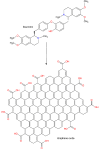 |
-
•
Neuroprotective activity
-
•
Reversed MDA and SOD level
-
•
Alleviated ROS level
-
•
Reduced apoptosis of SH-SY5Y cells
-
•
Improved neurocognitive deficits and anxiety-like behaviors
-
•
Restored damaged neurons
-
•
Reduced activation of astrocytes and microglia
|
[99] |
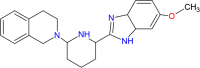
| Tetrahydroisoquinoline-benzimidazole |
 |
-
•
Inhibition of neuroinflammation and BACE1
-
•
Enhanced anti-neuroinflammatory activity
-
•
Reduced glutamate-induced cytotoxicity
-
•
ROS reduction
-
•
Increased GSH level
-
•
Able to penetrate BBB
|
[110] |
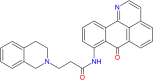
| Tetrahydroisoquinoline-oxoisoaporphine |
 |
|
[111] |
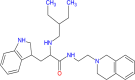
| Tryptophan-tetrahydroisoquinoline |
 |
-
•
Selective inhibitor of BChE
-
•
Inhibited self-aggregation of Aβ peptides
-
•
Neuroprotective effect from Aβ-induced cell death
-
•
Reversed Aβ-induced cognitive dysfunctions in mouse
-
•
Able to penetrate BBB
|
[11] |
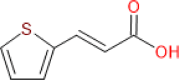
| Tetrahydroisoquinoline-cinnamic acid |
 |
-
•
Decreased activity of huBuChE
-
•
Inhibition of MAO-A and MAO-B
-
•
Good antioxidant potency and anti-inflammatory activity
-
•
Inhibition of self-induced Aβ42 aggregation
-
•
Neuroprotective effect against SH-SY5Y
-
•
Good BBB permeability via passive diffusion
-
•
Good stability in artificial gastric fluid and artificial intestinal fluid
-
•
Improved scopolamine-induced memory impairment
|
[130] |


