


Table 1.
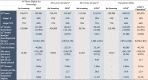 |
∗Smoking status as determined at the simulated start of screening (2022), including never-eligible smokers.
§Ever-eligible for screening at the start of screening (2022), including former smokers.
†Biennial screening ages 60–79 for those with at least 35 packyears or 2.6% PLCOm2012 risk, and maximally 10 years of smoking cessation.
‡Lung Cancer.
¶Low-dose Computed Tomography.
#For the population-wide results, we also present outcomes for the scenario with pharmacotherapy smoking cessation support, applied at every screening round. For this scenario, overdiagnosis is measured as excess incidence relative to the scenario with only smoking cessation support (no screening). Results are generated for cohorts 1942–1961, with cohort sizes matched to 2021 populations by birth-year and sex for the Netherlands. Together these cohorts represent 3.85 million people as of 2022. Outcomes are tallied for the entire simulated lifetimes from 2022 onwards.