



Abstract
Background
This analysis posits that COVID-19-related worker mental distress may be different for those continuously employed and for those who faced temporary job loss.
Methods
Mental distress during COVID-19 is characterized using two nationally representative surveys, the American Trend Panel (ATP) and the Household Pulse Survey (HPS). Using a probit model, we examine workplace perceptions for the mentally distressed in the ATP sample. We use graphical analysis to identify barriers to seeking mental healthcare using the 2021–22 HPS sample.
Results
In October 2020, the probability of mental distress increased between 7.1 and 9.1 percentage points in response to worsening work–life balance, lowered job security, lowered work productivity and lowered work satisfaction. Workers’ perception of advancement denial and poor connectivity with coworkers increased the probability of mental distress by 3.0–5.8 percentage points. In October 2021, over 40% of workers who had experienced job loss reported mental distress as compared to 20% of those with jobs. Only 25% of those with mental distress sought counseling. These high levels of mental distress continued into October 2022.
Conclusions
Mitigation strategies for worker mental health should include prosocial nudges, attention to employment history, managerial sensitivity and worker resilience training.
Keywords: COVID-19, mental health, worker well-being
Introduction
Little is known about how COVID-19-related mental distress shapes worker perceptions of job and performance. 1–5 The American Psychological Association 2023 Work in America Survey (APA-2023-WAS) concluded that mental health among workers is a high priority. The results from their survey show that 77% of workers reported work-related stress, 57% experienced burnout symptoms such as emotional exhaustion (31%), lowered desire to be prosocial (25%), desire to quit (23%) and lowered productivity (20%). In the same study, 19% described their workplace as toxic, 30% experienced harassment and 22% experienced verbal abuse.6
Against the background of persistent elevated worker mental distress discussed in the APA-2023-WAS, this paper brings attention to worker mental distress among the continuously employed during COVID-19, ranging from the October 2020 to October 2021 time period. The APA-2023-WAS study found that 26% of workers felt isolated and lonely at their workspaces even if the workers had frequent contact with coworkers and clients. Specifically, 35% of workers engaged in customer/client/patient services reported feelings of loneliness versus 23% in office work, or 22% in manual labor.6,7 For those who may have suffered job loss, there is scant evidence of their sense of loneliness, isolation, anxiety or depression. A recent commentary suggests that pro-sociality should be a public health priority for those who are vulnerable to feelings of isolation and loneliness.8 Investments in developing non-clinical pathways that improve the sense of belonging and feeling supported in workplaces might improve mental health outcomes.6–8 Related literature argues that mental distress may limit a worker’s ability to maintain healthy emotions, thus leading to conditions like absenteeism or presenteeism.9–12 Additionally, workers in mental distress may experience cognitive fatigue and these effects may have enduring effects on employment.13–15 Thus, simple interventions like creating a culture of caring, training managerial staff to be sensitive to post-pandemic workplace conditions, short breaks of kindness/compassion mindfulness practice or promoting friendly competition among work-based teams may restore a sense of connection to work.8
Using two nationally representative surveys, this paper investigates how mental distress varied for the employed and unemployed during COVID-19, a year and 2 years after the pandemic. It explores a rear-view perspective into the potential sources of mental distress among employed and pandemic-related unemployed workers.
Methods
The analysis uses two nationally representative surveys that address different dimensions of mental health to explain COVID-19-related worker mental distress. The American Trend Panel (ATP, N = 10 332) data collected from 13 to 19 October 2020 by the Pew Research Center has four measures of mental health (loneliness, social support, optimism and stress). It is an online survey that includes adults aged ≥18 years old, who were recruited via email, phone or mail. For the panel analyzed, the response rate was 88% and offered regional variation. The Household Pulse Survey (HPS) was collected from 29 September to 11 October 2021 (HPS, N = 49 523) and from 5 to 17 October 5 2022 (HPS, N = 36 484) by the Census.16,17 The HPS ran continuously from April 2020, originally designed as weekly surveys. As the pandemic progressed, the intervals between survey weeks increased, but the name ‘weekly release’ remained. Figure 1 presents a timeline for the surveys. We chose the October wave in 2021 and 2022, given our interest in understanding the degree of mental distress among Americans 1 and 2 years after the ATP survey. The HPS survey selects census addresses at random and invites the household members to participate by mail. It had a response rate of 5–6%, where each wave of the survey, a million people were invited, and ~50 000 participated per survey period. The HPS analysis can be done at the US state level. There are no overlapping respondents across the two surveys or survey years. The mental health variables in the HPS survey measure anxiety and depression.
Fig. 1.
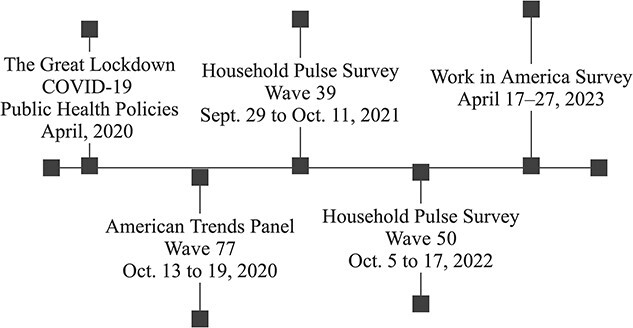
COVID-19 great lockdown, ATP and HPS survey timelines. The figure walks the reader through the sequencing of COVID-19 public policies in April 2020, the snapshot, views the ATP, October 2020 and HPS survey analyzed on October 2021 and 2022. The end point in this figure shows the Work in America Survey conducted in April 2023.
In the ATP survey, those who responded having full-time or part-time employment were classified as employed; the unemployed included retired workers as well as those currently not employed (Supplementary Appendix QA1). Four ATP questions about the respondents’ post-COVID-19 outbreak feelings measure loneliness (for questions, see Supplementary Appendix QA2a–QA2e), social support (QA2b), optimism (QA2c) and level of stress or anxiety (QA2e). We calculated the arithmetic mean to form an ATP-mental health scale with a Cronbach reliability of 0.69. On this scale, scores <2 convey healthier mental states, and scores >2 convey unhealthy mental states. Given that some level of unhealthy mental states during the pandemic would be natural, we wanted to focus on the group for whom the negative emotionality was more chronic and exceeded the ‘some of the time’ threshold. Respondents with mental health scores >2.5 tip over to experiencing mental distress ‘most of the time’, and they were categorized as mentally distressed (MDi, where ‘i’ is the respondent).
Responses to ATP questions on full-time worker experiences of job security (Supplementary Appendix QA3a), flexibility (QA3b), work–life balance (QA3c), hours (QA3d), productivity (QA3e), satisfaction (QA3f), advancement (QA4a), connectivity (QA4b) and supervisor appraisal (QA4c) post-COVID-19 define exogenous independent covariates. The control variables were age, education and sex. In the absence of a true baseline, these questions directly elicit COVID-19 work experience. Our probit model is given by
 |
where the independent variable  is our constructed binary variable indicating mental distress.
Our estimation equation is then given by:
 |
where the dependent variables 
 if respondent ‘i’ has experienced a negative state, and
 if the respondent has experienced the same or positive state. We present the marginal effects of a unit change of covariates on the probability of being mentally distressed.18,19 Results with P-values < 0.05 are considered to be statistically significant.
The HPS mental health measures were developed in response to COVID-19 in partnership with the Centers for Disease Control. In the HPS survey, two binary questions help determine employment status: (i) if anyone in the household experienced job loss and (ii) if the respondent had worked for pay in the past 7 days (Supplementary Appendix Q5Aa and Ab). The mental health questions on HPS are taken from validated psychometric scales, specifically from the PHQ-Patient Health and GAD-Generalized Anxiety Disorder Questionnaire. For rapid administration, these scales have been truncated to the two-item scale of generalized anxiety (GAD2; QA5c and QA5d: anxious and worry) and depressive disorder (PHQ-2; Supplementary Appendix QA5e and QA5f: interest and down). The questions are a measure of number of days of a week a respondent reported feeling anxious, worried, lacked interest or were feeling down. Responses to the GAD-2 and PHQ-2 were combined to create a four-item HPS–mental distress scale with a Cronbach reliability value of 0.92. Respondents with scores >2.5 were categorized as mentally distressed as it tips a person over experiencing mental distress symptoms for some of the days. This measure served to measure persistence in mental distress. The term persistence here connotes the aggregate levels of mental distress present among the US population, a year and 2 years after the ATP survey. Since the respondents in these surveys are not the same, they should be viewed as representative individuals of overall mental health in the USA. Additionally, the HPS measure of mental distress captures anxiety and depression levels and not aspects of emotional well-being that are captured in ATP. In the HPS 2020 survey, two questions characterized use of and access to mental health services: (i) Did you receive counseling or therapy from a mental health professional? and (ii) In the last four weeks, did you need counseling or therapy online or by phone and did not get it? (Supplementary Appendix Q5Ag and Q5Ah). These questions were not asked in HPS survey October 2022. Admittedly, these measures are not comparable, but they do give us insights into the overall mental and emotional well-being among the US population for the three time points: October 2020 with ATP survey, 2021 and 2022 with HPS survey. Together, the two surveys capture different dimensions of mental health that permit an investigation into workplace mental well-being.
Results
Of the ATP respondents, 46% were fully employed, 12% were employed part-time, 26% were retired and 15% were unemployed. Simple differences in mean t-tests of mental distress scores, for respondents with scores ≥2.5, showed that the employed were healthier compared to the unemployed where the t-statistic was 4.6 with a df = 0.05 (P < 0.001; see Supplementary Appendix Table A2a). The mental distress scores for the unemployed in age groups 18–29, 30–49 and 50–64 were statistically significant and higher than the employed in the same age groups. There was no difference in mental distress scores for the employed and unemployed for ages ≥65. Within race categories, the unemployed respondents who identified as Whites and ethnicity Hispanic had significantly higher mental health scores as compared to the employed within the same racial groups (Supplementary Appendix Table A2a). Lower differences in the mean mental health scores among Asians and Blacks could be a function of smaller numbers surveyed and under-reporting of mental distress, especially if they were unemployed. It was not possible to separate out COVID-19-related unemployment, retirement or underemployment. Additionally, in a t-test using ATP data, the mentally distressed workers were less likely to experience work satisfaction than mentally healthy workers where the t-statistic 11.8 was with df = 0.085 (P < 0.001; not shown in table).
Figure 2 (Supplementary Appendix Table A3) presents the probit results for full-time worker mental health and their work-related COVID-19 perceptions and experiences as compared to before the pandemic. Overall, real or perceived worsening of work conditions increased mental distress. For instance, the probability of mental distress increased by 7.4 percentage points with worsening work–life-balance (95% CI: 4.4%, 10.4%; P < 0.001), by 9.1 percentage points with less job security (95% CI: 5.7%, 12.4%; P < 0.001), by 7.9 percentage points with lower work productivity (95% CI: 4.4%, 11.4%; P < 0.001) and by 7.1 percentage points with less work satisfaction (95% CI: 4.0%, 10.3%; P < 0.001). A worker’s perception of being denied advancement increased the probability of mental distress by 5.8 percentage points (95% CI: 2.2%, 9.5%; P < 0.002), and lower levels of connectivity with coworkers increased mental distress by 3.0 percentage points (95% CI: 0.2%, 5.7%; P < 0.036).
Fig. 2.

Employee mental distress and workplace conditions (independent binary variable ATP-mental distress [0, 1]). Source: PEW, own estimation using ATP Wave 77, 13–19 October 2020. This figure plots the individual effects of the probit regression of MDi on the covariates. The overall effect sums each individual effect. Interpretion of overall effects is as follows if a worker experienced each of the elements in Real C-19 Consequences and Perceived C-19 Consequences then thecumulative workplace C-19 experience would be worse by 43% points, as a sum of all coefficients.
In October 2021, 42% of HPS respondents who lost a job experienced mental distress for over half the days of the week.9 Among those with a job, 16.7% experienced anxiety or depressive symptoms for over half the days of the week as compared to 41.8% among those with a job loss (Fig. 3). There was a significant difference in the mental distress scores between the employed and the unemployed respondents, with t-statistic of 11.69 with df = 0.15 (P < 0.001, Supplementary Appendix Table A2b). Over 35.8% of those without a job and mentally distressed did not have access to mental health services, and <25% of them sought counseling (see Fig. 3). As of October 2022, 22% reported that they spent ≥3 days of the week in mental distress. Among those with a job loss, 45% experienced mental distress, whereas this number was 20% among those with a job (Fig. 3). Significant differences in mental distress score between the employed and unemployed persisted in 2022 with a t-statistic of 10.57 with a df = 0.17 (P < 0.001; Supplementary Appendix Table A2c). Data on utilization of mental health services was not collected in October 2022. All unemployed adults, including potentially retired, age ≥18 years old, in HPS surveys in October 2021 and 2022, have a significantly higher mental distress score as compared to employed adults. However, in 2021, unemployed adults aged ≤49 years old showed higher scores for mental distress than the employed. This trend changes slightly in October 2022, where unemployed adults of ages 18–29 and 50–64 show higher mental distress scores as compared to the employed in the same age group (Supplementary Appendix Table A2c).
Fig. 3.

A) Job loss, B) mental health status, C) mental health visits and D) access to mental health services (Household Pulse Survey October 2021, N = 49 523, and October 2022, N = 33 598). Source: Household Pulse Survey waves October 2021 (Week 39) and October 2022 (Week 50). The mental health scale was calculated as ∑(anxious + worry + interest + down)/4. Respondents were classified as mentally distressed if their scores were >2.5 as it tips a person over experiencing mental disturbances some of the time. In Week 39, there were questions about the utilization of mental health services and access to mental health services; the Week 50 survey did not ask the same questions.
Discussion
Main findings of the study
The results showed that for the employed, negative appraisals of workplace conditions were associated with statistically significant increases in mental distress (between 8.5 and 11.6 percentage points). Negative perceptions of workplace conditions were associated with mental distress increases of 5.4–6.1 percentage points. While these results for employed workers are significant, the unemployed ATP respondents’ mental distress scores significantly higher by 0.05 points. HPS results showed significant differences in mental distress scores between the employed and the unemployed with a difference of 0.15 in 2021 and a difference of 0.17 in 2022, and few sought counseling. The increased levels of mental distress among the unemployed and employed populations are persistent across all 3 years and two surveys. These effects are across all ages and race-ethnicity classifications, which means addressing mental distress among the US adult population is a public health priority. The AWS survey results from July 2023 offer support to our findings by showing that mental distress (anxiety, depression, loneliness, social support, sense of belonging and coworker cohesion) has worsened because of COVID-19. Because the worsening of mental health for unemployed workers may have downstream undesirable consequences to their physical health and work life, a potential solution may be for employers to allocate resources to alleviate employee mental distress. The government, as well as philanthropic organizations, may also need to help unemployed populations.
What is already known on this topic
Mental distress may limit a worker’s capacity to live with healthy emotions, thus leading to conditions like absenteeism, presenteeism and poor quality of life.2,4,9–15 Finding the right cures for mental distress is often challenging for clinicians because they require identification of the causes of mental distress, which gets revealed over time.6–8 When mental distress is coupled with changing worker environments, job switches or unemployment, the sources and effects of mental distress may be different and nuanced.8–15 The pandemic added its own layer of environmental causes to attenuate preexisting or new onset of mental distress. We know from APS-2023-WAS that a significant proportion of the US population reports experiencing mental distress across all occupations—and that mental well-being is a public health priority for the US and globally.8 Related studies also point to public health attention to mental distress among the US working population.9–15,20
What this study adds
We discuss how mental distress may be different for the temporarily or permanently unemployed. Our insight reflecting on this period is that not all workers may respond to worker psychological well-being initiatives in the same way. This analysis uses two nationally representative survey data to offer a snapshot historical view into the causes, variation and persistence of mental distress over the period of 2 years post-COVID-19 public health crisis. Its main contributions are: (i) using the ATP survey to explain the potential sources of mental distress among continuously employed workers, (ii) illustrating mental distress among workers with job loss across ATP and HPS surveys, (iii) using the HPS survey to illustrate the use of and access to mental health services conditional on reporting mental distress in 2021 and (iv) illustrating the level of mental distress in the US was persistent in October 2022. We conclude by suggesting that investments in social and community support for displaced workers, focused on the prevention of mental distress, could facilitate faster reemployment and reduce long-term government spending. Additionally, the paper recommends offering workplace mental health support to continuously employed workers. Because COVID-19 affected both continuously employed and disrupted workers, public health agents and communities should understand how to provide resilience counseling across these different worker experiences.
Limitations of this study
This study suffers from several limitations. First, we did not have a baseline pre-COVID-19 measure for worker health. Second, we cannot analyze workplace conditions for the disrupted worker. This study emphasizes the need for collecting additional data on worker history (i.e. Did they experience any job switches or task switches due to COVID-19?) and worker mental health history to help raise public health awareness, guide governmental and community-based resilience interventions as well as mitigate mental distress. Third, we needed to use two surveys to characterize the nature of mental distress across key dimensions of mental health: loneliness, social support, optimism, stress, anxiety and depression. While the surveys were nationally representative, and we did not have the same covariates across surveys and survey time periods consequently, this analysis can point to the seriousness of mental distress but falls short of offering causal analysis. Fourth, we know workers have made changes to their work environment, such as increasing the number of hours worked remotely and switching to different jobs or roles if these switches came because of COVID-19, but we do not currently have data that inquires explicitly into work history and how that affects worker mental health and performance. Future work could focus on developing more robust surveys that could identify the differences in mental distress workers experience and offer potential solutions for managerial oversight and sensitivity, external pathways to mental well-being or a combination of the two.
Supplementary Material
Acknowledgements
We express gratitude to David Sundaram-Stukel and Scott Cunningham, Arin Dube, John Mullahy, Christopher Taber and Ivan Werning for helpful comments.
Reka Sundaram-Stukel, Honorary Research Fellow
Pelin Kesebir, Honorary Fellow
Regina Vidaver, Section Manager
Richard J. Davidson, William James and Vilas Professor of Psychology and Psychiatry
Contributor Information
Reka Sundaram-Stukel, Department of Economics, University of Wisconsin-Madison, 7415 Social Sciences, Madison, WI 53703, USA.
Pelin Kesebir, Center for Healthy Minds, University of Wisconsin, 325 West Washington Street, Madison, WI 53703, USA.
Regina Vidaver, Chronic Disease Prevention & Cancer Control, Wisconsin State Department of Health Services–Division of Public Health, 1 West Wilson St. Rm 218, Madison, WI 53703, USA.
Richard J Davidson, Center for Healthy Minds, 325 West Washington Street, Madison, WI 53703, USA.
Funding
National Center for Complementary and Integrative Health (grant U24AT011289-01 to R.J.D.). Other grants: National Institutes of Health, National Center for Complementary and Alternative Medicine (grant P01AT004952 to R.J.D.). National Institutes of Health, National Institute of Mental Health (grants R01-MH43454 and P50-MH084051 to R.J.D.).
Conflict of interest
Except for the funding details disclosed by co-author R.J.D., all other authors have no conflict of interest to disclose.
Data Availability
Data and code are available upon request from the corresponding author rsundara@wisc.edu.
References
- 1. Giuntella O, Hyde K, Saccardo S. et al. Lifestyle and mental health disruptions during COVID-19. Proc Natl Acad Sci U S A 2021;118(9):e2016632118. [DOI] [PMC free article] [PubMed] [Google Scholar]
- 2. Rothstein J. The lost generation? Labor market outcomes for post great recession entrants. National Bureau of Economic Research. Working Paper Series. 2020;27516:1–49. Available from NBER. http://www.nber.org.ezproxy.library.wisc.edu/papers/w27516.pdf. [Google Scholar]
- 3. Pew research Center. How the coronavirus outbreak has – and Hasn’t – changed the way Americans work. Social Trends Report. 2020. Available from PEW. https://www.pewresearch.org/social-trends/2020/12/09/how-the-coronavirus-outbreak-has-and-hasnt-changed-the-way-americans-work/.
- 4. Feng S, Lefgren L, Platt BC. et al. Job search under asymmetric information: endogenous wage dispersion and unemployment stigma. Econ Theory 2019;67(4):817–51. https://search-ebscohost-com.ezproxy.library.wisc.edu/login.aspx?direct=true&AuthType=ip,uid&db=ecn&AN=1775495&site=ehost-live&scope=site (2 November 2022, date last accessed). [Google Scholar]
- 5. U.S. Surgeon General . Workplace mental health and well-being. Current Priorities 2022. Available from HHS. https://www.hhs.gov/sites/default/files/workplace-mental-health-well-being.pdf. [Google Scholar]
- 6. American Psychological Association . 2023 Work in America Survey: Workplaces as engines of psychological health and well being . 2023. Available from APA. https://www.apa.org/pubs/reports/work-in-america/2023-workplace-health-well-being.
- 7. Wax A, Deutsch C, Lindner C. et al. Workplace loneliness: the benefits and detriments of working from home. Front Public Health 2022;10:903975. 10.3389/fpubh.2022.903975. PMID: 35692343; PMCID: PMC9184741. [DOI] [PMC free article] [PubMed] [Google Scholar]
- 8. Kubzansky LD, Epel ES, Davidson RJ. Prosociality should be a public health priority. Nat Hum Behav 2023;7(12):2051–3. Epub ahead of print. Erratum in: Nat Hum Behav. 2023 Nov 9; PMID: 37857873. [DOI] [PMC free article] [PubMed] [Google Scholar]
- 9. Ferreira AI, Mach M, Martinez LF. et al. Sickness Presenteeism in the aftermath of COVID-19: is Presenteeism remote-work behavior the new (ab)normal? Front Psychol 2022;27(12):748053. [DOI] [PMC free article] [PubMed] [Google Scholar]
- 10. Johnston DA, Harvey SB, Glozier N. et al. The relationship between depression symptoms, absenteeism and presenteeism. J Affect Disord 2019;256:536–40. [DOI] [PubMed] [Google Scholar]
- 11. van Dam A, Noordzij G, Born MP. Linking the fit between achievement goal orientation and learning opportunities with employee well-being and absenteeism. J Pers Psychol 2020;19(4):184–96. [Google Scholar]
- 12. Brunner B, Igic I, Keller AC. et al. Who gains the most from improving working conditions? Health-related absenteeism and presenteeism due to stress at work. Eur J Health Econ 2019;20(8):1165–80. [DOI] [PMC free article] [PubMed] [Google Scholar]
- 13. Ceban F, Ling S, Lui LMW. et al. Fatigue and cognitive impairment in post-COVID-19 syndrome: a systematic review and meta-analysis. Brain Behav Immun 2022;101:93–135. Epub 2021 Dec 29. PMID: 34973396; PMCID: PMC8715665. [DOI] [PMC free article] [PubMed] [Google Scholar]
- 14. Witteveen, D., & Velthorst, E. Economic hardship and mental health complaints during COVID-19. Proc Natl Acad Sci U S A 2020;117(44):27277–84. [DOI] [PMC free article] [PubMed] [Google Scholar]
- 15. Brand JE. The far-reaching impact of job loss and unemployment. Annu Rev Sociol 2015;41:359–75. 10.1146/annurev-soc-071913-043237. [DOI] [PMC free article] [PubMed] [Google Scholar]
- 16. Centers for disease control. Household pulse survey . Anxiety and depression 2020; 903975. Available from CDC. https://www.cdc.gov/nchs/covid19/pulse/mental-health.htm.
- 17. Pew Research Center . America trends panel. 2020. Available from PEW. https://www.pewresearch.org/our-methods/u-s-surveys/the-american-trends-panel/.
- 18. Norton EC, Dowd BE, Maciejewski ML. Marginal effects—quantifying the effect of changes in risk factors in logistic regression models. JAMA 2019;321(13):1304–5. [DOI] [PubMed] [Google Scholar]
- 19. Norton EC, Dowd BE, Maciejewski ML. Odds ratios—current best practice and use. JAMA 2018;320(1):84–5. [DOI] [PubMed] [Google Scholar]
- 20. Bureau of Labor Statistics. The Employment Situation. 2022; 1–37. https://www.bls.gov/news.release/pdf/empsit.pdf. [Google Scholar]
Associated Data
This section collects any data citations, data availability statements, or supplementary materials included in this article.
Supplementary Materials
Data Availability Statement
Data and code are available upon request from the corresponding author rsundara@wisc.edu.