



Abstract
Objectives
To examine if intergenerational transmission of parent weight talk occurs and the contextual factors prompting weight talk, and whether parent weight talk is associated with child weight, dietary intake, psychosocial outcomes, and food parenting practices.
Study design
Children ages 5–9 and their families (n=1307) from six racial and ethnic groups (African-American, Hispanic, Hmong, Native American, Somali/Ethiopian, White) were recruited for a longitudinal cohort study through primary care clinics in Minneapolis/St. Paul, Minnesota from 2016 through 2019. Parents filled out surveys at two time points, 18 months apart. Adjusted regression models examined associations of interest.
Results
Intergenerational transmission of parent weight talk was observed. In addition, significant associations were found between parent engagement in weight talk and higher weight status and poorer psychosocial outcomes in children 18 months later. Parent engagement in weight talk was also associated with more restrictive food parenting practices 18 months later.
Conclusions
Parents’ exposure to weight talk as children increased the likelihood of engaging in weight talk with their own children and had harmful associations over time with parent restrictive feeding practices, child weight, and psychosocial wellbeing in children. Health care providers may want to consider both modeling positive health-focused conversations and educating parents about the potential harmful and long-lasting consequences of engaging in weight talk with their children.
Keywords: weight conversations, food parenting, obesity, dietary intake, psychosocial wellbeing
Previous research has shown that parent weight talk, defined as talking about a child’s weight or size[1], is associated with harmful outcomes for adolescents [2–6]. Specifically, a systematic review [7], as well as several other cross sectional and longitudinal studies found that parent weight talk was associated with overweight/obesity, unhealthy weight control behaviors (e.g., skipping meals, taking diet pills) and binge eating [2,8–14], and poor psychosocial wellbeing (e.g., depressive symptoms, low self-esteem, low body satisfaction) among adolescents [13,15–20]. Even if parents have good intentions about addressing their child’s weight because of health concerns, research has shown that parent conversations about weight, shape, or size can have unintended consequences with negative child health outcomes such as overweight/obesity, unhealthy weight control behaviors and psychosocial wellbeing outcomes [21–23]. Additionally, findings showed that the impact of weight talk carried forward into adulthood [24,25]. However, it is unclear whether parent weight talk is similarly harmful in younger children, whether it is transmitted intergenerationally, and whether it is associated with a broad range of child health and wellbeing outcomes including weight, diet quality, emotional problems, hyperactivity, conduct problems, peer relationships, and prosocial behavior. Examining a broader range of outcomes, in addition to understanding whether weight talk is intergenerationally transmitted can help to establish the public health impact and scope of the problem.
Qualitative findings suggest that parents report different contextual prompts for engaging in weight talk with their children. Specifically, parents report engaging in weight talk after a doctor’s visit, at a family meal, or when shopping [26–29]. In addition, parents report different reasons for these conversations such as concerns about their child’s health, their child being teased by peers, or memories of struggling with their own weight as a child [4,5,27,30–32]. These qualitative findings help shed light on some of the contextual factors related to parental weight talk with children. An important next step is to measure the prevalence of these contextual factors quantitatively and to examine outcomes longitudinally in racially/ethnically diverse samples.
It is also important to understand the relationship between parent engagement in weight talk and food parenting practices. Prior research has shown that controlling food parenting practices such as restriction and pressure-to-eat are associated with child overweight status, disordered eating behaviors, and food responsiveness (ie, eating in the absence of hunger) [33–39]. If parent weight talk is also associated with higher controlling food parenting practices, it may be a potential target for reducing controlling feeding practices and thereby potentially decrease the risk for child higher weight status, unhealthy eating behaviors, and psychosocial outcomes. Longitudinal research is needed to examine the relationship between parental weight talk and food parenting practices.
Family Systems Theory (FST)[40] guides the current study. FST may be used to study the role of families in individual development across the lifespan, however, it is often applied to understand how parent-child interactions shape development during childhood and adolescence [41]. FST suggests that the family environment is the most proximal influence on child health and wellbeing and that transactions within family systems (e.g., conversations between parents and children) shape the course of child development [42–45]. For example, a parent engaging in conversations about a child’s weight or size may result in a child trying to lose weight or engaging in unhealthy eating behaviors to avoid disappointing their parent. The child might also feel embarrassed or depressed, which may result in psychosocial problems [29,46,47]. FST further suggests that transactions within families are not unidirectional and may be prompted by characteristics of the child or context [41]. This underscores the importance of investigating when and why parents engage in weight talk with their children. Additionally, FST posits that behaviors learned in the family context in which a person is raised are passed on intergenerationally [24,48,49]. For example, a child who is encouraged to lose weight by their parent may engage in similar weight talk with their own children when they are adults.
The main aims of the current study were to examine: whether intergenerational transmission of parent weight talk occurs; contextual factors (ie, when and why) prompting parent weight talk; and longitudinal associations between parent weight talk and children’s weight, dietary intake, and psychosocial wellbeing and food parenting practices over 18 months. Our hypotheses included: adults who experienced weight talk growing up would (1) engage in weight talk with their own children; (2) engage in these conversations during mealtimes, when trying on clothing, and after a doctor’s appointment; and would engage in these conversations because they were concerned about their child’s health and because of memories of being teased themselves; and (3) have children who have higher weight status, less healthful diet quality, and more emotional problems, conduct problems, hyperactivity, peer relationship problems, and less prosocial behavior, and would engage in more restrictive and pressure-to-eat food parenting practices.
METHODS
Data for the current study are from the Family Matters study [50], a mixed-methods study of children ages 5–9 years old (n=1307) and their families from low-income, racially and ethnically diverse, and immigrant/refugee households. At two time points 18 months apart (2016 through 2019 and 2018 through 2021), parents completed an online survey. At follow-up, 96% of the sample was retained (n=1259). Some (21.3%) follow-up survey responses were completed after March 13, 2020 (the date President Biden declared COVID-19 a national emergency).
Parent/child dyads were recruited from primary care clinics in Minneapolis/St. Paul. Families were eligible to participate if: (1) the child was 5–9 years old; (2) the child lived with the parent/guardian more than 50% of the time; (3) the child was from one of the following racial and ethnic backgrounds: African-American, Hispanic/Latino, Hmong, Native American, Somali, Ethiopian, or White; and (4) the child had a body mass index greater than the 5th percentile. The study was conducted according to the guidelines of the Declaration of Helsinki and was approved by the Institutional Review Board Human Subjects Committee at the University of Minnesota. Written informed consent and/or assent was obtained from all study participants before participating in the study. All study materials (eg, consent forms, surveys) were translated into Hmong, Somali and Spanish. In-depth details about the study are published elsewhere [50]. Development of the online survey followed best practice [51–53], including: (1) using established valid and reliable measures; (2) using survey psychometrics from our pilot study[54]; and (3) conducting a test-retest reliability sub-study with 125 participants (~20 per race and ethnicity) from the baseline sample who took the full online survey twice within two weeks. Data from this sub-study were used to estimate intraclass correlation coefficients from mixed models with participant-level random intercepts to capture the degree of agreement between measurements. All predictor, outcome, and control measures are described in Table I.
Table 1:
Predictor, outcome, and control variables used in analyses
| Construct | Question | Response Options | How Variable was Operationalized |
|---|---|---|---|
|
| |||
| Predictor Variables | |||
|
| |||
| Family weight talk while growing up: Retrospectively measured | Via online survey at baseline, parents’ exposure to family weight talk while growing up was assessed using six items modeled after items in the Family Fat Talk Questionnaire.50 These items assessed the frequency with which family members (a) complained that they were fat, (b) complained that they should not be eating fattening foods, (c) criticized their own bodies, (d) pressured each other to be thin, (e) commented on other people’s weight or size, and (f) teased or made fun of the parent because of their weight as a child. | Response options were 1 = Never, 2 = Rarely, 3 = Sometimes, 4 = Often, and 5 = Always. | Responses were averaged. Possible scores ranged from 1–5, with higher scores representing greater frequency of family weight talk while growing up (Cronbach’s α in the present sample = .91). |
|
| |||
| Parental weight talk with children: Prospectively measured | Via online survey at baseline, parental weight talk with children was assessed using four items that were modeled after items in the Parental Energy Index.51 Parents were asked about the frequency with which they have (a) had conversations with their child about their child's weight or size, (b) mentioned to their child that their child weighs too much, (c) encouraged their child to eat differently in order to control their weight, and (d) encouraged their child to exercise in order to control their weight. | Response options were 1 = Never or rarely, 2 = A few times a year, 3 = A few times a month, 4 = A few times a week, and 5 = Almost every day. | Responses were averaged. Possible scores ranged from 1–5, with higher scores representing greater frequency of parental weight with children (Cronbach’s α in the present sample = .77). |
|
| |||
| Contextual factors for when weight talk with children happens | Via online survey at both time points, if a parent reported having had conversations with their child about the child’s weight or size more frequently than never/rarely, they were asked when such conversations occurred. | Parents were asked to select all that applied of the following response options: (a) when eating a meal; (b) when out shopping; (c) when trying on clothing; (d) when watching a movie/TV; (e) at a sporting event; (f) after a doctor’s appointment. These response options were created based on our prior qualitative research.22,26 | Endorsement of each response option was examined. |
|
| |||
| Contextual factors for why weight talk with children happens | Via online survey at both time points, if a parent reported having had conversations with their child about the child’s weight or size more frequently than never/rarely, they were asked what prompted such conversations. | Parents were asked to select all that applied of the following response options: (a) child’s health; (b) child’s appearance; (c) child being teased about weight/size by others; (d) memories of struggling with own weight/size as a child. These response options were created based on our prior qualitative research.22,26,52 | Endorsement of each response option was examined. |
|
| |||
| Outcome Variables | |||
|
| |||
| Child weight | Baseline child height and weight from electronic medical records (EMR) were collected during recruitment. Child BMI percentiles were then calculated from electronic medical records according to CDC guidelines. | Child BMI percentiles were calculated according to CDC guidelines using height, weight, sex, and age. | BMI %iles ≥ 85th and ≥ 95th were examined in analyses. |
| At 18-month follow-up, EMR were used again for child height and weight. For those children without a height and weight in EMR because of moving clinics or not attending a clinic visit recently, the following strategies were used to collect updated data (in the following order of operations): (1) After Visit Summary (n=209); (2) Height/weight taken by study staff or other provider (e.g., school nurse) (n=65); (3) Study- provided measuring packet (n=262); (4) Parent self-report of child’s height/weight (n=154). | |||
|
| |||
| Child diet quality | Parents were asked to report on their child’s typical past-month intake of 15 food categories (e.g., dark green vegetables, fruit, refined grains) over the past month using an adapted version of the Children’s Eating Habits Questionnaire53,54 via online survey at both time points. | Response options for each category were: Never or less than 1 time/week, Few times a week (1–3 times per week), Nearly every day (4–6 times per week), 1 time/day, 2 times/day, 3+ times per day. | Using the Healthy Eating Index-201555 as a guide, staff dietitians created an overall dietary intake quality score ranging from 0–85, where higher scores indicate higher diet quality. Details regarding the dietary quality score have been published elsewhere.56 |
|
| |||
| Child psychosocial well-being | Parents reported their children’s emotional problems, conduct problems, hyperactivity, peer relationship problems, and prosocial behavior using the 25-item Strengths and Difficulties Questionnaire (SDQ)57,58 via online survey at both time points. | Response options were 0 = Not true, 1 = Somewhat true, and 2 = Certainly true. | Appropriate items were reverse coded, and responses were summed for each subscale. Subscale scores each ranged from 0–10, with higher scores representing greater endorsement of the respective problems or behaviors (Cronbach’s α in the present sample ranged from .52–.86 across subscales at baseline and from .54– .89 at follow-up). |
|
| |||
| Food parenting practices | Parental food restriction and pressure-to-eat practices were assessed by asking parents seven items from the Child Feeding Questionnaire (CFQ).59 Food restriction was measured using three items from the CFQ Restriction subscale assessing regulation of sweets, regulation of “junk food”, and keeping some foods out of reach. Pressure-to-eat was measured using all four items from the CFQ Pressure-to-Eat subscale. | Response options were 1 = disagree, 2 = slightly disagree,3 = neutral, 4 = slightly agree, and 5 = agree. | Responses were averaged across each subscale. Possible scores ranged from 1–5 for each subscale, with higher scores representing greater endorsement of the respective food parenting practice (Cronbach’s α in the present sample ranged from .65–.72 across subscales at baseline and from .63–.76 at follow-up). |
|
| |||
| Control Variables | |||
|
| |||
| Household race/ethnicity | Parents were asked via online survey to select the race/ethnicity that best characterizes your household (e.g., the foods you cook for your family, the language you speak at home, the holidays you celebrate). | White | Black/African American | Latino | Hmong | Native American | Somali | |
|
| |||
| Parent age | Parents were asked via online survey: “When is your birthday?” | Parents selected a calendar date | Parent age was calculated from subtracting the parent’s birth date from the survey date. |
|
| |||
| Parent gender | Parents were asked via online survey: “Do you identify as…” | Female | Male | |
|
| |||
| Parent educational attainment | Parents were asked via online survey: “What is the highest level of education that you have completed?” | Middle school or junior high; Some high school; High school graduate or GED; Vocational, technical, trade or other certification program; Associate degree; Some college; Bachelor’s degree; Graduate or professional degree | Categories were collapsed into: (1) less than high school; (2) high school diploma or equivalent; (3) some college or vocational/associate degree; (4) bachelor’s degree; and (5) graduate/professional degree. |
|
| |||
| Parent marital status | Parents were asked via online survey: “What is your relationship status?” | Married | Seriously dating someone/engaged | Separated/divorced | Widowed | Single/never married | Responses were collapsed into: (1) married; (2) not married (i.e., any response other than “married”). |
|
| |||
| Parent BMI | Parents were asked to self-report their height and weight via online survey. | Parent BMI was calculated using the CDC’s online BMI calculator.60 | Parent BMI at baseline was included in analyses as a continuous variable (in kg/m2). |
|
| |||
| Child age | Parents were asked via online survey: “When is [child]’s birthday?” | Parents selected a calendar date | Child age was calculated from subtracting the child’s birth date from the survey date. |
|
| |||
| Child gender | Parents were asked via online survey: “Does your child in the study identify as...” | Female | Male | |
|
| |||
| Timing of follow-up survey in relation to COVID- 19 pandemic | n/a | n/a | Follow-up surveys that were completed after March 13, 2020 (i.e., the date that President Biden declared COVID-19 a national emergency) were coded as 1 to indicate that the survey was completed during the pandemic; those completed prior to March 13, 2020 were coded as 0 to indicate that the survey was completed before the pandemic. |
Note. BMI = body mass index.
Among parents who reported having had conversations with their children about their children’s weight or size at least a few times a year, endorsement of each contextual factor for when and why they engaged in those conversations was described by examining the percentage endorsing each contextual factor overall and by household race and ethnicity. For parents with more than one child in the study, responses were aggregated such that endorsement of a given contextual factor for at least one child in the study by a given parent was counted as endorsement of that factor by that parent, and each parent was counted only once in analyses. Differences by household race ethnicity were tested with chi-square tests or—in cases of cell sizes smaller than five—with Fisher’s exact tests.
In the full analytic sample, generalized estimating equations with an independence correlation structure were used to examine associations of interest while accounting for correlated data within households [55]. Linear regression and modified Poisson regression models[56] were conducted for continuous and dichotomous outcomes, respectively. To assess for intergenerational transmission of weight talk, parents’ exposure to family weight talk while growing up (retrospectively measured) was examined as a predictor variable in relation to parent weight talk with children at baseline (prospectively measured). In separate models for each outcome, parent weight talk with children at baseline was also examined as a predictor variable in relation to outcome variables representing each health or well-being outcome at Time 1 follow-up, adjusting for the given outcome at baseline to examine changes over time, as well as for timing of the follow-up survey in relation to the COVID-19 pandemic [57,58]. All models also adjusted for household race and ethnicity, parent and child gender, parent educational attainment, parent marital status, parent and child age at baseline, and parent BMI at baseline. Analyses were performed in Stata 16.1 (College Station, TX).
RESULTS
Descriptive information on each of the outcome variables at baseline and follow up is presented in Table II. The analytic sample for the present study included 1,237 children and 1,074 caregivers (some families have more than one child enrolled in the study) representing 1,061 unique families (13 families had different primary caregivers for different children within the same household). These families were well distributed across the six racial/ethnic groups recruited (22.6% Black or African American, 17.1% Hispanic or Latino, 14.9% Hmong, 14.7% Native American, 8.8% Somali or Ethiopian, and 22.0% White). Children in the analytic sample were, on average, 6.9 years old at baseline (SD=1.5) and 49.3% were girls. Caregivers were, on average, 35.7 years old at baseline (SD=7.6), 89.9% were mothers, 37.4% had not attended school beyond a high school diploma or the equivalent, and 48.8% were married.
Table 2:
Outcomes at baseline and 18-month follow-up
| Baseline | 18-month Follow-Up | |
|---|---|---|
|
| ||
| % (n) or Mean ± SD | ||
|
| ||
| Child Weight Outcomes | ||
| ≥ 85th BMI percentile | 35.3 (429) | 41.3 (502) |
| ≥ 95th BMI percentile | 18.8 (228) | 24.9 (303) |
| Child Dietary Intake Outcomes | ||
| Diet quality (possible range: 0–85) | 57.3 ± 10.4 | 56.5 ± 10.3 |
| Child Psychosocial Outcomes | ||
| Emotional problems (possible range: 0–10) | 1.4 ± 1.9 | 1.5 ± 2.0 |
| Conduct problems (possible range: 0–10) | 1.9 ± 1.9 | 1.8 ± 1.9 |
| Hyperactivity (possible range: 0–10) | 3.3 ± 2.4 | 3.1 ± 2.4 |
| Peer relationship problems (possible range: 0–10) | 2.0 ± 1.7 | 2.0 ± 1.8 |
| Prosocial behavior (possible range: 0–10) | 8.3 ± 2.1 | 8.3 ± 2.3 |
| Food Parenting Practice Outcomes | ||
| Parental restrictive feeding (possible range: 1–5) | 3.6 ± 1.1 | 3.4 ± 1.2 |
| Parental pressure-to-eat (possible range: 1–5) | 2.9 ± 1.0 | 2.7 ± 0.9 |
Note. SD = standard deviation; BMI = body mass index.
Analyses examining intergenerational transmission of weight talk showed that greater exposure to family weight talk (measured retrospectively) when growing up was significantly associated with engaging in more parental weight talk (measured prospectively) with one’s own child (B = 0.12 (95% CI: 0.07, 0.18), p < .001), after adjusting for household race and ethnicity, parent gender, parent age, parent BMI, highest parental education, parent marital status, child age, and child gender.
Descriptive analyses of contextual factors regarding when and why parents engage in weight talk and the differences between household race and ethnicity are shown in Figures 1 and 2 (to illustrate the relative prevalences of contextual factors for when and why parents talk about weight with their children within each racial and ethnic group, data are also presented in the reverse orientation in Supplemental Figures 1 and 2). The most commonly reported contexts when parent weight talk occurred were while eating meals (45.2%) and after doctor appointments (40.5%). In addition, their child’s health (41.4%) and appearance (35.6%) were the most commonly reported reasons for why parent weight talk occurred.
Figure 1:
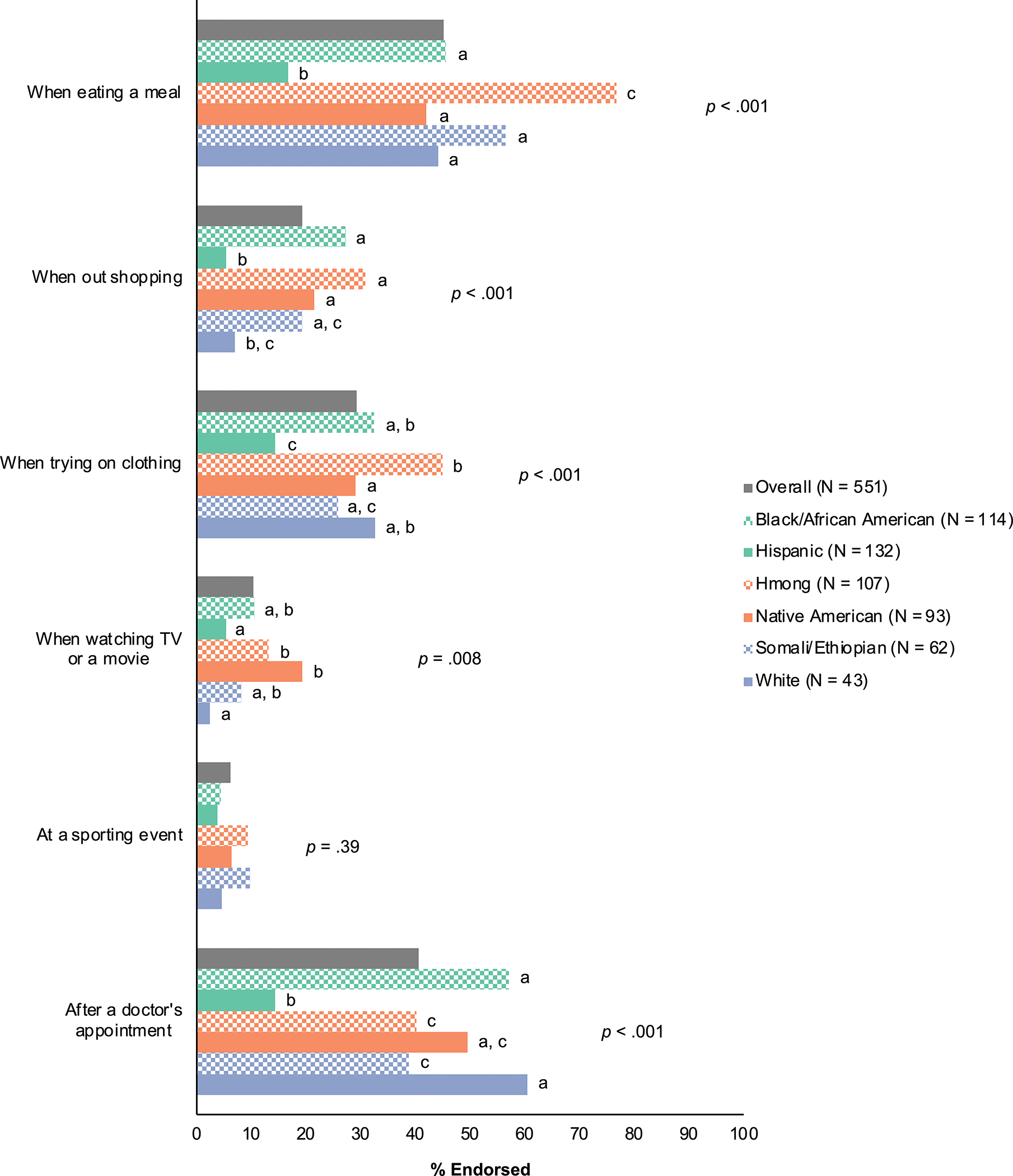
Contextual factors for when parents talk about weight with their children, overall and by household race and ethnicity (p-values represent results of omnibus tests for racial/ethnic differences; each unique letter [a, b, c] indicates a subset of racial/ethnic groups for whom endorsement of weight talk in that context does not differ significantly at p < .05).
Figure 2.
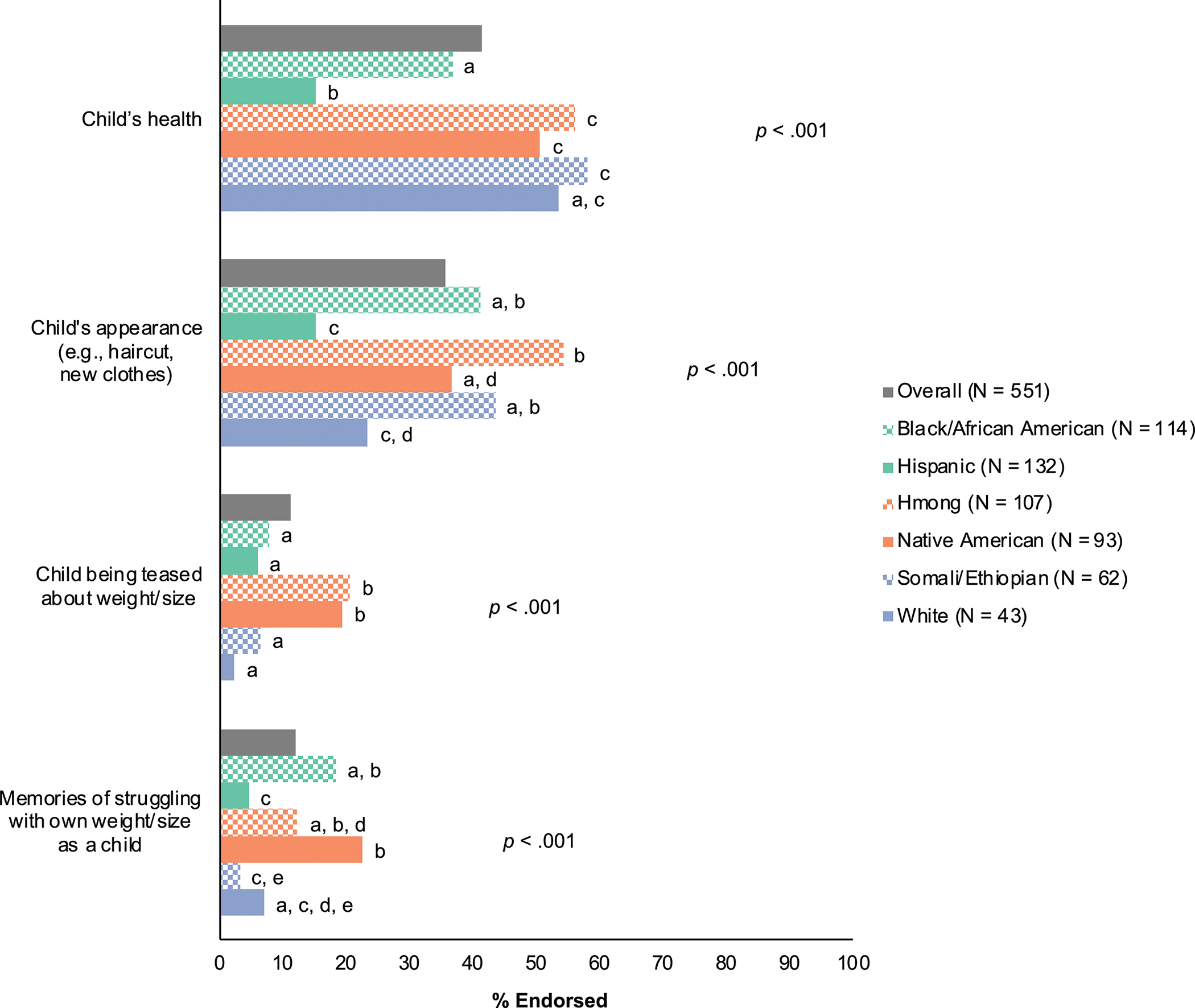
Contextual factors for why parents talk about weight with their children, overall and by household race and ethnicity (p-values represent results of omnibus tests for racial/ethnic differences; each unique letter [a, b, c, d, e] indicates a subset of racial/ethnic groups for whom endorsement of weight talk in that context does not differ significantly at p < .05).
There were significant differences by household race and ethnicity in the prevalence of weight talk contextual factors regarding when parent weight talk occurred (Figure 1). Parents from Hmong households reported significantly higher prevalence of engaging in weight talk with their children when eating a meal together, when trying on clothing, and when out shopping than parents from households of any other race and ethnicity. Parents from African-American and White households reported the highest prevalence of engaging in weight talk with their children after a doctor’s appointment, and parents from Native American households reported the highest prevalence of engaging in weight talk with their children when watching television or a movie.
There were significant differences by household race and ethnicity in the prevalence of weight talk contextual factors regarding why parental weight talk occurred (Figure 2). Parents from Hmong households were most likely to report weight talk being prompted by their child’s appearance and by their child being teased about their weight/size. Parents from Somali/Ethiopian households were most likely to report weight talk being prompted by their child’s health, and those from Native American households were most likely to report weight talk being prompted by memories struggling with their own weight/size as a child.
Greater parent weight talk (measured prospectively) at baseline significantly predicted increased prevalence of children with ≥ 85th BMI percentile (prevalence ratio [PR] = 1.07; 95% confidence interval [CI]: 1.01, 1.12; p = .01) and ≥ 95th BMI percentile (PR = 1.12; 95% CI: 1.04, 1.22; p = .004) 18 months later after adjusting for the respective outcome at baseline, as well as for household race and ethnicity, parent gender, parent age, parent BMI, highest parent educational attainment, parent marital status, child age, child gender, and timing of the follow-up survey in relation to the COVID-19 pandemic (Table III). In addition, greater parent weight talk at baseline predicted significant increases in child conduct problems (B = 0.14; 95% CI: 0.03, 0.26; p = .02) and peer relationship problems (B = 0.18; 95% CI: 0.07, 0.30; p = .002), and significant decreases in prosocial behavior (B = −0.17; 95% CI: −0.32, −0.03; p = .03) 18 months later. In addition, greater parent weight talk (measured prospectively) at baseline predicted improved child diet quality (B = 0.83; 95% CI: 0.19, 1.46; p = .01) 18 months later. No significant longitudinal associations were observed between parental weight talk and child emotional problems or hyperactivity.
Table 3.
Longitudinal associations between parental weight talk with children at baseline and outcomes at 18-month follow-up
| Baseline Parental Weight Talk with Children Predicting Outcomes at 18-Month Follow-Up, Adjusted for Outcome at Baseline | |||
|---|---|---|---|
|
| |||
| Child Weight Outcomes | PR | 95% CI | p |
|
| |||
| ≥ 85th BMI percentile | 1.07 | 1.01, 1.12 | .01 |
| ≥ 95th BMI percentile | 1.12 | 1.04, 1.22 | .004 |
|
| |||
| Child Dietary Intake Outcomes | B | 95% CI | p |
|
| |||
| Diet quality | 0.83 | 0.19, 1.46 | .01 |
|
| |||
| Child Psychosocial Outcomes | B | 95% CI | p |
|
| |||
| Emotional problems | 0.07 | −0.06, 0.20 | .29 |
| Conduct problems | 0.14 | 0.03, 0.26 | .02 |
| Hyperactivity | 0.03 | −0.11, 0.17 | .64 |
| Peer relationship problems | 0.18 | 0.07, 0.30 | .002 |
| Prosocial behavior | −0.17 | −0.32, −0.03 | .03 |
|
| |||
| Food Parenting Practice Outcomes | B | 95% CI | p |
|
| |||
| Parental restrictive feeding | 0.11 | 0.03, 0.20 | .006 |
| Parental pressure-to-eat | 0.03 | −0.03, 0.08 | .30 |
CI = confidence interval; PR = prevalence ratio; BMI = body mass index. Models were adjusted for household race/ethnicity, parent age at baseline, parent gender, parent educational attainment, parent marital status, parent body mass index at baseline, child age at baseline, child gender, whether or not follow-up data were collected during the COVID-19 pandemic, and outcome of interest at baseline. Example interpretation for a B estimate (corresponding to continuous outcome): after adjusting for all covariates, including diet quality at baseline, each one-point increase in baseline scores for parental weight talk with children predicted a significantly better diet quality score at follow-up by 0.83 points on average. Interpretation for PR estimate (corresponding to dichotomous outcome): after adjusting for all covariates, including obesity (i.e., ≥ 95th BMI percentile) at baseline, each one-point increase in baseline scores for parental weight talk with children significantly was associated with, on average, 12% higher prevalence of obesity at follow-up.
A significant association was found between exposure to parent engagement in weight talk (measured prospectively) at baseline and increases in levels of restrictive food parenting practices 18 months later (B = 0.11; 95% CI: 0.03, 0.20; p = .006) (Table III). There was not a significant longitudinal association between parental weight talk and pressure-to-eat.
DISCUSSION
Our findings bolster prior limited findings with children by showing that prospectively measured parent weight talk is longitudinally associated with higher weight status and poorer psychosocial outcomes in children [9,15,18]. Establishing firmer support of this harmful connection between parent weight talk and child weight and psychosocial health provides evidence for interventions to focus on mitigating parent weight talk and for health care clinicians to address parent weight talk in their anticipatory guidance with parents during well-child visits.
Results also extend prior qualitative research by showing the prevalence of contextual factors related to when and why parents engage in weight talk. During a family meal and after a doctor’s appointment were the most prevalent times parents engaged in weight talk. The most common reason why parents engaged in weight talk was concern for their child’s health. These findings are highly useful as they provide potential targets for intervention. For example, physicians who understand that health care visits may promote parent weight talk may be able to intervene before the weight talk occurs by modeling supportive language and health-focused conversations for parents during well-child visits. Health-focused conversations (e.g., emphasizing healthy eating and physical activity to promote strong muscle and bone growth) have been shown to not increase obesity risk or poor diet quality [30]. Given that prior research has shown that family meal frequency is associated with reduced risk for obesity and higher diet quality[59–63] it is important to find ways to help parents avoid engaging in weight talk at family meals to not diminish the protective nature of family meals. In addition, results examining racial/ethnic differences indicate the importance of incorporating these contexts when developing interventions for families. For example, Native American parents may experience an intervention to mitigate weight talk as more salient when eating a family meal, after a doctor’s visit, or watching TV/movie are used as examples of when parental weight talk might occur, and when child’s health or memories of struggling with their own weight or size as a child are presented as reasons why weight talk might occur.
Results also showed significant, prospective associations between parent weight talk and increased child conduct and peer relationship problems and reduced child prosocial behavior. This new finding improves our understanding of the sweeping negative impacts of parental weight talk, which may provide stronger evidence for practitioners who work with parents especially within health care settings and schools to provide resources for parents to not engage in weight talk in the home.
We found significant prospectively measured associations between parent weight talk and food parenting practices, which is a new finding. Prior research has shown that food restriction is associated with child overweight and unhealthy eating behaviors [33–39]. Thus, it is possible that parent weight talk and controlling food parenting practices go hand-in-hand and intervention researchers should consider including weight talk as a key factor when intervening on parenting practices.
Results regarding restrictive feeding practices may also provide insight into our unexpected finding that parental weight talk was associated with more healthful child diet quality. It is possible that parents who engaged in weight talk were more likely to be restrictive with their child’s eating behaviors and thus their child’s dietary intake was more healthful. It is also possible that the measure of child diet quality used in this study was biased because parents reported their child’s dietary intake rather than the child themselves and parents may have reported in a socially desirable way and/or not known what their child ate outside the home. There may also be an unknown factor contributing to the association between parental weight talk and dietary intake that remains unclear.
Our findings also support Family System Theory (FST), in that intergenerational transmission of parent weight talk occurred [24,48,49,64,65]. Specifically, parents who retrospectively reported growing up experiencing encouragement to diet from their own parents were more likely to prospectively report engaging in weight talk with their own child. The harmful effects of weight talk in the form of health and psychosocial wellbeing were passed on to their children. These findings suggest that the negative effects of parent weight talk may be perpetuated over time and impact not only the person directly receiving the messages, but also future generations.
Study results have several implications. Clinicians may want to incorporate resources specific to reducing parent weight talk in their after visit summaries such as the resources available from the Rudd Center: https://uconnruddcenter.org/research/weight-bias-stigma/weightbias-parents/. The knowledge that parent weight talk is transmitted to the next generation and creates home environments that may cultivate unhealthy child weight and psychosocial wellbeing suggests that researchers should consider designing family-based interventions to mitigate parent weight talk. Furthermore, our findings on the contexts of parent weight talk suggest ways that intervention researchers can tailor such interventions or adapt intervention delivery for specific populations to ensure the curriculum is salient to everyone.
Study limitations included the use of self-report survey items that may promote socially desirable answers. In addition, the retrospective nature of the measure assessing parents’ exposure to family weight talk while growing up is a limitation. Considering the similarity in formats of this measure and the measure of parents’ weight talk with their own children, it is possible that parents’ recall of family weight talk they were exposed to while growing up may be biased for congruence with their report of weight talk with their own children. Another limitation is that we only had parent-report of child data. Future studies would benefit from also including child self-report data. In addition, the sample was drawn from one geographic location; thus, generalizing findings to other populations should be done cautiously. Furthermore, as the majority of caregivers in this study were mothers, additional research is needed to examine whether parent weight talk differs by caregiver sex. Future research should also consider pulling apart the terms weight, shape, and size to examine whether they are differentially associated with health outcomes and to test for unique variances.
Health care clinicians may want to use study findings to inform their anticipatory guidance with parents during well-child visits. Additionally, researchers may want to intervene on parent weight talk in family-based interventions aimed at promoting child health.
Supplementary Material


Funding Source:
Research is supported by grant number R01HL126171 and R01HL156994 from the National Heart, Lung, and Blood Institute (PI of both grants: Jerica Berge). Anna Hochgraf was supported by award number T32HL150452 (PI: D. Neumark-Sztainer) from the National Heart, Lung, and Blood Institute of the National Institutes of Health. The content is solely the responsibility of the authors and does not necessarily represent the official views of the National Heart, Lung and Blood Institute or the National Institutes of Health.
Footnotes
Conflict of Interest Disclosures: The authors have no conflicts of interest relevant to this article to disclose.
Availability of data and materials
Deidentified individual participant data (including data dictionaries) used in the current study may be made available when requested from the first author. Proposals should be submitted to Dr. Jerica M. Berge (jberge@umn.edu; jerica.berge@cuanschutz.edu).
Publisher's Disclaimer: This is a PDF file of an unedited manuscript that has been accepted for publication. As a service to our customers we are providing this early version of the manuscript. The manuscript will undergo copyediting, typesetting, and review of the resulting proof before it is published in its final form. Please note that during the production process errors may be discovered which could affect the content, and all legal disclaimers that apply to the journal pertain.
References
- 1.Trofholz AC, Tate AD, Berge JM. An exploration of the frequency, location, and content of parents’ health- and weight-focused conversations with their children and associations with child weight status. Eat Behav. 2018/04/28. 2018;29:137–43. [DOI] [PMC free article] [PubMed] [Google Scholar]
- 2.Lydecker JA, Riley KE, Grilo CM. Associations of parents’ self, child, and other “fat talk” with child eating behaviors and weight. International Journal of Eating Disorders. 2018;51(6). [DOI] [PMC free article] [PubMed] [Google Scholar]
- 3.Berge JM, MacLehose R, Loth K, Eisenberg ME, Bucchianeri MM, Neumark-Sztainer D. Parent conversations about healthful eating and weight. JAMA Pediatr. 2013;167(8):746–53. [DOI] [PMC free article] [PubMed] [Google Scholar]
- 4.Berge JM, Trofholz A, Fong S, Blue L, Neumark-Sztainer D. A qualitative analysis of parents’ perceptions of weight talk and weight teasing in the home environments of diverse low-income children. Body Image [Internet]. 2015;15:8–15. Available from: 10.1016/j.bodyim.2015.04.006 [DOI] [PMC free article] [PubMed] [Google Scholar]
- 5.Berge JM, Hanson-Bradley C, Tate A, Neumark-Sztainer D. Do parents or siblings engage in more negative weight-based talk with children and what does it sound like? A mixed-methods study. Body Image [Internet]. 2016;18:27–33. Available from: http://linkinghub.elsevier.com/retrieve/pii/S1740144515300462 [DOI] [PMC free article] [PubMed] [Google Scholar]
- 6.Simone M, Hazzard VM, Berge JM, Larson N, Neumark-Sztainer D. Associations between weight talk exposure and unhealthy weight control behaviors among young adults: A person-centered approach to examining how much the source and type of weight talk matters. Body Image. 2021;36. [DOI] [PMC free article] [PubMed] [Google Scholar]
- 7.Gillison FB, Lorenc AB, Sleddens EFC, Williams SL, Atkinson L. Can it be harmful for parents to talk to their child about their weight? A meta-analysis. Prev Med (Baltim) [Internet]. 2016;93(2016):135–46. Available from: 10.1016/j.ypmed.2016.10.010 [DOI] [PubMed] [Google Scholar]
- 8.Berge JM, MacLehose R, Loth KA, Eisenberg M, Bucchianeri MM, Neumark-Sztainer D. Parent conversations about healthful eating and weight associations with adolescent disordered eating behaviors. JAMA Pediatr. 2013;167(8):746–53. [DOI] [PMC free article] [PubMed] [Google Scholar]
- 9.Balantekin KN, Savage JS, Marini ME, Birch LL. Parental encouragement of dieting promotes daughters’ early dieting. Appetite [Internet]. 2014;80:190–6. Available from: 10.1016/j.appet.2014.05.016 [DOI] [PMC free article] [PubMed] [Google Scholar]
- 10.Bauer KW, Bucchianeri MM, Neumark-Sztainer D. Mother-reported parental weight talk and adolescent girls’ emotional health, weight control attempts, and disordered eating behaviors. J Eat Disord. 2013;1(1):45. [DOI] [PMC free article] [PubMed] [Google Scholar]
- 11.Berge JM, MacLehose RF, Loth K a., Eisenberg ME, Fulkerson J a., Neumark-Sztainer D. Parent-adolescent conversations about eating, physical activity and weight: prevalence across sociodemographic characteristics and associations with adolescent weight and weight-related behaviors. J Behav Med. 2014;38(1):122–35. [DOI] [PMC free article] [PubMed] [Google Scholar]
- 12.Hanna AC, Bond MJ. Relationships between family conflict, perceived maternal verbal messages, and daughters’ disturbed eating symptomatology. Appetite. 2006;47(2):205–11. [DOI] [PubMed] [Google Scholar]
- 13.Neumark-Sztainer D, Bauer KW, Friend S, Hannan PJ, Story MT, Berge JM. Family weight talk and dieting: How much do they matter for body dissatisfaction and disordered eating behaviors in adolescent girls? Journal of Adolescent Health. 2010;47(3):270–6. [DOI] [PMC free article] [PubMed] [Google Scholar]
- 14.Neumark-Sztainer D, Falkner N, Story M, Perry C, Hannan PJ, Mulert S. Weight-teasing among adolescents: correlations with weight status and disordered eating behaviors. Int J Obes Relat Metab Disord. 2002;26(1):123–31. [DOI] [PubMed] [Google Scholar]
- 15.Eisenberg ME, Neumark-Sztainer D, Haines J, Wall M. Weight-teasing and emotional well-being in adolescents: Longitudinal findings from Project EAT. Journal of Adolescent Health [Internet]. 2006. Jun;38(6):675–83. Available from: http://www.ncbi.nlm.nih.gov/pubmed/16730595 [DOI] [PubMed] [Google Scholar]
- 16.Eisenberg ME, Neumark-Sztainer D, Story M. Associations of weight-based teasing and emotional well-being among adolescents. Arch Pediatr Adolesc Med. 2003;157(8):733–8. [DOI] [PubMed] [Google Scholar]
- 17.Fulkerson J a, Strauss J, Neumark-Sztainer D, Story M, Boutelle K. Correlates of psychosocial well-being among overweight adolescents: the role of the family. J Consult Clin Psychol [Internet]. 2007. Feb;75(1):181–6. Available from: http://www.ncbi.nlm.nih.gov/pubmed/17295578 [DOI] [PubMed] [Google Scholar]
- 18.Davison KK, Deane GD. The consequence of encouraging girls to be active for weight loss. Soc Sci Med. 2010;70(4). [DOI] [PMC free article] [PubMed] [Google Scholar]
- 19.McCormack LA, Laska MN, Gray C, Veblen-Mortenson S, Barr-Anderson D, Story M. Weight-Related teasing in a racially diverse sample of sixth-grade children. J Am Diet Assoc [Internet]. 2011;111(3):431–6. Available from: 10.1016/j.jada.2010.11.021 [DOI] [PubMed] [Google Scholar]
- 20.Van Den Berg P, Neumark-Sztainer D, Eisenberg ME, Haines J. Racial/ethnic differences in weight-related teasing in adolescents. Obesity. 2008;16(SUPPL. 2):3–10. [DOI] [PubMed] [Google Scholar]
- 21.Berge JM, Maclehose R, Loth KA, Eisenberg M, Bucchianeri MM, Neumark-Sztainer D. Parent conversations about healthful eating and weight: associations with adolescent disordered eating behaviors. JAMA Pediatr [Internet]. 2013/06/26. 2013;167(8):746–53. Available from: http://www.ncbi.nlm.nih.gov/pubmed/23797808 [DOI] [PMC free article] [PubMed] [Google Scholar]
- 22.Berge JM, Trofholz A, Fong S, Blue L, Neumark-Sztainer D. A qualitative analysis of parents’ perceptions of weight talk and weight teasing in the home environments of diverse low-income children. Body Image [Internet]. 2015/05/16. 2015;15:8–15. Available from: http://www.ncbi.nlm.nih.gov/pubmed/25978273 [DOI] [PMC free article] [PubMed] [Google Scholar]
- 23.Trofholz A, Hochgraf AK, Tschida L, Berge JM. Understanding Weight Talk in Racially/Ethnically Diverse Homes: A Qualitative Analysis With Parents. Nutr Educ Behav. 2023;55(10):721–33. [DOI] [PMC free article] [PubMed] [Google Scholar]
- 24.Berge JM, Winkler MR, Larson N, Miller J, Haynos AF, Neumark-Sztainer D. Intergenerational transmission of parent encouragement to diet from adolescence into adulthood. Pediatrics. 2018;141(4). [DOI] [PMC free article] [PubMed] [Google Scholar]
- 25.Abdalla S, Buffarini R, Weber AM, Cislaghi B, Costa JC, Menezes AMB, et al. Parent-Related Normative Perceptions of Adolescents and Later Weight Control Behavior: Longitudinal Analysis of Cohort Data From Brazil. Journal of Adolescent Health. 2020;66(1). [DOI] [PMC free article] [PubMed] [Google Scholar]
- 26.Trofholz AC, Tate AD, Berge JM. An exploration of the frequency, location, and content of parents’ health- and weight-focused conversations with their children and associations with child weight status. Eat Behav [Internet]. 2018;29(March):137–43. Available from: 10.1016/j.eatbeh.2018.03.007 [DOI] [PMC free article] [PubMed] [Google Scholar]
- 27.Trofholz A, Tate A, Telke S, Loth K, Buchanan G, Berge J. Associations Between Weight Talk and Biopsychosocial Outcomes in Children from Racially/Ethnically Diverse Households. J Child Fam Stud. 2022;1–13. [DOI] [PMC free article] [PubMed] [Google Scholar]
- 28.Puhl RM, Lessard LM, Foster GD, Cardel MI. A Comprehensive Examination of the Nature, Frequency, and Context of Parental Weight Communication: Perspectives of Parents and Adolescents. Nutrients. 2022;14(8). [DOI] [PMC free article] [PubMed] [Google Scholar]
- 29.Berge JM, Meyer C, Maclehose RF, Crichlow R, Neumark-Sztainer D. All in the family: Correlations between parents’ and adolescent siblings’ weight and weight-related behaviors. Obesity. 2015;23(4). [DOI] [PMC free article] [PubMed] [Google Scholar]
- 30.Berge JM, Trofholz A, Danner C, Brandenburg D, Pusalavidyasagar S, Loth K. Weight- and health-focused conversations in racially/ethnically diverse households with and without a child with overweight/obesity. Stigma Health. 2020; [DOI] [PMC free article] [PubMed] [Google Scholar]
- 31.Pudney E V, Puhl RM, Halgunseth LC, Schwartz MB. Parental Reasons for Engaging in or Avoiding Weight Talk with Children. Childhood Obesity. 2022; [DOI] [PubMed] [Google Scholar]
- 32.Jackson D, Wilkes L, McDonald G. “If I was in my daughter’s body I’d be feeling devastated”: Women’s experiences of mothering an overweight or obese child. Journal of Child Health Care. 2007;11(1). [DOI] [PubMed] [Google Scholar]
- 33.Tschann JM, Martinez SM, Penilla C, Gregorich SE, Pasch LA, de Groat CL, et al. Parental feeding practices and child weight status in Mexican American families: A longitudinal analysis. International Journal of Behavioral Nutrition and Physical Activity. 2015;12(1). [DOI] [PMC free article] [PubMed] [Google Scholar]
- 34.Zhang L, McIntosh WA. Children’s weight status and maternal and paternal feeding practices. Journal of Child Health Care. 2011;15(4). [DOI] [PubMed] [Google Scholar]
- 35.Wardle J, Carnell S. Parental feeding practices and children’s weight. In: Acta Paediatrica, International Journal of Paediatrics. 2007. [DOI] [PubMed] [Google Scholar]
- 36.Schmidt R, Hiemisch A, Kiess W, Hilbert A. Interaction effects of child weight status and parental feeding practices on children’s eating disorder symptomatology. Nutrients. 2019;11(10). [DOI] [PMC free article] [PubMed] [Google Scholar]
- 37.Haycraft E, Goodwin H, Meyer C. Adolescents’ level of eating psychopathology is related to perceptions of their parents’ current feeding practices. Journal of Adolescent Health. 2014;54(2). [DOI] [PubMed] [Google Scholar]
- 38.Bahreynian M, Mozafarian N, Motlagh ME, Qorbani M, Heshmat R, Kelishadi R. Association between parental feeding practices and later body mass index in children and adolescents: The Weight disorder survey of the CASPIAN-IV Study. Med J Nutrition Metab. 2019;12(1). [Google Scholar]
- 39.Wang J, Zhu B, Wu R, Chang YS, Cao Y, Zhu D. Bidirectional Associations between Parental Non-Responsive Feeding Practices and Child Eating Behaviors: A Systematic Review and Meta-Analysis of Longitudinal Prospective Studies. Vol. 14, Nutrients. 2022. [DOI] [PMC free article] [PubMed] [Google Scholar]
- 40.Whitchurch G, Constantine L. System Theory. In Boss P, Doherty WJ, LaRossa R, Schumm WR, Steinmetz SK(eds). In: Sourcebook on Family Theories and Methods: A contextual Approach . Boston, MA: Springer; 1993. p. 325–55. [Google Scholar]
- 41.Cox MJ, Paley B. Families as systems. Annu Rev Psychol. 1997;48(1):243–67. [DOI] [PubMed] [Google Scholar]
- 42.Berge JM, Wall M, Larson N, Loth KA, Neumark-Sztainer D. Family functioning: associations with weight status, eating behaviors, and physical activity in adolescents. Journal of Adolescent Health [Internet]. 2013/01/10. 2013;52(3):351–7. Available from: http://www.ncbi.nlm.nih.gov/pubmed/23299010 [DOI] [PMC free article] [PubMed] [Google Scholar]
- 43.Rhee K Childhood Overweight and the Relationship between Parent Behaviors, Parenting Style, and Family Functioning. Ann Am Acad Pol Soc Sci [Internet]. 2008. Jan 1;615(1):11–37. Available from: 10.1177/0002716207308400 [DOI] [Google Scholar]
- 44.Berge JM, Meyer C, MacLehose RF, Crichlow R, Neumark-Sztainer D. All in the family: correlations between parents’ and adolescent siblings’ weight and weight-related behaviors. Obesity (Silver Spring) [Internet]. 2015/03/31. 2015;23(4):833–9. Available from: http://www.ncbi.nlm.nih.gov/pubmed/25820257 [DOI] [PMC free article] [PubMed] [Google Scholar]
- 45.Pachucki MC, Lovenheim MF, Harding M. Within-Family Obesity Associations: Evaluation of Parent, Child, and Sibling Relationships. Am J Prev Med [Internet]. 2014. Oct 1;47(4):382–91. Available from: 10.1016/j.amepre.2014.05.018 [DOI] [PubMed] [Google Scholar]
- 46.von Bertalanffy L Theoretical Models in Biology and Psychology. In: Theoretical Models and Personality Theory. Durham, NC: Duke University Press; 1952. p. 24–38. [DOI] [PubMed] [Google Scholar]
- 47.Pachucki MC, Lovenheim MF, Harding M. Within-family obesity associations: Evaluation of parent, child, and sibling relationships. Am J Prev Med. 2014;47(4). [DOI] [PubMed] [Google Scholar]
- 48.Fitzgerald M, London-Johnson A, Gallus KL. Intergenerational transmission of trauma and family systems theory: an empirical investigation. J Fam Ther. 2020;42(3). [Google Scholar]
- 49.Priest JB. The science of family systems theory. The Science of Family Systems Theory. 2021. [Google Scholar]
- 50.Berge JM, Trofholz A, Tate AD, Beebe M, Fertig A, Miner MH, et al. Examining unanswered questions about the home environment and childhood obesity disparities using an incremental, mixed-methods, longitudinal study design: The Family Matters study. Contemp Clin Trials. 2017;62. [DOI] [PMC free article] [PubMed] [Google Scholar]
- 51.Birnbaum AS, Lytle LA, Murray DM, Story M, Perry CL, Boutelle KN, et al. Survey Development for Assessing Correlates of Young Adolescents’ Eating. Vol. 26, Am J Health Behav. 2002. [DOI] [PubMed] [Google Scholar]
- 52.Dillman DA, Smyth JD, Christian LM. Internet, Mail and Mixed-Mode Surveys: The Tailored Design Method (REIS N°133. CRÍTICA DE LIBROS). Vol. 133, Reis. Lepkowski; 2011. [Google Scholar]
- 53.Larson N, Neumark-Sztainer D, Harwood EM, Eisenberg ME, Wall MM, Hannan PJ. Do Young Adults Participate in Surveys that Go Green? Int J Child Health Hum Dev [Internet]. 2011;4(2):225–31. Available from: http://www.sph.umn.edu/facstaff/resources/hsrc/ [PMC free article] [PubMed] [Google Scholar]
- 54.Berge JM, Tate A, Trofholz A, Fertig AR, Miner M, Crow S, et al. Momentary parental stress and food-related parenting practices. Pediatrics. 2017;140(6). [DOI] [PMC free article] [PubMed] [Google Scholar]
- 55.Hanley JA, Negassa A, Edwardes MD de B, Forrester JE. Statistical analysis of correlated data using generalized estimating equations: An orientation. Am J Epidemiol. 2003;157(4):364–75. [DOI] [PubMed] [Google Scholar]
- 56.Zou G A Modified Poisson Regression Approach to Prospective Studies with Binary Data. Am J Epidemiol. 2004;159(7). [DOI] [PubMed] [Google Scholar]
- 57.Newsom JT. Basic Longitudinal Analysis Approaches for Continuous and Categorical Variables. In: Longitudinal Data Analysis: A Practical guide for researchers in aging, health, and social sciences 2012. [Google Scholar]
- 58.Bontempo DE, Grouzet FME, Hofer SM. Measurement Issues in the Analysis of Within-Person Change. In: Longitudinal data analysis : a practical guide for researchers in aging, health, and social sciences. 2012. [Google Scholar]
- 59.Berge JM, Wall M, Hsueh TF, Fulkerson J a., Larson N, Neumark-Sztainer D. The protective role of family meals for youth obesity: 10-year longitudinal associations. Journal of Pediatrics. 2015;166(2):296–301. [DOI] [PMC free article] [PubMed] [Google Scholar]
- 60.Berge JM, Miller J, Watts A, Larson N, Loth K, Neumark-Sztainer DR. Intergenerational transmission of family meal patterns from adolescence to parenthood: longitudinal associations with parents’ dietary intake, weight-related behaviours and psychosocial well-being. Public Health Nutr. 2018;21(2):299–308. [DOI] [PMC free article] [PubMed] [Google Scholar]
- 61.Woodruff SJ, Hanning RM. A Review of family meal influence on adolescents’ dietary intake. Vol. 69, Canadian Journal of Dietetic Practice and Research. 2008. p. 14–22. [DOI] [PubMed] [Google Scholar]
- 62.Welsh EM, French SA, Wall M. Examining the Relationship Between Family Meal Frequency and Individual Dietary Intake: Does Family Cohesion Play a Role? J Nutr Educ Behav. 2011. Jul;43(4):229–35. [DOI] [PMC free article] [PubMed] [Google Scholar]
- 63.Trofholz AC, Tate AD, Miner MH, Berge JM. Associations between TV viewing at family meals and the emotional atmosphere of the meal, meal healthfulness, child dietary intake, and child weight status. Appetite. 2017;108. [DOI] [PMC free article] [PubMed] [Google Scholar]
- 64.Van Petegem S, Albert Sznitman G, Darwiche J, Zimmermann G. Putting parental overprotection into a family systems context: Relations of overprotective parenting with perceived coparenting and adolescent anxiety. Fam Process. 2022;61(2). [DOI] [PubMed] [Google Scholar]
- 65.Calatrava M, Martins MV., Schweer-Collins M, Duch-Ceballos C, Rodríguez-González M. Differentiation of self: A scoping review of Bowen Family Systems Theory’s core construct. Vol. 91, Clinical Psychology Review. 2022. [DOI] [PubMed] [Google Scholar]
Associated Data
This section collects any data citations, data availability statements, or supplementary materials included in this article.