



Abstract
Political failure has left the health system in crisis and caused avoidable harm
The NHS is under new management. The Labour Party’s election win on 4 July 2024 marks the end of 14 years of Conservative led governments presiding over the English NHS—from David Cameron’s coalition with the Liberal Democrats in 2010-15 to Rishi Sunak’s stint in Number 10 in 2022-24, with Theresa May, Boris Johnson, and Liz Truss in between. Labour left the Conservatives a vastly improved NHS when it lost office in 2010.1 How do the Conservatives return it in 2024?
NHS performance deteriorated against headline measures since 2010.2 People are waiting longer in emergency departments to get care; longer in corridors for a hospital bed; longer for planned hospital services—like tests, scans, and surgery—and urgent cancer treatment. Covid-19 made things worse, but NHS performance had been declining for several years before the pandemic hit.3 For example, in 2010-11, just 3.9% of patients waited more than four hours in major emergency departments. This grew to 24.6% in 2019-20 and 41.9% in 2023-24.4 Totemic NHS targets—such as at least 92% of patients starting consultant led treatment within 18 weeks of a general practitioner referral—have been routinely missed for nearly a decade. The result is avoidable harm to patients.5
Quality deteriorated in key areas out of the spotlight too.6 For example, the proportion of patients feeling supported to manage chronic conditions has fallen.7 Patients are finding it harder to get general practice appointments and continuity of care with named GPs has worsened.8 9 But the picture is not uniform; some quality indicators showed improvements in the decade before the pandemic, such as aspects of patient safety.10 The overall proportion of NHS trusts with good or outstanding Care Quality Commission ratings for safety increased.10
Yet people see decline. Public satisfaction with the NHS rose from 34% in 1997 to 70% in 2010—the highest ever recorded. Since then, satisfaction has fallen—to 60% in 2019 and an all-time low of 24% in 2023 (fig 1).11 Satisfaction is low across all population groups and supporters of different political parties.
Fig 1.
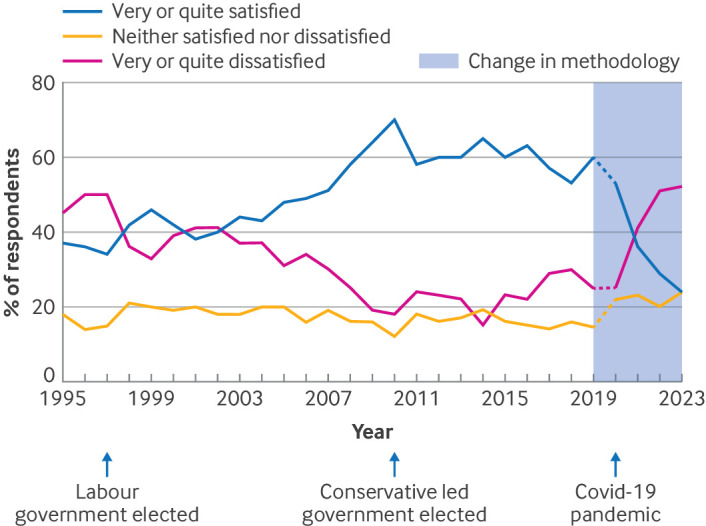
Public satisfaction with the NHS, 1995-202311
What went wrong?
Political choices by the Conservatives in government weakened the NHS and made it harder for staff to deliver a high performing service. A decade of underinvestment going into covid-19 constrained what the NHS could do. Health spending grew by around 2% a year in real terms between 2010 and 2019—well below the long term average in England (3.8% a year since the 1980s).12 Low capital investment left staff working in crumbling buildings, with inadequate equipment and IT.13 It also left the NHS falling behind other health systems. If the UK had matched comparable European countries’ average capital investment in healthcare as a share of gross domestic product (GDP) between 2010 and 2019, the UK would have invested £33bn more (around 55% higher).14 Failures in workforce planning meant the NHS went into the pandemic with fewer doctors and nurses per person than most comparable countries.15 Staff also had to cope with fewer physical resources, such as hospital beds and scanners.15
All this and more sent the NHS into crisis long before covid-19, leaving the health system vulnerable to the pandemic and worsening its impact. The NHS is still in crisis. The elective waiting list is now over 7.5 million, and pressures on emergency care are extreme.2 NHS staff shortages are widespread,16 and only around a third of staff think there are enough people in their organisation to do their job properly.17 Staff are stressed out, burnt out, and feeling the effects of real terms pay cuts since 2010.17 18 19 The long overdue NHS workforce plan published by Sunak’s government in 202320 has not been enough to convince striking NHS doctors that the government understands their value.
Policy failures elsewhere made things worse. Public health budgets have been cut.21 Investment in wider public services that shape health and inequalities has been weak.22 23 England’s threadbare social care system has been underfunded and unreformed.24 A national strategy to reduce England’s vast and growing health inequalities has been shockingly absent, despite a similar strategy being in place and making a difference in the 2000s.25 Brexit has made things harder for the NHS.26
The Conservatives’ approach to health service reform was messy. Despite promising no more top-down reorganisations of the NHS,27 the Conservatives bookended their 14 years in power with two of them, each pulling in different directions. First was the Health and Social Care Act 2012—a mammoth restructure that tried to strengthen competition in the NHS. The result was disruption and fragmentation,28 and a growing gap between the “rules in form” and “rules in use” as health leaders tried to join up local services.29 Fast forward a decade and the Health and Care Act 2022 scrapped key components of the 2012 reforms and many organisations it created, emphasising collaboration to improve care instead.30 Ironically, the NHS now has a structure that has broad support from its leaders.31 But time, energy, and resources have been wasted getting there.
A long line of policy initiatives to integrate health and social care services continued as the tectonic plates shifted—“pioneers,” “vanguards,” and more—but results were mixed and local efforts held back by limited funding and changing policy.32 A combination of policies aimed to improve patient safety after the Francis review, but their effects are hard to gauge and organisational catastrophes recur.33
Time for honesty
The NHS is weakened but not broken. The health service sees millions of people each week—delivering our babies, caring for our parents, treating our friends and colleagues. The number of appointments in general practice is now higher than before the pandemic, despite the number of fully qualified permanent GPs falling since 2015.34 Trends in use of private healthcare provide worrying signs that the social contract underpinning the NHS may be fraying as access to care worsens.35 36 But public support for the NHS’s core principles—available to all, free at the point of use, funded primarily through taxation—remain rock solid.11 The major strengths of the NHS model endure.37
Labour inherits a mess. Other international health systems face similar challenges, such as staff gaps and population ageing. But details on what Labour plan to do about it are—so far—thin. A first step should be honesty with the public about the substantial investment needed to recover NHS services, and the tricky trade-offs this would mean for other areas of public spending and levels of taxation.12
Competing interests: The BMJ has judged that there are no disqualifying financial ties to commercial companies. The author declares no other interests. Further details of The BMJ policy on financial interests are here: https://www.bmj.com/sites/default/files/attachments/resources/2016/03/16-current-bmj-education-coi-form.pdf.
Provenance and peer review: Commissioned; not externally peer reviewed.
References
- 1. Thorlby R, Maybin J, eds. A high performing NHS? A review of progress 1997-2010. King’s Fund, 2010, https://assets.kingsfund.org.uk/f/256914/x/54a86c88b5/high_performing_nhs_2010.pdf. [Google Scholar]
- 2.Nuffield Trust. NHS performance tracker. https://www.nuffieldtrust.org.uk/qualitywatch/nhs-performance-summary
- 3.Appleby J. 10 crucial trends: Quality in the NHS 2009 to 2017. 2017. https://www.nuffieldtrust.org.uk/news-item/10-crucial-trends-quality-in-the-nhs-2009-to-2017#toc-header-2
- 4.NHS England. A&E attendances and emergency admissions. https://www.england.nhs.uk/statistics/statistical-work-areas/ae-waiting-times-and-activity/
- 5. Jones S, Moulton C, Swift S, et al. Association between delays to patient admission from the emergency department and all-cause 30-day mortality. Emerg Med J 2022;39:168-73. 10.1136/emermed-2021-211572 [DOI] [PubMed] [Google Scholar]
- 6.Campbell D. Austerity has led to NHS quality of care declining in key areas, study finds. Guardian 2023 Jul 5. https://www.theguardian.com/society/2023/jul/05/austerity-has-led-to-nhs-quality-of-care-deteriorating-across-the-board-study-finds
- 7.Nuffield Trust. Care and support for long term conditions. https://www.nuffieldtrust.org.uk/resource/care-and-support-for-long-term-conditions
- 8. Levene LS, Baker R, Walker N, Williams C, Wilson A, Bankart J. Predicting declines in perceived relationship continuity using practice deprivation scores: a longitudinal study in primary care. Br J Gen Pract 2018;68:e420-6. 10.3399/bjgp18X696209 [DOI] [PMC free article] [PubMed] [Google Scholar]
- 9.Nuffield Trust. Access to GP appointments and services. https://www.nuffieldtrust.org.uk/resource/access-to-gp-services
- 10.Illingworth J, Shaw A, Fernandez Crespo R, et al. The national state of patient safety: what we know about avoidable harm in England. Imperial College London, 2022. https://www.imperial.ac.uk/media/imperial-college/institute-of-global-health-innovation/National-State-of-Patient-Safety-2022.pdf
- 11. Jeffries D, Wellings D, Morris J, Dayan M, Lobont C. Public satisfaction with the NHS and social care in 2023: results from the British Social Attitudes Survey. King’s Fund, 2024, https://assets.kingsfund.org.uk/f/256914/x/48c40ea52b/public_satisfaction_nhs_social_care_2023_bsa_2024.pdf. [Google Scholar]
- 12.Rocks S, Issa Z, Thorlby R, Douglas HR, Charlesworth A. How much funding does the NHS need over the next decade? Health Foundation, 2024. https://www.health.org.uk/publications/long-reads/how-much-funding-does-the-nhs-need-over-the-next-decade
- 13.Kraindler J, Gershlick B, Charlesworth A. Failing to capitalise? Capital spending in the NHS. Health Foundation, 2019. https://www.health.org.uk/publications/reports/failing-to-capitalise
- 14.Rebolledo I, Charlesworth A. How does UK health spending compare across Europe over the past decade? Health Foundation, 2022. www.health.org.uk/news-and-comment/charts-and-infographics/how-does-uk-health-spending-compare-across-europe-over-the-past-decade
- 15.Anandaciva S. How does the NHS compare to the health care systems of other countries? King’s Fund, 2023. www.kingsfund.org.uk/publications/nhs-compare-health-care-systems-other-countries
- 16.Rolewicz L, Palmer B, Lobont C. The NHS workforce in numbers: facts on staffing and staff shortages in England. Nuffield Trust, 2024. https://www.nuffieldtrust.org.uk/resource/the-nhs-workforce-in-numbers
- 17.NHS Staff Survey. https://www.nhsstaffsurveys.com/results/national-results/
- 18.Beech J, Fraser C, Gardner T, Buzelli L, Williamson S, Alderwick H. Stressed and overworked: what the Commonwealth Fund’s 2022 international health policy survey of primary care physicians in 10 countries means for the UK. Health Foundation, 2023. https://www.health.org.uk/publications/reports/stressed-and-overworked
- 19.Rolewicz L, Dayan M, Palmer B. Pay has fallen in real terms for most NHS staff groups since 2010. Nuffield Trust, 2022. https://www.nuffieldtrust.org.uk/resource/chart-of-the-week-pay-has-fallen-in-real-terms-for-most-nhs-staff-groups-since-2010
- 20.NHS England. NHS long term workforce plan. 2023. https://www.england.nhs.uk/publication/nhs-long-term-workforce-plan/
- 21.Finch D, Gazzillo A, Vriend M. Investing in the public health grant: what it is and why greater investment is needed. Health Foundation, 2024. https://www.health.org.uk/news-and-comment/charts-and-infographics/public-health-grant-what-it-is-and-why-greater-investment-is-needed
- 22.Zaranko B. Spending review 2020: covid-19, Brexit and beyond. Institute for Fiscal Studies, 2020. https://ifs.org.uk/books/spending-review-2020-covid-19-brexit-and-beyond
- 23.Marmot M, Allen J, Boyce T, Goldblatt T, Morrison J. Health equity in England: the Marmot review 10 years on. 2020. www.health.org.uk/publications/reports/the-marmot-review-10-years-on [DOI] [PubMed]
- 24.Allen L, Sameen H, Stevenson G, Tallack C, Alderwick H. Social care funding reform in England: choices for the next government. Health Foundation. 2024. https://www.health.org.uk/publications/long-reads/social-care-funding-reform-in-england
- 25. Holdroyd I, Vodden A, Srinivasan A, Kuhn I, Bambra C, Ford JA. Systematic review of the effectiveness of the health inequalities strategy in England between 1999 and 2010. BMJ Open 2022;12:e063137. 10.1136/bmjopen-2022-063137 [DOI] [PMC free article] [PubMed] [Google Scholar]
- 26.McCarey M, Dayan M, Jarman H, et al. Health and Brexit: six years on. Nuffield Trust, 2022. https://www.nuffieldtrust.org.uk/research/health-and-brexit-six-years-on
- 27.Timmins N. Never again? The story of the Health and Social Care Act 2012. King’s Fund, Institute for Government, 2012. https://assets.kingsfund.org.uk/f/256914/x/d046c0b3d0/never_again_2012.pdf
- 28.Ham C, Baird B, Gregory S, Jabbal J, Alderwick H. The NHS under the coalition government. Part one: NHS reform. King’s Fund, 2015. https://www.kingsfund.org.uk/insight-and-analysis/reports/nhs-under-coalition-government-reform
- 29. Alderwick H. NHS reorganisation after the pandemic. BMJ 2020;371:m4468. 10.1136/bmj.m4468 [DOI] [PubMed] [Google Scholar]
- 30. Alderwick H, Gardner T, Mays N. England’s new health and care bill. BMJ 2021;374:n1767. 10.1136/bmj.n1767 [DOI] [PMC free article] [PubMed] [Google Scholar]
- 31.NHS Confederation. Health and care bill: public bill committee written evidence. 2021. https://www.nhsconfed.org/publications/health-and-care-bill-public-bill-committee-written-evidence
- 32. Lewis RQ, Checkland K, Durand MA, et al. Integrated care in England—what can we learn from a decade of national pilot programmes? Int J Integr Care 2021;21:5. 10.5334/ijic.5631 [DOI] [PMC free article] [PubMed] [Google Scholar]
- 33. Martin G, Stanford S, Dixon-Woods M. A decade after Francis: is the NHS safer and more open? BMJ 2023;380:p513. 10.1136/bmj.p513 [DOI] [PMC free article] [PubMed] [Google Scholar]
- 34.Beech J, Opie-Martin S, Mendelsohn S, Callan C, Keith J, Fisher R. General practice data dashboard: monitoring data on general practice. Health Foundation, https://www.health.org.uk/general-practice-data-dashboard
- 35.Private Healthcare Information Network. PHIN private market update: June 2024 United Kingdom. 2024. https://www.phin.org.uk/news/phin-private-market-update-june-2024-united-kingdom
- 36.National Joint Registry. Hips-all procedures-activity. https://reports.njrcentre.org.uk/hips-all-procedures-activity
- 37. Alderwick H. Rhetoric about NHS reform is misplaced. BMJ 2023;380:p54. 10.1136/bmj.p54 [DOI] [PMC free article] [PubMed] [Google Scholar]