



Abstract
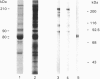
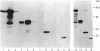
The epitopes of four monoclonal antibodies against coagulation Factor VIII were mapped with the use of recombinant DNA techniques. Full-length Factor VIII cDNA and parts thereof were inserted into the vector pSP64, permitting transcription in vitro with the use of a promoter specific for SP6 RNA polymerase. Factor VIII DNA inserts were truncated from their 3'-ends by selective restriction-enzyme digestion and used as templates for 'run-off' mRNA synthesis. Translation in vitro with rabbit reticulocyte lysate provided defined radiolabelled Factor VIII fragments for immunoprecipitation studies. Two antibodies are shown to be directed against epitopes on the 90 kDa chain of Factor VIII, between residues 712 and 741. The 80 kDa chain appeared to contain the epitopes of the other two antibodies, within the sequences 1649-1778 and 1779-1840 respectively. The effect of antibody binding to these sequences was evaluated at two distinct levels within the coagulation cascade. Both Factor VIII procoagulant activity and Factor VIII cofactor function in Factor Xa generation were neutralized upon binding to the region 1779-1840. The antibodies recognizing the region 713-740 or 1649-1778, though interfering with Factor VIII procoagulant activity, did not inhibit in Factor Xa generation. These findings demonstrate that antibodies that virtually inhibit Factor VIII in coagulation in vitro are not necessarily directed against epitopes involved in Factor VIII cofactor function. Inhibition of procoagulant activity rather than of cofactor function itself may be explained by interference in proteolytic activation of Factor VIII. This hypothesis is in agreement with the localization of the epitopes in the proximity of thrombin-cleavage or Factor Xa-cleavage sites.
Full text
PDF


Images in this article
Selected References
These references are in PubMed. This may not be the complete list of references from this article.
- Andersson L. O., Forsman N., Huang K., Larsen K., Lundin A., Pavlu B., Sandberg H., Sewerin K., Smart J. Isolation and characterization of human factor VIII: molecular forms in commercial factor VIII concentrate, cryoprecipitate, and plasma. Proc Natl Acad Sci U S A. 1986 May;83(9):2979–2983. doi: 10.1073/pnas.83.9.2979. [DOI] [PMC free article] [PubMed] [Google Scholar]
- Bradford M. M. A rapid and sensitive method for the quantitation of microgram quantities of protein utilizing the principle of protein-dye binding. Anal Biochem. 1976 May 7;72:248–254. doi: 10.1016/0003-2697(76)90527-3. [DOI] [PubMed] [Google Scholar]
- Brinkhous K. M., Sandberg H., Garris J. B., Mattsson C., Palm M., Griggs T., Read M. S. Purified human factor VIII procoagulant protein: comparative hemostatic response after infusions into hemophilic and von Willebrand disease dogs. Proc Natl Acad Sci U S A. 1985 Dec;82(24):8752–8756. doi: 10.1073/pnas.82.24.8752. [DOI] [PMC free article] [PubMed] [Google Scholar]
- Burke R. L., Pachl C., Quiroga M., Rosenberg S., Haigwood N., Nordfang O., Ezban M. The functional domains of coagulation factor VIII:C. J Biol Chem. 1986 Sep 25;261(27):12574–12578. [PubMed] [Google Scholar]
- Eaton D. L., Wood W. I., Eaton D., Hass P. E., Hollingshead P., Wion K., Mather J., Lawn R. M., Vehar G. A., Gorman C. Construction and characterization of an active factor VIII variant lacking the central one-third of the molecule. Biochemistry. 1986 Dec 30;25(26):8343–8347. doi: 10.1021/bi00374a001. [DOI] [PubMed] [Google Scholar]
- Eaton D., Rodriguez H., Vehar G. A. Proteolytic processing of human factor VIII. Correlation of specific cleavages by thrombin, factor Xa, and activated protein C with activation and inactivation of factor VIII coagulant activity. Biochemistry. 1986 Jan 28;25(2):505–512. doi: 10.1021/bi00350a035. [DOI] [PubMed] [Google Scholar]
- Fay P. J., Anderson M. T., Chavin S. I., Marder V. J. The size of human factor VIII heterodimers and the effects produced by thrombin. Biochim Biophys Acta. 1986 Jun 23;871(3):268–278. doi: 10.1016/0167-4838(86)90208-6. [DOI] [PubMed] [Google Scholar]
- Foster P. A., Fulcher C. A., Houghten R. A., Zimmerman T. S. An immunogenic region within residues Val1670-Glu1684 of the factor VIII light chain induces antibodies which inhibit binding of factor VIII to von Willebrand factor. J Biol Chem. 1988 Apr 15;263(11):5230–5234. [PubMed] [Google Scholar]
- Foster P. A., Fulcher C. A., Houghten R. A., de Graaf Mahoney S., Zimmerman T. S. Localization of the binding regions of a murine monoclonal anti-factor VIII antibody and a human anti-factor VIII alloantibody, both of which inhibit factor VIII procoagulant activity, to amino acid residues threonine351-serine365 of the factor VIII heavy chain. J Clin Invest. 1988 Jul;82(1):123–128. doi: 10.1172/JCI113559. [DOI] [PMC free article] [PubMed] [Google Scholar]
- Fulcher C. A., Roberts J. R., Holland L. Z., Zimmerman T. S. Human factor VIII procoagulant protein. Monoclonal antibodies define precursor-product relationships and functional epitopes. J Clin Invest. 1985 Jul;76(1):117–124. doi: 10.1172/JCI111933. [DOI] [PMC free article] [PubMed] [Google Scholar]
- Fulcher C. A., Roberts J. R., Zimmerman T. S. Thrombin proteolysis of purified factor viii procoagulant protein: correlation of activation with generation of a specific polypeptide. Blood. 1983 Apr;61(4):807–811. [PubMed] [Google Scholar]
- Fulcher C. A., de Graaf Mahoney S., Roberts J. R., Kasper C. K., Zimmerman T. S. Localization of human factor FVIII inhibitor epitopes to two polypeptide fragments. Proc Natl Acad Sci U S A. 1985 Nov;82(22):7728–7732. doi: 10.1073/pnas.82.22.7728. [DOI] [PMC free article] [PubMed] [Google Scholar]
- Fulcher C. A., de Graaf Mahoney S., Zimmerman T. S. FVIII inhibitor IgG subclass and FVIII polypeptide specificity determined by immunoblotting. Blood. 1987 May;69(5):1475–1480. [PubMed] [Google Scholar]
- Hamer R. J., Koedam J. A., Beeser-Visser N. H., Bertina R. M., Van Mourik J. A., Sixma J. J. Factor VIII binds to von Willebrand factor via its Mr-80,000 light chain. Eur J Biochem. 1987 Jul 1;166(1):37–43. doi: 10.1111/j.1432-1033.1987.tb13480.x. [DOI] [PubMed] [Google Scholar]
- Hultin M. B. Role of human factor VIII in factor X activation. J Clin Invest. 1982 Apr;69(4):950–958. doi: 10.1172/JCI110534. [DOI] [PMC free article] [PubMed] [Google Scholar]
- Jesty J., Silverberg S. A. Kinetics of the tissue factor-dependent activation of coagulation Factors IX and X in a bovine plasma system. J Biol Chem. 1979 Dec 25;254(24):12337–12345. [PubMed] [Google Scholar]
- Kane W. H., Davie E. W. Blood coagulation factors V and VIII: structural and functional similarities and their relationship to hemorrhagic and thrombotic disorders. Blood. 1988 Mar;71(3):539–555. [PubMed] [Google Scholar]
- Laemmli U. K. Cleavage of structural proteins during the assembly of the head of bacteriophage T4. Nature. 1970 Aug 15;227(5259):680–685. doi: 10.1038/227680a0. [DOI] [PubMed] [Google Scholar]
- Leyte A., Verbeet M. P., Brodniewicz-Proba T., Van Mourik J. A., Mertens K. The interaction between human blood-coagulation factor VIII and von Willebrand factor. Characterization of a high-affinity binding site on factor VIII. Biochem J. 1989 Feb 1;257(3):679–683. doi: 10.1042/bj2570679. [DOI] [PMC free article] [PubMed] [Google Scholar]
- Lollar P., Knutson G. J., Fass D. N. Activation of porcine factor VIII:C by thrombin and factor Xa. Biochemistry. 1985 Dec 31;24(27):8056–8064. doi: 10.1021/bi00348a033. [DOI] [PubMed] [Google Scholar]
- Marlar R. A., Griffin J. H. Alternative pathways of thromboplastin-dependent activation of human factor X in plasma. Ann N Y Acad Sci. 1981;370:325–335. doi: 10.1111/j.1749-6632.1981.tb29745.x. [DOI] [PubMed] [Google Scholar]
- Melton D. A., Krieg P. A., Rebagliati M. R., Maniatis T., Zinn K., Green M. R. Efficient in vitro synthesis of biologically active RNA and RNA hybridization probes from plasmids containing a bacteriophage SP6 promoter. Nucleic Acids Res. 1984 Sep 25;12(18):7035–7056. doi: 10.1093/nar/12.18.7035. [DOI] [PMC free article] [PubMed] [Google Scholar]
- Mertens K., Bertina R. M. Activation of human coagulation factor VIII by activated factor X, the common product of the intrinsic and the extrinsic pathway of blood coagulation. Thromb Haemost. 1982 Apr 30;47(2):96–100. [PubMed] [Google Scholar]
- Mertens K., van Wijngaarden A., Bertina R. M. The role of factor VIII in the activation of human blood coagulation factor X by activated factor IX. Thromb Haemost. 1985 Oct 30;54(3):654–660. [PubMed] [Google Scholar]
- Muller H. P., van Tilburg N. H., Derks J., Klein-Breteler E., Bertina R. M. A monoclonal antibody to VIII:C produced by a mouse hybridoma. Blood. 1981 Nov;58(5):1000–1006. [PubMed] [Google Scholar]
- Nunberg J. H., Rodgers G., Gilbert J. H., Snead R. M. Method to map antigenic determinants recognized by monoclonal antibodies: localization of a determinant of virus neutralization on the feline leukemia virus envelope protein gp70. Proc Natl Acad Sci U S A. 1984 Jun;81(12):3675–3679. doi: 10.1073/pnas.81.12.3675. [DOI] [PMC free article] [PubMed] [Google Scholar]
- Osterud B., Rapaport S. I. Activation of 125I-factor IX and 125I-factor X: effect of tissue factor and factor VII, factor Xa and thrombin. Scand J Haematol. 1980 Mar;24(3):213–226. doi: 10.1111/j.1600-0609.1980.tb01329.x. [DOI] [PubMed] [Google Scholar]
- Pennica D., Holmes W. E., Kohr W. J., Harkins R. N., Vehar G. A., Ward C. A., Bennett W. F., Yelverton E., Seeburg P. H., Heyneker H. L. Cloning and expression of human tissue-type plasminogen activator cDNA in E. coli. Nature. 1983 Jan 20;301(5897):214–221. doi: 10.1038/301214a0. [DOI] [PubMed] [Google Scholar]
- Rotblat F., O'Brien D. P., O'Brien F. J., Goodall A. H., Tuddenham E. G. Purification of human factor VIII:C and its characterization by Western blotting using monoclonal antibodies. Biochemistry. 1985 Jul 30;24(16):4294–4300. doi: 10.1021/bi00337a007. [DOI] [PubMed] [Google Scholar]
- Rusconi S., Yamamoto K. R. Functional dissection of the hormone and DNA binding activities of the glucocorticoid receptor. EMBO J. 1987 May;6(5):1309–1315. doi: 10.1002/j.1460-2075.1987.tb02369.x. [DOI] [PMC free article] [PubMed] [Google Scholar]
- Sanger F., Nicklen S., Coulson A. R. DNA sequencing with chain-terminating inhibitors. Proc Natl Acad Sci U S A. 1977 Dec;74(12):5463–5467. doi: 10.1073/pnas.74.12.5463. [DOI] [PMC free article] [PubMed] [Google Scholar]
- Scandella D., DeGraaf Mahoney S., Mattingly M., Roeder D., Timmons L., Fulcher C. A. Epitope mapping of human factor VIII inhibitor antibodies by deletion analysis of factor VIII fragments expressed in Escherichia coli. Proc Natl Acad Sci U S A. 1988 Aug;85(16):6152–6156. doi: 10.1073/pnas.85.16.6152. [DOI] [PMC free article] [PubMed] [Google Scholar]
- Stel H. V., Sakariassen K. S., Scholte B. J., Veerman E. C., van der Kwast T. H., de Groot P. G., Sixma J. J., van Mourik J. A. Characterization of 25 monoclonal antibodies to factor VIII-von Willebrand factor: relationship between ristocetin-induced platelet aggregation and platelet adherence to subendothelium. Blood. 1984 Jun;63(6):1408–1415. [PubMed] [Google Scholar]
- Tetteroo P. A., Lansdorp P. M., Leeksma O. C., von dem Borne A. E. Monoclonal antibodies against human platelet glycoprotein IIIa. Br J Haematol. 1983 Nov;55(3):509–522. doi: 10.1111/j.1365-2141.1983.tb02166.x. [DOI] [PubMed] [Google Scholar]
- Tiarks C., Ghalili K., Humphreys R. E., Goodall A. H., Tuddenham E. G., Pechet L. Identification of six functional clotting factor VIII:C epitopes by analysis of cross-reactive public idiotypes in murine monoclonal VIII:C inhibitors. Thromb Res. 1987 Mar 1;45(5):527–537. doi: 10.1016/0049-3848(87)90315-x. [DOI] [PubMed] [Google Scholar]
- Toole J. J., Knopf J. L., Wozney J. M., Sultzman L. A., Buecker J. L., Pittman D. D., Kaufman R. J., Brown E., Shoemaker C., Orr E. C. Molecular cloning of a cDNA encoding human antihaemophilic factor. Nature. 1984 Nov 22;312(5992):342–347. doi: 10.1038/312342a0. [DOI] [PubMed] [Google Scholar]
- Toole J. J., Pittman D. D., Orr E. C., Murtha P., Wasley L. C., Kaufman R. J. A large region (approximately equal to 95 kDa) of human factor VIII is dispensable for in vitro procoagulant activity. Proc Natl Acad Sci U S A. 1986 Aug;83(16):5939–5942. doi: 10.1073/pnas.83.16.5939. [DOI] [PMC free article] [PubMed] [Google Scholar]
- Veerman E. C., Stel H. V., Huisman J. G., van Mourik J. A. Application of sepharose-linked monoclonal antibodies for the immunoradiometric measurement of factor VIII-procoagulant antigen. Thromb Res. 1984 Jan 1;33(1):89–93. doi: 10.1016/0049-3848(84)90157-9. [DOI] [PubMed] [Google Scholar]
- Vehar G. A., Davie E. W. Preparation and properties of bovine factor VIII (antihemophilic factor). Biochemistry. 1980 Feb 5;19(3):401–410. doi: 10.1021/bi00544a001. [DOI] [PubMed] [Google Scholar]
- Vehar G. A., Keyt B., Eaton D., Rodriguez H., O'Brien D. P., Rotblat F., Oppermann H., Keck R., Wood W. I., Harkins R. N. Structure of human factor VIII. Nature. 1984 Nov 22;312(5992):337–342. doi: 10.1038/312337a0. [DOI] [PubMed] [Google Scholar]
- Veltkamp J. J., Drion E. F., Loeliger E. A. Detection of the carrier state in hereditary coagulation disorders. I. Thromb Diath Haemorrh. 1968 Mar 31;19(1):279–303. [PubMed] [Google Scholar]
- Wade-Evans A., Jenkins J. R. Precise epitope mapping of the murine transformation-associated protein, p53. EMBO J. 1985 Mar;4(3):699–706. doi: 10.1002/j.1460-2075.1985.tb03686.x. [DOI] [PMC free article] [PubMed] [Google Scholar]
- Ware J., Toomey J. R., Stafford D. W. Localization of a factor VIII-inhibiting antibody epitope to a region between residues 338 and 362 of factor VIII heavy chain. Proc Natl Acad Sci U S A. 1988 May;85(9):3165–3169. doi: 10.1073/pnas.85.9.3165. [DOI] [PMC free article] [PubMed] [Google Scholar]
- Wood W. I., Capon D. J., Simonsen C. C., Eaton D. L., Gitschier J., Keyt B., Seeburg P. H., Smith D. H., Hollingshead P., Wion K. L. Expression of active human factor VIII from recombinant DNA clones. Nature. 1984 Nov 22;312(5992):330–337. doi: 10.1038/312330a0. [DOI] [PubMed] [Google Scholar]
- Yanisch-Perron C., Vieira J., Messing J. Improved M13 phage cloning vectors and host strains: nucleotide sequences of the M13mp18 and pUC19 vectors. Gene. 1985;33(1):103–119. doi: 10.1016/0378-1119(85)90120-9. [DOI] [PubMed] [Google Scholar]
- van Dieijen G., Tans G., Rosing J., Hemker H. C. The role of phospholipid and factor VIIIa in the activation of bovine factor X. J Biol Chem. 1981 Apr 10;256(7):3433–3442. [PubMed] [Google Scholar]
- van Ree R., Clemens J. G., Aalbers M., Stapel S. O., Aalberse R. C. Characterization with monoclonal and polyclonal antibodies of a new major allergen from grass pollen in the group I molecular weight range. J Allergy Clin Immunol. 1989 Jan;83(1):144–151. doi: 10.1016/0091-6749(89)90489-2. [DOI] [PubMed] [Google Scholar]
- van Zonneveld A. J., Veerman H., Pannekoek H. Autonomous functions of structural domains on human tissue-type plasminogen activator. Proc Natl Acad Sci U S A. 1986 Jul;83(13):4670–4674. doi: 10.1073/pnas.83.13.4670. [DOI] [PMC free article] [PubMed] [Google Scholar]