



Abstract
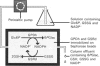
We report the development of a new spectrophotometric assay for 6-phosphogluconolactonase. The labile substrate 6-phosphoglucono-delta-lactone is prepared from glucose 6-phosphate by enzymes co-immobilized on Sepharose beads. The assay has the advantages of high sensitivity for routine determination of enzyme activity and allows determination of both Km and Vmax. from a single assay. A method for estimating the contribution of spontaneous hydrolysis to total hydrolysis is described. This assay overcomes the problems encountered with all previous assays.
Full text
PDF


Images in this article
Selected References
These references are in PubMed. This may not be the complete list of references from this article.
- Bauer H. P., Srihari T., Jochims J. C., Hofer H. W. 6-phosphogluconolactonase. Purification, properties and activities in various tissues. Eur J Biochem. 1983 Jun 1;133(1):163–168. doi: 10.1111/j.1432-1033.1983.tb07442.x. [DOI] [PubMed] [Google Scholar]
- Beutler E., Kuhl W., Gelbart T. 6-Phosphogluconolactonase deficiency, a hereditary erythrocyte enzyme deficiency: possible interaction with glucose-6-phosphate dehydrogenase deficiency. Proc Natl Acad Sci U S A. 1985 Jun;82(11):3876–3878. doi: 10.1073/pnas.82.11.3876. [DOI] [PMC free article] [PubMed] [Google Scholar]
- Beutler E., Kuhl W. Limiting role of 6-phosphogluconolactonase in erythrocyte hexose monophosphate pathway metabolism. J Lab Clin Med. 1985 Nov;106(5):573–577. [PubMed] [Google Scholar]
- Ford J., DeLuca M. A new assay for picomole levels of androsterone and testosterone using Co-immobilized luciferase, oxidoreductase, and steroid dehydrogenase. Anal Biochem. 1981 Jan 1;110(1):43–48. doi: 10.1016/0003-2697(81)90109-3. [DOI] [PubMed] [Google Scholar]
- Mattiasson B., Mosbach K. Assay procedures for immobilized enzymes. Methods Enzymol. 1976;44:335–353. doi: 10.1016/s0076-6879(76)44027-2. [DOI] [PubMed] [Google Scholar]
- Mosbach K., Mattiasson B. Multistep enzyme systems. Methods Enzymol. 1976;44:453–478. doi: 10.1016/s0076-6879(76)44033-8. [DOI] [PubMed] [Google Scholar]
- Orsi B. A., Tipton K. F. Kinetic analysis of progress curves. Methods Enzymol. 1979;63:159–183. doi: 10.1016/0076-6879(79)63010-0. [DOI] [PubMed] [Google Scholar]
- Rudolph F. B., Baugher B. W., Beissner R. S. Techniques in coupled enzyme assays. Methods Enzymol. 1979;63:22–42. doi: 10.1016/0076-6879(79)63004-5. [DOI] [PubMed] [Google Scholar]
- Schofield P. J., Sols A. Rat liver 6-phosphogluconolactonase: a low Km enzyme. Biochem Biophys Res Commun. 1976 Aug 23;71(4):1313–1318. doi: 10.1016/0006-291x(76)90798-1. [DOI] [PubMed] [Google Scholar]
- Storer A. C., Cornish-Bowden A. The kinetics of coupled enzyme reactions. Applications to the assay of glucokinase, with glucose 6-phosphate dehydrogenase as coupling enzyme. Biochem J. 1974 Jul;141(1):205–209. doi: 10.1042/bj1410205. [DOI] [PMC free article] [PubMed] [Google Scholar]
- Wienhausen G., DeLuca M. Bioluminescent assays of picomole levels of various metabolites using immobilized enzymes. Anal Biochem. 1982 Dec;127(2):380–388. doi: 10.1016/0003-2697(82)90191-9. [DOI] [PubMed] [Google Scholar]