



Abstract
Aims:
To provide an overview of the barriers and facilitators to overactive bladder (OAB) therapy initiation and adherence.
Methods:
A PubMed and Embase literature search was conducted to identify barriers to OAB therapy adherence.
Results:
OAB therapy adherence is associated with improvements in urinary symptoms, and quality of life with reductions in annual costs for OAB-related expenditures. However, adherence rates to behavioral therapies are as low as 32% at 1 year, only 15%-40% of treated patients remain on oral medications at 1 year due to several factors (e.g., inadequate efficacy, tolerability, and cost), and 5%–10% of OAB patients progress to advanced therapies. While some common barriers to therapy adherence are often fixed (e.g., costs, lack of efficacy, time, side effects, treatment fatigue), many are modifiable (e.g., lack of knowledge, poor relationships, negative experiences, poor communication with providers). Patient-centered care may help address some modifiable barriers. Emerging data demonstrate that patient-centered care in the form of treatment navigators improves OAB therapy adherence and progression to advanced therapies in the appropriate patient.
Conclusions:
There are numerous modifiable barriers to OAB therapy adherence. A patient-centered lens is needed to elicit patient goals, establish realistic treatment expectations, and tailor therapy to improve therapy adherence, optimize outcomes, and reduce healthcare expenditures. Further research is needed to develop and study low-cost, scalable solutions.
Keywords: behavioral therapy, overactive bladder, patient-centered care, pharmacotherapy, therapy adherence, third-line therapy, urinary incontinence
1 |. INTRODUCTION
Overactive bladder (OAB), characterized by urinary urgency, with or without urgency urinary incontinence (UI), urinary frequency, and nocturia,1 is a chronic debilitating condition that affects over 30 million Americans with health-related quality of life (QOL) and financial consequences.2–4 The negative impact on overall QOL is significant, including sleep disturbances, loss of independence, and diminished work productivity, sexuality, overall perceptions of health, and psychological well-being.5,6 In addition, affected individuals can develop social anxiety and unhealthy coping strategies such as bathroom mapping, extreme fluid restriction, and social isolation. Both prevalence and severity increase with age, affecting up to 30% of people over age 65.7,8 Frail and older OAB individuals are at higher risk for fall-related injuries and fractures, nursing home admission, depression, and social isolation.9,10 Further, annual direct and indirect healthcare costs were estimated to reach $86 billion by 2020 and healthcare-related costs are an estimated 33%–63% higher in individuals suffering from OAB than age-matched controls.11–13
OAB diagnosis and treatment are associated with improvements in urinary symptoms and overall QOL.14 Therapy adherence is the strongest predictor of decreased annual costs for OAB-related expenditures.15 Yet, OAB is underdiagnosed and undertreated with significant financial and health-related consequences.16 This has, in part, prompted the Centers for Medicare and Medicaid Services and other groups17 to recommend annual screening for UI and documentation of a plan of care in affected women over the age of 65. Research funding agencies such as Patient-Centered Outcomes Research Institute, National Institutes of Health, and the Agency for Healthcare Research and Quality continue to invest significant resources to help identify and implement accessible, effective, patient-centered, and evidence-based therapies with tolerable side effect profiles.18
The American Urological Association (AUA) and the Society of Urodynamics, Female Pelvic Medicine and Urogenital Reconstruction (SUFU) published evidence-based clinical guidelines to provide standards for diagnosis and management of OAB in an effort to improve the quality of care received by patients living with this chronic condition.4 The 2019 guideline amendments provide a clinical framework that does not require that every patient goes through each line of treatment in any particular order. Clinicians are encouraged to consider individual patient factors when identifying the best therapy. However, in most cases, the guidelines still recommend proceeding from least invasive to more invasive therapies, starting with behavioral therapy, then adding pharmacotherapy and advanced therapies for refractory cases (Table 1). These therapy recommendations are based on available clinical trial data, many of which report statistically significant changes in objective urinary parameters but do not take out of pocket costs, insurance coverage, or patient satisfaction into account. Consequently, OAB therapy adherence remains a significant barrier to symptom management, QOL improvement, and cost containment. In the following review, we aim to review the barriers to OAB therapy adherence and present the role of patient-centered care.
TABLE 1.
Overactive bladder therapy recommendations with evidence grade, side effects, and level of invasiveness (adapted from the SUFU/AUA OAB Guidelines).4
| Overactive bladder therapies | Evidence gradea | Side effects/morbidity | Level of invasiveness | |
|---|---|---|---|---|
| First-line therapies | • Behavioral therapies include dietary changes, bladder training, pelvic floor muscle training, and bladder control strategies | Standard, Grade B | Low risk | Noninvasive |
| • May combine behavioral therapy with oral pharmacotherapy (combination therapy) | Recommendation, Grade C | |||
|
| ||||
| Second-line therapies | • Oral antimuscarinics or oral Beta-3 Agonists | Standard, Grade B | Moderate | Noninvasive |
| • May combine an antimuscarinic and β3-adrenoceptor agonist for patients refractory to monotherapy (combination therapy) | Standard, Grade B | |||
| • Refractory patients should be evaluated by a specialist | Option, Grade B | |||
|
| ||||
| Third-line therapies | • Intradetrusor Onabotulinum toxinA | Standard, Grade B | Moderate | Minimally invasive |
| • Percutaneous Tibial Nerve Stimulation (PTNS) | Recommendation, Grade C | |||
| • Sacral Neuromodulation (SNM) | Recommendation, Grade C | |||
| • Combination therapy should be approached methodically | Expert opinion | |||
|
| ||||
| Fourth-line therapies | • Bladder augmentation | Expert opinion | High | Invasive |
| • Urinary diversion | ||||
Note: This clinical framework does not require that every patient goes through each line of treatment in order. PTNS can be considered in drug-naïve patients who opt to forego pharmacotherapy.
Grade A: high quality, Grade B: moderate quality, Grade C: low quality. Adapted from SUFU/AUA Guidelines, updated 2019.
2 |. METHODS
In this review of the literature, we conducted electronic English-language literature searches of the PubMed®, and EMBASE® databases from the earliest available date of indexing through October 30, 2021 using the following search terms: PubMed (“Urinary Bladder, Overactive/therapy” [MAJR]) AND (“Medication Adherence” [MeSH] OR “Patient Compliance/psychology” [MAJR] OR Barriers [Text Word]) and Embase: “overactive bladder” AND ((adherence OR “medication adherence” OR “compliance” OR “persistence”) AND “barriers”/exp OR barriers). Additionally, reference lists of identified studies and relevant systematic reviews were assessed to identify additional relevant studies. Studies reporting barriers to OAB therapy were included in the following review.
3 |. OAB THERAPY ADHERENCE
3.1 |. Behavioral therapy adherence
First-line therapy for the management of OAB consists of lifestyle changes (weight loss, dietary and fluid management, smoking cessation, avoidance of constipation), behavioral therapy (bladder training, timed voiding, urgency suppression strategies), and pelvic floor muscle training (PFMT). First-line therapies are considered the least invasive therapy upon which subsequent OAB therapies should be added. The efficacy of fluid management, bladder training strategies, and PFMT is well established in women,19,20 as well as combination behavioral and oral pharmacotherapy.21–24 Elimination of bladder irritants, such as caffeine and carbonated fluids, has been shown to be efficacious but challenging to maintain.25,26 Barriers specific to behavioral therapy include a lack of knowledge regarding bladder training strategies or PFMT (Table 2).27 In a mixed-methods study of OAB patients, only 30% were offered behavioral therapy, bladder training, or PFMT, suggesting persistent variability in care despite widespread dissemination of therapy guidelines across specialties.28,29 Adherence rates to PFMT are higher with supervised PFMT, yet wane over time with self-directed PFMT, with rates as low as 32% at 12 months.29 In a study of 31 women, adherence to home PFMT was dependent on the efficacy and simplicity of the exercise program, personal experiences with PFMT, as well as intrinsic factors (self-awareness or beliefs), and extrinsic factors (professional feedback).30 The largest barriers to adherence are time and remembering to exercise. Therefore, simplified, effective, mutually agreed upon programs with suggestions for incorporating them into daily routines may increase adherence.
TABLE 2.
Barriers to OAB therapy adherence
| General barriers • Unrealistic expectations • Lack of OAB-related knowledge ○ Bladder physiology ○ Rationale for OAB-related diagnostic testing ○ Implications of test results • Personal obligations • Treatment fatigue • Misconceptions regarding OAB chronicity and cure • Overall dissatisfaction with care • Poor communication with providers • Poor rapport with providers • Lack of patient-provider gender concordance • Cost (e.g., out of pocket costs) • Insurance complexities • Access |
| Behavioral therapy • Lack of knowledge regarding bladder training or PFMT • Time constraints • Remembering to exercise • Access to supervised PFMT |
| Pharmacotherapy • Inadequate therapy efficacy • Side effects • Prescription costs • Pill aversion • Perceptions of oral therapy • Engagement with the healthcare professionals • Prioritization of comorbid conditions |
| Advanced therapies • Insufficient office education • Lack of knowledge • Delays in therapy introduction • Misconceptions about treatment options • Negative experiences with prior therapies (e.g., pharmacotherapy) |
Abbreviations: OAB, overactive bladder; PFMT, pelvic floor muscle therapy.
However, access to physical therapists and variations in insurance coverage pose significant challenges to supervised PFMT, while time-limited clinic visits are often insufficient for effective behavioral therapy and bladder training teaching by healthcare providers. In the US healthcare system, these time constraints are compounded by a system that often favors billing for complex medical decision-making and a prescription medication over education and a referral to supervised PFMT.
Patient-centered mobile health (mHealth) applications are being studied to expand access to care, enable self-management, and improve adherence. These generally include instruction on PFMT with visual and audio cues, timers for holding contractions, motivational messaging, and reminders to perform the exercises, while others feature educational modules. A study evaluating the use of one mHealth application demonstrated 69% adherence to the application during the 12-week study period with a clinically significant improvement in urinary symptoms based on validated questionnaires in completers.31 However, a review of 20 PFMT mHealth applications concluded that available mHealth applications are widely variable in quality.32 Ultimately, mobile applications have not been formally compared to self-directed PFMT in clinical trials, and further study is warranted to evaluate whether long-term adherence is also improved.
Group therapy may provide a solution to time-constrained clinic visits and improve access to bladder health education. Among 232 women randomized to a 2-h bladder health class with written and audio materials, statistically significant improvements were observed in voiding diary and 24-h pad test over the 12-month study period.33 Although the projected 3-point difference in International Consultation on Incontinence Questionnaire-Short Form (ICIQ-SF) was not achieved, a statistically significant though clinically modest improvement was observed and importantly, a larger cohort of patients received valuable bladder health education.
3.2 |. Pharmacotherapy adherence
Pharmacotherapy including antimuscarinics and β3-adrenergic agonists may be added as second-line therapy. According to the International Society for Pharmacoeconomics and Outcomes Research, persistence is the duration from initiation to discontinuation of therapy, and adherence is the extent to which a patient follows the prescribed interval and dose of a dosing regimen.34 Pharmacotherapy adherence is well studied. The most widely cited reasons for poor adherence are inadequate effect, poor tolerability, and cost.35,36 Although antimuscarinics are effective at reducing urinary symptoms, up to 85% of treated patients will discontinue them in the first year.15,37,38 When discussing risk, benefits, and goals for adherence to antimuscarinic therapies with patients, clinicians must also consider the potential short-term effects such as delirium, falls, and fractures in addition to the growing body of evidence demonstrating an association between dementia and long-term anticholinergic use.39 Reported adherence rates for β3-adrenergic agonists are modestly higher with approximately 40% remaining on therapy at 1 year.36–38,40 Poor tolerability is a commonly reported barrier for antimuscarinic adherence, compared to cost for β3-adrenergic agonist therapy adherence. Patient attitudes toward medications, support with treatment, and individual patient priorities are important predictors of adherence. Pill aversion, perception of therapy, engagement with healthcare professionals, and prioritization of comorbid conditions are important factors in the discontinuation of oral OAB therapy.41
3.3 |. Advanced therapy (third-line therapy) adherence
Some OAB patients fail behavioral, oral, or combination therapy due to a lack of efficacy, tolerability, or symptom severity. According to the AUA/SUFU guidelines, in the carefully selected patient, advanced therapies such as Percutaneous Tibial Nerve Stimulation (PTNS), OnabotulinumtoxinA (BTX-A), and Sacral Neuromodulation (SNM) can be offered4 and have been shown to objectively improve urinary symptoms in these patients.42–46 While over 80% of symptomatic, medication refractory OAB patients report a willingness to try advanced therapies,47 only 5%–10% of OAB patients progress to advanced therapies.48,49 This large divide between patient preferences and the real-world clinical experience is even greater in vulnerable populations. Commercially insured racial and ethnic minorities were 11% less likely to undergo third-line therapies than their White counterparts when controlling for income and insurance coverage.48 Focus group data have shown that some women abandon medical care and develop individual self-management plans, coping techniques, and management without medications due to dissatisfaction with their overall management and care.27,41 Other unique barriers to advanced therapy initiation include insufficient patient education, lack of knowledge, delays in therapy introduction, and misconceptions about treatment options.50
Improving adherence to advanced therapies presents unique challenges. In a retrospective review of over 400 OAB patients treated with PTNS, 57% progressed to maintenance therapy, yet 40% of these patients discontinued therapy due to logistical reasons and ankle soreness.51 For SNM, studies evaluating true adherence rates are lacking and adherence to SNM therapy is challenging to study. Explant rate is often used as a surrogate; however, these rates do not consider implanted devices that have been turned off or require battery replacement. In a 5-year, prospective, multicenter trial, only 6% of participants required permanent explant due to lack of efficacy or adverse events.44 The authors also reported that 70% of patients continued to experience a benefit after 5 years of therapy. In another study, 80% of women continued use at 5 years.52 However, these findings suggest that up to 20% of patients kept their devices in place without benefit.
In a retrospective study of 128 women with at least 5-year follow-up data after receiving 200 units of intradetrusor BTX-A injection, 30% remained on BTX-A therapy at their last follow-up visit (mean follow-up of 8 years).53 Of the 70% that discontinued treatment, 27% discontinued after the first injection due to inadequate effect and 43% due to tolerability issues with the 200 unit dose (e.g., need for clean intermittent catheterization [CIC], urinary tract infections, pain). Only 2% of patients discontinued treatment after two injections, suggesting good BTX-A therapy adherence when adequate treatment effect and tolerability is achieved with the first treatment. In another study, 81% of patients who continued BTX-A therapy stated that they would consider it a lifelong management option.54 BTX-A is one such therapy that with further study could be tailored to individual patient characteristics to optimize outcomes and improve adherence. The various mechanisms by which BTX-A impacts bladder function both on the sensory afferent and motor efferent nerve fibers present unique opportunities to individualize injection paradigms based on a patient’s age, frailty score, OAB subtype (e.g., OAB-wet vs. OAB-dry), or willingness to perform CIC. However, the data are currently lacking to support the standard use of tailored injection paradigms and further studies are needed.
3.4 |. General barriers to OAB therapy
Individual barriers to OAB therapy include personal obligations, treatment fatigue, negative experiences with prior therapies (e.g., pharmacotherapy tolerability), and time restrictions.50 While efficacy, tolerability, cost, and insurance complexities are fixed barriers to OAB therapy adherence, patient-centered care may be a facilitator of modifiable barriers to therapy adherence.55 In several studies, overall dissatisfaction with care, miscommunication with providers, and poor rapport with providers were significant barriers to OAB care.27,28,41,50,56 Interviewees reported dissatisfaction with the frequency and quality of communication with providers and a lack of understanding. Over 75% of interviewees rated regular communication regarding their OAB as “very important.”28 Lack of gender concordance with providers may also be a barrier to treatment initiation and adherence. Women treated by female providers demonstrate higher OAB-related knowledge skills, while others felt embarrassed and uncomfortable discussing or undergoing therapy with a male provider.28
Fundamentally, many OAB patients have unrealistic treatment expectations with a poor understanding of the chronicity of the condition and the likely need for long-term combination therapy to achieve adequate symptom improvement.55 Further, there is often poor clinician awareness of individual patient treatment goals.
4 |. CHALLENGES OF PROVIDING PATIENT-CENTERED CARE TO IMPROVE OAB THERAPY ADHERENCE
Patient, provider, and consultation level factors are opportunities to individualize care and improve patient engagement, satisfaction, therapy adherence, and outcomes. Mead and Bower’s Patient-Centeredness conceptual framework41 emphasizes the importance of understanding the whole patient, agreeing on management, enhancing the doctor–patient relationship, and being realistic about personal limitations such as the availability of time and resources, while Bandura’s Social Cognitive Theory57 posits that behavioral change (e.g., therapy adherence) is dependent on both internal and external factors58 (Figure 1).
FIGURE 1.
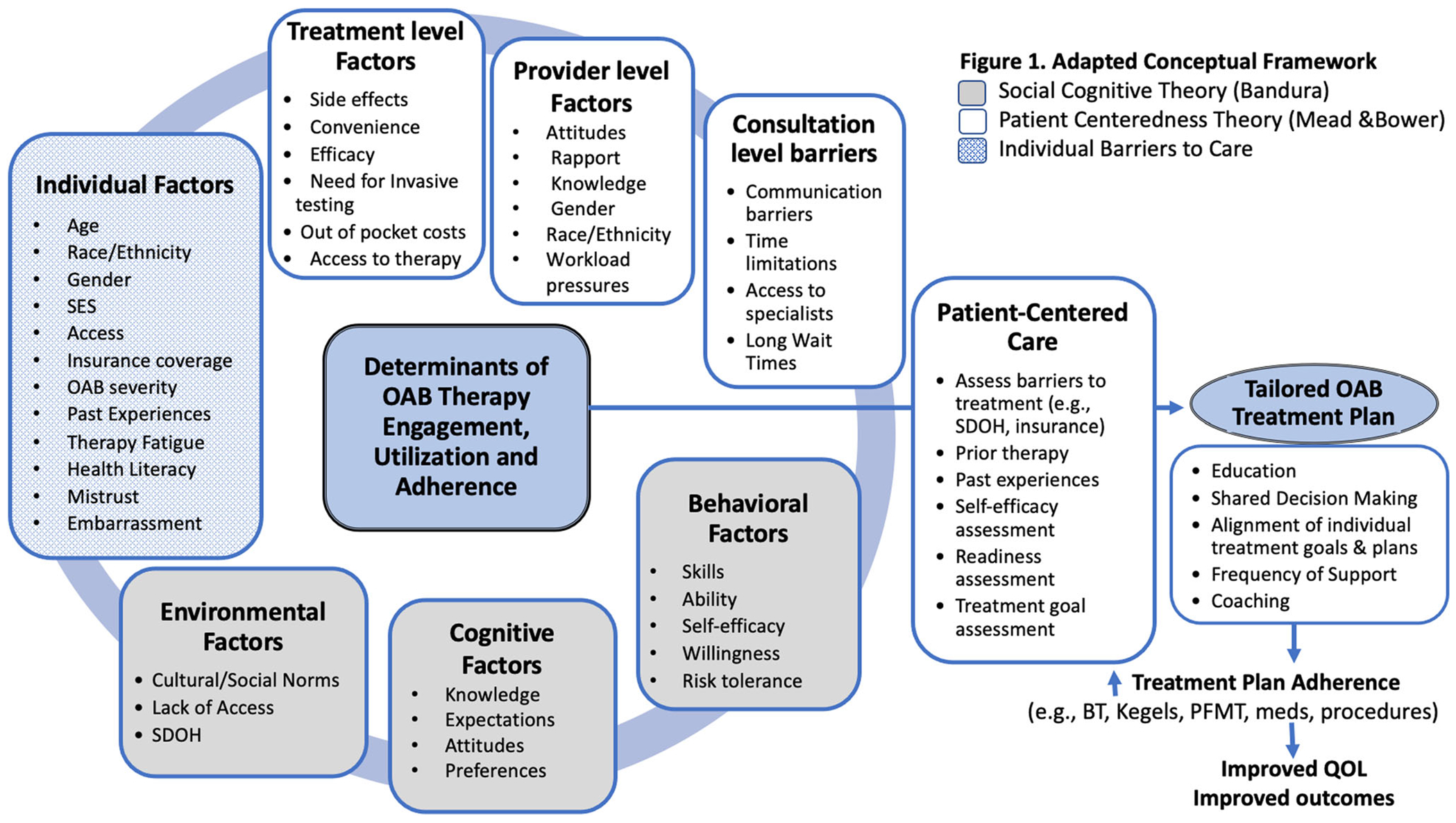
Strategies for improving OAB therapy adherence: an adapted conceptual framework.57,58 BT, bladder training; PFMT, pelvic floor muscle training; QOL, quality of life; SDM, shared decision-making; SDOH, social determinants of health; SES, socioeconomic status.
Patients are more satisfied and more likely to continue therapies and interventions when adequately educated about their medical condition and the potential benefits of treatment.59 In one study, women with OAB reported difficulty understanding their OAB physiology, the rationale for OAB-related diagnostic testing, the implications of their test results, and how they all relate to their treatment options, as barriers to therapy.56 While OAB management begins in the primary care setting, subsequent care for refractory symptoms is managed by urology and urogynecology specialists. Time-constrained office visits and multiple competing medical conditions profoundly limit provider–patient time for education, assessment of patient therapeutic goals, shared decision making, and integration of complex factors needed to formulate a patient-centered treatment plan despite evidence that patient priority-aligned care can be effective at achieving patient goals.60,61 While only 26% of OAB patients are referred to a specialist,62 the demand for specialty care is expected to increase as the population ages, yet lack of access to local providers and limited resources result in long wait times further limiting access to therapy. Finally, our healthcare system does not support seamless, affordable continuity of care from primary care to specialty care, creating additional barriers to patient-centered care.
4.1 |. Opportunities for improvement
Patient-centered care is a critical component of effective management strategies for chronic conditions like OAB that require behavior change and self-efficacy. Strong patient–physician relationships, patient engagement, informed shared decision-making, baseline goal and preference assessment with iterative feedback, and proper support are important tenets of patient-centered care (Figure 1). Collectively, these can improve patient knowledge, access to available therapeutic options, and treatment outcomes. Clinical pathways and guidelines must be applied with a patient-centered lens to achieve their anticipated impact. This approach requires attention to factors that affect adherence, patient outcomes and inform patient preferences, such as sociocultural considerations, risk tolerance, individual treatment goals, self-efficacy, and access.63
Providers need resources and strategies to efficiently assess and encourage adherence through educational and instructional programs, frequent communication with patients to identify shifting barriers to adherence, shared decision making, and mutually agreed-upon treatment plans.
Each OAB treatment option has unique risks, benefits, and success rates (Table 1). For example, first-line therapies are low risk but require behavioral change, self-efficacy, mental/physical effort, time, ability, resources and patience. Second-line therapies require adequate insurance coverage, copays, and tolerance (side effects). Advanced therapies involve minimally invasive procedures that require adequate insurance coverage and access to a specialist. In some cases, OAB therapies may require a willingness to undergo invasive testing (e.g., urodynamics), a weekly time commitment (e.g., PTNS), or a level of risk tolerance (e.g., the need to perform temporary CIC). The relative lack of side effects associated with some therapies may attract some patients, whereas the lack of time commitment may attract others. When faced with multiple choices involving risk, uncertain outcomes, and a need to make tradeoffs, some patients feel decisional conflict and may drop out of therapy prematurely.64 In these preference-sensitive decisions with more than one medically reasonable treatment option, the treatment choice should be based on patient treatment goals, self-efficacy, risk tolerance, and preference during the shared decision-making process to improve patient engagement, adherence, and outcomes.
There is a recognized need for an effective and efficient method of providing patient-centered care in OAB.27,56,65 One such baseline assessment tool is the Self-Assessment Goal Achievement (SAGA).66 This questionnaire features a fixed-goal section in which patients are provided with a list of symptom-based treatment goals, on a scale of 1 (not very important) to 5 (very important), or 0 (not applicable). The open goal section allows patients to provide up to five individual goals and priorities in their own words. The Patient-Identified Most Bothersome Symptom67 may also provide insight into individual patient priorities for symptom management. The Treatment Burden Questionnaire allows clinicians to evaluate competing treatment burdens.61 Individual perceptions of burden are measured using a 15-item questionnaire with composite scores ranging from 0 to 150, where higher scores indicate a greater perceived treatment burden. Finally, baseline assessments of social determinants of health can help identify otherwise undetected barriers.
OAB health education interventions and patient reinforcement improve therapy adherence compared to providing a prescription for oral pharmacotherapy alone.21,68 However, time constraints limit the clinician’s ability to gather these data, educate the patient, engage in effective shared decision-making, and importantly, provide critical ongoing support. Treatment navigators, defined as healthcare professionals focused on supporting patients through the clinical pathway, are one of the potential solutions to this problem. In a recent study, OAB patients with access to treatment navigators were 2.6 times more likely to progress to third-line therapy and 2.2 times more likely to adhere to onabotulinumtoxinA therapy for their refractory OAB symptoms than those without access to a navigator.69 Patients who undergo SNM benefit from preprogrammed devices, which reduce the need for in-office reprogramming. Access to device representatives provides additional support. Together, these supportive measures can improve OAB-related health literacy, access, adherence, and outcomes for all sociodemographic groups,70 including the unique needs of marginalized groups. As a result, these strategies could help address the health equity gap. Finally, multiple methods of home neuromodulation therapy (e.g., wearable, implantable) are being studied with promising results.71 These therapies should reduce time and transportation-related barriers to care and when effective, should also improve adherence.
With more data, baseline comorbidities may help us delineate OAB phenotypes and tailor therapies to improve therapy adherence.72 Up to one-third of OAB patients have comorbid conditions that alter the severity of their symptoms with a strong association between the number of nonurologic chronic illnesses and OAB severity.10,73 This emphasizes the importance of baseline assessments of comorbid conditions and attention to addressing these nonurologic issues to optimize OAB symptom management.
5 |. CONCLUSION
Fixed barriers to OAB therapy present challenges to OAB therapy adherence. Patient-centered approaches to care are important and may help address modifiable barriers to OAB therapy by assessing individual goals, preferences, and barriers to care while providing tailored support to improve therapy adherence and OAB outcomes. Time constraints, access to providers, ongoing support, and supervised care are some notable challenges. Further research is needed to develop and study low-cost, reproducible, and scalable patient-centered approaches to improving OAB therapy adherence and outcomes.
Abbreviations:
- AUA
American Urological Association
- BT
bladder training
- BTX-A
onabotulinumtoxinA
- CIC
clean intermittent catheterization
- CMS
Centers for Medicare and Medicaid Services
- ICIQ-SF
International Consultation on Incontinence Questionnaire-Short Form
- OAB
overactive bladder
- PI-MBS
Patient-Identified Most Bothersome Symptoms
- PTNS
percutaneous tibial nerve stimulation
- PFMT
pelvic floor muscle training
- mHealth
Mobile Health
- QOL
quality of life
- SNM
sacral neuromodulation
- SAGA
self-assessment goal achievement
- SDM
shared decision-making
- SES
socioeconomic status
- SDOH
social determinants of health
- SUFU
Society of Urodynamics, Female Pelvic Medicine and Urogenital Reconstruction
DATA AVAILABILITY STATEMENT
Data sharing is not applicable to this article as no new data were created or analyzed in this study.
REFERENCES
- 1.Haylen BT, de Ridder D, Freeman RM, et al. An International Urogynecological Association (IUGA)/International Continence Society (ICS) joint report on the terminology for female pelvic floor dysfunction. Int Urogynecol J. 2010;21:5–26. [DOI] [PubMed] [Google Scholar]
- 2.Stewart WF, Van Rooyen JB, Cundiff GW, et al. Prevalence and burden of overactive bladder in the United States. World J Urol. 2003;20:327–336. [DOI] [PubMed] [Google Scholar]
- 3.Coyne KS, Sexton CC, Bell JA, et al. The prevalence of lower urinary tract symptoms (LUTS) and overactive bladder (OAB) by racial/ethnic group and age: results from OAB-POLL. Neurourol Urodyn. 2013;32:230–237. [DOI] [PubMed] [Google Scholar]
- 4.Lightner DJ, Gomelsky A, Souter L, Vasavada SP. Diagnosis and treatment of overactive bladder (non-neurogenic) in adults: AUA/SUFU guideline amendment 2019. J Urol. 2019;202(3):558–563. [DOI] [PubMed] [Google Scholar]
- 5.Coyne KS, Sexton CC, Irwin DE, Kopp ZS, Kelleher CJ, Milsom I. The impact of overactive bladder, incontinence and other lower urinary tract symptoms on quality of life, work productivity, sexuality and emotional well-being in men and women: results from the EPIC study. BJU Int. 2008;101:1388–1395. [DOI] [PubMed] [Google Scholar]
- 6.Milsom I, Kaplan SA, Coyne KS, Sexton CC, Kopp ZS. Effect of bothersome overactive bladder symptoms on health-related quality of life, anxiety, depression, and treatment seeking in the United States: results from EpiLUTS. Urology. 2012;80:90–96. [DOI] [PubMed] [Google Scholar]
- 7.Nygaard IE, Lemke JH. Urinary incontinence in rural older women: prevalence, incidence and remission. J Am Geriatr Soc. 1996;44:1049–1054. [DOI] [PubMed] [Google Scholar]
- 8.Irwin DE, Milsom I, Hunskaar S, et al. Population-based survey of urinary incontinence, overactive bladder, and other lower urinary tract symptoms in five countries: results of the EPIC study. Eur Urol. 2006;50:1306–1314 discussion 14-15. [DOI] [PubMed] [Google Scholar]
- 9.Jayadevappa R, Chhatre S, Newman DK, Schwartz JS, Wein AJ. Association between overactive bladder treatment and falls among older adults. Neurourol Urodyn. 2018;37:2688–2694. [DOI] [PubMed] [Google Scholar]
- 10.Lai H, Gardner V, Vetter J, Andriole GL. Correlation between psychological stress levels and the severity of overactive bladder symptoms. BMC Urol. 2015;15:14. [DOI] [PMC free article] [PubMed] [Google Scholar]
- 11.Durden E, Walker D, Gray S, Fowler R, Juneau P, Gooch K. The economic burden of overactive bladder (OAB) and its effects on the costs associated with other chronic, age-related comorbidities in the United States. Neurourol Urodyn. 2018;37:1641–1649. [DOI] [PubMed] [Google Scholar]
- 12.Ganz ML, Smalarz AM, Krupski TL, et al. Economic costs of overactive bladder in the United States. Urology. 2010;75:526–532. [DOI] [PubMed] [Google Scholar]
- 13.Coyne KS, Wein A, Nicholson S, Kvasz M, Chen CI, Milsom I. Economic burden of urgency urinary incontinence in the United States: a systematic review. J Manag Care Pharm. 2014;20:130–140. [DOI] [PMC free article] [PubMed] [Google Scholar]
- 14.Andy UU, Arya LA, Smith AL, et al. Is self-reported adherence associated with clinical outcomes in women treated with anticholinergic medication for overactive bladder? Neurourol Urodyn. 2016;35:738–742. [DOI] [PMC free article] [PubMed] [Google Scholar]
- 15.Sexton CC, Notte SM, Maroulis C, et al. Persistence and adherence in the treatment of overactive bladder syndrome with anticholinergic therapy: a systematic review of the literature. Int J Clin Pract. 2011;65:567–585. [DOI] [PubMed] [Google Scholar]
- 16.Benner JS, Becker R, Fanning K, et al. Bother related to bladder control and health care seeking behavior in adults in the United States. J Urol. 2009;181:2591–2598. [DOI] [PubMed] [Google Scholar]
- 17.Phipps MG, Son S, Zahn C, et al. Women’s preventive services initiative’s well-woman chart: a summary of preventive health recommendations for women. Obstet Gynecol. 2019;134:465–469. [DOI] [PubMed] [Google Scholar]
- 18.Nonsurgical options for women with urinary incontinence. 2021. Accessed August 20, 2021. https://www.pcori.org/funding-opportunities/announcement/nonsurgical-options-women-urinary-incontinence-cycle-2-2021
- 19.Burgio KL, Locher JL, Goode PS, et al. Behavioral vs drug treatment for urge urinary incontinence in older women: a randomized controlled trial. JAMA. 1998;280:1995–2000. [DOI] [PubMed] [Google Scholar]
- 20.Goode PS, Burgio KL, Locher JL, et al. Effect of behavioral training with or without pelvic floor electrical stimulation on stress incontinence in women: a randomized controlled trial. JAMA. 2003;290:345–352. [DOI] [PubMed] [Google Scholar]
- 21.Klutke CG, Burgio KL, Wyman JF, et al. Combined effects of behavioral intervention and tolterodine in patients dissatisfied with overactive bladder medication. J Urol. 2009;181:2599–2607. [DOI] [PubMed] [Google Scholar]
- 22.Wyman JF, Klutke C, Burgio K, et al. Effects of combined behavioral intervention and tolterodine on patient-reported outcomes. Can J Urol. 2010;17:5283–5290. [PubMed] [Google Scholar]
- 23.Mattiasson A, Blaakaer J, Høye K, Wein AJ, Group TSS. Simplified bladder training augments the effectiveness of tolterodine in patients with an overactive bladder. BJU Int. 2003;91:54–60. [DOI] [PubMed] [Google Scholar]
- 24.Burgio KL, Locher JL, Goode PS. Combined behavioral and drug therapy for urge incontinence in older women. J Am Geriatr Soc. 2000;48:370–374. [DOI] [PubMed] [Google Scholar]
- 25.Lohsiriwat S, Hirunsai M, Chaiyaprasithi B. Effect of caffeine on bladder function in patients with overactive bladder symptoms. Urol Ann. 2011;3:14–18. [DOI] [PMC free article] [PubMed] [Google Scholar]
- 26.Miller JM, Garcia CE, Hortsch SB, Guo Y, Schimpf MO. Does instruction to eliminate coffee, tea, alcohol, carbonated, and artificially sweetened beverages improve lower urinary tract symptoms? a prospective trial. J Wound Ostomy Continence Nurs. 2016;43:69–79. [DOI] [PMC free article] [PubMed] [Google Scholar]
- 27.Anger JT, Nissim HA, Le TX, et al. Women’s experience with severe overactive bladder symptoms and treatment: insight revealed from patient focus groups. Neurourol Urodyn. 2011;30:1295–1299. [DOI] [PMC free article] [PubMed] [Google Scholar]
- 28.Filipetto FA, Fulda KG, Holthusen AE, McKeithen TM, McFadden P. The patient perspective on overactive bladder: a mixed-methods needs assessment. BMC Fam Pract. 2014;15:96. [DOI] [PMC free article] [PubMed] [Google Scholar]
- 29.Borello-France D, Burgio KL, Goode PS, et al. Adherence to behavioral interventions for urge incontinence when combined with drug therapy: adherence rates, barriers, and predictors. Phys Ther. 2010;90:1493–1505. [DOI] [PMC free article] [PubMed] [Google Scholar]
- 30.Navarro-Brazález B, Vergara-Pérez F, Prieto-Gómez V, Sánchez-Sánchez B, Yuste-Sánchez MJ, Torres-Lacomba M. What influences women to adhere to pelvic floor exercises after physiotherapy treatment? A qualitative study for individualized pelvic health care. J Pers Med. 2021;11:1368. [DOI] [PMC free article] [PubMed] [Google Scholar]
- 31.Goode PS, Markland AD, Echt KV, et al. A mobile telehealth program for behavioral treatment of urinary incontinence in women veterans: development and pilot evaluation of MyHealtheBladder. Neurourol Urodyn. 2020;39:432–439. [DOI] [PubMed] [Google Scholar]
- 32.Ho L, Macnab A, Matsubara Y, Peterson K, Tsang B, Stothers L. Rating of pelvic floor muscle training mobile applications for treatment of urinary incontinence in women. Urology. 2021;150:92–98. [DOI] [PubMed] [Google Scholar]
- 33.Diokno AC, Newman DK, Low LK, et al. Effect of group-administered behavioral treatment on urinary incontinence in older women: a randomized clinical trial. JAMA Intern Med. 2018;178:1333–1341. [DOI] [PMC free article] [PubMed] [Google Scholar]
- 34.Cramer JA, Roy A, Burrell A, et al. Medication compliance and persistence: terminology and definitions. Value Health. 2008;11:44–47. [DOI] [PubMed] [Google Scholar]
- 35.Balkrishnan R, Bhosle MJ, Camacho FT, Anderson RT. Predictors of medication adherence and associated health care costs in an older population with overactive bladder syndrome: a longitudinal cohort study. J Urol. 2006;175:1067–1071 discussion 71-72. [DOI] [PubMed] [Google Scholar]
- 36.Wagg A, Franks B, Ramos B, Berner T. Persistence and adherence with the new beta-3 receptor agonist, mirabegron, versus antimuscarinics in overactive bladder: early experience in Canada. Can Urol Assoc J. 2015;9:343–350. [DOI] [PMC free article] [PubMed] [Google Scholar]
- 37.Song YS, Lee HY, Park JJ, Kim JH. Persistence and adherence of anticholinergics and beta-3 agonist for the treatment of overactive bladder: systematic review and meta-analysis, and network meta-analysis. J Urol. 2021;205:1595–604. [DOI] [PubMed] [Google Scholar]
- 38.Yeowell G, Smith P, Nazir J, Hakimi Z, Siddiqui E, Fatoye F. Real-world persistence and adherence to oral antimuscarinics and mirabegron in patients with overactive bladder (OAB): a systematic literature review. BMJ Open. 2018;8:e021889. [DOI] [PMC free article] [PubMed] [Google Scholar]
- 39.Dmochowski RR, Thai S, Iglay K, et al. Increased risk of incident dementia following use of anticholinergic agents: a systematic literature review and meta-analysis. Neurourol Urodyn. 2021;40:28–37. [DOI] [PMC free article] [PubMed] [Google Scholar]
- 40.Chapple CR, Nazir J, Hakimi Z, et al. Persistence and adherence with mirabegron versus antimuscarinic agents in patients with overactive bladder: a retrospective observational study in UK clinical practice. Eur Urol. 2017;72:389–99. [DOI] [PubMed] [Google Scholar]
- 41.Ali M, Grogan S, Powell S, et al. Qualitative analysis of factors influencing patient persistence and adherence to prescribed overactive bladder medication in UK primary care. Adv Ther. 2019;36:3110–3122. [DOI] [PMC free article] [PubMed] [Google Scholar]
- 42.Amundsen CL, Richter HE, Wallace D, Network PFD. OnabotulinumtoxinA vs sacral neuromodulation for urgency incontinence-reply. JAMA. 2017;317:535–536. [DOI] [PMC free article] [PubMed] [Google Scholar]
- 43.Nitti VW, Dmochowski R, Herschorn S, et al. onabotulinumtoxina for the treatment of patients with overactive bladder and urinary incontinence: results of a phase 3, randomized, placebo controlled trial. J Urol. 2017;197:S216–S223. [DOI] [PubMed] [Google Scholar]
- 44.van Kerrebroeck PE, van Voskuilen AC, Heesakkers JP, et al. Results of sacral neuromodulation therapy for urinary voiding dysfunction: outcomes of a prospective, worldwide clinical study. J Urol. 2007;178:2029–2034. [DOI] [PubMed] [Google Scholar]
- 45.Peters KM, Carrico DJ, Perez-Marrero RA, et al. Randomized trial of percutaneous tibial nerve stimulation versus Sham efficacy in the treatment of overactive bladder syndrome: results from the SUmiT trial. J Urol. 2010;183:1438–1443. [DOI] [PubMed] [Google Scholar]
- 46.Peters KM, Macdiarmid SA, Wooldridge LS, et al. Randomized trial of percutaneous tibial nerve stimulation versus extended-release tolterodine: results from the overactive bladder innovative therapy trial. J Urol. 2009;182:1055–1061. [DOI] [PubMed] [Google Scholar]
- 47.Hashim H, Beusterien K, Bridges JF, Amos K, Cardozo L. Patient preferences for treating refractory overactive bladder in the UK. Int Urol Nephrol. 2015;47:1619–1627. [DOI] [PubMed] [Google Scholar]
- 48.Syan R, Zhang CA, Enemchukwu EA. Racial and socioeconomic factors influence utilization of advanced therapies in commercially insured OAB patients: an analysis of over 800,000 OAB patients. Urology. 2020;142:81–86. [DOI] [PubMed] [Google Scholar]
- 49.Moskowitz D, Adelstein SA, Lucioni A, Lee UJ, Kobashi KC. Use of third line therapy for overactive bladder in a practice with multiple subspecialty providers—are we doing enough? J Urol. 2018;199:779–784. [DOI] [PubMed] [Google Scholar]
- 50.Davenport A, Stark S, Quian A, Sheyn D, Mangel J. A patient-centered approach to refractory overactive bladder and barriers to third-line therapy. Obstet Gynecol. 2019;134:141–148. [DOI] [PubMed] [Google Scholar]
- 51.Te Dorsthorst MJ, Heesakkers JPFA, van Balken MR. Long-term real-life adherence of percutaneous tibial nerve stimulation in over 400 patients. Neurourol Urodyn. 2020;39:702–706. [DOI] [PMC free article] [PubMed] [Google Scholar]
- 52.Groen J, Blok BF, Bosch JL. Sacral neuromodulation as treatment for refractory idiopathic urge urinary incontinence: 5-year results of a longitudinal study in 60 women. J Urol. 2011;186:954–959. [DOI] [PubMed] [Google Scholar]
- 53.Marcelissen TA, Rahnama’i MS, Snijkers A, Schurch B, De Vries P. Long-term follow-up of intravesical botulinum toxin-A injections in women with idiopathic overactive bladder symptoms. World J Urol. 2017;35:307–311. [DOI] [PubMed] [Google Scholar]
- 54.Malde S, Dowson C, Fraser O, et al. Patient experience and satisfaction with Onabotulinumtoxin A for refractory overactive bladder. BJU Int. 2015;116:443–449. [DOI] [PubMed] [Google Scholar]
- 55.Garnett S, Swithinbank L, Ellis-Jones J, Abrams P. The long-term natural history of overactive bladder symptoms due to idiopathic detrusor overactivity in women. BJU Int. 2009;104:948–953. [DOI] [PubMed] [Google Scholar]
- 56.Smith AL, Nissim HA, Le TX, et al. Misconceptions and miscommunication among aging women with overactive bladder symptoms. Urology. 2011;77:55–59. [DOI] [PMC free article] [PubMed] [Google Scholar]
- 57.Bandura A. Self-efficacy: toward a unifying theory of behavioral change. Psychol Rev. 1977;84:191–215. [DOI] [PubMed] [Google Scholar]
- 58.Mead N, Bower P. Patient-centredness: a conceptual framework and review of the empirical literature. Soc Sci Med. 2000;51:1087–1110. [DOI] [PubMed] [Google Scholar]
- 59.Gold DT, McClung B. Approaches to patient education: emphasizing the long-term value of compliance and persistence. Am J Med. 2006;119:S32–S37. [DOI] [PubMed] [Google Scholar]
- 60.Légaré F, Ratté S, Gravel K, Graham ID. Barriers and facilitators to implementing shared decision-making in clinical practice: update of a systematic review of health professionals’ perceptions. Patient Educ Couns. 2008;73:526–535. [DOI] [PubMed] [Google Scholar]
- 61.Tinetti ME, Naik AD, Dindo L, et al. Association of patient priorities-aligned decision-making with patient outcomes and ambulatory health care burden among older adults with multiple chronic conditions: a nonrandomized clinical trial. JAMA Intern Med. 2019;179(12):1688–1697. [DOI] [PMC free article] [PubMed] [Google Scholar]
- 62.Linder BJ, Gebhart JB, Elliott DS, Van Houten HK, Sangaralingham LR, Habermann EB. National patterns of filled prescriptions and third-line treatment utilization for privately insured women with overactive bladder. Female Pelvic Med Reconstr Surg. 2021;27:e261–e266. [DOI] [PubMed] [Google Scholar]
- 63.Egbrink MO, IJzerman M. The value of quantitative patient preferences in regulatory benefit-risk assessment. J Mark Access Health Policy. 2014;2. doi: 10.3402/jmahp.v2.22761 [DOI] [PMC free article] [PubMed] [Google Scholar]
- 64.O’Connor AM. Validation of a decisional conflict scale. Med Decis Making. 1995;15:25–30. [DOI] [PubMed] [Google Scholar]
- 65.Shah S, Nitti VW. Defining efficacy in the treatment of overactive bladder syndrome. Rev Urol. 2009;11:196–202. [PMC free article] [PubMed] [Google Scholar]
- 66.Khullar V, Espuna-Pons M, Marschall-Kehrel D, et al. Clinical value of a patient-reported goal-attainment measure: the global development of self-assessment goal achievement (SAGA) questionnaire for patients with lower urinary tract symptoms. Neurourol Urodyn. 2014;33:90–94. [DOI] [PubMed] [Google Scholar]
- 67.Sand PK, Steers WD, Dmochowski R, Andoh M, Forero-Schwanhaeuser S. Patient-reported most bothersome symptoms in OAB: post hoc analysis of data from a large, open-label trial of solifenacin. Int Urogynecol J Pelvic Floor Dysfunct. 2009;20:667–675. [DOI] [PubMed] [Google Scholar]
- 68.Herschorn S, Becker D, Miller E, Thompson M, Forte L. Impact of a health education intervention in overactive bladder patients. Can J Urol. 2004;11:2430–2437. [PubMed] [Google Scholar]
- 69.Enemchukwu E, Miles-Thomas J, Syan R, et al. Treatment navigator impact on utilization of onabotulinumtoxinA as third-line treatment in overactive bladder: a retrospective database study in the United States. International Continence Society Annual Conference; 2021; Melbourne, Australia. [Google Scholar]
- 70.U.S. Department of Health and Human Services. Office of Disease Prevention and Health Promotion. National action plan to improve health literacy. 2010. Accessed August 22, 2020. https://health.gov/sites/default/files/2019-09/Health_Literacy_Action_Plan.pdf
- 71.Yamashiro J, de Riese W, de Riese C. New implantable tibial nerve stimulation devices: review of published clinical results in comparison to established neuromodulation devices. Res Rep Urol. 2019;11:351–357. [DOI] [PMC free article] [PubMed] [Google Scholar]
- 72.Peyronnet B, Mironska E, Chapple C, et al. A comprehensive review of overactive bladder pathophysiology: on the way to tailored treatment. Eur Urol. 2019;75:988–1000. [DOI] [PubMed] [Google Scholar]
- 73.Lai HH, Vetter J, Jain S, Andriole GL. Systemic nonurological symptoms in patients with overactive bladder. J Urol. 2016;196:467–472. [DOI] [PMC free article] [PubMed] [Google Scholar]
Associated Data
This section collects any data citations, data availability statements, or supplementary materials included in this article.
Data Availability Statement
Data sharing is not applicable to this article as no new data were created or analyzed in this study.