


Figure 3.
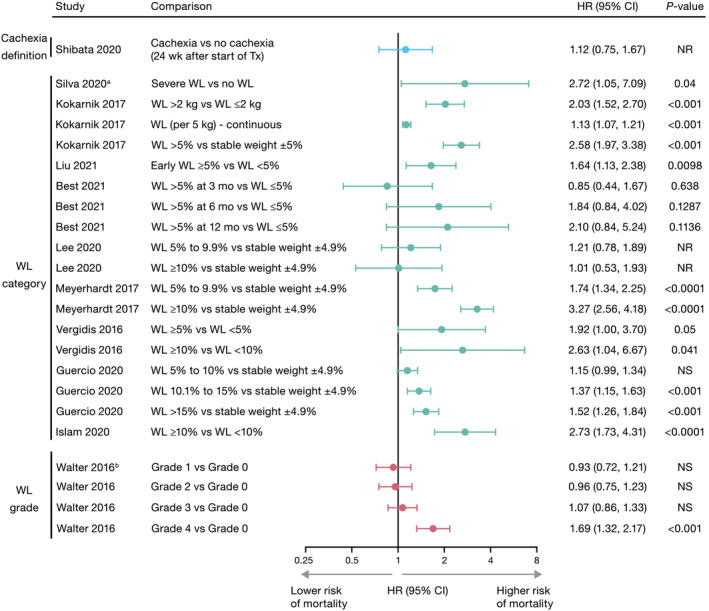
Association between cachexia or weight loss and overall survival from multivariate analyses in colorectal cancer studies. Of the 12 multivariate analyses in studies on colorectal cancer, 11 studies are shown: The remaining study (Gannavarapu et al., 2018 20 ) did not report an HR, but identified a significant association between WL ≥ 5% and worse survival. Overall, nine studies using multivariate analyses showed that for at least one category assessed, cachexia or WL was associated with a statistically significant poorer survival in patients with colorectal cancer. The 1 univariate analysis (Karabulut et al., 2021 39 ) showed no difference in survival for WL > 10% versus <10%. Studies have been grouped by cachexia definition, WL category, and WL grade. aHR was inversed to present severe WL versus no WL (reference category). bGrade 0: BMI ≥ 25 and WL < 2.5%; Grade 1: BMI 20 to <25 and WL < 2.5% or BMI ≥ 28 and WL 2.5% to <6%; Grade 2: BMI 20 to <28 and WL 2.5% to <6% or BMI ≥ 28 and WL 6% to <11%; Grade 3: BMI < 20 and WL < 6% or BMI 20 to <28 and WL 6% to <11%; Grade 4: BMI < 20 and WL ≥ 6% or BMI 20 to <22 and WL ≥ 11% or BMI 22 to <28 and WL ≥ 15%. Data are shown on a log2 scale. BMI, body mass index; CI, confidence interval; HR, hazard ratio; mo, months; NR, not reported; NS, not significant; Tx, treatment; wks, weeks; WL, weight loss.