



Abstract
Replacing petrochemicals with refined waste biomass as a sustainable chemical source has become an attractive option to lower global carbon emissions. Popular methods of refining lignocellulosic waste biomass use thermochemical processes, which have significant environmental downsides. Using electrochemistry instead would overcome many of these downsides, directly driving chemical reactions with renewable electricity and revolutionizing the way many chemicals are produced today. This review mainly focuses on two furanic platform chemicals that are produced from the dehydration of cellulose, 5-hydroxymethylfurfural and furfural, which can be electrochemically reduced or oxidized to replace fuels and monomers that today are obtained from petrochemicals. Critical parameters such as electrode materials and electrolyte pH are discussed in relation to their influence on conversion efficiency and product distribution.
This article is part of the discussion meeting issue ‘Green carbon for the chemical industry of the future’.
Keywords: electrochemistry, electrovalorization, biomass, platform chemicals
1. Introduction
At present, many chemicals that are used in everyday life are sourced from petrochemicals. These include fuels, pharmaceuticals, adhesives and polymers [1,2]. The refinement of crude oil and the subsequent use of petrochemical products are associated with greenhouse gas emissions, which result in well-publicized detrimental impacts on the Earth’s climate [3]. The climate crisis has highlighted the urgent need to phase out fossil fuels if humanity is to avoid a climate catastrophe, by keeping global temperature rises below 2.0°C to prevent non-reversible negative effects on the environment [4]. The only certain way to achieve this is to stop extracting fossil fuels completely; however, this will require us to find an alternative source of chemicals.
Biomass can provide us with chemicals that can replace the ones we obtain from crude oil [5]. Carbon feedstocks obtained from biomass are more oxygenated than fossil fuel-sourced carbon, meaning the synthesis of oxygen-containing commodity chemicals requires fewer processing steps. About 170 billion metric tonnes of biomass is produced each year by photosynthesis, with about 75% of this consisting of carbohydrates, yet only 3–4% of this is used by humans for food and other uses [6]. Of course, not all of this biomass is readily and sustainably available, but this upper bound is clearly a vastly greater amount of carbon in comparison with the approximately 5.25 billion metric tonnes of crude oil extracted annually [7]. As a lower bound to available biomass, consider that global agricultural waste is estimated at 6.3 billion dry metric tonnes per year [8] and that global annual municipal waste, 60% of which is biomass [9], totals more than 2 billion metric tonnes per year [10]. It is estimated that around 7 billion metric tonnes of biomass are needed to satisfy bioenergy demands for future net zero scenarios based on the numbers estimated by the International Energy Agency [11]. The potential to eliminate reliance on petroleum by utilizing available biomass is clear.
Lignocellulosic biomass can be extracted from municipal biomass waste and is made up of a combination of hemicellulose (15–30%), cellulose (40–50%) and lignin (15–30%) [12]. Hemicellulose and cellulose are biopolymers consisting of five- and six-ring-membered carbohydrate monomers, which can be hydrolyzed into monosaccharides including glucose, xylose and mannose [13]. Further dehydrations produce useful furanic (C5–6 chemicals containing a furan ring) and straight-chain ‘platform chemicals’, which are defined here as chemicals that can undergo a variety of chemical reactions to produce even higher valued chemicals. Platform chemicals include furanic compounds including furfural and 5-hydroxymethylfurfural (HMF), as well as straight-chain platform chemicals such as levulinic acid (LA) and ethylene glycol (EG). The annual production of some of the platform chemicals is denoted in figure 1. In this figure, we depict an estimation of the potential annual production of HMF based on the annual production of terephthalic acid (TPA), due to one of the products of HMF oxidation being a direct replacement of TPA in polyethylene terephthalate (PET), which will be discussed later in this section. While this may not be completely accurate, it still highlights the scale of the untapped market of furanic platform chemicals in the near future.
Figure 1.

Annual production of biomass and crude oil feedstock, compared with annual production of the platform chemicals EG, furfural and LA. Data points were extracted from references [5–7,14–16].
In an ideal future scenario for a greener world, the plethora of chemicals that are currently sourced from crude oil refineries are instead derived from biomass, creating a ‘biorefinery’. This concept was developed during the late 1990s and is currently defined by the US Department of Energy as a processing plant where biomass feedstock is upgraded into a spectrum of valuable products [17]. The biorefinery encompasses many novel organic chemical reactions, processes, technologies and catalysts needed to synthesize chemicals that can replace petrochemicals.
Novel reactions in the biorefinery utilizing electrochemistry can be used to replace the thermochemical synthesis for biomass-derived platform chemicals, to lower the overall carbon footprint of chemical synthesis. Consequently, this can be called the ‘electrochemical biorefinery’. The resultant products of the reactions from the electrochemical biorefinery can be used to serve different purposes including fuels, solvents, polymers and others [18].
Platform chemicals with multiple oxidation/reduction products can have their selectivity and reaction efficiency governed by a combination of the electrode material, salt composition, electrolyte pH, applied potential and the initial concentration of the biomass feedstock. These parameters each have their own significance, which all need to be optimized for the most efficient synthesis [19]. Faradaic efficiency (ratio of the charge that is required to complete an electrochemical reaction compared with the total charge passed during the reaction) is naturally assumed to be the most important parameter to optimize as high efficiencies are desired. A reaction with high Faradaic efficiency towards a single product can aid in easing later separation steps, consequently lowering separation costs; however, a high current density is also preferred to make sure a reasonable production rate of desired products is achieved. The choice of solvent and identity of any counter ion is important and can influence the selectivity of products [20], as some platform chemicals are unstable and may degrade in extreme pH; however, the electrocatalyst material is usually the main parameter that affects product selectivity. Electrode materials for these reactions can consist of nanoparticles of different loadings. For a future scale-up of electrosynthesis, the cost of precious metals must also be considered; however, the cost of the entire process is also important. For example, in proton electrolyzer membranes, the cost of the scarce iridium electrodes is only around 3% of the entire system [21], suggesting that the cost of the catalyst may not necessarily be the most important factor to optimize. Furthermore, most reactions reported in the literature describe biomass electrovalorization on a small benchtop scale. For the eventual industrial scale-up of these processes, a flow reactor would be preferable for a continuous synthesis, such as ones reported for electrochemical amino acid production [22] and electrochemical CO2 reduction [23]. In addition, methods to separate products need to be considered to lower production costs. In CO2 electrolyzers, Jouny et al. [24] determined that selectivity and overpotential were the most significant factors to optimize for high-electron products, whereas current density was the least significant. These results highlight that the optimization of parameters is dependent on the targeted product. In addition, product separation, storage, transportation and electricity costs also need to be considered [25]. Advances in these parameters in recent years point towards these challenges eventually being overcome as technology improves, and also as the cost of renewable electricity becomes cheaper [26].
Furfural is a C5 furanic aldehyde produced by the dehydration of hemicellulose [5]. The reduction of furfural can yield high-valued chemicals such as furfuryl alcohol (FAL) and 2-methylfuran (2-MF), which are used in polymers and biofuels [27]. Furthermore, furfural can be oxidized into furoic acid, which has uses in renewable polymers too [28].
HMF is a C6 furanic compound (figure 2) produced from the dehydration of cellulose [31]. HMF can be oxidized into 2,5-furandicarboxylic acid (FDCA), which has attracted attention as it can be used as a replacement monomer for TPA in PET to produce polyethylene furanoate polymers. FDCA was identified by the US Department of Energy as one of the most important chemicals for a sustainable future [32]. About 30.47 million metric tonnes of PET was produced in 2019 [33] and is mostly used in the beverage packing industry. The TPA used to make PET is currently obtained from the oxidation of p-xylene, which is sourced from non-renewable petrochemicals. Aside from uses in polymers, the reduction products of HMF can yield 2,5-dimethylfuran, which has a high energy density and can be used as a biofuel [34]. The vast number of compounds available from HMF makes this platform chemical extremely attractive for the future.
Figure 2.

Possible oxidation and reduction products available from (a) furfural and (b) HMF. Red labels depict electrochemical oxidation products, and blue labels depict electrochemical hydrogenation products. BHMF (2,5-bishydroxymethylfuran), 5-MF (5-methylfurfural), DFF (2,5-diformylfuran), HMFCA (5-hydroxymethyl−2-furancarboxylic acid), FFCA (5-formyl−2-furoic acid). ΔfG0 values for calculating electrode potentials (U0) obtained from references [29,30].
2. Electrochemical reduction reactions
The reduction of furfural produces useful chemicals such as FAL, 2-MF and hydrofuroin, as well as their fully hydrogenated derivatives if the furan ring itself is reduced. However, the extra thermodynamic stability of the furan ring makes the complete reduction of these compounds unfavourable under ambient conditions [35] and has only been reported in small amounts (8% Faradaic efficiency for 2-methyltetrahydrofuran) on Pd electrodes at high overpotentials [36]. Hence, for this review, the focus is on the reduction of the substituted functional groups. Furfural reduction reactions are given more focus here due to the greater usefulness of their products.
(a). Factors governing furfural reduction selectivity
(i). Electrode material
Figure 3 [46] shows a comparison of the electrochemical selectivity of various metal electrodes for furfural reduction. While the number of electrodes that can produce FAL is more diverse, the production of hydrofuroin is limited to Al, Hg, Pb and Cd electrodes, and for 2-MF only, Cu electrodes have been reported to produce 2-MF with selectivities above 80% Faradaic efficiency. While Nilges & Schroeder [39] have reported up to 28% Faradaic efficiency for 2-MF production on Ni electrodes, Cu electrodes are the present state-of-the-art for 2-MF production and report Faradaic efficiencies of over 80% and high current densities at relatively low operating potentials of −0.50 to −0.75 V versus the reversible hydrogen electrode (RHE) [39]. This is advantageous as Cu is a cheap transition metal and is relatively abundant. For electrochemical hydrofuroin production, the best-reported electrodes are carbon and Pb, which have shown between 60 and 70% Faradaic efficiency at mild cathodic potentials (figure 3) [39]. The effect of the electrode material on selectivity may be rationalized by relative binding affinities between an organic substrate, the electrode surface and hydrogen [47]. In brief, we can come to an initial observation that if a surface binds hydrogen too strongly, the hydrogen evolution reaction (HER) will likely dominate, whereas weaker hydrogen binding may prevent surface-level hydrogenation altogether leading to radical coupling, and a balance between the two can result in more effective electrochemical reductions, i.e. for 2-MF selectivity. This is roughly outlined in figure 4a,b, which depicts the theoretical binding energies of furfural with hydrogen and the linear sweep voltammograms of reported electrodes, outlining the reduction products seen on each. It is important to reacknowledge that selectivity can be governed by a combination of parameters, for example, Pb electrodes produce 2-MF at very cathodic overpotentials in acidic media [52].
Figure 3.

Summary of major reported furfural electrochemical reduction products on monometallic electrodes at moderate cathodic potentials. The ratio of the shaded squares depicts the major and minor products. The pinacol product represents hydrofuroin. Cu electrodes are the only monometallic species that produce 2-MF with high Faradaic efficiencies [37–45].
Figure 4.

Electroreduction products of furanic compounds on different electrodes. (a) Co-plotted linear sweep voltammograms of different metal cathodes for the electrochemical reduction of furfural or HMF in acidic electrolytes. Shaded areas depict a major reduction in productions reported [48–51]. (b) Adsorption energies of furfural and hydrogen obtained using density functional theory (DFT) and reported products. Co/CuPc depict metal phthalocyanines [30].
(ii). Effect of pH
The pH of the electrolyte is an important parameter that can be tuned to target specific reduction products. For 2-MF production, an acidic electrolyte is a necessity on Cu, which was proven by Liu et al. [53] by conducting furfural reduction in pH 10 and only seeing FAL as the main product with over 70% Faradaic efficiency. At low pH, the competing HER is more active compared with alkaline electrolytes [54]. An explanation for this was suggested whereby the activation barrier for HER is lower at this pH [49,54]. At a higher pH, there is a lower concentration of H+ and in turn a lower chance of inducing unwanted HER steps. From this, it is possible to hypothesize that running the electrochemical reduction reactions at basic pH could be one possible option to suppress the HER and increase overall efficiency towards organic reduction products. However, furanic compounds are known to degrade at high pH, which will be discussed in greater detail further into this review. In figure 5, it is seen that HMF hydrogenation and HER tend to have similar onset potentials (defined here as the potential needed to achieve a certain current density) at low pH [55]. There is a greater difference in the onset potentials between HER and HMF reduction at neutral/basic pH, but in acidic pH, the onset potentials of the HER and of HMF electroreduction are less cathodic than when compared with neutral media.
Figure 5.

Comparison of the onset potentials of (a) transition metals and (b) post-transition metals with regard to the HER and HMF reduction, in acidic (0.5 M H2SO4) and neutral (pH 7 phosphate buffer) media. The ‘product’ on the legend describes HMF reduction products. Onset potentials of the HER and HMF reduction were reported by recording the potential at which a current density of −0.5 mA cm−2 was achieved [55].
The effect of acidic pH on 2-MF production was seen on Cu electrodes by Jung & Biddinger [20], whereby electrochemical furfural reduction was tested in 0.1 M NH4Cl (pH 3.4), 0.1 M H2SO4 (pH 1.1) and 0.5 M H2SO4 (pH 0.5), at a constant current density of −10 mA cm−2. 2-MF had the highest Faradaic efficiency at pH 0.5 (31%) and decreased as the pH increased, with less than 2% Faradaic efficiency of 2-MF being recorded at pH 3.4 [20]. The authors also saw this effect using different concentrations of HCl, which suggested that this effect was due to pH and not the nature of the anion [20]. By contrast, the selectivity for FAL increased significantly when the pH was raised to between pH 6 and 10. Brosnahan et al. [43] also observed the same phenomenon while studying furfural reduction using Ag60Pd40 nanoparticles. To selectively produce FAL, a neutral pH was preferred due to lower onset potentials for furfural reduction, and low amounts of HER in these conditions compared with other electrolytes, namely the acidic electrolytes that showed increased levels of HER. Interestingly, neutral K+ and Na+ phosphate buffers showed no difference in FAL selectivity, which contrasts the electrochemical CO2 reduction reaction, in which product distribution is directly affected by the choice of cation [56].
(iii). Other effects on furfural reduction selectivity
The initial concentration of furfural is another factor that was shown to play a role in controlling the selectivity of furfural reduction products by Jung et al. [57] in acidic media (0.5 M H2SO4 with acetonitrile co-solvent). At low initial furfural concentrations, H2 gas was the main product, and the combined FAL and 2-MF Faradaic efficiency increases with increasing starting concentrations of furfural, alongside decreasing HER rates (figure 6). The addition of acetonitrile as a co-solvent is useful as it helps solubilize organic compounds with its high dielectric constant (37.5). Ledezma-Yanez et al. [58] showed that acetonitrile may adsorb on an electrode surface and affect HER rates. In electrosynthesis, the addition of acetonitrile can lower the formation of humins as water is critical for ring-opening reactions [59]. Parpot et al. observed humins formed as a by-product in high concentrations of furfural 0.1 M KOH (pH 13) on Cu electrodes [60]. It is seen that by increasing the initial concentration from 0.25 to 0.50 M, the total yield of furanic products decreased by 27%.
Figure 6.
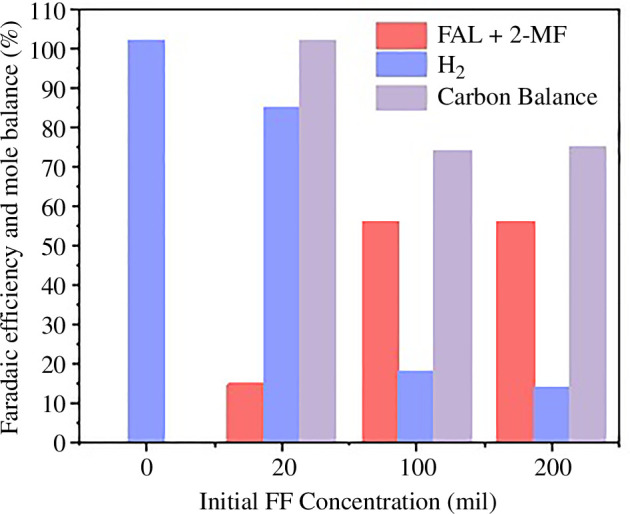
Products from electrochemical furfural reduction with changing initial furfural concentration. Reaction conditions: 0.5 M H2SO4 electrolyte with 4:1 ratio of acid to acetonitrile co-solvent, Cu foil electrode, 1.5 h reaction time at −0.80 VRHE. Figure adapted from reference [57].
Raman studies were used by Li & Kornienko [61] to study furfural reduction on different electropolished Cu single crystals (111, 110, 100 and roughened Cu), at −0.526 VRHE in acidic electrolytes. The study concluded that the Cu(110) surface produced FAL with the highest Faradaic efficiency (up to 80%), whereas the roughened Cu exhibited 2-MF as the major product. The authors suggested that this result is due to the increased number of defects in the roughened surface providing binding sites for a CH2OH group to adsorb, straining the bond and making it easier to cleave off. A qualitative representation for furfural reduction on Cu was produced by May & Biddinger [19] (figure 7) depicting the expected products that should be produced under certain parameters. Although the qualitative representations are from experimental results in their group, we could conjecture that some general trends can be used to explain or possibly predict results on other electrodes. For example, the humin products at very high initial furfural concentrations may be independent of electrode materials, due to the general instability of furfural, especially in alkaline pH.
Figure 7.

Qualitative selectivity predictions of furfural reduction products on Cu electrodes. The size of the molecules represents the relative abundance expected for each parameter [19].
(b). Mechanisms of carbonyl bond electroreductions
Understanding the mechanisms behind electrochemical reduction reactions can provide us with invaluable information to help produce more selective electrochemical syntheses in the future. For furfural reduction, these can be separated into two categories: carbonyl bond reduction to form FAL and 2-MF, and radical coupling to produce hydrofuroin.
(i). Carbonyl bond reduction
Following the adsorption of furfural, two possible mechanisms for reduction are possible, which include a direct reduction of the carbonyl bond using adsorbed hydrogens (ECH mechanism) or a proton-coupled electron transfer (PCET) using H+ ions in solution (electroreduction mechanism). An electrochemical hydrodeoxygenation is also possible and can remove oxygen atoms on furfural as water. Work from Chadderdon et al. [51] suggested two possible pathways of electrochemical carbonyl reduction in aqueous media on Cu electrodes (figure 8). The authors suggested an outer-sphere pathway where parts of the reduction do not occur on the electrode surface in the case of direct electroreduction (blue pathway; figure 8) and an inner-sphere pathway whereby the reduction of the carbonyl group is achieved completely on the electrode surface using adsorbed hydrogens (red pathway; figure 8).
Figure 8.

Proposed electrochemical reduction pathways of carbonyl compounds. The red pathway depicts the ECH pathway using adsorbed hydrogens, whereas the blue pathway depicts the PCET pathway [51].
(ii). Reductive radical coupling
The proposed outer-sphere electroreduction mechanism (blue pathway; figure 8) shows the potential for producing radical species that can self-dimerize to produce a pinacol product. This is a possible method of producing C–C bonds under mild conditions in contrast to popular methods of thermochemical C–C couplings done via expensive Pd-catalysed Suzuki [62] or Stille reactions [63]. By coupling two furfural molecules together, hydrofuroin can be produced, which is attracting attention as a potential drop-in jet fuel [48].
Electrochemical furfural reduction on Pb, Al and carbon electrodes was studied by Nilges & Schroeder [39]; they reported greater selectivity towards hydrofuroin than Cu. Chadderdon et al. [51] also reported results for furfural reduction on Pb electrodes in acidic electrolytes with about 30% Faradaic efficiency for hydrofuroin, but there were many unidentifiable products that were attributed to unselective radical coupling to form oligomers that can poison the electrode. Following this, it could be further suggested that the furfuryl radicals are coupled on the electrode surface without the use of any adsorbed hydrogen, as Pb has a notoriously large overpotential for HER due to H binding very weakly on this surface [64]. This was in contrast to a study by Lie et al. [49], whereby a combination of electron paramagnetic resonance spectroscopy and theoretical techniques identified the furfuryl radical in the electrolyte solution on Pb electrodes in acidic pH. This conclusion suggests that there may be a secondary mechanism for electrochemical reductive coupling reactions; however, further detailed literature on solution coupling mechanisms was limited. Furthermore, outer-sphere reactions were explored by Chadderdon et al. [51] using self-assembled monolayers to cover the binding surface of copper electrodes for furfural reduction aiming to facilitate only outer-sphere reactions. This resulted in zero 2-MF being produced and minor amounts of FAL and hydrogen as the major products.
Conductive carbon materials as electrodes are attractive options for electrodes because carbon is cheap and ubiquitous in nature. The dimerization of HMF was seen on carbon electrodes by Kloth et al. [65] in alkaline electrolyte, which produced the coupled species 5,5'-bis(hydroxymethyl)hydrofuroin with Faradaic efficiencies between 32 and 35%, but the other 65–68% of consumed HMF were unidentifiable products. This result was also seen in similar experiments of HMF electroreduction on carbon electrodes by Chadderdon et al. [43] where over 50% of the consumed HMF was also unidentifiable. Both authors suggested it was likely that unselective radical coupling occurred, which produced oligomers after the single electron transfer to produce the radical in the first step. Other carbon-containing materials were also reported in this study including an experiment using Ag/C cathodes [43]. While the main product detected was the diol 2,5-bishydroxymethylfuran (BHMF), some experiments reported that BHMF made up only about 50% of the total product distribution, with the rest being unidentifiable. While it could be argued the unidentifiable humins are from the Ag, it cannot be ruled out that secondary mechanisms occur on the carbon material that produces BHMF and oligomer products. The scope of electrochemical radical coupling was extended further by Anibal & Xu [66] who attempted the heterocoupling of two aldehydes (furfural and benzaldehyde) on Pb electrodes in a near-neutral electrolyte. Maximum Faradaic efficiency of 38% at −0.60 VRHE of the heterocoupled product was observed, with the rest of the products being the homocoupled hydrofuroin or hydrobenzoin. The effect of applied potential on selectivity was seen when, at more cathodic potentials, the rate of radical coupling decreased and the aldehyde reduction into alcohols was the dominant reaction (figure 9). Electrochemical cross-coupling between furfural and LA was also demonstrated by Wu et al. [67] but at an anodic potential of 1.41 VRHE, using Ni3N particles in alkaline media. A selectivity of 80% of the coupled product was recorded at this potential.
Figure 9.

Electrochemical reduction of furfural and benzaldehyde on Pb foil. Faradaic efficiencies of (a) coupled products and (b) reduced alcohol products after electrolysis. Reaction conditions: 0.25 M sodium phosphate buffer (pH 6.7), 20 mM of hydrofuroin and benzaldehyde [66].
Selective electrochemical HMF reduction can produce BHMF and was reported on AgCu foam cathodes with up to 82% Faradaic efficiency by de Luna et al. [68]. Analogous to furfural electroreduction, homocoupling of HMF was demonstrated and was also seen on Ag/C electrodes in a separate study by Dai et al. [69]. The auxiliary reaction at the anode for most reported biomass electroreduction reactions is water oxidation, which has a relatively high thermodynamic potential (1.23 VRHE). The thermodynamic potential required for biomass oxidation reactions is typically less positive than 1.23 VRHE, which could, in principle, lower the overall energy demand of the system. Conversely, while hydrogen production at the cathode yields a valuable chemical, the production rate of hydrogen from these systems compared with commercial water electrolyzers is far lower due to the limitations in current densities at the anode. Hence, producing useful commodity chemicals such as BHMF paired with electrochemical biomass oxidation reactions may be a more attractive option.
3. Electrochemical oxidation
A new library of products is available from the electrochemical oxidation of HMF using anodic potentials, which can produce the HMF oxidation products: DFF, HMFCA, FFCA and FDCA (scheme 1). Furoic acid, a result of furfural oxidation, has uses in renewable polymers and has been reported on Pt [70] and Au [71] electrodes in acidic media, with minor amounts of maleic acid produced via ring-opening reactions. While Faradaic efficiencies reached over 80%, total current densities were low, at around 1–10 µm cm−2. Higher current densities for furfural oxidation on the mA cm−2 scale were seen using CuNi nanoparticles in 1 M KOH [72]. While high current densities were observed, a low selectivity was seen. In this context, furfural oxidation was used as a paired reaction with the HER, resulting in a lowered energy demand for green hydrogen production compared with other auxiliary reactions such as water oxidation.
Scheme 1.

Competing pathways for HMF oxidation to FDCA.
(a). Significance of pH
There are fewer reports of electrochemical oxidation of furfural in the literature, likely due to the greater usefulness and prices of HMF oxidation products compared with furfural oxidation products. For this reason, this section will mainly focus on the electrochemical oxidation of HMF. Like electrochemical reduction reactions, the electrode material and the pH of the electrolyte can affect the selectivity and activity of oxidation reactions [73]. For electrochemical alcohol oxidation, the preference for alkaline electrolytes was highlighted by Kwon et al. [74] who reported that the first step of the reaction is an outer-sphere base-catalysed deprotonation to produce a reactive alkoxide species. In addition, it is observed that the maximum oxidation activity for a range of alcohols was achieved at a pH equal to the pKa of each alcohol. In this regard, for ethanol oxidation on Au electrodes, the oxidation activity was orders of magnitude higher in pH 13 than that of acidic pH, supporting this notion [74].
(b). Electrode material
The disubstituted nature of HMF results in two competing oxidation pathways (scheme 1), which adds an extra layer of complexity in controlling selectivity. The choice of electrode materials can be a major factor in determining which route HMF oxidation products take. HMF electrooxidation was reported as early as 1991 by Grabowski et al. [75] using Ni/NiOOH foam electrodes in 1 M NaOH electrolyte (pH 14), reporting a 71% product yield for FDCA production, with current densities as high as 16 mA cm−2 and 84% Faradaic efficiency. Other anode materials such as oxyhydroxides consisting of NiOOH, CoOOH and FeOOH were also reported for HMF oxidation activity by Taitt et al. [76] where it was seen that NiOOH films were the most efficient catalyst with reported FDCA selectivity and Faradaic efficiency at 96% in a 0.1 M KOH electrolyte (pH 13). The LSVs of each catalyst are denoted in figure 10 and show the superior performance of NiOOH compared with the others [76]. Latsuzbaia et al. [77] tested NiOOH foams for a continuous, industrial scale-up of HMF oxidation and reported high selectivity (90%) and Faradaic efficiency (80%) for FDCA at pH 12.
Figure 10.

LSVs of NiOOH, CoOOH and FeOOH before (dashed line) and after (solid line) the addition of 5 mM HMF. Reaction condition: 0.1 M KOH (pH 13), at room temperature, scan rate was 5 mV s−1. Data points were taken from reference [76].
Vuyyuru et al. [78] attempted to oxidize HMF on PtOx electrodes, which produced DFF at 18% Faradaic efficiency as the main organic product. PtOx electrodes exhibited some HMF oxidation activity at low pH whereby it was reported a 4% yield of DFF was obtained at 2.0 VRHE in a pH 1.06 electrolyte [77]. The remaining approximately 96% of HMF consumed was unaccounted for and was labelled as HMF degradation products. This result was also seen by Kubota et al. [79], whereby DFF was produced at just 8% Faradaic efficiency on PtOx electrodes at acidic pH, with large amounts of HMF being consumed yet unaccounted for during quantification. One compound that was detected from this HMF degradation was maleic acid, which is a precursor to succinic acid, a dicarboxylic acid that can be used in renewable polymers [80]. The same study also used a MnOx anode at 60°C, to achieve FDCA at an impressive Faradaic efficiency of 53.8% at 1.60 VRHE [79]. The synthesized FDCA spontaneously precipitated in the electrolyte due to the insolubility of FDCA in acidic media. This spontaneous precipitation of FDCA is useful because it negates the need for a reagent-heavy pH shift that would be required if an alkaline electrolyte was used (figure 11). It is worth mentioning, however, that many electrodes are generally unstable in acidic media and quickly degrade above 1.30 VRHE [81]. The authors annealed the MnOx electrodes at 400°C for 2 h to improve chemical stability, although long-term electrode stability after electrolysis was not reported.
Figure 11.

The electrochemical oxidation of HMF in acidic electrolyte at 1.60 VRHE using MnOx electrodes. (a) Products obtained from HMF oxidation at different amounts of charge passed. (b) Precipitation of FDCA in solution after cooling from 60°C. Figure reprinted with permission from the publisher [79].
Other materials that have been reported for electrochemical HMF oxidation are bimetallic PdxAuy nanoparticles. A study by Chadderdon et al. [81] reported electrochemical FDCA production with Faradaic efficiencies as high as 83% in alkaline media using Pd1Au2 anodes at 0.90 VRHE. They suggested that Au and Pd nanoparticles on carbon are favourable for aldehyde and alcohol oxidation, respectively (figure 12), hence the complete oxidation on Au/C and Pd/C electrodes required a higher potential for oxidation activity (1.20 VRHE). When combined in a ratio of Pd1Au2, a synergistic effect can produce FDCA at lower potentials with high FDCA selectivity. A similar conclusion was reached by Kim et al. [83], whereby Au/C anodes were deemed to be selective for aldehyde oxidation and would form HMFCA as the main product. The authors proposed that this is the only step possible on Au/C cathodes; however, a work by Heidary & Kornienko [84] using operando Raman techniques concluded that DFF was the main product and not HMF. Au3Pd2 bimetallic species were also tested by Latsuzbaia et al. [77] with noticeable differences in electrochemical activity. Similarities remained with regard to high Faradaic efficiency (84%) and selectivity (92%) for FDCA production; however, a decrease in current density from 3.00 to 0.07 mA cm−2 was seen after 6 h at 1.15 VRHE, most likely due to Au poisoning, which was not reported by the previous study. The authors attribute this difference to the advantages of AuxPdy nanoparticles used by Chadderdon et al. as opposed to flat electrodes and wires, as well as using a higher pH of 13 as opposed to 12 in their study. The electrochemical activity was able to be regained after a pulse for 1 s at 2.0 VRHE, which likely delaminated the poisoning off the electrode.
Figure 12.

Electrochemical oxidation of HMF on AuxPdy electrodes. (a) Reported favoured reaction routes of HMF oxidation on Au/C and Pd/C anodes. (b) LSVs of various Pd and Au anodes using different starting substrates HMF, HMFCA and FFCA [82]. Reaction conditions: 0.1 M KOH (pH 13), room temperature, scan rate 50 mV s−1.
Lu et al. [85] reported Co-based spinel oxides (Co3O4, ZnCo2O4) displaying FDCA production with Faradaic efficiencies of over 90% and current densities reaching 16 mA cm−2, with currents as high as 60 mA cm−2 when the spinel oxides are placed on Ni foam supports. Interestingly, metal-free catalysts for electrochemical oxidation reactions can be prepared from ubiquitous elements such as carbon, oxygen, nitrogen and hydrogen. These include molecular catalysts such as the stable nitroxy radical 2,2,6,6-tetramethylpiperidine-1-oxyl (TEMPO). An applied potential oxidizes TEMPO into the oxoammonium cation (TEMPO+), which facilitates the addition of an alcohol for further reduction. The TEMPO radical can then be electrochemically restored to complete the oxidation cycle (scheme 2). Cardiel et al. [86] reported the conversion of HMF into FDCA using TEMPO in a homogenous borate buffer solution (pH 9.2) and produced FDCA with 96.7% Faradaic efficiency at 1.60 VRHE. Electron-withdrawing effects were explored using 4-acetyl-TEMPO (ACT), which resulted in FDCA being produced at a faster rate than TEMPO. They suggested that the electron-withdrawing acetyl group quickly forms the active oxoammonium species, which results in a more anodic potential required to form the active TEMPO+ species. The low price, high activity, low toxicity and high FDCA yields obtained using TEMPO make this catalyst appealing for a scale-up of FDCA production.
Scheme 2.

Electrochemical catalytic cycle of TEMPO demonstrating alcohol oxidation into aldehydes.
4. Side reactions of furanic compounds
As well as electrochemical degradation, non-electrochemical HMF degradation into humin products is also an issue. HMF is a relatively unstable aldehyde that rapidly degrades into humin products without any catalyst or applied potential. Van Zandvoort et al. [87] reported that humin products form through condensation reactions between the aldehyde group of one HMF molecule and the beta position of the furan ring of another. This phenomenon is problematic as these oligomers can poison the electrode surface preventing oxidation activity. It is important to mention that the aldehyde group in HMF is non-enolizable (absence of an alpha-H) and consequently makes HMF susceptible to the Cannizzaro reaction at high pH [88]. This is a disproportionation reaction that occurs when two aldehydes react with each other in an alkaline solution (scheme 3). Studies on the Cannizaro reaction of HMF in different alkaline solutions show that HMF is converted into FFCA and BHMF, as well as some humin products [5]. As an alkaline electrolyte is preferred for oxidation, the Cannizzaro reaction and humin formation are difficult to avoid completely but may be minimized by using electrodes that rapidly oxidize HMF into more stable products or finding a method that avoids using highly alkaline electrolytes.
Scheme 3.

Mechanism for the base-catalysed Cannizzaro reaction starting from HMF.
5. Conclusion
In this review, we have provided specific examples of how electrification may potentially revolutionize the way clean fuels and chemicals are synthesized. The products obtained from upgrading furanic platform chemicals are viable for replacing chemicals sourced from petrochemical feedstock; however, several challenges need to be addressed first. Arguably, the biggest roadblock is the production rate of platform chemicals. While furfural is produced in quantities of about 0.25 million metric tonnes per year [89], the industrial scale-up of HMF production has not been yet established and so is not produced in the large quantities needed to completely replace petrochemical feedstocks. The work being done to produce industrial volumes of HMF is still in its relative infancy, although there have been ventures by the company Avantium [48] to produce large amounts of HMF and FDCA.
The electrosynthesis of useful chemicals is likely to become a frontier in lowering carbon footprints and directly utilizing green electricity. While some promising biomass electrovalorization processes have been reported here, most do not have high enough current densities required for a feasible industrial scale-up, have low selectivities and have not been reported in a continuous system that will likely be needed for the said industrial scale-up. In addition, the separation of products from the electrolyte will need to be addressed. We envisage that technoeconomic analyses coupled with life cycle assessment can assess the viability of these processes and guide scientists towards routes that make the largest possible impact [25].
Contributor Information
Zamaan Mukadam, Email: z.mukadam19@imperial.ac.uk.
Soren B. Scott, Email: sbs@chem.ku.dk.
Maria Magdalena Titirici, Email: m.titirici@imperial.ac.uk.
Ifan E. L. Stephens, Email: i.stephens@imperial.ac.uk.
Data accessibility
This article has no additional data.
Declaration of AI use
We have not used AI-assisted technologies in creating this article.
Authors’ contributions
Z.M.: conceptualization, writing—original draft, writing—review and editing; S.B.S.: writing—review and editing; M.M.T.: writing—review and editing; I.E.L.S.: supervision, writing—review and editing.
All authors gave final approval for publication and agreed to be held accountable for the work performed therein.
Conflict of interests
We declare we have no competing interests.
Funding
Z.M. would like to thank the EPSRC Standard Research Studentship for supporting this work (grant number: (EP/R513052/1). S.B.S. acknowledges an Energy for Future fellowship from the Iberdrola Foundation. I.E.L.S. and S.B.S. would like to acknowledge the European Research Council (ERC) under the European Union’s Horizon 2020 research and innovation programme (grant agreement no. 866402). M.M.T., Z.M. and I.E.L.S. gratefully acknowledge the EPSRC VALUED programme grant (reference: EP/W031019/1). S.B.S. was supported in part by the Marie Sklodowska Curie Actions and Iberdrola Group, (Grant Agreement number 101034297).
References
- 1. Wang Z, Fingas M, Yang C, Christensen JH. 1964. Crude oil and refined product fingerprinting: principles. Environ. Forensics. Contam. Specif. Guid. 339–407. ( 10.1016/B978-012507751-4/50038-0) [DOI] [Google Scholar]
- 2. Griffiths S, Sovacool BK, Kim J, Bazilian M, Uratani JM. 2022. Decarbonizing the oil refining industry: a systematic review of sociotechnical systems, technological innovations, and policy options. Energy Res. Soc. Sci. 89, 102542. ( 10.1016/j.erss.2022.102542) [DOI] [Google Scholar]
- 3. Szklo A, Schaeffer R. 2007. Fuel specification, energy consumption and CO2 emission in oil refineries. Energy 32, 1075–1092. ( 10.1016/j.energy.2006.08.008) [DOI] [Google Scholar]
- 4. IPCC Report. 2020. See https://www.ipcc.ch/sr15/download/#chapter (accessed 22 August 2024).
- 5. Mamman AS, Lee JM, Kim YC, Hwang IT, Park NJ, Hwang YK, Chang JS, Hwang JS. 2008. Furfural: hemicellulose/xylosederived biochemical. Biofuels. Bioprod. Bioref. 2, 438–454. ( 10.1002/bbb.95) [DOI] [Google Scholar]
- 6. Röper H. 2002. Renewable raw materials in europe - industrial utilisation of starch and sugar. Starch/Staerke 54, 89–99. ( 10.1002/1521-379X(200204)54:3/4<89::AID-STAR89>3.0.CO;2-I) [DOI] [Google Scholar]
- 7. Hughes L, Rudolph J. 2011. Future world oil production: growth, plateau, or peak? Curr. Opin. Environ. Sustain. 3, 225–234. ( 10.1016/j.cosust.2011.05.001) [DOI] [Google Scholar]
- 8. Sommer SG, Hamelin L, Olesen JE, Montes F, Jia W, Chen Q, Triolo JM. 2015. Supply chain management for sustainable food networks, pp. 67–106. Wiley. ( 10.1002/9781118937495) [DOI] [Google Scholar]
- 9. Liu X, Wang W, Gao X, Zhou Y, Shen R. 2012. Effect of thermal pretreatment on the physical and chemical properties of municipal biomass waste. Waste Manag. 32, 249–255. ( 10.1016/j.wasman.2011.09.027) [DOI] [PubMed] [Google Scholar]
- 10. Statista . 2024. Projected generation of municipal solid waste worldwide from 2016 to 2050. See https://www.statista.com/statistics/916625/global-generation-of-municipal-solid-waste-forecast (accessed 31 July 2024).
- 11. The Royal Society . 2024. Catalysing change: defossilising the chemical industry. Policy briefing. See https://royalsociety.org/-/media/policy/projects/defossilising-chemicals/defossilising-chemical-industry-report.pdf. [Google Scholar]
- 12. Singh SK. 2022. Ionic liquids and lignin interaction: an overview. Bioresour. Technol. Rep. 17, 100958. ( 10.1016/j.biteb.2022.100958) [DOI] [Google Scholar]
- 13. Li T, Takkellapati S. 2018. The current and emerging sources of technical lignins and their applications. Biofuel. Bioprod. Biorefin. 0, 1–32. ( 10.1002/bbb.1913) [DOI] [PMC free article] [PubMed] [Google Scholar]
- 14. Sajid M, Farooq U, Bary G, Azim MM, Zhao X. 2021. Sustainable production of levulinic acid and its derivatives for fuel additives and chemicals: progress, challenges, and prospects. Green Chem. 23, 9198–9238. ( 10.1039/D1GC02919C) [DOI] [Google Scholar]
- 15. Pang J, Zheng M, Sun R, Wang A, Wang X, Zhang T. 2016. Synthesis of ethylene glycol and terephthalic acid from biomass for producing PET. Green Chem. 18, 342–359. ( 10.1039/C5GC01771H) [DOI] [Google Scholar]
- 16. Production capacity of purified terephthalic acid worldwide in 2018 and 2023. 2024. See https://www.statista.com/statistics/1065886/global-purified-terephthalic-acid-production-capacity.
- 17. Takkellapati S, Li T, Gonzalez MA. 2018. An overview of biorefinery derived platform chemicals from a cellulose and hemicellulose biorefinery. Clean Technol. Environ. Policy 20, 1615–1630. ( 10.1007/s10098-018-1568-5) [DOI] [PMC free article] [PubMed] [Google Scholar]
- 18. Liu C, Wu S, Zhang H, Xiao R. 2019. Catalytic oxidation of lignin to valuable biomass-based platform chemicals: a review. Fuel Process. Technol. 191, 181–201. ( 10.1016/j.fuproc.2019.04.007) [DOI] [Google Scholar]
- 19. May AS, Biddinger EJ. 2020. Strategies to control electrochemical hydrogenation and hydrogenolysis of furfural and minimize undesired side reactions. ACS Catal. 10, 3212–3221. ( 10.1021/acscatal.9b05531) [DOI] [Google Scholar]
- 20. Ringe S, Clark EL, Resasco J, Walton A, Seger B, Bell AT, Chan K. 2019. Understanding cation effects in electrochemical CO2 reduction. Energy Environ. Sci. 12, 3001–3014. ( 10.1039/C9EE01341E) [DOI] [Google Scholar]
- 21. Mayyas A, et al. 2018. Manufacturing cost analysis for proton exchange membrane water electrolyzers. Natl. Renew. Energy Lab 65. ( 10.2172/1557965) [DOI] [Google Scholar]
- 22. Li M, Wu Y, Zhao BH, Cheng C, Zhao J, Liu C, Zhang B. 2023. Electrosynthesis of amino acids from NO and α-keto acids using two decoupled flow reactors. Nat. Catal. 6, 906–915. ( 10.1038/s41929-023-01012-4) [DOI] [Google Scholar]
- 23. She X, et al. 2024. Pure-water-fed, electrocatalytic CO2 reduction to ethylene beyond 1,000 h stability at 10 A. Nat. Energy 9, 81–91. ( 10.1038/s41560-023-01415-4) [DOI] [Google Scholar]
- 24. Jouny M, Luc W, Jiao F. 2018. General techno-economic analysis of CO2 electrolysis systems. Ind. Eng. Chem. Res. 57, 2165–2177. ( 10.1021/acs.iecr.7b03514) [DOI] [Google Scholar]
- 25. Nyhus AH, Yliruka M, Shah N, Chachuat B. 2024. Green ethylene production in the UK by 2035: a techno-economic assessment. Energy Environ. Sci. 17, 1931–1949. ( 10.1039/D3EE03064D) [DOI] [Google Scholar]
- 26. De Luna P, Hahn C, Higgins D, Jaffer SA, Jaramillo TF, Sargent EH. 2019. What would it take for renewably powered electrosynthesis to displace petrochemical processes? Science 364, eaav3506. ( 10.1126/science.aav3506) [DOI] [PubMed] [Google Scholar]
- 27. Wang Y, Zhao D, Rodríguez-Padrón D, Len C. 2019. Recent advances in catalytic hydrogenation of furfural. Catalysts 9, 796. ( 10.3390/catal9100796) [DOI] [Google Scholar]
- 28. Drault F, Snoussi Y, Paul S, Itabaiana I, Wojcieszak R. 2020. Recent advances in carboxylation of furoic acid into 2,5-furandicarboxylic acid: pathways towards bio-based polymers. ChemSusChem 13, 5164–5172. ( 10.1002/cssc.202001393) [DOI] [PubMed] [Google Scholar]
- 29. Production capacity of polyethylene terephthalate worldwide from 2014 to 2024. See https://www.statista.com/statistics/242764/global-polyethylene-terephthalate-production-capacity/#:~:text=The.
- 30. Hoang AT, Ölçer AI, Nižetić S. 2021. Prospective review on the application of biofuel 2,5-dimethylfuran to diesel engine. J. Energy Inst. 94, 360–386. ( 10.1016/j.joei.2020.10.004) [DOI] [Google Scholar]
- 31. Verevkin SP, Emel’yanenko VN, Stepurko EN, Ralys RV, Zaitsau DH, Stark A. 2009. Biomass-derived platform chemicals: thermodynamic studies on the conversion of 5-hydroxymethylfurfural into bulk intermediates. Ind. Eng. Chem. Res. 48, 10087–10093. ( 10.1021/ie901012g) [DOI] [Google Scholar]
- 32. Mukadam Z, et al. 2023. Furfural electrovalorisation using single-atom molecular catalysts. Energy Environ. Sci. 16, 2934–2944. ( 10.1039/D3EE00551H) [DOI] [Google Scholar]
- 33. Hansen TS, Mielby J, Riisager A. 2011. Synergy of boric acid and added salts in the catalytic dehydration of hexoses to 5-hydroxymethylfurfural in water. Green Chem. 13, 109–114. ( 10.1039/C0GC00355G) [DOI] [Google Scholar]
- 34. Bozell JJ, Petersen GR. 2010. Technology development for the production of biobased products from biorefinery carbohydrates—the US Department of Energy’s “top 10” revisited. Green Chem. 12, 539. ( 10.1039/b922014c) [DOI] [Google Scholar]
- 35. Green SK, Lee J, Kim HJ, Tompsett GA, Kim WB, Huber GW. 2013. The electrocatalytic hydrogenation of furanic compounds in a continuous electrocatalytic membrane reactor. Green Chem. 15, 1869. ( 10.1039/c3gc00090g) [DOI] [Google Scholar]
- 36. Delima RS, Stankovic MD, MacLeod BP, Fink AG, Rooney MB, Huang A, Jansonius RP, Dvorak DJ, Berlinguette CP. 2022. Selective hydrogenation of furfural using a membrane reactor. Energy Environ. Sci. 15, 215–224. ( 10.1039/D1EE02818A) [DOI] [Google Scholar]
- 37. zhao B, Chen M, Guo Q, Fu Y. 2014. Electrocatalytic hydrogenation of furfural to furfuryl alcohol using platinum supported on activated carbon fibers. Electrochim. Acta 135, 139–146. ( 10.1016/j.electacta.2014.04.164) [DOI] [Google Scholar]
- 38. Wang F, Xu M, Wei L, Wei Y, Hu Y, Fang W, Zhu CG. 2015. Fabrication of la-doped tio2 film electrode and investigation of its electrocatalytic activity for furfural reduction. Electrochim. Acta 153, 170–174. ( 10.1016/j.electacta.2014.11.203) [DOI] [Google Scholar]
- 39. Li Z, Kelkar S, Lam CH, Luczek K, Jackson JE, Miller DJ, Saffron CM. 2012. Aqueous electrocatalytic hydrogenation of furfural using a sacrificial anode. Electrochim. Acta 64, 87–93. ( 10.1016/j.electacta.2011.12.105) [DOI] [Google Scholar]
- 40. Ketkaew M, Assavapanumat S, Klinyod S, Kuhn A, Wattanakit C. 2022. Bifunctional Pt/Au Janus electrocatalysts for simultaneous oxidation/reduction of furfural with bipolar electrochemistry. Chem. Commun. 58, 4312–4315. ( 10.1039/D1CC06759A) [DOI] [PubMed] [Google Scholar]
- 41. Dhawan MS, Yadav GD, Calabrese Barton S. 2021. Zinc-electrocatalyzed hydrogenation of furfural in near-neutral electrolytes. Sustainable Energy Fuels 5, 2972–2984. ( 10.1039/D1SE00221J) [DOI] [Google Scholar]
- 42. Brosnahan JT, Zhang Z, Yin Z, Zhang S. 2021. Electrocatalytic reduction of furfural with high selectivity to furfuryl alcohol using AGPD alloy nanoparticles. Nanoscale 13, 2312–2316. ( 10.1039/d0nr07676g) [DOI] [PubMed] [Google Scholar]
- 43. Anibal J, Xu B. 2020. Electroreductive C–C coupling of furfural and benzaldehyde on Cu and Pb surfaces. ACS Catal. 10, 11643–11653. ( 10.1021/acscatal.0c03110) [DOI] [Google Scholar]
- 44. Albert WC, Lowy A. 1939. The electrochemical reduction of furfural. Trans. Electrochem. Soc. 75, 367. ( 10.1149/1.3498392) [DOI] [Google Scholar]
- 45. Liu S, Mukadam Z, Scott SB, Sarma SC, Titirici MM, Chan K, Govindarajan N, Stephens IEL, Kastlunger G. 2023. Unraveling the reaction mechanisms for furfural electroreduction on copper. EES Catal. 1, 539–551. ( 10.1039/d3ey00040k) [DOI] [PMC free article] [PubMed] [Google Scholar]
- 46. Nilges P, Schröder U. 2013. Electrochemistry for biofuel generation: production of furans by electrocatalytic hydrogenation of furfurals. Energy Environ. Sci. 6, 2925. ( 10.1039/c3ee41857j) [DOI] [Google Scholar]
- 47. Lenk T, Rabet S, Sprick M, Raabe G, Schröder U. 2023. Insight into the interaction of furfural with metallic surfaces in the electrochemical hydrogenation process. Chemphyschem 24. ( 10.1002/cphc.202200614) [DOI] [PubMed] [Google Scholar]
- 48. Liu H, Patel DM, Chen Y, Lee J, Lee TH, Cady SD, Cochran EW, Roling LT, Li W. 2022. Unraveling electroreductive mechanisms of biomass-derived aldehydes via tailoring interfacial environments. ACS Catal. 12, 14072–14085. ( 10.1021/acscatal.2c03163) [DOI] [Google Scholar]
- 49. Kwon Y, Birdja YY, Raoufmoghaddam S, Koper MTM. 2015. Electrocatalytic hydrogenation of 5-hydroxymethylfurfural in acidic solution. ChemSusChem 8, 1745–1751. ( 10.1002/cssc.201500176) [DOI] [PubMed] [Google Scholar]
- 50. Chadderdon XH, Chadderdon DJ, Matthiesen JE, Qiu Y, Carraher JM, Tessonnier JP, Li W. 2017. Mechanisms of furfural reduction on metal electrodes: distinguishing pathways for selective hydrogenation of bioderived oxygenates. J. Am. Chem. Soc. 139, 14120–14128. ( 10.1021/jacs.7b06331) [DOI] [PubMed] [Google Scholar]
- 51. Liu L, Liu H, Huang W, He Y, Zhang W, Wang C, Lin H. 2017. Mechanism and kinetics of the electrocatalytic hydrogenation of furfural to furfuryl alcohol. J. Electroanal. Chem. 804, 248–253. ( 10.1016/j.jelechem.2017.09.021) [DOI] [Google Scholar]
- 52. Shang X, Yang Y, Sun Y. 2020. Electrohydrodimerization of biomass-derived furfural generates a jet fuel precursor. Green Chem. 22, 5395–5401. ( 10.1039/D0GC01720E) [DOI] [Google Scholar]
- 53. Ledezma-Yanez I, Wallace WDZ, Sebastián-Pascual P, Climent V, Feliu JM, Koper MTM. 2017. Interfacial water reorganization as a pH-dependent descriptor of the hydrogen evolution rate on platinum electrodes. Nat. Energy. 2, 17031. ( 10.1038/nenergy.2017.31) [DOI] [Google Scholar]
- 54. Liu X, et al. 2019. PH effects on the electrochemical reduction of CO(2) towards C2 products on stepped copper. Nat. Commun. 10, 32. ( 10.1038/s41467-018-07970-9) [DOI] [PMC free article] [PubMed] [Google Scholar]
- 55. Jung S, Biddinger EJ. 2016. Electrocatalytic hydrogenation and hydrogenolysis of furfural and the impact of homogeneous side reactions of furanic compounds in acidic electrolytes. ACS Sustain. Chem. Eng. 4, 6500–6508. ( 10.1021/acssuschemeng.6b01314) [DOI] [Google Scholar]
- 56. Jung S, Biddinger EJ. 2018. Controlling competitive side reactions in the electrochemical upgrading of furfural to biofuel. Energy Tech. 6, 1370–1379. ( 10.1002/ente.201800216) [DOI] [Google Scholar]
- 57. Ledezma‐Yanez I, Díaz‐Morales O, Figueiredo MC, Koper MTM. 2015. Hydrogen oxidation and hydrogen evolution on a platinum electrode in acetonitrile. ChemElectroChem 2, 1612–1622. ( 10.1002/celc.201500341) [DOI] [Google Scholar]
- 58. Shi N, Liu Q, Cen H, Ju R, He X, Ma L. 2020. Formation of humins during degradation of carbohydrates and furfural derivatives in various solvents. Biomass Conv. Bioref. 10, 277–287. ( 10.1007/s13399-019-00414-4) [DOI] [Google Scholar]
- 59. Parpot P, Bettencourt AP, Chamoulaud G, Kokoh KB, Belgsir EM. 2004. Electrochemical investigations of the oxidation–reduction of furfural in aqueous medium. Electrochim. Acta 49, 397–403. ( 10.1016/j.electacta.2003.08.021) [DOI] [Google Scholar]
- 60. Li J, Kornienko N. 2021. Probing electrosynthetic reactions with furfural on copper surfaces. Chem. Commun. 57, 5127–5130. ( 10.1039/D1CC01429C) [DOI] [PubMed] [Google Scholar]
- 61. Miyaura N, Yamada K, Suzuki A. 1979. A new stereospecific cross-coupling by the palladium-catalyzed reaction of 1-alkenylboranes with 1-alkenyl or 1-alkynyl halides. Tetrahedron Lett. 20, 3437–3440. ( 10.1016/S0040-4039(01)95429-2) [DOI] [Google Scholar]
- 62. Milstein D, Stille JK. 1978. A general, selective, and facile method for ketone synthesis from acid chlorides and organotin compounds catalyzed by palladium. J. Am. Chem. Soc. 100, 3636–3638. ( 10.1021/ja00479a077) [DOI] [Google Scholar]
- 63. Björketun ME, Bondarenko AS, Abrams BL, Chorkendorff I, Rossmeisl J. 2010. Screening of electrocatalytic materials for hydrogen evolution. Phys. Chem. Chem. Phys. 12, 10536–10541. ( 10.1039/c003826c) [DOI] [PubMed] [Google Scholar]
- 64. Kloth R, Vasilyev DV, Mayrhofer KJJ, Katsounaros I. 2021. Electroreductive 5-hydroxymethylfurfural dimerization on carbon electrodes. ChemSusChem 14, 5245–5253. ( 10.1002/cssc.202101575) [DOI] [PMC free article] [PubMed] [Google Scholar]
- 65. Chadderdon XH, Chadderdon DJ, Pfennig T, Shanks BH, Li W. 2019. Paired electrocatalytic hydrogenation and oxidation of 5-(hydroxymethyl)furfural for efficient production of biomass-derived monomers. Green Chem. 21, 6210–6219. ( 10.1039/C9GC02264C) [DOI] [Google Scholar]
- 66. Wu J, et al. 2022. Anodic cross-coupling of biomass platform chemicals to sustainable biojet fuel precursors. J. Am. Chem. Soc. 144, 23649–23656. ( 10.1021/jacs.2c11153) [DOI] [PubMed] [Google Scholar]
- 67. de Luna GS, Sacco A, Hernandez S, Ospitali F, Albonetti S, Fornasari G, Benito P. 2022. Insights into the electrochemical reduction of 5-hydroxymethylfurfural at high current densities. ChemSusChem 15, e202102504. ( 10.1002/cssc.202102504) [DOI] [PMC free article] [PubMed] [Google Scholar]
- 68. Dai Z, Liu X, Liu N, Zhang Y, Zhao X. 2024. Upgrading biomass derived furan aldehydes by coupled electrochemical conversion over silver-based electrocatalysts. Chem. Eng. J. 488, 151001. ( 10.1016/j.cej.2024.151001) [DOI] [Google Scholar]
- 69. Román AM, Hasse JC, Medlin JW, Holewinski A. 2019. Elucidating acidic electro-oxidation pathways of furfural on platinum. ACS Catal. 9, 10305–10316. ( 10.1021/acscatal.9b02656) [DOI] [Google Scholar]
- 70. Román AM, Agrawal N, Hasse JC, Janik MJ, Medlin JW, Holewinski A. 2020. Electro-oxidation of furfural on gold is limited by furoate self-assembly. J. Catal. 391, 327–335. ( 10.1016/j.jcat.2020.08.034) [DOI] [Google Scholar]
- 71. Chen L, et al. 2024. Visible-light-enhanced hydrogen evolution through anodic furfural electro-oxidation using nickel atomically dispersed copper nanoparticles. Inorg. Chem. 63, 730–738. ( 10.1021/acs.inorgchem.3c03677) [DOI] [PubMed] [Google Scholar]
- 72. Cook AW, Waldie KM. 2020. Molecular electrocatalysts for alcohol oxidation: insights and challenges for catalyst design. ACS Appl. Energy Mater. 3, 38–46. ( 10.1021/acsaem.9b01820) [DOI] [Google Scholar]
- 73. Kwon Y, Lai SCS, Rodriguez P, Koper MTM. 2011. Electrocatalytic oxidation of alcohols on gold in alkaline media: base or gold catalysis? J. Am. Chem. Soc. 133, 6914–6917. ( 10.1021/ja200976j) [DOI] [PubMed] [Google Scholar]
- 74. Grabowski G, Lewkowski J, Skowroński R. 1991. The electrochemical oxidation of 5-hydroxymethylfurfural with the nickel oxide/hydroxide electrode. Electrochim. Acta 36, 1995. ( 10.1016/0013-4686(91)85084-K) [DOI] [Google Scholar]
- 75. Taitt BJ, Nam DH, Choi KS. 2019. A comparative study of nickel, cobalt, and iron oxyhydroxide anodes for the electrochemical oxidation of 5-hydroxymethylfurfural to 2,5-furandicarboxylic acid. ACS Catal. 9, 660–670. ( 10.1021/acscatal.8b04003) [DOI] [Google Scholar]
- 76. Latsuzbaia R, et al. 2018. Continuous electrochemical oxidation of biomass derived 5-(hydroxymethyl)furfural into 2,5-furandicarboxylic acid. J. Appl. Electrochem. 48, 611–626. ( 10.1007/s10800-018-1157-7) [DOI] [Google Scholar]
- 77. Vuyyuru KR, Strasser P. 2012. Oxidation of biomass derived 5-hydroxymethylfurfural using heterogeneous and electrochemical catalysis. Catal. Today. 195, 144–154. ( 10.1016/j.cattod.2012.05.008) [DOI] [Google Scholar]
- 78. Kubota SR, Choi KS. 2018. Electrochemical oxidation of 5-hydroxymethylfurfural to 2,5-furandicarboxylic acid (FDCA) in acidic media enabling spontaneous FDCA separation. ChemSusChem 11, 2138–2145. ( 10.1002/cssc.201800532) [DOI] [PubMed] [Google Scholar]
- 79. Bechthold I, Bretz K, Kabasci S, Kopitzky R, Springer A. 2008. Succinic acid: a new platform chemical for biobased polymers from renewable resources. Chem. Eng. Technol. 31, 647–654. ( 10.1002/ceat.200800063) [DOI] [Google Scholar]
- 80. Moradi M, Vasseghian Y, Khataee A, Kobya M, Arabzade H, Dragoi EN. 2020. Service life and stability of electrodes applied in electrochemical advanced oxidation processes: a comprehensive review. J. Ind. Eng. Chem. 87, 18–39. ( 10.1016/j.jiec.2020.03.038) [DOI] [Google Scholar]
- 81. Chadderdon DJ, Xin L, Qi J, Qiu Y, Krishna P, More KL, Li W. 2014. Electrocatalytic oxidation of 5-hydroxymethylfurfural to 2,5-furandicarboxylic acid on supported Au and Pd bimetallic nanoparticles. Green Chem. 16, 3778–3786. ( 10.1039/C4GC00401A) [DOI] [Google Scholar]
- 82. Lu Y, et al. 2020. Identifying the geometric site dependence of spinel oxides for the electrooxidation of 5‐hydroxymethylfurfural. Angew. Chem. Weinheim Bergstr. Ger. 132, 19377–19383. ( 10.1002/ange.202007767) [DOI] [PubMed] [Google Scholar]
- 83. Park M, Gu M, Kim BS. 2020. Tailorable electrocatalytic 5-hydroxymethylfurfural oxidation and H2 production: architecture-performance relationship in bifunctional multilayer electrodes. ACS Nano 14, 6812–6822. ( 10.1021/acsnano.0c00581) [DOI] [PubMed] [Google Scholar]
- 84. Heidary N, Kornienko N. 2019. Operando Raman probing of electrocatalytic biomass oxidation on gold nanoparticle surfaces. Chem. Commun. 55, 11996–11999. ( 10.1039/C9CC06646B) [DOI] [PubMed] [Google Scholar]
- 85. Cardiel AC, Taitt BJ, Choi KS. 2019. Stabilities, regeneration pathways, and electrocatalytic properties of nitroxyl radicals for the electrochemical oxidation of 5-hydroxymethylfurfural. ACS Sustain. Chem. Eng. 7, 11138–11149. ( 10.1021/acssuschemeng.9b00203) [DOI] [Google Scholar]
- 86. van Zandvoort I, Wang Y, Rasrendra CB, van Eck ERH, Bruijnincx PCA, Heeres HJ, Weckhuysen BM. 2013. Formation, molecular structure, and morphology of humins in biomass conversion: influence of feedstock and processing conditions. ChemSusChem 6, 1745–1758. ( 10.1002/cssc.201300332) [DOI] [PubMed] [Google Scholar]
- 87. Birdja YY, Koper MTM. 2017. The importance of Cannizzaro-type reactions during electrocatalytic reduction of carbon dioxide. J. Am. Chem. Soc. 139, 2030–2034. ( 10.1021/jacs.6b12008) [DOI] [PMC free article] [PubMed] [Google Scholar]
- 88. Subbiah S, Simeonov SP, Esperança JMSS, Rebelo LPN, Afonso CAM. 2013. Direct transformation of 5-hydroxymethylfurfural to the building blocks 2,5-dihydroxymethylfurfural (DHMF) and 5-hydroxymethyl furanoic acid (HMFA) via Cannizzaro reaction. Green Chem. 15, 2849. ( 10.1039/c3gc40930a) [DOI] [Google Scholar]
- 89. Avantium reaches Financial Close for its FDCA Flagship Plant. See https://www.avantium.com/general/avantium-reaches-financial-close-for-its-fdca-flagship-plant (accessed 15 March 2024).
Associated Data
This section collects any data citations, data availability statements, or supplementary materials included in this article.
Data Availability Statement
This article has no additional data.