



Abstract
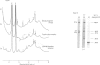
A deletion in vitro can be made in the aceEF-lpd operon encoding the pyruvate dehydrogenase multienzyme complex of Escherichia coli, which causes deletion of two of the three homologous lipoyl domains that comprise the N-terminal half of each dihydrolipoamide acetyltransferase (E2p) polypeptide chain. An active complex is still formed and 1H-n.m.r. spectroscopy of this modified complex revealed that many of the unusually sharp resonances previously attributed to conformationally mobile segments in the wild-type E2p polypeptide chains had correspondingly disappeared. A further deletion was engineered in the long (alanine + proline)-rich segment of polypeptide chain that linked the one remaining lipoyl domain to the C-terminal half of the E2p chain. 1H-n.m.r. spectroscopy of the resulting enzyme complex, which was also active, revealed a further corresponding loss in the unusually sharp resonances observed in the spectrum. These experiments strongly support the view that the sharp resonances derive, principally at least, from the three long (alanine + proline)-rich sequences which separate the three lipoyl domains and link them to the C-terminal half of the E2p chain. Closer examination of the 400 MHz 1H-n.m.r. spectra of the wild-type and restructured complexes, and of the products of limited proteolysis, revealed another sharp but smaller resonance. This was tentatively attributed to another, but smaller, (alanine + proline)-rich sequence that separates the dihydrolipoamide dehydrogenase-binding domain from the inner core domain in the C-terminal half of the E2p chain. If this sequence is also conformationally flexible, it may explain previous fluorescence data which suggest that dihydrolipoamide dehydrogenase bound to the enzyme complex is quite mobile. The acetyltransferase active site in the E2p chain was shown to reside in the inner core domain, between residues 370 and 629.
Full text
PDF


Images in this article

Selected References
These references are in PubMed. This may not be the complete list of references from this article.
- Ambrose M. C., Perham R. N. Spin-label study of the mobility of enzyme-bound lipoic acid in the pyruvate dehydrogenase multienzyme complex of Escherichia coli. Biochem J. 1976 May 1;155(2):429–432. doi: 10.1042/bj1550429. [DOI] [PMC free article] [PubMed] [Google Scholar]
- Angelides K. J., Hammes G. G. Fluorescence studies of the pyruvate dehydrogenase multienzyme complex from Escherichia coli. Biochemistry. 1979 Apr 3;18(7):1223–1229. doi: 10.1021/bi00574a017. [DOI] [PubMed] [Google Scholar]
- Bates D. L., Danson M. J., Hale G., Hooper E. A., Perham R. N. Self-assembly and catalytic activity of the pyruvate dehydrogenase multienzyme complex of Escherichia coli. Nature. 1977 Jul 28;268(5618):313–316. doi: 10.1038/268313a0. [DOI] [PubMed] [Google Scholar]
- Berbers G. A., Hoekman W. A., Bloemendal H., de Jong W. W., Kleinschmidt T., Braunitzer G. Proline- and alanine-rich N-terminal extension of the basic bovine beta-crystallin B1 chains. FEBS Lett. 1983 Sep 19;161(2):225–229. doi: 10.1016/0014-5793(83)81013-8. [DOI] [PubMed] [Google Scholar]
- Berman J. N., Chen G. X., Hale G., Perham R. N. Lipoic acid residues in a take-over mechanism for the pyruvate dehydrogenase multienzyme complex of Escherichia coli. Biochem J. 1981 Dec 1;199(3):513–520. doi: 10.1042/bj1990513. [DOI] [PMC free article] [PubMed] [Google Scholar]
- Bhandari D. G., Levine B. A., Trayer I. P., Yeadon M. E. 1H-NMR study of mobility and conformational constraints within the proline-rich N-terminal of the LC1 alkali light chain of skeletal myosin. Correlation with similar segments in other protein systems. Eur J Biochem. 1986 Oct 15;160(2):349–356. doi: 10.1111/j.1432-1033.1986.tb09978.x. [DOI] [PubMed] [Google Scholar]
- Bleile D. M., Munk P., Oliver R. M., Reed L. J. Subunit structure of dihydrolipoyl transacetylase component of pyruvate dehydrogenase complex from Escherichia coli. Proc Natl Acad Sci U S A. 1979 Sep;76(9):4385–4389. doi: 10.1073/pnas.76.9.4385. [DOI] [PMC free article] [PubMed] [Google Scholar]
- Cary P. D., Crane-Robinson C., Bradbury E. M., Dixon G. H. Structural studies of the non-histone chromosomal proteins HMG-T and H6 from trout testis. Eur J Biochem. 1981 Oct;119(3):545–551. doi: 10.1111/j.1432-1033.1981.tb05642.x. [DOI] [PubMed] [Google Scholar]
- Coggins J. R., Hooper E. A., Perham R. N. Use of dimethyl suberimidate and novel periodate-cleavable bis(imido esters) to study the quaternary structure of the pyruvate dehydrogenase multienzyme complex of Escherichia coli. Biochemistry. 1976 Jun 15;15(12):2527–2533. doi: 10.1021/bi00657a006. [DOI] [PubMed] [Google Scholar]
- Collins J. H., Reed L. J. Acyl group and electron pair relay system: a network of interacting lipoyl moieties in the pyruvate and alpha-ketoglutarate dehydrogenase complexes from Escherichia coli. Proc Natl Acad Sci U S A. 1977 Oct;74(10):4223–4227. doi: 10.1073/pnas.74.10.4223. [DOI] [PMC free article] [PubMed] [Google Scholar]
- Danson M. J., Hale G., Johnson P., Perham R. N., Smith J., Spragg P. Molecular weight and symmetry of the pyruvate dehydrogenase multienzyme complex of Escherichia coli. J Mol Biol. 1979 Apr 25;129(4):603–617. doi: 10.1016/0022-2836(79)90471-6. [DOI] [PubMed] [Google Scholar]
- Danson M. J., Perham R. N. Evidence for two lipoic acid residues per lipoate acetyltransferase chain in the pyruvate dehydrogenase multienzyme complex of Escherichia coli. Biochem J. 1976 Dec 1;159(3):677–682. doi: 10.1042/bj1590677. [DOI] [PMC free article] [PubMed] [Google Scholar]
- Grande H. J., Van Telgen H. J., Veeger C. Symmetry and asymmetry of the pyruvate dehydrogenase complexes from Azotobacter vinelandii and Escherichia coli as reflected by fluorescence and spin-label studies. Eur J Biochem. 1976 Dec 11;71(2):509–518. doi: 10.1111/j.1432-1033.1976.tb11139.x. [DOI] [PubMed] [Google Scholar]
- Grande H. J., Visser A. J., Veeger C. Protein mobility inside pyruvate dehydrogenase complexes as reflected by laser-pulse fluorometry. A new approach to multi-enzyme catalysis. Eur J Biochem. 1980 May;106(2):361–369. doi: 10.1111/j.1432-1033.1980.tb04582.x. [DOI] [PubMed] [Google Scholar]
- Guest J. R., Lewis H. M., Graham L. D., Packman L. C., Perham R. N. Genetic reconstruction and functional analysis of the repeating lipoyl domains in the pyruvate dehydrogenase multienzyme complex of Escherichia coli. J Mol Biol. 1985 Oct 20;185(4):743–754. doi: 10.1016/0022-2836(85)90059-2. [DOI] [PubMed] [Google Scholar]
- Hackert M. L., Oliver R. M., Reed L. J. A computer model analysis of the active-site coupling mechanism in the pyruvate dehydrogenase multienzyme complex of Escherichia coli. Proc Natl Acad Sci U S A. 1983 May;80(10):2907–2911. doi: 10.1073/pnas.80.10.2907. [DOI] [PMC free article] [PubMed] [Google Scholar]
- Hale G., Hooper E. A., Perham R. N. Amidination of pyruvate dehydrogenase complex of Escherichia coli under denaturing conditions. Biochem J. 1979 Jan 1;177(1):136–137. doi: 10.1042/bj1770136. [DOI] [PMC free article] [PubMed] [Google Scholar]
- Hale G., Perham R. N. Primary structure of the swinging arms of the pyruvate dehydrogenase complex of Escherichia coli. FEBS Lett. 1979 Sep 15;105(2):263–266. doi: 10.1016/0014-5793(79)80625-0. [DOI] [PubMed] [Google Scholar]
- Henry G. D., Dalgarno D. C., Marcus G., Scott M., Levine B. A., Trayer I. P. The occurrence of alpha-N-trimethylalanine as the N-terminal amino acid of some myosin light chains. FEBS Lett. 1982 Jul 19;144(1):11–15. doi: 10.1016/0014-5793(82)80558-9. [DOI] [PubMed] [Google Scholar]
- Packman L. C., Hale G., Perham R. N. Repeating functional domains in the pyruvate dehydrogenase multienzyme complex of Escherichia coli. EMBO J. 1984 Jun;3(6):1315–1319. doi: 10.1002/j.1460-2075.1984.tb01969.x. [DOI] [PMC free article] [PubMed] [Google Scholar]
- Packman L. C., Perham R. N. An amino acid sequence in the active site of lipoamide dehydrogenase from Bacillus stearothermophilus. FEBS Lett. 1982 Mar 22;139(2):155–158. doi: 10.1016/0014-5793(82)80839-9. [DOI] [PubMed] [Google Scholar]
- Packman L. C., Perham R. N. Limited proteolysis and sequence analysis of the 2-oxo acid dehydrogenase complexes from Escherichia coli. Cleavage sites and domains in the dihydrolipoamide acyltransferase components. Biochem J. 1987 Mar 1;242(2):531–538. doi: 10.1042/bj2420531. [DOI] [PMC free article] [PubMed] [Google Scholar]
- Packman L. C., Perham R. N., Roberts G. C. Cross-linking and 1H n.m.r. spectroscopy of the pyruvate dehydrogenase complex of Escherichia coli. Biochem J. 1982 Aug 1;205(2):389–396. doi: 10.1042/bj2050389. [DOI] [PMC free article] [PubMed] [Google Scholar]
- Packman L. C., Perham R. N., Roberts G. C. Domain structure and 1H-n.m.r. spectroscopy of the pyruvate dehydrogenase complex of Bacillus stearothermophilus. Biochem J. 1984 Jan 1;217(1):219–227. doi: 10.1042/bj2170219. [DOI] [PMC free article] [PubMed] [Google Scholar]
- Packman L. C., Stanley C. J., Perham R. N. Temperature-dependence of intramolecular coupling of active sites in pyruvate dehydrogenase multienzyme complexes. Biochem J. 1983 Aug 1;213(2):331–338. doi: 10.1042/bj2130331. [DOI] [PMC free article] [PubMed] [Google Scholar]
- Perham R. N., Duckworth H. W., Roberts G. C. Mobility of polypeptide chain in the pyruvate dehydrogenase complex revealed by proton NMR. Nature. 1981 Jul 30;292(5822):474–477. doi: 10.1038/292474a0. [DOI] [PubMed] [Google Scholar]
- Perham R. N., Roberts G. C. Limited proteolysis and proton n.m.r. spectroscopy of the 2-oxoglutarate dehydrogenase multienzyme complex of Escherichia coli. Biochem J. 1981 Dec 1;199(3):733–740. doi: 10.1042/bj1990733. [DOI] [PMC free article] [PubMed] [Google Scholar]
- Roberts G. C., Duckworth H. W., Packman L. C., Perham R. N. Mobility and active-site coupling in 2-oxo acid dehydrogenase complexes. Ciba Found Symp. 1983;93:47–71. doi: 10.1002/9780470720752.ch4. [DOI] [PubMed] [Google Scholar]
- Spencer M. E., Darlison M. G., Stephens P. E., Duckenfield I. K., Guest J. R. Nucleotide sequence of the sucB gene encoding the dihydrolipoamide succinyltransferase of Escherichia coli K12 and homology with the corresponding acetyltransferase. Eur J Biochem. 1984 Jun 1;141(2):361–374. doi: 10.1111/j.1432-1033.1984.tb08200.x. [DOI] [PubMed] [Google Scholar]
- Stephens P. E., Darlison M. G., Lewis H. M., Guest J. R. The pyruvate dehydrogenase complex of Escherichia coli K12. Nucleotide sequence encoding the dihydrolipoamide acetyltransferase component. Eur J Biochem. 1983 Jul 1;133(3):481–489. doi: 10.1111/j.1432-1033.1983.tb07490.x. [DOI] [PubMed] [Google Scholar]
- Stepp L. R., Bleile D. M., McRorie D. K., Pettit F. H., Reed L. J. Use of trypsin and lipoamidase to study the role of lipoic acid moieties in the pyruvate and alpha-ketoglutarate dehydrogenase complexes of Escherichia coli. Biochemistry. 1981 Aug 4;20(16):4555–4560. doi: 10.1021/bi00519a007. [DOI] [PubMed] [Google Scholar]