



ABSTRACT
Next-generation COVID-19 vaccines are being developed to expand the breadth of coverage against existing and future variants and to extend the duration of protection. Prime-2-CoV_Beta is an orf virus (ORFV) based multi-antigen COVID-19 vaccine that co-expresses Spike (S) and Nucleocapsid (N) antigens. The safety and immunogenicity of Prime-2-CoV_Beta is investigated in a phase 1 first-in-human (FIH) dose-finding trial (ORFEUS study, ClinicalTrials.gov: NCT05367843). Participants of two age groups (18–55 and 65–85 years) who previously completed at least two doses of mRNA vaccines were enrolled and sequentially assigned to different dose groups to receive one intramuscular dose of 3 × 10⁵, 3 × 10⁶, 1.5 × 10⁷, or 3 × 10⁷ plaque-forming units (PFU) of Prime-2-CoV_Beta on day 1 and a second dose on day 29. Here, we report safety and immunogenicity data collected up to 6 months after the first study vaccination. Prime-2-CoV_Beta is safe and well tolerated and elicits immune responses at higher dose levels in participants aged 18–55. A single dose of 3 × 10⁷ PFU boosted binding and cross-neutralizing antibody responses that are maintained through 6 months after the first booster vaccination. Polyfunctional S-specific CD4+ and CD8+ T cell responses are observed after vaccination. No pre-existing or vaccine-induced neutralizing anti-vector antibodies are detected. Our findings highlight the potential of the ORFV vector as a safe platform for future vaccine design, which provides the ability to deliver multiple antigens and allows for repeat immunization.
KEYWORDS: SARS-CoV-2 variants, COVID-19, booster vaccine, ORF virus-vector, first-in-human trial, immunogenicity, safety
Introduction
The emergence of COVID-19 has highlighted the need to develop new vaccine platforms to efficiently tackle any future pandemic. While existing SARS-CoV-2 vaccines have profoundly altered the course of the pandemic, the emergence of new variants with the capacity to evade S-specific immune responses continues to pose a challenge for current S-targeting vaccine strategies. In addition, repeat booster-doses of variant-adapted vaccines are needed to address the waning of antibodies and the continued genetic evolution of SARS-CoV-2.1 The development of next-generation COVID-19 vaccines to induce long-lasting cross-protective immune responses against newly emerging SARS-CoV-2 variants is, therefore, subject of intensive research.
To address this challenge, a novel vaccine platform based on the attenuated ORFV strain D1701-VrV, a member of the genus Parapoxvirus, was used to develop a multi-antigen COVID-19 vaccine (Material S1). The ORFV vector platform was specifically designed to support multi-antigenic vaccine concepts. Key benefits of this novel virus vector system are the very restricted host range of wild-type ORFV (sheep and goats), the short-term vector-specific immunity without formation of neutralizing antibodies, enabling repeat immunizations, and its ability to induce potent immunogenicity against foreign antigens.2–4 Prime-2-CoV_Beta is a D1701-VrV-derived multi-antigen SARS-CoV-2 vaccine candidate, expressing full-length S (including the receptor-binding domain (RBD) of the Beta variant) and N of the Wuhan Hu-1 strain. The widely conserved N-protein has been proposed as a target for the development of broadly protective next-generation vaccines and has been used in combination with S-protein in clinical vaccine candidates.5–7 Prime-2-CoV_Beta and variant-specific derivatives of Prime-2-CoV have shown robust immunogenicity in various species and protected hamsters and non-human primates against SARS-CoV-2 challenge.8,9
The novel ORFV platform has not previously been tested in humans. Here, we report the results of the FIH clinical trial to assess the safety and immunogenicity of the first clinical vaccine candidate Prime-2-CoV_Beta as a COVID-19 booster in healthy adults previously vaccinated with mRNA vaccines. Our results support the favorable safety and tolerability profile of the novel viral vector platform and demonstrate that heterologous booster immunization with Prime-2-CoV_Beta induces cross-neutralizing antibody responses in participants aged 18–55, which is impacted by pre-existing immunity. Results furthermore revealed the absence of pre-existing or vaccination-induced neutralizing anti-vector immunity, enabling the possibility of repeat immunization, if needed. Overall, these FIH clinical data highlight the potential of the ORFV vector platform for broader applications for future emerging and re-emerging pathogens.
Materials and methods
Study design and participants
The ORFEUS study was a phase 1 multi-center, open label, dose-finding trial conducted at two sites in Germany and five in US. The study enrolled healthy adults aged 18–55 and 65–85 who had completed at least two doses of an mRNA-based COVID-19 vaccine (Corminaty/Pfizer-BioNTech or Spikevax/Moderna, primary series with or without booster doses – henceforth referred to as ‘pre-vaccinated’) at least 3 months prior to study entry. Enrollment of vaccine-naïve adults was prematurely discontinued due to feasibility (Figure 1). Participants with a history of prior nucleic acid amplification test (NAAT)-confirmed SARS-CoV-2 infection in the previous 2 months and those with an NAAT-positive pharyngeal swab were excluded. This report presents the safety and immunogenicity data collected over a period of 6 months following the administration of Prime-2-CoV_Beta. The study met all ethics and regulatory requirements as determined in a review by the US Central Institutional Review Board (Advarra Inc, Columbia, MD, USA), local Institutional Biosafety Committees (IBCs) and the German Central Ethics Committee (Ethikkommission der Medizinischen Hochschule Hannover, Hanover, Germany). All participants provided written informed consent before any study procedures were conducted. The trial is registered on ClinicalTrials.gov (NCT05367843).
Figure 1.
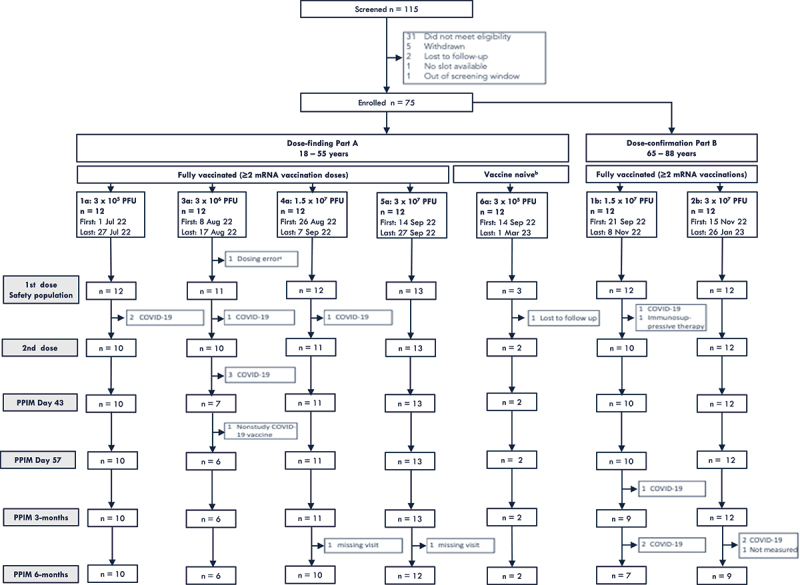
Participant disposition and analysis sets analyzed.
Seventy-two healthy adults fully vaccinated with mRNA vaccines were enrolled into the trial to receive two doses of Prime-2-CoV_Beta, 28 days apart: 48 participants aged 18–55 were enrolled in the dose-finding part (A), and 24 participants aged 65–85 were enrolled in the dose-confirmation part (B). The safety analysis set included all participants who received at least one dose of Prime-2-CoV_Beta. Immunogenicity analyses were performed in the per-protocol immunogenicity population (PPIM), including all participants who received both scheduled vaccinations and who had no major protocol deviations up to day 57. During follow-up, samples were included in the longitudinal immune-monitoring analysis up to the latest visit prior to any major deviation. n = number of participants.
a. One dosing error occurred in group 3a (n = 1 participant was assigned to Prime-2-CoV_Beta 3 × 10⁶ PFU but received 3 × 10⁷ PFU as first dose).
b. Data not reported in this report.
Procedures
Prime-2-CoV_Beta was manufactured and vialed by ABL Europe (France) and Nova Laboratories (UK) according to Good Manufacturing Practices (Material S1). Before each administration, the vaccine was thawed and diluted, as applicable, with sterile saline solution to the appropriate dose. One dose (1.0 mL each) of Prime-2-CoV_Beta was administered by intramuscular injection using the deltoid site on day 1 for the first vaccination and day 29 for the second vaccination.
Part A of the study included four groups of pre-vaccinated adults aged 18–55 to assess Prime-2-CoV_Beta at escalating dose levels (3 × 10⁵, 3 × 10⁶, 1.5 × 10⁷, and 3 × 10⁷ PFU), followed by Part B to assess two dose levels selected from data generated in Part A in pre-vaccinated adults aged 65–85. Participants were sequentially assigned to dose groups (each consisting of 12 subjects). Part A implemented a sentinel dosing and subject staggering design. For each dose level, sentinel subjects were dosed at least 48 h ahead of the remaining sentinel group(s), with intervals of at least 1 hpur (h) between the first seven participants and then at least 30 minutes (min) intervals for the remaining five participants. A safety review committee oversaw the safety of participants and reviewed the accumulating data in support of the dose escalation decisions. For each dose group, decision-making criteria were based on data from the first seven participants up to 7 days, and from the remaining five participants up to 48 h after the first dose. Reactogenicity and immunogenicity data assessed in Part A informed the selection of the 1.5 × 10⁷ and 3 × 10⁷ PFU dose being evaluated in Part B.
Sentinel participants were observed on-site for at least 6 h after each vaccination, all other participants were observed for at least 60 (Part A) or 30 min (Part B) after each vaccination. Participants were also monitored by phone calls at 24 and 48 h after the first vaccination and a phone call or site visit at 48 h/2 days after the second vaccination. Local and systemic solicited Adverse Events (AEs) were recorded daily over 14 days after each vaccination using an eDiary. Unsolicited Treatment-Emergent Adverse Events (TEAEs) were collected for a period of 28 days after each vaccination, Serious Adverse Events (SAEs) and Adverse Events of Special Interest (AESIs) were collected up to 12 months after the first vaccination. Scheduled follow-up visits covered laboratory assessments including biochemistry, hematology, and coagulation tests, vital signs, electrocardiogram (ECG), and cardiac markers. Participants also underwent a nasopharyngeal swab test for COVID-19 before each vaccination and were asked to report any SARS-CoV-2 infection confirmed by NAAT- or antigen-test. Solicited reactions, AEs and laboratory abnormalities were graded according to the US Food and Drug Administration toxicity grading scale.
Blood for immunogenicity testing was collected on day 1 prior to administration of Prime-2-CoV_Beta, and on days 8, 15, 29 (pre-dose), 43, 57, 85, and 183. Serum was processed on site, aliquoted, and stored at −80°C until shipment. Peripheral blood mononuclear cells (PBMC) from whole blood were isolated at sites using Ficoll density gradient centrifugation. Isolated cells were cryopreserved and stored at −80°C, shipped to central depot on dry ice, and were then transferred to liquid nitrogen for shipment and storage until further use.
Serum IgG levels against SARS-CoV-2 Spike-(S1), the receptor-binding domain (RBD) of the wild type and Beta variant (RBD-Beta), and Nucleocapsid-(N) protein were quantified by in-house Enzyme-linked immunosorbent assays (ELISA) (Method S1). Neutralizing antibodies against the early SARS-CoV-2 strain Wuhan-Hu-1 (Victoria/01/2020) and subsequent variants Beta (B.1.351), Delta (B.1.617.2) and Omicron (BA.5 and XBB.1.5) were measured as median tissue culture infectious dose (TCID50) using a micro-neutralization (MN) assay using live virus cytopathic effect (CPE) defined as MN-CPE (Method S2). Further, exploratory immunogenicity assessments included determination of the avidity of IgG directed toward RBD and RBD-Beta in participants of the highest dose groups (Method S3). Serum IgG antibodies against ORFV were quantified using in-house ELISA. Sera yielding a positive titer >20 underwent further analysis for their ORFV-neutralization capacity by MN-CPE (Method S4). S1- and S2-specific CD4+ and CD8+ T cells were measured by intracellular flow cytometry following simulation with overlapping peptide pools in a subset of participants aged 18–55 (Method S5).
Outcomes
The primary endpoints for safety were incidence and severity of solicited local and systemic reactions within 7 days after each vaccination, and unsolicited AEs within 28 days. Secondary safety endpoints included solicited reactions within 14 days after each vaccination, laboratory abnormalities, vital signs, ECG, as well as SAEs and AESIs through 12 months after the first dose. Secondary endpoints for immunogenicity were the geometric mean concentration (GMC) of SARS-CoV-2-specific binding IgG antibodies, and the geometric mean titer (GMT) of neutralizing antibodies against Victoria/01/2020 and variants of concern at each time point, and the geometric mean fold rise (GMFR) of GMC and GMT from baseline. Exploratory immunogenicity endpoints included SARS-CoV-2-specific CD4+/CD8+ T cell responses, RBD- and RBD-Beta-specific IgG avidity, and ORFV binding and neutralizing antibody titers.
Statistics
The sample size was estimated to allow a descriptive summary of the safety of different dose levels of Prime-2-CoV_Beta. With 12 participants per dose group, the probability to observe any AE with an event rate of 15% at least once per group is 86.5%. Safety analyses were performed on the safety population, including all participants who received at least one vaccination. Solicited and unsolicited AEs were summarized as counts and percentages. Unsolicited AEs were coded by Medical Dictionary for Regulatory Activities (MedDRA) version 25.1. Immunogenicity analyses were performed in the PPIM. For neutralizing and binding antibodies, GMTs/GMCs and GMFRs along with 95% Confidence Intervals (CIs) were calculated for each dose group. Additional post-hoc immunological analyses included comparison of post-dose humoral and cellular (14 and 28 days after each injection, respectively) responses to baseline, and evaluation of the impact of pre-existing SARS-CoV-2 immunity on Prime-2-CoV_Beta responses. Statistical comparisons used non-parametric tests (Wilcoxon test, Kruskal–Wallis test, Mann–Whitney test, Spearman’s rank test). Multiple comparison issues were not addressed with respect to these post-hoc exploratory immunogenicity analyses. Statistical analyses of immune data were performed using GraphPad Prism (Version 10.0.2 for macOS).
Results
Study participants
Between July 1, 2022, and January 26, 2023, a total of 72 healthy adults who had previously been vaccinated with at least two doses of an mRNA vaccine (primary series with or without booster doses) were enrolled to receive a double dose of Prime-2-CoV_Beta 28 days apart (Figure 1). Among these participants, 48 participants aged 18–55 were recruited into Part A of the study and assigned to four dose levels to receive Prime-2-CoV_Beta at 3 × 10⁵, 3 × 10⁶, 1.5 × 10⁷, or 3 × 10⁷ PFU (12 subjects per group). Additionally, 24 participants aged 65–85 were recruited into Part B and assigned to 2 dose levels to receive Prime-2-CoV_Beta at either 1.5 × 10⁷ or 3 × 10⁷ PFU. Baseline characteristics of pre-vaccinated participants are presented in Table 1. Enrollment of vaccine-naïve participants aged 18–55 was prematurely discontinued due to feasibility constraints. This report presents the safety and immunogenicity data collected from pre-vaccinated participants over a period of 6 months after administration of the first dose of Prime-2-CoV_Beta.
Table 1.
Characteristics of study participants at screening visit by age group, vaccination status, and dose group.
| Part A − 18 – 55 years |
Part B − 65 - 85 years |
|||||||||
|---|---|---|---|---|---|---|---|---|---|---|
| Pre-vaccinated |
Pre-vaccinated |
|||||||||
| 3 × 10⁵ PFU (n = 12) |
3 × 10⁶ PFU (n = 11*) |
1.5 × 10⁷ PFU (n = 12) |
3 × 10⁷ PFU (n = 13) |
Total | 1.5 × 10⁷ PFU (n = 12) |
3 × 10⁷ PFU (n = 12) |
Total | |||
| Sex, n (%) | ||||||||||
| Female | 5 (41.7) | 7 (63.6) | 6 (50.0) | 8 (61.5) | 26 (54.2) | 5 (41.7) | 10 (83.3) | 15 (62.5) | ||
| Male | 7 (58.3) | 4 (36.4) | 6 (50.0) | 5 (38.5) | 22 (45.8) | 7 (58.3) | 2 (16.7) | 9 (37.5) | ||
| Race, n (%) | ||||||||||
| Asian | 0 | 1 (9.1) | 0 | 0 | 1 (2.1) | 0 | 0 | 0 | ||
| Black/African American | 1 (8.3) | 1 (9.1) | 0 | 0 | 2 (4.2) | 0 | 2 (16.7) | 2 (8.3) | ||
| White | 11 (91.7) | 9 (81.8) | 12 (100) | 13 (100) | 45 (93.8) | 12 (100) | 10 (83.3) | 22 (91.7) | ||
| Ethnicity, n (%) | ||||||||||
| Hispanic or Latino | 1 (8.3) | 0 | 0 | 0 | 1 (2.1) | 0 | 0 | 0 | ||
| Non Hispanic or Latino | 11 (91.7) | 11 (100) | 12 (100) | 13 (100) | 47 (97.9) | 12 (100) | 12 (100) | 24 (100) | ||
| Median age, years (range) | 26.5 (21-54) |
42.0 (22-54) |
31.0 (22-52) |
32.0 (24-55) |
31.5 (21-55) |
71.5 (65-79) |
68.0 (65-73) |
69.8 (65-79) |
||
| Mean BMI, kg/m2 (SD) | 23.2 (2.6) | 24.5 (3.1) | 24.1 (3.8) | 24.8 (3.1) | 24.2 (3.1) | 25.3 (1.9) | 24.6 (3.6) | 24.9 (2.8) | ||
| Prior mRNA vaccination, n (%) | ||||||||||
| 2 doses | 5 (41.7) | 1 (9.1) | 3 (25.0) | 3 (23.1) | 12 (25.0) | 0 | 2 (16.7) | 2 (8.3) | ||
| 3 doses | 7 (58.3) | 10 (90.9) | 9 (75.0) | 9 (69.2) | 35 (72.9) | 7 (58.3) | 4 (33.3) | 11 (45.8) | ||
| 4 doses | 0 | 0 | 0 | 1 (7.7) | 1 (2.1) | 5 (41.7) | 5 (41.7) | 10 (41.7) | ||
| ≥5 doses | 0 | 0 | 0 | 0 | 0 | 0 | 1 (8.3) | 1 (4.2) | ||
| Vaccine manufacturer, n (%) | ||||||||||
| Pfizer-BioNTech | 9 (75.0) | 7 (63.6) | 8 (67.7) | 10 (76.9) | 34 (70.8) | 6 (50.0) | 7 (58.3) | 13 (54.2) | ||
| Moderna | 2 (16.7) | 1 (9.1) | 2 (16.7) | 3 (23.1) | 8 (16.7) | 2 (16.7) | 1 (8.3) | 3 (12.5) | ||
| Heterologous mRNA | 1 (8.3) | 3 (27.3) | 2 (16.7) | 0 | 6 (12.5) | 4 (33.3) | 4 (33.3) | 8 (33.3) | ||
| Time since last vaccination, months (range) | 7.5 (3.1-14-2) |
8.3 (6.8-14.0) |
9.0 (6.1-15.8) |
9.8 (5.7-17.3) |
8.7 (3.1-17.3) |
9.2 (4.9-12.0) |
9.6 (2.2-13.8) |
9.4 (2.2-13.8) |
||
| Self-reported prior COVID-19 infection#, n (%) | 6 (50.0) | 4 (36.4) | 5 (41.7) | 5 (38.5) | 20 (41.7) | 2 (16.7) | 2 (16.7) | 4 (16.7) | ||
| Time since last COVID-19 infection, months (range) | 6.2 (4.5-27.9) |
5.1 (2.8-6.5) |
7.9 (2.9-15.9) |
6.9 (1.9-9.9) |
6.6 (1.9-27.9) | 10.9 (9.8-12.0) |
12.4 (8.6-16.2) |
11.7 (8.6-16.2) |
||
SD = standard deviation. *One subject assigned to dose group 3 × 10⁶ PFU incorrectly received a dose of 3 × 10⁷ PFU at the first vaccination on day 1; as per Statistical Analysis Plan definition, this subject is listed under dose group 3 × 10⁷ PFU. #Prior COVID-19 infection was self-reported, as determined by positive NAAT- or antigen-test result.
Safety
Prime-2-CoV_Beta was overall well tolerated. Across both age groups, the most common solicited reactions within 7 days of any dose were pain at the injection site, headache, fatigue, and myalgia (Figure 2). Most solicited reactions occurred during the first 1–2 days after vaccination and had a short duration, with a median time to resolution of 1–2 days. All solicited reactions were mild or moderate in intensity, except for two reports of severe fatigue and temperature increase 6 and 7 days following the first and second vaccination, respectively, in two participants aged 18–55, one in the 1.5 × 10⁷ and one in the 3 × 10⁶ PFU group, and two reports of intermittent severe headache and fatigue 5–7 days after the second vaccination in a participant aged 65–85 of the 3 × 10⁷ PFU group. Solicited systemic reactions were more common among participants aged 18–55 than in participants aged 65–85. Overall, no clear dose-effect was observed. Frequencies of solicited reactions were in general similar following the first and second vaccination.
Figure 2.
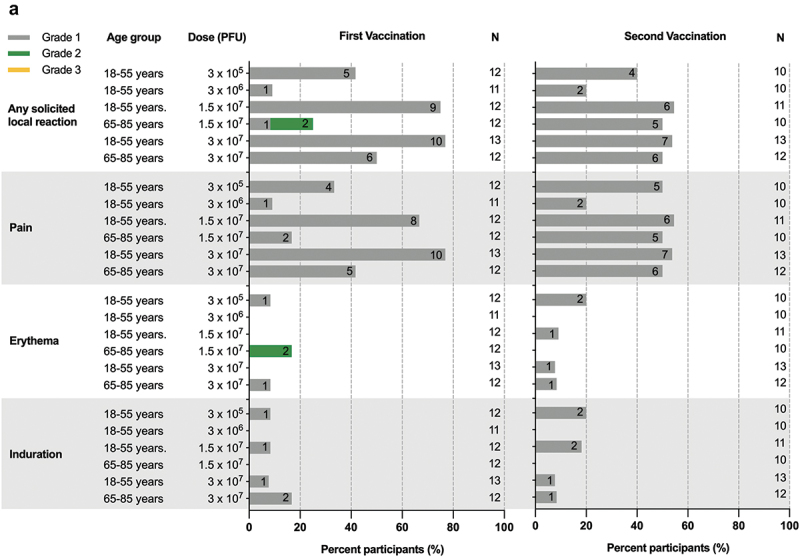
Solicited adverse reactions within 7 days after each study vaccination. (a) The percentages of participants reporting any solicited local AEs of the indicated severity up to 7 days after the first (left) or second (right) vaccination. (b) The percentages of participants reporting any solicited AEs of the indicated severity up to 7 days after the first (left) or second (right) vaccination. The highest severity grade is shown in case there were multiple reports of a given reaction per participant. Number of participants included in the solicited safety population are shown on the right of each diagram.
Figure 2.
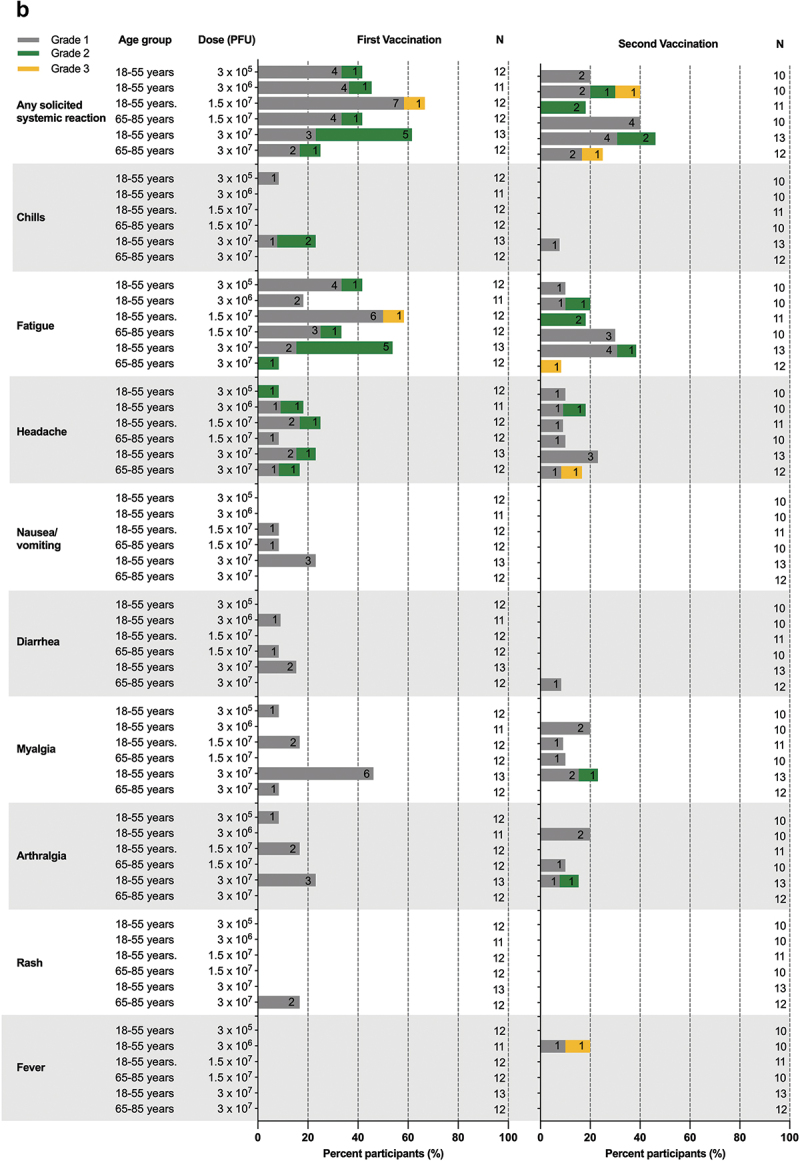
Continued.
44 (61%) of 72 participants reported at least one unsolicited AE within 28 days of any dose. The vast majority of AEs was mild to moderate in intensity and appeared to be distributed similarly across dose levels of both age groups (Table S1). Two severe AEs were reported: one case of serious nausea with emesis in one of the participants aged 18–55 of the 3 × 10⁶ PFU group, and one case of non-serious palpitations in one of the participants aged 65–85 of the 1.5 × 10⁷ PFU group. Both events were not considered related to vaccination. Two unrelated SAEs leading to hospitalization (alcohol abuse and alcohol withdrawal) occurred 26 and 44 days after the second vaccination in a participant aged 18–55 in the 3 × 10⁶ PFU group. No SAEs attributed to Prime-2-CoV_Beta were reported, and none of the prespecified stopping rules were met.
Immunogenicity
In the 18–55 age group, distinct neutralizing antibody responses measured by live SARS-CoV-2 MN-CPE assay were only observed after vaccination with Prime-2-CoV_Beta at a dose of 3 × 10⁷ PFU. Specifically, in this dose group, vaccination with Prime-2-CoV_Beta resulted in a significant 3.2- and 3.5-fold increase in GMTs of neutralizing antibodies against the early SARS-CoV-2 Wuhan-Hu-1 (Victoria/01/2020) and the Beta variant, and a significant 2.3- and 2.5-fold increase in GMTs of cross-neutralizing antibodies against the Delta and Omicron BA.5 variant 28 days after the first vaccination (Figure 3). Neutralizing antibody titers were not further increased following the second dose, however, titers remained elevated over baseline through day 183 in all dose groups. Neutralizing capacity against Omicron variant XXB.1.5 was overall modest and substantially reduced in comparison to Victoria (Figure S1).
Figure 3.
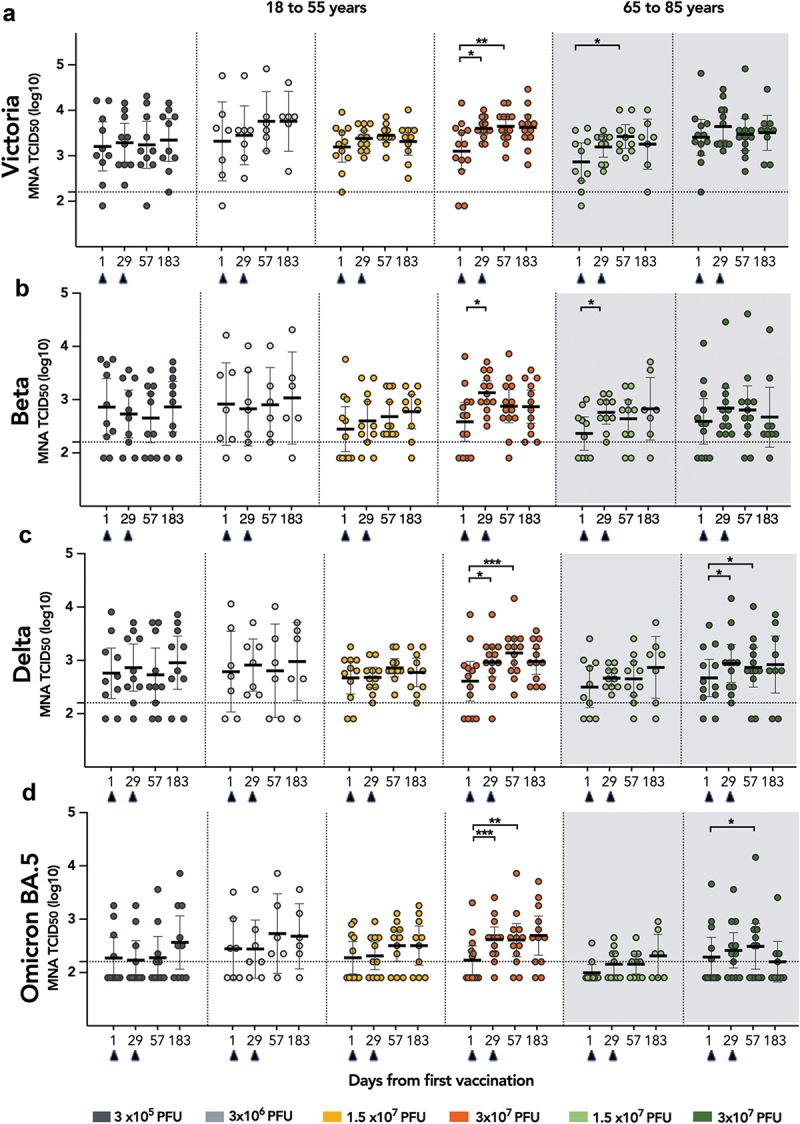
SARS-CoV-2 neutralizing antibody responses at key time points.
(a to d) Neutralizing antibody titers to Victoria/01/2020 (a), Beta (b), Delta (c), and Omicron variant BA.5 (d) assessed by MN-CPE at day 1 (baseline), and days 29, 57, and 183 following Prime-2-CoV_Beta at different dose levels in the two age groups participants aged 18–55 (left) and 65–85 (right, shaded gray). Each dot represents the TCID50 titer of each serum sample, bars represent group GMTs, error bars represent 95% CIs. LLOQs are presented as dotted lines. Arrowheads show time of vaccination. For each dose group, antibody titers from each post-baseline timepoint were compared to baseline (day 1) using a two-tailed Wilcoxon matched-pairs signed rank test. Kruskal Wallis test (age group 18–55) and Mann–Whitney test (age group 65–85) were used for comparison between dose groups. p values are marked with *p < .05; **p < .01; ***p < .001. Only significant comparisons are indicated. LLOQ = Lower limit of quantification.
In the group of participants aged 18–55 a single dose of 3 × 10⁷ PFU of Prime-2-CoV_Beta resulted in an increase in S1-, RBD-, RBD-Beta-, and N-binding IgG antibodies after the first vaccination. IgG antibody responses were not further enhanced by a second vaccination (Figure 4, S2). For all dose groups, IgG levels were maintained at or above baseline levels at 6 months after the first vaccination. SARS-CoV-2 binding and neutralizing antibodies were modestly increased in participants aged 65–85 following Prime-2-CoV_Beta at both dose levels. However, antibody titers were similarly maintained at around baseline titers through day 183 in the group of participants aged 65–85 (Figures 3, 4, S1, S2).
Figure 4.
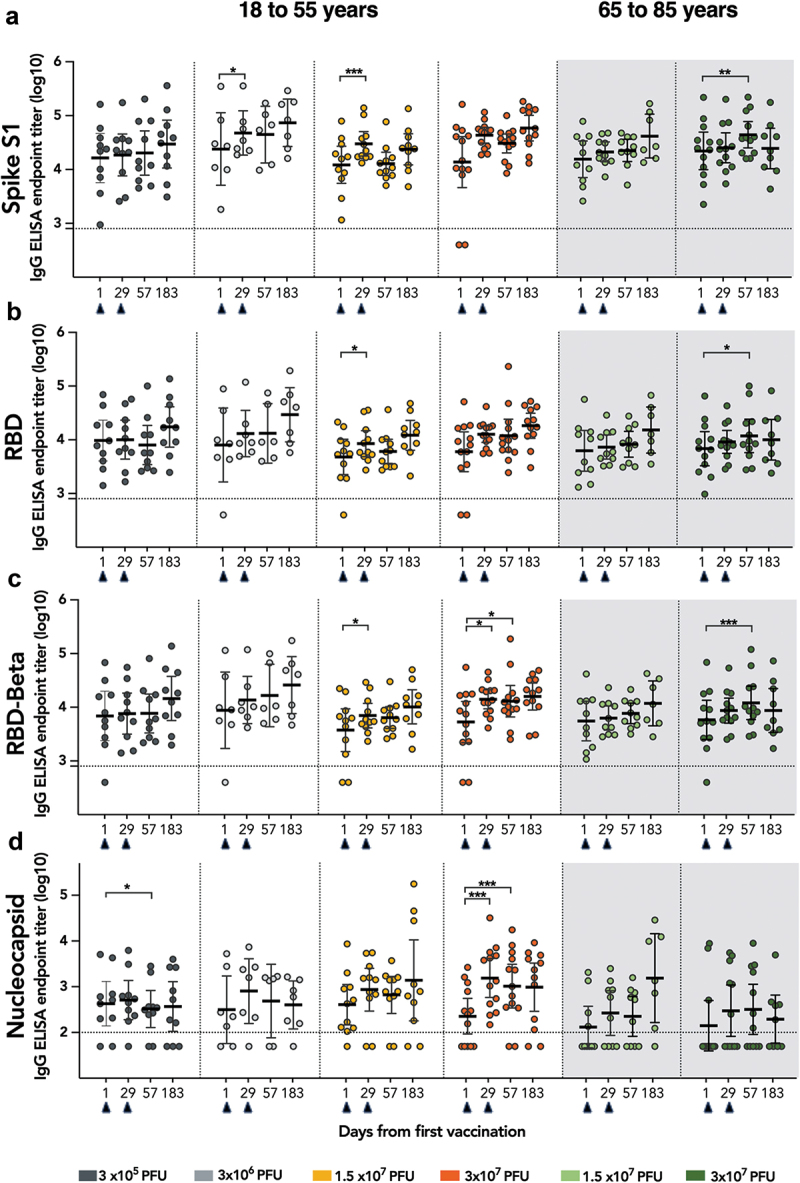
SARS-CoV-2 IgG-binding antibody responses at key time points.
(a to d) IgG-binding antibody levels to SARS-CoV-2 S1 (a), RBD (b), RBD-Beta (c), and N (d) assessed by ELISA at day 1 (baseline), day 29 (28 days after the first dose), day 57 (28 days after the second dose), and day 183 following Prime-2-CoV_Beta at different dose levels in participants aged 18–55 (left) and 65–85 (right, shaded gray). Each dot represents the reciprocal endpoint titer of each sample, bars represent group GMCs, error bars represent 95% CIs. LLOQs are presented as dotted lines. For each dose group, antibody titers from each post-baseline timepoint were compared to baseline (i.e., day 1) using a two-tailed Wilcoxon matched-pairs signed rank test. Differences between dose groups were evaluated using the Kruskal–Wallis test (age group 18–55) and Mann–Whitney test (age group 65–85). p values are marked with *p < .05; **p < .01; ***p < .001. Only significant comparisons are indicated.
Post-hoc analyses including data from the two highest dose groups (1.5 and 3 × 10⁷ PFU) showed a stronger neutralizing antibody response after boosting with Prime-2-CoV_Beta in participants with low baseline titers (<GMT), while those with a high baseline titer (GMT) did not exhibit significant GMT fold-changes over baseline (Figure 5). A significant inverse correlation between pre-existing antibody titers and neutralizing antibody responses following vaccination with Prime-2-CoV_Beta for Victoria, Beta, and Delta in both age groups was found (Figure S3). The same trend was observed for SARS-CoV-2-specific IgG responses (Figure S4).
Figure 5.
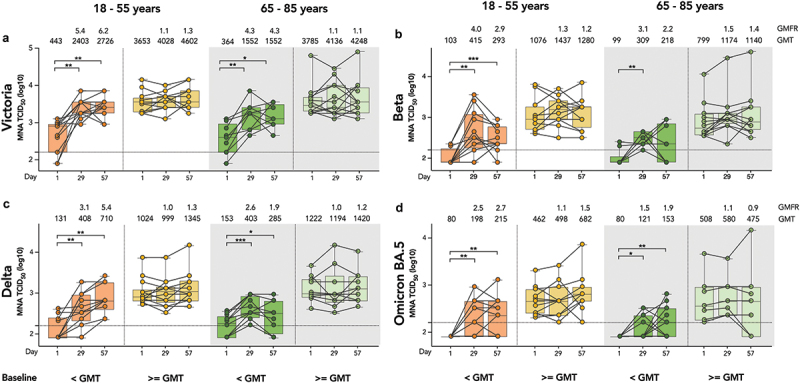
Fold-increase of neutralizing antibodies in participants with low versus high baseline titers.
(a to d) Fold increases in neutralizing antibody titer (TCID50 log10) by MNA assay against the Victoria/01/2020 (a), Beta (b), Delta (c), and Omicron BA.5 (d) strains at days 1, 29, and 57 in participants with low and high baseline neutralizing titers. Sera from participants of dose groups 1.5 × 10⁷ and 3 × 10⁷ PFU aged 18–55 (n = 24) (left) and 65–85 (n = 22) (right, shaded gray) from days 1, 29, and 57 were regrouped based on GMT levels at baseline (day 1), i.e., antibody titers below and equal to/above the GMT were considered low and high baseline titers, respectively. Wilcoxon test was used for paired statistical comparison; *p < .05, **p < .01, ***p < .001; only significant p values are indicated. Horizontal lines represent the LLOQ.
Antibody avidity maturation
To provide further insight into the antibody affinity maturation after vaccination, the avidity of IgG against the SARS-CoV-2 ancestral RBD and RBD-Beta was evaluated as a surrogate marker for affinity in the 1.5 and 3 × 10⁷ PFU dose groups of both age populations on an exploratory basis. IgG avidity to both RBD and RBD-Beta, expressed as avidity index (AI), was generally high in both age groups at study entry. As for neutralizing and binding antibodies, increases in IgG avidity following Prime-2-CoV_Beta were most evident in participants with low baseline avidity (Figure 6). For the 18–55 age group, a significant correlation between fold-increases in neutralizing titers against Victoria and changes in anti-RBD IgG avidity was found, indicating a possible functional relevance of IgG antibody avidity maturation observed after Prime-2-CoV_Beta vaccination (Figure 6).
Figure 6.
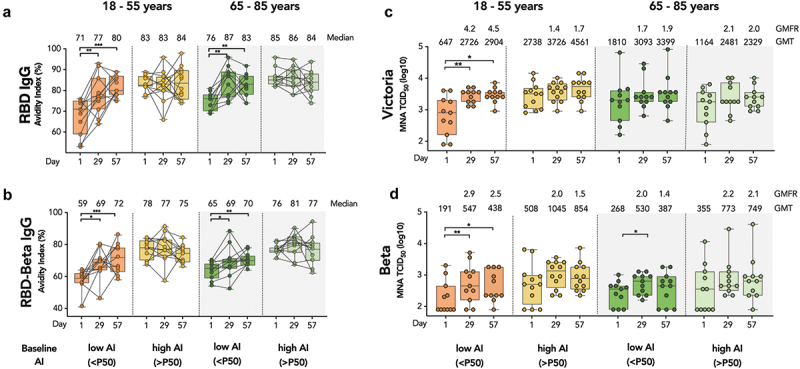
Change in IgG antibody avidity and neutralizing response in participants with high versus low antibody avidity at baseline.
(a to d) Increase in RBD (a) and RBD-Beta (b) binding IgG antibody avidity and fold-change in neutralizing antibody titer against Victoria/01/2020 (c) and the Beta (d) strain from baseline to days 28 and 57 after administration of Prime-2-CoV_Beta in participants with low and high baseline avidity. Sera from participants of dose groups 1.5 and 3 × 10⁷ PFU aged 18–55 (n = 23) and 65–85 (n = 22) were regrouped into low-avidity (below the baseline 50th percentile) and high-avidity (50th percentile and above) based on their baseline. Antibody avidity is expressed as AI. Neutralizing antibody titer was measured by MNA (microneutralization assay, TCID50). Data are presented as boxplots (median, whiskers, and interquartile range). Individual datapoints are overlayed. Wilcoxon test was used for paired statistical comparison; *p < .05, **p < .01, ***p < .001; only significant p values are indicated.
T cell responses
Using significant binding and neutralizing antibody responses as the basis for assessing T cell responses, CD4+/CD8+ T cell responses were only evaluated in participants aged 18–55 in the 3 × 10⁷ PFU group. Pre-existing S-specific CD4+ and/or CD8+ T cells were detectable at baseline in the large majority of participants. Upon restimulation with the S1 pool, polyfunctional (IFN-γ+ TNFα+ IL-2+) CD4+ T cells were observed after the first dose of Prime-2-CoV_Beta (Figure 7). S1-specific polyfunctional CD8+ T cells marginally increased after the first, but significantly increased after the second dose. Participants displayed comparatively high levels of CD4+ and CD8+ T cells against the S2 pool at baseline. No significant changes in S2-specific cytokine producing CD4+ and CD8+ cells were observed after the first or second vaccination.
Figure 7.
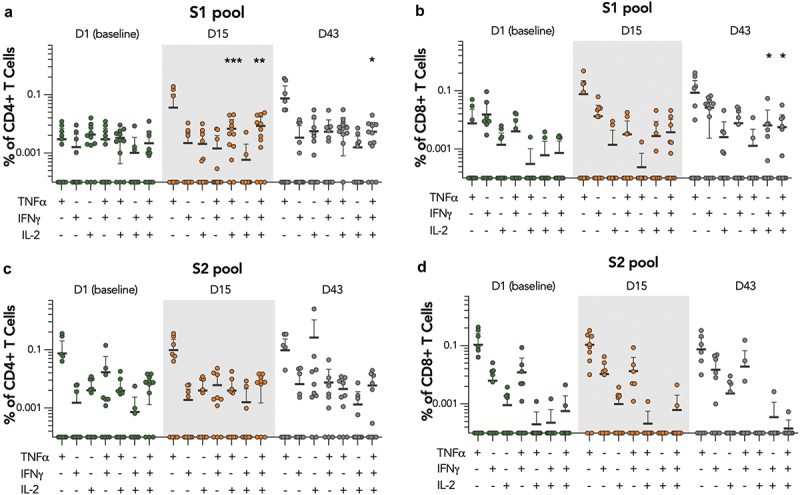
Prime-2-CoV_Beta induced T cell responses to S1/S2 peptide pools.
(a to d) Cellular immune response was measured by intracellular cytokine staining in 12 subjects from the 3 × 10⁷ PFU dose group at baseline (D1), 14-days after the first vaccination (D15) and the second vaccination (D43). CD4+ T cells (a-b) and CD8+ T cells (c-d) were analyzed for intracellular expression of cytokines positive cells (TNFα, IFNγ, and IL-2) upon restimulation overnight with peptides pool covering either S1 (a and c) or S2 (b and d). Data obtained after Boolean gating in FlowJo are presented as the mean of frequencies of CD4+ T cells and CD8+ T cells secreting each cytokine or any combination of TNFα, IFNγ, and IL-2. Wilcoxon test was used for paired statistical comparison to baseline (D1); *p < .05, **p < .01; only significant p values are indicated.
Anti-vector immunity
Anti-ORFV antibodies were assessed on an exploratory basis. A trend for an increase in the number and percentage of participants with positive anti-ORFV IgG antibodies after the second dose was found for dose groups 1.5 and 3 × 10⁷ PFU (Figure S5). 51% (21/41) of serum samples of participants aged 18–55 and 50% (11/22) of the samples of participants aged 65–85 had a titer of 20 or above and were analyzed for their ORFV-neutralizing capacity. None of the samples tested had a measurable ORFV-neutralizing titer of greater than 80, a value above which an impact on the virus immunogenicity can be anticipated since a neutralizing antibody titer in the range of 80–160 was reported for a positive control (Table 2).
Table 2.
IgG binding (A) and neutralizing (B) anti-ORFV antibodies in serum samples from participants at baseline (D1) and 14 days after each vaccination (D15, D43). Part a reports the number of samples (x) with an anti-orfv IgG antibody titer >20 in participants aged 18–55 (n = 41) and participants aged 65–85 (n = 22) participants across the different dose groups. Samples with an anti-ORFV IgG titer >20 underwent further testing for their neutralizing capacity. Part B reports the number of samples (x) at each sampling time point with neutralizing antibodies to ORFV in the indicated categories (<80, 80, >80) in participants aged 18–55 (n = 21) and 65–85 (n = 11) across the different dose groups.
| Age group 18 - 55 years |
Age group 65 – 85 years |
|||||||||||||||||||||||
|---|---|---|---|---|---|---|---|---|---|---|---|---|---|---|---|---|---|---|---|---|---|---|---|---|
| 3 × 10⁵ PFU n = 10 |
3 × 10⁶ PFU n = 7 |
1.5 × 10⁷ PFU n = 11 |
3 × 10⁷ PFU n = 13 |
1.5 × 10⁷ PFU n = 10 |
3 × 10⁷ PFU n = 12 |
|||||||||||||||||||
| A | ||||||||||||||||||||||||
| ELISA IgG titer x (%) | D1 | D15 | D43 | D1 | D15 | D43 | D1 | D15 | D43 | D1 | D15 | D43 | D1 | D15 | D43 | D1 | D15 | D43 | ||||||
| <20 | 7 (70) | 7 (70) | 9 (90) | 6 (86) | 6 (86) | 4 (57) | 10 (91) | 7 (64) | 5 (45) | 11 (85) | 12 (92) | 7 (54) | 8 (80) | 8 (80) | 7 (70) | 7 (58) | 6 (50) | 4 (33) | ||||||
| >20* | 3 (30) | 3 (30) | 1 (10) | 1 (14) | 1 (14) | 3 (43) | 1 (9) | 4 (36) | 6 (55) | 2 (15) | 1 (8) | 6 (46) | 2 (20) | 2 (20) | 3 (30) | 5 (42) | 6 (50) | 8 (67) | ||||||
| B | ||||||||||||||||||||||||
| ORFV nAb (TCID50) x | D1 (n = 3) |
D15 (n = 3) |
D43 (n = 1) |
D1 (n = 1) |
D15 (n = 1) |
D43 (n = 3) |
D1 (n = 1) |
D15 (n = 4) |
D43 (n = 6) |
D1 (n = 2) |
D15 (n = 1) |
D43 (n = 6) |
D1 (n = 2) |
D15 (n = 2) |
D43 (n = 3) |
D1 (n = 5) |
D15 (n = 6) |
D43 (n = 8) |
||||||
| <80 | 3 | 3 | 1 | 1 | 1 | 3 | 1 | 4 | 6 | 2 | 1 | 6 | 2 | 2 | 3 | 5 | 6 | 7 | ||||||
| = 80 | 1 | |||||||||||||||||||||||
| >80 | 0 | 0 | 0 | 0 | 0 | 0 | 0 | 0 | 0 | 0 | 0 | 0 | 0 | 0 | 0 | 0 | 0 | 0 | ||||||
*Samples underwent further testing for neutralizing capacity.
Discussion
Here, we report results from the FIH study of the SARS-CoV-2 multi-antigen vaccine Prime-2-CoV_Beta, the first clinical candidate derived from the novel ORFV platform. We found that Prime-2-CoV_Beta administered as a double-dose booster in healthy adults previously vaccinated with mRNA vaccines was well-tolerated. In participants aged 18–55 after a single Prime-2-CoV_Beta dose, enhanced cross-variant neutralizing activity relative to baseline immunity was observed. Importantly, Prime-2-CoV_Beta did not induce neutralizing anti-vector antibodies after two doses, further highlighting the potential of this novel ORFV vaccine platform.
Prime-2-CoV_Beta was safe and well tolerated in both age groups and across all dose levels. Solicited reactions were overall less frequent in participants aged 65–85 consistent with reports from other COVID-19 vaccine studies.10,11 Prime-2-CoV_Beta appeared to have a favorable reactogenicity profile compared to mRNA-based and adjuvanted booster vaccines, solicited reactions reported were milder in nature and included lower incidence of fever, chills, and malaise.11–14 The pattern of solicited reactions did not considerably differ from the reactogenicity profile of adenoviral vectored COVID-19 vaccines, although solicited reactions following Prime-2-CoV_Beta tended to be milder overall.10,15
Prime-2-CoV_Beta administered as a heterologous booster was immunogenic at higher doses in the group of participants aged 18–55. A single vaccine dose of 3 × 10⁷ PFU boosted both binding and neutralizing antibody titers, which were not further enhanced by a second dose. Neutralizing activity was broad in sera of the 3 × 10⁷ PFU group, whereby, however, a reduced activity against the Beta and Delta variant, and a marked reduction in the GMTs of neutralizing antibodies against the Omicron BA.5 variant was observed. Of note, reduced sensitivity of SARS-CoV-2 variants Beta and Delta to antibody neutralization, and a significantly lower neutralizing sensitivity of Omicron variant BA.5 to immune sera elicited by prototype mRNA booster vaccines have been reported.16,17 Cross-neutralization activity against Omicron XBB.1.5 was overall modest, in line with previous reports on mRNA boosters (monovalent original or Omicron-adapted bivalent booster) suggesting reduced neutralization against newly emerging Omicron sublineages.18 Participants aged 65–85 experienced modest changes in neutralizing antibody levels following vaccination with Prime-2-CoV_Beta at the two dose levels. Previous evidence described reduced antibody responses to COVID-19 vaccines in older adults compared to younger and middle-aged adults, which has been attributed to age-related immunosenescence.19,20 Notably, neutralizing antibody titers against the ancestral and SARS-CoV-2 variants showed a promising limited decay in participants of both age groups and were maintained at around baseline titers through day 183 after the first vaccination.
Neutralizing antibody titers in participants aged 18–55 vaccinated with Prime-2-CoV_Beta, as measured by live virus MN-CPE, were generally lower than those reported in previous studies after three or four doses of commercialized mRNA vaccines,16,21,22 although a direct comparison is hampered by the use of different test assays. A possible explanation for the overall modest boosting effect could be that, first, the immunogenicity of Prime-2-CoV_Beta as a booster is still suboptimal at a dose of 3 × 10⁷ PFU and the vaccine could benefit from increasing the dose, particularly in the participants aged 65–85. Second, the boost effect may be diminished in individuals whose baseline response is high from recent infections and/or vaccination. In fact, recent evidence suggests that a ‘ceiling effect’ may be approached for some individuals after repeat booster vaccination.13
Participants aged 18–55 exhibited high baseline cross-neutralizing antibody titers, with 46% of participants aged 18–55 showing detectable Omicron BA.5 neutralizing antibodies by live-virus neutralization and corresponding GMTs that appeared to be higher than reported among SARS-CoV-2 naïve individuals after three doses of homologous mRNA vaccines.21,23 The study was conducted between July 2022 and January 2023 when Omicron and its subvariants were predominant. Seroprevalence of N-specific IgG was relatively high (76%) in participants aged 18–55, suggesting that a substantial proportion of those participants entered the study with hybrid immunity through vaccination and previous breakthrough infections. Of note, recent reports found that Omicron breakthrough infection in triple-immunized individuals is associated with enhanced cross-neutralization against diverse Omicron variants.24,25
To further assess the impact of baseline immunity on Prime-2-CoV_Beta induced immune responses, sera of participants of the highest dose groups were pooled and regrouped according to baseline antibody titers (below and equal to or above GMT). Boosting of neutralizing antibody responses indeed correlated negatively with the levels of pre-existing antibody titers in participants aged 18–55, suggesting that there was limited boosting from Prime-2-CoV_Beta in participants with high pre-existing immunity and there could be a ceiling or maximum neutralizing response for the doses tested. Similar observations were also reported in other studies with homo- and heterologous COVID-19 booster vaccines.13,26,27
Pre-existing or treatment-induced anti-vector immunity is still a major obstacle to achieving effective immunogenicity, especially for adenovirus vector-based vaccine strategies.28,29 In this FIH study, a favorable low prevalence of IgG binding antibodies and the absence of pre-existing neutralizing antibodies to the candidate vector were shown. A trend for an increase in anti-ORFV IgG responses at higher dose levels was observed; however, a double dose of Prime-2-CoV_Beta did not elicit any neutralizing anti-vector immunity up to the highest dose.
This trial has several limitations. Recruitment of vaccine naïve participants was significantly impacted by the rollout of authorized vaccines and led to premature discontinuation of vaccine naïve groups, limiting the exploration of the novel platform. Trial participants exhibited high baseline immunity and considerable heterogeneity regarding prior antigen exposure. Though promising, the durability of immune responses was only assessed up to 6 months after the first booster vaccination, and data on long-term responses are not available. Lastly, the dose range explored was limited and data suggests that the optimal vaccine dose has not yet been reached. Given the favorable tolerability of Prime-2-CoV_Beta, testing of higher doses is warranted to optimize the balance between tolerability and immunogenicity, particularly in the elderly population.
In conclusion, Prime-2-Cov_Beta was shown to be safe and well tolerated and induced cross-neutralizing antibody responses after a single dose of 3 × 10⁷ PFU, dependent on age group and pr-existing antibody levels. Repeated immunization was not associated with the formation of anti-vector neutralizing antibodies, as opposed to other vector-based vaccine platforms. Overall, our findings highlight the potential of this novel ORFV-based platform as an attractive tool for vaccine development.
Supplementary Material
Acknowledgments
We thank the participants of the ORFEUS trial for furthering SARS-CoV-2 vaccine research. We would also like to thank Knut Elbers, CEO of Vira Therapeutics for technical support in the manufacturing and critical review of this manuscript. In addition, we thank Martin Bexon, MBBS, for chairing the study Safety Review Committee.
Prime-2-CoV development was supported in part by the EXIST Forschungstransfer 03EFKBW171 of the German Ministry for Economic Affairs and Climate Action, which is co-financed by the European Social Fund and the Carl Zeiss Stiftung
Biography
Madiha Derouazi is Chief Scientific offer at AC Immune in Lausanne, Switzerland, since January 2024. AC Immune is a clinical-stage biopharmaceutical company in precision medicine to diagnose, treat, and prevent neurodegenerative diseases including with active immunotherapy. She joined from Speransa Therapeutics, where she had been CEO/CSO since inception in 2021, leading development of a novel platform of prophylactic vaccines. Previously, she founded AMAL Therapeutics in 2012, an immuno-oncology company developing a new generation of therapeutic cancer vaccines and served as CEO and CSO of the company until 2022. During her career, she has taken several vaccines platforms from research through pre-clinical development and first-in-human clinical trials.
She holds a PhD in Cellular Biotechnology from the Swiss Federal Institute of Technology (EPFL) in Lausanne, which was followed by postdoctoral work concentrating on tumor immunology and vaccine development.
Correction Statement
This article has been corrected with minor changes. These changes do not impact the academic content of the article.
Funding Statement
The work was supported by the EXIST Forschungstransfer [03EFKBW171] of the German Federal Ministry for Economic Affairs and Energy.
Disclosure statement
Rald Amann holds ownership interest in Prime Vector Technologies GmbH, a company involved in the development of ORFV-based vaccines. Additionally, Ralf Amann is an inventor of patents related to ORFV, including a patent application of Prime-2-CoV. Ute Klinkhardt, Sylvia E. Schwarz and Madiha Derouazi were employed by Speransa Therapeutics GmbH. Arnaud M. Didierlaurent declared personal consulting fees for participation to scientific advisory boards for Speransa, Bioaster and Sanofi Pasteur, and participation on a Data Safety Monitoring Board for AMC Biosciences, all unrelated to the present work and is the chairman of the WHO Technical advisory group for Emergency use listing of COVID-19 vaccines..
Author contributions
K.U., D.M., A.R., S.E.S., S.M., S.C., and S.D. designed the trial. S.M., E.J., S.C., S.D., R.B., K.A., S.C., H.K., and Z.A. conducted the clinical trial investigation. S.E.S., K.U., and D.M. provided project management for the trial, supervised the trial, the sample collection, and analysis during the course of the study. M.M., H.N., and D.A.M. performed the immunological lab work. K.U., S.M., E.J., S.C., S.D., R.B., A.R., M.M., K.A., S.C., H.K., Z.A., H.N., D.A.M., S.E.S., and D.M. analyzed and interpreted the data and results. K.U., D.M. wrote the original draft manuscript, which was critically reviewed and approved by all authors.
Data availability statement
De-identified participant data that underlie the results reported in this Article will be made available upon request to the corresponding author, m.derouazi@speransatherapeutics.com. Proposals will be reviewed and approved by the sponsor on the basis of compliance with the informed consent and scientific merit. Clinical study reports and study protocol with any amendments will be shared upon request to the corresponding author.
Supplementary material
Supplemental data for this article can be accessed on the publisher’s website at https://doi.org/10.1080/21645515.2024.2410574
References
- 1.Krammer F, Ellebedy AH.. Variant-adapted COVID-19 booster vaccines. Science. 2023;382(6667):157–14. doi: 10.1126/science.adh2712. [DOI] [PubMed] [Google Scholar]
- 2.Amann R, Rohde J, Wulle U, Conlee D, Raue R, Martinon O, Rziha H-J.. A new rabies vaccine based on a recombinant ORF virus (parapoxvirus) expressing the rabies virus glycoprotein. J Virol. 2013;87(3):1618–1630. doi: 10.1128/JVI.02470-12. [DOI] [PMC free article] [PubMed] [Google Scholar]
- 3.Reguzova A, Ghosh M, Müller M, Rziha HJ, Amann R. Orf virus-based vaccine vector D1701-V induces strong CD8+ T cell response against the transgene but not against ORFV-Derived epitopes. Vaccines (Basel). 2020;8(2):8. doi: 10.3390/vaccines8020295. [DOI] [PMC free article] [PubMed] [Google Scholar]
- 4.Reguzova A, Fischer N, Müller M, Salomon F, Jaenisch T, Amann R. A novel orf virus D1701-VrV-based dengue virus (DENV) vaccine candidate expressing HLA-Specific T cell epitopes: a proof-of-concept study. Biomedicines. 2021;9(12):1862. doi: 10.3390/biomedicines9121862. [DOI] [PMC free article] [PubMed] [Google Scholar]
- 5.Ahn JY, Lee J, Suh YS, Song YG, Choi YJ, Lee KH, Seo SH, Song M, Oh J-W, Kim M, et al. Safety and immunogenicity of two recombinant DNA COVID-19 vaccines containing the coding regions of the spike or spike and nucleocapsid proteins: an interim analysis of two open-label, non-randomised, phase 1 trials in healthy adults. Lancet Microbe. 2022;3(3):173–183. doi: 10.1016/S2666-5247(21)00358-X. [DOI] [PMC free article] [PubMed] [Google Scholar]
- 6.Sieling P, King T, Wong R, Nguyen A, Wnuk K, Gabitzsch E, Rice A, Adisetiyo H, Hermreck M, Verma M, Zakin L. Prime hAd5 spike + nucleocapsid vaccination induces Ten-fold increases in mean T-Cell responses in phase 1 subjects that are sustained against spike variants. medRxiv 2021:2021.04.05.21254940.
- 7.Chiuppesi F, Zaia JA, Frankel PH, Stan R, Drake J, Williams B, Acosta AM, Francis K, Taplitz RA, Dickter JK, et al. Safety and immunogenicity of a synthetic multiantigen modified vaccinia virus Ankara-based COVID-19 vaccine (COH04S1): an open-label and randomised, phase 1 trial. Lancet Microbe. 2022;3(4):252–264. doi: 10.1016/S2666-5247(22)00027-1. [DOI] [PMC free article] [PubMed] [Google Scholar]
- 8.Reguzova A, Sigle M, Pagallies F, Salomon F, Rziha HJ, Bittner-Schrader Z, Verstrepen B, Böszörményi K, Verschoor E, Elbers K, et al. A novel multi-antigenic parapoxvirus-based vaccine demonstrates efficacy in protecting hamsters and non-human primates against SARS-CoV-2 challenge. Res Sq [preprint]. 2023. doi: 10.21203/rs.3.rs-2832501/v1. [DOI] [Google Scholar]
- 9.Burri DJ, Renz L, Mueller M, Pagallies F, Klinkhardt U, Amann R, Derouazi M. Novel multi-antigen orf-virus-derived vaccine elicits protective anti-SARS-CoV-2 response in monovalent and bivalent formats. Vaccines. 2024;12(5):490. doi: 10.3390/vaccines12050490. [DOI] [PMC free article] [PubMed] [Google Scholar]
- 10.Hardt K, Vandebosch A, Sadoff J, Le Gars M, Truyers C, Lowson D, Van Dromme I, Vingerhoets J, Kamphuis T, Scheper G, et al. Efficacy, safety, and immunogenicity of a booster regimen of Ad26.COV2.S vaccine against COVID-19 (ENSEMBLE2): results of a randomised, double-blind, placebo-controlled, phase 3 trial. Lancet Infect Dis. 2022;22(12):1703–1715. doi: 10.1016/S1473-3099(22)00506-0. [DOI] [PMC free article] [PubMed] [Google Scholar]
- 11.Polack FP, Thomas SJ, Kitchin N, Absalon J, Gurtman A, Lockhart S, Perez JL, Pérez Marc G, Moreira ED, Zerbini C, et al. Safety and efficacy of the BNT162b2 mRNA covid-19 vaccine. N Engl J Med. 2020;383(27):2603–2615. doi: 10.1056/NEJMoa2034577. [DOI] [PMC free article] [PubMed] [Google Scholar]
- 12.Mallory RM, Formica N, Pfeiffer S, Wilkinson B, Marcheschi A, Albert G, McFall H, Robinson M, Plested JS, Zhu M, et al. Safety and immunogenicity following a homologous booster dose of a SARS-CoV-2 recombinant spike protein vaccine (NVX-CoV2373): a secondary analysis of a randomised, placebo-controlled, phase 2 trial. Lancet Infect Dis. 2022;22(11):1565–1576. doi: 10.1016/S1473-3099(22)00420-0. [DOI] [PMC free article] [PubMed] [Google Scholar]
- 13.Munro APS, Feng S, Janani L, Cornelius V, Aley PK, Babbage G, Baxter D, Bula M, Cathie K, Chatterjee K, et al. Safety, immunogenicity, and reactogenicity of BNT162b2 and mRNA-1273 COVID-19 vaccines given as fourth-dose boosters following two doses of ChAdOx1 nCoV-19 or BNT162b2 and a third dose of BNT162b2 (COV-BOOST): a multicentre, blinded, phase 2, randomised trial. Lancet Infect Dis. 2022;22(8):1131–1141. doi: 10.1016/S1473-3099(22)00271-7. [DOI] [PMC free article] [PubMed] [Google Scholar]
- 14.Parés-Badell O, Zules-Oña R, Armadans L, Pinós L, Borrás-Bermejo B, Otero S, Rodrigo-Pendás JÁ, Vivet-Escalé M, Cossio-Gil Y, Agustí A, et al. Reactogenicity to the mRNA-1273 booster according to previous mRNA COVID-19 vaccination. Vaccines (Basel). 2022;10(8):10. doi: 10.3390/vaccines10081217. [DOI] [PMC free article] [PubMed] [Google Scholar]
- 15.Falsey AR, Sobieszczyk ME, Hirsch I, Sproule S, Robb ML, Corey L, Neuzil KM, Hahn W, Hunt J, Mulligan MJ, et al. Phase 3 safety and efficacy of AZD1222 (ChAdox1 nCoV-19) covid-19 vaccine. N Engl J Med. 2021;385(25):2348–2360. doi: 10.1056/NEJMoa2105290. [DOI] [PMC free article] [PubMed] [Google Scholar]
- 16.Chalkias S, Harper C, Vrbicky K, Walsh SR, Essink B, Brosz A, McGhee N, Tomassini JE, Chen X, Chang Y, et al. A bivalent omicron-containing booster vaccine against Covid-19. N Engl J Med. 2022;387(14):1279–1291. doi: 10.1056/NEJMoa2208343. [DOI] [PMC free article] [PubMed] [Google Scholar]
- 17.Branche AR, Rouphael NG, Diemert DJ, Falsey AR, Losada C, Baden LR, Frey SE, Whitaker JA, Little SJ, Anderson EJ, et al. Comparison of bivalent and monovalent SARS-CoV-2 variant vaccines: the phase 2 randomized open-label COVAIL trial. Nat Med. 2023;29(9):2334–2346. doi: 10.1038/s41591-023-02503-4. [DOI] [PMC free article] [PubMed] [Google Scholar]
- 18.Kurhade C, Zou J, Xia H, Liu M, Chang HC, Ren P, Xie X, Shi P. Low neutralization of SARS-CoV-2 omicron BA.2.75.2, BQ.1.1 and XBB.1 by parental mRNA vaccine or a BA.5 bivalent booster. Nat Med. 2023;29(2):344–347. doi: 10.1038/s41591-022-02162-x. [DOI] [PubMed] [Google Scholar]
- 19.Richards NE, Keshavarz B, Workman LJ, Nelson MR, Platts-Mills TAE, Wilson JM. Comparison of SARS-CoV-2 antibody response by age among recipients of the BNT162b2 vs the mRNA-1273 vaccine. Vol. 4. JAMA Netw Open; 2021. p. e2124331. doi: 10.1001/jamanetworkopen.2021.24331. [DOI] [PMC free article] [PubMed] [Google Scholar]
- 20.Brockman MA, Mwimanzi F, Lapointe HR, Sang Y, Agafitei O, Cheung PK, Ennis S, Ng K, Basra S, Lim LY, et al. Reduced magnitude and durability of humoral immune responses to COVID-19 mRNA vaccines among older adults. J Infect Dis. 2022;225(7):1129–1140. doi: 10.1093/infdis/jiab592. [DOI] [PMC free article] [PubMed] [Google Scholar]
- 21.Chalkias S, Whatley JL, Eder F, Essink B, Khetan S, Bradley P, Brosz A, McGhee N, Tomassini JE, Chen X, et al. Original SARS-CoV-2 monovalent and omicron BA.4/BA.5 bivalent COVID-19 mRNA vaccines: phase 2/3 trial interim results. Nat Med. 2023;29(9):2325–2333. doi: 10.1038/s41591-023-02517-y. [DOI] [PMC free article] [PubMed] [Google Scholar]
- 22.Committee VaRBPA . Advisory committee meeting, vaccines and related biological products advisory committee June 28, 2022. 2022.
- 23.Favresse J, Gillot C, Bayart JL, David C, Simon G, Wauthier L, Closset M, Dogné J-M, Douxfils J. Vaccine-induced binding and neutralizing antibodies against omicron 6 months after a homologous BNT162b2 booster. J Med Virol. 2023;95(1):e28164. doi: 10.1002/jmv.28164. [DOI] [PMC free article] [PubMed] [Google Scholar]
- 24.Hornsby H, Nicols AR, Longet S, Liu C, Tomic A, Angyal A, Kronsteiner B, Tyerman JK, Tipton T, Zhang P, et al. Omicron infection following vaccination enhances a broad spectrum of immune responses dependent on infection history. Nat Commun. 2023;14(1):5065. doi: 10.1038/s41467-023-40592-4. [DOI] [PMC free article] [PubMed] [Google Scholar]
- 25.Markewitz R, Pauli D, Dargvainiene J, Steinhagen K, Engel S, Herbst V, Zapf D, Krüger C, Sharifzadeh S, Schomburg B, et al. B-cell responses to vaccination with BNT162b2 and mRNA-1273 6 months after second dose. Clin Microbiol Infect. 2022;28(7):1024.1–.6. doi: 10.1016/j.cmi.2022.02.028. [DOI] [PMC free article] [PubMed] [Google Scholar]
- 26.Hannawi S, Saifeldin L, Abuquta A, Alamadi A, Mahmoud SA, Hassan A, Liu D, Yan L, Xie L. Safety and immunogenicity of a bivalent SARS-CoV-2 protein booster vaccine, SCTV01C, in adults previously vaccinated with mRNA vaccine: a randomized, double-blind, placebo-controlled phase 1/2 clinical trial. EBioMedicine. 2023;87:104386. doi: 10.1016/j.ebiom.2022.104386. [DOI] [PMC free article] [PubMed] [Google Scholar]
- 27.Das S, Singh J, Shaman H, Singh B, Anantharaj A, Sharanabasava P, Pandey R, Lodha R, Pandey AK, Medigeshi GR, et al. Pre-existing antibody levels negatively correlate with antibody titers after a single dose of BBV152 vaccination. Nat Commun. 2022;13(1):3451. doi: 10.1038/s41467-022-31170-1. [DOI] [PMC free article] [PubMed] [Google Scholar]
- 28.Wang S, Liang B, Wang W, Li L, Feng N, Zhao Y, Wang T, Yan F, Yang S, Xia X, et al. Viral vectored vaccines: design, development, preventive and therapeutic applications in human diseases. Signal Transduct Target Ther. 2023;8(1):149. doi: 10.1038/s41392-023-01408-5. [DOI] [PMC free article] [PubMed] [Google Scholar]
- 29.Kim J, Kim C, Lee JA, Lee SJ, Lee KH, Kim JH, Ahn JY, Jeong SJ, Ku NS, Yeom J-S, et al. Immunogenicity differences of the ChAdOx1 nCoV-19 vaccine according to pre-existing adenovirus immunity. Vaccines (Basel). 2023;11(4):11. doi: 10.3390/vaccines11040784. [DOI] [PMC free article] [PubMed] [Google Scholar]
Associated Data
This section collects any data citations, data availability statements, or supplementary materials included in this article.
Supplementary Materials
Data Availability Statement
De-identified participant data that underlie the results reported in this Article will be made available upon request to the corresponding author, m.derouazi@speransatherapeutics.com. Proposals will be reviewed and approved by the sponsor on the basis of compliance with the informed consent and scientific merit. Clinical study reports and study protocol with any amendments will be shared upon request to the corresponding author.