



Abstract
Congenital cytomegalovirus (cCMV) infection is the most common cause of neurodevelopmental sequelae in the United States (US). The most common long-term disability associated with cCMV is sensorineural hearing loss (SNHL). Among children with cCMV-associated SNHL, over 40% will pass their newborn hearing screen (NHS). Therefore, to maximize the identification of infants at risk for SNHL, there is a strong rationale for universal cCMV screening. Early identification of cCMV also allows for the timely commencement of antiviral therapies for some infants, which in turn can improve clinical outcomes. Congenital infection must be diagnosed in the newborn infant in the first 21 days of life since demonstration of CMV infection beyond this time point commonly reflects postnatal acquisition, typically from breastfeeding. Although many advocates are enthusiastic about universal cCMV screening (1–3), other experts express hesitancy in embracing such a policy recommendation until there is more evidence of cost-effectiveness. Moreover, since most infants with cCMV are asymptomatic and have a good prognosis for normal neurodevelopmental outcomes, there is concern that universal screening may raise undue anxiety for parents of infants with asymptomatic cCMV infection (4). This review considers the pros and cons of different cCMV screening approaches, emphasizing enhancing awareness of new and emerging approaches for neonatologists in clinical practice.
Keywords: Congenital CMV, newborn screening, TORCH infection, antiviral therapy
Background: Congenital CMV Infection
The overall prevalence of cCMV infection has been reported to range from 0.2% to 2.5% (5, 6), with an overall prevalence of 0.64% estimated in a meta-analysis (7). The economic burden is substantial (8). Congenital transmission rates are higher in low- and middle-income countries (9) and vary substantially worldwide (10). The likelihood that cCMV will complicate a pregnancy is directly proportional to maternal seroprevalence rates in the population being studied (11). As noted in the accompanying manuscript in this issue of Neonatology Today by Hillyer and colleagues (Hillyer et al., 2024), cCMV infection is a disease of health disparities that disproportionately impact black and multiracial infants (12–16).
Infants with cCMV are at risk for developmental disabilities, in particular, and SNHL. Indeed, of all infectious diseases, cCMV is the most common cause of disability in the US and probably globally. Most cCMV infections are not clinically apparent, and only 12.7% of infants are reported to have symptoms at birth (5). Isolated SNHL occurring in the setting of cCMV, in the absence of any other clinical, laboratory, or neuroimaging evidence of infection, was defined by an international consensus panel as “asymptomatic” cCMV (17). These definitions are in flux, and European expert consensus statements have defined cCMV-associated SNHL as a “symptomatic” congenital infection (18, 19). Both symptomatic and clinically inapparent cCMV infections can result in SNHL. Approximately 30–50% of those children with clinically apparent cCMV disease (symptomatic infants) and 8–12% of those children who are born with clinically inapparent infections (asymptomatic infants) due to cCMV will either be born with or will subsequently go on to develop SNHL (20). Morton and Nance have noted that 21% of cases of SNHL at birth and 25% of cases of SNHL that occur by five years of age are caused by cCMV (21). The challenge for physicians who care for newborn infants is that over 40% of pediatric SNHL due to cCMV infection is not present at birth and, therefore, is missed by the NHS (22–25). The fact that SNHL may be delayed in onset and may occur in the absence of other clinically evident manifestations of the disease becomes a compelling reason to pursue newborn screening programs for cCMV. Early identification of cCMV provides the opportunity to carefully perform serial audiological monitoring of infants toward the early identification of SNHL. Early identification of SNHL, in turn, can prompt corrective interventions that will optimize speech and language outcomes (26).
CMV Screening Approaches: Targeted, Expanded-Targeted, and Universal
SNHL is a major driving force behind cCMV screening. However, NHS is inadequate for finding all babies destined to have CMV-associated audiologic difficulties, given the frequently delayed-onset pattern of cCMV-associated SNHL. In the absence of cCMV screening, many cases of cCMV-associated SNHL will be missed. For those infants with cCMV that have delayed-onset SNHL, waiting until a child demonstrates evidence of hearing loss to test for CMV is not acceptable. There are three issues to consider:
Finding evidence of an active CMV infection in an infant beyond 21 days of age cannot be presumed to represent in-utero transmission of the virus since postnatal acquisition of CMV, most commonly from breast milk, is ubiquitous in breast-fed infants (27), and this mode of infection is not associated with SNHL. To be sure, postnatal acquisition of CMV infection in premature infants from breast milk is a particular concern for practicing neonatologists. Premature infants in the NICU setting may acquire CMV from breast milk, and subsequently, these infants may shed virus in urine and saliva. This can be a late complication of an infant’s NICU stay, occurring sometimes after many weeks of hospitalization. Since pasteurization destroys viral infectivity, donor milk does not pose this risk, although pasteurization does modify salutary components of milk (lactoferrin, defensins, leukocytes, etc.). Although such postnatal infections may be associated with disease, generally, they are not of great clinical significance (28), and there is no evidence to suggest that they carry a risk of neurodevelopmental sequelae such as SNHL. Since the finding of a positive CMV study from saliva and/or urine in a premature infant in the nursery setting after 21 days of age might be mistaken for cCMV infection, a routine baseline CMV study obtained in the immediate newborn period should be considered for infants at the time of all NICU admissions. This policy, recommended in the accompanying manuscript in this issue of Neonatology Today by Pesch et al., can improve the clarity of cCMV diagnosis in the NICU.
Second and more significantly, waiting until a child has delayed-onset SNHL before consideration of the diagnosis of cCMV represents a “missed opportunity” where early surveillance and monitoring could have improved speech and language outcomes.
Third, the practicing neonatologist needs to recognize that the most recent edition (2024–2027 edition) of the Red Book published by the American Academy of Pediatrics (AAP) now suggests a change in the valganciclovir treatment approach for cCMV infection (29). If SNHL can be demonstrated, even without other signs and symptoms, a six-week course of oral valganciclovir is now recommended. This new development, driven by the results of the CONCERT study in The Netherlands, represents a substantial change in clinical practice in 2024 (30, 31).
If cCMV screening is warranted, what should be the approach to the establishment and structure of such a screening program (Table 1)? An approach that has gained momentum throughout the US and Canada in recent years is so-called targeted screening (also known as “hearing-targeted” screening). This type of screening is driven by the finding of a “refer” or “fail” status on the NHS. A CMV test can be ordered for these newborns that fail the NHS (32–41), and such a test can be ordered to evaluate whether congenital infection is present. Targeted screening has been implemented in several states in the US. The American Academy of Audiology endorsed targeted screening in a publication in 2023 (42). A concern with respect to targeted cCMV screening is the intrinsically high failure rate for NHS; most infants who “refer” on the NHS have normal hearing (43). The expected percentage of targeted screening tests that are positive for cCMV in infants that fail the NHS is not known with certainty but appears to fall between 1.5–3% (33, 44, 45).
Table 1.
Hearing-Targeted, Expanded-Targeted, and Universal cCMV Screening Approaches: Pros and Cons.
| Screening Approach | Pro | Con |
|---|---|---|
| Targeted Screening | • Identifies up to 7% of cCMV cases. • Cost-savings: requires testing for fewer newborns. • Enables early diagnosis for etiology of SNHL; allows antivirals to be commenced in a timely fashion. |
• Misses most cases of cCMV. • Most infants that “refer” on NHS have normal hearing on audiological follow-up. |
| Expanded Targeted Screening | • Captures cases of cCMV that might have been otherwise been overlooked. • Enables early diagnosis of cCMV and allows antivirals to be commenced in a timely fashion. |
• Misses most cases of cCMV. • Criteria for screening incompletely defined; cost-effectiveness not studied. |
| Universal Screening | • By definition, it is more sensitive than targeted or expanded-targeted screening. • Identifies clinically inapparent cCMV cases in infants at risk for sequelae, particularly SNHL. • Early identification facilitates comprehensive diagnostic evaluation. • Amenable to high-throughput testing using DBS. |
• Most infants are asymptomatic with a good prognosis; this may raise undue anxiety (“vulnerable child syndrome”). • Risk of unwarranted antivirals with attendant toxicities. • If saliva is used for screening, the potential for false-positives. • If DBS is used for screening, there is potential for false negatives. |
In addition to infants that fail the NHS, the targeted screening definition has been expanded to include a category of expanded targeted screening. In this approach, suggestive clinical findings, such as abnormal head size, small-for-gestational-age status, low birth weight status, petechial rash, and other findings (44, 46, 47), trigger a targeted screening test. Although it might be argued that experienced clinicians know when to consider a diagnosis of cCMV infection (48), often there are classic signs and symptoms that are overlooked, and cases of cCMV infection are missed (49–51). Of importance to neonatologists is the issue of whether newborns that are SGA, IUGR, or have unexplained premature birth should be included in the expanded targeted screening approach. The diagnosis of cCMV should probably be considered in all infants with unexplained premature birth since there appears to be a higher cCMV prevalence in premature infants (52, 53).
Given the substantial percentage of infants with cCMV who have delayed SNHL, the utility of targeted and expanded-targeted cCMV screening is unclear: there is still concern that many babies destined to have cCMV-associated hearing loss will be missed. Pesch et al. argue that universal screening is the most appropriate solution. With universal screening, no cases are missed (assuming a sufficiently sensitive screening test). Recently, advances in technology have made the dried blood spot (DBS) a tenable source for newborn screening, a cost-effective strategy insofar as the DBS is already routinely collected for the panoply of other newborn screening tests that are an intrinsic part of newborn care. Enhanced extraction techniques yield a sensitivity of the DBS PCR (for a two-primer-pair comparison) in the ~85% range (54). Moreover, and as pointed out by the two other articles in this edition of Neonatology Today (Pesch et al., 2024; Hillyer et al., 2024), universal screening helps to ensure health equity since, in principle, every newborn gets tested in a universal screening program.
What do expert groups opine about universal cCMV screening? More recently, the American Academy of Otolaryngology and Head and Neck Surgeons endorsed the concept of implementation of a universal cCMV screening approach (55). This seems to be the path forward and should be considered for implementation as a part of the standard NICU admission order set (Pesch et al., 2024). The AAP has not yet taken a position on newborn screening for cCMV, although an updated practice guideline for managing cCMV is expected in 2024–2025 and may address this question.
CMV Screening Approaches: Is There a Downside?
The potential “downsides” of cCMV screening chiefly center around the issue of whether such testing meets the classic Wilson and Jungner (56) criteria for a newborn screenable disorder: specifically, the question of the sensitivity of the screening test; the cost-effectiveness of newborn screening; and the efficacy of inventions for infants found to have the infection. The demonstration of enhanced sensitivity of the DBS PCR through methodologic improvements shown in recent studies (55) has engendered enthusiasm for incorporating cCMV into newborn DBS-based screening programs. Recent reports of high-throughput universal cCMV screening using a pooled saliva technique also offer the promise of enhanced sensitivity at reduced costs (57), although it is essential to be mindful of the risks of false positive PCR results (due to colostrum/breast milk) when saliva is used as the screening template (58). Minnesota commenced universal DBS-based cCMV screening in 2023, and preliminary results from the first year of screening have been reported (59). New York State is currently screening all newborns for cCMV, using the DBS as a template, under the aegis of a NICHD-sponsored study, and universal screening is likely to continue as standard practice beyond the study period. Connecticut also passed legislation in 2023 that will mandate universal screening, which is expected to commence in 2025.
Two other “downsides” of cCMV screening, particularly universal screening, merit discussion. First, there is concern that universal screening may create unwarranted parental anxiety (a “vulnerable child syndrome”). This stems from the fact that most infants identified with cCMV by universal screening are expected to have clinically inapparent infections and are predicted to be asymptomatic with a good prognosis for a normal outcome (60). Pesch et al. challenged the concern regarding excessive parental anxiety (61), and, given a choice, most parents would prefer to know about their child’s cCMV infection, even if sequelae never ensued (62). Surveys of women of child-bearing potential support universal cCMV screening (63). Second, the concern for over-treatment with antivirals (ganciclovir and valganciclovir) is important, particularly for asymptomatic/clinically inapparent infections. Although the AAP has recently expanded the indications for antiviral therapy (29) to include treatment of otherwise-asymptomatic infants with isolated SNHL, universal newborn screening might increase the number of asymptomatic children with cCMV receiving antivirals on an unwarranted basis. There is a lack of data on the long-term safety of ganciclovir and valganciclovir (64), but even though no human cancers have been linked to these drugs, the concerns about the carcinogenic potential of these agents warrant continued surveillance.
Conclusion:
In conclusion, the era of cCMV screening is here! Of the cCMV screening options before us—universal, targeted, expanded-targeted, or none-of-the-above—the only alternative that is not acceptable is “none-of-the-above.” Even when confronted with uncertainty in prognosis and long-term outcomes, parents prefer to have the knowledge that their infant has a cCMV infection (63). Screening will only become more commonplace in the years ahead. Two provinces in Canada—Ontario and Saskatchewan—have commenced universal cCMV screening, and two states in the US also screen all newborns for this infection—Minnesota, through legislative action (the “Vivian Act”) that commissioned the Minnesota Department of Health (MDH) to begin screening in 2023 (59), and New York, which currently screens all newborn through an NICHD-funded program. New York will almost certainly continue screening after the research program has concluded. Connecticut has also passed legislation to begin universal cCMV screening in 2025. Many US states currently conduct targeted screening for cCMV if infants refer (fail) on the NHS or expanded targeted screening if other risk factors are present. The states in the US that have either commenced screening or have legislation either submitted or under consideration by stakeholders in cCMV research and advocacy are shown in Figure 1 (65). Federal legislation, the “Stop CMV Act,” has been introduced in the US Senate (S.3864) by Senators Richard Blumenthal (D-CT), Chris Murphy (D-CT), and Roger Marshall (R-KS), and in the US House by Representatives (H.R.7542) by Mike Lawler (R-NY) and Greg Landsman (D-OH). The bill authorizes funding to states for hospitals and other healthcare entities caring for infants to administer congenital CMV tests and to provide standards and procedures for these tests (65). This would be a welcome development, and the pediatric and neonatology communities should advocate for this legislation.
Figure 1.
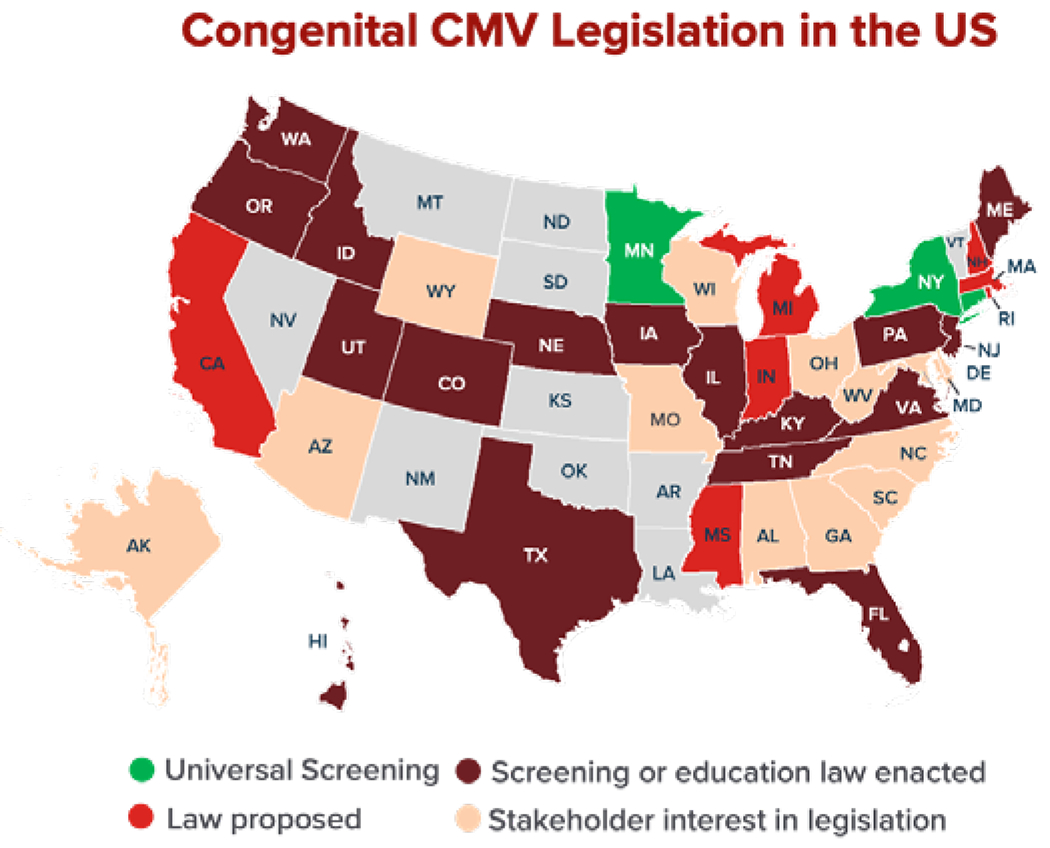
Map of states in the US that currently either conduct targeted or universal cCMV screening, states that have legislation pending or under consideration, and states where there is stakeholder interest in legislation. Three states have universal cCMV screening: Minnesota, which commenced screening through legislation (the Vivian Act) in 2023; New York, which currently conducts universal cCMV screening through a NICHD-sponsored program, with a plan to incorporate screening permanently into the newborn screening program; and Connecticut, which passed legislation in 2023 (HB8821) to commence universal screening in 2025. All three states base the universal cCMV screen on DBS PCR analysis. (adapted from https://www.nationalcmv.org/about-us/advocacy)
As screening moves forward, it is imperative that state legislatures that pass bills directing health departments to perform targeted or universal screening adequately fund such programs. In Minnesota, the fees in the Vivian Act legislation were generated, in part, by increasing the “per specimen” fee for screening by $43 to a total of $220 per specimen (Minnesota.gov statutes, 2023). Additional funds were earmarked to fund personnel costs required in administration and follow-up. Indeed, the cost of a DBS PCR assay is nominal, particularly if the test is included in the costs of other screening assays routinely performed in newborns. Instead, the costs are associated with the long-term neurodevelopmental and audiology follow-up required for screen-positive infants with confirmed cCMV. Despite the costs associated with a cCMV newborn screening program, a recent analysis demonstrated that universal cCMV screening was more cost-effective and averted more cases of severe hearing loss than did targeted cCMV testing—even in areas of low overall CMV prevalence (66). These observations are encouraging, but more data is needed on the cost-effectiveness of screening, parental acceptance of screening, the ideal substrate for testing (DBS or saliva), and the efficacy of and indications for antiviral treatments. As clinical practice evolves, health equity is also critical, as Hillyer et al. discussed in this Neonatology Today issue (Hillyer et al., 2024). Even as newborn screening moves forward, maternal education programs and preconception vaccines are needed to help reduce the disease and disability burdens associated with cCMV.
Acknowledgments:
Financial Support. Funding support from the University of South Carolina’s Research and Dissemination Center (DRDC), through its Cooperative Agreement (Number 6U19DD001218) with the Centers for Disease Control and Prevention (CDC), and from the NIH, R01 HD099866, is acknowledged.
Disclosures:
Mark R. Schleiss is the UMN site PI for the Moderna mRNA-1647 CMV vaccine trial, which provides research support for the UMN but no personal honoraria for the PI. Dr Schleiss also reported consultant fees from Sanofi Vaccines and GlaxoSmithKline Vaccines outside of the submitted work.
Abbreviations:
- AAP
American Academy of Pediatrics
- cCMV
Congenital CMV infection
- DBS
Dried blood spot
- MDH
Minnesota Department of Health
- NHS
Newborn hearing screening
- SNHL
Sensorineural hearing loss
Biography

Dr. Mark R. Schleiss, Professor of Pediatrics, did his training in Pediatrics at the Oregon Health and Sciences University in Portland, Oregon, followed by Fellowship Training in Pediatric Infectious Diseases at Seattle Children’s Hospital at the University of Washington in Seattle, Washington. He holds the American Legion and Auxiliary Heart Research Foundation Endowed Chair at the University of Minnesota (UMN) Medical School. His laboratory studies vaccines for preventing congenital cytomegalovirus (cCMV) infection, and he provides expertise nationally and internationally in evaluating and managing cCMV. The NIH and the CDC fund his research program, and he advocates universal cCMV screening. His work with the Minnesota Legislature, in collaboration with families with children with cCMV, led to the successful implementation in 2023 of the “Vivian Act,” novel legislation that enabled universal CMV screening in Minnesota newborns. Minnesota is the first state in the USA to adopt universal cCMV screening. He is also the principal investigator of a CDC-funded MAT-LINK site in Minnesota that is currently engaged in cCMV surveillance and follow-up (https://ctsi.umn.edu/news/ctsi-part-team-studying-follow-infants-cmv-infections). His laboratory also studies the immunology and molecular virology of congenital and post-natally acquired CMV infections in preterm infants and the long-term audiologic and neurodevelopmental impact of such infections.
References:
- 1.Ronchi A, Shimamura M, Malhotra PS, Sanchez PJ. Encouraging postnatal cytomegalovirus (CMV) screening: the time is NOW for universal screening! Expert Rev Anti Infect Ther. 2017;15(5):417–9. Epub 2017/03/10. doi: 10.1080/14787210.2017.1303377. [DOI] [PubMed] [Google Scholar]
- 2.Demmler Harrison GJ. Newborn Screening for Congenital Cytomegalovirus Infection…It Is Time. Clin Infect Dis. 2020;70(7):1385–7. Epub 2019/05/21. doi: 10.1093/cid/ciz415. [DOI] [PubMed] [Google Scholar]
- 3.Cannon MJ, Griffiths PD, Aston V, Rawlinson WD. Universal newborn screening for congenital CMV infection: what is the evidence of potential benefit? Rev Med Virol. 2014;24(5):291–307. Epub 2014/04/25. doi: 10.1002/rmv.1790. [DOI] [PMC free article] [PubMed] [Google Scholar]
- 4.Pass RF. Congenital cytomegalovirus infection: screening and treatment. J Pediatr. 2010;157(2):179–80. Epub 2010/06/15. doi: 10.1016/j.jpeds.2010.04.045. [DOI] [PubMed] [Google Scholar]
- 5.Dollard SC, Grosse SD, Ross DS. New estimates of the prevalence of neurological and sensory sequelae and mortality associated with congenital cytomegalovirus infection. Rev Med Virol. 2007;17(5):355–63. Epub 2007/06/02. doi: 10.1002/rmv.544. [DOI] [PubMed] [Google Scholar]
- 6.Friedman S, Ford-Jones EL. Congenital cytomegalovirus infection - An update. Paediatr Child Health. 1999;4(1):35–8. Epub 1999/01/01. doi: 10.1093/pch/4.1.35. [DOI] [PMC free article] [PubMed] [Google Scholar]
- 7.Kenneson A, Cannon MJ. Review and meta-analysis of the epidemiology of congenital cytomegalovirus (CMV) infection. Rev Med Virol. 2007;17(4):253–76. Epub 2007/06/21. doi: 10.1002/rmv.535. [DOI] [PubMed] [Google Scholar]
- 8.Diaz-Decaro J, Myers E, Mucha J, Neumann M, Lewandowski W, Kaczanowska M, et al. A systematic literature review of the economic and healthcare resource burden of cytomegalovirus. Curr Med Res Opin. 2023;39(7):973–86. Epub 2023/07/03. doi: 10.1080/03007995.2023.2222583. [DOI] [PubMed] [Google Scholar]
- 9.Ssentongo P, Hehnly C, Birungi P, Roach MA, Spady J, Fronterre C, et al. Congenital Cytomegalovirus Infection Burden and Epidemiologic Risk Factors in Countries With Universal Screening: A Systematic Review and Meta-analysis. JAMA Netw Open. 2021;4(8):e2120736. Epub 2021/08/24. doi: 10.1001/jamanetworkopen.2021.20736. [DOI] [PMC free article] [PubMed] [Google Scholar]
- 10.Lanzieri TM, Dollard SC, Bialek SR, Grosse SD. Systematic review of the birth prevalence of congenital cytomegalovirus infection in developing countries. Int J Infect Dis. 2014;22:44–8. Epub 2014/03/19. doi: 10.1016/j.ijid.2013.12.010. [DOI] [PMC free article] [PubMed] [Google Scholar]
- 11.Britt W. Controversies in the natural history of congenital human cytomegalovirus infection: the paradox of infection and disease in offspring of women with immunity prior to pregnancy. Med Microbiol Immunol. 2015;204(3):263–71. Epub 2015/03/13. doi: 10.1007/s00430-015-0399-9. [DOI] [PubMed] [Google Scholar]
- 12.Hussein K, Shanley R, Schleiss MR. Exploring health disparities in congenital CMV (cCMV): a study in a Somali-American community to assess awareness of cCMV and facilitate understanding of universal cCMV screening. Discov Soc Sci Health. 2024;4(1). Epub 2024/05/02. doi: 10.1007/s44155-024-00070-8. [DOI] [PMC free article] [PubMed] [Google Scholar]
- 13.Lantos PM, Hoffman K, Permar SR, Jackson P, Hughes BL, Kind A, et al. Neighborhood Disadvantage is Associated with High Cytomegalovirus Seroprevalence in Pregnancy. J Racial Ethn Health Disparities. 2018;5(4):782–6. Epub 2017/08/26. doi: 10.1007/s40615-017-0423-4. [DOI] [PMC free article] [PubMed] [Google Scholar]
- 14.Lantos PM, Hoffman K, Permar SR, Jackson P, Hughes BL, Swamy GK. Geographic Disparities in Cytomegalovirus Infection During Pregnancy. J Pediatric Infect Dis Soc. 2017;6(3):e55–e61. Epub 2017/02/16. doi: 10.1093/jpids/piw088. [DOI] [PMC free article] [PubMed] [Google Scholar]
- 15.Lantos PM, Permar SR, Hoffman K, Swamy GK. The Excess Burden of Cytomegalovirus in African American Communities: A Geospatial Analysis. Open Forum Infect Dis. 2015;2(4):ofv180. Epub 2015/12/31. doi: 10.1093/ofid/ofv180. [DOI] [PMC free article] [PubMed] [Google Scholar]
- 16.Fowler KB, Ross SA, Shimamura M, Ahmed A, Palmer AL, Michaels MG, et al. Racial and Ethnic Differences in the Prevalence of Congenital Cytomegalovirus Infection. J Pediatr. 2018;200:196–201 e1. Epub 2018/05/23. doi: 10.1016/j.jpeds.2018.04.043. [DOI] [PubMed] [Google Scholar]
- 17.Rawlinson WD, Boppana SB, Fowler KB, Kimberlin DW, Lazzarotto T, Alain S, et al. Congenital cytomegalovirus infection in pregnancy and the neonate: consensus recommendations for prevention, diagnosis, and therapy. Lancet Infect Dis. 2017;17(6):e177–e88. Epub 2017/03/16. doi: 10.1016/S1473-3099(17)30143-3. [DOI] [PubMed] [Google Scholar]
- 18.Luck SE, Wieringa JW, Blazquez-Gamero D, Henneke P, Schuster K, Butler K, et al. Congenital Cytomegalovirus: A European Expert Consensus Statement on Diagnosis and Management. Pediatr Infect Dis J. 2017;36(12):1205–13. Epub 2017/11/16. doi: 10.1097/INF.0000000000001763. [DOI] [PubMed] [Google Scholar]
- 19.Leruez-Ville M, Chatzakis C, Lilleri D, Blazquez-Gamero D, Alarcon A, Bourgon N, et al. Consensus recommendation for prenatal, neonatal and postnatal management of congenital cytomegalovirus infection from the European congenital infection initiative (ECCI). Lancet Reg Health Eur. 2024;40:100892. Epub 2024/04/09. doi: 10.1016/j.lanepe.2024.100892. [DOI] [PMC free article] [PubMed] [Google Scholar]
- 20.Iowa Health and Human Services, 2008; https://hhs.iowa.gov/media/496/download?inline
- 21.Morton CC, Nance WE. Newborn hearing screening--a silent revolution. N Engl J Med. 2006;354(20):2151–64. Epub 2006/05/19. doi: 10.1056/NEJMra050700. [DOI] [PubMed] [Google Scholar]
- 22.Fowler KB, Dahle AJ, Boppana SB, Pass RF. Newborn hearing screening: will children with hearing loss caused by congenital cytomegalovirus infection be missed? J Pediatr. 1999;135(1):60–4. Epub 1999/07/07. doi: 10.1016/s0022-3476(99)70328-8. [DOI] [PubMed] [Google Scholar]
- 23.Fowler KB, McCollister FP, Dahle AJ, Boppana S, Britt WJ, Pass RF. Progressive and fluctuating sensorineural hearing loss in children with asymptomatic congenital cytomegalovirus infection. J Pediatr. 1997;130(4):624–30. Epub 1997/04/01. doi: 10.1016/s0022-3476(97)70248-8. [DOI] [PubMed] [Google Scholar]
- 24.Fowler KB, McCollister FP, Sabo DL, Shoup AG, Owen KE, Woodruff JL, et al. A Targeted Approach for Congenital Cytomegalovirus Screening Within Newborn Hearing Screening. Pediatrics. 2017;139(2). Epub 2017/01/04. doi: 10.1542/peds.2016-2128. [DOI] [PMC free article] [PubMed] [Google Scholar]
- 25.Rohren L, Shanley R, Smith M, Yue M, Huang TC, Nelson P, et al. Congenital Cytomegalovirus-Associated Sensorineural Hearing Loss in Children: Identification Following Universal Newborn Hearing Screening, Effect of Antiviral Treatment, and Long-Term Hearing Outcomes. Ear Hear. 2023. Epub 2023/08/11. doi: 10.1097/AUD.0000000000001411. [DOI] [PMC free article] [PubMed] [Google Scholar]
- 26.Yoshinaga-Itano C. From Screening to Early Identification and Intervention: Discovering Predictors to Successful Outcomes for Children With Significant Hearing Loss. J Deaf Stud Deaf Educ. 2003;8(1):11–30. Epub 2004/09/28. doi: 10.1093/deafed/8.1.11. [DOI] [PubMed] [Google Scholar]
- 27.Osterholm EA, Schleiss MR. Impact of breast milk-acquired cytomegalovirus infection in premature infants: Pathogenesis, prevention, and clinical consequences? Rev Med Virol. 2020;30(6):1–11. Epub 2020/07/15. doi: 10.1002/rmv.2117. [DOI] [PMC free article] [PubMed] [Google Scholar]
- 28.Hernandez-Alvarado N, Shanley R, Schleiss MR, Ericksen J, Wassenaar J, Webo L, et al. Clinical, Virologic and Immunologic Correlates of Breast Milk Acquired Cytomegalovirus (CMV) Infections in Very Low Birth Weight (VLBW) Infants in a Newborn Intensive Care Unit (NICU) Setting. Viruses. 2021;13(10). Epub 2021/10/27. doi: 10.3390/v13101897. [DOI] [PMC free article] [PubMed] [Google Scholar]
- 29.Schleiss MR. Evolving Concepts in Care for Congenital Cytomegalovirus (cCMV) Infection: Better Outcomes for More Babies! J Pediatr. 2024;270:114044. Epub 2024/04/05. doi: 10.1016/j.jpeds.2024.114044. [DOI] [PubMed] [Google Scholar]
- 30.Chung PK, Schornagel F, Oudesluys-Murphy AM, de Vries LS, Soede W, van Zwet E, et al. Targeted screening for congenital cytomegalovirus infection: clinical, audiological and neuroimaging findings. Arch Dis Child Fetal Neonatal Ed. 2023;108(3):302–8. Epub 2022/12/23. doi: 10.1136/archdischild-2022-324699. [DOI] [PMC free article] [PubMed] [Google Scholar]
- 31.Chung PK, Schornagel FAJ, Soede W, van Zwet EW, Kroes ACM, Oudesluys-Murphy AM, et al. Valganciclovir in Infants with Hearing Loss and Clinically Inapparent Congenital Cytomegalovirus Infection: A Nonrandomized Controlled Trial. J Pediatr. 2024:113945. Epub 2024/02/10. doi: 10.1016/j.jpeds.2024.113945. [DOI] [PubMed] [Google Scholar]
- 32.Haller T, Shoup A, Park AH. Should hearing targeted screening for congenital cytomegalovirus infection Be implemented? Int J Pediatr Otorhinolaryngol. 2020;134:110055. Epub 2020/05/04. doi: 10.1016/j.ijporl.2020.110055. [DOI] [PMC free article] [PubMed] [Google Scholar]
- 33.Ronner EA, Glovsky CK, Herrmann BS, Woythaler MA, Pasternack MS, Cohen MS. Congenital Cytomegalovirus Targeted Screening Implementation and Outcomes: A Retrospective Chart Review. Otolaryngol Head Neck Surg. 2022;167(1):178–82. Epub 2021/09/15. doi: 10.1177/01945998211044125. [DOI] [PubMed] [Google Scholar]
- 34.Gillespie AN, Dalziel K, Webb E, Wong J, Jones CA, Sung V, et al. Targeted screening for congenital cytomegalovirus: A micro-costing analysis. J Paediatr Child Health. 2023;59(1):64–71. Epub 2022/10/18. doi: 10.1111/jpc.16239. [DOI] [PMC free article] [PubMed] [Google Scholar]
- 35.Beswick R, David M, Higashi H, Thomas D, Nourse C, Koh G, et al. Integration of congenital cytomegalovirus screening within a newborn hearing screening programme. J Paediatr Child Health. 2019;55(11):1381–8. Epub 2019/03/28. doi: 10.1111/jpc.14428. [DOI] [PubMed] [Google Scholar]
- 36.Webb E, Gillespie AN, Poulakis Z, Gartland T, Buttery J, Casalaz D, et al. Feasibility and acceptability of targeted salivary cytomegalovirus screening through universal newborn hearing screening. J Paediatr Child Health. 2022;58(2):288–94. Epub 2021/09/15. doi: 10.1111/jpc.15705. [DOI] [PubMed] [Google Scholar]
- 37.Kadambari S, Luck S, Davis A, Walter S, Agrup C, Atkinson C, et al. Evaluating the feasibility of integrating salivary testing for congenital CMV into the Newborn Hearing Screening Programme in the UK. Eur J Pediatr. 2015;174(8):1117–21. Epub 2015/03/07. doi: 10.1007/s00431-015-2506-8. [DOI] [PubMed] [Google Scholar]
- 38.Kadambari S, Luck S, Davis A, Williams E, Berrington J, Griffiths P, et al. Clinically targeted screening for congenital CMV - potential for integration into the National Hearing Screening Programme. Acta Paediatr. 2013;102(10):928–33. Epub 2013/08/10. doi: 10.1111/apa.12335. [DOI] [PubMed] [Google Scholar]
- 39.Williams EJ, Kadambari S, Berrington JE, Luck S, Atkinson C, Walter S, et al. Feasibility and acceptability of targeted screening for congenital CMV-related hearing loss. Arch Dis Child Fetal Neonatal Ed. 2014;99(3):F230–6. Epub 2014/03/07. doi: 10.1136/archdischild-2013-305276. [DOI] [PubMed] [Google Scholar]
- 40.Ari-Even Roth D, Lubin D, Kuint J, Teperberg-Oikawa M, Mendelson E, Strauss T, et al. Contribution of targeted saliva screening for congenital CMV-related hearing loss in newborns who fail hearing screening. Arch Dis Child Fetal Neonatal Ed. 2017;102(6):F519–F24. Epub 2017/05/05. doi: 10.1136/archdischild-2016-311859. [DOI] [PubMed] [Google Scholar]
- 41.Medoro AK, Malhotra PS, Shimamura M, Findlen U, Gerth H, Hounam G, et al. Timing of newborn hearing screening in the neonatal intensive care unit: implications for targeted screening for congenital cytomegalovirus infection. J Perinatol. 2021;41(2):310–4. Epub 2020/09/08. doi: 10.1038/s41372-020-00801-0. [DOI] [PubMed] [Google Scholar]
- 42.Kettler M, Shoup A, Moats S, Steuerwald W, Jones S, Stiell SC, et al. American Academy of Audiology Position Statement on Early Identification of Cytomegalovirus in Newborns. J Am Acad Audiol. 2023. Epub 2023/03/28. doi: 10.1055/s-0043-1768036. [DOI] [PubMed] [Google Scholar]
- 43.Wroblewska-Seniuk KE, Dabrowski P, Szyfter W, Mazela J. Universal newborn hearing screening: methods and results, obstacles, and benefits. Pediatr Res. 2017;81(3):415–22. Epub 2016/11/20. doi: 10.1038/pr.2016.250. [DOI] [PubMed] [Google Scholar]
- 44.Zhang Y, Egashira T, Egashira M, Ogiwara S, Tomino H, Shichijo A, et al. Expanded targeted screening for congenital cytomegalovirus infection. Congenit Anom (Kyoto). 2023;63(3):79–82. Epub 2023/03/23. doi: 10.1111/cga.12512. [DOI] [PubMed] [Google Scholar]
- 45.Choi KY, Schimmenti LA, Jurek AM, Sharon B, Daly K, Khan C, et al. Detection of cytomegalovirus DNA in dried blood spots of Minnesota infants who do not pass newborn hearing screening. Pediatr Infect Dis J. 2009;28(12):1095–8. Epub 2009/10/13. doi: 10.1097/INF.0b013e3181af6230. [DOI] [PubMed] [Google Scholar]
- 46.Suarez D, Nielson C, McVicar SB, Sidesinger M, Ostrander B, O’Brien E, et al. Analysis of an Expanded Targeted Early Cytomegalovirus Testing Program. Otolaryngol Head Neck Surg. 2023;169(3):679–86. Epub 2023/03/09. doi: 10.1002/ohn.320. [DOI] [PubMed] [Google Scholar]
- 47.Akiva MH, Hyde De Souza H, Lamarre V, Boucoiran I, Gantt S, Renaud C, et al. Identifying Clinical Criteria for an Expanded Targeted Approach to Screening for Congenital Cytomegalovirus Infection-A Retrospective Study. Int J Neonatal Screen. 2023;9(3). Epub 2023/07/25. doi: 10.3390/ijns9030040. [DOI] [PMC free article] [PubMed] [Google Scholar]
- 48.Gantt S. Newborn cytomegalovirus screening: is this the new standard? Curr Opin Otolaryngol Head Neck Surg. 2023;31(6):382–7. Epub 2023/10/11. doi: 10.1097/MOO.0000000000000925. [DOI] [PubMed] [Google Scholar]
- 49.Sorichetti B, Goshen O, Pauwels J, Kozak FK, Tilley P, Krajden M, et al. Symptomatic Congenital Cytomegalovirus Infection Is Underdiagnosed in British Columbia. J Pediatr. 2016;169:316–7. Epub 2015/11/26. doi: 10.1016/j.jpeds.2015.10.069. [DOI] [PubMed] [Google Scholar]
- 50.Shahar-Nissan K, Oikawa Tepperberg M, Mendelson E, Bilavsky E. Retrospective identification of congenital cytomegalovirus infection using dried blood samples - missed opportunities and lessons. J Clin Virol. 2022;152:105186. Epub 2022/05/24. doi: 10.1016/j.jcv.2022.105186. [DOI] [PubMed] [Google Scholar]
- 51.Wilson KL, Shah K, Pesch MH. Inconsistent Provider Testing Practices for Congenital Cytomegalovirus: Missed Diagnoses and Missed Opportunities. Int J Neonatal Screen. 2022;8(4). Epub 2022/11/23. doi: 10.3390/ijns8040060. [DOI] [PMC free article] [PubMed] [Google Scholar]
- 52.Schleiss MR. Congenital cytomegalovirus: Impact on child health. Contemp Pediatr. 2018;35(7):16–24. Epub 2019/02/12. [PMC free article] [PubMed] [Google Scholar]
- 53.Lorenzoni F, Lunardi S, Liumbruno A, Ferri G, Madrigali V, Fiorentini E, et al. Neonatal screening for congenital cytomegalovirus infection in preterm and small for gestational age infants. J Matern Fetal Neonatal Med. 2014;27(15):1589–93. Epub 2013/12/18. doi: 10.3109/14767058.2013.871253. [DOI] [PubMed] [Google Scholar]
- 54.Dollard SC, Dreon M, Hernandez-Alvarado N, Amin MM, Wong P, Lanzieri TM, et al. Sensitivity of Dried Blood Spot Testing for Detection of Congenital Cytomegalovirus Infection. JAMA Pediatr. 2021;175(3):e205441. Epub 2021/02/02. doi: 10.1001/jamapediatrics.2020.5441. [DOI] [PMC free article] [PubMed] [Google Scholar]
- 55.American Academy of Otolaryngology—Head and Neck Surgery. Universal Congenital CMV (cCMV) Screening. 2024. https://www.entnet.org/resource/universal-newborn-congenital-cytomegalovirus-ccmv-screening).
- 56.Wilson JM, Jungner YG. [Principles and practice of mass screening for disease]. Bol Oficina Sanit Panam. 1968;65(4):281–393. Epub 1968/10/01. [PubMed] [Google Scholar]
- 57.Merav L, Ofek Shlomai N, Oiknine-Djian E, Caplan O, Livneh A, Sido T, et al. Implementation of pooled saliva tests for universal screening of cCMV infection. Nat Med. 2024;30(4):1111–7. Epub 2024/03/09. doi: 10.1038/s41591-024-02873-3. [DOI] [PMC free article] [PubMed] [Google Scholar]
- 58.Wunderlich W, Sidebottom AC, Schulte AK, Taghon J, Dollard S, Hernandez-Alvarado N. The Use of Saliva Samples to Test for Congenital Cytomegalovirus Infection in Newborns: Examination of False-Positive Samples Associated with Donor Milk Use. Int J Neonatal Screen. 2023;9(3). Epub 2023/08/22. doi: 10.3390/ijns9030046. [DOI] [PMC free article] [PubMed] [Google Scholar]
- 59.Kaye T, Dufort EM, Rosendahl SD, et al. Notes from the Field: Universal Newborn Screening and Surveillance for Congenital Cytomegalovirus — Minnesota, 2023–2024. MMWR Morb Mortal Wkly Rep 2024;73:703–705. DOI: 10.15585/mmwr.mm7332a2. [DOI] [PubMed] [Google Scholar]
- 60.Gievers LL, Holmes AV, Loyal J, Larson IA, Oliveira CR, Waldman EH, et al. Ethical and Public Health Implications of Targeted Screening for Congenital Cytomegalovirus. Pediatrics. 2020;146(1). Epub 2020/06/28. doi: 10.1542/peds.2020-0617. [DOI] [PMC free article] [PubMed] [Google Scholar]
- 61.Pesch MH, Danziger P, Ross LF, Antommaria AHM. An Ethical Analysis of Newborn Congenital Cytomegalovirus Screening. Pediatrics. 2022;149(6). Epub 2022/06/01. doi: 10.1542/peds.2021-055368. [DOI] [PubMed] [Google Scholar]
- 62.Din ES, Brown CJ, Grosse SD, Wang C, Bialek SR, Ross DS, et al. Attitudes toward newborn screening for cytomegalovirus infection. Pediatrics. 2011;128(6):e1434–42. Epub 2011/11/16. doi: 10.1542/peds.2011-1444. [DOI] [PubMed] [Google Scholar]
- 63.Tastad KJ, Schleiss MR, Lammert SM, Basta NE. Awareness of congenital cytomegalovirus and acceptance of maternal and newborn screening. PLoS One. 2019;14(8):e0221725. Epub 2019/08/27. doi: 10.1371/journal.pone.0221725. [DOI] [PMC free article] [PubMed] [Google Scholar]
- 64.Fang H, Yan HHN, Bilardi RA, Flensburg C, Yang H, Barbour JA, et al. Ganciclovir-induced mutations are present in a diverse spectrum of post-transplant malignancies. Genome Med. 2022;14(1):124. Epub 2022/11/02. doi: 10.1186/s13073-022-01131-w. [DOI] [PMC free article] [PubMed] [Google Scholar]
- 65.National CMV Foundation. National CMV Foundation Advocacy. 2024. https://www.nationalcmv.org/about-us/advocacy
- 66.Lantos PM, Gantt S, Janko M, Dionne F, Permar SR, Fowler K. A Geographically Weighted Cost-effectiveness Analysis of Newborn Cytomegalovirus Screening. Open Forum Infect Dis. 2024. Jun 7;11(6):ofae311. doi: 10.1093/ofid/ofae311. [DOI] [PMC free article] [PubMed] [Google Scholar]