



Abstract
To better understand factors that may contribute to HIV outcomes experienced by Black women living with HIV (BWLWH), the present study examined the relationships among gendered racial microaggressions (GRM; subtle daily insults due to racism and sexism), self-silencing, substance use, antiretroviral therapy (ART) medication adherence, and viral suppression using structural equation modeling and path analysis. Self-silencing and substance use were examined as potential mediators. Participants were 119 BWLWH residing in South Florida. Results of this study showed that GRM was directly and positively associated with self-silencing and indirectly and negatively associated with medication adherence via self-silencing. Self-silencing was directly and negatively associated with medication adherence. Medication adherence was directly and negatively related to viral suppression. The model fit the data well. Identifying the negative consequences of GRM in conjunction with self-silencing and substance use may help inform prevention and intervention strategies to improve mental health and HIV-related outcomes among BWLWH.
Keywords: Black women, HIV, Microaggressions, Substance Use, Self-Silencing, Medication Adherence
RESUMEN
Para comprender mejor los factores que pueden contribuir a los resultados del VIH experimentados por las mujeres negras que viven con el VIH (BWLWH), el presente estudio examinó las relaciones entre las microagresiones raciales de género (GRM; sutiles insultos diarios debido al racismo y el sexismo), el auto silenciamiento, el uso de sustancias, la adherencia a la medicación de la terapia antirretroviral (ART) y la supresión viral utilizando modelos de ecuaciones estructurales y análisis de ruta. El autosilenciamiento y el consumo de sustancias se examinaron como mediadores potenciales. Los participantes fueron 119 BWLWH que residían en el sur de Florida. Los resultados de este estudio mostraron que GRM se asoció directa y positivamente con el autosilenciamiento e indirecta y negativamente se asoció con la adherencia a la medicación a través del autosilenciamiento. El autosilenciamiento se asoció directa y negativamente con la adherencia a la medicación. La adherencia a la medicación se relacionó directa y negativamente con la supresión viral. El modelo se ajusta bien a los datos. Identificar las consecuencias negativas de GRM junto con el auto silenciamiento y el uso de sustancias puede ayudar a informar estrategias de prevención e intervención para mejorar la salud mental y los resultados relacionados con el VIH entre BWLWH.
INTRODUCTION
Black women account for 58% of new HIV diagnoses among women in the U.S. [1] and experience higher mortality rates in HIV than women of other races and ethnicities [2]. HIV disparities are particularly pronounced in South Florida which is often deemed as the epicenter of the HIV epidemic [3]. Although Black people in Miami-Dade County account for 17% of the population, they represent over 30% of newly diagnosed people living with HIV (PLWH) [4]. Further, Black women are 13 times more likely to be diagnosed with HIV than White women in Miami-Dade County [4]. Moreover, Black women living with HIV (BWLWH) are less likely to adhere to their anti-retroviral medication (ART) regimen and be virally suppressed when compared with White women [5–7]. Potential barriers that may explain racial and ethnic disparities in HIV treatment management and disease progression among BWLWH are lack of social support, poor quality HIV care and access, financial instability, and experiencing HIV stigma [8]. Such barriers may be more pervasive among BWLWH due to experiencing marginalization and oppression related to their social identities, above and beyond their HIV status [9–11]. Notably, discrimination based on race and gender is prevalent among BWLWH and has been linked to barriers to care [12,13], HIV-related outcomes [14], and mental health [15–18]. Despite, sexism and racism being linked to health outcomes driving disparities in HIV they are often examined as discrete categories rather than interconnected issues that shape the experiences and health of BWLWH [2,6,9]. Hence, there is an urgent need to utilize an intersectional lens when deciphering mechanisms that contribute to the inequities disproportionately affecting Black women across the HIV care continuum. In recent years, research has shown that gendered racial microaggressions (GRM) – everyday insults and slights experienced by Black women as a result of racism and sexism– may lead to negative health consequences for BWLWH [8,11,12]. The stress associated with managing HIV, as well as HIV-related discrimination/stigma may be further exacerbated by navigating day-to-day life as Black women in the context of racism and sexism [9,10,19]. Given the increased risk of experiencing victimization and discrimination during their lifetime as a consequence of racism, sexism, and HIV stigma, it is important to understand how the unique stressors associated with these factors influence coping mechanisms and health behaviors, such as self-silencing and problematic substance use and HIV-related outcomes (e.g., ART medication adherence, viral suppression) among BWLWH.
Gendered racial microaggressions may have a harmful impact on the health and well-being of Black women over time [20,21]. Examples of GRM include negative remarks and behaviors painting Black women as loud and angry, extremely independent, and hyper-sexual, which are distressing to Black women and may influence how they cope and navigate the world [20,21]. While both gender discrimination and racial discrimination have been shown to influence the mental and physical health outcomes of Black women living with and without HIV [14,22–25], it is important to better understand how gendered racism uniquely impacts BWLWH. In 2019, researchers reported that GRM predicted barriers to medical and psychological care [12]. Consequently, GRM have been linked to mental health outcomes among BWLWH [15,16,18,26]. For instance, BWLWH who endured GRM more frequently and greater stress as a result have been more likely to report traumatic stress and trauma-related thoughts [15], depression [16], and current and lifetime suicidality [18]. Regarding the potential link between GRM and HIV-related outcomes among BWLWH, a recent study found that racism-related coping buffered the relationship between GRM and medication adherence [27]. Despite these findings, the influence GRM may have on health behaviors such as substance use and coping mechanisms such as self-silencing among BWLWH is unknown.
Self-silencing– the suppression of emotions, thoughts, and needs in effort to maintain harmonious relationships – has been associated with adverse psychosocial outcomes among Black women in general [28,29] and BWLWH specifically [5,18,30,31]. The Theory of Silencing the Self (TSTS) developed by Jack (1991) highlights the tendency for women to inhibit self-expression by withholding true feelings and desires as a coping mechanism aimed at minimizing conflict in intimate relationships [32]. Jack theorized that self-silencing is reflected by putting the needs of others before their own, judging oneself based on external standards, suppressing thoughts, emotions, and desires, and presenting an ideal image to hide one’s authentic self. Such silence is often a result of women experiencing oppression, discrimination, and victimization based on gender and undergoing gender role socialization which emphasizes the desire for women to be care-takers, reserved, and selfless. For Black women in particular, self-silencing has been linked to the Strong Black Woman (SBW) role first coined by bell hooks (1988), who described the cultural script as a mechanism that emphasizes the strength, resilience, and independence possessed by Black women, yet ignores the oppression and marginalization they often experience which gave rise to and maintains the need to be “strong” [33].
Despite aspects of the SBW role often being seen as protective mechanisms to cope with sexism and racism, Abrams, Hill, and Maxwell (2019) found that self-silencing mediated the relationship between endorsing the SBW role and depression symptoms among a sample of Black women [28]. Adherence to the SBW role has also predicted self-silencing and issues related to emotion inhibition and regulation among African American women with histories of trauma [29]. Moreover, research has shown that self-silencing has been particularly prevalent among BWLWH which may be due to past trauma and abuse, as well as socioeconomic factors [5,30]. In a study examining gender roles and mental health among a predominately African American and low-income sample of women at risk for or living with HIV, Brody and colleagues (2014) found that when compared to women without an HIV diagnosis, WLWH reported higher levels of self-silencing and depressive symptoms [34]. Furthermore, findings showed that higher self-silencing was a significant predictor of increased depressive symptoms over time and poorer quality of life. More recently, self-silencing was linked to suicidality among BWLWH [18]. Such findings highlight the need for more research examining how self-silencing and other forms of coping (e.g., substance use) may impact BWLWH’s health outcomes in the context of gendered racism.
WLWH are more likely to experience unique challenges related to poverty, gender roles, and trauma exposure that may lead to substance use for coping and avoidance [35–37]. Psychosocial factors such as intimate partner violence (IPV), histories of child abuse, psychological distress, and discrimination are particularly prevalent among BWLWH [12,38–40]. Such stressors, have been shown to increase the risk for substance use, suboptimal ART adherence, and HIV disease progression [41–46]. In a study exploring the syndemic effects of substance abuse and violence among Women of Color (WOC) living with HIV, Sullivan and colleagues (2015) examined the presence and combined impact five psychosocial factors related to the SAVA (Substance Abuse, Violence, HIV/AIDS) syndemic had on viral suppression. The factors examined were substance abuse, binge drinking, IPV, poor mental health, and sexual risk taking. Women who had a higher SAVA score (0 to 5) were less likely to maintain viral suppression. Over half of the sample (54%) reported substance use, 73% reported sexual risk behaviors, and almost 40% reported poor mental health. Viral suppression began to significantly drop for the 30% of women who reported a SAVA score of three or higher.
The impact substance use has on viral suppression may be partially explained by mechanisms which impede on health promotion and self-care practices such as medication adherence. Indeed, research has shown that WLWH who engage in problematic substance use (PSU) are less likely to take their medication as prescribed when compared to women who not do not engage in PSU [45,47–49]. In a study focused on WLWH with child sexual abuse histories, Lui and colleagues (2006) found that women who used drugs and had lower self-esteem and lower medication self-efficacy were more likely to report lower medication adherence. While traumatic events such as physical and sexual abuse have been linked to substance use and medication adherence among BWLWH, little is known about how gendered racial microaggressions in connection with self-silencing may be associated with these health behaviors.
Given that GRM has been linked to barriers to HIV-related outcomes and care [12,27] and psychological distress [15,16,18] among BWLWH, it is important to understand how GRM may relate to self-silencing and substance use and directly or indirectly impact medication adherence and viral suppression. Both substance use and self-silencing have been shown to be prevalent factors for BWLWH that have been linked to HIV-related outcomes such as medication adherence and viral suppression [5,31,44,47,48,50,51]. Brody and colleagues (2014) found that WLWH who reported lower self-silencing were significantly more likely to adhere to ART and have a lower viral load. Similarly, in a study examining alcohol use and HIV-related outcomes among BWLWH, Lipira and colleagues (2021) reported that heavy episodic drinking was associated with poorer medication adherence and unhealthy alcohol use was associated with viral non-suppression. Despite these findings, there is limited research examining how racial- and gender-based stressors such as GRM may be a predictor of self-silencing and substance use, an ultimately HIV health outcomes among BWLWH.
For BWLWH, self-silencing and substance use may be used in effort to manage stress unique to the discrimination Black women experience day-to-day. As such, the present study examined how GRM may influence self-silencing and examined if GRM and self-silencing predicts problematic substance use among BWLWH which may in turn impact ART medication adherence and viral suppression. The specific aims of the present study are summarized below and of note the theoretical model for GRM frequency shown in Figure 1 includes the hypothesized direct and indirect associations which also mirrors the hypotheses for the GRM stress appraisal theoretical model:
Figure 1:
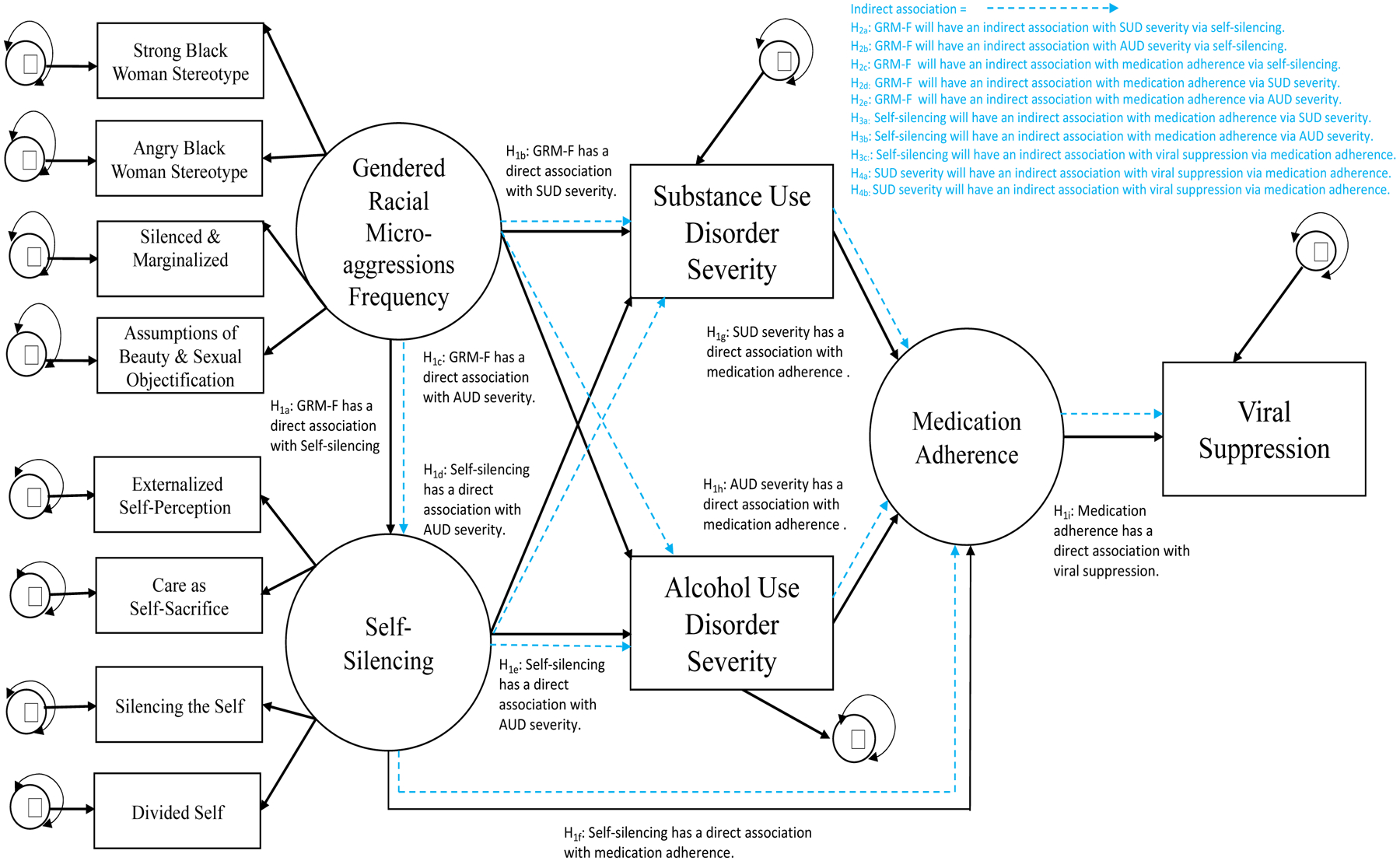
Theoretical Structural Equation Modeling Diagram for Gendered Racial Microaggressions Frequency Model
Study Aims
Aim 1: Examine the direct associations among GRM (frequency and stress appraisal), self-silencing, problematic substance use, ART medication adherence, and viral suppression.
Aim 2: Examine the indirect association of GRM (frequency and stress appraisal) on the relationships among self-silencing, problematic substance use, and medication adherence.
Aim 3: Examine the indirect association of self-silencing on the relationships among problematic substance use, medication adherence, and viral suppression.
Aim 4: Examine the indirect association of problematic substance use on viral suppression via medication adherence.
METHOD
One hundred and nineteen BWLWH residing in South Florida were recruited to participate in a behavioral medicine intervention study focused on improving medication adherence between 2017 to 2019. Participants were recruited through outreach at community events and the distribution of flyers and posters in healthcare settings such as hospitals, clinics, and community health centers. Potential participants who expressed interest in the study were screened via phone for eligibility by a member of the research team. To be scheduled for an in person baseline visit women had to meet the following criteria: (1) ≥ 18 years of age, (2) identify as Black and/or African American, (3) cis-gender woman (4) living with HIV, (5) fluent in English, (6) prescribed ART for at least the past 2 months (7) history of trauma and/or abuse, and (8) indicated the possibility of low ART adherence, a detectable viral load, and/or missed HIV-related medical visits within the past year.
Women were scheduled for two baseline visits (to determine eligibility for parent study randomization) over a two-week period. Participants who provided their informed consent (1) completed self-report measures and a clinical interview and (2) received a Wisepill adherence monitor. Participants received a $50 stipend for completing both baseline visits. The Institutional Review Board (IRB) of the University of Miami approved all study procedures and materials.
Measures
Sociodemographics.
Participants provided demographic information via self-report which included questions on age, country of origin, religion, sexual orientation, relationship status, highest level of education, employment status, annual income, and HIV viral load status.
Gendered Racial Microaggressions (GRMS – BW;[21]).
The GRMS – BW was used to assess the frequency (how often they occurred) and stress appraisal (level of stress endured) of microaggressions experienced by participants based on the intersection of their race and gender. The 26-item scale consist of four subscales: Assumptions of Beauty and Sexual Objectification, Angry Black Woman Stereotype, Strong Black Woman Stereotype, and Silenced and Marginalized. The Assumption of Beauty and Sexual Objectification subscale represents stereotypes and assumptions related to standards of beauty and attractiveness. The Angry Black Woman Stereotype subscale captures the portrayal of Black women being angry and/or hostile. The Strong Black Woman (SBW) Stereotype subscale represents the expectation of Black women being self-reliant and “strong”. The Silenced and Marginalized scale captures the silencing and dismissal of Black women in professional settings. On a 6-point Likert scale ranging from 0 to 5, participants were asked to (1) identify how often they experienced a microaggression in their lifetime (0 = never, 1 = less than once a year … 5 = once a week) and (2) rate how stressful the experience was (0 = never happened, 1 = not stressful at all … 5 = extremely stressful). The GRMS – BW has been utilized among both Black women living with [12,15,16,18] and without HIV [20,21,52–55] across various studies and has demonstrated internal and external validity. The GRMS – BW has shown great internal reliability (appraisal α = 0.93 and frequency α = 0.92) in measuring everyday slights and insults experienced by Black women [21]. In the current study, the internal reliability for GRMS – BW was excellent (appraisal α = 0.96 and frequency α = 0.95).
The Silencing the Self Scale (STSS; [56]).
The STSS was used to capture the suppression of emotions, thoughts, and behaviors among women in their interpersonal relationships to maintain harmony and minimize conflict. The 31-item scale consist of four subscales: Care as Self-sacrifice, Externalized Self-perception, Silencing the Self, and The Divided Self. The Care as Self-sacrifice subscale represents the act of women putting someone else’s needs and feelings before their own. The Externalized Self-perception subscale captures self-judgement based on the standards of others. The Silencing the Self subscale represents the tendency to withhold feelings and actions to secure relationships and avoid potential conflict. The Divided Self subscale captures the inner conflict experienced by women who conceal their true feelings and desired behaviors to satisfy loved ones. Each item was rated on a 5-point Likert scale ranging from strongly disagree to strongly agree and higher scores indicate greater self-silencing. The STSS has demonstrated good validity and reliability across various studies focused on WLWH in general [5,30,51] and BWLWH specifically [18,31]. STSS has shown excellent internal reliability (α = .90) among BWLWH [18]. The current study’s internal reliability for the STSS was also excellent (α = .91).
Mini International Neuropsychiatric Interview (MINI; [57]).
The MINI was used to assess alcohol use disorder (AUD) and substance use disorder (SUD). The brief structured diagnostic interview is used to determine DSM-5 and ICD-10 psychiatric disorders, such as major depression disorder (MDD) and generalized anxiety disorder (GAD). The AUD module (I) and the SUD (J) module examines symptoms of abuse and dependence among alcohol and non-alcohol substance users in the past 12 months, respectively. Additionally, the severity of abuse and dependence is assessed. The MINI has shown great reliability and sensitivity in detecting disorders across a range of clinical populations, including PLWH [16,18,58].
HIV medication adherence self-reported [59].
During baseline self-reported adherence to HIV medication(s) for the past week, past two weeks, and past four weeks was assessed and rated by participants on 6-point Likert scale ranging from 1 = ‘very poor’ to 6 = ‘excellent’. To capture HIV medication adherence, we utilized an item developed in a previous study examining medication adherence among PLWH [59]: ‘Thinking about the past X weeks, how would you rate your ability to take all of your medications as your doctor prescribed them?’ The internal reliability for this measure in the current study was good (α = .81).
Wisepill Medication Monitor [60].
The Wisepill medication monitor was used to capture HIV medication adherence across the two-week baseline period. Participants selected a single ART pill to be monitored during the intervention. The percent of ART adherence (days Wisepill was opened ÷ total days) was calculated. Analysis looked at dichotomized Wisepill medication adherence.
Viral Load.
During the baseline visit, HIV-1 RNA lab tests were performed and collected from participants. HIV viral suppression was <200 copies/ml of HIV in the blood.
Data Analytic Plan
Statistical analyses were conducted with SPSS 27 and Mplus 8.6. All 119 participants who completed baseline assessments were included in the analyses. Missing values were addressed by using Weighted Least Square Mean and Variance (WLSMV). Descriptive statistics were conducted to summarize participant characteristics, calculate means and standard deviations of continuous variables, and obtain frequencies of categorical variables. Cronbach’s α were used to assess scale reliability.
Structural equation modeling (SEM) was used to evaluate the theoretical models. Each model consisted of three latent variables – with one model focused on GRM appraisal and the other focused on GRM frequency. The two additional latent variables that were used in the models are self-silencing and medication adherence. Self-silencing, GRM appraisal, and GRM frequency was measured by their subscales. The self-silencing latent variable consisted of four indicators: Care as Self-sacrifice, Externalized Self-perception, Silencing the Self, and The Divided Self. The latent variable of GRM appraisal consisted of four indicators which include: Assumptions of Beauty and Sexual Objectification appraisal, Angry Black Woman Stereotype appraisal, SBW Stereotype appraisal, and Silenced and Marginalized appraisal. The latent variable of GRM frequency consisted of four indicators which include: Assumptions of Beauty and Sexual Objectification frequency, Angry Black Woman Stereotype frequency, SBW Stereotype frequency, and Silenced and Marginalized frequency. The latent variable of medication adherence was measured by three self-report items assessing adherence to HIV medication during the past 1-, 2-, and 4- weeks and two dichotomous variables captured through the Wisepill medication monitor that calculated the percentage of medication adherence during 1- and 2-weeks. Participants who adhered to the medication ≥80% as reported by the Wisepill monitor during the past two weeks were coded “1”. Participants who adhered to the medication <80% as reported by the Wisepill monitor during the past two weeks were coded “0”. The observed variables of problematic substance use were continuous and captured by SUD symptom severity scores and AUD symptom severity scores. Lastly, the observed variable of viral suppression captured by viral load log was continuous.
Confirmatory factor analysis (CFA) was performed to assess the goodness of fit of the measurement model before proceeding to a structural equation model. With a satisfactory measurement model, SEM was performed to assess the hypothesized relationships (see study aims and Figure 1) among GRM, self-silencing, problematic substance use, medication adherence, and viral suppression. To evaluate goodness of model fit of the measurement and structural models, the Chi-square Statistic, Comparative Fit Index (CFI), Root Mean Square Error of Approximation (RMSEA), and Standardized Root of Approximation (SRMR) were reviewed. A Chi-square statistic with non-significant p-value (p ≥ .05) indicates better model fit. CFI ≥ 0.90, RMSEA ≤ 0.06, and SRMR ≤ 0.08 indicate good model fit.
RESULTS
The average age for women who participated in the study was 49 years old (range = 22 – 67), 63% of the women had an annual income below $12,000, 66% of the women completed a high school education or higher, and 57% of the women received disability benefits. Twenty-four percent of the women met criteria for SUD and 11% of the women met criteria for AUD at baseline. Over a third (37.8%) of women engaged in substance use in the past 30 days. The most common substances used were alcohol, cocaine, and marijuana. On average, women reported a moderate level of self-silencing (mean = 81.92) and a low to moderate level of stress related to microaggressions (appraisal mean = 25.34). The median score for self-reported medication adherence was 5 which indicates “very good” ART adherence. Eighty percent of women were virally suppressed. Additional sociodemographic characteristics are shown in Table 1.
Table 1:
Sociodemographics of Study Participants
| Characteristic | N (%) or mean (SD) |
|---|---|
| Age | 49.27 (range 22 to 67) |
| Education | |
| Eighth grade or lower | 6 (5%) |
| Some high school | 35 (28.9%) |
| High school graduate or GED | 41 (33.9%) |
| Some college | 29 (24%) |
| College graduate | 7 (5%) |
| Some graduate school | 1 (.8%) |
| Annual household income | |
| Less than $5,000 | 43 (35.5%) |
| $5,000 through $11,9999 | 32 (26.4%) |
| $12,000 through $15,999 | 8 (6.6%) |
| $16,000 through $24,999 | 6 (5%) |
| $25,000 through $34,999 | 3 (2.5%) |
| $35,000 through $49,999 | 2 (1.7%) |
| $50,000 and greater | 3 (2.5%) |
| Employment/School Enrollment Status | |
| Full time employment | 8 (6.6%) |
| Part time employment | 8 (6.6%) |
| Full time or part time student | 5 (4.1%) |
| Unemployed nor a student | 26 (21.5%) |
| On disability | 69 (57%) |
| Other | 6 (5%) |
| Relationship Status | |
| Married | 17 (14%) |
| Cohabitating relationship | 18 (14.9%) |
| Non-cohabitating relationship | 15 (12.4%) |
| Single | 53 (43.8%) |
| Divorced or separated | 11 (9.1%) |
| Widowed | 3 (2.5%) |
| Sexual Orientation | |
| Heterosexual | 102 (85.7%) |
| Bisexual | 8 (6.6%) |
| Lesbian | 4 (3.3%) |
| Religion | |
| Christian | 32 (26.4%) |
| Catholic | 5 (4.1%) |
| Baptist | 62 (51.2%) |
| None | 9 (7.4%) |
| Other | 9 (7.4%) |
| Country of origin | |
| US born | 114 (95%) |
| Other country | 4 (3.3%) |
The CFA indicated that the measurement model (see Table 2) with the GRM appraisal, self-silencing, and medication adherence latent variables had an acceptable model fit (X2 (62) = 65.34, p = 0.36, CFI = 0.98, RMSEA = 0.02, SRMR = 0.08). Additionally, the measurement model consisting of GRM frequency (see Table 3), self-silencing, and medication adherence latent variables had an acceptable model fit (X2 (62) = 79.70, p = 0.06, CFI = 0.92, RMSEA = 0.05, SRMR = 0.08). Results of the standardized factor loadings are shown in Figure 2 and Figure 3.
Table 2:
Parameter Estimates for CFA Model with Gendered Racial Microaggression Appraisal Latent
| Latent Variable Indicator | Unstandardized Coefficient (SE) | Standardized Coefficient | Sig. |
|---|---|---|---|
| Gendered Racial Microaggression Appraisal | |||
| Beauty and Sexual Objectification Appraisal | 1.000(0.00) | 0.921 | <0.001* |
| Silenced and Marginalized Appraisal | 0.815(0.22) | 0.709 | <0.001* |
| Strong Black Woman Stereotype Appraisal | 0.436(0.09) | 0.600 | <0.001* |
| Angry Black Woman Stereotype Appraisal | 0.530(0.15) | 0.493 | <0.001* |
| Self-Silencing | |||
| Externalized Self-Perception | 1.00(0.00) | 0.858 | <0.001* |
| Care as Self-Sacrifice | 0.681(0.13) | 0.596 | <0.001* |
| Silencing the Self | 1.223(0.19) | 0.786 | <0.001* |
| The Divided Self | 1.093(0.17) | 0.860 | <0.001* |
| Medication Adherence | |||
| Self-reported Medication Adherence Rating – Week 1 | 1.000(0.00) | 0.914 | <0.001* |
| Self-reported Medication Adherence Rating – Week 2 | 1.013(0.09) | 0.976 | <0.001* |
| Self-reported Medication Adherence Rating – Week 4 | 0.952(0.12) | 0.843 | <0.001* |
| Wise Pill Medication Adherence -Week 1 | 0.964(0.35) | 0.751 | <0.001* |
| Wise Pill Medication Adherence -Week 2 | 0.615(0.17) | 0.587 | <0.001* |
Table 3:
Parameter Estimates for CFA Model with Gendered Racial Microaggression Frequency Latent
| Latent Variable Indicator | Unstandardized Coefficient (SE) | Standardized Coefficient | Sig. |
|---|---|---|---|
| Gendered Racial Microaggression Frequency | |||
| Beauty and Sexual Objectification Frequency | 1.000(0.00) | 0.878 | <0.001* |
| Silenced and Marginalized Frequency | 1.174(0.16) | 0.940 | <0.001* |
| Strong Black Woman Stereotype Frequency | 0.552(0.15) | 0.364 | <0.001* |
| Angry Black Woman Stereotype Frequency | 1.130(0.23) | 0.670 | <0.001* |
| Self-Silencing | |||
| Externalized Self-Perception | 1.00(0.00) | 0.825 | <0.001* |
| Care as Self-Sacrifice | 0.696(0.13) | 0.586 | <0.001* |
| Silencing the Self | 1.290(0.20) | 0.796 | <0.001* |
| The Divided Self | 1.178(0.19) | 0.892 | <0.001* |
| Medication Adherence | |||
| Self-reported Medication Adherence Rating – Week 1 | 1.000(0.00) | 0.902 | <0.001* |
| Self-reported Medication Adherence Rating – Week 2 | 1.021(0.09) | 0.972 | <0.001* |
| Self-reported Medication Adherence Rating – Week 4 | 0.946(0.12) | 0.828 | <0.001* |
| Wise Pill Medication Adherence -Week 1 | 1.057(0.38) | 0.776 | <0.001* |
| Wise Pill Medication Adherence -Week 2 | 0.678(0.18) | 0.619 | <0.001* |
Figure 2: CFA Model with Gendered Racial Microaggression Appraisal Latent.
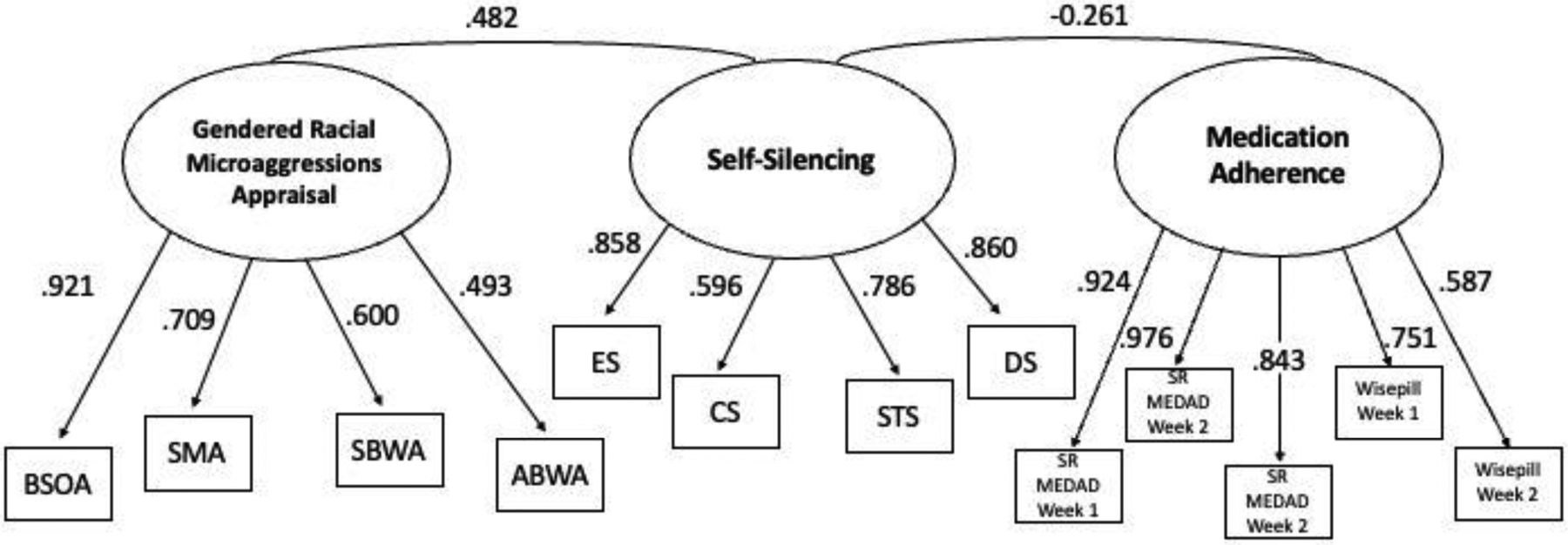
KEY: BSOA=Beauty and Sexual Objectification Stress Appraisal, SMA=Silenced and Marginalized Stress Appraisal, SBWA= Strong Black Woman Stress Appraisal, ABWA=Angry Black Woman Stress Appraisal, ES=Externalized Self-Perception, CS=Care as Self-sacrifice, STS=Silencing the Self, DS=The Divided Self, SR MEDAD= Self-reported Medication Adherence
Figure 3: CFA Model with Gendered Racial Microaggression Frequency Latent.
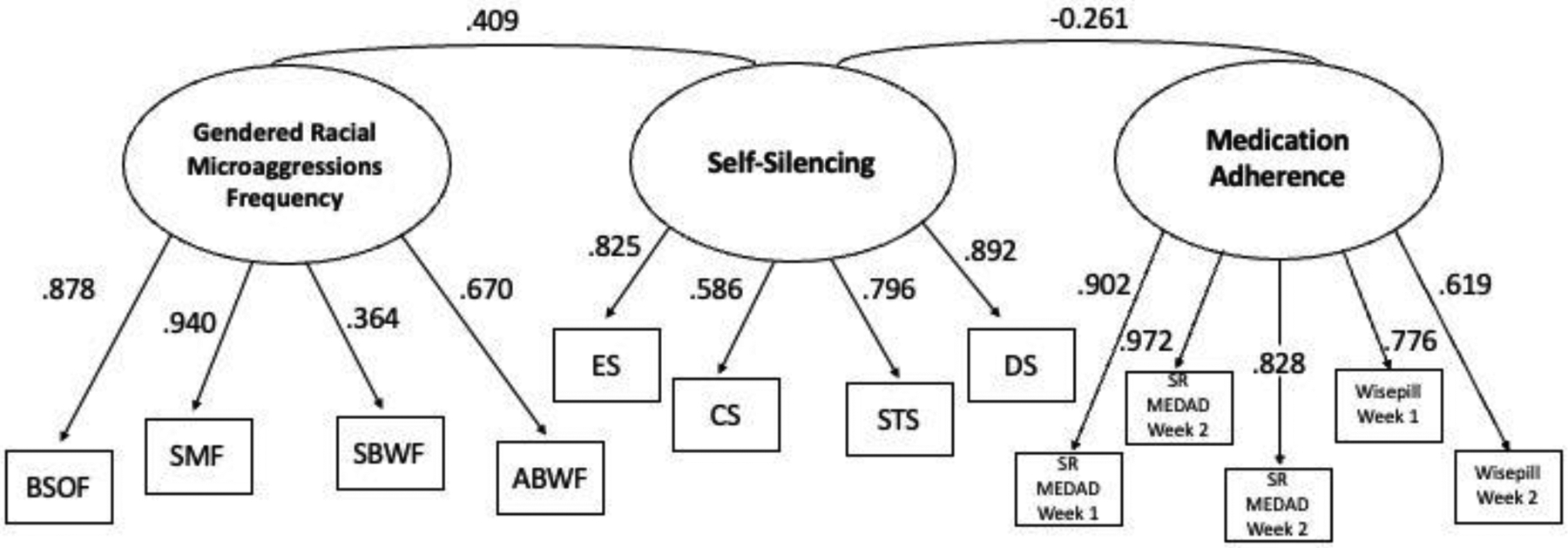
KEY: BSOF=Beauty and Sexual Objectification Frequency, SMF=Silenced and Marginalized Frequency, SBWF= Strong Black Woman Frequency, ABWF=Angry Black Woman Frequency, ES=Externalized Self-Perception, CS=Care as Self-sacrifice, STS=Silencing the Self, DS=The Divided Self, SR MEDAD= Self-reported Medication Adherence
Results of the SEM focused on GRM appraisal indicated that the overall model (see Figure 4) had an acceptable model fit (X2 (93) = 98.23, p = 0.36, CFI = 0.98, RMSEA = 0.02, SRMR = 0.08). The SEM focused on GRM frequency also indicated that the overall model (see Figure 5) had an acceptable model fit (X2 (93) = 107.84, p = 0.14, CFI = 0.94, RMSEA = 0.04, SRMR = 0.08).
Figure 4:
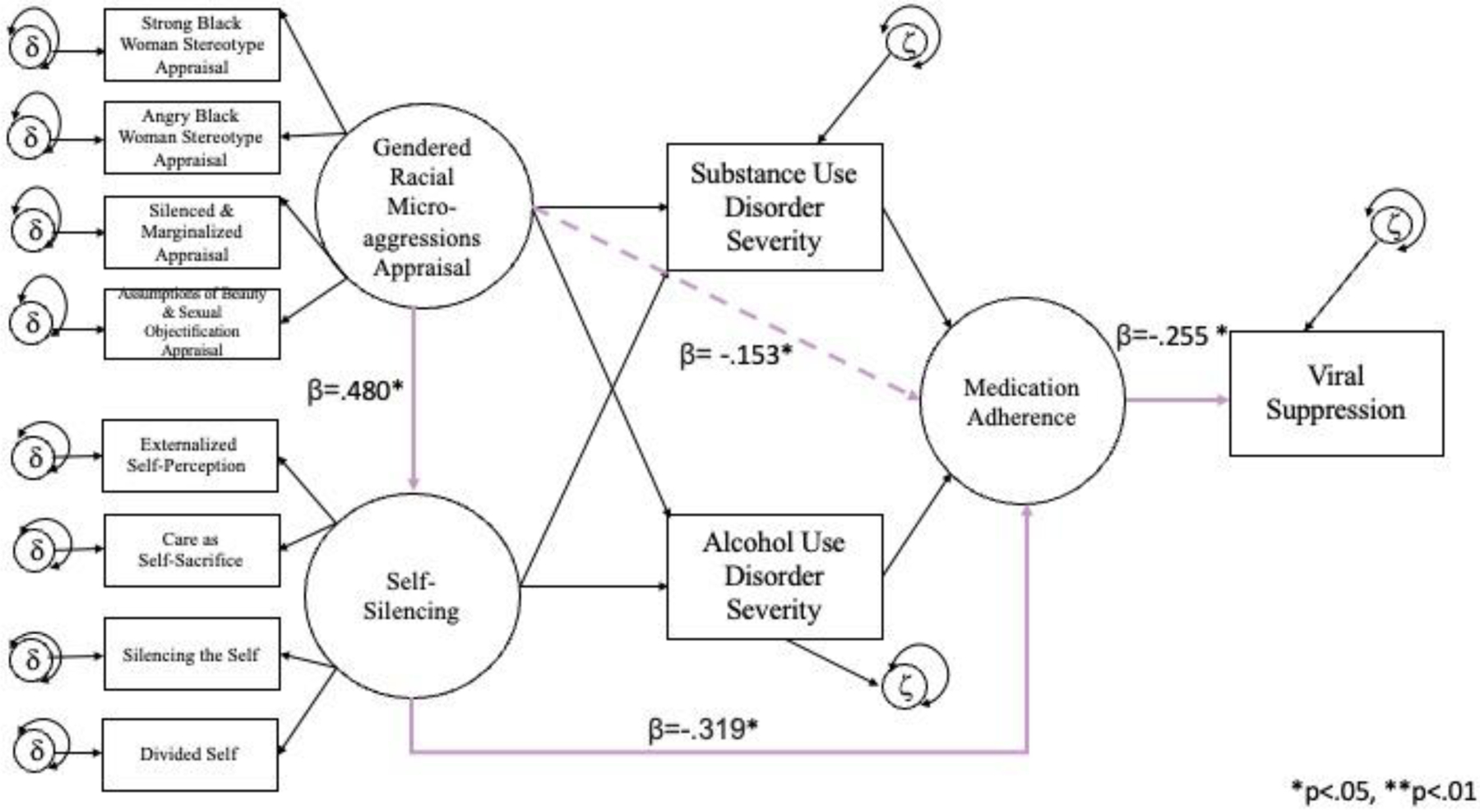
Hybrid Model with Gendered Racial Microaggression Appraisal Latent
Figure 5:
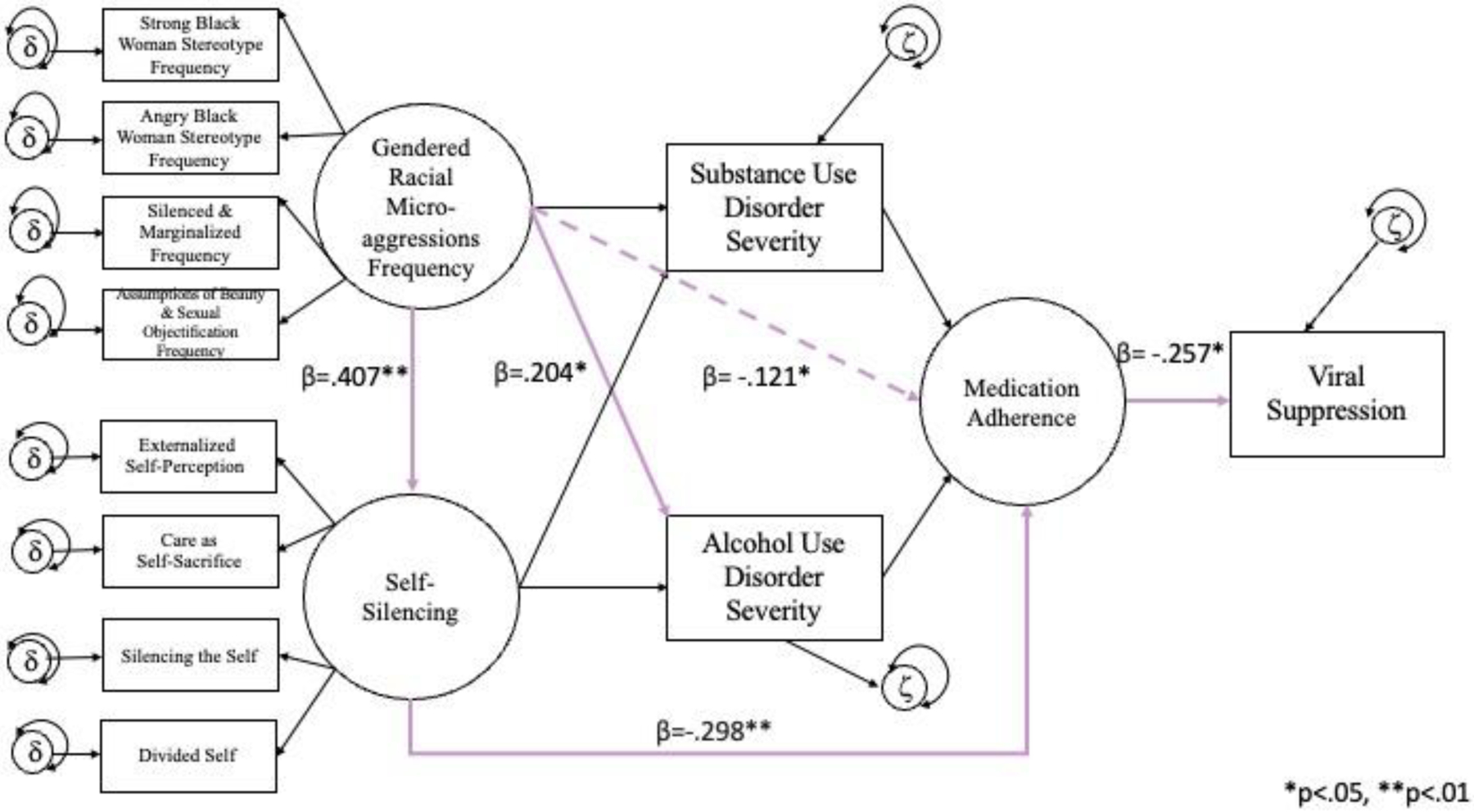
Hybrid Model with Gendered Racial Microaggression Frequency Latent
Results of parameter estimates and path coefficients are shown in Tables 4–6. Higher stress appraisal of GRM was directly related to higher self-silencing (β = 0.48, SE = 0.09, p < 0.001), which was in turn related to lower medication adherence (β = −0.15, SE = 0.07, p = 0.024). Higher frequency of GRM was also directly related to higher self-silencing (β = 0.41, SE = 0.09, p < 0.001), which was in turn related to lower medication adherence (β = −0.12, SE = 0.06, p = 0.030). Stress appraisal of GRM was not directly related to AUD severity (β = 0.056, SE = 0.07, p = 0.634), however higher frequency of GRM was directly related to higher AUD severity (β = 0.204, SE = 0.09, p = 0.02). Stress appraisal of GRM was not directly related to SUD severity (β = 0.059, SE = 0.09, p = 0.63). The frequency of GRM was not directly related to SUD severity (β = 0.012, SE = 0.14, p = 0.929). Stress appraisal of GRM was not indirectly related to AUD severity (β = 0.09, SE = 0.05, p = 0.097) and SUD severity (β = 0.05, SE = 0.06, p = 0.373) via self-silencing. The frequency of GRM was not indirectly related to AUD severity (β = 0.05, SE = 0.04, p = 0.191) and SUD severity (β = 0.05, SE = 0.05, p = 0.299) via self-silencing. Stress appraisal of GRM was not indirectly related to medication adherence via AUD severity (β= −0.01, SE= 0.01, p = 0.648) and SUD severity (β = −0.01, SE = 0.01, p = 0.664). The frequency of GRM was not indirectly related to medication adherence via AUD severity (β = 0.022, SE = 0.03, p = 0.381) and SUD severity (β = .00, SE = 0.01, p = 0.93).
Table 4:
Parameter Estimates for Final Hybrid Models
| Parameter | Unstandardized Coefficient (SE) | Standardized Coefficient | Sig. |
|---|---|---|---|
| Self-Silencing on | |||
| Gendered Racial Microaggressions Appraisal | 2.012(0.59) | 0.480 | <0.001* |
| Gendered Racial Microaggressions Frequency | 2.515(0.742) | 0.407 | <0.001* |
| Problematic Substance Use | |||
| Alcohol Use Disorder Severity on | |||
| Self-Silencing | 0.026(0.02) | 0.188 | 0.074 |
| Gendered Racial Microaggressions Appraisal | 0.032(0.07) | 0.056 | 0.634 |
| Gendered Racial Microaggressions Frequency | 0.181(0.09) | 0.204 | 0.020* |
| Substance Use Disorder Severity | |||
| Self-Silencing | 0.018(0.02) | 0.103 | 0.363 |
| Gendered Racial Microaggressions Appraisal | 0.04(0.09) | 0.059 | 0.630 |
| Gendered Racial Microaggressions Frequency | 0.012(0.14) | 0.011 | 0.929 |
| HIV-related Outcomes | |||
| Medication Adherence on | |||
| Self-Silencing | −0.066(0.03) | −0.319 | 0.006* |
| Alcohol Use Disorder Severity | 0.159(0.18) | 0.106 | 0.375 |
| Substance Disorder Severity | 0.119(0.11) | 0.100 | 0.285 |
| Viral Suppression on | |||
| Medication Adherence | −0.229(0.10) | −0.225 | 0.010* |
Table 6:
Path Coefficients and Indirect Effects for Mediation Model with GRM Frequency Latent
| Path Coefficients | Indirect Effects | ||||||
|---|---|---|---|---|---|---|---|
| Self-Silencing (SS) | to AUD Severity | to SUD Severity | To Medication Adherence (MedAd) | To Viral Suppression (VS) | Estimate | Sig. | |
| GRM-Frequency (GRM-F) | .41 (.09) | .20 (.09) | .01 (.12) | −.01 (.12) | |||
| Self-Silencing | .13 (.10) | 0.12 (.12) | −.30 (.11) | ||||
| AUD Severity | .11 (.12) | −.01 (.13) | |||||
| SUD Severity | .10 (.09) | .11 (.08) | |||||
| Medication Adherence | −.26 (.10) | ||||||
| Mediation Models | |||||||
| GRM-F →SS →AUD | .05 (.04) | .191 | |||||
| GRM-F →SS →SUD | .05 (.05) | .299 | |||||
| GRM-F→SS→MedAd | −.12 (.06) | .030* | |||||
| GRM-F→ AUD→MedAd | .022 (.03) | .381 | |||||
| GRM-F→SUD→MedAd | .00 (.01) | .930 | |||||
| SS→AUD→MedAd | .02 (.02) | .529 | |||||
| SS→SUD→MedAd | 0.12 (.02) | .468 | |||||
| SS→MedAd→VS | .08 (.05) | .091 | |||||
| AUD→MedAd→VS | −.03 (.04) | .417 | |||||
| SUD→MedAd→VS | −.03 (.03) | .320 | |||||
KEY: GRM-F= Gendered Racial Microaggression Frequency, SS= Self-Silencing, AUD=Alcohol Use Disorder Severity, SUD=Substance Use Disorder Severity, MedAd=Medication Adherence, VS= Viral Suppression
Higher levels of self-silencing were directly associated with lower medication adherence (β = −0.319, SE = 0.03, p = 0.006). Self-silencing was not directly associated with AUD severity (β = 0.188, SE = 0.02, p = 0.074) or SUD severity (β = 0.103, SE = 0.02, p = 0.363). Self-silencing did not have a indirect relation to medication adherence via AUD severity (β = 0.02, SE = 0.03, p = 0.498) and SUD severity (β = 0.01, SE = 0.02, p = 0.501). Self-silencing did not have an indirect relation to viral suppression via medication adherence (β = 0.08, SE = 0.05, p = 0.089).
Higher medication adherence was directly related to viral suppression (β = −0.225, SE = 0.10, p = 0.01). AUD severity (β = 0.106, SE = 0.18, p = 0.375) and SUD severity (β = 0.10, SE= 0.11, p = 0.285) were not directly associated with medication adherence. AUD severity (β = −0.03, SE= 0.03, p = 0.42) and SUD severity (β = −0.03, SE = 0.03, p = 0.324) was not indirectly associated with viral suppression via medication adherence.
DISCUSSION
The present study utilized structural equation modeling and path analysis to examine the relationships between gendered racial microaggressions, self-silencing, problematic substance use, and HIV-related outcomes among BWLWH. To our knowledge, this is the first study to evaluate GRM as predictors of self-silencing and problematic substance use and the indirect associations GRM may have on HIV medication adherence through self-silencing and problematic substance use. The potential direct and indirect relationships of self-silencing and problem substance use on medication and viral suppression were also explored. The results showed that BWLWH experience moderate stress from GRM and may be more prone to engaging in self-silencing as a response to GRM. This finding extends previous work focused on highlighting the negative impact GRM may have on the mental health [12,15,18,26] and HIV outcomes [27] among BWLWH. Additionally, results indicated that there is an indirect pathway between the frequency and stress appraisal of GRM and medication adherence via self-silencing. Such findings may be explained by women attempting to self-silence as a means to reduce the frequency and in turn the stress resulted from GRM. For example, women who have been stereotyped as angry and hostile may take on a demure demeanor in effort to avoid experiencing microaggressions related to the angry Black woman stereotype which may increase self-silencing. Silencing the self may also lead to increased stress and decreased self-care which may result in lower medication adherence. Further, as a part of self-silencing women may be sacrificing their own needs and time to care for others and thereby neglect their own self-care [64]. Indeed, our findings support previous research showing that self-silencing is a significant predictor of medication adherence [5,51]. The current study extends the literature and presents novel findings indicating GRM as a predictor of self-silencing that also has an indirect influence on medication adherence.
Contrary to the study’s hypotheses neither the stress appraisal of GRM nor self-silencing predicted problematic substance use which was captured by AUD and SUD symptom severity among BWLWH. However, the results indicated that the frequency of experiencing GRM is a significant predictor of AUD symptom severity. Despite the stress of experiencing GRM not being predictive of AUD symptom severity, women who experience a greater amount of GRM over time may become more likely to engage in alcohol use as a method to reduce stress [61]. Due to the high frequency of GRM, they may have normalized such experiences which may lead to a lower stress appraisal. In a recent study utilizing ecological momentary assessments (EMA) to examine daily microaggressions related to race, gender, sexual orientation and living with HIV among BWLWH during the COVID-19 pandemic and the Black Lives Matter protests, researchers (2021) found that higher microaggression-related distress was associated with past 30-day alcohol use [61]. Such findings highlight that monitoring microaggressions and related distress in real time may better capture both the frequency and stress appraisal of microaggressions and predict its relation to health behaviors such as alcohol use.
Problematic substance use did not indirectly influence the relationships between GRM, self-silencing, and HIV outcomes. Given that substance use has been associated with stressful life events, such as IPV, child abuse, and stigma among BWLWH, it was important to further examine the potential relationship between GRM and problematic substance use among this population [44,46,48,62]. Research has shown that substance use is prevalent among BWLWH and serves as a barrier to medication adherence which in turn influences viral suppression [44,48,49]. Less than 25% of women in the study met criteria for SUD and/or AUD, which may explain the null findings. BWLWH may also engage in more adaptive coping mechanisms such as seeking social support and engaging in religious and spiritual practices to help manage stress related to GRM and lessen the negative consequences of self-silencing [26,27,63]. Such protective factors may reduce the likelihood of problematic substance use. Moreover, additional research consisting of larger samples of BWLWH is needed to further explore potential relationships between GRM, self-silencing, and substance use.
As hypothesized, self-reported medication adherence was a significant predictor of viral suppression. Indeed, women with a greater ability to adhere to their ART regimen were more likely to be virally suppressed which supports existing literature [7,41,47,51]. Opposite to previous research examining the relationships between substance use, medication adherence, and viral suppression, results from the present study showed that problematic substance use was not a significant predictor of medication adherence [45,47–49]. Furthermore, problematic substance use did not have an indirect influence on viral suppression through medication adherence. Such findings may again be related to the relatively low rates of AUD and SUD diagnoses and the high rates of medication adherence among the sample women. Future research should continue to explore substance use in relation to HIV-related outcomes in the context of other structural and psychosocial factors unique to BWLWH.
Several limitations are worth noting regarding the present study. First, the study is cross-sectional in nature thus we cannot infer causality in our findings and rely solely on associations. Second, the study utilized self-report measures to capture GRM, self-silencing, substance use, and medication adherence ratings which may be influenced by social desirability and recall bias. However, medication adherence was also captured using the Wisepill medication monitor. Future studies may consider using longitudinal ecological momentary approaches to better capture experiences of GRM, self-silencing, and substance use as they occur and examine the impact those factors may have on the medication adherence and viral suppression over time. Third, our study sample consisted of 119 BWLWH in a Southeastern metropolitan area in the U.S. which may limit generalizability. While Miami-Dade County remains a epicenter of the HIV epidemic in the United States [3], where Black women are disproportionately impacted by disparities across the HIV care continuum, it is important to highlight that there may be unique aspects to their experiences given the geographical location and sociopolitical context. Our sample was 119 and a larger sample may have increased our statistical power to detect additional significant pathways. Additionally, the study limited participation to BWLWH who were fluent in English, which may have excluded foreign born non-English speaking BWLWH residing in Miami and the surrounding areas. As such, a large-scale study that includes a geographically, ethnically, linguistically, and culturally diverse sample of BWLWH may further increase our understanding. Lastly, our recruitment approach entailed outreach at community events and the distribution of flyers and posters in healthcare settings such as hospitals, clinics, and community health centers. While the community outreach may have broadened our reach to BWLWH who may not be connected to care, there still may be potential selection bias with this recruitment strategy. Future research will benefit from diversifying recruitment strategies that include community-based approaches, as well as utilizing social media to reach more BWLWH.
Primary findings from this study show that both the frequency of and stress from GRM relates to self-silencing which in turns influences medication adherence among BWLWH. To our knowledge, this is the first study to explore the relationships between gendered racial microaggressions, self-silencing, medication adherence, and viral suppression. Additionally, our study filled a research gap by examining GRM and self-silencing as psychosocial factors that may influence substance use and in turn impact HIV-related outcomes. There is a need for large-scale longitudinal studies exploring how stress from GRM may lead to self-silencing and other adverse health outcomes among BLWLH. Protective factors such as resilience, social support, spirituality, and meaning making should also be explored. The direct association self-silencing had on medication adherence is also noteworthy and highlights the need for behavioral interventions that promote self-care, adaptive coping, and social support among BWLWH who may struggle with stress related to discrimination, IPV, and economic barriers that may influence medication adherence, HIV outcomes, and mental health.
Table 5:
Path Coefficients and Indirect Effects for Mediation Model with GRM Appraisal Latent
| Path Coefficients | Indirect Effects | ||||||
|---|---|---|---|---|---|---|---|
| Self-Silencing (SS) | to AUD Severity | to SUD Severity | To Medication Adherence (MedAd) | To Viral Suppression (VS) | Estimate | Sig. | |
| GRM-Appraisal (GRM-A) | .48 (.09) | .06 (.12) | .06 (0.12) | .038 (.11) | |||
| Self-Silencing | .19 (.11) | .10 (.11) | −.32 (.12) | ||||
| AUD Severity | .11 (.12) | .00 (0.12) | |||||
| SUD Severity | .10 (.09) | .11 (.08) | |||||
| Medication Adherence | −.26 (.01) | ||||||
| Mediation Models | |||||||
| GRM-A →SS →AUD | .09 (.05) | 0.097 | |||||
| GRM-A →SS →SUD | .05 (.06) | .373 | |||||
| GRM-A→SS→MedAd | −.15 (.07) | .024* | |||||
| GRM-A→ AUD→MedAd | .01 (.01) | .648 | |||||
| GRM-A→SUD→MedAd | .01 (.01) | .664 | |||||
| SS→AUD→MedAd | .02 (.03) | .498 | |||||
| SS→SUD→MedAd | .01 (.02) | .501 | |||||
| SS→MedAd→VS | .08 (.05) | .089 | |||||
| AUD→MedAd→VS | −.03 (.03) | .420 | |||||
| SUD→MedAd→VS | −.03 (.03) | .324 | |||||
KEY: GRM-A= Gendered Racial Microaggression Stress Appraisal, SS= Self-Silencing, AUD=Alcohol Use Disorder Severity, SUD=Substance Use Disorder Severity, MedAd=Medication Adherence, VS= Viral Suppression
Acknowledgements:
We would like to extend extensive gratitude to the women who participated in this study, community stakeholders, and research staff. The research reported in this publication and the principal investigator (Dr. Sannisha Dale) were funded by K23MH108439 from the National Institute of Mental Health (NIMH). Dr. Dale was additionally funded by R56MH121194 and R01MH121194 from NIMH. Naysha Shahid was also funded by T32 MH126772 from NIMH. The content of this publication is solely the responsibility of the authors and does not necessarily represent the official views of the National Institutes of Health.
Statements and Declarations/ Competing Interests: Unrelated to data in this manuscript, Dr. Dale is a co-investigator on a Merck & Co. funded project on “ A Qualitative Study to Explore Biomedical HIV Prevention Preferences, Challenges and Facilitators among Diverse At-Risk Women Living in the United States” and has served as a workgroup consultant on engaging people living with HIV for Gilead Sciences, Inc. All other authors declare that they do not have competing interests.
REFERENCES
- 1.CDC. HIV Surveillance Report 2018 (updated). Centers for Disease Control and Prevention [Internet]. 2020. [cited 2022 Dec 20];31. Available from: https://www.cdc.gov/hiv/library/reports/hiv-surveillance.html [Google Scholar]
- 2.Bradley ELP, Williams AM, Green S, Lima AC, Geter A, Chesson HW, et al. Disparities in Incidence of Human Immunodeficiency Virus Infection Among Black and White Women — United States, 2010–2016. MMWR Morb Mortal Wkly Rep. 2019;68:416–8. [DOI] [PMC free article] [PubMed] [Google Scholar]
- 3.Velis E, Shaw G. The AIDS epidemic in South Florida: Black non-Hispanics in our communities remain increasingly vulnerable. 3rd Mediterranean Interdisciplinary Forum on Social Sciences and Humanities, MIFS 2015. 2015;17–19. [Google Scholar]
- 4.AIDSVu. Miami (Miami-Dade County) [Internet]. 2020. Available from: https://aidsvu.org/local-data/united-states/south/florida/miami/
- 5.Bruck-Segal D, Schwartz RM, Cohen MH, Weber KM, Burke-Miller JK, Kassaye S, et al. The Costs of Silencing the Self and Divided Self in the Context of Physical Abuse, Racial/Ethnic Identity, and Medication Adherence in Women Living with HIV. Sex Roles. 2020;82:716–30. [DOI] [PMC free article] [PubMed] [Google Scholar]
- 6.Geter A, Sutton MY, Armon C, Durham MD, Palella FJ, Tedaldi E, et al. Trends of racial and ethnic disparities in virologic suppression among women in the HIV Outpatient Study, USA, 2010–2015. Blackard J, editor. PLoS ONE. 2018;13:e0189973. [DOI] [PMC free article] [PubMed] [Google Scholar]
- 7.Geter A, Sutton MY, Armon C, Buchacz K. Disparities in Viral Suppression and Medication Adherence among Women in the USA, 2011–2016. AIDS Behav. 2019;23:3015–23. [DOI] [PubMed] [Google Scholar]
- 8.Geter A, Sutton MY, Hubbard McCree D. Social and structural determinants of HIV treatment and care among black women living with HIV infection: a systematic review: 2005–2016. AIDS Care. 2018;30:409–16. [DOI] [PMC free article] [PubMed] [Google Scholar]
- 9.Rao D, Andrasik MP, Lipira L. HIV Stigma Among Black Women in the United States: Intersectionality, Support, Resilience. Am J Public Health. 2018;108:446–8. [DOI] [PMC free article] [PubMed] [Google Scholar]
- 10.Rice WS, Logie CH, Napoles TM, Walcott M, Batchelder AW, Kempf M-C, et al. Perceptions of intersectional stigma among diverse women living with HIV in the United States. Social Science & Medicine. 2018;208:9–17. [DOI] [PMC free article] [PubMed] [Google Scholar]
- 11.Sangaramoorthy T, Jamison A, Dyer T. Intersectional stigma among midlife and older Black women living with HIV. Culture, Health & Sexuality. 2017;19:1329–43. [DOI] [PMC free article] [PubMed] [Google Scholar]
- 12.Dale SK, Dean T, Sharma R, Reid R, Saunders S, Safren SA. Microaggressions and Discrimination Relate to Barriers to Care Among Black Women Living with HIV. AIDS Patient Care and STDs. 2019;33:175–83. [DOI] [PMC free article] [PubMed] [Google Scholar]
- 13.Logie CH, Wang Y, Marcus N, Kaida A, O’Brien N, Nicholson V, et al. Factors Associated with the Separate and Concurrent Experiences of Food and Housing Insecurity Among Women Living with HIV in Canada. AIDS Behav. 2018;22:3100–10. [DOI] [PubMed] [Google Scholar]
- 14.Kelso GA, Cohen MH, Weber KM, Dale SK, Cruise RC, Brody LR. Critical Consciousness, Racial and Gender Discrimination, and HIV Disease Markers in African American Women with HIV. AIDS Behav. 2014;18:1237–46. [DOI] [PMC free article] [PubMed] [Google Scholar]
- 15.Dale SK, Safren SA. Gendered racial microaggressions predict posttraumatic stress disorder symptoms and cognitions among Black women living with HIV. Psychological Trauma: Theory, Research, Practice, and Policy. 2019;11:685–94. [DOI] [PMC free article] [PubMed] [Google Scholar]
- 16.Dale SK, Safren SA. Gendered Racial Microaggressions Associated with Depression Diagnosis among Black Women Living with HIV. J Urban Health. 2020;97:377–86. [DOI] [PMC free article] [PubMed] [Google Scholar]
- 17.Perry BL, Pullen EL, Oser CB. Too Much of a Good Thing? Psychosocial Resources, Gendered Racism, and Suicidal Ideation among Low Socioeconomic Status African American Women. Soc Psychol Q. 2012;75:334–59. [DOI] [PMC free article] [PubMed] [Google Scholar]
- 18.Thompson M, Dale SK. Gendered Racial Microaggressions and Self-Silencing Associated with Suicidality Among Black Women Living with HIV. J Racial and Ethnic Health Disparities [Internet]. 2021. [cited 2021 Dec 4]; Available from: http://link.springer.com/10.1007/s40615-021-01009-4 [DOI] [PMC free article] [PubMed] [Google Scholar]
- 19.Teti M, Bowleg L, Lloyd L. ‘Pain on Top of Pain, Hurtness on Top of Hurtness’: Social Discrimination, Psychological Well-Being, and Sexual Risk Among Women Living With HIV/AIDS. International Journal of Sexual Health. 2010;22:205–18. [Google Scholar]
- 20.Lewis JA, Williams MG, Peppers EJ, Gadson CA. Applying intersectionality to explore the relations between gendered racism and health among Black women. Journal of Counseling Psychology. 2017;64:475–86. [DOI] [PubMed] [Google Scholar]
- 21.Lewis JA, Neville HA. Construction and initial validation of the Gendered Racial Microaggressions Scale for Black women. Journal of Counseling Psychology. 2015;62:289–302. [DOI] [PubMed] [Google Scholar]
- 22.Logie CH, Wang Y, Lacombe-Duncan A, Wagner AC, Kaida A, Conway T, et al. HIV-related stigma, racial discrimination, and gender discrimination: Pathways to physical and mental health-related quality of life among a national cohort of women living with HIV. Preventive Medicine. 2018;107:36–44. [DOI] [PubMed] [Google Scholar]
- 23.Perry BL, Harp KLH, Oser CB. Racial and Gender Discrimination in the Stress Process: Implications for African American Women’s Health and Well-Being. Sociological Perspectives. 2013;56:25–48. [PMC free article] [PubMed] [Google Scholar]
- 24.Stevens-Watkins D, Perry B, Pullen E, Jewell J, Oser CB. Examining the associations of racism, sexism, and stressful life events on psychological distress among African-American women. Cultural Diversity and Ethnic Minority Psychology. 2014;20:561–9. [DOI] [PMC free article] [PubMed] [Google Scholar]
- 25.Thomas MD, Michaels EK, Reeves AN, Okoye U, Price MM, Hasson RE, et al. Differential associations between everyday versus institution-specific racial discrimination, self-reported health, and allostatic load among black women: implications for clinical assessment and epidemiologic studies. Annals of Epidemiology. 2019;35:20–28.e3. [DOI] [PMC free article] [PubMed] [Google Scholar]
- 26.Dale SK, Nelson CM, Wright IA, Etienne K, Lazarus K, Gardner N, et al. Structural equation model of intersectional microaggressions, discrimination, resilience, and mental health among black women with hiv. Health Psychology. 2023;42:299–313. [DOI] [PMC free article] [PubMed] [Google Scholar]
- 27.Reid R, Dale SK. Structural equation modeling of microaggressions, religious and racism-related coping, medication adherence, and viral load among Black women living with HIV. J Behav Med [Internet]. 2023. [cited 2023 Jul 10]; Available from: https://link.springer.com/10.1007/s10865-023-00403-z [DOI] [PMC free article] [PubMed] [Google Scholar]
- 28.Abrams JA, Hill A, Maxwell M. Underneath the Mask of the Strong Black Woman Schema: Disentangling Influences of Strength and Self-Silencing on Depressive Symptoms among U.S. Black Women. Sex Roles. 2019;80:517–26. [DOI] [PMC free article] [PubMed] [Google Scholar]
- 29.Harrington EF, Crowther JH, Shipherd JC. Trauma, binge eating, and the “strong Black woman”. Journal of Consulting and Clinical Psychology. 2010;78:469–79. [DOI] [PubMed] [Google Scholar]
- 30.Dale SK, Cohen MH, Kelso GA, Cruise RC, Weber KM, Watson C, et al. Resilience Among Women with HIV: Impact of Silencing the Self and Socioeconomic Factors. Sex Roles. 2014;70:221–31. [DOI] [PMC free article] [PubMed] [Google Scholar]
- 31.DeMarco RF, Lanier LR. The Concept of “Silencing the Self” in Low-Income, Aging, HIV-Infected African American Women: A 10-Year Community-Based Participatory Program of Research With Results. Journal of the Association of Nurses in AIDS Care. 2014;25:112–22. [DOI] [PubMed] [Google Scholar]
- 32.Jack DC. Silencing the self: Women and depression. Harvard University Press; 1991. [Google Scholar]
- 33.hooks bell. Talking back: Thinking feminist, thinking black. South End Press; 1989. [Google Scholar]
- 34.Brody LR, Stokes LR, Dale SK, Kelso GA, Cruise RC, Weber KM, et al. Gender Roles and Mental Health in Women With and at Risk for HIV. Psychology of Women Quarterly. 2014;38:311–26. [DOI] [PMC free article] [PubMed] [Google Scholar]
- 35.Illangasekare S, Burke J, Chander G, Gielen A. The Syndemic Effects of Intimate Partner Violence, HIV/AIDS, and Substance Abuse on Depression among Low-Income Urban Women. J Urban Health. 2013;90:934–47. [DOI] [PMC free article] [PubMed] [Google Scholar]
- 36.Tsuyuki K, Pitpitan EV, Levi-Minzi MA, Urada LA, Kurtz SP, Stockman JK, et al. Substance Use Disorders, Violence, Mental Health, and HIV: Differentiating a Syndemic Factor by Gender and Sexuality. AIDS Behav. 2017;21:2270–82. [DOI] [PMC free article] [PubMed] [Google Scholar]
- 37.Whittle HJ, Sheira LA, Frongillo EA, Palar K, Cohen J, Merenstein D, et al. Longitudinal associations between food insecurity and substance use in a cohort of women with or at risk for HIV in the United States: Food insecurity and substance use in the US. Addiction. 2019;114:127–36. [DOI] [PMC free article] [PubMed] [Google Scholar]
- 38.Anderson JC, Campbell JC, Glass NE, Decker MR, Perrin N, Farley J. Impact of intimate partner violence on clinic attendance, viral suppression and CD4 cell count of women living with HIV in an urban clinic setting. AIDS Care - Psychological and Socio-Medical Aspects of AIDS/HIV. 2018;30:399–408. [DOI] [PMC free article] [PubMed] [Google Scholar]
- 39.Turan B, Rice WS, Crockett KB, Johnson M, Neilands TB, Ross SN, et al. Longitudinal association between internalized HIV stigma and antiretroviral therapy adherence for women living with HIV: the mediating role of depression. AIDS. 2019;33:571–6. [DOI] [PMC free article] [PubMed] [Google Scholar]
- 40.Wyatt GE, Carmona JV, Loeb TB, Williams JK. HIV-positive black women with histories of childhood sexual abuse: Patterns of substance use and barriers to health care. Journal of Health Care for the Poor and Underserved. 2005;16:9–23. [DOI] [PubMed] [Google Scholar]
- 41.Dale S, Cohen M, Weber K, Cruise R, Kelso G, Brody L. Abuse and Resilience in Relation to HAART Medication Adherence and HIV Viral Load Among Women with HIV in the United States. AIDS Patient Care and STDs. 2014;28:136–43. [DOI] [PMC free article] [PubMed] [Google Scholar]
- 42.Neblett RC, Hutton HE, Lau B, McCaul ME, Moore RD, Chander G. Alcohol consumption among HIV-infected women: Impact on time to antiretroviral therapy and survival. Journal of Women’s Health. 2011;20:279–86. [DOI] [PMC free article] [PubMed] [Google Scholar]
- 43.Stevens-Watkins D, Perry B, Harp KL, Oser CB. Racism and Illicit Drug Use Among African American Women: The Protective Effects of Ethnic Identity, Affirmation, and Behavior. Journal of Black Psychology. 2012;38:471–96. [DOI] [PMC free article] [PubMed] [Google Scholar]
- 44.Sullivan KA, Messer LC, Quinlivan EB. Substance Abuse, Violence, and HIV/AIDS (SAVA) Syndemic Effects on Viral Suppression Among HIV Positive Women of Color. AIDS Patient Care and STDs. 2015;29:S42–8. [DOI] [PMC free article] [PubMed] [Google Scholar]
- 45.Telfair Sharpe T, Lee LM, Nakashima AK, Elam-Evans LD, Fleming PL. Crack Cocaine Use and Adherence to Antiretroviral Treatment Among HIV-Infected Black Women. Journal of Community Health. 2004;29:117–27. [DOI] [PubMed] [Google Scholar]
- 46.Vu M, Li J, Haardörfer R, Windle M, Berg CJ. Mental health and substance use among women and men at the intersections of identities and experiences of discrimination: insights from the intersectionality framework. BMC Public Health. 2019;19:108. [DOI] [PMC free article] [PubMed] [Google Scholar]
- 47.Lipira L, Rao D, Nevin PE, Kemp CG, Cohn SE, Turan JM, et al. Patterns of alcohol use and associated characteristics and HIV-related outcomes among a sample of African-American women living with HIV. Drug and Alcohol Dependence. 2020;206:107753. [DOI] [PMC free article] [PubMed] [Google Scholar]
- 48.Liu H, Longshore D, Williams JK, Rivkin I, Loeb T, Warda US, et al. Substance Abuse and Medication Adherence Among HIV-Positive Women with Histories of Child Sexual Abuse. AIDS Behav. 2006;10:279–86. [DOI] [PMC free article] [PubMed] [Google Scholar]
- 49.Zhang Y, Wilson TE, Adedimeji A, Merenstein D, Milam J, Cohen J, et al. The Impact of Substance Use on Adherence to Antiretroviral Therapy Among HIV-Infected Women in the United States. AIDS Behav. 2018;22:896–908. [DOI] [PMC free article] [PubMed] [Google Scholar]
- 50.Hutton HE, Cardin N, Ereme K, Chander G, Xu X, McCaul ME. Psychiatric Disorders and Substance Use Among African American Women in HIV Care. AIDS Behav. 2020;24:3083–92. [DOI] [PubMed] [Google Scholar]
- 51.Brody LR, Stokes LR, Kelso GA, Dale SK, Cruise RC, Weber KM, et al. Gender Role Behaviors of High Affiliation and Low Self-Silencing Predict Better Adherence to Antiretroviral Therapy in Women with HIV. AIDS Patient Care and STDs. 2014;28:459–61. [DOI] [PMC free article] [PubMed] [Google Scholar]
- 52.Burke LA, Chijioke S, Le TP. Gendered racial microaggressions and emerging adult Black women’s social and general anxiety: Distress intolerance and stress as mediators. J Clin Psychol. 2022;jclp.23460. [DOI] [PubMed] [Google Scholar]
- 53.Lewis JA, Mendenhall R, Harwood SA, Browne Huntt M. “Ain’t I a Woman?”: Perceived Gendered Racial Microaggressions Experienced by Black Women. The Counseling Psychologist. 2016;44:758–80. [Google Scholar]
- 54.Sissoko DRG, Lewis JA, Nadal KL. It’s More Than Skin-Deep: Gendered Racial Microaggressions, Skin Tone Satisfaction, and Traumatic Stress Symptoms Among Black Women. Journal of Black Psychology. 2022;009579842211379. [Google Scholar]
- 55.Moody AT, Lewis JA. Gendered Racial Microaggressions and Traumatic Stress Symptoms Among Black Women. Psychology of Women Quarterly. 2019;43:201–14. [Google Scholar]
- 56.Jack DC, Dill D. The Silencing the Self Scale: Schemas of Intimacy Associated With Depression in Women. Psychology of Women Quarterly. 1992;16:97–106. [Google Scholar]
- 57.Lecrubier Y, Sheehan DV, Weiller E, Amorim P, Bonora I, Sheehan KHarnett, et al. The Mini International Neuropsychiatric Interview (MINI). A short diagnostic structured interview: reliability and validity according to the CIDI. European psychiatry. 1997;12:224–31. [Google Scholar]
- 58.Gaynes BN, Pence BW, Atashili J, O’Donnell JK, Njamnshi AK, Tabenyang ME, et al. Changes in HIV Outcomes Following Depression Care in a Resource-Limited Setting: Results from a Pilot Study in Bamenda, Cameroon. Price MA, editor. PLoS ONE. 2015;10:e0140001. [DOI] [PMC free article] [PubMed] [Google Scholar]
- 59.Lu M, Safren SA, Skolnik PR, Rogers WH, Coady W, Hardy H, et al. Optimal Recall Period and Response Task for Self-Reported HIV Medication Adherence. AIDS Behav. 2008;12:86–94. [DOI] [PubMed] [Google Scholar]
- 60.Haberer JE, Kahane J, Kigozi I, Emenyonu N, Hunt P, Martin J, et al. Real-Time Adherence Monitoring for HIV Antiretroviral Therapy. AIDS Behav. 2010;14:1340–6. [DOI] [PMC free article] [PubMed] [Google Scholar]
- 61.Dale SK, Pan Y, Gardner N, Saunders S, Wright IA, Nelson CM, et al. Daily Microaggressions and Related Distress among Black Women Living with HIV during the Onset of the COVID-19 Pandemic and Black Lives Matter Protests. AIDS Behav. 2021;25:4000–7. [DOI] [PMC free article] [PubMed] [Google Scholar]
- 62.Wyatt GE, Carmona JV, Loeb TB, Williams JK. HIV-Positive Black Women with Histories of Childhood Sexual Abuse: Patterns of Substance Use and Barriers to Health Care. Journal of Health Care for the Poor and Underserved. 2005;16:9–23. [DOI] [PubMed] [Google Scholar]
- 63.Reid R, Dale SK. Moderating effects of social support on the relationship between substance use disorders and HIV viral load and medication adherence among Black women living with HIV in the United States. AIDS Care. 2021;1–10. [DOI] [PMC free article] [PubMed] [Google Scholar]
- 64.Dale SK, Pierre-Louis C, Bogart LM, O’Cleirigh C, Safren SA. Still I rise: The need for self-validation and self-care in the midst of adversities faced by Black women with HIV. Cultural Diversity and Ethnic Minority Psychology. 2018;24(1):15. [DOI] [PMC free article] [PubMed] [Google Scholar]