



Abstract
BACKGROUND
Correction of cheek wrinkles using poly-l-lactic acid (PLLA-SCA) was demonstrated in a 12-month study.
OBJECTIVE
This analysis assessed change from baseline in lifting effect of PLLA-SCA using a 3D camera to provide additional quantified data.
METHODS
Subjects received PLLA-SCA (reconstituted in 8 mL of sterile water + 1 mL of 2% lidocaine) in both cheeks or no treatment (control). Assessments included the Galderma Cheek Wrinkle Scale (GCWS), aesthetic improvement, and 3D photography. In subjects with severe GCWS at baseline, Canfield software analyzed 3D images for change from baseline in midface volume projection and volume change of both cheeks at Month 9.
RESULTS
The primary study showed a statistically significant higher at-rest GCWS responder rate at Month 12 for PLLA-SCA, 71.6%, versus control, 26.1% (p < .0001). In this Month 9 analysis, mean midface volume projection demonstrated a positive volume shift for PLLA-SCA (left: 0.45 mm; right: 0.34 mm; n = 46) versus control (left: 0.25 mm; right: −0.01 mm; n = 21). Midface volume and max projection changes for PLLA-SCA were +4.88 mL/+1.62 mm (left), +2.84 mL/+1.12 mm (right) versus +0.26 mL/+0.34 mm (left), +0.68 mL/+0.37 mm (right) for control.
CONCLUSION
Poly-l-lactic acid-treatment of subjects with severe GCWS had a clinically meaningful lifting effect in both cheeks (positive volume shift, positive volume change, and max projection) in the midface.
Clinical trial registry number
The injectable poly-l-lactic acid (PLLA-SCA; Sculptra) is a collagen biostimulator approved for facial aesthetic uses since 1999 in Europe and in the United States in 2004 for the restoration and correction of the signs of facial fat loss (lipoatrophy) in people with HIV. Since then, PLLA-SCA has been approved for use in immune-competent subjects as a single regimen for the correction of shallow to deep nasolabial fold contour deficiencies, fine lines and wrinkles in the cheek region, and other facial wrinkles.1 The injection methods used for PLLA-SCA administration in the cheek region include linear antegrade, linear retrograde, bolus, fanning, and cross-hatching.1
Poly-l-lactic acid-SCA has also been used for facial rejuvenation, improving skin laxity and restoring volume,2,3 and more recently the product has been utilized in various other regions with a focus on reducing flaccidity, increasing the volume of the gluteal region, and improving skin quality, such as reducing cellulite.4
To meet the need for aesthetic treatments to reduce cheek wrinkles and improve skin quality, 2 studies were conducted: an initial 12-month study (NCT04124692)5 and an extension study with follow-up to 24 months after baseline.6 The primary objective of the main study was to assess the responder rate of ≥1-grade improvement on the at-rest Galderma Cheek Wrinkle Scale (GCWS) at Month 12 versus a no-treatment control. The study demonstrated the effectiveness and safety of PLLA-SCA for correction of cheek wrinkles versus a no-treatment control (NCT04124692),5 and the extension study demonstrated effectiveness and safety through 24 months.6
In the 12-month study and the subsequent extension, PLLA-SCA was reconstituted using an established method recently incorporated into the US label.1 This involved reconstitution with 8 mL of sterile water for injection (SWFI), followed by addition of 1 mL of 2% lidocaine immediately prior to use.
Analysis of 3-dimensional (3D) images can provide more insight into other effects on the skin surface after treatment, complementing data provided by other assessment scales. The objective of this exploratory analysis was to assess the change from baseline in lifting effect of PLLA-SCA on both cheeks concurrently using a 3D camera in the 12-month study (NCT04124692)5 to provide additional quantified data on the effectiveness of wrinkle correction therapies.
Methods
Study Design
This was a prospective, randomized, evaluator-blinded, no-treatment controlled study to assess the effectiveness and safety of treatment with PLLA-SCA for correction of cheek wrinkles (NCT04124692).5 Across 13 sites in the United States, adults over 21 years of age seeking correction of cheek wrinkles and with an at-rest GCWS score of 2 (moderate) or 3 (severe) on each side of the face were randomized (2:1) to either treatment with PLLA-SCA (Sculptra) or no treatment (control group).
Eligible subjects underwent a screening and a baseline visit (these visits could be combined, if appropriate). All subjects randomized to receive treatment were injected by the Treating Investigator on Day 1. Subjects received PLLA-SCA injections in both cheeks during the treatment session or were left untreated as controls (Figure 1). A sufficient amount of PLLA-SCA, as determined by the Treating Investigator, was injected to achieve optimal correction, which was defined as ≥1-grade improvement on the at-rest GCWS and best correction that could have been achieved as agreed by the Treating Investigator and the subject. If needed, 3 additional treatment sessions, each 1 month apart, could be performed to achieve optimal correction, as determined by the Treating Investigator and subject (Figure 1). Treatment stopped when optimal correction was achieved, and subsequent visits became follow-up visits. All subjects in both the treatment and control groups returned to the clinic at Months 7, 9, and 12. Effectiveness and safety data were collected for up to 12 months after the first treatment.
Figure 1.

Treatment and visit schedule. Subjects were randomized 2:1 to receive PLLA-SCA or no treatment (control). A maximum of 9 mL of PLLA-SCA was administered by subdermal injection in each cheek on Day 1. Up to 3 additional treatments were allowed at monthly intervals until Month 3. Follow-up visits were conducted at Months 7, 9, and 12. PLLA-SCA, poly-l-lactic acid-Sculptra.
Study Treatment
Each vial contained 150 mg of PLLA-SCA, 90 mg of sodium carboxymethylcellulose, and 127.5 mg of nonpyrogenic mannitol and was reconstituted prior to use by the addition of 8 mL of SWFI at the investigational site. Immediately prior to injection, 1 mL of 2% lidocaine hydrochloride was added to make the total volume 9 mL.
Each subject received up to 4 injection sessions at 1-month intervals. PLLA-SCA was administered using a 25-gauge needle using the bolus, fanning, cross-hatching, linear threading, or other injection technique at the discretion of the Treating Investigator. Injections were subdermal (i.e., in the subcutaneous and supraperiosteal region).
A maximum of 18 mL (2 vials) of PLLA-SCA were administered per treatment session with a maximum of 9 mL (1 vial) per cheek, evenly distributed within the treatment area. The treatment area was within the following borders: superior border—from top of tragus to top of alar crease; medial border—from top of the alar crease, along the nasolabial fold to the inferior border of the mandibular ramus; inferior border—from medial border at mandibular ramus to angle of mandibular ramus; and lateral border—from angle of mandibular ramus to top of tragus.
Effectiveness Assessments
In the main study, at-rest and dynamic GCWS were assessed up to 12 months after the first treatment using the validated 5-point GCWS (0 = none, 1 = mild, 2 = moderate, 3 = severe, 4 = very severe). The primary end point was ≥1-grade improvement in the at-rest GCWS in both cheeks at Month 12.
Safety Assessments
The incidence, severity, time to onset, and duration of adverse events (AEs) were collected throughout the study period.
Three-Dimensional Image Analysis
In subjects with a “severe” at-rest GCWS score at baseline (n = 46 treated with PLLA-SCA; n = 21 untreated controls), 3D photographs were analyzed using Canfield software for change from baseline in midface volume projection and volume change of both cheeks at Month 9, measured using high-resolution imaging to track skin lift and volume change.
Results
In the main study, 97 subjects were treated with PLLA-SCA and 52 were left untreated as controls. The baseline characteristics and mean treatment volumes are shown in Table 1. In PLLA-SCA–treated subjects with an at-rest severe GCWS score at baseline (n = 46), additional PLLA-SCA treatments were required at Months 1, 2, and 3 for 45 (97.8%), 43 (93.5%), and 42 (91.3%) subjects, respectively. Overall, a total mean injection volume of 54.1 mL was received per subject in the treatment group. The median injection volume (left + right sides) at each treatment session was 16.0 mL. The minimum volume injected was 7.5 mL in Session 1, 8.0 mL in Session 2, 3.0 mL in Session 3, and 6.1 mL in Session 4; the maximum volume injected at each treatment session was 18.0 mL, and the median total injection volume was 58.5 mL. The most common injection methods were linear retrograde (91.3%) and fanning (81.2%). Subcutaneous injection depths were preferred over supraperiosteal (left and right sides equally). Subcutaneous injections were used in all subjects for both the left and right sides of the cheeks, whereas supraperiosteal injections were used for 67.0% of subjects for both the left and right sides of the cheeks.
TABLE 1.
Baseline Characteristics and Treatment Volumes
| Control (n = 52) | PLLA-SCA (n = 97) | |
| Mean age (range), years | 60.4 (45–88) | 60.9 (41–89) |
| Females, % | 96 | 97 |
| Baseline at-rest GCWS | ||
| Moderate | Left: 54% Right: 71% |
Left 52% Right: 62% |
| Severe | Left: 46% Right: 29% |
Left: 48% Right: 38% |
| Mean injected PLLA-SCA volume,* N treated | ||
| Treatment 1 | — | 15.3 mL (n = 97) |
| Treatment 2 | — | 15.3 mL (n = 95) |
| Treatment 3 | — | 15.1 mL (n = 86) |
| Treatment 4 | — | 15.2 mL (n = 67) |
GCWS, Galderma Cheek Wrinkles Scale.
Total of both cheeks.
A total of 61.2% of subjects received an anesthetic before injection, with a topical anesthetic being the most commonly utilized (55.4%). Most subjects received injection concomitant procedures (83.8%), with massage (65.5%) and an ice pack (60.3%) being the most commonly administered.
Galderma Cheek Wrinkle Scale Responder Rate (Main Study Primary Outcome)
The primary end point of the main study, the at-rest GCWS responder rate was significantly higher for PLLA-SCA compared with controls at Month 12 (71.6% vs 26.1%; p < .0001).5 Similarly, the at-rest GCWS responder rates were significantly higher for PLLA-SCA compared with controls at Months 7 (66.2% vs 38.6%; p < .01) and 9 (70.6% vs 31.1%; p < .0001).5
The dynamic GCWS responder rates were significantly higher in the PLLA-SCA group compared with controls at Months 7 (67.5% vs 27.3%; p < .0001), 9 (64.7% vs 22.2%; p < .0001), and 12 (70.5% vs 28.3%; p < .0001).5
3D Image Analyses
In the Month 9 subgroup analysis of subjects with a baseline at-rest GCWS severe score, the mean midface volume projection showed a positive volume shift for the PLLA-SCA group (left cheek: 0.45 mm; right cheek: 0.34 mm; n = 46) versus the control group (left cheek: 0.25 mm; right cheek: −0.01 mm; n = 21) (Figure 2A, B).
Figure 2.
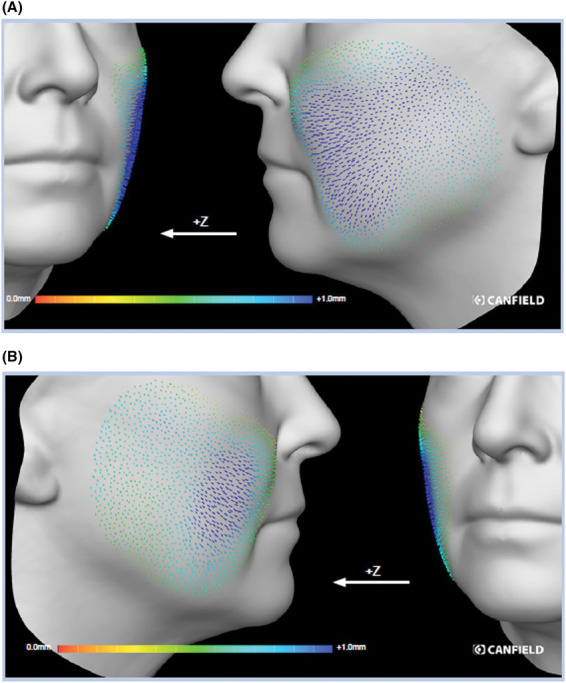
Left (A) and right (B) mean midface volume projection at Month 9 in subjects with a baseline at-rest GCWS severe score treated with either PLLA-SCA (n = 46) or control (n = 21). GCWS, Galderma Cheek Wrinkle Scale; PLLA-SCA, poly-l-lactic acid-Sculptra.
The mean midface volume change/maximum projection change at Month 9 for the PLLA-SCA–treated group were left cheek: +4.88 mL/+1.62 mm and right cheek: +2.84 mL/+1.12 mm, whereas for the control group, these were left cheek: +0.26 mL/+0.34 mm and right cheek: +0.68 mL/+0.37 mm (Figure 3).
Figure 3.
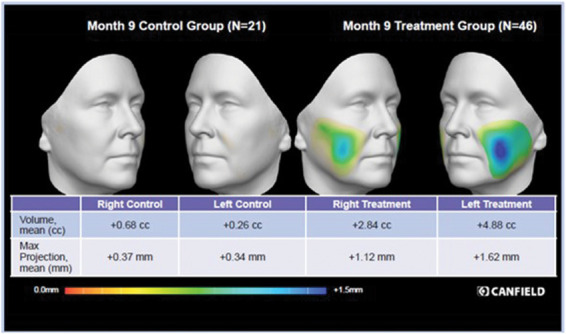
Mean midface volume change and mean maximum projection at Month 9 in subjects with a baseline at-rest GCWS severe score treated with either PLLA-SCA (n = 46) or control (n = 21). GCWS, Galderma Cheek Wrinkle Scale.
Figure 4 shows the left cheek, right cheek, and positive volume change image analysis at Month 9 of a 63-year-old woman with a baseline at-rest GCWS severe score who received 4 treatments with PLLA-SCA (4.5 mL per cheek/session).
Figure 4.
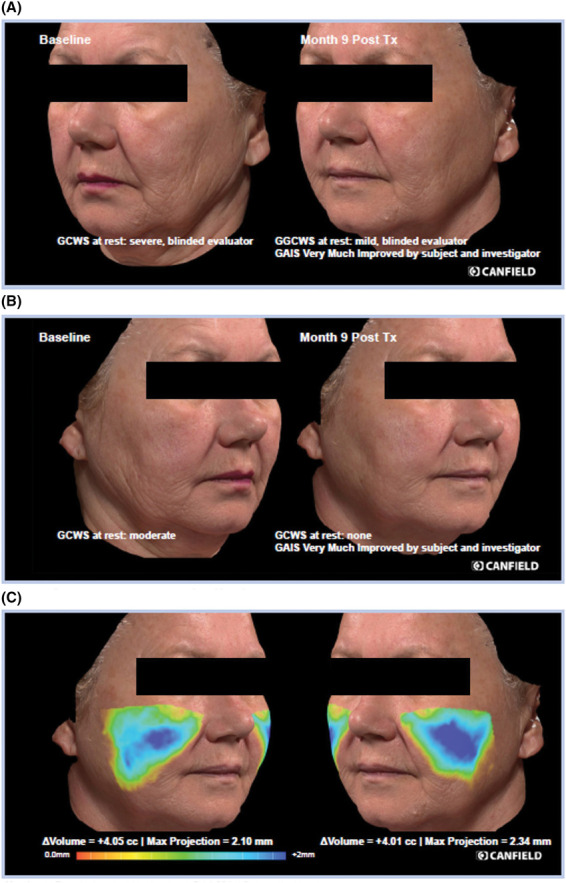
Left (A), right (B), and volume change image analysis (C) at Month 9 of a 63-year-old woman with a baseline at-rest GCWS severe score who received 4 treatments with PLLA-SCA (4.5 mL per cheek/session). GCWS, Galderma Cheek Wrinkle Scale.
Safety (From Main Study)
During the main study, the most common self-reported (diary card) post-treatment symptoms were tenderness (93.5%), bruising (93.5%), swelling (87.1%), and pain (83.9%), most of which were mild/moderate in intensity (97.8%). Among the 97 subjects randomized to receive PLLA-SCA, 20 (20.6%) experienced treatment-related/injection procedure–related AEs. Seventeen subjects (17.5%) in the PLLA-SCA group experienced mild treatment-related AEs and 3 (3.1%) had events of moderate severity. No serious treatment-related AEs were reported. The most common treatment-related AEs in the PLLA-SCA group were injection site bruising (11.3%), dizziness (2.1%), and headache (2.1%), all of which resolved in 1 to 13 days.
Discussion
The effectiveness and safety of correction of moderate and severe cheek wrinkles using PLLA-SCA, given as up to 4 individual treatments approximately 1 month apart, was demonstrated in this 12-month study.5 The improvements observed in wrinkle severity were long-lasting with significant reductions in severity being observed over the 12-month study period5 and continued into a 24-month extension study.6 These outcomes aligned well in terms of magnitude of treatment effectiveness with other studies evaluating wrinkle correction with PLLA-SCA.7–9 The reported duration of treatment effectiveness of 24 months observed in the extension study6 mirrored a nasolabial fold study in which the effectiveness, safety, and treatment satisfaction after PLLA-SCA therapy was demonstrated at 25 months.7
The effectiveness that was observed in terms of GCWS at-rest responder rate was supported by treating investigators' reported improvements in skin radiance, tighter appearance, and jawline contour; PLLA-SCA recipients' reported high satisfaction levels regarding improvements in skin quality (skin radiance, sagging, and firmness) as well as natural looking results and a desire for repeat treatment.5,6
This 3D-image analysis of subjects with a baseline at-rest GCWS severe score found that PLLA-SCA treatment had clinically meaningful lifting and volumization effects (positive volume shift, positive volume change, and maximum projection) in both cheeks in the midface at Month 9. These effects complement and align with the results of the primary and extension studies.5,6 It is noteworthy that the subjects selected for this analysis were those with a severe at-rest GCWS score, that is those in the study with the greatest severity of cheek wrinkles. The response seen in this group was extremely positive, which is reassuring as there is often concern that those with the most severe conditions are likely to demonstrate least improvement. While these exploratory results should be interpreted with caution, the use of 3D-image analysis definitely warrants further investigation.
Poly-l-lactic acid-SCA injections were generally well tolerated with predominantly mild treatment-related AEs, typically occurring at the injection site. Comparable incidences of treatment-related AEs has been reported in other studies that involved higher administration volumes.7–9
Conclusion
This exploratory analysis found that PLLA-SCA treatment of subjects with severe GCWS at baseline had a clinically meaningful lifting effect in both cheeks (positive volume shift, positive volume change, and max projection) in the midface at Month 9, complementing the primary end points.
Acknowledgments
Drs Tiffani Hamilton, Brenda LaTowsky, Rebecca Kazin, Keith Marcus, Flor Mayoral, John Joseph, Deirdre Hooper, Sachin Shridharani, Benjamin Bassichis, Z. Paul Lorenc, Melissa Chiang, and Michael Somenek are acknowledged for their contribution as principal investigators in the 12-month study and Anthony Whittaker at Canfield Scientific for his contributions to data analysis.
Footnotes
Research was funded by Galderma R&D, LLC
The authors have indicated no significant interest with commercial supporters.
S.G. Fabi is an investigator and consultant for Galderma, Merz, Revance and Allergan. J. Le is an employee of Galderma, Dallas, US. I. Prygova and D. Bråsäter are employees of Galderma, Uppsala, Sweden.
Contributor Information
Jennifer H.T.D. Le, Email: jennifer.le@galderma.com.
Inna Prygova, Email: inna.prygova@galderma.com.
Daniel Bråsäter, Email: daniel.brasater@galderma.com.
References
- 1.Sculptra®. US instructions for use. Available from: https://www.sculptrausa.com/docs/Sculptra-e-IFU. Accessed on 1 May 2024.
- 2.Alessio R, Rzany B, Eve L, Grangier Y, et al. European expert recommendations on the use of injectable poly-L-lactic acid for facial rejuvenation. J Drugs Dermatol 2014;13:1057–66. [PubMed] [Google Scholar]
- 3.Lam SM, Azizzadeh B, Graivier M. Injectable poly-L-lactic acid (Sculptra): technical considerations in soft-tissue contouring. Plast Reconstr Surg 2006;118(3 suppl):55S–63S. [DOI] [PubMed] [Google Scholar]
- 4.Haddad A, Menezes A, Guarnieri C, Coimbra D, et al. Recommendations on the use of injectable poly-L-lactic acid for skin laxity in off-face areas. J Drugs Dermatol 2019;18:929–35. [PubMed] [Google Scholar]
- 5.Fabi S, Hamilton T, LaTowsky B, Kazin R, et al. Effectiveness and safety of Sculptra poly-L-lactic acid injectable implant in the correction of cheek wrinkles. J Drugs Dermatol 2024;23:1297–305. [DOI] [PubMed] [Google Scholar]
- 6.Fabi S, Hamilton T, LaTowsky B, Kazin R, et al. Effectiveness and safety of correction of cheek wrinkles using a biostimulatory poly-L-lactic acid injectable implant—clinical study data up to 24 months. IMCAS 26–28 January 2023. Paris, France. Abstract #123101.
- 7.Narins RS, Baumann L, Brandt FS, Fagien S, et al. A randomized study of the efficacy and safety of injectable poly-L-lactic acid versus human-based collagen implant in the treatment of nasolabial fold wrinkles. J Am Acad Dermatol 2010;62:448–62. [DOI] [PubMed] [Google Scholar]
- 8.Palm M, Mayoral F, Rajani A, Goldman MP, et al. Chart review presenting safety of injectable PLLA used with alternative reconstitution volume for facial treatments. J Drugs Dermatol 2021;20:118–22. [DOI] [PubMed] [Google Scholar]
- 9.Palm M, Weinkle S, Cho Y, LaTowsky B, et al. A randomized study on PLLA using higher dilution volume and immediate use following reconstitution. J Drugs Dermatol 2021;20:760–6. [DOI] [PubMed] [Google Scholar]