



Abstract
Background
Liver cancer is a common malignant tumor of the digestive system. We aimed to estimate the trend in the burden of liver cancer in Fujian Province, China, during 2011–2020.
Methods
The population-based cancer data was collected from the cancer registry in Fujian Province during 2011–2020. Segi’s world standard population was used to calculate the age-standardized incidence rates and age-standardized mortality rates. The temporal trend of liver cancer was displayed by annual percentage change and average annual percentage change (AAPC). Relative survival of liver cancer was calculated as the ratio of observed survival to expected survival. The age-standardized relative survival was calculated according to the International Cancer Survival Standards 1.
Results
There were 14,725 patients diagnosed with liver cancer and 12,698 patients died between 2011 and 2020. For males, there was a downward trend in incidence and mortality (AAPC: -3.86%, -3.44%). Similarly, the downward trend was also shown in females (AAPC: -3.96%, -2.79%). The highest age-specific incidence and mortality were in the 75–79 age group (146.59/100,000 and 137.99/100,000, respectively), and there was no downward trend in this group during the period. The overall age-standardized 5-year relative survival was 10.77% in 2011–2015 and 14.54% in 2016–2020. During the study period, the percentage improvement of survival was higher in males than in females (34.75% and 25.33%). The percentage improvement of survival in urban was higher than that in rural (38.64% and 28.75%). Except for the age group over 75, the survival of patients in other age groups all has improved.
Conclusions
Liver cancer remains a serious public health problem in Fujian Province, China, which needs to be solved, especially in some high-risk groups such as the elderly, high-risk males, and rural populations. Early detection and treatment is the key to the prevention and treatment of liver cancer.
Keywords: Live cancer, Incidence, Mortality, Survival, Trend
| Text box 1. Contributions to the literature |
|---|
| • This study comprehensively analysed the trend of the burden of liver cancer in Fujian Province, China in the past 10 years, highlighting the changing patterns of liver cancer in different populations. |
| • The role of the HBV vaccination policy, which contributes to the differential trends of liver cancer by age. |
| • The elderly need more effective measures to prevent and treat liver cancer. |
Background
Liver cancer is a malignant tumor with high incidence and mortality. The quality of life of patients is seriously affected by liver cancer, which frequently results in poor prognosis of patients [1]. According to GLOBOCAN 2022, there were 865,269 people diagnosed with liver cancer and 757,948 deaths caused by liver cancer worldwide [2]. The number of cases and deaths of liver cancer ranked sixth and third, respectively, among malignant tumors. The disease burden of liver cancer was different on each continent. The highest incidence and mortality of liver cancer were found in Eastern Asia. Due to the large population, China has the world’s largest liver cancer burden. Although the trends in incidence and mortality of liver cancer in some areas of China (such as Shanghai and Guangzhou) are decreasing, there are still no less than 40% of the world’s new liver cancer cases occurring in China [3–5].
There are many risk factors related to liver cancer. The main risk factors include chronic hepatitis virus infection, aflatoxin exposure and living environment [6–8]. These risk factors may cause the different burdens of liver cancer in each region. Fujian Province is located in southeastern China and has a long coastline. After the first retrospective survey of the causes of death in the 1970s, some areas in Fujian Province were identified as regions with high incidence of liver cancer [9]. Liver cancer seriously endangered the health of local people. However, there is no study that has reported the trend of burden of liver cancer in Fujian Province in recent years. Since 2009, more and more regions in Fujian Province began to carry out population-based cancer registration and follow-up projects. Improvements in the quality of cancer registry data can result in the data needed for new studies of trends in cancer incidence, mortality, and survival. In this study, we comprehensively evaluated the incidence, mortality and survival of liver cancer in Fujian from 2011 to 2020. The results of this study can be used to estimate the effect of prevention and treatment of liver cancer in the previous period and help inform policymaking in the next period at the same time.
Methods
Data sources
The Fujian Cancer Prevention and Control Office collects the data reported by all cancer registries in the Fujian and controls the quality of the data. There were 8 cancer registries provided data. However, due to incomplete incidence and follow-up data, one registry was not included in this study. Therefore, we selected data from seven other registries with better data quality in Fujian Province. The incidence and mortality of patients who were diagnosed with liver cancer from January 1, 2011, to December 31, 2020, were included in the study. These seven registries are evenly distributed in each direction of Fujian Province, covering 5,192,272 population in 2020.
Each registry contained information on new cancer cases from hospitals in its jurisdiction through the Fujian Provincial Cancer Registration Information Reporting Platform. The survival status of each patient was obtained through active and passive follow-up methods. With passive follow-up, the staff of the registry matched cause-of-death surveillance data with incidence data of cancer to supplement time and survival outcome information. If the case cannot match the cause-of-death surveillance data, we used active follow-up to collect survival information. Active follow-up included telephone or home visits to ascertain the survival status of cases. All cases were updated until April 30, 2022. Population data for the registry was obtained from the Bureau of Statistics. The 3rd edition of the International Classification of Diseases for Oncology (ICD-O-3) and the 10th edition of the International Classification of Diseases (ICD-10) were used for the coding of liver cancer. In this study, the ICD-10 code of liver cancer was C22. The research was performed in line with the Declaration of Helsinki, and the research data were kept confidential.
Quality control
According to the guide of Chinese Guideline for Cancer Registration (2016) [10], only cases with correct logical relationships can pass the verification and be reported. The data should meet the evaluation criteria of completeness, timeliness and validity. Therefore, International Agency for Research on Cancer/International Association of Cancer Registries (IARC/IACR) data-quality criteria were used to evaluate cancer data indicators [11, 12]. In the study, the proportion of morphological verification (MV%) of liver cancer was 37.47%, proportion of cases reported with death certification only (DCO%) was 0.46% and mortality to incidence ratio (M/I) was 0.78. If a case was based only on death certificates or a case had more than two primary malignant tumours, these cases would be excluded from the survival analysis.
Statistical analysis
To calculate crude incidence and mortality, we divided the number of new cases or deaths by the population, respectively, in the same registry areas. The age-standardized incidence rates (ASIRs) and age-standardized mortality rates (ASMRs) were calculated using Segi’s world standard population. SAS 9.0 was used for the calculation of all incidence and mortality rates. Joinpoint regression models were used to estimate temporal trends in incidence and mortality, and calculate the annual percentage change (APC), average annual percentage change (AAPC) and 95% confidence interval (CI) [13]. The AAPC was calculated by summarizing the trend over the time period as a weighted average of APC [14]. This model was calculated by Joinpoint Regression Program 4.9.1 developed by the National Cancer Institute [15]. The maximum number of joinpoints in this model was 1.
The Strs package was used to calculate relative survival in Stata 12. Relative survival was calculated as the ratio of observed survival to expected survival. The life table method and the Ederer II model were used to calculate observed and expected survival rates, respectively [16, 17]. When analysing survival of patients in different periods, patients were divided into two groups (2011–2015 and 2016–2020) based on year of diagnosis. The cohort and complete methods were used to calculate the relative survival for these two time periods, respectively [18]. The age-standardized relative survival of liver cancer was calculated according to the International Cancer Survival Standards 1 (ICSS1) (0 to 44 years: 7%, 45 to 54 years: 12%, 55 to 64 years: 23%, 65 to 74 years: 29%, and 75 to 99 years: 29%) [19]. The Z test was used to compare the relative survival of gender, region and age group in different periods. The p < 0.05 was considered statistically significant.
Results
Incidence and mortality
There were 14,725 patients diagnosed with liver cancer between 2011 and 2020, including 11,587 males and 3138 females. The ASIRs of both sexes declined from 29.13/100,000 in 2011 to 19.95/100,000 in 2020 with an AAPC of −4.04% (95% CI: −4.90, −3.18). The ASIRs of different gender declined, and the ASIRs of males was always higher than that of females (Fig. 1). The ASIRs of males decreased from 46.86/100,000 to 33.28/100,000 with an AAPC of −3.86% (95% CI: −4.77, −2.95), and females decreased from 11.97/100,000 to 7.82/100,000 with an AAPC of −3.96% (95% CI: −4.94, −2.98). The ASIRs decreased in both urban areas (AAPC: −4.08%, 95% CI: −5.63, −2.51) and rural areas (AAPC: −4.06%, 95% CI: −5.39, −2.72) (Table 1).
Fig. 1.

The temporal trend of age-standardized incidence and mortality of liver cancer in males and females between 2011 and 2020 in Fujian Province, China
Table 1.
The incidence and mortality of liver cancer from 2011 to 2020 in Fujian Province, China
| Incidence | Mortality | |||||||||
|---|---|---|---|---|---|---|---|---|---|---|
| CR(1/105) | ASR(1/105) | AAPC of ASR(95%CI) | CR(1/105) | ASR(1/105) | AAPC of ASR(95%CI) | |||||
| 2011 | 2020 | 2011 | 2020 | 2011–2020 | 2011 | 2020 | 2011 | 2020 | 2011–2020 | |
| Total | 33.8 | 27.44 | 29.13 | 19.95 | −4.04(−4.90,−3.18) | 27.28 | 22.69 | 23.29 | 16.01 | −3.41(−4.79,−2.01) |
| Gender | ||||||||||
| Male | 52.56 | 43.67 | 46.86 | 33.28 | −3.86(−4.77,−2.95) | 44.08 | 32.16 | 38.93 | 26.68 | −3.44(−5.37,−1.48) |
| Female | 14.66 | 11.24 | 11.97 | 7.82 | −3.96(−4.94,−2.98) | 10.14 | 9.93 | 8.12 | 6.42 | −2.79(−5.48,−0.02) |
| Area | ||||||||||
| Urban | 35.19 | 27.44 | 28.07 | 20.20 | −4.08(−5.63,−2.51) | 27.52 | 21.45 | 21.80 | 15.27 | −3.50(−6.56,−0.34) |
| Rural | 32.14 | 27.45 | 30.98 | 19.59 | −4.06(−5.39,−2.72) | 27.00 | 24.55 | 25.77 | 17.09 | −4.15(−5.27,−3.02) |
CR crude rate, ASR age-standardized rate, AAPC average annual percentage change, CI Confidence interval
During 2011–2020, 12,698 patients died of liver cancer, including 10,044 males and 2654 females. The ASMRs of both sexes declined from 23.29/100,000 in 2011 to 16.01/100,000 in 2020 with an AAPC of −3.41% (95% CI: −4.79, −2.01). The ASMRs of different gender declined, and the ASMRs of males was always higher than that of females (Fig. 1). The ASMRs of males decreased by 31.47%, from 38.93/100,000 to 26.68/100,000 with an AAPC of −3.44% (95% CI: −5.37, −1.48), and females decreased by 20.94%, from 8.12/100,000 to 6.42/100,000 with an AAPC of −2.79% (95% CI: −5.48, −0.02). The ASMRs decreased in both urban areas (AAPC: −3.50%, 95% CI: −6.56, −0.34) and rural areas (AAPC: −4.15%, 95% CI: −5.27, −3.02) (Table 1).
The age-specific incidence and mortality from 2011 to 2020 was shown in Fig. 2. Before 50 years old, the age-specific incidence of both sexes was relatively low, but increased dramatically after 50. Males reached the peak of incidence at the age group of 75–79 years (223.91/100,000), females reached the peak of incidence at the age group of 80–84 years (88.31/100,000). The age-specific mortality of males and females was relatively low before 55, and sharply increased after 55. The age-specific mortality of males increased with age, peaking at over 85 years old (225.91/100,000). Female mortality peaked in the 80–84 age group (84.66/100,000).
Fig. 2.

The age-specific incidence (A) and mortality (B) of liver cancer in males and females during 2011–2020 in Fujian Province, China
The temporal trend of incidence and mortality in the five age groups was displayed in Table 2. Before 75 + years, the incidence rate of all age groups showed a downward trend. The most obvious decline was in the age group younger than 45 years old with an AAPC of −5.24% (95% CI: −7.95, −2.42). However, there was no downward trend for ages 75 + with an AAPC of −1.79% (95% CI: −3.64, 0.08) between 2011 and 2020. Similarly, we can see a downward trend of mortality in each age group before 65 + years. The most significant decline was in the age group younger than 45 years old with an AAPC of −6.89% (95% CI: −11.03, −2.55). However, there was no downward trends for ages 65–74 (AAPC of −1.52% (95% CI: −3.92, 0.94)) and 75+ (AAPC of 1.18% (95% CI: −3.24, 5.81)).
Table 2.
The trend of incidence and mortality of liver cancer in five main age groups between 2011 and 2020 in Fujian Province, China
| Trend 1 | Trend 2 | AAPC of 2011–2020 (%)(95%CI) | |||
|---|---|---|---|---|---|
| Years | APC(%)(95%CI) | Years | APC(%)(95%CI) | ||
| Incidence | |||||
| <45 | 2011–2013 | 2.24(−12.51,19.48) | 2013–2020 | −7.26(−9.17,−5.31) | −5.24(−7.95,−2.42) |
| 45–54 | 2011–2020 | −4.27(−6.29,−2.21) | −4.27(−6.29,−2.21) | ||
| 55–64 | 2011–2018 | −4.24(−6.46,−1.95) | 2018–2020 | −5.88(−21.08,12.25) | −4.60(−7.69,−1.41) |
| 65–74 | 2011–2014 | −0.27(−7.21,7.18) | 2014–2020 | −4.01(−6.32,−1.64) | −2.78(−4.90,−0.61) |
| ≥ 75 | 2011–2020 | −1.79(−3.64,0.08) | −1.79(−3.64,0.08) | ||
| Mortality | |||||
| <45 | 2011–2020 | −6.89(−11.03,−2.55) | −6.89(−11.03,−2.55) | ||
| 45–54 | 2011–2018 | −3.63(−6.21,−0.98) | 2018–2020 | −16.59(−31.92,2.17) | −6.68(−10.15,−3.07) |
| 55–64 | 2011–2020 | −5.03(−7.11,−2.90) | −5.03(−7.11,−2.90) | ||
| 65–74 | 2011–2015 | 5.04(−0.54,10.92) | 2015–2020 | −6.46(−10.00,−2.78) | −1.52(−3.92,0.94) |
| ≥ 75 | 2011–2017 | 2.99(−1.96,8.19) | 2017–2020 | −2.34(−15.58,12.99) | 1.18(−3.24,5.81) |
APC annual percentage change, AAPC average annual percentage change, CI Confidence interval
Survival analysis
A total of 14,297 patients were included in the survival analysis. As shown in Fig. 3, the age-standardized relative survival was different between those diagnosed 2011–2015 and those diagnosed 2016–2020. In 2011–2015, the age-standardized 5-year relative survival was 10.77%. The age-standardized 5-year relative survival in 2016–2020 was 14.54%, which was higher than that in 2011–2015 (Z = 4.89, P < 0.001). The survival of males increased from 11.05 to 14.89% (Z = 3.95, P < 0.001), and females survival increased from 11.45 to 14.35% (Z = 1.97, P = 0.048). The percentage increase in the survival rate of males was higher than that of females (34.75% and 25.33%). Moreover, age-standardized 5-year relative survival in both urban (Z = 4.18, P < 0.001) and rural (Z = 2.35, P = 0.018) have improved, and the percentage increase in the survival of urban areas was higher than that of rural areas (38.64% and 28.75%) (Table 3).
Fig. 3.
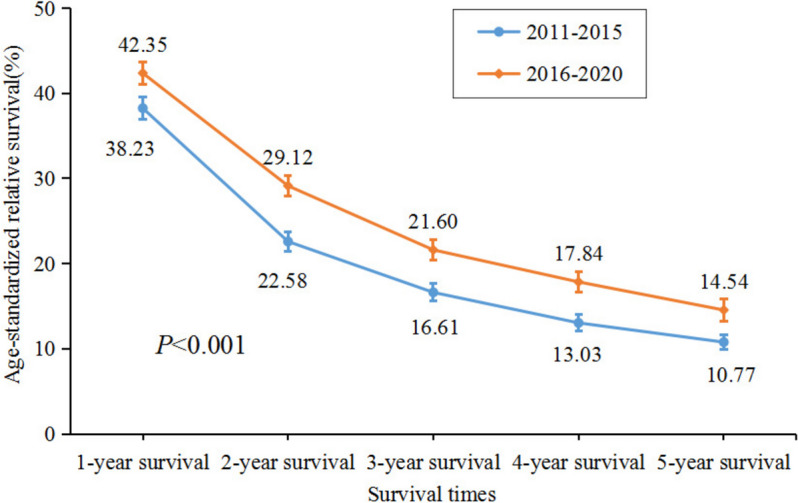
The survival curve of liver cancer in Fujian Province, China, 2011–2015 and 2016–2020
Table 3.
The 5-year age-standardized relative survival of liver cancer in Fujian Province, China, 2011–2020
| Sex | Area | Age-standardized 5-year relative survival(%)(95%CI) | |
|---|---|---|---|
| 2011–2015 | 2016–2020 | ||
| Male | All | 11.05(9.96–12.20) | 14.89(13.32–16.53) |
| Urban | 12.05(10.58–13.62) | 16.50(14.36–18.76) | |
| Rural | 9.67(8.14–11.37) | 12.75(10.58–15.13) | |
| Female | All | 11.45(9.82–13.21) | 14.35(11.94–16.97) |
| Urban | 12.32(10.14–14.73) | 17.16(13.67–21.00) | |
| Rural | 10.31(7.98–12.96) | 10.93(7.97–14.41) | |
| Total | All | 10.77(9.91–11.68) | 14.54(13.25–15.89) |
| Urban | 11.80(10.62–13.05) | 16.36(14.55–18.27) | |
| Rural | 9.39(8.17–10.70) | 12.09(10.36–13.96) | |
CI Confidence interval
For the different age groups, the lowest relative survival was observed among those age 75+ (2011–2015: 7.69%, 2016–2020: 6.95%), followed by those aged 65–74 (2011–2015: 10.72%, 2016–2020: 16.84%). Compared with the elderly, young people with liver cancer have better survival. The highest relative survival was seen in those aged 55–64 diagnosed in 2011–2015 (13.50%) and in those aged 45–54 diagnosed in 2016–2020 (19.83%). The survival gap between the age group with the highest relative survival and the age group with the lowest relative survival was 5.81% in 2011–2015 and 12.88% in 2016–2020. Besides those over 75 years old, the survival of patients in other age groups has improved in the study period (P < 0.01) (Fig. 4).
Fig. 4.
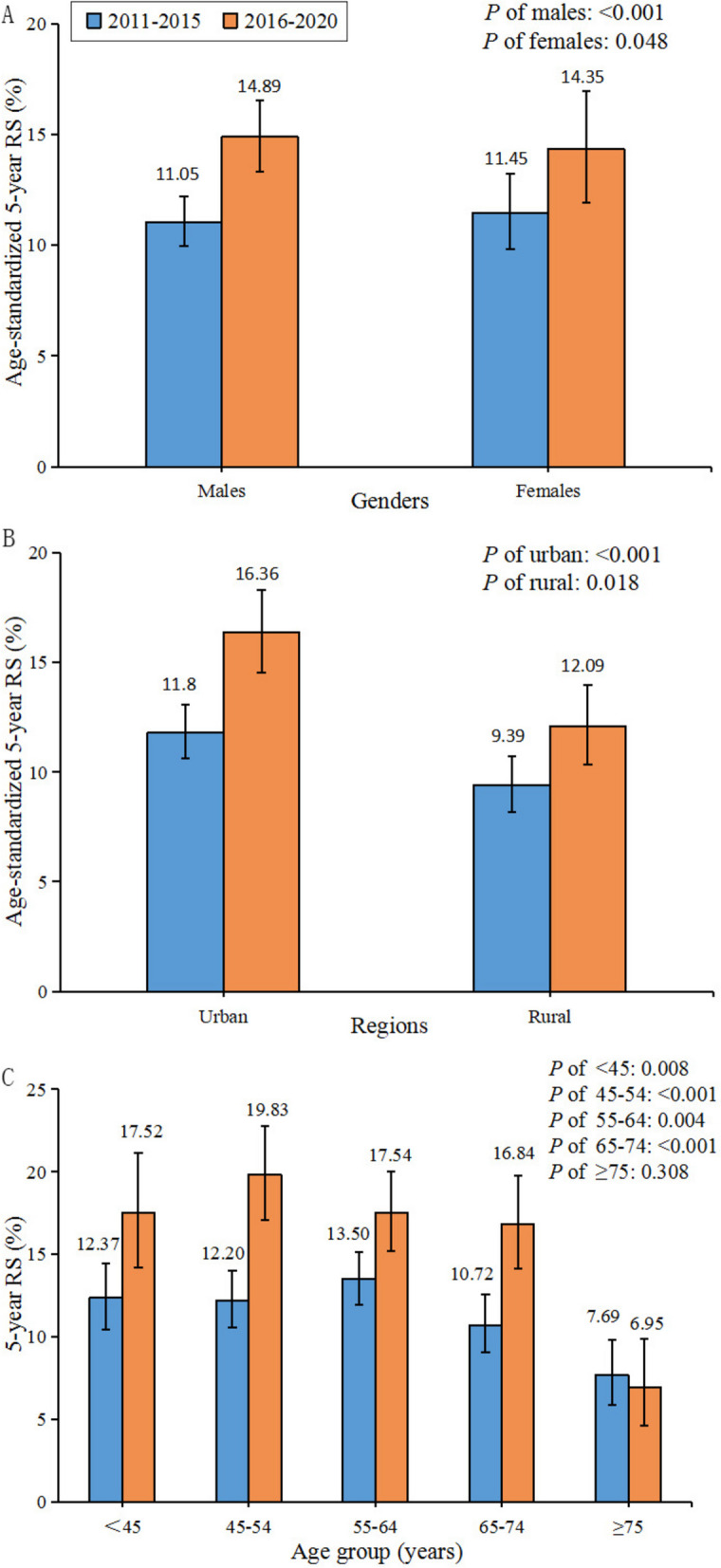
The 5-year relative survival of liver cancer in gender (A), region (B), and age group (C) in Fujian Province, China. A p-value of less than 0.05 was considered statistically significant in the differences in survival across various periods, categorized by gender, region, and age. RS, relative survival
Discussion
The main characteristics of liver cancer are occult onset and a high degree of malignancy [20]. We used the latest cancer registration data to analyse trends in incidence, mortality and survival of liver cancer in Fujian Province, China from 2011 to 2020. The age-standardized incidence and mortality of liver cancer in Fujian Province in 2020 were 19.95/100,000 and 16.01/100,000, respectively, which were higher than the latest average levels in China [5]. The age-standardized incidence and mortality of males was about 4–5 times that of females. The burden of liver cancer began to rise with the increase of age. The peak of incidence and mortality in males were 75 years old and over 85 years old respectively, while the peak for females was in the age group of 80 years old. Regardless of gender or region, age-standardized incidence and mortality of liver cancer showed a downward trend from 2011 to 2020. Compared with other regions in East Asia, the decline rate of males liver cancer incidence in Fujian was slower than that in Japan (4.6%), but faster than that in South Korea (2.2%). The rate of decline of incidence in women is faster than in Japan (3.3%) and South Korea (2.2%) [21]. In addition, although the incidence of liver cancer in United Kingdom, Australia and the United States is on the rise, the incidence of liver cancer in Fujian Province is still higher than in these countries [22]. Compared with 2011–2015, the age-standardized 5-year relative survival of liver cancer patients in 2016–2020 was higher. This survival was already higher than that of some developed European countries, such as Croatia (9.3%) and Denmark (7.5%) [23]. However, it was still lower than other provinces in China or neighboring countries such as Japan (30.1%) or South Korea (27.2%) [23–25]. Although the burden of liver cancer in Fujian Province has declined, it still seriously affects people’s health.
In order to effectively control the harm caused by liver cancer, the government has launched a number of measures in recent years to reduce the incidence of liver cancer. Hepatitis B vaccination plays an important role in primary prevention of liver cancer. Since 1992, hepatitis B vaccination has been included in the routine immunization program for infants, thus newborns can also be fully immunized [26]. In Fujian, compared with 1992, the prevalence of hepatitis B virus (HBV) infection in children under 5 years old has decreased from 21.67 to 0.23% in 2014 [27]. Adults can also be revaccinated with hepatitis B vaccination at any time. Such a high vaccination rate can establish an effective immune barrier and reduce hepatitis B virus infection, thereby reducing the incidence of hepatitis and liver cancer. Fujian Province has a humid climate that is suitable for mold growth. Peanut is the main oil crop in Fujian Province. It is one of the most susceptible crops to aflatoxin contamination [28]. Therefore, some people have been exposed to the environments with high aflatoxin content for a long time. As the economy develops and the environment improves, people have reduced their exposure to aflatoxin by preventing mold in food and drinking clean water. The above factors can be considered as the reasons for the downward trend of the incidence of liver cancer in Fujian Province.
In addition, a number of screening programs and advanced treatment methods are the main reasons for the decrease in mortality and increase in survival. Since 2005, Fujian Province has carried out the Cancer Screening program in rural and urban areas and population-based cohort research projects in some areas. Screening identifies patients with early-stage liver cancer and prevents the disease from worsening [29]. However, compared with neighboring provinces, fewer people in Fujian Province participate in liver cancer screening [30, 31]. Usually, patients are diagnosed with liver cancer in the middle or late stages and the prognosis is poor. This could be one of the reasons why survival rates are still lower than those in other provinces. Currently, non-invasive testing methods have been applied to early liver cancer screening and have achieved certain results. This method is convenient and highly accurate, and can increase the willingness of the population to participate in liver cancer screening [32]. At the same time, advanced and safe technology has been widely used to treat liver cancer. Robotic surgery for liver cancer can reduce the trauma associated with open hepatectomy [33]. Multidisciplinary treatment based on the individual patient’s condition can minimize complications [34].
The burden of liver cancer in Fujian Province is significantly different between females and males. This result was the same as that of other regions in China [35, 36]. This difference can be mainly explained by HBV infection, smoking and drinking alcohol [37]. According to the Global Burden of Diseases 2019 report, about 300 million people around the world were infected with HBV, and the number of deaths from HBV-associated liver cancer was 192,000 in 2019 [38]. HBV infection will lead to inflammation of liver cells, and long-term inflammation and injury will lead to cancerization of liver cells. The serological surveys of HBV in Fujian Province showed that the positive rate of hepatitis B surface antigen in males was higher than that of females (11.6% and 8.9%, respectively) [39]. This difference may be the reason for the higher incidence of liver cancer in males than in females. Furthermore, smoking contributes to incidence of liver cancer in males and females aged 20 and above in China, with population attributable fraction of 15.7% and 4.8%, respectively. Although strong measures have been taken to control smoking, the smoking rate of males in Fujian is still significantly higher than that of females (48.9% and 0.9%, respectively) [40]. The survey results of health risk factors of residents in Fujian province showed that there was a significantly difference in drinking rates between males and females (54.3% and 18.1%, respectively) [41]. Alcohol can increase the burden on liver metabolism, and excessive drinking can lead to cirrhosis and an increased risk of liver cancer.
The study found that the incidence and mortality of liver cancer increased rapidly after 50 years old, reaching the peak over the age of 75. There was no downward trend in incidence after age 75 over the past 10 years. The main cause of liver cancer in young people is HBV infection. Nowadays, the widespread vaccination of HBV makes young people have a lower risk of liver cancer. However, characteristics of aging such as decreased cellular function, metabolic abnormalities, mitochondrial dysfunction, and epigenetic alterations increase the risk of liver cancer in the elderly [42]. In addition, the mortality rate of each age group displayed a downward trend before the age of 65, and the mortality rate did not change after the age of 65. This may be related to the poor effectiveness and low tolerance of treatment among the elderly. The elderly may not benefit from some drugs, such as sorafenib [43]. The burden of liver cancer in the elderly may be reduced by using popular science materials for health education and multidisciplinary comprehensive treatment. For the difference burden of liver cancer between urban and rural areas, good awareness of anti-cancer and rich medical resources are the advantages of urban areas. Living in a favorable ecological environment and receiving good treatment may be the reasons for the high survival of urban residents. In addition, compared with urban areas, the economic conditions of residents in rural areas are poor, and many residents give up treatment because of economic pressure.
The most notable advantage of our study is the up-to-date and high accuracy of liver cancer data in Fujian Province. The data were collected in strict accordance with quality control standards. In addition, patients’ survival information was obtained through active and passive follow-up. However, there were some limitations existed in this study. First, the most common subtypes of liver cancer are hepatocellular carcinoma and intrahepatic cholangiocarcinoma. But the information about the histological type of liver cancer was incomplete in most patients, because there was no requirement for staff to submit the information of histological type. So the burden of different histological types of liver cancer may be analysed by supplementing information or building a model to impute liver cancer cases of unknown subtypes. Second, there are many risk factors related to the occurrence and development of liver cancer. However, due to the limited data collected, it is not yet possible to analyse the impacts of such variables on liver cancer in a large population. Thirdly, the collection of incidence and follow-up data may be affected by the COVID-19 epidemic. For example, patients can’t see a doctor or participate in screening programs as a result of the lockdown. The staff of cancer registry are usually arranged to prevent and control the COVID-19. The doctor may rest because he is infected with COVID-19, which makes patients unable to be diagnosed with cancer in time. However, these conditions are not the main factors affecting the change in the incidence of liver cancer. COVID-19 mainly harms the lung, but has little effect on the liver. The trend of the incidence of liver cancer is mainly affected by the hepatitis B vaccine and the improvement of the environment.
Conclusions
In short, we used the population-based cancer registration database to analyse liver cancer incidence, mortality and survival in Fujian Province, China from 2011 to 2020. Although the burden of liver cancer has been decreasing in Fujian Province, the elderly, high-risk males and rural populations are still high-risk groups for liver cancer. The government and health departments should take targeted measures to reduce the burden of liver cancer, including emphasizing regular screening for the elderly, promoting non-invasive screening technologies, and enhancing health education initiatives.
Acknowledgements
Not applicable.
Abbreviations
- WHO
World Health Organization
- ASIRs
Age-standardized incidence rates
- ASMRs
Age-standardized mortality rates
- APC
Annual percentage change
- AAPC
Average annual percentage change
- CI
Confidence interval
- HBV
Hepatitis B virus
Authors’ contributions
YZ and JL designed and administered the research. JM, YL and YW collected the data. ZX, YH and JM performed the statistical analysis and made the figures and tables. ZX, YH, YZ and JL wrote and revised the manuscript. All authors read and approved the final manuscript.
Funding
None.
Data availability
The datasets used and/or analysed during the current study are available from the corresponding author on reasonable request.
Declarations
Ethics approval and consent to participate
The Ethics Committee of Fujian Cancer Hospital determined that ethics approval and informed consent were not required for this research, because this was a retrospective study that used source data that were completely unidentifiable, and all data were anonymous.
Consent for publication
Not applicable.
Competing interests
The authors declare no competing interests.
Footnotes
Publisher’s Note
Springer Nature remains neutral with regard to jurisdictional claims in published maps and institutional affiliations.
Zhisheng Xiang and Yongying Huang contributed equally to this work.
Contributor Information
Yan Zhou, Email: zhouyan9893@fjzlhospital.com.
Jingfeng Liu, Email: drjingfeng@fjmu.edu.cn.
References
- 1.Devarbhavi H, Asrani SK, Arab JP, Nartey YA, Pose E, Kamath PS. Global burden of liver disease: 2023 update. J Hepatol. 2023;79(2):516–37. 10.1016/j.jhep.2023.03.017. [DOI] [PubMed] [Google Scholar]
- 2.Bray F, Laversanne M, Sung H, Ferlay J, Siegel R, Soerjomataram I, et al. Global cancer statistics 2022: GLOBOCAN estimates of incidence and mortality worldwide for 36 cancers in 185 countries. CA Cancer J Clin. 2024;74(3):229–63. 10.3322/caac.21834. [DOI] [PubMed] [Google Scholar]
- 3.Wang D, Hu X, Xu H, Chen Y, Wang S, Lin G, et al. Trend analysis and age-period-cohort effects on morbidity and mortality of liver cancer from 2010 to 2020 in Guangzhou, China. Front Oncol. 2014;14:1387587. 10.3389/fonc.2024.1387587. [DOI] [PMC free article] [PubMed] [Google Scholar]
- 4.Bai L, Liu Z, Fang Q, Yan Q, Shi O, Bao P, et al. The trends and projections in the incidence and mortality of liver cancer in urban Shanghai: a population-based study from 1973 to 2020. Clin Epidemiol. 2018;10:277–88. 10.2147/CLEP.S153951. [DOI] [PMC free article] [PubMed] [Google Scholar]
- 5.Han B, Zheng R, Zeng H, Wang S, Sun K, Chen R, et al. Cancer incidence and mortality in China, 2022. J Natl Cancer Cent. 2024;4(1):47–53. 10.1016/j.jncc.2024.01.006. [DOI] [PMC free article] [PubMed] [Google Scholar]
- 6.Li Q, Cao M, Lei L, Yang F, Li H, Yan X, et al. Burden of liver cancer: from epidemiology to prevention. Chin J Cancer Res. 2022;34(6):554–66. 10.21147/j.issn.1000-9604.2022.06.02. [DOI] [PMC free article] [PubMed] [Google Scholar]
- 7.McGlynn K, Petrick J, London W. Global epidemiology of hepatocellular carcinoma: an emphasis on demographic and regional variability. Clin Liver Dis. 2015;19(2):223–38. 10.1016/j.cld.2015.01.001. [DOI] [PMC free article] [PubMed] [Google Scholar]
- 8.Pimpin L, Cortez-Pinto H, Negro F. Burden of liver disease in Europe: Epidemiology and analysis of risk factors to identify prevention policies. J Hepatol. 2018;69(3):718–35. 10.1016/j.jhep.2018.05.011. [DOI] [PubMed] [Google Scholar]
- 9.Tang T, Zhu X, Hong Z, Chen S, Huang Y, Qiu T, et al. Research on comprehensive preventive measures for high incidence of liver cancer in Tongan. Strait J Prev Med. 2001;7(5): 2. 10.3969/j.issn.1007-2705.2001.05.032. [Google Scholar]
- 10.He J, Chen W. Chinese guideline for cancer registration. Beijing: People’s Medical Publishing House; 2016.
- 11.Parkin DM, Bray F. Evaluation of data quality in the cancer registry: principles and methods part II. Completeness. Eur J Cancer. 2009;45:756–64. [DOI] [PubMed] [Google Scholar]
- 12.Bray F, Parkin D. Evaluation of data quality in the cancer registry: principles and methods. Part I: comparability, validity and timeliness. Eur J Cancer. 2009;45:747–55. [DOI] [PubMed] [Google Scholar]
- 13.Esteve J, Benhamou E, Raymond L. Statistical methods in cancer research Volume IV Descriptive epidemiology (ed). Lyon: Int Agency Res Cancer Sci Public. 1994;128:1–302. [PubMed] [Google Scholar]
- 14.Zhou J, Zheng R, Zhang S, Chen R, Wang S, Sun K, et al. Gastric and esophageal cancer in China 2000 to 2030: recent trends and short-term predictions of the future burden. Cancer Med. 2022;11(8):1902–12. 10.1002/cam4.4586. [DOI] [PMC free article] [PubMed] [Google Scholar]
- 15.Kim H, Fay M, Feuer E, Midthune D. Permutation tests for joinpoint regression with applications to cancer rates. Stat Med. 2000;19:335–51. [DOI] [PubMed] [Google Scholar]
- 16.Chiang C. Introduction to stochastic processes in biostatistics. New York: Stochastic Wiley; 1968.
- 17.Ederer F, Heise H. Instructions to IBM 650 programers in processing survival computation, technical, end results evaluation sectioned. Bethesda, MD: National Cancer Institute; 1959.
- 18.Brenner H, Rachet B. Hybrid analysis for up-to-date long-term survival rates in cancer registries with delayed recording of incident cases. Eur J Cancer. 2004;40:2494–501. [DOI] [PubMed] [Google Scholar]
- 19.Corazziari I, Quinn M, Capocaccia R. Standard cancer patient population for age standardising survival ratios. Eur J Cancer. 2004;40:2307–16. 10.1016/j.ejca.2004.07.002. [DOI] [PubMed] [Google Scholar]
- 20.Huang J, Lok V, Ngai CH, Chu C, Patel H, Chandraseka V, et al. Disease Burden, Risk factors, and recent trends of Liver Cancer: A Global Country-Level analysis. Liver Cancer. 2021;10(4):330–45. 10.1159/000515304. [DOI] [PMC free article] [PubMed] [Google Scholar]
- 21.Ferlay J, Colombet M, Bray F. Cancer incidence in five continents, CI5plus: IARC CancerBase No. 9. Lyon: International Agency for Research on Cancer; 2018. http://ci5.iarc.fr/CI5plus/Default.aspx. Accessed 7 Nov 2024.
- 22.Qiu H, Cao S, Xu R. Cancer incidence, mortality, and burden in China: a time-trend analysis and comparison with the United States and United Kingdom based on the global epidemiological data released in 2020. Cancer Commun (Lond). 2021;41(10):1037–48. 10.1002/cac2.12197. [DOI] [PMC free article] [PubMed] [Google Scholar]
- 23.Allemani C, Matsuda T, Di Carlo V, Harewood R, Matz M, Nikšić M, et al. Global surveillance of trends in cancer survival 2000-14 (CONCORD-3): analysis of individual records for 37 513 025 patients diagnosed with one of 18 cancers from 322 population-based registries in 71 countries. Lancet. 2018;391(10125):1023–75. 10.1016/S0140-6736(17)33326-3. [DOI] [PMC free article] [PubMed] [Google Scholar]
- 24.Li H, Wang Y, Gong W, Zhu C, Wang L, Chen Y, et al. Cancer survival analysis on population-based cancer registry data in Zhejiang Province, China (2018–2019). J Natl Cancer Cent. 2024;4(1). 10.1016/j.jncc.2023.12.003. [DOI] [PMC free article] [PubMed]
- 25.Jiang F, Fu Z, Lu Z, Chu J, Guo X, Xu A, et al. Cancer survival during 2012–2018 in cancer registries of Shandong Province. Chin J Prev Med. 2022;56(6):806–14. 10.3760/cma.j.cn112150-20210910-00882. [DOI] [PubMed] [Google Scholar]
- 26.Liang X, Bi S, Yang W, Wang L, Cui G, Cui F, et al. Epidemiological serosurvey of hepatitis B in China–declining HBV prevalence due to hepatitis B vaccination. Vaccine. 2009;27(47):6550–7. 10.1016/j.vaccine.2009.08.048. [DOI] [PubMed] [Google Scholar]
- 27.Huang L, Zhou Y, Yang X. Epidemiological characteristics of hepatitis B infection in 1–29 year old population in Fujian Province. Strait J Prev Med. 2018;24(3):32–3. [Google Scholar]
- 28.Qin M, Liang J, Yang D, Yang X, Cao P, Wang X, et al. Spatial analysis of dietary exposure of aflatoxins in peanuts and peanut oil in different areas of China. Food Res Int. 2021;140:109899. 10.1016/j.foodres.2020.109899. [DOI] [PubMed] [Google Scholar]
- 29.Sherman M. Liver cancer screening in high-risk populations. Hepat Oncol. 2016;3(1):13–8. 10.2217/hep.15.35. [DOI] [PMC free article] [PubMed] [Google Scholar]
- 30.Guo L, Zhang S, Liu S, Zheng L, Chen Q, Cao X, et al. Compliance of screening for liver cancer in urban areas of Henan Province and its influencing factors. Chin J Oncol. 2021;43(2):233–7. 10.3760/cma.j.cn112152-20200331-00286. [DOI] [PubMed] [Google Scholar]
- 31.Ji M, Liu Z, Chang ET, Yu X, Wu B, Deng L, et al. Mass screening for liver cancer: results from a demonstration screening project in Zhongshan City, China. Sci Rep. 2018;8(1):12787. 10.1038/s41598-018-31119-9. [DOI] [PMC free article] [PubMed] [Google Scholar]
- 32.Xing X, Cai L, Ouyang J, Wang F, Li Z, Liu M, et al. Proteomics-driven noninvasive screening of circulating serum protein panels for the early diagnosis of hepatocellular carcinoma. Nat Commun. 2023;14(1):8392. 10.1038/s41467-023-44255-2. [DOI] [PMC free article] [PubMed] [Google Scholar]
- 33.Zhu P, Liao W, Zhang W, Chen L, Shu C, Zhang Z, et al. A prospective study using propensity score matching to compare long-term survival outcomes after robotic-assisted, laparoscopic, or open liver resection for patients with BCLC stage 0-A Hepatocellular Carcinoma. Ann Surg. 2023;277(1):e103-11. 10.1097/SLA.0000000000005380. [DOI] [PubMed] [Google Scholar]
- 34.Brown Z, Tsilimigras D, Ruff S, Mohseni A, Kamel IR, Cloyd JM, et al. Management of Hepatocellular Carcinoma: a review. JAMA Surg. 2023;158(4):410–20. 10.1001/jamasurg.2022.7989. [DOI] [PubMed] [Google Scholar]
- 35.Wang Y, Li H, Gong W, Chen Y, Zhu C, Wang L, et al. Cancer incidence and mortality in Zhejiang Province, Southeast China, 2016: a population-based study. Chin Med J (Engl). 2021;134(16):1959–66. 10.1097/CM9.0000000000001666. [DOI] [PMC free article] [PubMed] [Google Scholar]
- 36.Feng C, Liu J, Ran H, Wu L, Liang X, Sun H, et al. Spatial and temporal analysis of liver cancer mortality in Yunnan province, China, 2015–2019. Front Public Health. 2022;10: 1010752. 10.3389/fpubh.2022.1010752. [DOI] [PMC free article] [PubMed] [Google Scholar]
- 37.El-Serag HB, Rudolph K. Hepatocellular carcinoma: epidemiology and molecular carcinogenesis. Gastroenterology. 2007;132:2557–76. 10.1053/j.gastro.2007.04.061. [DOI] [PubMed] [Google Scholar]
- 38.Collaborators GBD2019HB. Global, regional, and national burden of hepatitis B, 1990–2019: a systematic analysis for the global burden of Disease Study 2019. Lancet Gastroenterol Hepatol. 2022;7(9):796–829. 10.1016/S2468-1253(22)00124-8. [DOI] [PMC free article] [PubMed] [Google Scholar]
- 39.Zhou Y, Huang L, Wu R, Lin Z, Zheng J. Epidemiological characteristics of hepatitis B infection in Fujian Province. Strait J Prev Med. 2009;15(2):28–30. [Google Scholar]
- 40.Zhang G, Zhan J, Fu H. Trends in Smoking Prevalence and Intensity between 2010 and 2018: implications for Tobacco Control in China. Int J Environ Res Public Healt. 2022;19(2): 670. 10.3390/ijerph19020670. [DOI] [PMC free article] [PubMed] [Google Scholar]
- 41.Lin S, Zhong W, Lin X, Lin X, Lin D. Prevalence and related behaviors of major chronic diseases among adults in Fujian Province in 2011. Chin J Health Educ. 2014;30(5):397–400. 10.16168/j.cnki.issn.1002-9982.2014.05.005. [Google Scholar]
- 42.Macias R, Monte M, Serrano M, González-Santiago J, Martín -Arribas I, Simão A, et al. Impact of aging on primary liver cancer: epidemiology, pathogenesis and therapeutics. Aging. 2021;13(19):23416–34. 10.18632/aging.203620. [DOI] [PMC free article] [PubMed] [Google Scholar]
- 43.Williet N, Clavel L, Bourmaud A, Verot C, Bouarioua N. Tolerance and outcomes of sorafenib in elderly patients treated for advanced hepatocellular carcinoma. Dig Liver Dis. 2017;49(9):1043–9. 10.1016/j.dld.2017.06.008. [DOI] [PubMed] [Google Scholar]
Associated Data
This section collects any data citations, data availability statements, or supplementary materials included in this article.
Data Availability Statement
The datasets used and/or analysed during the current study are available from the corresponding author on reasonable request.