



Abstract
The majority of a health plan’s performance and designated Star Rating is related to medication-related behavior, eg, medication adherence, medication review, and reconciliation, that are intricately related to adverse drug events (ADEs). Altered pharmacodynamics and pharmacokinetics owing to aging make older adults more vulnerable to ADEs like falls, fractures, hospitalizations, and mortality. Prevention of avoidable risk factors such as medication burden can help maintain quality of life. Studies of multiple populations have established drug burden index (DBI), a dose-dependent measure of anticholinergic and sedative burden, to be strongly associated with worsening vertigo, dizziness, and balance, which all predicate falls. The mean difference in DBI greater than 0.1 provides greater predictive power for adverse events, such as falls and 30-day readmission rates. Inclusion of a DBI delta metric especially on an electronic medical record has the potential to reduce fall incidence and associated health outcomes such as hospitalizations and death; this presents an opportunity to improve Centers for Medicare & Medicaid Services Star Ratings by using meaningful tools to foster engagement among informed and active Medicare beneficiaries. We believe this information is extremely relevant in real-world decision-making for health care professionals, specifically when the changes are dynamic and happen very quickly. Moreover, managed care organizations are now dedicated to eliciting a deeper understanding and mitigation of social inequalities in medication use and consequences. Among the proposed solutions includes tailoring prescription utilization management tools with DBI to decrease avoidable incidences of complications and unintended costs. Understanding the dynamic relationship between medication exposures causing ADEs and associated health care utilization and costs to third-party payments remains vital because in the United States, approximately one-third of hospital admissions in older adults occur because of ADEs. This can be achieved by emphasizing equitable therapy and tailoring quality initiatives that minimize racial disparities and avoidable costs that affect the financial burden of these patients. Importantly, this approach becomes even more critical as health care systems increasingly emphasize star ratings, which reflect the quality of care delivered to patients. By prioritizing DBI metrics in these ratings, we can ensure that care is not only clinically effective but also equitable and focused on improving patients’ overall well-being. Lastly, as the future directions, the timely application of advanced technologies like artificial intelligence and machine learning in analyzing DBI metrics could enhance our ability to predict the value of DBI adjustments and their correlation with falls and other unintended ADEs. These real-world technologies can process vast amounts of data quickly and accurately, identifying patterns and potential risks that might otherwise go unnoticed.
Plain language summary
The US government and managed care organizations may start restricting hyperpolypharmacy but are still deciding what methodology to use, emphasizing equitable therapy and tailoring quality initiatives. Drug burden has been at the forefront for many years; although formal long-term data on patient experiences are vital, it is time to learn from international studies that could improve US policy/medication use guidelines.
Implications for managed care pharmacy
A deep dive to achieve equitable therapy and tailoring limits is not possible without pinpointing the drug burden and bringing patient experience in the middle. Managed care techniques will lead to minimizing racial disparities and avoidable costs affecting the financial burden of patients. Although maintaining patient access to medicines is vital, a firm handle on the connection between medication exposures causing adverse drug events may prevent susceptible negative health outcomes and reduce costs to third-party payments, eliciting a deeper understanding and mitigation of social inequalities in medication use and consequences.
Altered pharmacodynamics and pharmacokinetics due to aging make older adults more vulnerable to adverse drug events (ADEs) like falls, fracture, hospitalization, and mortality. Prevention of avoidable risk factors to help maintain quality of life becomes the mainstay of health management by effectively individualizing care based on risk exposures. Approximately 33% of community-dwelling individuals experience a fall every year.1 Of these, one-third are hospitalized with multiple complications including brain hemorrhage and hip fractures; and ADEs are one of the preventable causes of such events.1 Accurate predicting fall risk is an important public health challenge. Healthy People 2030 injury prevention goals include reduction of fall-related emergency department visits and reduction of prescriptions that promote falls in older adults.2 These goals indicate the importance of falls as a serious health hazard and a reduction of ADEs as a focus of prevention of falls.1,3 The Beers Criteria is largely used by clinicians and health care professionals to identify potentially inappropriate medications that can lead to poor health outcomes in older adults. For example, anticholinergics and sedatives have strong evidence-based recommendations for “avoidance” by the American Geriatric Society in the Beers List of inappropriate medications.1,3 Both drug classes have been associated separately with cognitive impairment and fall risk, mostly owing to their central nervous system depressant effects. In addition, comorbidities like renal impairment, frailty, and polypharmacy with drug-drug interactions in older adults can compound the effects of these medications. ADEs’ influence on falls are often reversible by decreasing dosage or deprescribing. Assessment of medication burden (type, number, and dose) is a parsimonious and effective strategy to predict fall susceptibility and to prevent fall events in older adults. However, current practice may be insufficient because the majority of risk-assessment tools measure the medication burden of each drug separately and sometimes do not account for dose- or time-related effects on older adults. Additionally, most risk-assessment tools are not part of the electronic medical record (EMR) that can calculate such burden timely in a clinical setting.
The drug burden index (DBI) has utility in this regard. It is a tool that can measure cumulative anticholinergic and sedative drug exposure based on pharmacological principles such as dose.4 It is calculated based on the daily dose and minimum recommended daily dose for anticholinergic and sedative medications, as approved by the US Food and Drug Administration5 using the following equation:  . Currently, all studies using DBI have been extensively used in community-dwelling, residential aged care home older adults, and in claims-based studies. In 2007, DBI was measured in 3,075 community-dwelling older adults between ages 70 and 79 years as a measure of physical and cognitive performance.4 Physical and cognitive performance are strongly associated with quality of life in older adults, and deficiencies in these 2 areas are linked with poor outcomes like falls and death. Any exposure to medications with anticholinergic and sedative effects was associated with poorer physical and cognitive performance, and seemingly, a higher number and dose of anticholinergic and sedative drugs were strongly associated with worse outcomes in older adults. An increase in drug burden was equivalent to the effect of having 3 physical comorbidities and a greater effect than the presence of anxiety, depression, or cognitive impairment in physical performance.4 In relation to poor cognitive performance, an increase in drug burden was equivalent to 4 physical comorbidities and significantly exacerbates anxiety, depression, and cognitive impairment.4 Since 2007, DBI has been expanded to multiple populations to examine the effect on different outcomes. In 2009, a small cohort of older community-dwelling Australian men between ages 70 and 79 years taking anticholinergic and sedative medications were evaluated with different components of physical performance.6 High DBI score was associated with slow walking speed, balance difficulty, grip weakness, and difficulties in instrumental activities of daily living even after adjusting for falls, education, age, cognitive impairment, and medical conditions.6 Although in this publication, association of poor physical performance was strongly linked to sedatives rather than anticholinergic drugs, both of these drugs are associated with poor health outcomes in older adults, and the DBI calculates burdens from both. These findings on DBI’s impact on physical performance was also reflected in the KORA-FF4 study, where DBI was strongly associated with worsening vertigo, dizziness, and balance issues.7 Moreover, another recent study published in 2018 revealed that in 180 older patients with multiple comorbidities and anticholinergic and sedative drug exposure, high DBI greatly impacted functional score and slightly affected cognitive impairment even after adjustment.8 Harrison et al observed the impact of DBI on quality of life in residential aged care homes in Australia. High DBI was associated with lower quality of life and dementia-related quality of life based on European Quality of Life Five Dimensions Questionnaire and Dementia Quality of Life Questionnaire-Self-Report-Utility scores, respectively.9 Their findings also revealed an alarmingly large percentage (>80%) of older adults that received at least 1 anticholinergic or sedative drug in the residential care home.9 In a racially diverse study of patients with type 2 diabetes, Margolis et al showed significant impairment in short-term memory with high DBI in older adults.10 The investigators also saw this effect in patients with Alzheimer disease aged older than 65 years in a subsequent study. All the studies conducted so far using DBI have revealed a substantial impact on older adults, whether it be on physical performance, cognitive performance, or both. However, this impact does not appear to be present in hospitalized older adults. In a study with 127 participants with anticholinergic and sedative drug exposure, any DBI exposure was associated with increased hospital length of stay, but there did not appear to be any difference in effect between median low and high DBI scores.11 However, in older patients with a high DBI exposure during prehospital admission and eventually hospitalized for fall, 30-day readmission rates were strongly associated with greater than 0.1 difference in DBI before and at time of the fall.5 Exposure to single or multiple anticholinergic or sedative medications demonstrated lower quality of life with poorer functional and cognitive status as well as increased hospital length of stay and 30-day rehospitalization, both metrics in the quality matrix for hospital outcomes.5,6,11-14
Discussion
Mean or median DBI associated with fall differs across studies, as does reported correlations between DBI and ADEs (Figure 1). We contend, however, that it is the change in DBI over time, and not the point estimate, that is clinically predictive of falls. We recently demonstrated that change of DBI of greater than 0.1, between the time of hospital admission and time of in-hospital fall, was significantly associated with higher rates of 30-day readmission in older adults (P < 0.05).5 The mean or median DBI can vary by population and association (Figure 1A), but the mean difference in DBI provides greater predictive power (Figure 1B). The following scenario exemplifies this application to determine who would be at risk of 30-day readmission after an inpatient fall due to increased DBI. If DBI on admission (day zero) for patients A and B are 0.3 and 0.4, respectively, and at the time of the in-hospital fall, DBI had increased to 0.34 for patient A and 0.6 for patient B, the differences of DBI at admission vs in-hospital fall for patient A and B would be 0.04 and 0.2, respectively. Therefore, patient A would be in the green zone (within the safety parameters), and patient B would be in the red zone (reached risk level for fall) (Figure 1B).5 This information is extremely relevant in real-world decision-making for health care professionals, specifically when the changes are dynamic and happen very quickly.
FIGURE 1.
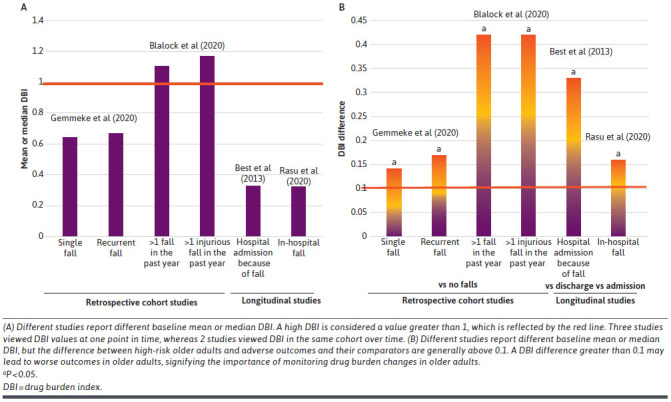
Comparison of DBI Differences in Older Adults Among Different Studies
Although formal long-term data with patient experiences are unavailable, the exact dynamic changes in anticholinergic and sedative burden directly impact patient fall and hospital readmission, which in turn influence CMS Star Ratings. Despite perceived limits, the inclusion of a DBI delta metric, especially on an EMR, has the potential to reduce fall incidence and associated health outcomes such as hospitalizations and death; this presents an opportunity to improve CMS Star Ratings by using meaningful tools to foster engagement among informed and active Medicare beneficiaries, as well as an opportunity to create agreements with managed care organizations dedicated to eliciting deeper understanding and mitigation of social inequalities in medication use and adverse consequences.15,16 Among the proposed solutions includes tailoring prescription utilization management tools with DBI to decrease avoidable incidence of complications and unintended costs.
Although maintaining patient access to medicines is vital, a firm handle on the dynamic relationship between medication exposures causing ADEs and associated health care utilization and costs to third-party payments remains crucial because one-third of hospital admissions in older adults occur because of ADEs—emulating early and transparent solutions toward a strategy for improving risk assessment and developing a methodology capable of achieving much needed affordability and accessibility of equitable therapy.
Regardless of studies describing calculation methods and utility of use of DBI in decreasing risk of falls and hospital readmissions for the same,1,5-7 there is a lack of real-life evidence of DBI’s utility in improving health outcomes using quality metrics used by hospitals.14 Future studies should focus on an expanded population of older adults as well as outcomes not frequently studied with DBI such as health-related quality of life,7 fall risk, recurrent falls, function, frailty, and death. To gather robust evidence across diverse populations, it is essential that more intensive, rigorous, and large-scale real-world studies be conducted.14 Furthermore, beyond just measuring clinical outcomes, it is crucial to extend the evaluation of DBI’s relevance from a quality-of-life perspective, cognition, function, and frailty. In translation to clinical practice, DBI monitoring could be facilitated by an EMR-based visual analogue transitional scale to provide ranges for fall risk from safety (green), caution (yellow), and danger (red) to cue just-in-time decision-making for prescription reduction or deprescribing related to fall risk. We believe that the inclusion of a DBI delta metric may contribute to reduced incidence of falls in an emerging older patient population, reduce 30-day readmission rates and associated health care costs, and improve the quality of life of older adults. Using real-world artificial intelligence (AI) and machine learning (ML) techniques could make this approach far more approachable and predictable.
Most studies on DBI are international, indicating a need for longitudinal and prospective research to establish threshold definitions and medical management among older Americans. With AI and ML application,17 we are equipped to pinpoint patient trajectory and minimize unintended and preventable damage like ADEs. Embracing innovative analytical techniques will assist managed care organization and others to achieve goals (beyond cost savings) and ensure good ratings. Current managed care medication coverage strategies, quantity limits, and quality control techniques could directly impact this situation at large. Using DBI metrics may help clinicians and hospitals minimize harmful medication-related consequences.14 Finally, the availability of DBI metrics presents a significant opportunity to eliminate avoidable costs, such as those associated with costly ADEs, by integrating these metrics into a system that provides timely alerts. By doing so, health care providers can be better equipped to prevent these poor outcomes before they occur.
Moreover, the timely application of advanced technologies like AI and ML in analyzing DBI metrics could enhance our ability to predict the value of DBI adjustments and their correlation with falls and other unintended ADEs. These technologies can process vast amounts of data quickly and accurately, identifying patterns and potential risks that might otherwise go unnoticed, emphasizing the potential benefits of integrating DBI metrics with AI/ML technologies to enhance patient care and overall well-being and reduce costs.
REFERENCES
- 1.Morley JE, Caplan G, Cesari M, et al. International survey of nursing home research priorities. J Am Med Dir Assoc. 2014;15(5):309-12. doi:10.1016/j.jamda.2014.03.003 [DOI] [PubMed] [Google Scholar]
- 2.National Academies of Sciences, Engineering, and Medicine; Health and Medicine Division; Board on Population Health and Public Health Practice; Committee on Informing the Selection of Leading Health Indicators for Healthy People 2030. Criteria for Selecting the Leading Health Indicators for Healthy People 2030. Washington (DC): National Academies Press; 2019. [PubMed] [Google Scholar]
- 3.Moncada LVV, Mire LG. Preventing falls in older persons. Am Fam Physician. 2017;96(4):240-7. [PubMed] [Google Scholar]
- 4.Hilmer SN, Mager DE, Simonsick EM, et al. A drug burden index to define the functional burden of medications in older people. Arch Intern Med. 2007;167(8):781-7. doi:10.1001/archinte.167.8.781 [DOI] [PubMed] [Google Scholar]
- 5.Rasu RS, Agbor-Bawa W, Rianon NJ. Greater changes in drug burden index (DBI) during hospitalization and increased 30-day readmission rates among older in-hospital fallers. Hosp Top. 2020;98(2):59-67. doi:10.1080/00185868.2020.1777916 [DOI] [PubMed] [Google Scholar]
- 6.Best O, Gnjidic D, Hilmer SN, Naganathan V, McLachlan AJ. Investigating polypharmacy and drug burden index in hospitalised older people. Intern Med J. 2013;43(8):912-8. doi:10.1111/imj.12203 [DOI] [PubMed] [Google Scholar]
- 7.Phillips A, Heier M, Strobl R, et al. Exposure to anticholinergic and sedative medications using the Drug Burden Index and its association with vertigo, dizziness and balance problems in older people - Results from the KORA-FF4 Study. Exp Gerontol. 2019;124:110644. doi:10.1016/j.exger.2019.110644 [DOI] [PubMed] [Google Scholar]
- 8.O’Connell J, Burke É, Mulryan N, et al. Drug burden index to define the burden of medicines in older adults with intellectual disabilities: An observational cross-sectional study. Br J Clin Pharmacol. 2018;84(3):553-67. doi:10.1111/bcp.13479 [DOI] [PMC free article] [PubMed] [Google Scholar]
- 9.Harrison SL, Kouladjian O#x2019;Donnell L, Redston MR, et al. Associations between the Drug Burden Index, potentially inappropriate medications and quality of life in residential aged care. Drugs Aging. 2018;35(1):83-91. doi:10.1007/s40266-017-0513-3 [DOI] [PubMed] [Google Scholar]
- 10.Margolis SA, Zughaft Sears M, Daiello LA, et al. Anticholinergic/sedative drug burden predicts worse memory acquisition in older racially/ethnically diverse patients with type 2 diabetes mellitus. Int J Geriatr Psychiatry. 2019;34(10):1545-54. doi:10.1002/gps.5173 [DOI] [PMC free article] [PubMed] [Google Scholar]
- 11.Blalock SJ, Renfro CP, Robinson JM, Farley JF, Busby-Whitehead J, Ferreri SP. Using the Drug Burden Index to identify older adults at highest risk for medication-related falls. BMC Geriatr. 2020;20(1):208. doi:10.1186/s12877-020-01598-5 [DOI] [PMC free article] [PubMed] [Google Scholar]
- 12.Gemmeke M, Koster ES, Pajouheshnia R, Kruijtbosch M, Taxis K, Bouvy ML. Using pharmacy dispensing data to predict falls in older individuals. Br J Clin Pharmacol. 2021;87(3):1282-90. doi:10.1111/bcp.14506 [DOI] [PMC free article] [PubMed] [Google Scholar]
- 13.Cardwell K, Kerse N, Ryan C, et al. The association between drug burden index (DBI) and health-related outcomes: A longitudinal study of the ‘oldest old’ (LiLACS NZ). Drugs Aging. 2020;37(3):205-13. doi:10.1007/s40266-019-00735-z [DOI] [PubMed] [Google Scholar]
- 14.Liu BM, Kouladjian O’Donnell L, Redston MR, et al. Association of the Drug Burden Index (DBI) exposure with outcomes: A systematic review. J Am Geriatr Soc. 2024;72(2):589-603. doi:10.1111/jgs.18691 [DOI] [PubMed] [Google Scholar]
- 15.Kogut SJ. Racial disparities in medication use: Imperatives for managed care pharmacy. J Manag Care Spec Pharm. 2020;26(11):1468-74. doi:10.18553/jmcp.2020.26.11.1468 [DOI] [PMC free article] [PubMed] [Google Scholar]
- 16.Kogut SJ, Vyas A. Pharmacy deductibles can complicate the relationship between measures of patient cost sharing and medication adherence. J Manag Care Spec Pharm. 2023;29(2):222. [DOI] [PMC free article] [PubMed] [Google Scholar]
- 17.Meeting/CE presentation and panel discussion at SW-AMCP, The Day of Education. “Pharmacists’ Role in Using Artificial Intelligence to Improve Health Outcomes.” February 3, 2024. [Google Scholar]