



Abstract
Background
Colleges and universities are currently facing the major public health issue of poor sleep quality. Sleep quality must be taken seriously to maintain the students’ emotional and physical well-being. Thus, this study sought to determine how university students’ levels of physical activity related to the quality of their sleep, as well as to explore the mechanisms via which physical activity affects sleep and provide suggestions for improving it.
Methods
A total of 883 university students from Ganzhou City, Jiangxi Province, China participated in the study. Their physical activity, sleep quality, ruminative thinking levels, and depression were assessed using various questionnaires.
Results
Through the mediating effects of rumination and depression as well as the chain-mediated effects of these two factors, physical exercise changed the quality of sleep.
Conclusion
University students’ sleep quality can be improved by increasing their physical activity and decreasing ruminative thinking and depression levels.
Keywords: University students, Physical activity, Sleep quality, Mediating effects
Introduction
A thorough assessment of the length and effectiveness of sleep onset and the quantity of deep sleep is known as sleep quality [1]. Good sleep quality is crucial to normal physiological and psychological functioning. For university students, long-term sleep deprivation can affect their academic life and cause their academic performance to decline [2]. Endocrine disruption may become a sleep disorder if sleep issues are not treated for an extended period. This can result in mental health issues, like depressive and anxious disorders [3] as well as an increased risk of suicidal thoughts [4]. In the United States, more than two-thirds of adolescents sleep less than eight hours per night [5]. According to a Jordanian survey, two-thirds of university students reported that their sleep was either very poor or fairly poor [6]. A lot of Chinese university students have trouble sleeping [7]. In Guangdong Province, China, research on students’ sleep quality discovered that 48.18% (1217/2526) of 2,526 university students had varying degrees of sleep disorders [8]. More than 50% of people worldwide suffer from sleep disturbances. 33% of adults say they have had insomnia symptoms, which include difficulty falling or staying asleep, waking up early, poor sleep quality, and the inability to regain energy [9]. Although the frequency of sleep disorders differs internationally and locally, there is a global increase in public and healthcare environments [10–12]. Therefore, this study aimed to identify the potential mechanisms that affect sleep quality by integrating psychological and physiological factors and to offer theoretical information and practical data to university students to enhance their sleep quality.
There is a negative correlation between poor sleep quality among university students and the degree of physical activity within a given range; this is an important driver of sleep quality [13]. A three-year Chinese survey of 827 university students revealed a link between sleep and physical activity [14]. According to a systematic review on how exercise affects the quality of sleep conducted in Hungary, moderate physical activity benefited young people’s sleep quality [15]. A global poll of university students revealed that the majority of those with inadequate sleep also lacked exercise [16]. Additionally, various studies have demonstrated that regular exercise is essential for enhancing sleep quality [17, 18]. Consequently, we propose the following hypothesis:
H1: There is a negative correlation between the degree of poor sleep quality among university students and the degree of physical activity within a given range.
Studies that consider numerous factors simultaneously are scarce, despite the abundance of research on the association link quality of sleep and physical activity.
Rumination may be one such significant factor in the relationship among exercise and the quality of sleep. The concept of rumination was first proposed by Nolen-Hoesksema, who described it as passive, repeated, and prolonged contemplation of the reasons and detrimental consequences of unpleasant feelings in the face of a stressful event without actively solving the problem [19]. A Danish study examined the relationship between rumination and the quality of sleep. among 126 young adults found that rumination was remarkably and positively connected with overall Pittsburgh Sleep Quality Index scores, underlining the independent contribution of rumination to sleep quality [20]. Randomized controlled trials in Germany and a study in Australia showed that rumination caused individuals difficulty in entering or maintaining sleep, which in turn affected sleep quality [21, 22]. Therefore, ruminative thinking may be a significant indicator of sleep caliber. Furthermore, physical exercise was discovered to be an adverse indicator of rumination. in a study of depression and physical activity among university students from China [23]. Increased physical exercise may reduce rumination in people, thus tangentially improving sleep quality. Physical exercise is an environmental factor that promotes neuroplasticity. Studies show that physical activity promotes changes in brain structure and function [24]. Physiologically, physical activity stimulates the brain to secrete neurotransmitters such as dopamine and endorphins. Dopamine creates a sense of pleasure and endorphins have a similar effect to natural painkillers. They help improve the mood, thus reducing the likelihood of experiencing negative emotions and rumination. Psychologically, physical exercise can be a form of distraction. During exercise, people focus their attention on specific things, such as body movements and the exercise environment. Consequently, the brain has no time to think on negative emotions and events, thus reducing rumination. Moreover, long-term adherence to physical exercise can enhance a sense of self-efficacy, leading to more positivity and confidence in the face of problems. This reduces negative emotions and inhibits rumination. Therefore, their biological and psychological benefits cannot be ignored. Based on these studies, we put out the following hypothesis:
H2: Physical exercise negatively anticipates ruminative thinking, Ruminative thinking and sleep quality are positively connected, and physical exercise predicts the quality of sleep by way of ruminative thought’s mediating function.
Exercise, depression, and sleep quality may all be significantly correlated. Prior studies have demonstrated that depression is a strong predictor of sleep issues and lowers the quality of sleep. According to a Chinese study regarding the link between depression and sleep quality, sickness, and general features, depression can result in different degrees of insomnia, wakefulness during the night, and other sleep disturbances [25]. According to an Australian sample of 741 teenagers, depressive symptoms strongly influenced the associations between age, short sleep duration, and sleep quality [26]. Several studies have demonstrated that people who have relatives that are affected by anxiety and depression are more inclined to suffer from inadequate sleep [27, 28]. As a result, depression may significantly predict low-quality sleep. Exercise has been found to enhance sleep quality and reduce anxiety and depressive symptoms [29, 30] Physical activity may attenuate depressive mood and thereby improve sleep quality. Therefore, hypothesis H3 is proposed.
H3: Depression and sleep quality are positively connected, exercise has a negative correlation with depression. and depression acts as a moderator in the relationship between university students’ sleep quality and physical exercise.
Studies have reported a correlation between rumination level and depressed mood. The response style theory of rumination states that one significant risk factor for depression is ruminating. which is triggered by repeated thoughts about negative events that result in a rise in unpleasant emotional experiences [31, 32]. A survey of 127 adolescents found that negative cognition and self-schemas resulting from rumination interacted with stressful life events, which in turn exacerbated depression [33]. We propose the following hypothesis in light of this:
H4: Depression and ruminative thinking operate as mediators between physical exercise and sleep quality.
There are also multiple theories within the sport psychology and health science body of theory that support this study. For example, the stress-recovery theory of physical activity suggests that moderate activity disrupts homeostasis and the body initiates self-repair, which involves neuroendocrine regulation and is related to sleep regulation, supporting the effect of physical activity on sleep quality [34]. Cognitive-emotional processing theory suggests that individuals have cognitive experiences during physical activity and that rumination is a deep cognitive process that triggers more rumination when faced with difficult challenges [35]. According to the cognitive susceptibility model of affective disorders, prolonged excessive rumination increases the susceptibility to negative emotions, which may lead to depression, and it may interfere with neurotransmitter balance, alter the perception of psychological stress, and affect sleep quality [36]. These theories lead to the research question of the effect of physical activity on sleep quality and the chain-mediated role of rumination and depression levels in college students, which needs to be explored in depth to find out the complex relationship and the underlying mechanisms.
There is a lot of curiosity in how exercise, both direct and indirect, affects the quality of sleep. However, no study has demonstrated how rumination and depression mediate this association. Thus, the purpose of this research was to investigate the nature of the connection between physical exercise and sleep quality, as well as whether depression and rumination operate as associative mediators in this relationship. The four aforementioned hypotheses were investigated (Fig. 1).
Fig. 1.
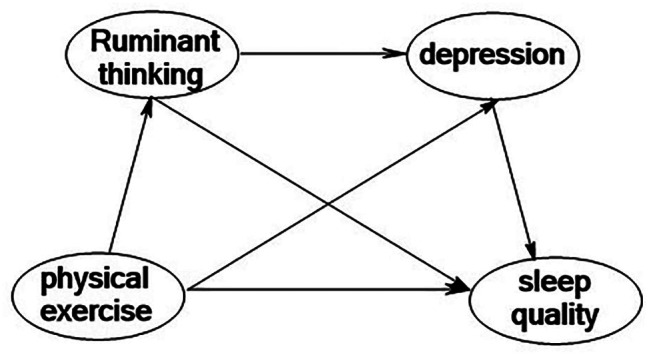
Hypothetical modelling of the path of physical activity’s effect on sleep quality
Materials and methods
Procedure and participants
Convenience sampling was used to conduct a cross-sectional study of Jiangxi Province’s Chinese university students. The survey included basic personal information, the Ruminative Thinking Scale (RRS-CV), Self-Rating Depression Scale (SDS), Physical Activity Rating Scale (PARS-3), and Pittsburgh Sleep Quality Index (PSQI). Every participant provided their informed consent to participate in the study, and the sample size was determined using a sample-to-variable ratio, suggested by a minimum observation-to-variable ratio of 5:1 [37]. Participants completed the questionnaires in class and returned them on the spot. Each questionnaire took 5–15 min to complete.
Measures and instruments
Physical activity rating scale (PARS-3)
The Physical Activity Rating Scale (PARS-3) was used to measure physical exercise levels [38]. The three dimensions of exercise that this scale assesses are the intensity, duration, and volume of exercise. Total workout volume is equal to intensity times time and frequency. There is a maximum of 100 points and a minimum of 0, with intensity and frequency graded from 1 to 5, with 1 to 5 points, and time graded from 1 to 5, with 0 to 4 points, respectively. The following points are used to determine the amount of exercise: ≤19 for small, 20–42 for medium, and > 43 for large. In this study, the Cronbach’s alpha coefficient for this scale was 0.721.
Ruminative response scale (RRS)
The rumination level was assessed using the Rumination Response Scale (RRS) [39]. The scale consists of 22 items across three dimensions: symptomatic rumination, obsessive thinking, and introspective deep thinking. Higher scores indicate a stronger tendency to ruminate. The measure is graded on a 4-point Likert scale: 1 = never; 4 = constantly. In this study, the Cronbach’s alpha coefficient for this scale was 0.936.
Self-rating depression scale (SDS)
Depression was evaluated using the Depression Self-Rating Scale [40]. Twenty items on the scale are graded using a Likert scale with 4 points: “1” means not at all or never, “2” means sometimes, “3” means frequently, and “4” means mostly or always. Each item’s score was totaled up to get an approximate total score, which was then multiplied by 1.25 using the Chinese norm. The total number was taken as the final standardized score, and the severity of the symptoms increased with a higher standardized score. When assessing depression, a score of 53 or below was considered normal, a score of 53 to 62 indicated mild depression, a score of 63 to 72 indicated moderate depression, and a score of 72 or higher indicated severe depression. In this study, the Cronbach’s alpha coefficient for this scale in this study was 0.813.
Pittsburgh sleep quality index (PSQI)
The Pittsburgh Sleep Quality Index (PSQI) was used to assess the quality of sleep, an 18-item self-assessment scale with scores ranging from 0 to 21. The scale evaluates an individual’s sleep over a period of one month [41]. Higher scores correspond to lower sleep quality. In this study, the Cronbach’s alpha coefficient for this scale was 0.825.
Statistical analysis
First, the EpiData 3.1 software was used for double entry into the computer, and valid data were obtained after deleting missing questionnaires. For statistical analysis, the SPSS software (version 26.0) was utilized, which was performed for demographic variables using descriptive statistics. A test for common method bias was run on the gathered information. Pearson correlation analyses were performed on the main study variables and t-tests were performed for between-group comparisons of the variables. The PROCESS plug-in’s Model 6 was used to investigate how physical exercise affects sleep quality through a chain reaction.
Results
Common method bias test
Harman’s one-factor test was used to examine the sample for common method bias in order to ascertain the consistency of the results. The first component accounted for 20.63% of the variance, which is less than the crucial criterion of 40%. There was no discernible common approach bias in the data, according to the results, which showed that 14 factors had eigenvalues larger than one.
Descriptive statistics
Basic information on survey respondents
A total of 958 questionnaires were circulated and 883 valid questionnaires (92.17% of the total) were received after qualifying and reviewing the responses. The sample comprised 439 males (49.7%) and 444 women (50.3%). The age range of the participants was 16 to 24 years.
Depression, sleep quality, and physical activity
Of the 883 university students surveyed, physical exercise was low intensity for 666 (75.4%), medium intensity for 151 (17.1%), and high intensity for 66 (7.5%). Sleep quality was very good (0 ≤ PSQI ≤ 5) for 457 (51.8%) and okay (6 ≤ PSQI ≤ 10) for 364 (41.2%) students, while others accounted for the remaining 10%. Furthermore, 568 (64.3%) participants had no depression, 261 (29.6%) had mild depression, and 6.1% had moderate-to-severe depression.
Correlation analysis
Physical activity, ruminative thinking, depression, and sleep quality showed statistically significant correlations, as shown in Table 1. According to correlation studies, exercise has a negative correlation with rumination, depressive mood, and sleep quality (p < 0.05, p < 0.01, and p < 0.05, respectively). Physical activity differed across genders (p < 0.01), while age was not correlated with any of the indicators, except for sleep quality. Further t-tests were conducted on students of different genders. Table 2 shows that female students had significantly lower physical activity, higher rumination, higher depression, and poorer sleep quality than male students (p < 0.05).
Table 1.
Variable means, standard deviations, and correlations(N = 883)
| M | SD | Sex | Age | Physical exercise | Ruminant thinking | Depression | Sleep quality | |
|---|---|---|---|---|---|---|---|---|
| Sex | 1.50 | 0.500 | 1 | |||||
| Age | 18.7 | 1.105 | -0.097** | 1 | ||||
| Physical exercise | 14.8 | 15.228 | -0.158** | 0.040 | 1 | |||
| Ruminant thinking | 42.3 | 11.867 | 0.080* | -0.046 | -0.072* | 1 | ||
| Depression | 48.8 | 9.670 | 0.067* | 0.005 | -0.095** | 0.173** | 1 | |
| Sleep quality | 5.88 | 3.635 | 0.213** | 0.105** | -0.084* | 0.191** | 0.358** | 1 |
SD = Standard Deviation
*P < 0.05, **P < 0.01
Table 2.
Analysis of differences in variables by gender
| Gender | N | M ± SD | t | p | |
|---|---|---|---|---|---|
| Physical exercise | Male | 439 | 17.26 ± 17.16 | 4.734 | < 0.001 |
| Female | 444 | 12.46 ± 12.61 | |||
| Ruminant thinking | Male | 439 | 41.30 ± 12.17 | -2.379 | 0.018* |
| Female | 444 | 43.19 ± 11.50 | |||
| Depression | Male | 439 | 48.17 ± 9.93 | -1.983 | 0.048* |
| Female | 444 | 49.46 ± 9.37 | |||
| Sleep quality | Male | 439 | 5.10 ± 3.05 | -6.494 | < 0.001 |
| Female | 444 | 6.65 ± 3.99 |
SD = Standard Deviation
*P < 0.05, **P < 0.01, ***P < 0.001
A test of the mediating effect between physical activity and sleep quality
To identify the mediating effects, the Hayes’ Process Model 6 macro program for SPSS was utilized. Table 3 presents the study outcomes. Initially, we explored how exercise directly affects the quality of sleep. The results demonstrated that there was a direct link between physical activity and sleep quality before the mediating variable was included (β = -0.0841, t = -2.5057, p < 0.05); therefore, Hypothesis 1 was valid. After adding the mediating variable, physical activity did not significantly impact the quality of sleep directly; however, the remaining direct pathways attained importance and had the potential to influence the quality of sleep via three indirect pathways: (1) Physical exercise → ruminative thinking → sleep quality; (2) Physical exercise → depressive mood → sleep quality; and (3) Physical exercise → ruminative thinking → depressive mood → sleep quality. Following the testing of Hypotheses 2 and 3, physical activity was found to have a major direct impact on ruminative thinking (β = -0.0718, t = -2.1376, p < 0.05) and ruminative thinking affect the quality of sleep (β = 0.1306, t = 4.1241, p < 0.001). Additionally, exercise had a direct impact with depression (β = -0.0832, t = -2.5098, p < 0.05), depressive mood on sleep quality (β = 0.3309, t = 10.4260, p < 0.001), and ruminative thinking on depressed mood (β = 0.1669, t = 5.0317, p < 0.001). These results suggest a chain-mediating variable between ruminative thinking and depressed mood, supporting Hypothesis 4.
Table 3.
Analysis of regression relationships between variables
| Effect | Item | Effect | SE | t | p | LLCI | ULCI |
|---|---|---|---|---|---|---|---|
| Direct effect | PE→SQ | -0.0432 | 0.0075 | -1.3788 | 0.1683 | -0.0250 | 0.0044 |
| Indirect effect | PE→RT | -0.0718 | 0.0262 | -2.1376 | 0.0328 | -0.1074 | -0.0046 |
| PE→DP | -0.0832 | 0.0211 | -2.5098 | 0.0123 | -0.0942 | -0.0115 | |
| RT→DP | 0.1669 | 0.0270 | 5.0317 | < 0.001 | 0.0829 | 0.1890 | |
| RT→SQ | 0.1306 | 0.0097 | 4.1241 | < 0.001 | 0.0210 | 0.0591 | |
| DP→SQ | 0.3309 | 0.0119 | 10.4260 | < 0.001 | 0.1010 | 0.1478 | |
| Total effect | PE→SQ | -0.0841 | -0.008 | -2.5057 | 0.0124 | -0.0358 | -0.0044 |
PE, Physical Exercise; SQ, Sleep Quality: RT, Ruminant Thinking: DP, Depression
Using the bias-corrected percentile Bootstrap approach (5,000 repeated samples), Table 4 presents the confidence interval for the 95% Bootstrap results of the mediating effect. The confidence interval for physical exercise → rumination → sleep quality was (-0.0050, -0.0003), and the mediating effect size was − 0.0022. The confidence interval for physical exercise → depressive mood → sleep quality was (-0.0122, -0.0011), and the mediating effect size was − 0.0066. The confidence interval for physical exercise → ruminative thinking → depressive mood → sleep quality was (-0.0020, -0.0001), with a mediation effect size of -0.0009. Additionally, a significant mediation effect was shown by the fact that the confidence intervals did not contain 0. The moderating effects of rumination and depression on physical activity and sleep quality are shown in Fig. 2.
Table 4.
Analysis of the mediating effect of physical activity and sleep quality
| Path | Effect | The proportion of mediations in the total effect | BootSE | 95% Confidence interval | |
|---|---|---|---|---|---|
| Lower limit | Upper limit | ||||
| PE→RT→SQ | -0.0022 | 11% | 0.0012 | -0.0050 | -0.0003 |
| PE→DP→SQ | -0.0066 | 33% | 0.0029 | -0.0122 | -0.0011 |
| PE→RT→DP→SQ | -0.0009 | 4% | 0.0005 | -0.0020 | -0.0001 |
PE, Physical Exercise; SQ, Sleep Quality: RT, Ruminant Thinking: DP, Depression
Fig. 2.
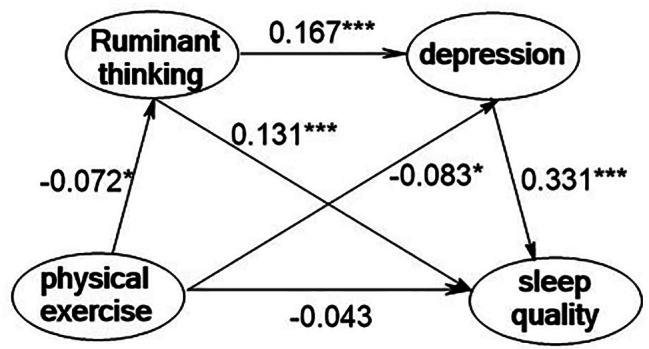
A chain-mediated model of physical activity and sleep quality. *P < 0.05, **P < 0.01, ***P < 0.001
Discussion
Relationship between physical activity and sleep quality
There was a negative correlation between the degree of poor sleep quality among university students and the degree of physical activity within a given range; the more physically active students were, the lower their sleep quality score was. This validates hypothesis 1 and is in line with the findings of another research.
Numerous prior research studies have indicated that university students’ sleep quality is greatly impacted by physical exercise. According to a German study, exercise increased sleep efficiency and decreased sleep latency, which enhanced the quality of sleep [42]. Moderate exercise training enhanced the quality of sleep, resulting in deeper sleep, longer sleep duration, and reduced latency, according to a comprehensive meta-analysis of 66 American studies [43]. Aerobic training and aerobic combined with resistance training have been demonstrated to be effective in reducing negative emotions like tension and anxiety, which in turn enhances the quality of sleep [44]. Numerous research studies have additionally exhibited the beneficial impacts of diverse exercise modalities (e.g., physical and mental exercises and strenuous strength exercises) [45, 46] and intensities on the quality of sleep. A related study carried out in China discovered that teens’ levels of physical activity directly and strongly correlated with the quality of their sleep [47]. These studies demonstrate that physical activity can improve sleep quality to some extent. The thermoregulatory hypothesis provides the most plausible theoretical foundation for the beneficial effects of exercise on sleep [48]. Physical activity is the primary way of thermoregulatory control, which is why sleep is based on the thermoregulatory process. It initiates the first sleep cycle and, via the suprachiasmatic nucleus (SCN), regulates the circadian rhythm, keeping the body temperature at a generally constant level. The results of this study, in which male students scored higher on physical activity and female students had poorer sleep quality than male students, also suggest that insufficient levels of exercise among female students may be a significant contributor to poorer sleep quality. In other words, lack of physical activity reduces sleep quality. Thus, increasing physical activity will help enhance sleep quality by lowering sleep-related issues.
The independent mediating role of ruminative thinking
The current study’s results support Hypothesis 2 by demonstrating that ruminative thinking acts as a mediator in the association between physical exercise and sleep quality. This is in line with other relevant research.in which physical activity significantly negatively predicted ruminative thinking [23]and ruminative thinking significantly positively predicted sleep quality [20].
A study including 1,103 university students investigated the detrimental impact of rumination on sleep quality, which was mediated by negative emotions and bedtime procrastination [49]. In line with the cognitive sleep model, negative rumination, a common form of intrusive thinking, negatively affects an individual’s ability to enter and maintain sleep, which in turn affects sleep quality [21, 22]. Importantly, physical exercise negatively predicts ruminative thinking, can attenuate persistent bad feelings, and lowers the degree of ruminative thought, which, to some extent, can reduce university students’ sleep problems due to higher levels of ruminative thinking [50]. Hypothalamic–pituitary–adrenal (HPA) axis responses are a type of physiological stress response that ruminative thinking tends to amplify and prolong. However, people who engage in regular physical activity can mitigate the impacts of ruminative thinking on HPA axis responsiveness and recuperation from severe stress [51].
The study’s conclusions showed that male students performed better than female students in terms of physical activity and that female students also exhibited significantly higher levels of ruminative thinking and lower sleep quality. These findings point to the significant role of ruminative thinking in female students’ low exercise levels, which in turn contributes to their lower sleep quality. Furthermore, ruminative thinking is associated with poor mental health outcomes among university students who do not exercise, and tends to impair sleep quality. By contrast, physical activity can help release physical tension, improve mood and self-perception, reduce the mobilization of ruminative thought patterns, and reduce negative self-doubt. Individuals who do not experience high levels of rumination before going to sleep experience a reduced impact on sleep quality. Consequently, rumination is a major contributing factor to poor sleep quality and lack of physical activity among university students.
Independent mediators of depressed mood
Additionally, the current study verified Hypothesis 3 by demonstrating that depressed mood mediates the link between quality of sleep and physical activity. This is consistent with findings from related research indicating exercise has a negative correlation with depression, which further predicts sleep quality.
Among university students, there was a robust and positive correlation between mood depression and sleep quality. In a Chinese study examining the relationship between depression and general characteristics, illness, and sleep quality, depression was associated with various degrees of sleep disturbances, including difficulty falling asleep, insomnia, and sleep arousal [25]. Shorter rapid eye movement latency and forward shift in the first REM period following sleep initiation were observed on polysomnography among individuals with major depressive disorders, which resulted in a higher proportion of REM sleep and shorter duration of slow-wave sleep [52–54]. According to the antidepressant theory of physical activity and cognitive behavioral theory, physical activity negatively predicts depression. Physical activity is a form of distraction and catharsis that stimulates neuroplasticity, increases hippocampal volume and white matter integrity, strengthens the frontal cortex and other brain structures involved in the “emotion and reward network” [55, 56], and activates cortical areas associated with the evaluation of emotional stimuli [57], resulting in a pleasurable effect after exercise [58].
The findings demonstrated that while female students had significantly higher levels of depression and worse sleep quality than male students, male students scored higher on physical activity, suggesting that high levels of ruminative depression among females may also be an important mechanism for their insufficient levels of exercise, causing lower quality sleep compared to male students. In the presence of insufficient exercise and high levels of depression, individuals exhibit long sleep onset times, inefficient sleep, easy awakening from sleep, and excessive nocturnal dreams.
Chain-mediated effects of ruminative thinking and levels of depression
To investigate how physical activity affects university students’ sleep quality, we identified a chain mediator consisting of rumination, a poor cognitive style that affects the onset, severity, and duration of depression. Previous research has indicated that negative cognition and self-schemas from rumination interact with stressful life events, which can exacerbate depression [33]. Results from a study involving 1057 teenagers in the United States revealed that girls exhibited more depressed symptoms and rumination than boys did, and that rumination significantly increased depression [59]. For university students, rumination may be the preferred way to cope with challenges and changing circumstances, especially among those who have difficulty tolerating uncertainty, persevering, and reassessing important life goals. The feeling of exemption from responsibility that arises after assessing a situation as hopeless may reinforce rumination as a coping strategy. This may exacerbate pessimistic thinking and depression while inhibiting positive problem solving [60]. The results of this study, which showed that women think more ruminatively than men, may be the reason why female students have far higher rates of depression and poorer sleep quality than male students. Physical exercise can help relieve physical tension, improve mood and self-perception, reduce the mobilization of high ruminative thinking patterns, reduce negative self-doubt, and lower depression, thereby reducing sleep problems and improving sleep quality. Consequently, university students who engage in physical activity tend to think less ruminatively and experience depression at lower levels, thereby reducing sleep disorders.
Practical significance
This study investigated how exercise affected the quality of sleep to provide a reference for improving sleep quality. Exercise is not only an important indicator of the caliber of sleep but also of ruminative thinking and depression. This research expands our corpus of knowledge in the areas of physical activity and sleep quality, which is useful for helping university students achieve better sleep. Currently, university students experience increasing sleep problems. Physical exercise can be used as a supplement to non-pharmacological methods of enhancing sleep quality. Educators at universities and colleges should focus on the importance of physical exercise, organize appropriate opportunities for physical activity on campus, and encourage students to engage in physical activity on a regular basis. Also, in order to effectively increase the quality of their sleep, students’ depression and ruminative thinking should be kept within a normal range.
Strengths and limitations
In this research, several strengths are worth noting. Firstly, unlike most previous studies that focused only on the single association between physical activity and sleep quality, this study constructed a chain mediation model between physical activity, rumination, depression level and sleep quality. This design provides a new perspective to comprehensively understand the pathways of physical activity’s influence on college students’ sleep quality, and helps to fill the gaps in the exploration of mechanisms in related areas of research. Secondly, the present study used a variety of well-established scales with good reliability and validity to measure physical activity, rumination, depression level and sleep quality, which can capture the characteristics of each variable and its changes in a more comprehensive way than some previous studies that relied on only a single or a limited number of assessment indexes, thus enhancing the reliability and validity of the results of the study, and providing useful references for subsequent studies in terms of the methods of variable measurement. In addition, this study focuses on the college student population, considering that college students are at a special stage in their lives, facing academic pressure, social changes, and self-cognitive development, among other factors, and that their physical activity, psychological state, and sleep patterns are unique. The results of this study can reflect the specific patterns and intrinsic links of the effects of physical activity on the sleep quality of college students, which is more relevant and practical guidance than a broad population-based study, and can provide an empirical basis for health promotion activities in colleges and universities. Ultimately, it can provide a more solid theoretical foundation and practical guidance for improving the physical and mental health of college students.
Despite offering theoretical and practical assistance, there are certain restrictions on the study’s findings. First, this was a status quo study that could not elucidate causal connections between the variables under investigation. In the future, cohort or experimental studies should be included in systematic analyses. Second, because the questionnaires were lengthy and multiple in number, many students did not actively complete the questionnaires when they were distributed, which biased the authenticity of the data. During our investigations, the following measures were considered to minimize bias in this regard: (1) Incentives: appropriate rewards, such as small gifts and opportunities for lucky draws, were provided to increase participants’ motivation. (2) Advance communication: before distributing the questionnaires, we explained their importance, significance, and the time needed to fill them out so that participants could be psychologically prepared. (3) Completion in stages: we divided the questionnaire into several parts so that participants could complete it in stages to reduce fatigue. Third, each response variable has a wide range of impacting factors, and the mediating variables derived in this study are ruminative thinking and depression, which are not unique; in fact, more mediating variables and mediation models might exist. The conclusions of this study highlight the small proportion of the influence on sleep quality, and examining a wide range of other mediating variables would be worthwhile.
Conclusion
The physical and mental health of university students has always been an important topic of concern. Among many influencing factors, the relationship between physical activity, rumination, depression level, and sleep quality are of particular interest. Among university students, there were notable gender differences in rumination, depression, exercise, and quality of sleep. Physical exercise affected the quality of sleep of university students through the chain and independent mediation of depression and rumination. The results of this study provide new perspectives and bases for an in-depth understanding of the physical and mental health of university students. Moreover, it reminds us to consider gender differences and the complex interactions between different psychological factors when focusing on the university student population. This will encourage more targeted measures to promote the healthy growth of university students.
Acknowledgements
The authors wish to thank the study participants for their contribution to the research, as well as investigators and staffs.
Author contributions
L.X.: Study design, data collection, data analysis and manuscript writing; W.Y. and G.H.: Study design, data collection and data analysis; Z.H. and C.W.: Study design and data analysis; M.H.: Study design, data collection, data analysis and funding acquisition. All authors read and approved the fnal manuscript.
Funding
This study was supported by the Starting Research Fund from the Gannan Medical University, grant number: QD202121.
Data availability
The datasets used and analyzed in the current study are available from the corresponding author on reasonable request.
Declarations
Ethics approval and consent to participate
The study was conducted in accordance with the Tenets of the Declaration of Helsinki. Complete research objectives and survey contents were explained to the participants. All participants provided written informed consent and agreed to the required measurement and survey completion procedures. This study was approved by the Ethical Committee of Gannan Medical University, China, No: 2021110.
Consent for publication
Not applicable.
Competing interests
The authors declare no competing interests.
Footnotes
Publisher’s note
Springer Nature remains neutral with regard to jurisdictional claims in published maps and institutional affiliations.
References
- 1.Vargas PA, Flores M, Robles E. Sleep quality and body Mass Index in College students: the role of Sleep disturbances. J Am Coll Health. 2014;62(8):534–41. 10.1080/07448481.2014.933344. [DOI] [PMC free article] [PubMed] [Google Scholar]
- 2.Naderi H, Dehghan H, Dehrouyeh S, Tajik E. Academic burnout among undergraduate nursing students: Predicting the role of sleep quality and healthy lifestyle. Res Dev Med Educ. 2021;10(1):16–16. 10.34172/rdme.2021.016. [Google Scholar]
- 3.Marvaldi M, Mallet J, Dubertret C, Moro MR, Guessoum SB. Anxiety, depression, trauma-related, and sleep disorders among healthcare workers during the COVID-19 pandemic: a systematic review and meta-analysis. Neurosci Biobehav Rev. 2021;126:252–64. 10.1016/j.neubiorev.2021.03.024. [DOI] [PMC free article] [PubMed] [Google Scholar]
- 4.Guo SR. The effect of sleep quality on suicidal ideation in college students: the role of depression and self-esteem. Psychol Res. 2021;14:464–72. [Google Scholar]
- 5.Guglielmo D, Gazmararian JA, Chung J, Rogers AE, Hale L. Racial/ethnic sleep disparities in US school-aged children and adolescents: a review of the literature. Sleep Health. 2018;4(1):68–80. 10.1016/j.sleh.2017.09.005. [DOI] [PMC free article] [PubMed] [Google Scholar]
- 6.Albqoor MA, Shaheen AM. Sleep quality, sleep latency, and sleep duration: a national comparative study of university students in Jordan. Sleep Breath. 2021;25(2):1147–54. 10.1007/s11325-020-02188-w. [DOI] [PubMed] [Google Scholar]
- 7.Tan YT, Liu S. The Effect of College Students’ Mobile phone addition tendency on Sleep Quality: the moderating role of perceived stress. Adv Psychol. 2020;10(10):1422–9. 10.12677/AP.2020.1010167. [Google Scholar]
- 8.Zhang R, Jiao G, Guan Y, Huang Q, Pan J. Correlation between chronotypes and depressive symptoms mediated by Sleep Quality among Chinese College Students during the COVID-19 pandemic. Nat Sci Sleep 2023; Volume 15:499–509. 10.2147/NSS.S403932 [DOI] [PMC free article] [PubMed]
- 9.American Psychiatric Association. Diagnostic and statistical manual of mental disorders (DSM-5®). American Psychiatric Pub; 2013.
- 10.Alexander M, Ray MA, Hébert JR, Youngstedt SD, Zhang H, Steck SE, et al. The national veteran sleep disorder study: descriptive epidemiology and secular trends, 2000–2010. Sleep. 2016;39(7):1399–410. 10.5665/sleep.5972. [DOI] [PMC free article] [PubMed] [Google Scholar]
- 11.Hoyos C, Glozier N. Marshall. Recent evidence on Worldwide Trends on Sleep Duration. Curr Sleep Med Rep. 2015;1:195–204. 10.1007/s40675-015-0024-x. [Google Scholar]
- 12.Mollayeva T, Thurairajah P, Burton K, Mollayeva S, Shapiro CM, Colantonio A. The Pittsburgh sleep quality index as a screening tool for sleep dysfunction in clinical and non-clinical samples: a systematic review and meta-analysis. Sleep Med Rev. 2016;25:52–73. 10.1016/j.smrv.2015.01.009. [DOI] [PubMed] [Google Scholar]
- 13.Ye J, Jia X, Zhang J, Guo K. Effect of physical exercise on sleep quality of college students: Chain intermediary effect of mindfulness and ruminative thinking. Front Psychol. 2022;13. 10.3389/fpsyg.2022.987537. [DOI] [PMC free article] [PubMed]
- 14.Semplonius T, Willoughby T. Long-term links between physical activity and sleep quality. Med Sci Sports Exerc. 2018;50(12):2418–24. 10.1249/MSS.0000000000001706. [DOI] [PubMed] [Google Scholar]
- 15.Wang F, Boros S. The effect of physical activity on sleep quality: a systematic review. Eur J Physiother. 2021;23(1):11–8. 10.1080/21679169.2019.1623314. [Google Scholar]
- 16.Mahfouz M, Ali S, Bahari A, Ajeebi R, Sabei H, Somaily S, et al. Association between Sleep Quality and Physical Activity in Saudi Arabian University students. Nat Sci Sleep. 2020;12775–82. 10.2147/NSS.S267996.<\/p> [DOI] [PMC free article] [PubMed] [Google Scholar]
- 17.Li JY, Luan J, Zhang WY, Li HJ. Exploration of the status quo and influencing factors of sleep procrastination behavior of 839 college students in a city. Chin Sch Nurse. 2023;37:241–54. [Google Scholar]
- 18.Dolezal B, Neufeld E, Boland D, Martin J, Cooper C. Interrelationship between Sleep and Exercise: a systematic review. Adv Prev Med. 2017;2017:1–14. 10.1155/2017/1364387. [DOI] [PMC free article] [PubMed] [Google Scholar]
- 19.Brinker J, Chin Z, Wilkinson R. Ruminative thinking style and the MMPI-2-RF. Pers Individ Dif. 2014;66:102–5. 10.1016/j.paid.2014.03.001. [Google Scholar]
- 20.Thomsen D, Mehlsen M, Christensen S, Zachariae R. Rumination—relationship with negative mood and sleep quality. Pers Individ Dif. 2003;34:(7):1293–301. 10.1016/S0191-8869(02)00120-4. [Google Scholar]
- 21.Butz S, Stahlberg D. Can self-compassion improve sleep quality via reduced rumination? Self Identity. 2018;17(6):666–86. 10.1080/15298868.2018.1456482. [Google Scholar]
- 22.Guastella A, Moulds M. The impact of rumination on sleep quality following a stressful life event. Pers Individ Dif. 2007;42(6):1151–62. 10.1016/j.paid.2006.04.028. [Google Scholar]
- 23.Liu Y, Feng Q, Guo K. Physical activity and depression of Chinese college students: chain mediating role of rumination and anxiety. Front Psychol. 2023;14. 10.3389/fpsyg.2023.1190836. [DOI] [PMC free article] [PubMed]
- 24.Mandolesi L, Polverino A, Montuori S, Foti F, Ferraioli G, Sorrentino P, et al. Effects of Physical Exercise on Cognitive Functioning and Wellbeing: Biological and Psychological benefits. Front Psychol. 2018;9. 10.3389/fpsyg.2018.00509. [DOI] [PMC free article] [PubMed]
- 25.Jiang Y, Jiang T, Xu L, Ding L. Relationship of depression and sleep quality, diseases and general characteristics. World J Psychiatry. 2022;12(5):722–38. 10.5498/wjp.v12.i5.722. [DOI] [PMC free article] [PubMed] [Google Scholar]
- 26.Raniti M, Allen N, Schwartz O, Waloszek J, Byrne M, Woods M, et al. Sleep duration and sleep quality: associations with depressive symptoms across adolescence. Behav Sleep Med. 2017;15(3):198–215. 10.1080/15402002.2015.1120198. [DOI] [PubMed] [Google Scholar]
- 27.Rachel Manber, Andrea S, Chambers. Insomnia and depression: a multifaceted interplay. Curr Psychiatry Rep. 2009;11(6):437–42. [DOI] [PubMed] [Google Scholar]
- 28.Ramsawh H, Stein M, Belik S, Jacobi F, Sareen J. Relationship of anxiety disorders, sleep quality, and functional impairment in a community sample. J Psychiatr Res. 2009;43(10):926–33. 10.1016/j.jpsychires.2009.01.009. [DOI] [PubMed] [Google Scholar]
- 29.Kalak N, Gerber M, Kirov R, Mikoteit T, Yordanova J, Pühse U, et al. Daily Morning running for 3 weeks improved sleep and psychological functioning in healthy adolescents compared with controls. J Adolesc Health. 2012;51(6):615–22. 10.1016/j.jadohealth.2012.02.020. [DOI] [PubMed] [Google Scholar]
- 30.Brand S, Gerber M, Beck J, Hatzinger M, Pühse U, Holsboer-Trachsler E. High Exercise levels are related to favorable sleep patterns and psychological functioning in adolescents: a comparison of athletes and controls. J Adolesc Health. 2010;46(2):133–41. 10.1016/j.jadohealth.2009.06.018. [DOI] [PubMed] [Google Scholar]
- 31.Michl L, McLaughlin K, Shepherd K, Nolen-Hoeksema S. Rumination as a mechanism linking stressful life events to symptoms of depression and anxiety: longitudinal evidence in early adolescents and adults. J Abnorm Psychol. 2013;122(2):339–52. 10.1037/a0031994. [DOI] [PMC free article] [PubMed] [Google Scholar]
- 32.Conway M, Csank P, Holm S, Blake C. On assessing individual differences in rumination on sadness. J Pers Assess. 2000;75(3):404–25. 10.1207/S15327752JPA7503_04. [DOI] [PubMed] [Google Scholar]
- 33.Shapero B, McClung G, Bangasser D, Abramson L, Alloy L. Interaction of Biological stress recovery and cognitive vulnerability for Depression in Adolescence. J Youth Adolesc. 2017;46(1):91–103. 10.1007/s10964-016-0451-0. [DOI] [PMC free article] [PubMed] [Google Scholar]
- 34.Tan X, van Egmond LT, Cedernaes J, Benedict C. The role of exercise-induced peripheral factors in sleep regulation. Mol Metabolism. 2020;42:101096. 10.1016/j.molmet.2020.101096. [DOI] [PMC free article] [PubMed] [Google Scholar]
- 35.Mischel W, Shoda Y. A cognitive-affective system theory of personality: reconceptualizing situations, dispositions, dynamics, and invariance in personality structure. Psychol Rev. 1995;102(2):246–68. 10.1037/0033-295X.102.2.246. [DOI] [PubMed] [Google Scholar]
- 36.Rosenhan DL, Seligman MEP. Abnormal psychology. WW Norton & Co; 1989.
- 37.Memon MA, Ting H, Cheah JH, Thurasamy R, Chuah F, Cham TH. Sample size for survey research: review and recommendations. J Appl Struct Equation Model. 2020;4(2):1–20. [Google Scholar]
- 38.Liang DQ. Stress level of college students and its relationship with physical exercise. Chin J Mental Health. 1994;8(2):5–6. [Google Scholar]
- 39.Nolen-Hoeksema S, Morrow J. A prospective study of depression and posttraumatic stress symptoms after a natural disaster: the 1989 Loma Prieta earthquake. J Pers Soc Psychol. 1991;61(1):115–21. 10.1037/0022-3514.61.1.115. [DOI] [PubMed] [Google Scholar]
- 40.Zung, William WK. Zung self-rating depression scale and depression status inventory. Assessment of depression Berlin, Heidelberg: Springer Berlin Heidelberg. 1986;221–31.
- 41.Buysse D, Reynolds C, Monk T, Berman S, Kupfer D. The Pittsburgh sleep quality index: a new instrument for psychiatric practice and research. Psychiatry Res. 1989;28(2):193–213. 10.1016/0165-1781(89)90047-4. [DOI] [PubMed] [Google Scholar]
- 42.Dworak M, Wiater A, Alfer D, Stephan E, Hollmann W, Strüder H. Increased slow wave sleep and reduced stage 2 sleep in children depending on exercise intensity. Sleep Med. 2008;9(3):266–72. 10.1016/j.sleep.2007.04.017. [DOI] [PubMed] [Google Scholar]
- 43.Kredlow M, Capozzoli M, Hearon B, Calkins A, Otto M. The effects of physical activity on sleep: a meta-analytic review. J Behav Med. 2015;38(3):427–49. 10.1007/s10865-015-9617-6. [DOI] [PubMed] [Google Scholar]
- 44.Dong Y. Intervention effect of two different exercise modes on sleep quality of patients with primary insomnia. J Shanghai Univ Sport. 2020;44(11):38–43. 10.16099/j.sus.2020.11.005. [Google Scholar]
- 45.Brupbacher G, Gerger H, Zander-Schellenberg T, Straus D, Porschke H, Gerber M, et al. The effects of exercise on sleep in unipolar depression: a systematic review and network meta-analysis. Sleep Med Rev. 2021;59:101452. 10.1016/j.smrv.2021.101452. [DOI] [PubMed] [Google Scholar]
- 46.Lederman O, Ward P, Firth J, Maloney C, Carney R, Vancampfort D, et al. Does exercise improve sleep quality in individuals with mental illness? A systematic review and meta-analysis. J Psychiatr Res. 2019;109:96–106. 10.1016/j.jpsychires.2018.11.004. [DOI] [PubMed] [Google Scholar]
- 47.Liu Q, Zhou Z, Niu G, Fan C. Mobile phone addiction and sleep quality in adolescents: mediation and moderation analyses. Acta Physiol Sinica. 2017;49(12):1524. 10.3724/SP.J.1041.2017.01524. [Google Scholar]
- 48.Oliveira L de, Silva A da, Santos M dos, Diniz R-D Rm, Prb. Exercicio Fisico Ou Atividade Fisica: qual Apresenta Maior Associacao Com A Percepcao Da Qualidade do Sono De Adolescentes? Revista Paulista De Pediatria. 2018;36(3):322–8. 10.1590/1984-0462/;2018;36;3;00014. [DOI] [PMC free article] [PubMed]
- 49.You Z, Li X, Ye N, Zhang L. Understanding the effect of rumination on sleep quality: a mediation model of negative affect and bedtime procrastination. Curr Psychol. 2021;1–9. 10.1007/s12144-020-01337-4.
- 50.Bernstein E, McNally R. Acute aerobic exercise hastens emotional recovery from a subsequent stressor. Health Psychol. 2017;36(6):560–7. 10.1037/hea0000482. [DOI] [PubMed] [Google Scholar]
- 51.Puterman E, O’Donovan A, Adler NE, Tomiyama AJ, Kemeny M, Wolkowitz OM, et al. Physical activity moderates effects of Stressor-Induced rumination on Cortisol Reactivity. Psychosom Med. 2011;73(7):604–11. 10.1097/PSY.0b013e318229e1e0. [DOI] [PMC free article] [PubMed] [Google Scholar]
- 52.Blasco-Serra A, Escrihuela-Vidal F, González-Soler EM, Martínez-Expósito F, Blasco-Ausina MC, Martínez-Bellver S, et al. Depressive-like symptoms in a reserpine-induced model of fibromyalgia in rats. Physiol Behav. 2015;151:456–62. 10.1016/j.physbeh.2015.07.033. [DOI] [PubMed] [Google Scholar]
- 53.Wang Y, Li R, Zhang M, Zhang Z, Qu W, Huang Z. The neurobiological mechanisms and treatments of REM sleep disturbances in Depression. Curr Neuropharmacol. 2015;13(4):543–53. 10.2174/1570159X13666150310002540. [DOI] [PMC free article] [PubMed] [Google Scholar]
- 54.Steiger A, Pawlowski M. Depression and Sleep. Int J Mol Sci. 2019;20(3):607. 10.3390/ijms20030607. [DOI] [PMC free article] [PubMed] [Google Scholar]
- 55.Schmitt A, Upadhyay N, Martin JA, Rojas S, Strüder H, Boecker H. Modulation of distinct intrinsic resting state brain networks by Acute Exercise bouts of Differing Intensity. Brain Plast. 2019;5(1):39–55. 10.3233/BPL-190081. [DOI] [PMC free article] [PubMed] [Google Scholar]
- 56.Weng T, Pierce G, Darling W, Falk D, Magnotta V, Voss M. The Acute effects of Aerobic Exercise on the functional connectivity of human brain networks. Brain Plast. 2017;2(2):171–90. 10.3233/BPL-160039. [DOI] [PMC free article] [PubMed] [Google Scholar]
- 57.Li L, Men W, Chang Y, Fan M, Ji L, Wei G. Acute Aerobic Exercise increases cortical activity during Working Memory: a functional MRI study in Female College Students. PLoS ONE. 2014;9(6):e99222. 10.1371/journal.pone.0099222. [DOI] [PMC free article] [PubMed] [Google Scholar]
- 58.Petruzzello S, Landers D, Hatfield B, Kubitz K, Salazar W. A Meta-analysis on the anxiety-reducing effects of Acute and Chronic Exercise. Sports Med. 1991;11(3):143–82. 10.2165/00007256-199111030-00002. [DOI] [PubMed] [Google Scholar]
- 59.Hosseinichimeh N, Wittenborn A, Rick J, Jalali M, Rahmandad H. Modeling and estimating the feedback mechanisms among depression, rumination, and stressors in adolescents. PLoS ONE. 2018;13(9):e0204389. 10.1371/journal.pone.0204389. [DOI] [PMC free article] [PubMed] [Google Scholar]
- 60.Nolen-Hoeksema S, Davis CG. Thanks for sharing that: ruminators and their social support networks. J Pers Soc Psychol. 1999;77(4):801–14. 10.1037/0022-3514.77.4.801. [DOI] [PubMed] [Google Scholar]
Associated Data
This section collects any data citations, data availability statements, or supplementary materials included in this article.
Data Availability Statement
The datasets used and analyzed in the current study are available from the corresponding author on reasonable request.