



Abstract
Background
Concussion in children is a significant public health burden in the United States with 2.3 million children under the age of 17 years sustaining a concussion in 2022 alone. Children post-concussion experience a wide range of symptoms of vestibular dysfunction. Vestibular rehabilitation therapy (VRT) has been shown to substantially decrease dizziness and improve gait and balance function in adults post-concussion, but limited information is available for children. Purpose: The purpose of this systematic review was to determine the effectiveness of VRT on improving vestibular function, postural control, and gait in children post-concussion.
Study design
Systematic review.
Methods
An electronic search of MEDLINE and CINAHL was conducted in October 2022 and later updated in April 2024 using MeSH terms and keywords related to vestibular rehabilitation, concussion, and children. Quality appraisal was conducted independently by two reviewers using the Joanna Briggs Institute checklist, the Critical Appraisal Skills Programme checklist and Cochrane risk of bias assessment tool. The Preferred Reporting Items for Systematic reviews and Meta-Analyses (PRISMA) guidelines were utilized for screening and data extraction.
Results
Overall, twelve studies (three randomized controlled trials, five cohort studies, two case series and two case reports) were included in the review. The Dizziness Handicap Inventory (DHI) was the most frequently utilized measure (five studies). Three studies reported a statistically significant improvement in DHI (change scores = 19-25, p < 0.05), gait speed (F = 38.3, p < 0.001), Balance Error Scoring System (BESS) (change score percentage 12.1 – 52%, p < 0.01), and Activities-specific Balance Confidence (ABC) scale (change = 20-29 points, p <0.01).
Conclusion
VRT shows promise and may result in symptom improvements in children post-concussion when used as part of a multimodal intervention plan. Further research with larger samples is recommended to make informed decisions about dosage and long-term functional outcomes in children post-concussion.
Level of Evidence
3
Keywords: Concussion, vestibular rehabilitation, children, function, symptoms
BACKGROUND
Concussion in children is a significant public health burden in the United States with an estimated rise in prevalence by 71% since 2010.1 In 2020, the CDC reported that 2.3 million children under the age of 17 years sustained a concussion in 2022 alone with the highest reported lifetime concussion symptoms in the 12-17 age group.2,3 Given the prominent anatomical and physiological differences in the nervous and musculoskeletal system from adults, children experience higher symptom severity and prolonged recovery times post-concussion.4–6
Children may experience a wide range of symptoms of vestibular dysfunction including dizziness, vertigo, poor postural control, poor vision, oculomotor control, and cognitive dysfunction post-concussion.7 Among these, dizziness is the most disabling symptom. Children with dizziness post-concussion are at six times higher risk for delayed recovery as compared to children without dizziness.8 Studies have reported that dizziness post-concussion was strongly associated with learning disability (95% CI = 2.18-5.45), attention deficit disorder (95% CI = 1.06-2.81), and intellectual disability (95% CI = 2.6-16.79) when compared to no dizziness post-concussion.9 Additionally, children with vestibular dysfunction are 2.46 times (95% CI = 1.48-4.10) more likely to use special education services when compared to children without vestibular dysfunction.9,10
Vestibular rehabilitation therapy (VRT) is an exercise approach that has been shown to substantially decrease dizziness and improve gait and balance function in adults post-concussion.11,12 Recent reviews have highlighted preliminary evidence indicating a possibility of VRT as a treatment option for children post-concussion.13,14 Given the growing attention in this area, there is a need to systematically examine evidence to determine the effectiveness of VRT specifically for children post-concussion. Additionally, previous reviews contained a small number of studies and were limited to randomized controlled trials and retrospective studies. Given the limited availability of randomized controlled trials for children in this area, multiple study designs must be included. To the authors’ knowledge, this is the first systematic review which has focused specifically on VRT for children post-concussion. The purpose of this systematic review was to determine the effectiveness of VRT on improving vestibular function, postural control, and gait in children post-concussion.
METHODS
Study Selection
This study was conducted following the Preferred Reporting Items for Systematic reviews and Meta-Analyses (PRISMA) statement guidelines.15 A systematic literature search was conducted, where four study team members independently screened articles for inclusion using a screening form created by the study team. Titles and abstracts of retrieved studies were screened prior to obtaining full text articles for full text review.
Eligibility criteria
Studies were included if they: 1) involved children between the ages of 0 and 18, 2) examined the effectiveness of VRT for mild TBI or concussion, and 3) were peer-reviewed and published in the English language. Studies were excluded if participants sustained moderate to severe TBI. All types of study designs were included. Grey literature was excluded.
Literature review and search strategy
A systematic electronic literature search was conducted in October 2022 and later updated in April 2024 to identify relevant published work from January 2009 to May 2023. Medline, CINAHL, and PubMed were searched using the following keywords and MeSH terms related to concussion and vestibular rehabilitation in children: cervical rehabilitation or vestibular rehabilitation or vestibular therapy or cervical therapy AND children or youth or child or teenager or kids or pediatric or paediatric AND concussion or mild Traumatic Brain Injury or mild TBI or mTBI. A research librarian was consulted while designing the literature search. The search was also supplemented by manual search to identify additional studies from the back references of published articles.
Data Extraction
Four study team members (VT, PC, AW, and MO) independently extracted data using a data extraction sheet designed by the study team. Variables extracted included author and year, study design, average age of participants, total number of participants, sex, setting, details of experimental and control intervention, frequency and duration of intervention, scores on outcomes measures pre and post-intervention, outcomes with statistically significant and clinically meaningful improvements, attrition rate, and reasons for attrition.
Risk of bias assessment
Given multiple study designs included in this systematic reviews, risk of bias assessment was conducted using multiple tools. The Joanna Briggs institute (JBI) checklist16 was utilized for case reports and case series, Cochrane risk of bias assessment (ROB-2)17 was used for randomized controlled trials, and the Critical Appraisal Checklist Programme (CASP) checklist18 was used for the cross-sectional and cohort studies.
The JBI tool contains 10 questions for case series and 8 questions for case reports with each item being scored using four criteria (yes, no, unclear and not applicable).16 The CASP checklist is comprised of 12 items and each item is scored on a 3-point scale (yes, no, can’t tell) except items 7 and 8 (open-ended responses) that describe the key results and their precision.18 Two reviewers (one licensed physical therapist and one Doctor of Physical Therapy student) independently completed the appraisals. To ensure consistency in rating, the reviewers underwent training to use the critical appraisal tools. The first author (DT) trained for the two reviewers (ME and KA) to ensure consistency in the reviewing process. The training comprised of detailed discussion of each critical appraisal tool which was followed by independent appraisal of two articles by each reviewer. The appraisals were then discussed with the first author to ensure uniformity of rating. Appraisal for the remaining articles was completed independently by each reviewer with periodic check ins by first author (DT). Any conflicts were resolved by mutual consensus. If the conflict was not resolved, a third reviewer was consulted.
RESULTS
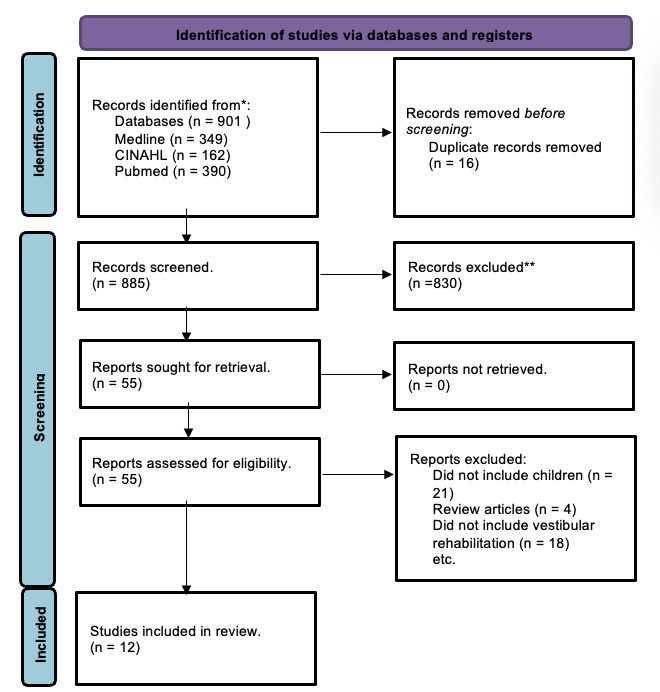
The initial electronic search yielded 901 articles. As indicated in the PRISMA flow diagram, after removing duplicates and completed the title and abstract screening, 55 articles went through a full-text review for eligibility. Finally, twelve articles met the inclusion criteria and were selected (Figure 1).
Figure 1. PRISMA flow diagram (N = 12 studies).
Study Characteristics
Included studies comprised three randomized controlled trials,19–21 five retrospective cohort studies,11,22–25 two case series26,27 and two case reports.28,29 A total of 585 participants between the age range of 8-37 years were found across studies. Four studies included children and adults11,21,24,27 while other studies focused primarily on children. Included studies utilized VRT comprising of vestibular-ocular reflex exercises, gaze control, habituation, postural stability training, balancing challenges, Canalith repositioning procedure, and convergence training. Three of the studies also included aerobic training as part of the intervention.23,26,28 The duration of rehabilitation programs varied among the studies, ranging from 72 hours to 266 days. Detailed characteristics of the included studies are presented in Table 1.
Table 1. Treatment frequency and duration from included studies for the current systematic review.
| Author | Study design | Age in years. Mean (SD)/median (range) | Sample size and Sex N(female) |
Number of Sessions,
mean (SD)/median (range) |
Frequency | Visit duration |
Treatment Duration mean (SD/ range) |
Outcomes with significant improvements |
|---|---|---|---|---|---|---|---|---|
| Ahluwalia 2021 | Retrospective cohort | 16.14 (2.98) | 23(13) | Early therapy: 2.5 (2, 5.25) Late therapy: 4 (3, 8) |
NR | NR | NR | Days to RTP, Days to symptom resolution |
| Alsalaheen 2020 | Retrospective chart review | Concussion group = 14.3 (2.2), Control = 15.4 (1.3) | 154(88) | 3 (1-4) | 1 /wk. | 1 hr. | 28 (15-47 days) |
All domains of VOMS |
| Alsalaheen 2010 | Retrospective chart review | Children = 16 (8-18); adults = 41 (19-37) | 67(45) | 4 (2-13) | NR | NR | 33 (7-181 days) |
Dizziness, ABC, DHI, DGI, FGA, gait speed, SOT, TUG, FTSTS |
| Grabowski 2017 | Retrospective cohort | 15 (12-20) | 25(14) | 4 (2-16) | 1/(1-2wk) | Variable,depended on the needs | 84 (7-266 days) |
Total PCSS scores, BESS, symptom free heart rate, mean duration of exercise. |
| Gunter 2018 | Case report | 14 (NA) | 1(1) | 8 | 2/week | NR | 4 wk. | JPE, VMS, NRS, VOR, DVAT, BESS. |
| Hugentobler 2015 | Case series | NR (15-19) | 6(2) | 6.8 | NR | NR | 9.8 wk. | Total PCSS scores between pre/post assessment |
| Hurtado 2022 | Case series | 23.1 (12.4) | 23(10) | 4 | 1/wk. | 1 hr. | 6.9 (2.5 wk). |
Gait speed, FGA, ABC, DHI, VVAS, VRBQ QOL, VRBQ Total, VRBQ Symptoms, VRBQ MOTPROV |
| Kontos 2021 | RCT | 15.3 (1.6) | 50(31) | NR | NR | NR | 4 wk. | NSI |
| Renekar 2017 | RCT | Exp 1= 16.5 (2.9), Exp 2 = 15.9 (2.9) | 41(16) | 8 | 2/wk. | 30-60 min | 4 wk. | NR |
| Schneider 2014 | RCT | Exp = 15 (12-27), Cont. = 15 (13-30) | 30(13) | 8 | 1/wk. | NR | 8 wk. | Medical clearance for RTS |
| Story 2018 | Retrospective cohort study | 11.8 (3.4) | 109(50) | 7 (5-9) | NR | NR | 8 wk. | BESS, tandem gait backwards with eyes closed |
| Zikas 2019 | Case study | 16 (NA) | 1(1) | 9 | 1x/wk. | 1 hr. | 9 wk. | ABC, DHI, Total PCSS |
Note: ABC= Activities-Specific Balance Confidence Scale, BESS= Balance Error Scoring System, d= Day, DGI= Dynamic Gait Index, DHI= Dizziness Handicap Inventory, DVAT= Dynamic Visual Acuity Test, FGA= Functional Gait Assessment, FTSTS= Five Times Sit to Stand, hr.= Hour, JPE= Joint Position Error Test, min= Minute, MOTPROV= Motion provoking dizziness, NR = Not reported, NRS= Numeric Rating Scare, NSI= No significant improvements, PCSS= Post-Concussion Symptom Scale, QOL= Quality of Life, RCT= Randomized clinical trial, RTP= Return to play, RTS= Return to sport, SCAT5= Sport Concussion Assessment Tool 5, SD= Standard deviation, SOT= Sensory Organization Test, TUG= Timed Up and Go, VMS= Visual Motion Sensitivity, VOMS= Vestibular/ocular Motor Screening ,VOR= Vestibular-Ocular Reflex, VRBQ= Vestibular Rehabilitation Benefit Questionnaire, VVAS= Visual Vertigo Analog Scale, wk.= Week.
Risk of Bias Assessment
Risk of bias assessment results are reported in Appendix 1. The most identified factors for a potential bias in case series studies included 1) clear reporting of participant demographics, 2) clear reporting of the presenting site(s)/clinic(s) demographic information, 3) consecutive and complete inclusion of participants and 4) use of appropriate statistical analysis. In terms of case reports, no significant concerns related to risk of bias were observed. Two factors were identified in three studies23,25,30 in the cohort and cross-sectional segment included 1) identification of confounding factors and 2) accounting for the confounding factors in the design and/or statistical analysis. Finally, for the randomized controlled trials, only one19 of the three studies demonstrated concerns for bias in terms of measurement of outcomes. As acknowledged in the study, clinicians may have not been completely blinded to the participant group given the significant differences in nature of the interventions.19 (Appendix 1).
Effectiveness of VRT
Dizziness and vestibular function
Five studies used the Dizziness Handicap Inventory (DHI) to report the effectiveness of VRT on dizziness.11,19,21,27,29 Three studies found significant improvements in DHI after VRT (Table 2).11,21,27 All three studies included both pediatric and adult populations. However, results were not reported separately for the pediatric age group.
Table 2. Outcome measures post-vestibular rehabilitation.
| Measure |
Pre-intervention mean (SD)/ median (range)/percentage |
Post-intervention mean (SD)/ median (range)/percentage. | Change scores mean (SD)/ median (range)/percentage. | F statistic/t statistic/, Z score, effect size, p-value | |
|---|---|---|---|---|---|
| Dizziness Handicap Inventory (DHI) | |||||
| Alsalaheen 2010 | 49 (21) | 30 (22) | NR | F = 45.5, p < 0.001 |
|
| Hurtado 2022 | NR | NR | Multiple regression Estimate = -29.19 Standard error = 6.49 |
T = -4.50, p = 0.001 |
|
| Kontos 2021 | Exp = 35.9 (14.9) Cont. = 30.1 (11.8) |
NR | Exp = -24.94 (3.72) Cont. = -17.89 (3.61) |
p = 0.18 | |
| Schneider 2014 | Exp = 46 (6-84) Cont. = 42 (0-66) |
NR | Exp cleared = -24 (-50 - -6) Exp not cleared = -13 (-16 - -8) Cont. cleared (N = 1) = - 48 Cont not cleared = -21 (-58 – 2) |
p = 0.01 | |
| Zikas 2019 | 78 | 14 | NR | NR | |
| Vestibular/ocular motor screening (VOMS) | |||||
| Kontos 2021 | Smooth pursuits | Exp = 0.9 (1.6) Cont = 0.8 (1.4) |
NR | Exp = -0.94 (0.33) Cont = -0.56 (0.32) |
ES = 0.01, p = 0.41 |
| Horizontal saccades | Exp = 1.8 (1.8) Cont = 1.2 (1.7) |
Exp = -1.65 (0.41) Cont = - 0.94(0.40) |
ES = 0.01, p = 0.22 |
||
| Vertical saccades | Exp = 2.4 (2.3) Cont = 1.8 (1.9) |
Exp = -2.41 (0.52) Cont = -1.17 (0.50) |
ES = 0.06, p = 0.09 |
||
| NPC | Exp = 2.6 (2.4) Cont = 3.0 (2.8) |
Exp = -2.77 (1.6) Cont = 0.8 (1.4) |
ES = 0.01, p = 0.32 |
||
| NPC distance | Exp = 4.7 (5.7) Cont = 4.4 (6.2) |
Exp = -3.46 (1.03) Cont = -0.76 (1.4) |
ES = 0.06, p = 0.07 |
||
| Horizontal VOR | Exp = 4.0 (2.6) Cont = 4.1 (2.6) |
NR | NR | ||
| Vertical VOR | Exp = 4.5 (2.9) Cont = 4.3 (3.3) |
NR | NR | ||
| VMS | Exp = 5.0 (3.7) Cont = 4.9 (3.8) |
NR | NR | ||
| VOMS total | Exp = 56.6 (32.7) Cont = 54.3 (33.4) |
Exp = -57.59 (8.36) Cont = -41.22 (8.12) |
ES = 0.06, p = 0.17 |
||
| Alsalaheen 2020 (Median) |
Smooth pursuit | Exp = 0 (0-6) Cont = 0 (0-2) |
0 (0-2) | NR | ES = 0.6, p < 0.001 |
| Horizontal saccades | Exp = 1 (0-11) Cont = 0 (0-3) |
0 (0-3) | ES = 0.6, p < 0.001 |
||
| Vertical saccades | Exp = 1 (0-12) Cont = 0 (0-3) |
0 (0-4) | ES = 0.7, p < 0.001 |
||
| Convergence | Exp = 1 (0-11) Cont = 0 (0-4) |
0 (0-6) | ES = 0.7, p < 0.001 |
||
| Horizontal VOR | Exp = 2 (0-10) Cont = 0 (0-3) |
0 (0-5) | ES = 0.7, p < 0.001 |
||
| Vertical VOR | Exp = 2 (0-9) Cont = 0 (0-5) |
0 (0-5) | ES = 0.7, p < 0.001 |
||
| VMS | Exp = 3 (0-12) Cont = 0 (0-3) |
0 (0-5) | ES = 0.7, p < 0.001 |
||
| NPC distance | Exp = 6 (2-33) Cont = 0 (0-21) |
3 (2-39) | ES = 0.6, p < 0.001 |
||
| Activities Specific Balance Confidence (ABC) scale | |||||
| Alsalaheen 2010 | 64 (27) | 84 (17) | NR | F = 31.5, p < 0.001 |
|
| Hurtado 2022 | NR | NR | Multiple regression Estimate = 17.93 Standard error = 4.51 |
T=3.97, p = 0.003 |
|
| Schneider 2014 | Exp = 80 (40-95) Cont = 85 (45-100) |
NR | Exp cleared = 8 (0-52) Exp not cleared = 19.5 (-6 - 43.5) Cont cleared (N = 1) = 30 Cont not cleared = 12.75 (0-55) |
NR | |
| Zikas 2019 | 68 | 96.88 | NR | NR | |
| Gait speed | |||||
| Alsalaheen 2010 | 1.02 (0.28) | 1.28 (0.23) | NR | F = 38.3, p <0.001 |
|
| Hurtado 2022 | Multiple regression Estimate = 0.12, Standard error = 0.04 | NA | NA | T = 3.10, p = 0.015 |
|
| Functional gait assessment (FGA) | |||||
| Alsalaheen 2010 | 22 (5) | 28 (3) | NR | F = 62.9, p < 0.001 |
|
| Hurtado 2022 | Multiple regression Estimate = 5.78, Standard error = 1.04 | NA | NA | T=5.55, p < 0.001 |
|
| Schneider 2014 | Exp = 27 (17-30) Cont = 27 (24-30) |
NR | Exp cleared = 1 (-1 - 5) Exp not cleared = 3 (1-5) Cont cleared (N = 1) = 3 Cont not cleared = 1 (2-6) |
NR | |
| Balance Error Scoring System (BESS) | |||||
| Grabowski 2017 | NR | NR | 52% | p < 0.01 | |
| Gunter 2018 | 38 | 12 | NR | NR | |
| Hugentobler 2015 | 14 (3.68) | 12.3 (3.20) | 12.10% | NR | |
| Storey 2018 | 33.8 (NR) | 21.7 (NR) | 35.80% | p < 0.001 | |
| Post-Concussion Symptom Scale (PCSS) | |||||
| Grabowski 2017 | Total PCSS (mean) | 18.2 (14.2) | 9.1 (10.8) | 9.1 (NR) | P < 0.001 |
| Hugentobler 2015 | Total PCSS (mean) | 32.83 (22.23) | 11.83 (7.35) | NR | NR |
| Kontos 2021 | Total PCSS | Exp = 45.2 (22.9) Cont = 42.2 (20.4) |
NR | Exp = -34.46 (5.42) Cont = -28.70 (5.49) |
ES = 0.01, p = 0.58 |
| Reneker 2017 | Total PCSS | Exp 1 = 36.9 Cont. = 39.2 |
NR | NR | NR |
| Zikas 2019 | Total PCSS | 46 points | 10 points | NR | NR |
| Number of Days for return to play/symptom resolution | |||||
| Ahluwalia 2021 | Return to Play | NR | LT = 110 (61.3, 150.8) ET: 31(22.5, 74.5) |
( −115.0, −8.0) | p = 0.03 |
| Symptom Resolution | NR | LT: 121.5 (71, 222.8) ET: 54 (27, 91) |
(−150.0, −9.0) | p = 0.02 | |
| Joint Position Error | |||||
| Gunter 2018 | L:1/4 R:4/5 |
L:5/5 R:5/5 |
NR | NR | |
| Visual Motion Sensitivity Test w/ Numeric Rating Scale | |||||
| Gunter 2018 | 4/10 | 0/10 | NR | NR | |
| Dynamic Visual Acuity Test | |||||
| Gunter 2018 | 3-line loss w/symptoms | 1 line loss, no symptoms | NR | NR | |
| Brain Injury Vision Symptom Survey | |||||
| Zikas 2019 | 18 points | 14 points | NR | NR | |
| Convergence Insufficiency Symptom Survey | |||||
| Zikas 2019 | 31 points | 19 points | NR | NR | |
Two studies determined improvements in VOMS following VRT. Alsalaheen et al.19,23 found significant improvements in all subcategories involved in VOMS including smooth pursuit, horizontal saccades, near-point convergence distance (Effect size (ES) = 0.6, p < 0.001), vertical saccades, convergence, horizontal VOR, vertical VOR, visual motion sensitivity (ES = 0.7, p < 0.001). In contrast, Kontos et al19 found no significant improvements in the following subcategories: smooth pursuits (ES = 0.01, p = 0.41), horizontal saccades (ES = 0.01, p = 0.22), vertical saccades (ES = 0.06, p = 0.09), near-point convergence (ES = 0.01, p = 0.32), near-point convergence distance (ES = 0.06, p = 0.07), and VOMS total score (ES = 0.06, p = 0.17).19 The study did not discuss results for VOMS score improvements for horizontal VOR, vertical VOR, and visual motion sensitivity.
Postural control
The Activities Specific Balance Confidence (ABC) scale11,21,27,29 and the Balance Error Scoring System (BESS) were used to evaluate postural control across studies.24–26,28 Four studies investigated improvements in self-perceived balance confidence using the ABC Scale with two studies reporting statistically significant improvements.11,27 Schneider et al.21 reported improvements in the ABC scale of 8 points for those cleared to return to sport and 19.5 points for those not cleared to return to sport. However, the improvements were not statistically significant.
The BESS was used in four studies to evaluate changes in scores after VRT24–26,28 with two studies reporting statistically significant improvements (change score = 52%, p < 0.01, 35.8%, p < 0.001).24,25 An improvement of 68.42% and 12.1% was observed in the remaining two studies but it did not reach statistical significance (Table 2).26,28 However, improvements observed in two studies25,28 were more than the established minimal detectable change values for concussion (8.6-11.3 errors).31
Gait
Gait speed using 10-meter-walk test11,27 and Functional Gait Assessment (FGA)11,21,27 were utilized to examine gait. Both studies that included gait speed using the 10-meter walk test, reported statistically significant improvements.11,27 Alsalaheen et al. (change score = 6 points, p < 0.001) and Hurtado (multiple regression estimate = 0.12 (0.04), p = 0.01) found significant improvements on the FGA scores,11,27 whereas Schneider et al.21 did not find a significant improvement.
Post-Concussion Symptom Scale (PCSS)
Other Outcomes
Five studies assessed the effects of VRT on improvements in the Post-Concussion Symptom Scale (Table 2).19,20,24,26,29 Of those studies, only one study reported statistically significant improvement in the PCSS scores (change score = 9.1 points, p < 0.001).24 Similar results were reported by Renekar et al.20 where the pragmatic progressive group (including VRT and manual therapy) to recover faster than the control group on PCSS (Hazard ratio = 2.91; 95% CI = 1.01-8.43) but the difference between groups were not statistically significant. Although the PCSS scores showed variable reduction in studies by Hugentobler and, Zikas (11.8-36 points) tests of significance were not conducted.26,29 Kontos and colleagues reported a non-significant small effect size for the total PCSS scores (ES = 0.01, p = 0.58) indicating no statistically significant difference between groups.19
Additional measures included the number of days for return to play or symptoms resolution, joint position error, visual motion sensitivity test, dynamic visual acuity test, brain injury vision symptom survey, and the convergence insufficiency symptom survey. Ahluwalia et al.22 found significant improvements in symptom reduction (p = 0.02) and number of days for return to play (p = 0.03). The studies reporting on changes in joint position error, visual motion sensitivity test, dynamic visual acuity, brain injury vision symptom survey, and convergence insufficiency symptoms survey did not report significance or mean changes in scores.28,29
DISCUSSION
This systematic review included twelve articles to discernt the evidence for the effectiveness of VRT in improving dizziness, postural control, gait, and return to sport in children post-concussion. Previous systematic reviews conducted on the effectiveness of VRT in the adult population reported that VRT may reduce time to return to play in the acute phase and may result in improvements in dizziness, gait, and quality of life for patients with concussion.32,33 This systematic review showed that the dosage for VRT ranged from 30-60-minute sessions, one to two times per week for 4-10 weeks and it may result in improvements in dizziness, oculomotor control, postural control, and gait.
Dizziness and vestibular function
Although the DHI scores showed statistically significant improvement in only three out of the five studies, all five studies demonstrated clinically meaningful improvements in the DHI scores.11,19,21,27,29 However, it is important to consider that the DHI currently has not been validated for the population below 18 years34 and minimally clinically important difference values have not been established for children. Hence, the generalization of these findings is limited.
As children are in the developmental phase of both physical and cognitive systems, their perception of disability as well as contextual expectations are significantly different form adults warranting use of age-specific outcome measures.35 Therefore, it is questionable whether drawing inference from a measure designed for the adult population may accurately represent true perceived disability and warrants further investigation.
Conflicting results were obtained for the VOMS scores between Alsalaheen et al.23 and Kontos et al.19 with Alsalaheen et al. reporting significant improvements with moderate effect size in smooth pursuits, horizontal and vertical saccades, Vestibulo-ocular reflex, visual motion sensitivity and near point convergence distance whereas results from Kontos et al.19 indicated no improvements in either the total VOMS or in any individual category of the VOMS. Variability was observed in VOMS score reporting between the studies. Mean scores were reported by Kontos et.al.19 whereas Alsalaheen et. al.23 reported median scores. Additionally, it is possible that variability existed in assessing VOMS given the retrospective study design of the study by Alsalaheen et al.23
The RCT by Kontos et al.19 provided 30-minute individualized vestibular rehabilitation exercises and instructed the patients to perform them at home for 30 minutes per day. A retrospective chart review by Alsalaheen et al.23 indicated that the patients received a one-hour weekly VRT session (total sessions ranging from 2-4) in the clinic and VRT was further augmented by a 45-minute home exercise program that was modified and progressed each visit. In-clinic sessions augmented with a home exercise program may provide additional practice and may lead to larger improvements in vestibular-ocular function.
Postural control
High variability in the conventional BESS scores across studies could be attributed to the developing sensorimotor system in children.36 Additionally, the reliability of the conventional BESS may vary greatly depending on the clinician’s experience with experienced clinicians demonstrating better reliability.37 It was also difficult to determine whether the scores demonstrated a clinically meaningful change, as currently there is still no consensus on the clinically meaningful change values of the BESS. Future studies using instrumented BESS (posturography) may provide objective data that can detect subtle meaningful clinical changes as it greatly reduces inter-rater bias which is more likely to be observed in conventional BESS.
Although the ABC scale showed improvements in balance confidence across studies with some studies potentially showing a tendency toward a ceiling effect,11,29 it is important to highlight that the ABC scale like the DHI was primarily developed for older adults and its measurement properties have not been established for the pediatric population.38,39 Additionally, some items of the ABC scale (sweep the floor, step on and off an escalator while you are holding onto a railing, step onto or off an escalator while holding onto parcels such that you cannot hold onto the railing) may not be contextually relevant for children. Finally, most of the items are focused on walking and do not involve age-appropriate activities like running, playing, and participating with peers. Hence, the results relevant to balance confidence must be interpreted with caution as there could be a ceiling effect for this population.39
Gait
Gait was one of the less examined constructs across studies with only three studies including gait assessment. Similar to the ABC scale, the FGA may demonstrate ceiling effect to a certain extent in children.39 Using more challenging measures like high level mobility assessment tool (HiMAT) may provide precise results in this population.40
Other outcomes
PCSS scores showed improvements in four out of five studies. It is a possibility that early initiation of VRT may result in earlier symptom resolution on the PCSS and earlier return to play.20–22 Vestibular network contributes to modulate space, body, and self-awareness expanding into dimensions of emotion processing, mental health, and social cognition.41 VRT may result in potential habituation of vestibular system and responses similar to exercise training.19 VRT post-concussion requires the patient to be repeatedly exposed to the provocative stimuli to reduce symptom severity thereby improving recovery time.19
Ahluwalia and colleagues reported potential benefits of early VRT and showed that early initiation of VRT may result in faster symptom resolution and earlier return to play.22 This was supported by a recent systematic review which highlighted that early VRT post-concussion in athletes has been shown to reduce severity of symptoms and duration, therefore decreasing recovery time to less than 21 days.14 Early intervention timeline was reported to be within 30 days post-concussion in an adult population, but there is no consensus on the time frame for children.22 Hence, early initiation of VRT may allow for improved spatiotemporal adjustments limiting the duration of symptoms.
Limitations
This systematic review included only the studies that were published in English which could have resulted in exclusion of research published in other languages. A second limitation was the specific age constraints which led to the exclusion of some articles due to a lack of separation between the children and adults as well as limiting the effectiveness of one study that did not report separation in results based on age group. Outcomes measures varied greatly across studies that studied the effectiveness of VRT. Although VRT shows promise in pediatric concussion, the evidence remains limited. Given that most studies included in this review were non-experimental (case series, case report, and cohort studies), findings must be interpreted with caution when making informed clinical decisions.
Many of the studies included in this review used a multimodal approach examining vestibular therapy in conjunction with other methods of intervention. Future studies should assess the stand-alone effect of VRT compared to conventional therapy using rigorous experimental designs. Finally, due to substantial variability in study design, sample size and outcome measures used, a meta-analysis could not be performed to statistically support the effectiveness of VRT in children post-concussion.
CONCLUSION
In conclusion, this review suggests that VRT shows promise and may result in symptom improvements in children post-concussion when used as part of a multimodal intervention plan. However, it is important to establish the most effective intervention dose and training parameters. Additionally, it is important to utilize age-appropriate validated measures to ascertain the effectiveness of VRT in this population.
Conflicts of interest
The authors report no conflicts of interest.
Supplementary Material
References
- Epidemiology and incidence of pediatric concussions in general aspects of life. Yaramothu C., Goodman A.M., Alvarez T.L. 2019Brain Sci. 9(10) doi: 10.3390/brainsci9100257. https://doi.org/10.3390/brainsci9100257 [DOI] [PMC free article] [PubMed] [Google Scholar]
- Prevention CfDCa Quickstats: Percentage of children and adolescents aged ≤17 years who had ever received a diagnosis of concussion or brain injury, by sex and age group — national health interview survey, United States, 2022. [2024-4-10]. https://www.cdc.gov/mmwr/volumes/72/wr/mm7233a5.htm?s_cid=mm7233a5_w#suggestedcitation [DOI] [PMC free article] [PubMed]
- Black L., Zablotsky B. Concussions and brain injuries in children: United States, 2020. [2024-4-10]. https://stacks.cdc.gov/view/cdc/111174 [PubMed]
- Symptom burden and profiles in concussed children with and without prolonged recovery. Schilling S., Mansour A., Sullivan L., Ding K., Pommering T., Yang J. 2020Int J Environ Res Public Health. 17(1) doi: 10.3390/ijerph17010351. https://doi.org/10.3390/ijerph17010351 [DOI] [PMC free article] [PubMed] [Google Scholar]
- Concussion in the pediatric and adolescent population: Different population, different concerns. Karlin A. M. 2011PM R. 3(10 Suppl 2):S369–379. doi: 10.1016/j.pmrj.2011.07.015. https://doi.org/10.1016/j.pmrj.2011.07.015 [DOI] [PubMed] [Google Scholar]
- The rise of concussions in the adolescent population. Zhang A. L., Sing D. C., Rugg C. M., Feeley B. T., Senter C. 2016Orthop J Sports Med. 4(8):2325967116662458. doi: 10.1177/2325967116662458. https://doi.org/10.1177/2325967116662458 [DOI] [PMC free article] [PubMed] [Google Scholar]
- Vestibular deficits following youth concussion. Corwin D. J., Wiebe D. J., Zonfrillo M. R.., et al. 2015J Pediatr. 166(5):1221–1225. doi: 10.1016/j.jpeds.2015.01.039. https://doi.org/10.1016/j.jpeds.2015.01.039 [DOI] [PMC free article] [PubMed] [Google Scholar]
- Which on-field signs/symptoms predict protracted recovery from sport-related concussion among high school football players? Lau B. C., Kontos A. P., Collins M. W., Mucha A., Lovell M. R. 2011Am J Sports Med. 39(11):2311–2318. doi: 10.1177/0363546511410655. https://doi.org/10.1177/0363546511410655 [DOI] [PubMed] [Google Scholar]
- Association between vertigo, cognitive and psychiatric conditions in us children: 2012 national health interview survey. Bigelow R. T., Semenov Y. R., Hoffman H. J., Agrawal Y. 2020Int J Pediatr Otorhinolaryngol. 130:109802. doi: 10.1016/j.ijporl.2019.109802. https://doi.org/10.1016/j.ijporl.2019.109802 [DOI] [PMC free article] [PubMed] [Google Scholar]
- Vision and vestibular system dysfunction predicts prolonged concussion recovery in children. Master C. L., Master S. R., Wiebe D. J.., et al. 2018Clin J Sport Med. 28(2):139–145. doi: 10.1097/JSM.0000000000000507. [DOI] [PubMed] [Google Scholar]
- Vestibular rehabilitation for dizziness and balance disorders after concussion. Alsalaheen B. A., Mucha A., Morris L. O.., et al. 2010J Neurol Phys Ther. 34(2):87–93. doi: 10.1097/NPT.0b013e3181dde568. https://doi.org/10.1097/NPT.0b013e3181dde568 [DOI] [PubMed] [Google Scholar]
- Effectiveness of vestibular rehabilitation after concussion: A systematic review of randomised controlled trial. Galeno E., Pullano E., Mourad F., Galeoto G., Frontani F. 2022Healthcare. 11(1) doi: 10.3390/healthcare11010090. https://doi.org/10.3390/healthcare11010090 [DOI] [PMC free article] [PubMed] [Google Scholar]
- Effectiveness of vestibular rehabilitation therapy for treatment of concussed adolescents with persistent symptoms of dizziness and imbalance. Park K., Ksiazek T., Olson B. 2018J Sport Rehabil. 27(5):485–490. doi: 10.1123/jsr.2016-0222. https://doi.org/10.1123/jsr.2016-0222 [DOI] [PubMed] [Google Scholar]
- Vestibular rehabilitation as an early intervention in athletes who are post-concussion: A systematic review. Babula G., Warunek E., Cure K., Nikolski G., Fritz H., Barker S. 2023Int J Sports Phys Ther. 18(3):577. doi: 10.26603/001c.75369. [DOI] [PMC free article] [PubMed] [Google Scholar]
- The prisma 2020 statement: An updated guideline for reporting systematic reviews. Page M. J., McKenzie J. E., Bossuyt P. M.., et al. 2021BMJ. 372:n71. doi: 10.1136/bmj.n71. https://doi.org/10.1136/bmj.n71 [DOI] [PMC free article] [PubMed] [Google Scholar]
- Methodological quality of case series studies: An introduction to the jbi critical appraisal tool. Munn Z., Barker T. H., Moola S.., et al. 2020JBI Evidence Synthesis. 18(10):2127–2133. doi: 10.11124/jbisrir-d-19-00099. https://doi.org/10.11124/jbisrir-d-19-00099 [DOI] [PubMed] [Google Scholar]
- Rob 2: A revised tool for assessing risk of bias in randomised trials. Sterne J. A. C., Savović J., Page M. J.., et al. 2019BMJ. 366:l4898. doi: 10.1136/bmj.l4898. https://doi.org/10.1136/bmj.l4898 [DOI] [PubMed] [Google Scholar]
- Critical apprisal skills programme. CASP (cohort studies) [2023-11-12]. https://casp-uk.net/checklists/casp-cohort-studies-checklist.pdf
- A randomized controlled trial of precision vestibular rehabilitation in adolescents following concussion: Preliminary findings. Kontos A.P., Eagle S.R., Mucha A.., et al. 2021J Pediatr. 239:193–199. doi: 10.1016/j.jpeds.2021.08.032. https://doi.org/10.1016/j.jpeds.2021.08.032 [DOI] [PubMed] [Google Scholar]
- Feasibility of early physical therapy for dizziness after a sports-related concussion: A randomized clinical trial. Reneker J., Hassen A., Phillips R., Moughiman M., Donaldson M., Moughiman J. 2017Scand J Med Sci Sports. 27(12):2009–2018. doi: 10.1111/sms.12827. [DOI] [PubMed] [Google Scholar]
- Cervicovestibular rehabilitation in sport-related concussion: A randomised controlled trial. Schneider K. J., Meeuwisse W. H., Nettel-Aguirre A.., et al. 2014Br J Sports Med. 48(17):1294–1298. doi: 10.1136/bjsports-2013-093267. https://doi.org/10.1136/bjsports-2013-093267 [DOI] [PubMed] [Google Scholar]
- A pilot study evaluating the timing of vestibular therapy after sport-related concussion: Is earlier better? Ahluwalia R., Miller S., Dawoud F. M.., et al. 2021Sports Health. 13(6):573–579. doi: 10.1177/1941738121998687. https://doi.org/10.1177/1941738121998687 [DOI] [PMC free article] [PubMed] [Google Scholar]
- Changes in vestibular/ocular-motor screen scores in adolescents treated with vestibular therapy after concussion. Alsalaheen B., Carender W., Grzesiak M.., et al. 2020Pediatr Phys Ther. 32(4):331–337. doi: 10.1097/pep.0000000000000729. https://doi.org/10.1097/pep.0000000000000729 [DOI] [PubMed] [Google Scholar]
- Multimodal impairment-based physical therapy for the treatment of patients with post-concussion syndrome: A retrospective analysis on safety and feasibility. Grabowski P., Wilson J., Walker A., Enz D., Wang S. 2017Phys Ther Sport. 23:22–30. doi: 10.1016/j.ptsp.2016.06.001. https://doi.org/10.1016/j.ptsp.2016.06.001 [DOI] [PubMed] [Google Scholar]
- Vestibular rehabilitation is associated with visuovestibular improvement in pediatric concussion. Storey E. P., Wiebe D. J., DʼAlonzo B. A.., et al. 2018J Neurol Phys Ther. 42(3):134–141. doi: 10.1097/npt.0000000000000228. https://doi.org/10.1097/npt.0000000000000228 [DOI] [PubMed] [Google Scholar]
- Physical therapy intervention strategies for patients with prolonged mild traumatic brain injury symptoms: A case series. Hugentobler J. A., Vegh M., Janiszewski B., Quatman-Yates C. 2015Int J Sports Phys Ther. 10(5):676–689. [PMC free article] [PubMed] [Google Scholar]
- Technology-enhanced visual desensitization home exercise program for post-concussive visually induced dizziness: A case series. Hurtado J. E., Heusel-Gillig L., Risk B. B.., et al. 2022Physiother Theory Pract. 38(8):985–994. doi: 10.1080/09593985.2020.1815259. https://doi.org/10.1080/09593985.2020.1815259 [DOI] [PubMed] [Google Scholar]
- Rehabilitation of an adolescent equestrian athlete with a history of multiple concussions: A case report describing an adapted return-to-sport protocol. Gunter K. B., Shields C. J., Ott S. D., Coronado R. A. 2018J Orthop Sports Phys Ther. 48(12):934–942. doi: 10.2519/jospt.2018.8214. https://doi.org/10.2519/jospt.2018.8214 [DOI] [PMC free article] [PubMed] [Google Scholar]
- Integration of vision and vestibular therapy for vestibulo-ocular post-concussion disorder–a case study. Ziaks L., Giardina R., Kloos A. 2019Internet J Allied Health Sci Pract. 17(3):11. doi: 10.46743/1540-580X/2019.1754. [DOI] [Google Scholar]
- Sequencing and integration of cervical manual therapy and vestibulo-oculomotor therapy for concussion symptoms: Retrospective analysis. Wong C. K., Ziaks L., Vargas S., DeMattos T., Brown C. 2021Int J Sports Phys Ther. 16(1):12–20. doi: 10.26603/001c.18825. https://doi.org/10.26603/001c.18825 [DOI] [PMC free article] [PubMed] [Google Scholar]
- Minimal detectable change scores and reliability of the balance error scoring system in student-athletes with acute concussion. Carlson C. D., Langdon J. L., Munkasy B. A., Evans K. M., Buckley T. A. 2020Athl Train Sports Health Care. 12(2):67–73. doi: 10.3928/19425864-20190401-02. [DOI] [Google Scholar]
- Galeno E., Pullano E., Mourad F., Galeoto G., Frontani F. Effectiveness of vestibular rehabilitation after concussion: A systematic review of randomised controlled trial; Healthcare2022; [DOI] [PMC free article] [PubMed] [Google Scholar]
- Effectiveness of vestibular rehabilitation on concussion-induced vertigo: A systematic review. Kinne B. L., Bott J. L., Cron N. M., Iaquaniello R. L. 2018Phys Ther Rev. 23(6):338–347. doi: 10.1080/10833196.2018.1517032. [DOI] [Google Scholar]
- Measurement properties of the dizziness handicap inventory by cross-sectional and longitudinal designs. Tamber A.-L., Wilhelmsen K. T., Strand L. I. 2009Health Rel Qual of Life. 7(1):101. doi: 10.1186/1477-7525-7-101. https://doi.org/10.1186/1477-7525-7-101 [DOI] [PMC free article] [PubMed] [Google Scholar]
- "Not just little adults": Qualitative methods to support the development of pediatric patient-reported outcomes. Arbuckle R., Abetz-Webb L. 2013The Patient. 6(3):143–159. doi: 10.1007/s40271-013-0022-3. https://doi.org/10.1007/s40271-013-0022-3 [DOI] [PubMed] [Google Scholar]
- Instrumented balance error scoring system in children and adolescents—a cross sectional study. Schönberg N. K. T., Poppel J., Howell D.., et al. 2024Diagnostics. 14(5):513. doi: 10.3390/diagnostics14050513. [DOI] [PMC free article] [PubMed] [Google Scholar]
- Novice vs expert inter-rater reliability of the balance error scoring system in children between the ages of 5 and 14. Kuo K. T., Hunter B. C., Obayashi M.., et al. 2021Gait Posture. 86:13–16. doi: 10.1016/j.gaitpost.2021.02.026. https://doi.org/https://doi.org/10.1016/j.gaitpost.2021.02.026 [DOI] [PubMed] [Google Scholar]
- The activities-specific balance confidence (abc) scale. Powell L. E., Myers A. M. 1995J Gerontol A Biol Sci Med Sci. 50a(1):M28–34. doi: 10.1093/gerona/50a.1.m28. https://doi.org/10.1093/gerona/50a.1.m28 [DOI] [PubMed] [Google Scholar]
- Performance of high school adolescents on functional gait and balance measures. Alsalaheen B. A., Whitney S. L., Marchetti G. F.., et al. 2014Pediatr Phys Ther. 26(2):191–199. doi: 10.1097/pep.0000000000000037. https://doi.org/10.1097/pep.0000000000000037 [DOI] [PMC free article] [PubMed] [Google Scholar]
- High-level mobility assessment tool (himat): Interrater reliability, retest reliability, and internal consistency. Williams G. P., Greenwood K. M., Robertson V. J., Goldie P. A., Morris M. E. 2006Phys Ther. 86(3):395–400. doi: 10.1093/ptj/86.3.395. https://doi.org/10.1093/ptj/86.3.395 [DOI] [PubMed] [Google Scholar]
- The vestibular system: Balancing more than just the body. Lopez C. 2016Curr Opin Neurol. 29(1):74–83. doi: 10.1097/wco.0000000000000286. https://doi.org/10.1097/wco.0000000000000286 [DOI] [PubMed] [Google Scholar]
Associated Data
This section collects any data citations, data availability statements, or supplementary materials included in this article.