


Figure 2.
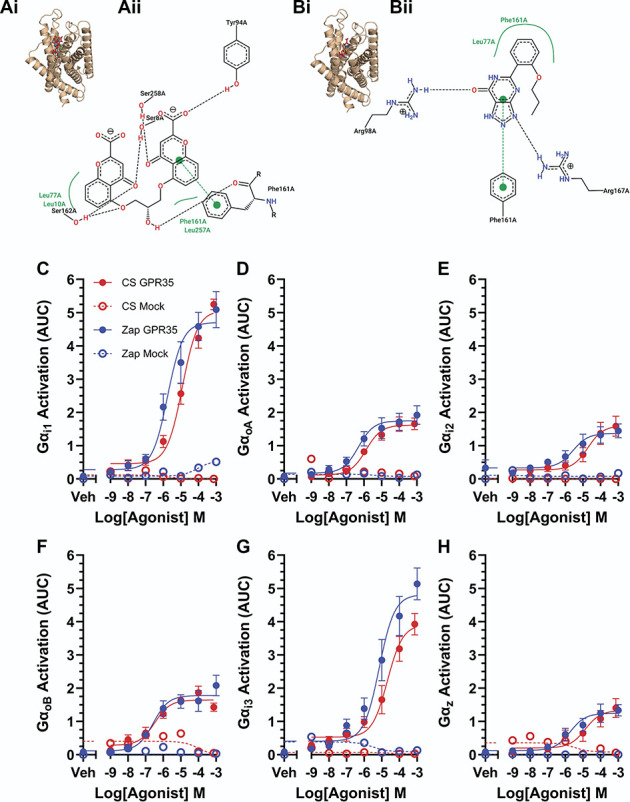
Cromolyn and zaprinast are agonists of GPR35. (A) (i) Predicted binding mode of cromolyn at mouse GPR35 based on the 10 best ranked binding poses obtained through independent docking runs in GOLD v.5.3. (ii) Ligand interaction diagram generated using PoseView. The most representative pose for cromolyn is shown. Dotted black lines indicate hydrogen bonding, solid green lines represent hydrophobic interactions, and dotted green lines represent π-π stacking. (B) (i) Predicted binding mode of zaprinast at mouse GPR35 based on the 10 best ranked binding poses obtained through independent docking runs in GOLD v.5.3. (ii) Ligand interaction diagram generated using PoseView. The most representative pose for zaprinast is shown. Dotted black lines indicate hydrogen bonding, solid green lines represent hydrophobic interactions, and dotted green lines represent π-π stacking. (C-H) Dissociation of given Gi/o subunits in response to stimulation of human GPR35 with CS (red) or Zap (blue). Filled symbols show results from cells transfected with GPR35; open symbols show mock-transfected cells. Points are plotted as mean ± SEM and fit with a three-parameter log [agonist]-response Boltzmann curve. CS, cromolyn.