


Figure 3.
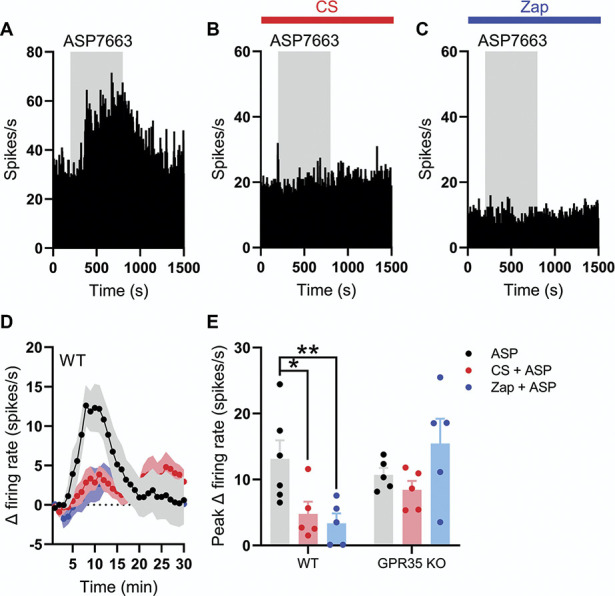
TRPA1-mediated colonic afferent firing is attenuated by activation of GPR35. (A) Example rate histogram showing the change in afferent firing evoked by the application of ASP7663 (grey shaded region). (B) Example rate histogram showing the change in afferent firing evoked by the application of ASP7663 (grey shaded region) in the presence of cromolyn (CS, 100 µM, red bar). (C) Example rate histogram showing the change in afferent firing evoked by the application of ASP7663 (grey shaded region) in the presence of zaprinast (Zap, 100 µM, blue bar). (D) Grouped data showing the mean change in afferent firing evoked by ASP7336 (points indicate the mean; shaded regions show the standard error) in the presence of either CS (100 µM, red) or Zap (100 µM, blue). (E) Grouped data showing the peak change in afferent firing evoked by ASP7336 in the presence of either CS (100 µM, red) or Zap (100 µM, blue) in both wildtype (WT) and GPR35−/− animals. Data for each genotype analysed using a one-way ANOVA with Dunnett post-hoc tests. TRPA1, transient receptor potential ankyrin 1.