


Figure 4.
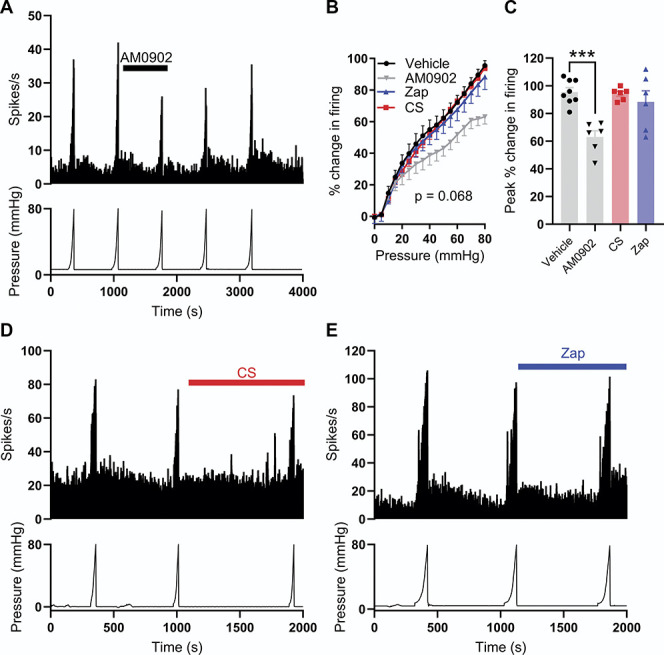
TRPA1 contributes to colonic afferent mechanosensitivity. (A) Example recording showing afferent firing during 5 successive ramp distensions with AM0902 (1 mM) applied before and during the third ramp distension. (B) Grouped data showing the percentage change in afferent firing during the third ramp distension in vehicle- (black), AM0902- (grey), CS- (red), and Zap- (blue) treated tissue. Two-way repeated measures ANOVA with Dunnett post-hoc tests. The percentage change in firing is relative to peak firing during the preceding ramp distension. (C) Grouped data showing the peak change in afferent firing during the third ramp distension in vehicle-, AM0902-, CS-, and Zap-treated tissue. One-way ANOVA with Dunnett post-hoc tests. (D) Example recording showing afferent firing during 3 consecutive ramp distensions with CS applied before and during the third ramp distension. (E) Example recording showing afferent firing during 3 consecutive ramp distensions with Zap applied before and during the third ramp distension. CS, cromolyn; TRPA1, transient receptor potential ankyrin 1.