


Figure 9.
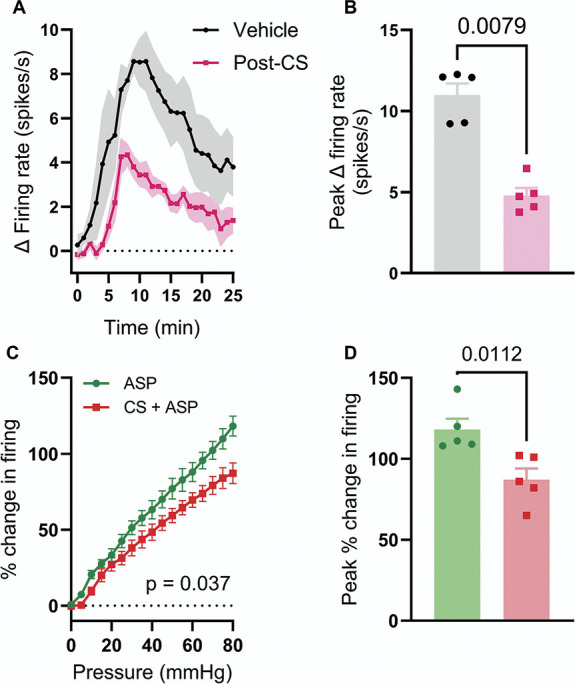
CS inhibits ASP7663-induced afferent activity and mechanical hypersensitivity in tissue from female mice. (A) Grouped data showing the change in afferent firing after the application of ASP7663 (30 µM) to tissue preincubated with vehicle (black) or CS (100 µM, pink). Solid points show the mean change in afferent firing; shaded regions show SEM. (B) Grouped data showing the change in afferent firing evoked by ASP7663 in vehicle- and CS-treated tissue. Data analysed using a two-tailed Mann–Whitney U test. (C) Grouped data showing the peak change in afferent firing during the third (post-ASP7663) ramp distension in tissue treated with ASP7663 with or without CS. Two-way repeated measures ANOVA. (D) Grouped data showing the peak percentage change in afferent firing during the third (post-ASP7333) ramp distension in tissue treated with ASP7663 alone (green) or ASP7663 and CS (red). Two-tailed unpaired t test. CS, cromolyn.